
All Topics  
Basal body


   Email Print
   Bookmark   Link


Basal body


.

A basal body (sometimes basal granule or kinetosome) is an organelle
Organelle

In cell biology, an organelle is a specialized subunit within a cell that has a specific function, and is usually separately enclosed within its own lipid membrane....
 formed from a centriole
Centriole

A centriole is a barrel-shaped organelle found in most animal eukaryotic Cell s, though absent in higher plants and most fungi. The walls of each centriole are usually composed of nine triplets of microtubules ....
, a short cylindrical array of microtubules. It is found at the base of a eukaryotic undulipodium
Undulipodium

An undulipodium or 9+2 organelle is an extracellular projection of a eukaryotic cell containing a microtubule array. Both flagella and cilia are considered undulipodia and are similar structurally, however each differs functionally....
 (cilium
Cilium

A cilium is an organelle found in eukaryote cell s. Cilia are tail-like projections extending approximately 5?10 micrometres from the cell body....
 or flagellum
Flagellum

A flagellum is a tail-like structure that projects from the cell body of certain prokaryotic and eukaryotic cells, and it functions in locomotion....
) and serves as a nucleation site for the growth of the axoneme
Axoneme

Numerous eukaryotic Cell carry whip-like appendages whose inner core consists of a cytoskeleton structure called the axoneme.The axoneme serves as the "skeleton" of these organelles, both giving support to the structure and, in some cases, causing it to bend....
 microtubules. Centrioles, from which basal bodies are derived, act as anchoring sites for proteins that in turn anchor microtubules within centrosomes, one type of microtubule organizing center
Microtubule organizing center

The microtubule-organizing center is a structure found in eukaryote cells from which microtubules emerge. MTOCs have two main functions: The organization of eukaryotic flagellum and cilium and the organization of the mitosis and meiosis spindle apparatus separating the chromosomes during cell division....
 (MTOC).


Discussion
Ask a question about 'Basal body'
Start a new discussion about 'Basal body'
Answer questions from other users
Full Discussion Forum


Encyclopedia


.

A basal body (sometimes basal granule or kinetosome) is an organelle
Organelle

In cell biology, an organelle is a specialized subunit within a cell that has a specific function, and is usually separately enclosed within its own lipid membrane....
 formed from a centriole
Centriole

A centriole is a barrel-shaped organelle found in most animal eukaryotic Cell s, though absent in higher plants and most fungi. The walls of each centriole are usually composed of nine triplets of microtubules ....
, a short cylindrical array of microtubules. It is found at the base of a eukaryotic undulipodium
Undulipodium

An undulipodium or 9+2 organelle is an extracellular projection of a eukaryotic cell containing a microtubule array. Both flagella and cilia are considered undulipodia and are similar structurally, however each differs functionally....
 (cilium
Cilium

A cilium is an organelle found in eukaryote cell s. Cilia are tail-like projections extending approximately 5?10 micrometres from the cell body....
 or flagellum
Flagellum

A flagellum is a tail-like structure that projects from the cell body of certain prokaryotic and eukaryotic cells, and it functions in locomotion....
) and serves as a nucleation site for the growth of the axoneme
Axoneme

Numerous eukaryotic Cell carry whip-like appendages whose inner core consists of a cytoskeleton structure called the axoneme.The axoneme serves as the "skeleton" of these organelles, both giving support to the structure and, in some cases, causing it to bend....
 microtubules. Centrioles, from which basal bodies are derived, act as anchoring sites for proteins that in turn anchor microtubules within centrosomes, one type of microtubule organizing center
Microtubule organizing center

The microtubule-organizing center is a structure found in eukaryote cells from which microtubules emerge. MTOCs have two main functions: The organization of eukaryotic flagellum and cilium and the organization of the mitosis and meiosis spindle apparatus separating the chromosomes during cell division....
 (MTOC). These microtubules provide structure and facilitate movement of vesicles and organelles within many eukaryotic cells. Basal bodies, however, are specifically the bases for cilia and flagella that extend out of the cell.

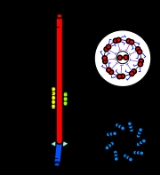
Basal bodies are derived from centrioles through a largely mysterious process. They are structurally the same, each containing a microtubules triplet 9+0 helocoidal configuration forming a hollow cylinder.

Regulation of basal body production and spatial orientation is a function of the nucleotide-binding domain of ?-tubulin (Shang et al, 2005).

External links

- "Ultrastructure of the Cell: ciliated epithelium, cilia and basal bodies"