

Barry Railway Company

Encyclopedia

South Wales
South Wales is an area of Wales bordered by England and the Bristol Channel to the east and south, and Mid Wales and West Wales to the north and west. The most densely populated region in the south-west of the United Kingdom, it is home to around 2.1 million people and includes the capital city of...
valleys to the existing monopoly of the Taff Vale Railway
Taff Vale Railway
The Taff Vale Railway is a railway in Glamorgan, South Wales, and is one of the oldest in Wales. It operated as an independent company from 1836 until 1922, when it became a constituent company of the Great Western Railway...
and Cardiff Docks
Cardiff Docks
Cardiff Docks is a port in south Cardiff, Wales. At its peak, the port was one of the largest dock systems in the world with a total quayage of almost...
. Incorporated from 1884 and built from 1885, by 1910 it had overtaken Cardiff
Cardiff
Cardiff is the capital, largest city and most populous county of Wales and the 10th largest city in the United Kingdom. The city is Wales' chief commercial centre, the base for most national cultural and sporting institutions, the Welsh national media, and the seat of the National Assembly for...
as the largest export point of South Wales coal
South Wales Coalfield
The South Wales Coalfield is a large region of south Wales that is rich with coal deposits, especially the South Wales Valleys.-The coalfield area:...
thanks to its greater efficiency. Like much of the South Wales infrastructure, it quickly declined following the 1926 miners strike, and never recovered after World War II
World War II
World War II, or the Second World War , was a global conflict lasting from 1939 to 1945, involving most of the world's nations—including all of the great powers—eventually forming two opposing military alliances: the Allies and the Axis...
, with the docks becoming the home of the most famous site for the scrapping of British Railways steam locomotives in the 1960s onwards. Now a smaller operation than its former rival, what remains of the railway infrastructure has been absorbed into Network Rail
Network Rail
Network Rail is the government-created owner and operator of most of the rail infrastructure in Great Britain .; it is not responsible for railway infrastructure in Northern Ireland...
, while the docks, now owned by Associated British Ports, are being given a light industrial and residential make-over.
Formation
David DaviesDavid Davies (industrialist)
David Davies was a Welsh industrialist and Liberal politician who sat in the House of Commons between 1874 and 1886. Davies was often known as David Davies Llandinam , in order to differentiate him from others of the same name.Davies was the son of David Davies and his wife Elizabeth...
of Ocean Collieries was one of the premier business men of the South Wales coal fields, but like many suffered from the capacity and monopoly issues created by two companies:
- The Taff Vale RailwayTaff Vale RailwayThe Taff Vale Railway is a railway in Glamorgan, South Wales, and is one of the oldest in Wales. It operated as an independent company from 1836 until 1922, when it became a constituent company of the Great Western Railway...
which provided the dominant rail infrastructure. Capacity issues were particularly dominant after PontypriddPontypridd railway stationPontypridd railway station serves the town of Pontypridd in Rhondda Cynon Taf, Wales. It is located on the Merthyr and Rhondda lines and is the main line station for the town.Until the 1930s, Pontypridd had another two stations...
, where down loaded trains and up return empty wagons were restricted to a single double track route, which could not be expanded due to the geographic challenges of the valley - Cardiff DocksCardiff DocksCardiff Docks is a port in south Cardiff, Wales. At its peak, the port was one of the largest dock systems in the world with a total quayage of almost...
, which having been developed by Lord Bute, were sufficient to serve his coal-exporting needs, but did not have sufficient capacity to cope with new mine developments
In light of the geographic restrictions of the valley south of Pontypridd, Davies proposed development of a secondary route which terminated at Barry, where a dock infrastructure could be developed without the mud flat or tidal restrictions which gave Cardiff's Tiger Bay
Tiger Bay
Tiger Bay was the local name for an area of Cardiff which covered Butetown and Cardiff Docks. It was re-branded as Cardiff Bay following the building of the Cardiff Barrage which dams the tidal rivers Ely and Taff to create a body of water.-History:...
its name. This would create a competitive edge to the development, and due to being later developed to a more easily accessible docks, a resultant efficiency advantge over Cardiff.
The Barry Dock and Railway Bill was introduced in the 1883 Parliamentary session but was defeated by opposition, particularly from the Bute Docks and Taff Vale Railway. The Bill was introduced again the following year and the Barry Dock and Railway Company Act
Act of Parliament
An Act of Parliament is a statute enacted as primary legislation by a national or sub-national parliament. In the Republic of Ireland the term Act of the Oireachtas is used, and in the United States the term Act of Congress is used.In Commonwealth countries, the term is used both in a narrow...
was passed on 14 August 1884 for the construction of a dock at Barry Island. The name was changed to the Barry Railway Company by an Act of 5 August 1891.
Chronology
- 1888 Construction of route from Wenvoe to Pontypridd begins
- 1889 Opening of Barry railway to Trehafod
- 1898 Wenvoe tunnel opens to traffic
- 1901 Walnut Tree viaduct opens
- 1905 Opening of Penrhos Branch
- 1905 Garth tunnel opens
- 1923 Barry Railway Company grouped into Great Western Railway
- 1930 All traffic to Barry Junc and Penrhos Junc ceases
- 1930 Penrhos & Penyrheol viaducts dismantled
- 1930 Tonteg junction & Pontypridd Graig closes to passengers
- 1937 De-commissioned Llanbradach viaduct sold for scrap and demolished
- 1951 Tonteg junction closes to goods
- 1958 Cadoxton to Wenvoe Branch closes
- 1962 Cadoxton to Treforest Branch closes
- 1963 Garth tunnel closes
- 1963 Penrhos Branch closes
- 1962 Track from Cadoxton to Treforest lifted
- 1964 Wenvoe tunnel closes
- 1965 Ty'n'y Caeau signal box destroyed in fire
- 1969 Dismantling of Walnut Tree Viaduct begins
- 1971 Barry Pier and tunnel closes
- 1974 Removal of Walnut Tree Viaduct complete
- 1981 Ely & St Fagan's viaduct demolished
Barry Railway
Starting in 1885, the company constructed 7 miles (11 km) of track from CardiffCardiff
Cardiff is the capital, largest city and most populous county of Wales and the 10th largest city in the United Kingdom. The city is Wales' chief commercial centre, the base for most national cultural and sporting institutions, the Welsh national media, and the seat of the National Assembly for...
, and by 1888 had completed its main line from Barry to Trehafod, a distance of 18½ miles although the several branches brought this to 26 miles (41.6 km) in length covering an area from the docks to the Rhondda Valley
Rhondda
Rhondda , or the Rhondda Valley , is a former coal mining valley in Wales, formerly a local government district, consisting of 16 communities built around the River Rhondda. The valley is made up of two valleys, the larger Rhondda Fawr valley and the smaller Rhondda Fach valley...
. Additionally, access was created via junctions with the existing and authorised railways, to all the other great mineral-producing districts of South Wales. The original line had connected with the Taff Vale Railway
Taff Vale Railway
The Taff Vale Railway is a railway in Glamorgan, South Wales, and is one of the oldest in Wales. It operated as an independent company from 1836 until 1922, when it became a constituent company of the Great Western Railway...
at Trehafod, and connections were added with the GWR
Great Western Railway
The Great Western Railway was a British railway company that linked London with the south-west and west of England and most of Wales. It was founded in 1833, received its enabling Act of Parliament in 1835 and ran its first trains in 1838...
at Peterston and Bridgend (1900) and the Brecon and Merthyr Railway
Brecon and Merthyr Railway
The Brecon and Merthyr Junction Railway was one of several railways that served the industrial areas of South Wales and Monmouthshire. It ranked fifth amongst them in size, although hemmed in by the Taff Vale Railway and Great Western Railway...
at Caerphilly (1903). Eventually the Company had a total of 68 miles (109.4 km) route miles, but with an additional 140 miles (225.3 km) of sidings, 100 miles (160.9 km) of which were around the docks. The head office of the railway was at Barry. Apart from owning the docks themselves—which consisted of three docks entered by locks—the main portions of the rail network were:
- the main line from Barry to TrehafodTrehafodTrehafod is a village in the Rhondda Valley between Porth and Pontypridd in the county borough of Rhondda Cynon Taf, Wales, although in administrative terms is split between the electoral division of Cymmer to the West and Rhondda to the East...
(via WenvoeWenvoeWenvoe is a Welsh village between Barry and Cardiff in the Vale of Glamorgan, Wales. Nearby is the Wenvoe Transmitter near Twyn-yr-Odyn and the HTV Wales Television Centre at Culverhouse Cross in the suburbs of Cardiff.-History:...
, CreigiauCreigiauCreigiau is a dormitory settlement in the north-west of Cardiff, the capital of Wales. The village currently has about 1,000 houses and a population of approximately 2,400 people.- History :...
, Efail IsafEfail IsafEfail Isaf is a small village located to the south of Llantwit Fardre in south Wales and is located in the County Borough of Rhondda Cynon Taf within the community of Llantwit Fardre. The former Barry Railway ran nearby. Efail Isaf has a village hall...
, TontegTontegTonteg is a village around three and a half miles from Pontypridd, south Wales. It is north west of Cardiff and four miles north east of Llantrisant. The village is within the community of Llantwit Fardre...
and TrefforestTrefforestTreforest is a village in the south-east of Pontypridd in the county borough of Rhondda Cynon Taf, Wales situated in the Treforest electoral ward along with the village of Glyntaff , being part of the Pontypridd Community...
) - a branch from CadoxtonCadoxton, Vale of GlamorganCadoxton is a district of Barry in the Vale of Glamorgan, Wales. Cadoxton was once originally its own village, separate from Barry. It grew up around Saint Cadoc's parish church, which survives.The area is served by Cadoxton railway station- History :...
giving access to CardiffCardiffCardiff is the capital, largest city and most populous county of Wales and the 10th largest city in the United Kingdom. The city is Wales' chief commercial centre, the base for most national cultural and sporting institutions, the Welsh national media, and the seat of the National Assembly for...
via the Taff Vale RailwayTaff Vale RailwayThe Taff Vale Railway is a railway in Glamorgan, South Wales, and is one of the oldest in Wales. It operated as an independent company from 1836 until 1922, when it became a constituent company of the Great Western Railway... - the Penrhos branch from St Fagans to south-east of LlanbradachLlanbradachLlanbradach is a village in the Welsh county borough of Caerphilly, within the historic boundaries of Monmouthshire, south Wales less than 3 miles north of the town of Caerphilly....
and a connection with the Rhymney RailwayRhymney RailwayThe Rhymney Railway was virtually a single stretch of main line, some fifty miles in length, by which the Rhymney Valley was connected to the docks at Cardiff in the county of Glamorgan, South Wales.-History:...
and Brecon and Merthyr RailwayBrecon and Merthyr RailwayThe Brecon and Merthyr Junction Railway was one of several railways that served the industrial areas of South Wales and Monmouthshire. It ranked fifth amongst them in size, although hemmed in by the Taff Vale Railway and Great Western Railway...
(via RhydlafarRhydlafarRhydlafar is a small settlement in Wales located on the outskirts of Cardiff being around 5 miles west of the city centre and 5 miles south-east of Llantrisant. The village falls within the community and ward of Creigiau & St Fagans...
, Morganstown, Taff's WellTaff's WellTaff's Well or Taffs Well is a village located just north of the city of Cardiff and from its city centre. Located in the county borough of Rhondda Cynon Taf, Taff's Well serves as a commuter town.-Name:...
and CaerphillyCaerphillyCaerphilly is a town in the county borough of Caerphilly, south Wales, located at the southern end of the Rhymney Valley, with a population of approximately 31,000. It is a commuter town of Cardiff and Newport, which are located some 7.5 miles and 12 miles away, respectively...
) - the Barry Island branch
- the line via AberthawAberthawAberthaw is a village of the Vale of Glamorgan west of Barry on the coast of South Wales.The village is split into two halves - East Aberthaw and West Aberthaw, separated by the River Thaw. It is home to Aberthaw Cement Works and Aberthaw Power Station a coal power station plant that was linked to...
to BridgendBridgendBridgend is a town in the Bridgend County Borough in Wales, west of the capital, Cardiff. The river crossed by the original bridge, which gave the town its name, is the River Ogmore but the River Ewenny also passes to the south of the town...
, linking with the Great Western RailwayGreat Western RailwayThe Great Western Railway was a British railway company that linked London with the south-west and west of England and most of Wales. It was founded in 1833, received its enabling Act of Parliament in 1835 and ran its first trains in 1838...
. This was the Vale of Glamorgan RailwayVale of Glamorgan RailwayThe Barry Tourist Railway is a railway developed to attract visitors to Barry in the Vale of Glamorgan, South Wales...
, promoted by the Barry.
Despite the disadvantages of the line (not serving many collieries directly, crossing valleys rather than using them leaving to higher construction charges and running costs, and the Barry docks being further from the mines than Cardiff and Newport), the Barry Railway was by far the most successful of the South Wales companies.
Being largely owned by the mine owners, they used it wherever possible and the expansion of coal production meant there was more demand for transport than other lines could cope with. The docks were also larger and more efficient, sharing common management, being accessible to larger ships for more hours, and not needing to be dredged as much due to not being on an estuary.
Tunnels
Wenvoe tunnel is one of the longest railway tunnels in South Wales. Traffic ceased through the tunnel on 31 March 1963 due to a fire at Tynycaeau North signal box..Vale of Glamorgan Railway
The Vale of Glamorgan Railway was incorporated by an Act of Parliament on 26 August 1889 but the Barry Railway was cautious about competition from the line, this being resolved by an agreement for the Barry Railway to operate the line for 60% of the gross receipts. Despite this, the company experienced difficulty in raising the necessary capital, and a subsequent Barry Railway act of 1893 saw the Vale of Glamorgan become effectively a subsidiary of the Barry Railway in return for a guaranteed 4% dividend. The Vale of Glamorgan officially opened in 1897, still a nominally independent railway with its own directors. This situation remained until the grouping in 1923 when it became part of the GWRGreat Western Railway
The Great Western Railway was a British railway company that linked London with the south-west and west of England and most of Wales. It was founded in 1833, received its enabling Act of Parliament in 1835 and ran its first trains in 1838...
.
The Vale of Glamorgan Railway ran from a junction with the Barry Railway just west of Barry station, to a junction with the GWR Bridgend-Tondu line at Coity, with a 33 chain link to the GWR station at Bridgend itself. There were 5 passenger stations when the line opened, at Southerndown Road, Llantwit Major, Gileston, Aberthaw, and Rhoose. In addition, Llandow Halt was opened on 1 May 1915, St. Athan Halt on 1 September 1939 and Llandow (Wick Road) Halt on 19 April 1943. Passenger services were withdrawn on 15 June 1964.
At first passenger services on the Barry were only run on the Cogan branch, but soon further services were run, including those for passengers using the steamers in the docks. There were 150 coaching vehicles owned in 1912; and 138 locomotives.
Locomotives of the Barry Railway
Being quite a small concern, the Barry Railway used private locomotive works to supply its motive power, particularly Sharp Stewart and Company and in common with many similar railways in South Wales, preferred locos with six or eight coupled (i.e. driving) wheels.Rolling stock of the Barry Railway
Coaching stock was painted in an overall Dark Lake (a dark red colour) with 'Straw' lining, With the Carrage's lettering in Gill Sans, this was in gold, and shaded to the right and below in red, and to the left and lower left in dark grey, to imitate the reflection of the paint work on an embossed letter.There are very few of these coaches left, and none are presently in service. Coach No.163 is presently undergoing restoration at Hampton Loade railway station
Hampton Loade railway station
Hampton Loade railway station is a station on the Severn Valley Railway heritage line, close to the hamlet of Hampton on the western bank of the River Severn; Hampton Loade itself is on the eastern bank, and may be reached by the Hampton Loade Ferry across the river.-History:Hampton Loade station...
on the Severn Valley Railway
Severn Valley Railway
The Severn Valley Railway is a heritage railway in Shropshire and Worcestershire, England. The line runs along the Severn Valley from Bridgnorth to Kidderminster, following the course of the River Severn for much of its route...
.
Wagons were painted in red oxide, generally identified by 24 inches (609.6 mm) high letters BR in white. Wagon numbers were shown on the lower left of the vehicles, while load and tare details were on the lower right.
Locomotive Superintendents
- J. H. Hosgood (1884–1905)
- H. F. Golding (1905–1909)
- John Auld (1909–1922)
Barry Docks
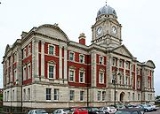
By 1871 the population of Barry was over 100 people and there were 21 buildings, the new estate-owning Romilly family being involved in the build up of the village but it remained a largely agricultural community.Developed solely as a coal port, work commenced on Barry Docks in 1884 and the first dock basin was opened in 1889 to be followed by two other docks and extensive port installations. The company developed extensive dock offices
Barry Dock Offices
Barry Docks Offices is a council building in Barry, Vale of Glamorgan in south-east Wales. It was built in the late nineteenth century by David Davies to regulate the substantial coal exporting trade which had grown to world prominence in the town Barry Docks....
to cope with the administration of both the docks and the railway. Trade grew from one million tons in the first year, to over nine million tons by 1903, and as early as 1892 it was handling a third more coal than Cardiff Docks
Cardiff Docks
Cardiff Docks is a port in south Cardiff, Wales. At its peak, the port was one of the largest dock systems in the world with a total quayage of almost...
. The port was crowded with ships and had flourishing ship repair yards, cold stores, flour mills and an ice factory. By 1913 Barry was the largest coal exporting port in the world handling 4000 ships and 11 million tons of coal, but during its industrial peak a number of ships sank off the Barry coast. Behind the docks rose the terraced houses of Barry which, with Cadoxton, soon formed a sizeable town.
Scrapping of British Railways steam locomotives
Following the rise of diesel and electric power on the UK's railways, the marshalling yards at Barry Docks became the largest repository of steam engines awaiting scrapping in the UK. Operated by Dai WoodhamDai Woodham
Dai Woodham, MBE, BEM , born David Lloyd Victor Woodham, is remembered by many steam railway enthusiasts as the man who saved over 200 former British Railways steam locomotives from the scrap heap...
as part of his family scrapyard business Woodham Brothers, during the 1960s nearly 300 withdrawn British Railways steam locomotive
Steam locomotive
A steam locomotive is a railway locomotive that produces its power through a steam engine. These locomotives are fueled by burning some combustible material, usually coal, wood or oil, to produce steam in a boiler, which drives the steam engine...
s were sent there. Although many were vandalised or looted by souvenir hunters, eventually a significant proportion of the engines were saved by rail preservation organisations.
ABP
In 1962, the British Transport Docks BoardBritish Transport Docks Board
The British Transport Docks Board was a nationalised industry, managing former railway-owned docks in Great Britain. It was created by the Transport Act 1962 and abolished by the Transport Act 1981, which provided for its privatisation as Associated British Ports.The business had its origins in...
was formed as a government-owned body to manage various ports throughout Great Britain formerly owned by the rail industry, including Barry. In 1981, the Conservative government of Margaret Thatcher
Margaret Thatcher
Margaret Hilda Thatcher, Baroness Thatcher, was Prime Minister of the United Kingdom from 1979 to 1990...
implemented the Transport Act 1981
Transport Act 1981
The Transport Act 1981 was a Act of Parliament in the United Kingdom. Amongst other items it introduced the compulsory wearing of seat belts for front seat passengers for a trial period of three year....
, which provided for the BTDB's privatisation. In 1983 the British Government allowed the company to become a public limited company
Public limited company
A public limited company is a limited liability company that sells shares to the public in United Kingdom company law, in the Republic of Ireland and Commonwealth jurisdictions....
quoted on the London Stock Exchange
London Stock Exchange
The London Stock Exchange is a stock exchange located in the City of London within the United Kingdom. , the Exchange had a market capitalisation of US$3.7495 trillion, making it the fourth-largest stock exchange in the world by this measurement...
known as Associated British Ports, which still owns and runs the docks infrastructure today.
Barry and Bristol Channel Steamship Company
.jpg)
Barry Island
Barry Island may refer to:*Barry Island , Wales*Barry Island , Antarctica...
a popular resort.
From the 1890s, the company persuaded P and A Campbell
P and A Campbell
P & A Campbell Ltd of Bristol with its White Funnel Fleet became the dominant excursion-steamer operator in the Bristol Channel by the 1890s; and along the South Coast of England in the first half of the twentieth century.-The White Funnel fleet:...
to run steamers from a pier built alongside the dock across the Bristol Channel
Bristol Channel
The Bristol Channel is a major inlet in the island of Great Britain, separating South Wales from Devon and Somerset in South West England. It extends from the lower estuary of the River Severn to the North Atlantic Ocean...
, but in 1905 they started to build their own fleet of four ships. But as a railway company, parliamentary powers were required to operate steamships and the powers granted generally included provisions which limited operations to routes genuinely associated with the mother company's principal business (i.e. railway connections to non-accessible locations). The powers were also granted to take account of the legitimate interests of existing operators.
The company were limited to calls on the southern bank of the Channel between Weston super Mare and Ilfracombe
Ilfracombe
Ilfracombe is a seaside resort and civil parish on the North Devon coast, England with a small harbour, surrounded by cliffs.The parish stretches along the coast from 'The Coastguard Cottages' in Hele Bay toward the east and 4 miles along The Torrs to Lee Bay toward the west...
, with additional summer excursion destinations allowed so long as the cruises started and finished at Barry. To circumvent these restrictions, the company resorted to the ploy of registering their vessels in the names of its directors and set up an operating company, the Barry and Bristol Channel Steamship Company. P and A Campbell
P and A Campbell
P & A Campbell Ltd of Bristol with its White Funnel Fleet became the dominant excursion-steamer operator in the Bristol Channel by the 1890s; and along the South Coast of England in the first half of the twentieth century.-The White Funnel fleet:...
resorted to successful legal action which ensured that by July 1907, the Barry Railway Company was required to abide by the terms of the original legislation.
Services were maintained despite deteriorating financial fortunes, but as a cost saving measure, PS Gwalia was sold to the Furness Railway
Furness Railway
The Furness Railway was a railway company operating in the Furness area of Lancashire in North West England.-History:The company was established on May 23, 1844 when the Furness Railway Act was passed by Parliament...
on 7 May 1910. Five days later the remaining three steamers were sold to Bristol Channel Passenger Boats Ltd. The latter company struggled to make the business pay and after two seasons, sold out to P and A Campbell
P and A Campbell
P & A Campbell Ltd of Bristol with its White Funnel Fleet became the dominant excursion-steamer operator in the Bristol Channel by the 1890s; and along the South Coast of England in the first half of the twentieth century.-The White Funnel fleet:...
.
Paddle Steamers owned
| Ship | Launched | Tonnage (GRT) | Notes |
|---|---|---|---|
| Barry | 1907 | 497 | To Bristol Channel Passenger Boats Ltd in 1910, then P & A Campbell in 1911. Requisitioned during the First World War. Returned to P & A Campbell in 1920. Renamed Waverley in 1936. Requisitioned by the Royal Navy Royal Navy The Royal Navy is the naval warfare service branch of the British Armed Forces. Founded in the 16th century, it is the oldest service branch and is known as the Senior Service... in the Second World War as . Bombed on 5 July 1941 off Sunderland. |
| Devonia | 1905 | 520 | To Bristol Channel Passenger Boats Ltd in 1910, then P & A Campbell in 1911. Requisitioned during the First World War and used as a minesweeper Minesweeper (ship) A minesweeper is a small naval warship designed to counter the threat posed by naval mines. Minesweepers generally detect then neutralize mines in advance of other naval operations.-History:... . Returned to Campbells in 1923. Laid up in 1939 then conveted to a minesweeper. Abandoned on 31 May 1940 at Dunkirk, France France The French Republic , The French Republic , The French Republic , (commonly known as France , is a unitary semi-presidential republic in Western Europe with several overseas territories and islands located on other continents and in the Indian, Pacific, and Atlantic oceans. Metropolitan France... . |
| Gwalia | 1905 | 562 | Sold in 1910 to the Furness Railway Furness Railway The Furness Railway was a railway company operating in the Furness area of Lancashire in North West England.-History:The company was established on May 23, 1844 when the Furness Railway Act was passed by Parliament... for £22,750 and renamed Lady Moyra. Requisitioned during the First World War and subsequently returned to the FR. Sold in 1933 to P & A Campbell and renamed Brighton Queen. Bombed on 1 June 1940 and sunk at Dunkirk. |
| Westonia | 1889 | 393 | Built for Galloway Saloon Steam Packet Co as Tantallon Castle. Renamed Sussex Belle in 1901. To Sussex Steam Packet Co in 1902, then Colwyn Bay & Liverpool Steamship Co later that year, renamed Rhos Colwyn. Bought by BR in 1905 and renamed Westonia. To Bristol Channel Passenger Boats Ltd in 1910, then P & A Campbell in 1911. Rebuilt and renamed Tintern. Sold in 1912 to Portugal, renamed Alentejo. Scrapped in 1924. |
After 1923 - post grouping
Great Western Railway
The Great Western Railway was a British railway company that linked London with the south-west and west of England and most of Wales. It was founded in 1833, received its enabling Act of Parliament in 1835 and ran its first trains in 1838...
in 1923, post the railway grouping
Railways Act 1921
The Railways Act 1921, also known as the Grouping Act, was an enactment by the British government of David Lloyd George intended to stem the losses being made by many of the country's 120 railway companies, move the railways away from internal competition, and to retain some of the benefits which...
.
Local traffic on the line included that from the limestone quarries and the cement works Aberthaw, and Rhoose cement works at the eastern end of the line. Wartime
World War II
World War II, or the Second World War , was a global conflict lasting from 1939 to 1945, involving most of the world's nations—including all of the great powers—eventually forming two opposing military alliances: the Allies and the Axis...
traffic was created from Tremains and Brackla Hill at Bridgend and the RAF base at St. Athan.
The docks were separated from railway from 1961 as part of the British Docks Board. Traffic since has included the opening of Aberthaw power station
Aberthaw Power Station
Aberthaw Power Station refers to a series of two coal-fired power stations situated on the coast of South Wales, near Barry in the Vale of Glamorgan. It is actually located on the waterfront of the nearby villages of Gileston and West Aberthaw on Limpert Bay...
in February 1966, and the Ford engine plant at Bridgend in January 1980.
1964-present
The Barry-Bridgend passenger service finished on 13 June 1964 as part of the Beeching cuts, but the line continued to be used by through passenger trains between Cardiff and Bridgend when the main line via PontyclunPontyclun
Pontyclun is a village in the County Borough of Rhondda Cynon Taf, Wales. It is served by the South Wales Main Line and has its own local rugby union club...
was closed. By the late 1990s, a daily train runs between Ford’s plants at Dagenham
Dagenham
Dagenham is a large suburb in East London, forming the eastern part of the London Borough of Barking and Dagenham and located east of Charing Cross. It was historically an agrarian village in the county of Essex and remained mostly undeveloped until 1921 when the London County Council began...
and Bridgend and merry-go-round coal trains run between Onllwyn and Cwmgwrach (to the west), Tower Colliery
Tower Colliery
Tower Colliery is the oldest continuously working deep-coal mine in the United Kingdom, and possibly the world, and the last mine of its kind to remain in the South Wales Valleys...
, Newport Docks and Avonmouth
Avonmouth
Avonmouth is a port and suburb of Bristol, England, located on the Severn Estuary, at the mouth of the River Avon.The council ward of Avonmouth also includes Shirehampton and the western end of Lawrence Weston.- Geography :...
(to the east), to Aberthaw power station averaging some 10 trains a day.
As a result of pressure from local groups, the Vale of Glamorgan council and increasing traffic from Cardiff International Airport
Cardiff International Airport
Cardiff Airport is an international airport serving Cardiff, and the rest of South, Mid and West Wales. Around 1.4 million passengers passed through the airport in 2010....
, from 1999 various studies and business plans eventually resulted in a reopening of the line by Welsh Assembly government minister Andrew Davies on 10 June 2005 with the first fare paying passengers transported on Sunday 12 June 2005 with 143606/624
British Rail Class 143
The British Rail Class 143 is a diesel multiple unit, part of the Pacer family of trains introduced between 1985 and 1986. They originally worked in the North-East of England but were later transferred to Wales and South-West England....
working the 0840 Cardiff-Bridgend and 0945 return.
External links
- Barry railway at Railscot.co.uk
- Modelling the Barry Railway
- Barry Railway Penrhos Branch
- Barry Railway Company on Cardiffrail
- Barry Railway Penrhos gallery
- Barry Railway Trehafod gallery
- Barry Railway route to Trehafod
- Creigiau and Efail Isaf Stations gallery
- Report on accident on the Barry Railway 4th August 1920