

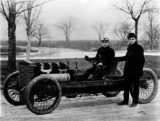
Barney Oldfield

Encyclopedia
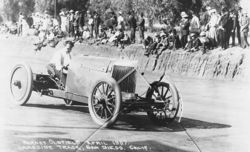
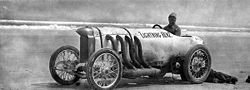
Automobile
An automobile, autocar, motor car or car is a wheeled motor vehicle used for transporting passengers, which also carries its own engine or motor...
racer and pioneer. He was born on a farm on the outskirts of Wauseon, Ohio
Wauseon, Ohio
As of the census of 2000, there were 7,091 people, 2,706 households, and 1,875 families residing in the city. The population density was 1,437.6 people per square mile . There were 2,851 housing units at an average density of 578.0 per square mile...
. He was the first man to drive a car at 60 miles per hour (96 km/h) on an oval. His accomplishments led to the expression "Who do you think you are? Barney Oldfield?"
Bicycle racer
Oldfield began as a bicycle racer in 1894, winning silver medals and a gold watch. At age 16, in 1894, he entered his first bicycle race and soon officials from Dauntless bicycle factory asked him to ride for the OhioOhio
Ohio is a Midwestern state in the United States. The 34th largest state by area in the U.S.,it is the 7th‑most populous with over 11.5 million residents, containing several major American cities and seven metropolitan areas with populations of 500,000 or more.The state's capital is Columbus...
state championship. Although Oldfield came in second in the race, it was a turning point in his life and he was hired as a parts sales representative for Stearns where he met his future wife, Beatrice Lovetta Oatis who he married in 1896.
By 1896, he was being paid handsomely by the Stearns bicycle factory in Syracuse, New York
Syracuse, New York
Syracuse is a city in and the county seat of Onondaga County, New York, United States, the largest U.S. city with the name "Syracuse", and the fifth most populous city in the state. At the 2010 census, the city population was 145,170, and its metropolitan area had a population of 742,603...
to race on its amateur team.
Auto racer
Oldfield was lent a gasoline-powered bicycle to race at Salt Lake CitySalt Lake City, Utah
Salt Lake City is the capital and the most populous city of the U.S. state of Utah. The name of the city is often shortened to Salt Lake or SLC. With a population of 186,440 as of the 2010 Census, the city lies in the Salt Lake City metropolitan area, which has a total population of 1,124,197...
, which led to a meeting with Henry Ford
Henry Ford
Henry Ford was an American industrialist, the founder of the Ford Motor Company, and sponsor of the development of the assembly line technique of mass production. His introduction of the Model T automobile revolutionized transportation and American industry...
. Ford had readied two automobiles for racing, and he asked Oldfield if he would like to test one at Ford's Grosse Pointe
Grosse Pointe
Grosse Pointe refers to a coastal area in Metro Detroit, Michigan, United States that comprises five adjacent individual communities. From southwest to northeast, they are:*Grosse Pointe Park, city*Grosse Pointe, city*Grosse Pointe Farms, city...
track. Oldfield agreed and traveled to Michigan for the trial, but neither car would start. In spite of the fact that Oldfield had still never driven an automobile, he and fellow racing cyclist Tom Cooper
Tom Cooper (driver)
Tom Cooper was an 1890s champion bicycle racer and early auto racing driver. He is best known for his rivalry with Major Taylor as well as his later work with Henry Ford and Barney Oldfield.- Early years :...
purchased both test vehicles when Ford offered to sell them for $800. One of those first vehicles was the famous "No. 999" which debuted in October, 1902 at the Manufacturer's Challenge Cup. The car can be found today at the Henry Ford Museum in Greenfield Village.
Oldfield agreed to drive against the current champion Alexander Winton. Oldfield was rumored to have learned how to operate the controls of that car the morning of the event. Oldfield won by a half mile in the five mile (8 km) race. He slid through the corners like a motorcycle racer did instead of braking. It was a great victory for Ford and led both Barney Oldfield and Ford to become household names.
John Wilkinson
John Wilkinson (Franklin automobile)
John Wilkinson was born in Syracuse, New York. He invented the air-cooled motor which was used in the Franklin produced by H. H. Franklin Manufacturing Company where he was chief engineer and designer from 1902 to 1924.He was a native of Syracuse and a member of an established, respected, wealthy...
, who designed an air-cooled engine for Franklin Automobile Company
Franklin (automobile)
The Franklin Automobile Company was a manufacturer of automobiles in the United States between 1902 and 1934 in Syracuse, New York. Herbert H. Franklin, the founder, began his career in the metal die casting business before establishing his automobile enterprise.Franklin founded the H. H. Franklin...
and was their chief engineer, raced against Barney Oldfield in 1902, winning the state 5 miles (8 km) championship in the record time of 6:54:6 in a Franklin.
On June 20, 1903, at the Indiana State Fairgrounds in Indiana, Oldfield became the first driver to run a mile track in one minute flat or 60 mi/h. Two months later, he drove a mile in 55.8 seconds at the Empire City Race Track in Yonkers, New York
Yonkers, New York
Yonkers is the fourth most populous city in the state of New York , and the most populous city in Westchester County, with a population of 195,976...
. Winton hired Oldfield and agreed to supply free cars in addition to his salary. Oldfield, with his manager Ernest Moross
Ernest Moross
Ernest "Ernie" Moross was an early twentieth century press agent and promoter specializing in American motorsports. He was a longtime associate of the first American auto racing superstar, Barney Oldfield. Moross also obtained distinction as the first Contest Director for the Indianapolis Motor...
and front-man agent Will Pickens, crisscrossed the United States in a series of timed runs and match races, where he earned a reputation as a showman. One year he competed at twenty tracks in 18 weeks while driving for Peerless, and won sixteen straight match races. He frequently raced in three event matches; in one, he won the first part by a nose, lost the second, before he won the third.
Oldfield made a fine showing at the opening of the Indianapolis Speedway (August 19–21, 1909), in a Mercedes.
He bought a Benz, and raised his speed in 1910 to 70.159 mi/h in his "Blitzen Benz
Blitzen Benz
In 1909, the Blitzen Benz was built in Mannheim by Benz & Cie. The vehicle was one of six built with a , inline four engine enlarged from the company's Grand Prix racer. The car was modified to improve its aerodynamics. At Brooklands on November 9, 1909, land speed racer Victor Hémery of France...
". Later that year he drove to 131.25 mi/h. He used the car to break the existing mile, two mile (3 km), and kilometer records at the Daytona Beach Road Course
Daytona Beach Road Course
Daytona Beach Road Course was a race track that was instrumental in the formation of the National Association for Stock Car Auto Racing, or NASCAR. It originally became famous as the location where fifteen world land speed records were set...
at Ormond, Florida. He was able to charge $4000 for each appearance after that.
Suspension and later career
Oldfield was suspended by the AAAAmerican Automobile Association
AAA , formerly known as the American Automobile Association, is a federation of 51 independently operated motor clubs throughout North America. AAA is a not-for-profit member service organization with more than 51 million members. AAA provides services to its members such as travel, automotive,...
for his "outlaw" racing activities and was unable to race at sanctioned events for much of the prime of his career. Speed records, match races and exhibitions made up most of Oldfield's career. He put on at least 35 shows in 1914 with the aviator Lincoln Beachey
Lincoln Beachey
Lincoln J. Beachey was a pioneer American aviator and barnstormer. He became famous and wealthy from flying exhibitions, staging aerial stunts, helping invent aerobatics, and setting aviation records....
. Oldfield raced his Fiat
Fiat
FIAT, an acronym for Fabbrica Italiana Automobili Torino , is an Italian automobile manufacturer, engine manufacturer, financial, and industrial group based in Turin in the Italian region of Piedmont. Fiat was founded in 1899 by a group of investors including Giovanni Agnelli...
car against Beachey's aircraft.
He was reinstated and he competed in the 1914 and 1916 Indianapolis 500
Indianapolis 500
The Indianapolis 500-Mile Race, also known as the Indianapolis 500, the 500 Miles at Indianapolis, the Indy 500 or The 500, is an American automobile race, held annually, typically on the last weekend in May at the Indianapolis Motor Speedway in Speedway, Indiana...
, finishing fifth in each attempt but becoming the first person in Indianapolis history to run a 100-mile-per-hour lap. His 1914 Indy finish was in an Indianapolis-built Stutz, making him the highest finishing driver in an American car in a race dominated by Europeans. Oldfield used the same car in his victory at the Los Angeles to Phoenix off-road race in November 1914. Oldfield also finished second in two major road races that year, the Vanderbilt Cup
Vanderbilt Cup
The Vanderbilt Cup was the first major trophy in American auto racing.-History:An international event, it was founded by William Kissam Vanderbilt II in 1904 and first held at a course set out in Nassau County on Long Island, New York. The announcement that the race was to be held caused...
and the Corona
Corona
A corona is a type of plasma "atmosphere" of the Sun or other celestial body, extending millions of kilometers into space, most easily seen during a total solar eclipse, but also observable in a coronagraph...
300. In 1915 he won the Venice, California 300 road race.
In June 1917 he used his Golden Submarine
Golden Submarine
The Golden Submarine was an early twentieth century streamlined race car designed and built in 1917 by Fred Offenhauser and Harry A. Miller for Barney Oldfield...
to beat fellow racing legend Ralph DePalma
Ralph DePalma
Ralph De Palma was an Italian-American racecar driving champion, most notably winner of the 1915 Indianapolis 500. His entry at the International Motorsports Hall of Fame estimates that he won about 2000 races...
in a series of 10 to 25 miles (40.2 km) match races at Milwaukee. He retired from racing in 1918, but he continued to tour and make movies.
In 1932 he tried to re-enter speed record racing again with a new car design he touted in a major magazine article he wrote. But he found no supporters for the venture. That was his last attempt at racing in his life.
Stage and film performances
He starred in the Broadway musical The Vanderbilt CupVanderbilt Cup
The Vanderbilt Cup was the first major trophy in American auto racing.-History:An international event, it was founded by William Kissam Vanderbilt II in 1904 and first held at a course set out in Nassau County on Long Island, New York. The announcement that the race was to be held caused...
(1906) for ten weeks. His movie career included the silent film Barney Oldfield's Race for a Life
Barney Oldfield's Race for a Life
Barney Oldfield's Race for a Life is a silent comedy short, directed and produced by Mack Sennett and starring Sennett, Mabel Normand, and Barney Oldfield as himself...
(1913), where he raced against a train to rescue a heroine tied to the train tracks. He was also featured in The First Auto
The First Auto
The First Auto is a 1927 film about the transition from horses to cars and the rift it causes in one family. It stars Russell Simpson, Charles Emmett Mack, and Patsy Ruth Miller...
(1927) as an early pioneer of automotive history. He was a technical advisor for the Vanderbilt Cup sequence in the feature film Back Street
Back Street (1941 film)
Back Street is a 1941 drama film made by Universal Pictures, directed by Robert Stevenson. The film stars Charles Boyer and Margaret Sullavan. It is a remake of the 1932 film of the same name, also from Universal. The film follows the 1931 Fannie Hurst novel and the 1932 film version very closely,...
(1941). He starred as himself in a racing film titled The Blonde Comet, the story of a young woman trying to achieve success as a race car driver.
Contributions to racing safety
Oldfield worked with Harry Arminius MillerHarry Arminius Miller
Harry Arminius Miller was an influential and famous American race car builder, most active in the 1920s and 1930s...
, who developed and built carburetor
Carburetor
A carburetor , carburettor, or carburetter is a device that blends air and fuel for an internal combustion engine. It is sometimes shortened to carb in North America and the United Kingdom....
s in Los Angeles and became one of the most famous engine builders in America, to create a racing machine that would not only be fast and durable, but that would also protect the driver in the event of an accident. Bob Burman
Bob Burman
Bob Burman was an American racecar driver active in the formative years of auto racing.-Biography:He was born on April 23, 1884 in Imlay City, Michigan. He was the winner of the Prest-O-Lite Trophy Race in 1909. He competed at the inaugural Indianapolis 500 in 1911...
, one of Oldfield's top rivals and closest friends, was killed in a wreck during a race in Corona, California
Corona, California
Corona is a city in Riverside County, California, United States. As of the 2010 census, the city had a population of 152,374, up from 124,966 at the 2000 census...
. Burman died from severe injuries suffered while rolling over in his open-cockpit car. Oldfield and Miller joined forces to build a race car that incorporated a roll cage inside a streamlined driver's compartment that completely enclosed the driver (called the "Golden Submarine
Golden Submarine
The Golden Submarine was an early twentieth century streamlined race car designed and built in 1917 by Fred Offenhauser and Harry A. Miller for Barney Oldfield...
").
Business ventures
Barney Oldfield also helped fellow racer Carl G. FisherCarl G. Fisher
Carl Graham Fisher was an American entrepreneur. Despite having severe astigmatism, he became a seemingly tireless pioneer and promoter of the automotive, auto racing, and real estate development industries...
found the Fisher Automobile Company
Fisher Automobile Company
Fisher Automobile Company in Indianapolis, Indiana, is believed to have been the first automobile dealership in the United States. It carried multiple models of Oldsmobiles, Reos, Packards, Stoddard-Daytons, Stutz and others....
in Indianapolis, Indiana
Indianapolis, Indiana
Indianapolis is the capital of the U.S. state of Indiana, and the county seat of Marion County, Indiana. As of the 2010 United States Census, the city's population is 839,489. It is by far Indiana's largest city and, as of the 2010 U.S...
, which is believed to be the first automobile dealership in the United States
United States
The United States of America is a federal constitutional republic comprising fifty states and a federal district...
. http://www.lostindiana.net/html/crown_hill__fisher.html
He developed the Oldfield tire for Firestone
Firestone Tire and Rubber Company
The Firestone Tire and Rubber Company is an American tire company founded by Harvey Firestone in 1900 to supply pneumatic tires for wagons, buggies, and other forms of wheeled transportation common in the era. Firestone soon saw the huge potential for marketing tires for automobiles. The company...
, which helped put Firestone on the map. Firestone used the slogan "'Firestone Tires are my only life insurance,' says Barney Oldfield, world's greatest driver."
In 1924, the Kimball Truck Co. of Los Angeles, CA, built the only 1924 Oldfield.
Death
He died on October 4, 1946 and was buried in the Holy Cross CemeteryHoly Cross Cemetery, Culver City
Holy Cross Cemetery is a Roman Catholic cemetery at 5835 West Slauson Avenue in Culver City, California, operated by the Roman Catholic Archdiocese of Los Angeles....
in Culver City, California
Culver City, California
Culver City is a city in western Los Angeles County, California. As of the 2010 census, the city had a population of 38,883, up from 38,816 at the 2000 census. It is mostly surrounded by the city of Los Angeles, but also shares a border with unincorporated areas of Los Angeles County. Culver...
.
Indy 500 results
| ||||||||||||||||||||||||||||||||||||
Awards
- In 1953, Oldfield was among the first 10 pioneers of auto racing to be "enshrined in Auto Racing's Hall of Fame."
- In 1990, he was inducted into the International Motorsports Hall of FameInternational Motorsports Hall of FameThe International Motorsports Hall of Fame is a Hall of Fame dedicated to enshrining those who have contributed the most to auto racing either as a driver, owner, developer or engineer...
. - He was named to the National Sprint Car Hall of FameNational Sprint Car Hall of Fame & MuseumThe National Sprint Car Hall of Fame & Museum is a Hall of Fame and museum for sprint car drivers, owners, mechanics, builders, manufacturers, promoters, sanctioning officials and media members....
in 1990. - He was inducted into the Motorsports Hall of Fame of AmericaMotorsports Hall of Fame of AmericaThe Motorsports Hall of Fame of America is a Hall of Fame and museum for American motorsports legends. It was originally located in Novi, Michigan and it moved to the Detroit Science Center in 2009.-Museum:...
in the inaugural 1989 class as the at-large representative.
Other Honors
Oakshade Raceway in Oakshade, Ohio, near where Oldfield was born, Has an annual Barney Oldfield race.Biographies
- "Barney Oldfield: The Life And Times Of America's Legendary Speed King"; William F. Nolan; ISBN 978-1888978124