


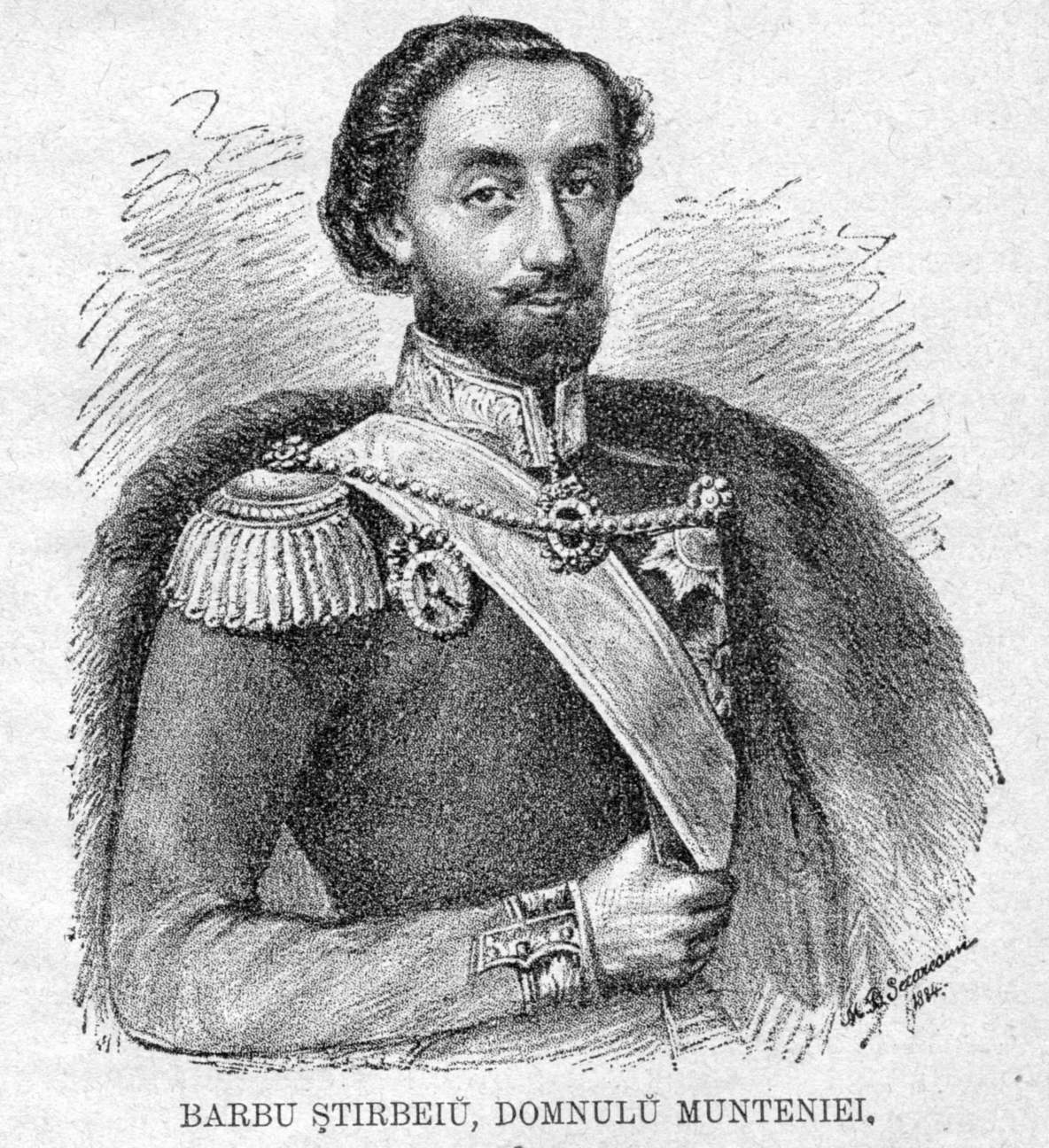
Barbu Dimitrie Stirbei

Encyclopedia
Boyar
A boyar, or bolyar , was a member of the highest rank of the feudal Moscovian, Kievan Rus'ian, Bulgarian, Wallachian, and Moldavian aristocracies, second only to the ruling princes , from the 10th century through the 17th century....
family, was a Prince of Wallachia
Wallachia
Wallachia or Walachia is a historical and geographical region of Romania. It is situated north of the Danube and south of the Southern Carpathians...
on two occasions, in 1848–1853 and in 1854–1856.
Early life
Born to Dumitrache Bibescu and his wife, he was adopted by his grandfather, the last of the Ştirbei family who left him heir to his wealth and family name.He studied philosophy and law in Paris
Paris
Paris is the capital and largest city in France, situated on the river Seine, in northern France, at the heart of the Île-de-France region...
, at the beginning of Louis XVIII
Louis XVIII of France
Louis XVIII , known as "the Unavoidable", was King of France and of Navarre from 1814 to 1824, omitting the Hundred Days in 1815...
's reign, in 1815. Returned in Wallachia, in 1821 he took refuge in Braşov
Brasov
Brașov is a city in Romania and the capital of Brașov County.According to the last Romanian census, from 2002, there were 284,596 people living within the city of Brașov, making it the 8th most populated city in Romania....
, Transylvania
Transylvania
Transylvania is a historical region in the central part of Romania. Bounded on the east and south by the Carpathian mountain range, historical Transylvania extended in the west to the Apuseni Mountains; however, the term sometimes encompasses not only Transylvania proper, but also the historical...
(part of the Austrian Empire
Austrian Empire
The Austrian Empire was a modern era successor empire, which was centered on what is today's Austria and which officially lasted from 1804 to 1867. It was followed by the Empire of Austria-Hungary, whose proclamation was a diplomatic move that elevated Hungary's status within the Austrian Empire...
at the time) from the Wallachian uprising of 1821
Wallachian uprising of 1821
The Wallachian uprising of 1821 was an uprising in Wallachia against Ottoman rule which took place during 1821.-Background:...
.
Ascension
In 1825, he returned to BucharestBucharest
Bucharest is the capital municipality, cultural, industrial, and financial centre of Romania. It is the largest city in Romania, located in the southeast of the country, at , and lies on the banks of the Dâmbovița River....
and took on several offices with the administration of Grigore IV Ghica
Grigore IV Ghica
Grigore IV Ghica or Grigore Dimitrie Ghica was Prince of Wallachia between 1822 and 1828. A member of the Ghica family, Grigore IV was the brother of Alexandru Ghica and the uncle of Dora d'Istria....
. After Wallachia was occupied by Imperial Russia following The Russo-Turkish War of 1828-1829
Russo-Turkish War, 1828-1829
The Russo–Turkish War of 1828–1829 was sparked by the Greek War of Independence. The war broke out after the Sultan, incensed by the Russian participation in the Battle of Navarino, closed the Dardanelles for Russian ships and revoked the Akkerman Convention....
, general Pavel Kiseleff promoted him to the central government, where he served as president of the Wallachian commission charged with drafting the Organic Regulation
Regulamentul Organic
Regulamentul Organic was a quasi-constitutional organic law enforced in 1834–1835 by the Imperial Russian authorities in Moldavia and Wallachia...
, the first form of constitutional law
Constitution of Romania
The 1991 Constitution of Romania, adopted on 21 November 1991, voted in the referendum of 8 December 1991 and introduced on the same day, is the current fundamental law that establishes the structure of the government of Romania, the rights and obligations of the country's citizens, and its mode...
ever implemented in Wallachia.
In 1836, he was given the administration of the Justice Department, where he set up a new commercial code, based on the Napoleonic model
Napoleonic code
The Napoleonic Code — or Code Napoléon — is the French civil code, established under Napoléon I in 1804. The code forbade privileges based on birth, allowed freedom of religion, and specified that government jobs go to the most qualified...
, and improved the criminal
Criminal law
Criminal law, is the body of law that relates to crime. It might be defined as the body of rules that defines conduct that is not allowed because it is held to threaten, harm or endanger the safety and welfare of people, and that sets out the punishment to be imposed on people who do not obey...
and civil
Civil law (common law)
Civil law, as opposed to criminal law, is the branch of law dealing with disputes between individuals or organizations, in which compensation may be awarded to the victim...
procedures. After Grigore IV Ghica was removed from the throne, Ştirbei was a candidate for the office in the only elections carried under the Regulations provisions, but renounced his votes in favour of his brother, Gheorghe Bibescu
Gheorghe Bibescu
Gheorghe Bibescu was a hospodar of Wallachia between 1843 and 1848. His rule coincided with the revolutionary tide that culminated in the 1848 Wallachian revolution.-Early political career:...
.
Prince of Wallachia
After the 1848 Wallachian Revolutionary Government was overthrown by OttomanOttoman Empire
The Ottoman EmpireIt was usually referred to as the "Ottoman Empire", the "Turkish Empire", the "Ottoman Caliphate" or more commonly "Turkey" by its contemporaries...
troops, and a new hospodar was to be named, Sultan
Ottoman Dynasty
The Ottoman Dynasty ruled the Ottoman Empire from 1299 to 1922, beginning with Osman I , though the dynasty was not proclaimed until Orhan Bey declared himself sultan...
‘Abdu’l-Mijid I supported Barbu Ştirbei for the office, and he was awarded the throne for a seven-year term (under the provisions of the 1849 Convention of Balta-Liman). His reign began under the common occupation of Ottoman Empire and Imperial Russia, occupation which ended in 1851, when Barbu Ştirbei was awarded the Order of St. Anna
Order of St. Anna
The Order of St. Anna ) is a Holstein and then Russian Imperial order of chivalry established by Karl Friedrich, Duke of Holstein-Gottorp on 14 February 1735, in honour of his wife Anna Petrovna, daughter of Peter the Great of Russia...
by the Russian Emperor Nicholas I
Nicholas I of Russia
Nicholas I , was the Emperor of Russia from 1825 until 1855, known as one of the most reactionary of the Russian monarchs. On the eve of his death, the Russian Empire reached its historical zenith spanning over 20 million square kilometers...
.
During his reign, Ştirbei pushed moderate reforms, such as a slight reform of the judiciary
Judiciary
The judiciary is the system of courts that interprets and applies the law in the name of the state. The judiciary also provides a mechanism for the resolution of disputes...
system which led to an increase in the number of solved legal disputes. He took steps to enforce a (still very conservative
Conservatism
Conservatism is a political and social philosophy that promotes the maintenance of traditional institutions and supports, at the most, minimal and gradual change in society. Some conservatives seek to preserve things as they are, emphasizing stability and continuity, while others oppose modernism...
) land reform
Land reform
[Image:Jakarta farmers protest23.jpg|300px|thumb|right|Farmers protesting for Land Reform in Indonesia]Land reform involves the changing of laws, regulations or customs regarding land ownership. Land reform may consist of a government-initiated or government-backed property redistribution,...
, by passing a law, in 1851, in which the peasants were referred to as "tenants", and which allowed them to more easily move between boyar
Boyar
A boyar, or bolyar , was a member of the highest rank of the feudal Moscovian, Kievan Rus'ian, Bulgarian, Wallachian, and Moldavian aristocracies, second only to the ruling princes , from the 10th century through the 17th century....
properties. In the matter Roma
Roma minority in Romania
The Roma constitute one of the major minorities in Romania. According to the 2002 census, they number 535,140 people or 2.5% of the total population, being the second-largest ethnic minority in Romania after Hungarians...
slavery
Slavery
Slavery is a system under which people are treated as property to be bought and sold, and are forced to work. Slaves can be held against their will from the time of their capture, purchase or birth, and deprived of the right to leave, to refuse to work, or to demand compensation...
, Ştirbei began by limiting the internal trading in slaves, forbade the separation of families through the latter, and ultimately abolished the institution altogether.
At the beginning of the Crimean War
Crimean War
The Crimean War was a conflict fought between the Russian Empire and an alliance of the French Empire, the British Empire, the Ottoman Empire, and the Kingdom of Sardinia. The war was part of a long-running contest between the major European powers for influence over territories of the declining...
, in 1853, Wallachia was once again occupied by Imperial Russian troops. Barbu Ştirbei stayed in Bucharest until the formal declaration of war from the Ottoman Empire, after which he fled to Vienna
Vienna
Vienna is the capital and largest city of the Republic of Austria and one of the nine states of Austria. Vienna is Austria's primary city, with a population of about 1.723 million , and is by far the largest city in Austria, as well as its cultural, economic, and political centre...
, only to return the following year, in the autumn of 1854, after the Russian withdrawal, when the country was under Austrian and Ottoman occupation.
In 1856, after the end of the war, at the Treaty of Paris
Treaty of Paris (1856)
The Treaty of Paris of 1856 settled the Crimean War between Russia and an alliance of the Ottoman Empire, the British Empire, Second French Empire, and the Kingdom of Sardinia. The treaty, signed on March 30, 1856 at the Congress of Paris, made the Black Sea neutral territory, closing it to all...
, the question of the unification of Moldavia and Wallachia, the two Danubian Principalities
Danubian Principalities
Danubian Principalities was a conventional name given to the Principalities of Moldavia and Wallachia, which emerged in the early 14th century. The term was coined in the Habsburg Monarchy after the Treaty of Küçük Kaynarca in order to designate an area on the lower Danube with a common...
, became in order. Ştirbei supported the union, although not very strongly, as he hoped to become prince of the resulting state. However, in early summer, as his term had ended, he stepped back as hospodar and left for Paris.
Later life
In 1857, he was elected deputy in the Ad-hoc divan, an assembly charged with giving Wallachia a new constitutional framework. After the divans confirmed the union of the two countries by electing Alexander John CuzaAlexander John Cuza
Alexander John Cuza was a Moldavian-born Romanian politician who ruled as the first Domnitor of the United Principalities of Moldavia and Wallachia between 1859 and 1866.-Early life:...
as Domnitor
Domnitor
Domnitor was the official title of the ruler of the United Principalities of Wallachia and Moldavia between 1859 and 1866....
, he returned to Paris together with his brother Gheorghe Bibescu
Gheorghe Bibescu
Gheorghe Bibescu was a hospodar of Wallachia between 1843 and 1848. His rule coincided with the revolutionary tide that culminated in the 1848 Wallachian revolution.-Early political career:...
.
He temporarily returned to the country in 1866, in support of the newly elected Carol
Carol I of Romania
Carol I , born Prince Karl of Hohenzollern-Sigmaringen was reigning prince and then King of Romania from 1866 to 1914. He was elected prince of Romania on 20 April 1866 following the overthrow of Alexandru Ioan Cuza by a palace coup...
of the Principality of Romania
Kingdom of Romania
The Kingdom of Romania was the Romanian state based on a form of parliamentary monarchy between 13 March 1881 and 30 December 1947, specified by the first three Constitutions of Romania...
. Barbu Ştirbey spent his last years in France, where he died in 1869, in Nice
Nice
Nice is the fifth most populous city in France, after Paris, Marseille, Lyon and Toulouse, with a population of 348,721 within its administrative limits on a land area of . The urban area of Nice extends beyond the administrative city limits with a population of more than 955,000 on an area of...
, after visiting Bucharest one last time in 1868.