
|
|
|
|
Barbara Hepworth
|
| |
|
| |
Dame Barbara Hepworth DBE (10 January 1903 – 20 May 1975, christened Jocelyn Barbara Hepworth) was a major British sculptor and artist of the twentieth century.

Discussion
Ask a question about 'Barbara Hepworth'
Start a new discussion about 'Barbara Hepworth'
Answer questions from other users
|
Encyclopedia
Dame Barbara Hepworth DBE (10 January 1903 – 20 May 1975, christened Jocelyn Barbara Hepworth) was a major British sculptor and artist of the twentieth century. She was a contemporary and friend of Henry Moore.
Life and work
Hepworth was born in Wakefield, West Yorkshire, attended Wakefield Girls High School, and won a scholarship and studied at the Leeds School of Art from 1920 (where she met Moore). She then won a County scholarship to the Royal College of Art and studied there from 1921 until she awarded the diploma of the Royal College of Art in 1924. She later studied for a period in Italy.
Barbara Hepworth is one of the most significant sculptors and artists of the 20th century. Her work exemplifies Modernism and along with her contemporaries in England such as Ivon Hitchens, Henry Moore, Ben Nicholson, Naum Gabo and others she helped to develop modern art (sculpture in particular) immeasurably.
One of her most prestigious works is Single Form, in memory of her friend and collector of her works Dag Hammarskjöld, at the United Nations building in New York City. It was commissioned in 1961 by the Jacob and Hilda Blaustein Foundation following Hammarskjöld's death in a plane crash.
Hepworth's first marriage was to the sculptor John Skeaping, with whom she had a son, Paul, in 1929. Her second marriage was to the painter Ben Nicholson. They married on 17 November 1938 at Hampstead Register Office. The couple had triplets in 1934, Simon, Rachel and Sarah; Simon also became an artist. The couple divorced in 1951. Her eldest son, Paul, was killed on 13 February 1953 in a plane crash while serving with the Royal Air Force in Thailand; Hepworth created a a memorial to him, entitled Madonna and Child, in the church in St Ives.
She was made a Dame in 1965, ten years before her death during a fire in her St Ives studio in Cornwall, aged seventy-two. The studio and her home now form the Barbara Hepworth Museum.
As well as at the Barbara Hepworth Museum, more of Hepworth's work will be on display at The Hepworth Wakefield a museum currently under construction in Wakefield. An opening in 2010 is anticipated.
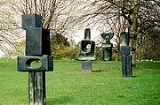
Her work may also be seen at St. Catherine's College, Oxford, the School of Music at Cardiff University, the Yorkshire Sculpture Park in West Bretton, West Yorkshire; Clare College, Churchill College and Murray Edwards College (formerly New Hall), Cambridge; Snape Maltings, Snape, Suffolk; and on view in or attached to the John Lewis department store, part of the John Lewis Partnership, in Oxford Street (see picture); and Kenwood House, both in London. Her 1966 work "Construction (Crucifixion): Homage to Mondrian" can be seen in the grounds of Winchester Cathedral next to the The Pilgrims' School. The Tate Gallery owns many of her works. In The Netherlands, the Kroller-Mueller museum also owns several of her sculptures. "Curved Form (Trevalgan)" (1956) which stood in Margaret Gardiner's rear garden in Hampstead is now at the Pier Art Gallery in Stromness together with 67 other works donated by Gardiner. Trevalgan was Hepworth's first entire bronze form.
Gallery
List of selected works
 | 1928 | Doves | Parian marble | | 1932-33 | Seated Figure | lignum vitae | | 1933 | Two Forms | alabaster and limestone | | 1934 | Mother and Child | Cumberland alabaster | | 1935 | Three Forms | Serravezza marble | | 1936 | Ball Plane and Hole | lignum vitae, mahogany and oak | | 1940 | Sculpture with Colour (Deep Blue and Red) | mixed | | 1943 | Oval Sculpture | cast material | | 1943-44 | Wave | wood, paint and string | | 1944 | Landscape Sculpture | wood (cast in bronze, 1961) | | 1946 | Pelagos | -
| Tides | wood and paint | | 1947 | Blue and green (arthroplasty) 31 December 1947 | oil and pencil on pressed paperboard | | 1949 | Operation: Case for Discussion | oil and pencil on pressed paperboard | | 1951 | Group I (Concourse) February 4 1951 | Serravezza marble | | 1953 | Hieroglyph | Ancaster stone | | 1954-55 | Two Figures | teak and paint | | 1955 | Oval Sculpture (Delos) | scented guarea wood and paint | | 1955-56 | Coré | bronze | | 1956 | Orpheus (Maquette), Version II | -
| Stringed Figure (Curlew), Version II | brass and cotton string | | 1958 | Cantate Domino | -
| Sea Form (Porthmeor) | bronze | | 1960 | Figure for a Landscape | -
| Archaeon | bronze | | 1962-63 | Bronze Form (Patmos) | bronze | | 1964 | Rock Form (Porthcurno) | -
| Sea Form (Atlantic) | bronze | Oval Form (Trezion) >| bronze | |
| 1966 | Figure in a Landscape | -
| Four-Square Walk Through | bronze | | 1968 | Two Figures | bronze and gold | | 1970 | Family of Man | bronze | | 1971 | The Aegean Suite | -
| Summer Dance | painted bronze | | 1972 | Minoan Head | - valign=top
| Assembly of Sea Forms | white marble mounted on stainless steel base | | 1973? | Conversation with Magic Stones | bronze and silver |
External links
-
-
-
-
-
- online journal for art and artists in Cornwall
|
| |
|
|