

Bar-le-Duc

Encyclopedia
Bar-le-Duc, formerly known as Bar, is a commune
in the Meuse
département, of which it is the préfecture (capital). The department is in Lorraine
in north-eastern France
-clad hills, and is traversed throughout its length by the Ornain
, which is crossed by several bridges. It is limited towards the north-east by the Marne-Rhine Canal
, on the south-west by a small arm of the Ornain, called the Canal des Usines, on the left bank of which the upper town (Ville Haute) is situated.
, of Bar. Though probably of ancient origin, the town was unimportant till the 10th century when it became the residence of the counts. Originally part of the early medieval duchy of Upper Lorraine, at some stage in the early modern period it was acquired by the neighbouring dukes of Lorraine
.
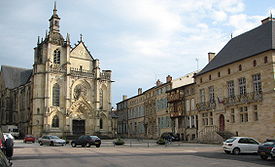
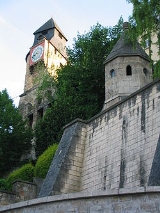
 The Ville Haute, which is reached by staircases and steep narrow thoroughfares, is intersected by a long, quiet street, bordered by houses of the 15th, 16th and 17th centuries. In this quarter are the remains (16th century) of the chateau of the dukes of Bar, dismantled in 1670, the old clock-tower, and the college, built in the latter half of the 16th century. Its church of Saint-Étienne (constructed during the 14th and 15th centuries) contains a skillfully-carved effigy in white stone of a half-decayed corpse, erected to the memory of René of Châlon
(d. 1544), the work of 16th century artist Ligier Richier
, a pupil of Michelangelo
.
The lower town contains the official buildings and the churches of Notre-Dame, the most ancient in the town, and St. Antony, with 14th century frescoes. Among the statues of distinguished natives of the town is one to Nicolas Oudinot
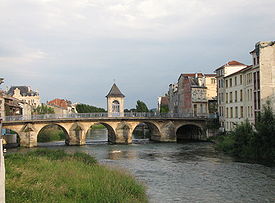
, whose house serves as the hotel-de-ville. Other sights include the Notre-Dame Bridge, with five arches surmounted by a chapel in the middle.
, also known as Lorraine Jelly
, is a spreadable preparation of white currant
or red currant
fruit preserves, hailing from this town. First referenced in the historical record in 1344, it is also colloquially referred to as Bar Caviar.
A great silk factory was established here by Jean-François Jacqueminot
.
, Russia Griesheim
, Germany Wilkau-Haßlau
, Germany Gyönk
, Hungary
Communes of France
The commune is the lowest level of administrative division in the French Republic. French communes are roughly equivalent to incorporated municipalities or villages in the United States or Gemeinden in Germany...
in the Meuse
Meuse
Meuse is a department in northeast France, named after the River Meuse.-History:Meuse is one of the original 83 departments created during the French Revolution on March 4, 1790...
département, of which it is the préfecture (capital). The department is in Lorraine
Lorraine (région)
Lorraine is one of the 27 régions of France. The administrative region has two cities of equal importance, Metz and Nancy. Metz is considered to be the official capital since that is where the regional parliament is situated...
in north-eastern France
Geography
The lower, more modern and busier part of the town extends along a narrow valley, shut in by wooded or vineVine
A vine in the narrowest sense is the grapevine , but more generally it can refer to any plant with a growth habit of trailing or scandent, that is to say climbing, stems or runners...
-clad hills, and is traversed throughout its length by the Ornain
Ornain
The Ornain is a 116 km long river in northeastern France, right tributary of the Saulx . It is formed near the village Gondrecourt-le-Château by the confluence of the small rivers Ognon and Maldite. It flows generally northwest...
, which is crossed by several bridges. It is limited towards the north-east by the Marne-Rhine Canal
Marne-Rhine Canal
The Marne-Rhine Canal is a canal in north eastern France. It connects the river Marne in Vitry-le-François with the Rhine in Strasbourg. Combined with the canalised part of the Marne, it allows transport between Paris and eastern France. The original objective of the canal was to connect Paris...
, on the south-west by a small arm of the Ornain, called the Canal des Usines, on the left bank of which the upper town (Ville Haute) is situated.
History
Bar-le-Duc was at one time the seat of the countship, later duchyDuchy
A duchy is a territory, fief, or domain ruled by a duke or duchess.Some duchies were sovereign in areas that would become unified realms only during the Modern era . In contrast, others were subordinate districts of those kingdoms that unified either partially or completely during the Medieval era...
, of Bar. Though probably of ancient origin, the town was unimportant till the 10th century when it became the residence of the counts. Originally part of the early medieval duchy of Upper Lorraine, at some stage in the early modern period it was acquired by the neighbouring dukes of Lorraine
Lorraine (province)
The Duchy of Upper Lorraine was an historical duchy roughly corresponding with the present-day northeastern Lorraine region of France, including parts of modern Luxembourg and Germany. The main cities were Metz, Verdun, and the historic capital Nancy....
.
Main sights
René of Châlon
René of Châlon , also known as Renatus of Châlon, was a Prince of Orange and stadtholder of Holland, Zeeland, Utrecht and Gelre....
(d. 1544), the work of 16th century artist Ligier Richier
Ligier Richier
Ligier Richier was a French sculptor active in Saint-Mihiel.Richier primarily worked in the churches of his native Saint-Mihiel. From 1530, he was under the protection of Duke Antoine of Lorraine, for whom he did important work. Ligier Richier did work in wood, but preferred pale, soft limestone...
, a pupil of Michelangelo
Michelangelo
Michelangelo di Lodovico Buonarroti Simoni , commonly known as Michelangelo, was an Italian Renaissance painter, sculptor, architect, poet, and engineer who exerted an unparalleled influence on the development of Western art...
.
The lower town contains the official buildings and the churches of Notre-Dame, the most ancient in the town, and St. Antony, with 14th century frescoes. Among the statues of distinguished natives of the town is one to Nicolas Oudinot
Nicolas Oudinot
Nicolas Charles Oudinot, 1st Comte Oudinot, 1st Duc de Reggio , was a Marshal of France.-Early life:...
, whose house serves as the hotel-de-ville. Other sights include the Notre-Dame Bridge, with five arches surmounted by a chapel in the middle.
Food
The highly rarefied Bar-le-duc jellyBar-le-duc jelly
Bar-le-duc jelly is a highly regarded preparation of jelly originally composed of select whole seeded currants, typically white currants or alternatively red currants. The name Bar-le-duc refers to the geographical origin of the preparation in the French town of Bar-le-duc...
, also known as Lorraine Jelly
Bar-le-duc jelly
Bar-le-duc jelly is a highly regarded preparation of jelly originally composed of select whole seeded currants, typically white currants or alternatively red currants. The name Bar-le-duc refers to the geographical origin of the preparation in the French town of Bar-le-duc...
, is a spreadable preparation of white currant
White currant
The white currant , sometimes called the pink or yellow currant, is a member of the genus Ribes. The flowers are a pale yellow-green, maturing into translucent berries with a pink to white hue.- White and red :...
or red currant
Redcurrant
The redcurrant , Ribes rubrum, is a member of the genus Ribes in the gooseberry family Grossulariaceae, native to parts of western Europe...
fruit preserves, hailing from this town. First referenced in the historical record in 1344, it is also colloquially referred to as Bar Caviar.
Notable people
Bar-le-Duc was the birthplace of:- Francis, Duke of GuiseFrancis, Duke of GuiseFrancis de Lorraine II, Prince of Joinville, Duke of Guise, Duke of Aumale , called Balafré , was a French soldier and politician.-Early life:...
(1519–1563), soldier and politician - Nicolas OudinotNicolas OudinotNicolas Charles Oudinot, 1st Comte Oudinot, 1st Duc de Reggio , was a Marshal of France.-Early life:...
(1767–1847), marshal of FranceMarshal of FranceThe Marshal of France is a military distinction in contemporary France, not a military rank. It is granted to generals for exceptional achievements... - Rémi Exelmans (1775–1852), marshal of FranceMarshal of FranceThe Marshal of France is a military distinction in contemporary France, not a military rank. It is granted to generals for exceptional achievements...
- Pierre MichauxPierre MichauxPierre Michaux was a blacksmith who furnished parts for the carriage trade in Paris during the 1850s and 1860s. He started building bicycles with pedals in the early 1860s. He, or his son Ernest, may have been the inventor of this machine, by adapting cranks and pedals on the front wheel of a...
(1813–1883) inventor - Edmond LaguerreEdmond LaguerreEdmond Nicolas Laguerre was a French mathematician, a member of the Académie française . His main works were in the areas of geometry and complex analysis. He also investigated orthogonal polynomials...
(1834–1886), mathematician - Raymond PoincaréRaymond PoincaréRaymond Poincaré was a French statesman who served as Prime Minister of France on five separate occasions and as President of France from 1913 to 1920. Poincaré was a conservative leader primarily committed to political and social stability...
(1860–1934), statesman - Benjamin CompaoreBenjamin CompaoréBenjamin Compaoré is a French triple jumper..-Achievements:-References:...
(1987- , athlete
A great silk factory was established here by Jean-François Jacqueminot
Jean-François Jacqueminot
Jean François Jacqueminot, viscount of Ham was a French general.He was born at Nancy, studied at the École Militaire, entered the army in 1803, and , distinguished himself at the battles of Austerlitz, Essling, Wagram, and the Beresina. In 1814 he was promoted colonel. When Napoleon returned from...
.
Twin towns
Bar-le-Duc is twinned with: TambovTambov
Tambov is a city and the administrative center of Tambov Oblast, Russia, located at the confluence of the Tsna and Studenets Rivers southeast of Moscow...
, Russia Griesheim
Griesheim
Griesheim is a town in the Darmstadt-Dieburg district, in Hessen, Germany. It is situated approx. 7 km west of Darmstadt.-History:...
, Germany Wilkau-Haßlau
Wilkau-Haßlau
Wilkau-Haßlau is a town in the Zwickau district, in the Free State of Saxony, Germany. It is situated on the river Zwickauer Mulde, about 6 km south of Zwickau....
, Germany Gyönk
Gyönk
-History:Gyönk was mentioned for the first time in 1280, but the neighborhood was already a populated area by then. The village was inhabited by Turks for some time, and the time of Rákóczi it was depopulated. In the early 1700s Hungarian and German families arrived in the village. The school was...
, Hungary
External links
- Official website
- INSEE commune file* Tourism Office website
- Pictures
- Voie SacreeVoie SacréeThe Voie Sacrée is a road that connects Bar-le-Duc to Verdun , France. It was given its name after the end of World War I because of the vital role it played during the Battle of Verdun.-History:...
.