
Home      Discussion      Topics      Dictionary      Almanac
Signup       Login
Bank of England note issues

Bank of England note issues

Overview
The Bank of England
Bank of England
The Bank of England is, despite its name, the central bank of the whole of the United Kingdom and is the model on which most modern, large central banks have been based. It was established in 1694 to act as the English Government's banker, and to this day it still acts as the banker for the UK...

 is the Central Bank
Central bank
A central bank, reserve bank, or monetary authority is a banking institution granted the exclusive privilege to a lend a government its currency...

 of the United Kingdom
United Kingdom
The United Kingdom of Great Britain and Northern Ireland is a sovereign state located off the northwestern coast of continental Europe. It is an island country, spanning an archipelago including Great Britain, the northeastern part of Ireland, and many small islands...

 and one of eight banks legally authorised to issue banknotes in the UK. Only Bank of England notes have the status of legal tender
Legal tender
Legal tender or forced tender is an offered payment that, by law, cannot be refused in settlement of a debt, and have the debt remain in force....

, and only within England and Wales; they are accepted in Scotland and Northern Ireland along with other notes.

The Bank of England has issued banknotes since 1694. The Bank of England has not always had a monopoly of note issue in England and Wales.
Discussion
Ask a question about 'Bank of England note issues'
Start a new discussion about 'Bank of England note issues'
Answer questions from other users
Full Discussion Forum
 
Encyclopedia
The Bank of England
Bank of England
The Bank of England is, despite its name, the central bank of the whole of the United Kingdom and is the model on which most modern, large central banks have been based. It was established in 1694 to act as the English Government's banker, and to this day it still acts as the banker for the UK...

 is the Central Bank
Central bank
A central bank, reserve bank, or monetary authority is a banking institution granted the exclusive privilege to a lend a government its currency...

 of the United Kingdom
United Kingdom
The United Kingdom of Great Britain and Northern Ireland is a sovereign state located off the northwestern coast of continental Europe. It is an island country, spanning an archipelago including Great Britain, the northeastern part of Ireland, and many small islands...

 and one of eight banks legally authorised to issue banknotes in the UK. Only Bank of England notes have the status of legal tender
Legal tender
Legal tender or forced tender is an offered payment that, by law, cannot be refused in settlement of a debt, and have the debt remain in force....

, and only within England and Wales; they are accepted in Scotland and Northern Ireland along with other notes.

History


The Bank of England has issued banknotes since 1694. The Bank of England has not always had a monopoly of note issue in England and Wales. Until the middle of the Nineteenth Century, private banks in Great Britain and Ireland were free to issue their own banknotes.

Provincial banknote issues


Attempts to restrict banknote issue by other banks began in 1708 and 1709, when Acts of Parliament were passed which prohibited companies of more than six people to set up banks and issue notes. Many provincial banks, however, were small enough to escape this prohibition, and money issued by provincial English and Welsh banking companies continued to circulate freely as a means of payment.

Gold shortages


Gold shortages in the 18th Century caused by the Seven Years' War
Seven Years' War
The Seven Years' War lasted between 1754 and 1763 and involved all of the major European powers of the period. The war pitted Prussia and Britain and a coalition of smaller German states against an alliance consisting of Austria, France, Russia, Sweden, and Saxony...

 and war with Revolutionary France
French Revolutionary Wars
The French Revolutionary Wars were a series of major conflicts, from 1792 until 1802, fought between the French Revolutionary government and several European states...

 began to affect the supply of gold bullion reserves, giving rise to the "Restriction Period". The result was that the Bank was often unable to pay out gold for its notes, and the bank started to issue lower denominations of £1 and £2 notes. Other private note-issuing banks were affected by the gold shortage, with many going out of business, rendering their banknotes worthless. Confidence in the value of banknotes was adversely affected.

Restriction of banknote issues


The Country Bankers’ Act 1826 relaxed some of the laws of 1709, allowing joint-stock banks with more than six partners to issue notes, as long as they were over 65 miles from London. This Act also allowed the Bank of England to open branches in major provincial cities, enabling better distribution for its notes.

Introduction of legal tender


With the passing of the Bank Notes Act 1833, Bank of England notes over £5 in value were first given the status of "legal tender" in England and Wales, effectively guaranteeing the worth of the Bank's notes and ensuring public confidence in the notes in times of crisis or war. The Currency and Bank Notes Act 1954 extended the definition of legal tender to ten-shilling and £1 notes; unlike the 1833 act, this law also applied to Scotland, meaning that English notes under £5 were classed as legal tender. The Bank of England ten-shilling note was withdrawn in 1969 and the £1 was removed from circulation in 1988, today leaving a legal curiosity in Scots law
Scots law
Scots law is a unique legal system with an ancient basis in Roman law. Grounded in uncodified civil law dating back to the Corpus Juris Civilis, it also features elements of common law with medieval sources...

 whereby there is no paper legal tender in Scotland (Scottish notes were not included in the 1833 or 1954 acts).

Note-issuing monopoly


The Bank Charter Act 1844
Bank Charter Act 1844
The Bank Charter Act 1844 was an Act of the Parliament of the United Kingdom, passed under the government of Robert Peel, which restricted the powers of British banks and gave exclusive note-issuing powers to the central Bank of England....

 began the process which gave the Bank of England exclusive note-issuing powers. Under the Act, no new banks could start issuing notes, and note-issuing banks were barred from expanding their note issue. Gradually, these banks vanished through mergers and closures, and their note-issuing powers went with them. The last privately issued banknotes in Wales were withdrawn in 1908, on the closure of the last Welsh bank, the North and South Wales Bank. The last private English banknotes were issued in 1921 by Fox, Fowler and Company
Fox, Fowler and Company
Fox, Fowler, and Company was a British private bank, based in Wellington, Somerset. The company was founded in 1787 as a supplementary business to the main activities of the Fox family, sheep-herding and wool-making.-Banknote issue:...

, a Somerset bank. Today, the Bank of England has a monopoly on banknote issue in England and Wales.

Note printing


Notes were originally hand-written; although they were partially printed from 1725 onwards, cashiers still had to sign each note and make them payable to someone. Notes were fully printed from 1855, no doubt to the relief of the bank's workers. Until 1928 all notes were "White Notes", printed in black and with a blank reverse. During the 20th century White Notes were issued in denominations between £5 and £1000, but in the 18th and 19th centuries there were White Notes for £1 and £2.

The 20th century


In the twentieth century, the Bank issued notes for ten shilling
Shilling
The shilling is a unit of currency used in current and former English Commonwealth countries and still used in countries which have become republics, such as Kenya. The word shilling comes from schilling, an accounting term that dates back to Anglo-Saxon times where it was deemed to be the value of...

s and one pound for the first time on 22 November 1928 when the Bank took over responsibility for these denominations from the Treasury which had issued notes of these denominations three days after the declaration of war
World War I
World War I , also known as the First World War, the Great War, and the War to End All Wars, was a global military conflict which involved most of the world's great powers, assembled in two opposing alliances: the Triple Entente and the Triple Alliance...

 in 1914 in order to remove gold coin
Coin
A coin is a piece of hard material, usually metal or a metallic material and sometimes made of synthetic materials, usually in the shape of a disc, and most often issued by a government. Coins are used as a form of money in transactions of various kinds, from the everyday circulation coins to the...

s from circulation.

In 1921 the Bank of England
Bank of England
The Bank of England is, despite its name, the central bank of the whole of the United Kingdom and is the model on which most modern, large central banks have been based. It was established in 1694 to act as the English Government's banker, and to this day it still acts as the banker for the UK...

 gained a legal monopoly
Monopoly
In economics, a monopoly exists when a specific individual or an enterprise has sufficient control over a particular product or service to determine significantly the terms on which other individuals shall have access to it...

 on the issue of banknotes in England and Wales, a process that started with the Bank Charter Act of 1844 when the ability of other banks to issues notes was restricted.

The first coloured banknotes were issued in 1928, and were also the first notes to be printed on both sides. At the start of World War I
World War I
World War I , also known as the First World War, the Great War, and the War to End All Wars, was a global military conflict which involved most of the world's great powers, assembled in two opposing alliances: the Triple Entente and the Triple Alliance...

, the UK government issued £1 and 10-shilling Treasury
HM Treasury
HM Treasury, in full Her Majesty's Treasury, informally The Treasury, is the United Kingdom government department responsible for developing and executing the British government's public finance policy and economic policy.- History :...

 notes to supplant the sovereign and half-sovereign gold coins. World War II
World War II
World War II, or the Second World War , was a global military conflict which involved a majority of the world's nations, including all great powers, organized into two opposing military alliances: the Allies and the Axis...

 saw a reversal in the trend of warfare creating more notes when, in order to combat forgery
Operation Bernhard
Operation Bernhard was the codename of a secret Nazi plan devised during the Second World War by the RSHA and the SS to destabilise the British economy by flooding the country with forged Bank of England £5, £10, £20, and £50 notes...

, higher denomination notes (at the time as high as £1,000) were removed from circulation.

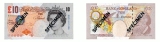
As of 13 March 2007 the Bank of England banknotes in circulation, known as Series E, did not exceed £50. The notes were as follows:
  • 5 pound note depicting Elizabeth Fry
    Elizabeth Fry
    Elizabeth Fry was an English prison reformer, social reformer and, as a Quaker, a Christian philanthropist....

    , showing a scene with her reading to prisoners in Newgate Prison
    Newgate Prison
    Newgate Prison was a prison in London, at the corner of Newgate Street and Old Bailey just inside the City of London. It was originally located at the site of a gate in the Roman London Wall. The gate/prison was rebuilt in the 12th century, and demolished 1777...

    .
  • 10 pound note depicting Charles Darwin
    Charles Darwin
    Charles Robert Darwin FRS was an English naturalist who realised and presented compelling evidence that all species of life have evolved over time from common ancestors, through the process he called natural selection...

    , a hummingbird
    Hummingbird
    Hummingbirds are among the smallest of birds, and include the smallest extant bird species, the Bee Hummingbirds. They can hover in mid-air by rapidly flapping their wings 12-90 times per second . They can also fly backwards, and are the only group of birds able to do so. Their English name derives...

     and the HMS Beagle
    HMS Beagle
    HMS Beagle was a Cherokee class 10-gun brig-sloop of the Royal Navy, named after the beagle, a breed of dog. She was launched on 11 May 1820 from the Woolwich Dockyard on the River Thames, at a cost of £7,803...

    .
  • 20 pound note depicting Sir Edward Elgar
    Edward Elgar
    Sir Edward William Elgar, 1st Baronet, OM, GCVO was an English composer. Several of his first major orchestral works, including the Enigma Variations and the Pomp and Circumstance Marches, were greeted with acclaim. He also composed oratorios, chamber music, symphonies, instrumental concertos,...

    , with a view of the west face of Worcester Cathedral
    Worcester Cathedral
    Worcester Cathedral is an Anglican cathedral in Worcester, England; situated on a bank overlooking the River Severn. It is the seat of the Anglican Bishop of Worcester. Its official name is The Cathedral Church of Christ and the Blessed Mary the Virgin of Worcester...

    .
  • 50 pound note depicting Sir John Houblon
    John Houblon
    Sir John Houblon was the first Governor of the Bank of England from 1694 to 1697.-Biography:Sir John was the third son of James Houblon, a London merchant, and his wife, Mary De Quesne. He became Sheriff of the City of London in 1689, an Alderman from 1689 to 1712, and Master of the Grocer's...

    , with a view of his house in Threadneedle Street.

Bank of England notes since series D
Series D
Value Reverse portrait Issued Withdrawn
£1 Sir Isaac Newton
Isaac Newton
Sir Isaac Newton FRS was an English physicist, mathematician, astronomer, natural philosopher, alchemist, and theologian who is perceived and considered by a substantial number of scholars and the general public as one of the most influential men in history...

 
9 February 1978 11 March 1988
£5 Duke of Wellington
Arthur Wellesley, 1st Duke of Wellington
Field Marshal Arthur Wellesley, 1st Duke of Wellington, KG, KP, GCB, GCH, PC, FRS , was an Anglo-Irish soldier and statesman, and one of the leading military and political figures of the nineteenth century....

 
11 November 1971 29 November 1991
£10 Florence Nightingale
Florence Nightingale
Florence Nightingale, OM, RRC was an English nurse, writer and statistician. She came to prominence during the Crimean War for her pioneering work in nursing, and was dubbed "The Lady with the Lamp" after her habit of making rounds at night to tend injured soldiers...

 
20 February 1975 20 May 1994
£20 William Shakespeare
William Shakespeare
William Shakespeare was an English poet and playwright, widely regarded as the greatest writer in the English language and the world's preeminent dramatist. He is often called England's national poet and the "Bard of Avon"...

 
9 July 1970 19 March 1993
£50 Sir Christopher Wren
Christopher Wren
Sir Christopher Wren was one of the best known and highest acclaimed English architects in history,...

 
20 March 1981 20 September 1996
Series E
£5 George Stephenson
George Stephenson
George Stephenson was an English civil engineer and mechanical engineer who built the first public railway line in the world to use steam locomotives, and he is renowned as being the "Father of Railways"...

 
7 June 1990 21 November 2003
£10 Charles Dickens
Charles Dickens
Charles John Huffam Dickens FRSA , pen-name "Boz", was the most popular English novelist of the Victorian era and one of the most popular of all time. He created some of literature's most memorable characters. His novels and short stories have never gone out of print...

 
29 April 1992 31 July 2003
£20 Michael Faraday
Michael Faraday
Michael Faraday, FRS was an English chemist and physicist who contributed to the fields of electromagnetism and electrochemistry....

 
5 June 1991 28 February 2001
£50 Sir John Houblon
John Houblon
Sir John Houblon was the first Governor of the Bank of England from 1694 to 1697.-Biography:Sir John was the third son of James Houblon, a London merchant, and his wife, Mary De Quesne. He became Sheriff of the City of London in 1689, an Alderman from 1689 to 1712, and Master of the Grocer's...

 
20 April 1994 in use
Series E revision
£5 Elizabeth Fry
Elizabeth Fry
Elizabeth Fry was an English prison reformer, social reformer and, as a Quaker, a Christian philanthropist....

 
21 May 2002 in use
£10 Charles Darwin
Charles Darwin
Charles Robert Darwin FRS was an English naturalist who realised and presented compelling evidence that all species of life have evolved over time from common ancestors, through the process he called natural selection...

 
7 November 2000 in use
£20 Sir Edward Elgar
Edward Elgar
Sir Edward William Elgar, 1st Baronet, OM, GCVO was an English composer. Several of his first major orchestral works, including the Enigma Variations and the Pomp and Circumstance Marches, were greeted with acclaim. He also composed oratorios, chamber music, symphonies, instrumental concertos,...

 
22 June 1999 in use
Series F
£20 Adam Smith
Adam Smith
Adam Smith was a Scottish moral philosopher and a pioneer of political economy. One of the key figures of the Scottish Enlightenment, Smith is the author of The Theory of Moral Sentiments and An Inquiry into the Nature and Causes of the Wealth of Nations...

 
13 March 2007 in use
£50 James Watt
James Watt
James Watt FRS was a Scottish inventor and mechanical engineer whose improvements to the Newcomen steam engine were fundamental to the changes brought by the Industrial Revolution in both the Kingdom of Great Britain and the world.-Biography:James Watt was born on 19 January 1736 in Greenock,...

 and Matthew Boulton
Matthew Boulton
Matthew Boulton, FRS was an English manufacturer and business partner of Scottish engineer James Watt. In the final quarter of the 18th century the partnership installed hundreds of Boulton & Watt steam engines, which were a great advance on the state of the art, making possible the...

 
18 mth from June 09 not yet issued

On 13 March 2007, the first note from the new Series F entered circulation. This is the new 20 pound note depicting Adam Smith
Adam Smith
Adam Smith was a Scottish moral philosopher and a pioneer of political economy. One of the key figures of the Scottish Enlightenment, Smith is the author of The Theory of Moral Sentiments and An Inquiry into the Nature and Causes of the Wealth of Nations...

, with an illustration of 'The division of labour in pin manufacturing', which will replace the Series E Elgar note.

As of 2005, they are signed by the Chief Cashier, Andrew Bailey
Andrew Bailey
Andrew Bailey is the current Executive Director Banking and Chief Cashier at the Bank of England. He was appointed to his current role in January 2004 and has several key responsibilities to fulfil. He is also a member of the Governor's Executive Team, which is the bank's senior management group...

.

All the notes issued since Series C in 1960 also depict Elizabeth II of the United Kingdom
Elizabeth II of the United Kingdom
Elizabeth II is the queen regnant of sixteen independent states known informally as the Commonwealth realms: the United Kingdom, Canada, Australia, New Zealand, Jamaica, Barbados, the Bahamas, Grenada, Papua New Guinea, the Solomon Islands, Tuvalu, Saint Lucia, Saint Vincent and the Grenadines,...

 in full view facing left and as a watermark
Watermark
----A watermark is a recognizable image or pattern in paper that appears as various shades of lightness/darkness when viewed by transmitted light , caused by thickness variations in the paper. There are two main types of watermark, the Dandy Roll process, and the more complex Cylinder Mould process...

, hidden, facing right; recent issues have the EURion constellation
EURion constellation
The EURion constellation is a pattern of symbols found on a number of banknote designs since about 1996. It is added to help software detect the presence of a banknote in a digital image...

 around. The custom of depicting historical figures on the reverse began with Series D in 1970. Previous banknotes have depicted Sir Isaac Newton
Isaac Newton
Sir Isaac Newton FRS was an English physicist, mathematician, astronomer, natural philosopher, alchemist, and theologian who is perceived and considered by a substantial number of scholars and the general public as one of the most influential men in history...

 (£1), the Duke of Wellington
Arthur Wellesley, 1st Duke of Wellington
Field Marshal Arthur Wellesley, 1st Duke of Wellington, KG, KP, GCB, GCH, PC, FRS , was an Anglo-Irish soldier and statesman, and one of the leading military and political figures of the nineteenth century....

 (£5), Florence Nightingale
Florence Nightingale
Florence Nightingale, OM, RRC was an English nurse, writer and statistician. She came to prominence during the Crimean War for her pioneering work in nursing, and was dubbed "The Lady with the Lamp" after her habit of making rounds at night to tend injured soldiers...

 (£10), William Shakespeare
William Shakespeare
William Shakespeare was an English poet and playwright, widely regarded as the greatest writer in the English language and the world's preeminent dramatist. He is often called England's national poet and the "Bard of Avon"...

 (£20), Sir Christopher Wren
Christopher Wren
Sir Christopher Wren was one of the best known and highest acclaimed English architects in history,...

 (£50), George Stephenson
George Stephenson
George Stephenson was an English civil engineer and mechanical engineer who built the first public railway line in the world to use steam locomotives, and he is renowned as being the "Father of Railways"...

 (£5), Charles Dickens
Charles Dickens
Charles John Huffam Dickens FRSA , pen-name "Boz", was the most popular English novelist of the Victorian era and one of the most popular of all time. He created some of literature's most memorable characters. His novels and short stories have never gone out of print...

 (£10) and Michael Faraday
Michael Faraday
Michael Faraday, FRS was an English chemist and physicist who contributed to the fields of electromagnetism and electrochemistry....

 (£20).

On 29 October 2006 the Governor of the Bank of England announced that, to herald the launch of the new Series F banknotes from Spring 2007, a new £20 was to be issued featuring the Scottish economist, Adam Smith
Adam Smith
Adam Smith was a Scottish moral philosopher and a pioneer of political economy. One of the key figures of the Scottish Enlightenment, Smith is the author of The Theory of Moral Sentiments and An Inquiry into the Nature and Causes of the Wealth of Nations...

. The note, which also includes enhanced security features entered circulation on 13 March 2007.

The Bank of England Series D one pound note was discontinued in 1984, having been replaced by a pound coin the year before, and was officially withdrawn from circulation in 1988.

All banknotes, regardless of when they were withdrawn from circulation may be presented at the Bank of England where they will be exchanged for current banknotes and coin. In most cases this is done on the spot; however, the issues counterfeited by the Germans must be authenticated. In practice, commercial banks will accept most banknotes from their customers and negotiate them with the Bank of England themselves.

Higher-value notes are used within the banking system – particularly the £1 million and £100 million notes used to maintain parity with Scottish and Northern Irish notes. These resemble simple IOUs and bear no aesthetic design features, and are never seen by the public.

10/-


The Bank of England's first ever ten shilling note was issued on 22 November 1928. This note featured a vignette of Britannia
Britannia
Britannia was the term used by the Romans to refer to the Roman province covering much of the island of Great Britain. The area beyond the Antonine Wall belonging to the Picts in the north was known as Caledonia. The name itself derives from Pretannia, Diodorus's rendering of the indigenous name...

, a feature of the Bank's notes since 1694. The predominant colour was red-brown. Unlike previous notes it, and the contemporaneous £1 note, were not dated but are instead identified by the signature of the Chief Cashier of the time. In 1940 a metal security thread
Security thread
A security thread is a security feature of many bank notes to protect against counterfeiting, consisting of a thin ribbon which is threaded through the note's paper....

 was introduced for the first time, and the colour of the note was changed to mauve for the duration of the war. The original design of the note was replaced by the "Series C" design in 1961, when Queen Elizabeth II
Elizabeth II of the United Kingdom
Elizabeth II is the queen regnant of sixteen independent states known informally as the Commonwealth realms: the United Kingdom, Canada, Australia, New Zealand, Jamaica, Barbados, the Bahamas, Grenada, Papua New Guinea, the Solomon Islands, Tuvalu, Saint Lucia, Saint Vincent and the Grenadines,...

 agreed to allow the use of her portrait on the notes. The ten shilling note was withdrawn following the introduction on 14 October 1969 of the fifty pence coin.

£1


The first Bank of England £1 note was issued on 26 February 1797 under the direction of Thomas Raikes
Thomas Raikes
Thomas Raikes was a British banker and newspaper proprietor. Notably, he was Governor of the Bank of England during the 1797 currency crisis, when the Bank was prohibited by the British Government from paying out in gold.- Biography :Raikes was born at Gloucester in 1741, third son of Mary Drew...

, Governor
Governor
A governor is a governing official, usually the executive of a non-sovereign level of government, ranking under the head of state...

 of the Bank of England and according to the orders of the government
First Pitt the Younger Ministry
-The Initial Ministry:For the first several days of the ministry, Lord Temple held both the secretaryships of state.-Changes:*March, 1784 - The Duke of Rutland becomes Lord-Lieutenant of Ireland, remaining also Lord Privy Seal....

 of
William Pitt The Younger
William Pitt the Younger
William Pitt, the Younger was a British politician of the late eighteenth and early nineteenth centuries. He became the youngest Prime Minister in 1783 at the age of 24 . He left office in 1801, but was Prime Minister again from 1804 until his death in 1806...

, in response to the need for smaller denomination banknotes to replace gold
Gold
Gold is a chemical element with the symbol Au and an atomic number of 79. It has been a highly sought-after precious metal for coinage, jewelry, and other arts since the beginning of recorded history. The metal occurs as nuggets or grains in rocks, in veins and in alluvial deposits. Gold is...

 coin
Coin
A coin is a piece of hard material, usually metal or a metallic material and sometimes made of synthetic materials, usually in the shape of a disc, and most often issued by a government. Coins are used as a form of money in transactions of various kinds, from the everyday circulation coins to the...

 during the French Revolutionary Wars
French Revolutionary Wars
The French Revolutionary Wars were a series of major conflicts, from 1792 until 1802, fought between the French Revolutionary government and several European states...


The Bank of England's first one pound note since 1845 was issued on 22 November 1928. This note featured a vignette of Britannia
Britannia
Britannia was the term used by the Romans to refer to the Roman province covering much of the island of Great Britain. The area beyond the Antonine Wall belonging to the Picts in the north was known as Caledonia. The name itself derives from Pretannia, Diodorus's rendering of the indigenous name...

, a feature of the Bank's notes since 1694. The predominant colour was green. Unlike previous notes it, and the contemporaneous ten shilling note, were not dated but are instead identified by the signature of the Chief Cashier of the time. In 1940 a metal security thread was introduced for the first time, and the colour of the note was changed to pink for the duration of the war. The original design of the note was replaced by the "Series C" design in 1960, when Queen Elizabeth II agreed to allow the use of her portrait on the notes.
In 1978 the "Series D" design (known as the "Pictorial Series") featuring Sir Isaac Newton
Isaac Newton
Sir Isaac Newton FRS was an English physicist, mathematician, astronomer, natural philosopher, alchemist, and theologian who is perceived and considered by a substantial number of scholars and the general public as one of the most influential men in history...

 on the reverse was issued, but following the introduction in 1983 of the One Pound coin, the note was withdrawn from circulation in summer 1988.

£2


The first Bank of England £2 note was issued on 26 February 1797 under the direction of Thomas Raikes
Thomas Raikes
Thomas Raikes was a British banker and newspaper proprietor. Notably, he was Governor of the Bank of England during the 1797 currency crisis, when the Bank was prohibited by the British Government from paying out in gold.- Biography :Raikes was born at Gloucester in 1741, third son of Mary Drew...

, Governor
Governor
A governor is a governing official, usually the executive of a non-sovereign level of government, ranking under the head of state...

 of the Bank of England and according to the orders of the government
First Pitt the Younger Ministry
-The Initial Ministry:For the first several days of the ministry, Lord Temple held both the secretaryships of state.-Changes:*March, 1784 - The Duke of Rutland becomes Lord-Lieutenant of Ireland, remaining also Lord Privy Seal....

 of
William Pitt The Younger
William Pitt the Younger
William Pitt, the Younger was a British politician of the late eighteenth and early nineteenth centuries. He became the youngest Prime Minister in 1783 at the age of 24 . He left office in 1801, but was Prime Minister again from 1804 until his death in 1806...

, in response to the need for smaller denomination banknotes to replace gold
Gold
Gold is a chemical element with the symbol Au and an atomic number of 79. It has been a highly sought-after precious metal for coinage, jewelry, and other arts since the beginning of recorded history. The metal occurs as nuggets or grains in rocks, in veins and in alluvial deposits. Gold is...

 coin
Coin
A coin is a piece of hard material, usually metal or a metallic material and sometimes made of synthetic materials, usually in the shape of a disc, and most often issued by a government. Coins are used as a form of money in transactions of various kinds, from the everyday circulation coins to the...

 during the French Revolutionary Wars
French Revolutionary Wars
The French Revolutionary Wars were a series of major conflicts, from 1792 until 1802, fought between the French Revolutionary government and several European states...

. It was later discontinued.

£5


The first Bank of England £5 note was issued in 1793 in response to the need for smaller denomination banknotes to replace gold
Gold
Gold is a chemical element with the symbol Au and an atomic number of 79. It has been a highly sought-after precious metal for coinage, jewelry, and other arts since the beginning of recorded history. The metal occurs as nuggets or grains in rocks, in veins and in alluvial deposits. Gold is...

 coin
Coin
A coin is a piece of hard material, usually metal or a metallic material and sometimes made of synthetic materials, usually in the shape of a disc, and most often issued by a government. Coins are used as a form of money in transactions of various kinds, from the everyday circulation coins to the...

 during the French Revolutionary Wars
French Revolutionary Wars
The French Revolutionary Wars were a series of major conflicts, from 1792 until 1802, fought between the French Revolutionary government and several European states...

 (previously the smallest note issued had been £10). The 1793 design, latterly known as the "White Fiver" (black printing on white paper), remained in circulation essentially unchanged until 1957 when the multicoloured (although predominantly dark blue) "Series B" note, depicting the helmeted Britannia
Britannia
Britannia was the term used by the Romans to refer to the Roman province covering much of the island of Great Britain. The area beyond the Antonine Wall belonging to the Picts in the north was known as Caledonia. The name itself derives from Pretannia, Diodorus's rendering of the indigenous name...

 was introduced. This note was replaced in turn in 1963 by the "Series C" £5 note which for the first time introduced the portrait of the monarch, Queen Elizabeth II, to the £5 note (the Queen's portrait having first appeared on the Series C ten shilling
Shilling
The shilling is a unit of currency used in current and former English Commonwealth countries and still used in countries which have become republics, such as Kenya. The word shilling comes from schilling, an accounting term that dates back to Anglo-Saxon times where it was deemed to be the value of...

 and one pound notes issued in 1960). In 1971 the "Series D" pictorial £5 note was issued, showing a slightly older portrait of the Queen and a battle scene featuring the Duke of Wellington
Arthur Wellesley, 1st Duke of Wellington
Field Marshal Arthur Wellesley, 1st Duke of Wellington, KG, KP, GCB, GCH, PC, FRS , was an Anglo-Irish soldier and statesman, and one of the leading military and political figures of the nineteenth century....

 on the reverse. On 7 June 1990 the "Series E" £5 note, by now the smallest denomination issued by the Bank, was issued. The Series E note (known as the "Historical Series") changed the colour of the denomination to a turquoise blue, and incorporated design elements to make photocopying and computer reproduction of the notes more difficult. Initially the reverse of the Series E £5 note featured the railway engineer George Stephenson
George Stephenson
George Stephenson was an English civil engineer and mechanical engineer who built the first public railway line in the world to use steam locomotives, and he is renowned as being the "Father of Railways"...

, but on 21 May 2002 a new Series E note was produced featuring the prison reformer Elizabeth Fry
Elizabeth Fry
Elizabeth Fry was an English prison reformer, social reformer and, as a Quaker, a Christian philanthropist....

. The initial printing of several million Stephenson notes was destroyed when it was noticed that the wrong year for his death had been printed. The original issue of the Fry banknote was withdrawn after it was found the ink on the serial number could be rubbed off the surface of the note. The Stephenson £5 note was withdrawn as legal tender from 21 October 2003, at which time it formed around 54 million of the 211 million £5 notes in circulation.

£10


The first ten pound note was issued in 1759, when the Seven Years War caused severe gold shortages. Following the withdrawal of the denomination after the Second World War, it was not reintroduced until the Series C design of the mid 1960s produced the brown ten pound note. The Series D pictorial note appeared in 1975, featuring nurse Florence Nightingale
Florence Nightingale
Florence Nightingale, OM, RRC was an English nurse, writer and statistician. She came to prominence during the Crimean War for her pioneering work in nursing, and was dubbed "The Lady with the Lamp" after her habit of making rounds at night to tend injured soldiers...

 (1820-1910) on the reverse, plus a scene showing her work at the army hospital in Scutari
Scutari
Scutari may refer to:*Üsküdar , in Anatolia, Turkey*Scutari Barracks in Üsküdar; former hospital where Florence Nightingale worked*Shkodër, in Albania; also known as Scutari in antiquity...

 during the Crimean War
Crimean War
The Crimean War was fought between the Russian Empire on one side and an alliance of the British Empire, France, the Ottoman Empire and the Kingdom of Sardinia on the other. The war was part of a long-running contest between the major European powers for influence over territories of the declining...

. This note was subsequently replaced in the early 1990s by the Series E note, where the predominant colour was changed from brown to orange. The reverse of the first Series E £10 featured Charles Dickens
Charles Dickens
Charles John Huffam Dickens FRSA , pen-name "Boz", was the most popular English novelist of the Victorian era and one of the most popular of all time. He created some of literature's most memorable characters. His novels and short stories have never gone out of print...

 and a scene from the Pickwick Papers (this note was withdrawn from circulation in July 2003), while a second Series E note was issued in 2000 featuring Charles Darwin
Charles Darwin
Charles Robert Darwin FRS was an English naturalist who realised and presented compelling evidence that all species of life have evolved over time from common ancestors, through the process he called natural selection...

, the HMS Beagle
HMS Beagle
HMS Beagle was a Cherokee class 10-gun brig-sloop of the Royal Navy, named after the beagle, a breed of dog. She was launched on 11 May 1820 from the Woolwich Dockyard on the River Thames, at a cost of £7,803...

, a hummingbird, and flowers under a magnifying glass, illustrating the Origin of Species. The hummingbird's inclusion has been criticised, since Darwin's ideas were spurred by finches and mockingbirds
Darwin's finches
Darwin's finches are 13 or 14 separate combinatory species of Passerine birds related to a group that Charles Darwin collected on the Galápagos Islands during the voyage of the Beagle...

, not hummingbirds.

£20


After the Second World War
World War II
World War II, or the Second World War , was a global military conflict which involved a majority of the world's nations, including all great powers, organized into two opposing military alliances: the Allies and the Axis...

, the £20 denomination did not reappear until Series D in the early 1970s. The predominant colour of this denomination is purple. The reverse of the Series D £20 features a statue of William Shakespeare
William Shakespeare
William Shakespeare was an English poet and playwright, widely regarded as the greatest writer in the English language and the world's preeminent dramatist. He is often called England's national poet and the "Bard of Avon"...

 and the balcony scene from Romeo and Juliet
Romeo and Juliet
Romeo and Juliet is a tragedy written early in the career of playwright William Shakespeare about two young "star-cross'd lovers" whose untimely deaths ultimately unite their feuding families. It was among Shakespeare's most popular plays during his lifetime and, along with Hamlet and Macbeth, is...

. In 1992 this note was replaced by the first Series E note, featuring the physicist Michael Faraday
Michael Faraday
Michael Faraday, FRS was an English chemist and physicist who contributed to the fields of electromagnetism and electrochemistry....

 and the Royal Institution lectures. By 1999 this note had been extensively copied, and therefore it became the first denomination to be replaced by a second Series E design, featuring a bolder denomination figure at the top left of the obverse side, and a reverse side featuring the composer Sir Edward Elgar
Edward Elgar
Sir Edward William Elgar, 1st Baronet, OM, GCVO was an English composer. Several of his first major orchestral works, including the Enigma Variations and the Pomp and Circumstance Marches, were greeted with acclaim. He also composed oratorios, chamber music, symphonies, instrumental concertos,...

 and Worcester Cathedral
Worcester Cathedral
Worcester Cathedral is an Anglican cathedral in Worcester, England; situated on a bank overlooking the River Severn. It is the seat of the Anglican Bishop of Worcester. Its official name is The Cathedral Church of Christ and the Blessed Mary the Virgin of Worcester...

. The £20 banknote was known to have suffered from higher cases of counterfeiting (276,000 out of 290,000 cases detected in 2007) than any other denominations.

In February 2006, the Bank announced a new design for the note which featured Scottish economist Adam Smith
Adam Smith
Adam Smith was a Scottish moral philosopher and a pioneer of political economy. One of the key figures of the Scottish Enlightenment, Smith is the author of The Theory of Moral Sentiments and An Inquiry into the Nature and Causes of the Wealth of Nations...

 with a drawing of a pin factory – the institution which supposedly inspired his theory of economics. Smith is the first Scot to appear on a Bank of England note, although the economist
Economist
An economist is an expert in the social science of economics. The individual may also study, develop, and apply theories and concepts from economics and write about economic policy...

 has already appeared on Scottish Clydesdale Bank
Clydesdale Bank
Clydesdale Bank is a commercial bank in Scotland, a subsidiary of the National Australia Bank Group. In Scotland, Clydesdale Bank is the third largest clearing bank, although it also retains a branch network in London and the north of England...

 £50 notes. The design of the £20 note was controversial for two reasons: the choice of a Scottish figure on an English note was a break with tradition; and the removal of Elgar took place in the year of the 150th anniversary of the composer's birth, causing a group of English MPs to table a motion in the House of Commons
British House of Commons
The House of Commons is the lower house of the Parliament of the United Kingdom, which also comprises the Sovereign and the House of Lords . Both Commons and Lords meet in the Palace of Westminster. The Commons is a democratically elected body, consisting of 646 members, who are known as "Members...

 calling for the new design to be delayed. The new note entered circulation on 13 March 2007.

£50


The fifty pound denomination did not reappear until 1981 when a Series D design was issued featuring the architect Christopher Wren
Christopher Wren
Sir Christopher Wren was one of the best known and highest acclaimed English architects in history,...

 and the plan of Saint Paul's Cathedral on the reverse of this large note. In 1994 this denomination was the last of the Series E issue, when the Bank commemorated its own impending tercentenary by putting its first governor, Sir John Houblon
John Houblon
Sir John Houblon was the first Governor of the Bank of England from 1694 to 1697.-Biography:Sir John was the third son of James Houblon, a London merchant, and his wife, Mary De Quesne. He became Sheriff of the City of London in 1689, an Alderman from 1689 to 1712, and Master of the Grocer's...

 on the reverse. A new design featuring James Watt
James Watt
James Watt FRS was a Scottish inventor and mechanical engineer whose improvements to the Newcomen steam engine were fundamental to the changes brought by the Industrial Revolution in both the Kingdom of Great Britain and the world.-Biography:James Watt was born on 19 January 1736 in Greenock,...

 and Matthew Boulton
Matthew Boulton
Matthew Boulton, FRS was an English manufacturer and business partner of Scottish engineer James Watt. In the final quarter of the 18th century the partnership installed hundreds of Boulton & Watt steam engines, which were a great advance on the state of the art, making possible the...

 was announced by the Bank of England. It is expected to enter circulation around November 2010 and will be the first Bank of England note to feature two portraits on the reverse.. The predominant colour of this denominator is red.

£100


The Bank of England does not currently issue £100 notes; however several banks issue this denomination in Northern Ireland and Scotland.

£1,000,000 and £100,000,000


The bank notes issued by the banks in Scotland and Northern Ireland are required to be backed pound for pound by Bank of England notes. Due to the large number of notes issued by these banks it would be cumbersome and wasteful to hold Bank of England notes in the standard denominations. High denomination notes, for one million pounds ("Giants") and one hundred million pounds ("Titans"), are used for this purpose. These are used only internally within the Bank and are never seen in circulation.

Counterfeits and old notes


During the Second World War
World War II
World War II, or the Second World War , was a global military conflict which involved a majority of the world's nations, including all great powers, organized into two opposing military alliances: the Allies and the Axis...

 the German Operation Bernhard
Operation Bernhard
Operation Bernhard was the codename of a secret Nazi plan devised during the Second World War by the RSHA and the SS to destabilise the British economy by flooding the country with forged Bank of England £5, £10, £20, and £50 notes...

 attempted to counterfeit various denominations between £5 and £50 producing 500,000 notes each month in 1943. The original plan was to parachute the money on Britain in an attempt to destabilise the British economy, but it was found more useful to use the notes to pay German agents operating throughout Europe — although most fell into Allied
Allies
In general, allies are people, groups, or nations that have joined together in an association for mutual benefit or to achieve some common purpose. In English usage, those who share a common goal and whose work toward that goal is complementary may be viewed as allies for various purposes even when...

 hands at the end of the war, forgeries were frequently appearing for years afterwards, so all denominations of banknote above £5 were subsequently removed from circulation.

All old Bank of England notes remain exchangeable for current notes forever. Forgeries however will be retained and destroyed by the Bank (including Bernhard notes). If a suspect note is found to be genuine a full refund by cheque will be made. However it is a criminal offence to knowingly hold or pass a counterfeit bank note without lawful authority or excuse.

In popular culture

  • The 2007 film, The Counterfeiters
    The Counterfeiters (film)
    The Counterfeiters is a 2007 Austrian-German film written and directed by Stefan Ruzowitzky. It fictionalizes Operation Bernhard, a secret plan by the Nazis during the Second World War to destabilize the United Kingdom by flooding its economy with forged Bank of England currency...

     tells the story of Salomon Sorowitsch, a Jewish forger who is put to work forging Bank of England notes on Operation Bernhard in Sachsenhausen concentration camp
    Sachsenhausen concentration camp
    Sachsenhausen or Sachsenhausen-Oranienburg was a Nazi concentration camp in Oranienburg, Germany, used primarily for political prisoners from 1936 to the end of the Third Reich in May, 1945. After World War II, when Oranienburg was in the Soviet Occupation Zone, the structure was used as an NKVD...

    .
  • Mark Twain
    Mark Twain
    Samuel Langhorne Clemens , better known by the pen name Mark Twain, was an American author and humorist. Twain is most noted for his novels Adventures of Huckleberry Finn, which has since been called the Great American Novel, and The Adventures of Tom Sawyer. He is extensively quoted...

    's short story The Million Pound Bank Note
    The Million Pound Bank Note
    "The Million Pound Bank Note" is a short story by the American author Mark Twain.- Plot :In Edwardian London, two very rich, eccentric brothers, Oliver and Roderick Montpelier, commission their bank to create a million pound note in order to settle a wager...

    deals with an impoverished American in London who is given the use of a million-pound Bank of England note for thirty days--two Englishmen betting whether or not he will be able to survive on a note for which he cannot possibly be given change. He does succeed in surviving, quite well, and marries one of the bettors' daughters. The story was also made into a 1953 film, The Million Pound Note
    The Million Pound Note
    The Million Pound Note is a 1953 film starring Gregory Peck, based on a short story by Mark Twain, "The Million Pound Bank Note".-Plot summary:...

    stars Gregory Peck
    Gregory Peck
    Gregory Peck was an American actor.One of 20th Century Fox's most popular film stars from the 1940s to the 1960s, Peck continued to play important roles well into the 1990s...

  • A fictionalized version of the Operation Bernhard
    Operation Bernhard
    Operation Bernhard was the codename of a secret Nazi plan devised during the Second World War by the RSHA and the SS to destabilise the British economy by flooding the country with forged Bank of England £5, £10, £20, and £50 notes...

     story was the topic of a comedy drama serial Private Schulz
    Private Schulz (TV series)
    Private Schulz was a BBC television comedy drama mini-series starring Michael Elphick in the title role and Ian Richardson playing various parts. Other notable actors included Tony Caunter, Billie Whitelaw, Billy Murray and Mark Wingett....

    (starring Michael Elphick
    Michael Elphick
    Michael John Elphick was an English actor, noted for his deep-lined, ruggedly handsome features.Elphick was known primarily in the UK for his trademark croaky voice and his work on British television, in particular his roles as the eponymous private investigator in the ITV series Boon and later...

     and Ian Richardson
    Ian Richardson
    Ian William Richardson CBE was a Scottish actor best known for his portrayal of the Machiavellian Tory politician, Francis Urquhart, in the BBC's House of Cards trilogy. He was also as a leading Shakespearian stage actor...

    ) produced by the BBC
    BBC
    The British Broadcasting Corporation, usually referred to by its abbreviation as the "BBC", is the longest established and largest broadcaster in the world...

    in 1980.

External links