

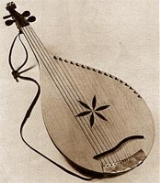
Bandura

Encyclopedia
Bandura refers to a Ukrainian
plucked string folk instrument
. It combines elements of a box zither
and lute
, as well as its lute
-like predecessor, the kobza
. It typically has 30 to 68 strings
The term is also occasionally used when referring to a number of other Eastern Europe
an string instrument
s such as the hurdy gurdy
and the 5 string guitar
(commonly referred to by the diminutive
bandurka).
Musician
s who play the bandura are referred to as bandurist
s. Some traditional bandura players, often blind, were referred to as kobzar
s.
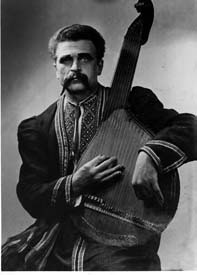 The earliest mention of the term bandura dates back to a Polish chronicle of 1441, which states that the Polish King Sigismund III had a court bandurist known as Taraszko who was of Ukrainian ethnicity and was also the king's companion in chess
. A number of other court bandurists of Ukrainian ethnicity have also been recorded in medieval Polish documents.
The term bandura is generally thought to have entered the Ukrainian language via Polish, either from Latin or from the Greek pandora
or pandura
, although some scholars feel that the term was introduced into Ukraine directly from the Greek language.
The term kobza
was often used as a synonym for bandura and the terms were used interchangeably until mid 20th century.
The use of the term kobza pre-dates the first known use of the term bandura. Kobza and was first mentioned in a Polish
chronicle in 1313, having been introduced into the Ukrainian language
sometime in the 12-13th century. It is thought to have Turkic
pedigree.
Occasionally one comes across the combined term kobza-bandura which refers to the dual origins of the instrument, however this is rarely used in spoken language.
The term bandoura, a transliteration of the Ukrainian term via French is occasionally found.
The term bandore or bandora can also be found when referring to this instrument. The usage of this term stems from an inaccurate and discredited assumption made by Russian academic A. Famintsyn that the Ukrainian people borrowed the instrument from England. The term made its way into usage through early 20th century Soviet Ukrainian-English and Russian-English dictionaries.
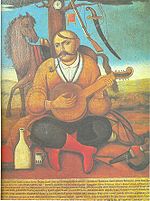 The use of lute-like instruments by the inhabitants of the lands that now constitute Ukraine
dates back to 591. In that year Byzantine
Greek chronicles mention Bulgar
warriors who travelled with lute-like instruments which they call "kitharas".
There are icon
ographic depictions of lute-like instruments in the 11th century fresco
es of St. Sophia Cathedral in Kiev
, once the capital
of a vast medieval kingdom of the Rus'. It is not known by what specific term these instruments were referred to in these early times, although it has been surmised that the lute-like instrument was referred to by the generic medieval slavic term for a string instrument - husli.
The instrument became popular in the courts of the nobility
in Eastern Europe. There are numerous citations mentioning the existence of Ukrainian bandurists in both Russia and Poland. Empress Elisabeth of Russia (the daughter of Peter the Great) was secretly married her Ukrainian court bandurist, Olexii Rozumovsky
.
Use of the instrument fell into decline amongst the nobility with the introduction of Western musical instruments and Western Music fashions, but it remained the favourite instrument of the Ukrainian Cossacks. After the destruction of the Zaporozhian Sich the instrument continued to be played by wandering blind itinerant musicians known as kobzari primarilly in Right bank Ukraine.
elements of lute
and psaltery
is sometimes credited to Francesco Landini
, an Italian lutenist-composer of trecento
. Filippo Villani
writes in his Liber de civitatis Florentiae, "...[Landini] invented a new sort of instrument, a cross between lute and psaltery, which he called the serena serenarum, an instrument that produces an exquisite sound when its strings are struck." Rare iconographic evidence (by artists such as Alessandro Magnasco
) reveals that such instruments were still in use in Italy ca. 1700. Similar instruments have been documented as having existed in Ukraine in the preceding century.
In the hands of the Zaporozhian cossacks
, the bandura underwent significant transformations, due to the development of a specific repertoire. Because of the primary role as an instrument for the accompaniment of the voice, the construction and playing technique was adapted in order to better accommodate these functions. At the Zaporozhian Sich, special schools for blind bards
were established, setting the foundation for a class of itinerant musicians known as the kobzar
s. By the 18th century, the instrument had developed into a form with approximately four to six stoppable strings strung along the neck (with or without frets) and up to sixteen treble strings known as prystrunky
strung in a diatonic scale
across the soundboard
. The bandura existed in this form relatively unchanged until the end of the 19th century.
The development of the bandura without stopped strings on the neck was thought to have happened later, some time before 1800. This type of bandura superseded the fretted type, and became the forerunner of the modern-day bandura.
 The bandura underwent significant changes in the 20th century, paralleling the development of Ukrainian ethnic awareness
. Sanctions introduced by the Russian government
in 1876 (Ems ukaz
) severely restricting the use of Ukrainian language which also restricted the use of the bandura on the concert stage as virtually all of the repertoire was sung in Ukrainian.
Because of these restrictions and the rapid disappearance of kobzars and bandurists the topic of the minstrel art of the itinerant blind bandura players was again brought up for discussion at the XIIth Archeological Conference held in Kharkiv in 1902. It had been believed that the last blind kobzar, (Ostap Veresai
) had died in 1890, however upon investigation six blind traditional kobzars were found to be alive and performed on stage at the conference. Thenafter, the rise in Ukrainian self-awareness the bandura became very popular particularly among young students and intellectuals. Gut strings
were replaced by metal strings (standard after 1902). The number of strings and size of the instrument also began to grow to accommodate the sound production required for stage performances and to accommodate a new repertoire of urban folkloric song.
Subsequent developments included metal tuning peg
s (introduced in 1912), additional chromatic strings (introduced in 1925) and a mechanical lever system for rapid retuning of the instrument (first introduced in 1931).
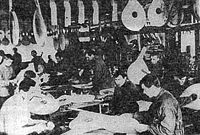
Although workshops for the serial manufacture of banduras had been established earlier outside of Ukraine (in Moscow
(1908), and Prague
(1924)), continuous serial manufacture of banduras was started in Ukraine in sometime in 1930. After World War II
, two factories dominated the manufacturing of banduras: the Chernihiv Musical Instrument Factory
(which produced 120 instruments a month, over 30,000 instruments from 1954 to 1991) and the Trembita Musical Instrument Factory
in Lviv
(which has produced over 3,000 instruments since 1964).
 The first mentions of an institution for the study of bandura playing date back to 1738 to a music academy in Hlukhiv
where the bandura and violin were taught to be played from music. This was the first music school in Eastern Europe and prepared musicians and singers for the Tsarist Court in St Petersburg.
In 1908, the Mykola Lysenko
Institute of Music and Drama in Kyiv began offering classes in bandura playing, instructed by kobzar Ivan Kuchuhura Kucherenko
. Kucherenko taught briefly until 1911, and attempts were made to reopen the classes in 1912 with Hnat Khotkevych
, but the death of Mykola Lysenko, Khotkevych's subsequent exile in 1912 prevented this from happening. Khotkevych published the first primer
for the bandura in Lviv
in 1909. It was followed by a number of other primers specifically written for the instrument, most notably those by Mykhailo Domontovych, Vasyl Shevchenko
and Vasyl Ovchynnikov
, published in 1913-14.
Formal conservatory courses in bandura playing were reestablished only after the Soviet revolution
, when Khotkevych returned to Kharkiv
and was invited to teach a class of bandura playing at the Muz-Dram Institute in 1926. This development was prompted by the establishment in 1923 by Vasyl Yemetz
of a bandura school in Prague
with over 60 students. Other classes in bandura instruction were opened in 1930 at the conservatories in Kiev
and Odessa
. By 1932-33, however, in order to control the rapid rise of Ukrainian self-awareness, severe restrictions were placed on Ukrainian urban folk culture and all bandura classes in Ukraine were disbanded and many bandurists were repressed by the Soviet government.
After World War II, and particularly after the death of Joseph Stalin
, these restrictions were relaxed and bandura courses were again re-established in music schools and conservatories in Ukraine, initially at the Kiev
conservatory under the direction of Khotkevych's student Volodymyr Kabachok
, who had recently released from a gulag
labor camp in Kolyma
.
Today, all the conservatories of music in Ukraine offer courses majoring
in bandura performance
. Bandura instruction is also offered in all music colleges and most music schools, and it is now possible to get advanced degrees specialising in bandura performance and pedagogy
. The most renowned of these establishments are the Kyiv and Lviv conservatories and the Kiev University of Culture, primarily because of their well-established staff. Other centers of rising prominence are the Odessa Conservatory and Kharkiv University of Culture.
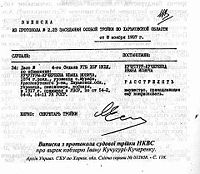
 Many bandurists and kobzars were systematically persecuted by authorities that controlled Ukraine at various times. This was because of the association of the bandura with specific aspects of Ukrainian history
and also the prevalence of religious elements in the kobzar repertoire that eventually was adopted by the latter-day bandurists. Much of the unique repertoire of the kobzars idealized the legacy of the Ukrainian Cossacks. A significant section of the repertoire consisted of para-liturgical chants (kanty) and psalms which were sung by the kobzari outside of churches as the latter were often suspicious of and sometimes hostile to kobzars' moral authority.
In the 1930s, Soviet
authorities took measures to control and curtail aspects of Ukrainian culture (see Russification
) they deemed unsuitable. This also included any interest in the bandura. Various sanctions were introduced to limit cultural activities that were deemed anti-Soviet. When these sanctions proved to have little effect on the growth in interest in such cultural artifacts, the carriers of these artefacts such as bandurists often came under harsh persecution from the Soviet authorities. Many were arrested and some executed or sent to labor camp
s. At the height of the Great Purge
in the late 1930s, the official State Bandurist Capella in Kyiv was changing artistic director
s every 2 weeks because of these arrests.
In recent years evidence pointing to an event, often masked as an ethnographic conference, was held in Kharkiv
, the capital of the Ukrainian SSR in December 1933. Many itinerant street musicians from all over the country, specifically blind kobzars and lirnyk
s, were invited to attend (estimated 300 participants). All were subsequently executed as unwanted elements in the new Soviet Society.
After the death of Joseph Stalin
the severe policies of the Soviet administration were halted. Many bandurists who during that period had been shot or sent to labour camps were "rehabilitated
". Some returned to Ukraine. Conservatory courses were once again re-established and in time the serial manufacture of banduras by musical instrument factories in Chernihiv
and Lviv
was established.
Although direct and open confrontation ceased, the Communist party continued to control and manipulate the art of the bandurist through indirect means. Bandura players now had to self-censor their repertoire and stop any cultural aspects that appeared to be anti-Soviet. This included songs with religious texts or melodies, christmas carols, historic songs about the cossack past, and songs with any hint of a nationalistic sub-text. Some bandurists rose in the ranks of the Communist Party to become high level administrators. (e.g. Professor Serhiy Bashtan
was the first secretary of the Communist Party at the Kiev conservatory for over 30 years and in that position restricted the develpment of many aspects of Ukrainian culture in the premier Music establishment in Ukraine).
A policy of feminization of the bandura severely restricted the number of male bandurists able to study the bandura at a professional level (kobzarstvo had originally been an exclusively male domain). This was perplexing as there was only one professional ensemble and it was made up exclusively of male players. The feminization of the instrument influenced a significant change ін the repertoire of the bandurist from a heroic epic tradition to one singing songs of love. Restrictions existed in obtaining instruments and control was exercised in the publication of musical literature for the bandura. Only "trusted" performers were allowed to perform on stage with severely censored and restrictive repertoire. These restrictions continued to leave a significant impact on the contemporary development of the art form.
, poplar
, cherry
or maple
). Since the 1960s, glued back instruments have also become common; even more recently, banduras have begun to be constructed with fiberglass
backs. The soundboard
is traditionally made from a type of spruce
. The wrest planks and bridge are made from hard woods such as birch
.
The instrument was originally a diatonic instrument, and despite the addition of chromatic strings in the 1920s, it has continued to be played as a diatonic instrument. Most contemporary concert instruments have a mechanism which allows for the rapid retuning of the instrument into different keys. These mechanisms were first included in concert instruments in the late 1950s.
Significant contributions to bandura construction were made by Hnat Khotkevych
, Leonid Haydamaka
, Peter Honcharenko, Ivan Skliar, Vasyl Herasymenko and William Vetzal
.
 The Starosvitska
or authentic traditional banduras: also sometimes referred to as classical or old-time bandura.
These instruments usually have some 20-23 strings
and are hand-made, with no two instruments being exactly the same. The backs are usually hewn out of a single piece of wood. Wooden pegs hold the strings which are tuned diatonically. Traditionally these instruments had gut strings, however, at the beginning of the 20th century common performance practice changed over to steel strings.
There has been a revival in interest in authentic performance in Ukraine which was spearheaded by Heorhy Tkachenko
and his followers, notably Mykola Budnyk, Kost Cheremsky, Mykola Tovkailo, Mykhilo Khai and Jurij Fedynskyj
.
Several notable, present day makers of the instrument include the late Mykola Budnyk, Mykola Tovkailo, Rusalim Kozlenko, Vasyl Boyanivsky, Jurij Fedynskyj
, and Bill Vetzal.
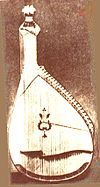 The Kiev-style or academic bandura: these are the most common banduras in use today in Ukraine. These instruments have 55-65 metal strings tuned chromatically through 5 octaves, with or without retuning mechanisms.
The instruments are known as Kiev-style banduras because they are constructed for players of the Kiev style technique pioneered by the Kiev Bandurist Capella
. Because the playing style was based on the techniques of the kobzars from Chernihiv the instrument is occasionally referred to as the Chernihiv style bandura.
These instruments exist in two main types: Standard prima instruments and concert instruments which differ from the Prima instruments in that they have a retuning mechanism placed in the side of the instrument.
Concert Kiev-style banduras were manufactured by the Chernihiv Musical Instrument Factory
and continue to be made by the Trembita Musical Instrument Factory
in Lviv
. Rarer instruments also exist from the now defunct Melnytso-Podilsk and Kiev workshops.

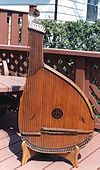
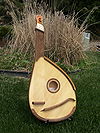 These instruments are primarily made by craftsmen outside of Ukraine; however, in more recent times, they have become quite sought after in Ukraine. They are strung either diatonically (with 34-36 strings) or chromatically (with 61-65 strings).
The Kharkiv bandura was first developed by Hnat Khotkevych
and Leonid Haydamaka
in the mid 1920's. It was later refined by the Honcharenko brothers. A number of instruments were made in the 1980s by Vasyl Herasymenko. The Hnat Khotkevych Ukrainian Bandurist Ensemble
was the only ensemble in the West to explout the Kharkiv bandura and Kharkiv style.
Currently Canadian bandura maker Bill Vetzal has focused on making these instruments with some success. His latest instruments are fully chromatic with mechanism and are made of fibreglass. Additionally, Andrij (Andy) Birko - an American Bandura Maker - is continuing development of the Kharkiv instrument by applying construction and acoustic principals from guitars - both flat top and arch top - in an attempt to provide a more balanced and even tone to the instrument. Currently he produces chromatic instruments but without re-tune mechanisms.
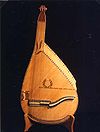
 Attempts have been made to combine aspects of the Kharkiv and Kiev bandura into a unified instrument. The first attempts were made by the Honcharenko brothers in Germany in 1948. Attempts were made in the 1960s by Ivan Skliar, and in the 1980s by V. Herasymenko and more recently by Bill Vetzal
in Canada.
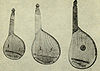 Orchestral banduras were first developed by Leonid Haydamaka in Kharkiv 1928 in order to extend the range of the bandura section in his orchestra of Ukrainian folk instruments.
Other instruments (Kiev style) were developed by Ivan Skliar for use in the Kiev Bandurist Capella, in particular alto bass and contrabass sizes. these instruments were not commercially available and were made in very small quantities.
. Some folk dance tunes were also part of the repertoire.
In 1910, the first composition for the bandura was published in Kiev by Hnat Khotkevych
. It was a dance
piece entitled "Odarochka" for an starosvitsky Kharkiv-style bandura. Khotkevych prepared a book of pieces in 1912, but because of the arrest of the publisher, it was never printed. Despite numerous compositions being composed for the instrument in the late 1920s and early 30's, and the preparation of these works for publication, little music for the instrument was published in Ukraine.
A number of bandura primers appeared in print in 1913-14 written by Mykhailo Domontovych, Vasyl Shevchenko
and Vasyl Ovchinnikov, which contained arrangements of Ukrainian folk songs with bandura accompaniment.
In 1926, a collection of bandura compositions compiled by Mykhailo Teliha
was published in Prague.
Hnat Khotkevych also prepared a number of collections of pieces for the bandura in 1928, however because of dramatic political changes within the Soviet Union, none of these collections were published.
Professional Ukrainian composers only started composing seriously for the instrument after World War II, and specifically in the 1950-70's including such composers such as Mykola Dremliuha, Anatoly Kolomiyetz, Yuriy Oliynyk and Kost Miaskov who have created complex works such as sonata
s, suite
s, and concerti for the instrument.
In recent times more Ukrainian composers have started to incorporate the bandura in their orchestral works with traditional Ukrainian folk operas such as Natalka Poltavka
being re-scored for the bandura, and contemporary works such as Kupalo by Y. Stankovych and The Sacred Dnipro by Valery Kikta incorporating the bandura as part of the orchestra
.
Western composers of Ukrainian background such as Yuriy Oliynyk and Peter Senchuk have also begun composing serious works for the bandura.
. Other important bandura ensembles in the West that have made significant contributions to the art form are the Canadian Bandurist Capella
and the Hnat Khotkevych Ukrainian Bandurist Ensemble
.
Numerous similar ensembles have also become popular in Ukrainian centres with some small ensembles becoming extremely popular.
Ukrainians
Ukrainians are an East Slavic ethnic group native to Ukraine, which is the sixth-largest nation in Europe. The Constitution of Ukraine applies the term 'Ukrainians' to all its citizens...
plucked string folk instrument
Plucked string instrument
Plucked string instruments are a subcategory of string instruments that are played by plucking the strings. Plucking is a way of pulling and releasing the string in such as way as to give it an impulse that causes the string to vibrate...
. It combines elements of a box zither
Zither
The zither is a musical string instrument, most commonly found in Slovenia, Austria, Hungary citera, northwestern Croatia, the southern regions of Germany, alpine Europe and East Asian cultures, including China...
and lute
Lute
Lute can refer generally to any plucked string instrument with a neck and a deep round back, or more specifically to an instrument from the family of European lutes....
, as well as its lute
Lute
Lute can refer generally to any plucked string instrument with a neck and a deep round back, or more specifically to an instrument from the family of European lutes....
-like predecessor, the kobza
Kobza
The kobza is a Ukrainian folk music instrument of the lute family , a relative of the Central European mandora...
. It typically has 30 to 68 strings
The term is also occasionally used when referring to a number of other Eastern Europe
Eastern Europe
Eastern Europe is the eastern part of Europe. The term has widely disparate geopolitical, geographical, cultural and socioeconomic readings, which makes it highly context-dependent and even volatile, and there are "almost as many definitions of Eastern Europe as there are scholars of the region"...
an string instrument
String instrument
A string instrument is a musical instrument that produces sound by means of vibrating strings. In the Hornbostel-Sachs scheme of musical instrument classification, used in organology, they are called chordophones...
s such as the hurdy gurdy
Hurdy gurdy
The hurdy gurdy or hurdy-gurdy is a stringed musical instrument that produces sound by a crank-turned rosined wheel rubbing against the strings. The wheel functions much like a violin bow, and single notes played on the instrument sound similar to a violin...
and the 5 string guitar
Guitar
The guitar is a plucked string instrument, usually played with fingers or a pick. The guitar consists of a body with a rigid neck to which the strings, generally six in number, are attached. Guitars are traditionally constructed of various woods and strung with animal gut or, more recently, with...
(commonly referred to by the diminutive
Diminutive
In language structure, a diminutive, or diminutive form , is a formation of a word used to convey a slight degree of the root meaning, smallness of the object or quality named, encapsulation, intimacy, or endearment...
bandurka).
Musician
Musician
A musician is an artist who plays a musical instrument. It may or may not be the person's profession. Musicians can be classified by their roles in performing music and writing music.Also....* A person who makes music a profession....
s who play the bandura are referred to as bandurist
Bandurist
A bandurist is a person who plays the Ukrainian plucked string instrument known as the bandura.-Types of performers:There are a number of different types of bandurist who differ in their paricular choice of instrument, the specific repertoire they play and manner in which they approach their...
s. Some traditional bandura players, often blind, were referred to as kobzar
Kobzar
A Kobzar was an itinerant Ukrainian bard who sang to his own accompaniment.-Tradition:Kobzars were often blind, and became predominantly so by the 1800s...
s.
Etymology
Chess
Chess is a two-player board game played on a chessboard, a square-checkered board with 64 squares arranged in an eight-by-eight grid. It is one of the world's most popular games, played by millions of people worldwide at home, in clubs, online, by correspondence, and in tournaments.Each player...
. A number of other court bandurists of Ukrainian ethnicity have also been recorded in medieval Polish documents.
The term bandura is generally thought to have entered the Ukrainian language via Polish, either from Latin or from the Greek pandora
Pandora
In Greek mythology, Pandora was the first woman. As Hesiod related it, each god helped create her by giving her unique gifts...
or pandura
Pandura
The pandura is an ancient Greek string instrument from the Mediterranean basin.It is derived from pandur, a Sumerian term for long-necked lutes...
, although some scholars feel that the term was introduced into Ukraine directly from the Greek language.
The term kobza
Kobza
The kobza is a Ukrainian folk music instrument of the lute family , a relative of the Central European mandora...
was often used as a synonym for bandura and the terms were used interchangeably until mid 20th century.
The use of the term kobza pre-dates the first known use of the term bandura. Kobza and was first mentioned in a Polish
Poland
Poland , officially the Republic of Poland , is a country in Central Europe bordered by Germany to the west; the Czech Republic and Slovakia to the south; Ukraine, Belarus and Lithuania to the east; and the Baltic Sea and Kaliningrad Oblast, a Russian exclave, to the north...
chronicle in 1313, having been introduced into the Ukrainian language
Ukrainian language
Ukrainian is a language of the East Slavic subgroup of the Slavic languages. It is the official state language of Ukraine. Written Ukrainian uses a variant of the Cyrillic alphabet....
sometime in the 12-13th century. It is thought to have Turkic
Turkic languages
The Turkic languages constitute a language family of at least thirty five languages, spoken by Turkic peoples across a vast area from Eastern Europe and the Mediterranean to Siberia and Western China, and are considered to be part of the proposed Altaic language family.Turkic languages are spoken...
pedigree.
Occasionally one comes across the combined term kobza-bandura which refers to the dual origins of the instrument, however this is rarely used in spoken language.
The term bandoura, a transliteration of the Ukrainian term via French is occasionally found.
The term bandore or bandora can also be found when referring to this instrument. The usage of this term stems from an inaccurate and discredited assumption made by Russian academic A. Famintsyn that the Ukrainian people borrowed the instrument from England. The term made its way into usage through early 20th century Soviet Ukrainian-English and Russian-English dictionaries.
Early history
Ukraine
Ukraine is a country in Eastern Europe. It has an area of 603,628 km², making it the second largest contiguous country on the European continent, after Russia...
dates back to 591. In that year Byzantine
Byzantine
Byzantine usually refers to the Roman Empire during the Middle Ages.Byzantine may also refer to:* A citizen of the Byzantine Empire, or native Greek during the Middle Ages...
Greek chronicles mention Bulgar
Bulgars
The Bulgars were a semi-nomadic who flourished in the Pontic Steppe and the Volga basin in the 7th century.The Bulgars emerge after the collapse of the Hunnic Empire in the 5th century....
warriors who travelled with lute-like instruments which they call "kitharas".
There are icon
Icon
An icon is a religious work of art, most commonly a painting, from Eastern Christianity and in certain Eastern Catholic churches...
ographic depictions of lute-like instruments in the 11th century fresco
Fresco
Fresco is any of several related mural painting types, executed on plaster on walls or ceilings. The word fresco comes from the Greek word affresca which derives from the Latin word for "fresh". Frescoes first developed in the ancient world and continued to be popular through the Renaissance...
es of St. Sophia Cathedral in Kiev
Kiev
Kiev or Kyiv is the capital and the largest city of Ukraine, located in the north central part of the country on the Dnieper River. The population as of the 2001 census was 2,611,300. However, higher numbers have been cited in the press....
, once the capital
Capital City
Capital City was a television show produced by Euston Films which focused on the lives of investment bankers in London living and working on the corporate trading floor for the fictional international bank Shane-Longman....
of a vast medieval kingdom of the Rus'. It is not known by what specific term these instruments were referred to in these early times, although it has been surmised that the lute-like instrument was referred to by the generic medieval slavic term for a string instrument - husli.
The instrument became popular in the courts of the nobility
Nobility
Nobility is a social class which possesses more acknowledged privileges or eminence than members of most other classes in a society, membership therein typically being hereditary. The privileges associated with nobility may constitute substantial advantages over or relative to non-nobles, or may be...
in Eastern Europe. There are numerous citations mentioning the existence of Ukrainian bandurists in both Russia and Poland. Empress Elisabeth of Russia (the daughter of Peter the Great) was secretly married her Ukrainian court bandurist, Olexii Rozumovsky
Alexey Razumovsky
Count Alexei Grigorievich Razumovsky , was a Ukrainian Cossack who rose to become lover and, the morganatic spouse of the Russian Empress Elizaveta Petrovna.- Early life :...
.
Use of the instrument fell into decline amongst the nobility with the introduction of Western musical instruments and Western Music fashions, but it remained the favourite instrument of the Ukrainian Cossacks. After the destruction of the Zaporozhian Sich the instrument continued to be played by wandering blind itinerant musicians known as kobzari primarilly in Right bank Ukraine.
Development
The invention of an instrument combining organologicalOrganology
Organology is the science of musical instruments and their classification. It embraces study of instruments' history, instruments used in different cultures, technical aspects of how instruments produce sound, and musical instrument classification...
elements of lute
Lute
Lute can refer generally to any plucked string instrument with a neck and a deep round back, or more specifically to an instrument from the family of European lutes....
and psaltery
Psaltery
A psaltery is a stringed musical instrument of the harp or the zither family. The psaltery of Ancient Greece dates from at least 2800 BC, when it was a harp-like instrument...
is sometimes credited to Francesco Landini
Francesco Landini
Francesco degli Organi, Francesco il Cieco, or Francesco da Firenze, called by later generations Francesco Landini or Landino was an Italian composer, organist, singer, poet and instrument maker...
, an Italian lutenist-composer of trecento
Trecento
The Trecento refers to the 14th century in Italian cultural history.Commonly the Trecento is considered to be the beginning of the Renaissance in art history...
. Filippo Villani
Filippo Villani
Filippo Villani was a chronicler of Florence. Son of the chronicler Matteo Villani, he extended the original Nuova Cronica of his uncle Giovanni Villani down to 1382.-Career:...
writes in his Liber de civitatis Florentiae, "...[Landini] invented a new sort of instrument, a cross between lute and psaltery, which he called the serena serenarum, an instrument that produces an exquisite sound when its strings are struck." Rare iconographic evidence (by artists such as Alessandro Magnasco
Alessandro Magnasco
Alessandro Magnasco , also known as il Lissandrino, was an Italian late-Baroque painter active mostly in Milan and Genoa...
) reveals that such instruments were still in use in Italy ca. 1700. Similar instruments have been documented as having existed in Ukraine in the preceding century.
In the hands of the Zaporozhian cossacks
Zaporozhian Host
The Zaporozhian Cossacks or simply Zaporozhians were Ukrainian Cossacks who lived beyond the rapids of the Dnieper river, the land also known as the Great Meadow in Central Ukraine...
, the bandura underwent significant transformations, due to the development of a specific repertoire. Because of the primary role as an instrument for the accompaniment of the voice, the construction and playing technique was adapted in order to better accommodate these functions. At the Zaporozhian Sich, special schools for blind bards
Blind musicians
Blind musicians are singers or instrumentalists, or in some cases singer-accompanists, who are legally blind.- Resources :Historically, many blind musicians, including some of the most famous, have performed without the benefit of formal instruction, since such instruction relies extensively on...
were established, setting the foundation for a class of itinerant musicians known as the kobzar
Kobzar
A Kobzar was an itinerant Ukrainian bard who sang to his own accompaniment.-Tradition:Kobzars were often blind, and became predominantly so by the 1800s...
s. By the 18th century, the instrument had developed into a form with approximately four to six stoppable strings strung along the neck (with or without frets) and up to sixteen treble strings known as prystrunky
Prystrunky
Prystrunky - term used for the additional strings strung across the body of Ukrainian folk instruments such as the kobza, bandura and torban. Literally meaning "Near the strings". These additional strings are thought to have appeared on these instruments in the 17th century. On the contemporary...
strung in a diatonic scale
Diatonic scale
In music theory, a diatonic scale is a seven note, octave-repeating musical scale comprising five whole steps and two half steps for each octave, in which the two half steps are separated from each other by either two or three whole steps...
across the soundboard
Soundboard
Soundboard or sound board may refer to:*Sound board , a part of a musical instrument*Sounding board, an attachment to a pulpit to assist a human speaker*Alternate name of a mixing console, used to combine electronic audio signals...
. The bandura existed in this form relatively unchanged until the end of the 19th century.
The development of the bandura without stopped strings on the neck was thought to have happened later, some time before 1800. This type of bandura superseded the fretted type, and became the forerunner of the modern-day bandura.
Ukraine after the Russian Revolution
Ukrainian territory was fought over by various factions after the Russian Revolution of 1917 and the First World War, which added the collapse of Austria-Hungary to that of the Imperial Russia. The crumbling of the empires had a great effect on the Ukrainian nationalist movement and in the short...
. Sanctions introduced by the Russian government
Russian Empire
The Russian Empire was a state that existed from 1721 until the Russian Revolution of 1917. It was the successor to the Tsardom of Russia and the predecessor of the Soviet Union...
in 1876 (Ems ukaz
Ems Ukaz
The Ems Ukaz, or Ems Ukase , was a secret decree of Tsar Alexander II of Russia issued in 1876, banning the use of the Ukrainian language in print, with the exception of reprinting of old documents. The ukaz also forbade the import of Ukrainian publications and the staging of plays or lectures in...
) severely restricting the use of Ukrainian language which also restricted the use of the bandura on the concert stage as virtually all of the repertoire was sung in Ukrainian.
Because of these restrictions and the rapid disappearance of kobzars and bandurists the topic of the minstrel art of the itinerant blind bandura players was again brought up for discussion at the XIIth Archeological Conference held in Kharkiv in 1902. It had been believed that the last blind kobzar, (Ostap Veresai
Ostap Veresai
Ostap Mykytovych Veresai , was a renowned minstrel and kobzar from the Poltava Governorate of the Russian Empire...
) had died in 1890, however upon investigation six blind traditional kobzars were found to be alive and performed on stage at the conference. Thenafter, the rise in Ukrainian self-awareness the bandura became very popular particularly among young students and intellectuals. Gut strings
Strings (music)
A string is the vibrating element that produces sound in string instruments, such as the guitar, harp, piano, and members of the violin family. Strings are lengths of a flexible material kept under tension so that they may vibrate freely, but controllably. Strings may be "plain"...
were replaced by metal strings (standard after 1902). The number of strings and size of the instrument also began to grow to accommodate the sound production required for stage performances and to accommodate a new repertoire of urban folkloric song.
Subsequent developments included metal tuning peg
Tuning peg
A tuning peg is used to hold a string in the pegbox of a stringed instrument. It may be made of ebony, rosewood, boxwood or other material. Some tuning pegs are ornamented with shell, metal, or plastic inlays, beads or rings....
s (introduced in 1912), additional chromatic strings (introduced in 1925) and a mechanical lever system for rapid retuning of the instrument (first introduced in 1931).
Although workshops for the serial manufacture of banduras had been established earlier outside of Ukraine (in Moscow
Moscow
Moscow is the capital, the most populous city, and the most populous federal subject of Russia. The city is a major political, economic, cultural, scientific, religious, financial, educational, and transportation centre of Russia and the continent...
(1908), and Prague
Prague
Prague is the capital and largest city of the Czech Republic. Situated in the north-west of the country on the Vltava river, the city is home to about 1.3 million people, while its metropolitan area is estimated to have a population of over 2.3 million...
(1924)), continuous serial manufacture of banduras was started in Ukraine in sometime in 1930. After World War II
World War II
World War II, or the Second World War , was a global conflict lasting from 1939 to 1945, involving most of the world's nations—including all of the great powers—eventually forming two opposing military alliances: the Allies and the Axis...
, two factories dominated the manufacturing of banduras: the Chernihiv Musical Instrument Factory
Chernihiv Musical Instrument Factory
The Chernihiv musical instruments factory was a factory founded in 1933 making stringed instruments.It is named in honour of Pavel Postyshev.-History:...
(which produced 120 instruments a month, over 30,000 instruments from 1954 to 1991) and the Trembita Musical Instrument Factory
Trembita Musical Instrument Factory
-History:The Lviv factory of musical instruments known as "Trembita" is primarily a factory for the manufacture of guitars and mandolins.A workshop for the serial production of banduras was established there and since 1964 the factory has produced various types of banduras designed by Professor...
in Lviv
Lviv
Lviv is a city in western Ukraine. The city is regarded as one of the main cultural centres of today's Ukraine and historically has also been a major Polish and Jewish cultural center, as Poles and Jews were the two main ethnicities of the city until the outbreak of World War II and the following...
(which has produced over 3,000 instruments since 1964).
Education
Hlukhiv
Hlukhiv or Glukhov is a historic town in Sumy region of Ukraine, just south from the Russian border . As of 2001, the city's population is 35,800...
where the bandura and violin were taught to be played from music. This was the first music school in Eastern Europe and prepared musicians and singers for the Tsarist Court in St Petersburg.
In 1908, the Mykola Lysenko
Mykola Lysenko
Mykola Vitaliiovych Lysenko was a Ukrainian composer, pianist, conductor and ethnomusicologist.- Biography :Lysenko was born in Hrynky, Kremenchuk Povit, Poltava Governorate, the son of Vitaliy Romanovich Lysenko . From childhood he became very interested in the folksongs of Ukrainian peasants and...
Institute of Music and Drama in Kyiv began offering classes in bandura playing, instructed by kobzar Ivan Kuchuhura Kucherenko
Ivan Kuchuhura Kucherenko
Ivan Iovych Kuchuhura-Kucherenko Ivan Iovych Kuchuhura-Kucherenko Ivan Iovych Kuchuhura-Kucherenko (July 7, 1878—November 24, 1937 was a Ukrainian minstrel (kobzar) and one of the most influential kobzars of the early 20th century...
. Kucherenko taught briefly until 1911, and attempts were made to reopen the classes in 1912 with Hnat Khotkevych
Hnat Khotkevych
Hnat Martynovych Khotkevych December 31, 1877 in Kharkiv, Russian Empire – October 8, 1938 in Kharkiv, in the Ukrainian SSR of the Soviet Union) was a Ukrainian writer, ethnographer, playwright, composer, musicologist, and bandurist....
, but the death of Mykola Lysenko, Khotkevych's subsequent exile in 1912 prevented this from happening. Khotkevych published the first primer
Primer (textbook)
A primer is a first textbook for teaching of reading, such as an alphabet book or basal reader. The word also is used more broadly to refer to any book that presents the most basic elements of a subject....
for the bandura in Lviv
Lviv
Lviv is a city in western Ukraine. The city is regarded as one of the main cultural centres of today's Ukraine and historically has also been a major Polish and Jewish cultural center, as Poles and Jews were the two main ethnicities of the city until the outbreak of World War II and the following...
in 1909. It was followed by a number of other primers specifically written for the instrument, most notably those by Mykhailo Domontovych, Vasyl Shevchenko
Vasyl Shevchenko
Vasyl' Kuzmych Shevchenko - was one of the most active Ukrainian bandurists and torbanists at the turn of the 19-20th century.-Biography:There is not very much detailed information about him. We do know that he was a high school teacher in Moscow teaching singing, having also worked as a stagehand...
and Vasyl Ovchynnikov
Vasyl Ovchynnikov
Vasyl' Pavlovych OvchynnikovVasyl' Pavlovych Ovchynnikov was a performing artist in the Moscow Theatre . A renowned singer he was also a popularizer of the bandura at the turn of the century...
, published in 1913-14.
Formal conservatory courses in bandura playing were reestablished only after the Soviet revolution
Soviet Union
The Soviet Union , officially the Union of Soviet Socialist Republics , was a constitutionally socialist state that existed in Eurasia between 1922 and 1991....
, when Khotkevych returned to Kharkiv
Kharkiv
Kharkiv or Kharkov is the second-largest city in Ukraine.The city was founded in 1654 and was a major centre of Ukrainian culture in the Russian Empire. Kharkiv became the first city in Ukraine where the Ukrainian Soviet Socialist Republic was proclaimed in December 1917 and Soviet government was...
and was invited to teach a class of bandura playing at the Muz-Dram Institute in 1926. This development was prompted by the establishment in 1923 by Vasyl Yemetz
Vasyl Yemetz
Vasyl' Kostovych Yemetz was born in the village of Sharivka, 40 km from Kharkiv, Ukraine. Son of Kost' and Yevdokia . Married to Maria Horta-Doroshenko...
of a bandura school in Prague
Prague
Prague is the capital and largest city of the Czech Republic. Situated in the north-west of the country on the Vltava river, the city is home to about 1.3 million people, while its metropolitan area is estimated to have a population of over 2.3 million...
with over 60 students. Other classes in bandura instruction were opened in 1930 at the conservatories in Kiev
Kiev
Kiev or Kyiv is the capital and the largest city of Ukraine, located in the north central part of the country on the Dnieper River. The population as of the 2001 census was 2,611,300. However, higher numbers have been cited in the press....
and Odessa
Odessa
Odessa or Odesa is the administrative center of the Odessa Oblast located in southern Ukraine. The city is a major seaport located on the northwest shore of the Black Sea and the fourth largest city in Ukraine with a population of 1,029,000 .The predecessor of Odessa, a small Tatar settlement,...
. By 1932-33, however, in order to control the rapid rise of Ukrainian self-awareness, severe restrictions were placed on Ukrainian urban folk culture and all bandura classes in Ukraine were disbanded and many bandurists were repressed by the Soviet government.
After World War II, and particularly after the death of Joseph Stalin
Joseph Stalin
Joseph Vissarionovich Stalin was the Premier of the Soviet Union from 6 May 1941 to 5 March 1953. He was among the Bolshevik revolutionaries who brought about the October Revolution and had held the position of first General Secretary of the Communist Party of the Soviet Union's Central Committee...
, these restrictions were relaxed and bandura courses were again re-established in music schools and conservatories in Ukraine, initially at the Kiev
Kiev
Kiev or Kyiv is the capital and the largest city of Ukraine, located in the north central part of the country on the Dnieper River. The population as of the 2001 census was 2,611,300. However, higher numbers have been cited in the press....
conservatory under the direction of Khotkevych's student Volodymyr Kabachok
Volodymyr Kabachok
Volodymyr Andryievych Kabachok was a bandura player in the Ukraine.-Biography:Born in the village of Petrivka, in the Poltava region, Kabachok became a singer in the Archbishop's choir in Poltava until 1907 when he entered the Poltava music college.Kabachok continued his music education at the...
, who had recently released from a gulag
Gulag
The Gulag was the government agency that administered the main Soviet forced labor camp systems. While the camps housed a wide range of convicts, from petty criminals to political prisoners, large numbers were convicted by simplified procedures, such as NKVD troikas and other instruments of...
labor camp in Kolyma
Kolyma
The Kolyma region is located in the far north-eastern area of Russia in what is commonly known as Siberia but is actually part of the Russian Far East. It is bounded by the East Siberian Sea and the Arctic Ocean in the north and the Sea of Okhotsk to the south...
.
Today, all the conservatories of music in Ukraine offer courses majoring
Academic major
In the United States and Canada, an academic major or major concentration is the academic discipline to which an undergraduate student formally commits....
in bandura performance
Performance
A performance, in performing arts, generally comprises an event in which a performer or group of performers behave in a particular way for another group of people, the audience. Choral music and ballet are examples. Usually the performers participate in rehearsals beforehand. Afterwards audience...
. Bandura instruction is also offered in all music colleges and most music schools, and it is now possible to get advanced degrees specialising in bandura performance and pedagogy
Pedagogy
Pedagogy is the study of being a teacher or the process of teaching. The term generally refers to strategies of instruction, or a style of instruction....
. The most renowned of these establishments are the Kyiv and Lviv conservatories and the Kiev University of Culture, primarily because of their well-established staff. Other centers of rising prominence are the Odessa Conservatory and Kharkiv University of Culture.
Persecution
History of Ukraine
The territory of Ukraine was a key center of East Slavic culture in the Middle Ages, before being divided between a variety of powers. However, the history of Ukraine dates back many thousands of years. The territory has been settled continuously since at least 5000 BC, and is also a candidate site...
and also the prevalence of religious elements in the kobzar repertoire that eventually was adopted by the latter-day bandurists. Much of the unique repertoire of the kobzars idealized the legacy of the Ukrainian Cossacks. A significant section of the repertoire consisted of para-liturgical chants (kanty) and psalms which were sung by the kobzari outside of churches as the latter were often suspicious of and sometimes hostile to kobzars' moral authority.
In the 1930s, Soviet
Ukrainian SSR
The Ukrainian Soviet Socialist Republic or in short, the Ukrainian SSR was a sovereign Soviet Socialist state and one of the fifteen constituent republics of the Soviet Union lasting from its inception in 1922 to the breakup in 1991...
authorities took measures to control and curtail aspects of Ukrainian culture (see Russification
Russification
Russification is an adoption of the Russian language or some other Russian attributes by non-Russian communities...
) they deemed unsuitable. This also included any interest in the bandura. Various sanctions were introduced to limit cultural activities that were deemed anti-Soviet. When these sanctions proved to have little effect on the growth in interest in such cultural artifacts, the carriers of these artefacts such as bandurists often came under harsh persecution from the Soviet authorities. Many were arrested and some executed or sent to labor camp
Labor camp
A labor camp is a simplified detention facility where inmates are forced to engage in penal labor. Labor camps have many common aspects with slavery and with prisons...
s. At the height of the Great Purge
Great Purge
The Great Purge was a series of campaigns of political repression and persecution in the Soviet Union orchestrated by Joseph Stalin from 1936 to 1938...
in the late 1930s, the official State Bandurist Capella in Kyiv was changing artistic director
Artistic director
An artistic director is the executive of an arts organization, particularly in a theatre company, that handles the organization's artistic direction. He or she is generally a producer and director, but not in the sense of a mogul, since the organization is generally a non-profit organization...
s every 2 weeks because of these arrests.
In recent years evidence pointing to an event, often masked as an ethnographic conference, was held in Kharkiv
Kharkiv
Kharkiv or Kharkov is the second-largest city in Ukraine.The city was founded in 1654 and was a major centre of Ukrainian culture in the Russian Empire. Kharkiv became the first city in Ukraine where the Ukrainian Soviet Socialist Republic was proclaimed in December 1917 and Soviet government was...
, the capital of the Ukrainian SSR in December 1933. Many itinerant street musicians from all over the country, specifically blind kobzars and lirnyk
Lirnyk
The lirnyk was an itinerant Ukrainian musician who performed religious, historical and epic songs to the accompaniment of a lira, the Ukrainian version of the hurdy-gurdy....
s, were invited to attend (estimated 300 participants). All were subsequently executed as unwanted elements in the new Soviet Society.
After the death of Joseph Stalin
Joseph Stalin
Joseph Vissarionovich Stalin was the Premier of the Soviet Union from 6 May 1941 to 5 March 1953. He was among the Bolshevik revolutionaries who brought about the October Revolution and had held the position of first General Secretary of the Communist Party of the Soviet Union's Central Committee...
the severe policies of the Soviet administration were halted. Many bandurists who during that period had been shot or sent to labour camps were "rehabilitated
Rehabilitation (Soviet)
Rehabilitation in the context of the former Soviet Union, and the Post-Soviet states, was the restoration of a person who was criminally prosecuted without due basis, to the state of acquittal...
". Some returned to Ukraine. Conservatory courses were once again re-established and in time the serial manufacture of banduras by musical instrument factories in Chernihiv
Chernihiv
Chernihiv or Chernigov is a historic city in northern Ukraine. It is the administrative center of the Chernihiv Oblast , as well as of the surrounding Chernihivskyi Raion within the oblast...
and Lviv
Lviv
Lviv is a city in western Ukraine. The city is regarded as one of the main cultural centres of today's Ukraine and historically has also been a major Polish and Jewish cultural center, as Poles and Jews were the two main ethnicities of the city until the outbreak of World War II and the following...
was established.
Although direct and open confrontation ceased, the Communist party continued to control and manipulate the art of the bandurist through indirect means. Bandura players now had to self-censor their repertoire and stop any cultural aspects that appeared to be anti-Soviet. This included songs with religious texts or melodies, christmas carols, historic songs about the cossack past, and songs with any hint of a nationalistic sub-text. Some bandurists rose in the ranks of the Communist Party to become high level administrators. (e.g. Professor Serhiy Bashtan
Serhiy Bashtan
Serhiy Vasylievych Bashtan is a professor of Bandura at the Kiev ConservatoryBashtan was born in the village of Novi Birochky, now Velykyj Khutir, Cherkasy Oblast....
was the first secretary of the Communist Party at the Kiev conservatory for over 30 years and in that position restricted the develpment of many aspects of Ukrainian culture in the premier Music establishment in Ukraine).
A policy of feminization of the bandura severely restricted the number of male bandurists able to study the bandura at a professional level (kobzarstvo had originally been an exclusively male domain). This was perplexing as there was only one professional ensemble and it was made up exclusively of male players. The feminization of the instrument influenced a significant change ін the repertoire of the bandurist from a heroic epic tradition to one singing songs of love. Restrictions existed in obtaining instruments and control was exercised in the publication of musical literature for the bandura. Only "trusted" performers were allowed to perform on stage with severely censored and restrictive repertoire. These restrictions continued to leave a significant impact on the contemporary development of the art form.
Construction
The back of a traditional bandura is usually carved from a solid piece of wood (either willowWillow
Willows, sallows, and osiers form the genus Salix, around 400 species of deciduous trees and shrubs, found primarily on moist soils in cold and temperate regions of the Northern Hemisphere...
, poplar
Poplar
Populus is a genus of 25–35 species of deciduous flowering plants in the family Salicaceae, native to most of the Northern Hemisphere. English names variously applied to different species include poplar , aspen, and cottonwood....
, cherry
Cherry
The cherry is the fruit of many plants of the genus Prunus, and is a fleshy stone fruit. The cherry fruits of commerce are usually obtained from a limited number of species, including especially cultivars of the wild cherry, Prunus avium....
or maple
Maple
Acer is a genus of trees or shrubs commonly known as maple.Maples are variously classified in a family of their own, the Aceraceae, or together with the Hippocastanaceae included in the family Sapindaceae. Modern classifications, including the Angiosperm Phylogeny Group system, favour inclusion in...
). Since the 1960s, glued back instruments have also become common; even more recently, banduras have begun to be constructed with fiberglass
Fiberglass
Glass fiber is a material consisting of numerous extremely fine fibers of glass.Glassmakers throughout history have experimented with glass fibers, but mass manufacture of glass fiber was only made possible with the invention of finer machine tooling...
backs. The soundboard
Soundboard
Soundboard or sound board may refer to:*Sound board , a part of a musical instrument*Sounding board, an attachment to a pulpit to assist a human speaker*Alternate name of a mixing console, used to combine electronic audio signals...
is traditionally made from a type of spruce
Spruce
A spruce is a tree of the genus Picea , a genus of about 35 species of coniferous evergreen trees in the Family Pinaceae, found in the northern temperate and boreal regions of the earth. Spruces are large trees, from tall when mature, and can be distinguished by their whorled branches and conical...
. The wrest planks and bridge are made from hard woods such as birch
Birch
Birch is a tree or shrub of the genus Betula , in the family Betulaceae, closely related to the beech/oak family, Fagaceae. The Betula genus contains 30–60 known taxa...
.
The instrument was originally a diatonic instrument, and despite the addition of chromatic strings in the 1920s, it has continued to be played as a diatonic instrument. Most contemporary concert instruments have a mechanism which allows for the rapid retuning of the instrument into different keys. These mechanisms were first included in concert instruments in the late 1950s.
Significant contributions to bandura construction were made by Hnat Khotkevych
Hnat Khotkevych
Hnat Martynovych Khotkevych December 31, 1877 in Kharkiv, Russian Empire – October 8, 1938 in Kharkiv, in the Ukrainian SSR of the Soviet Union) was a Ukrainian writer, ethnographer, playwright, composer, musicologist, and bandurist....
, Leonid Haydamaka
Leonid Haydamaka
Leonid Hryhorovych HaydamakaLeonid Haydamaka has left his impression on the development of bandura art in the 20th century....
, Peter Honcharenko, Ivan Skliar, Vasyl Herasymenko and William Vetzal
William Vetzal
William "Bill" Vetzal Born in Oshawa, Ontario, Canada, Vetzal is a full-time bandura designer and manufacturer.Vetzal studied the art of bandura making from the Honcharenko brothers in Detroit in the 1970s...
.
Types
Today there are four main types of bandura which differ somewhat in construction, holding, playing technique, repertoire and also in the quality of the sound that they produce.Folk or Starosvitska Bandura
Starosvitska bandura
The Starosvitska bandura or traditional bandura is a Ukrainian folk instrument of the zither family, common from the late 18th century.The Starosvitska bandura is also referred to as "Classical", "authentic" or "old-time" bandura....
or authentic traditional banduras: also sometimes referred to as classical or old-time bandura.
These instruments usually have some 20-23 strings
Strings (music)
A string is the vibrating element that produces sound in string instruments, such as the guitar, harp, piano, and members of the violin family. Strings are lengths of a flexible material kept under tension so that they may vibrate freely, but controllably. Strings may be "plain"...
and are hand-made, with no two instruments being exactly the same. The backs are usually hewn out of a single piece of wood. Wooden pegs hold the strings which are tuned diatonically. Traditionally these instruments had gut strings, however, at the beginning of the 20th century common performance practice changed over to steel strings.
There has been a revival in interest in authentic performance in Ukraine which was spearheaded by Heorhy Tkachenko
Heorhy Tkachenko
Heorhiy Kyrylovych Tkachenko .-Biography:Tkachenko was able to complete his high school education in Kharkiv before continuing his education in Moscow. He completed his education in Moscow as an architect in 1929 and continued to live in Moscow where he designed many of the parks around the city...
and his followers, notably Mykola Budnyk, Kost Cheremsky, Mykola Tovkailo, Mykhilo Khai and Jurij Fedynskyj
Jurij Fedynskyj
Jurij Fedynskyj is a Ukrainian-American folk singer, kobzar and bandurist as well as a composer, producer, luthier, sound engineer, cultural activist and educator....
.
Several notable, present day makers of the instrument include the late Mykola Budnyk, Mykola Tovkailo, Rusalim Kozlenko, Vasyl Boyanivsky, Jurij Fedynskyj
Jurij Fedynskyj
Jurij Fedynskyj is a Ukrainian-American folk singer, kobzar and bandurist as well as a composer, producer, luthier, sound engineer, cultural activist and educator....
, and Bill Vetzal.
Kiev-style bandura
The instruments are known as Kiev-style banduras because they are constructed for players of the Kiev style technique pioneered by the Kiev Bandurist Capella
Kiev Bandurist Capella
The Kiev Bandurist Capella is a male vocal-instrumental ensemble that accompanies its singing with the playing of the multi-stringed Ukrainian folk instrument known as the bandura....
. Because the playing style was based on the techniques of the kobzars from Chernihiv the instrument is occasionally referred to as the Chernihiv style bandura.
These instruments exist in two main types: Standard prima instruments and concert instruments which differ from the Prima instruments in that they have a retuning mechanism placed in the side of the instrument.
Concert Kiev-style banduras were manufactured by the Chernihiv Musical Instrument Factory
Chernihiv Musical Instrument Factory
The Chernihiv musical instruments factory was a factory founded in 1933 making stringed instruments.It is named in honour of Pavel Postyshev.-History:...
and continue to be made by the Trembita Musical Instrument Factory
Trembita Musical Instrument Factory
-History:The Lviv factory of musical instruments known as "Trembita" is primarily a factory for the manufacture of guitars and mandolins.A workshop for the serial production of banduras was established there and since 1964 the factory has produced various types of banduras designed by Professor...
in Lviv
Lviv
Lviv is a city in western Ukraine. The city is regarded as one of the main cultural centres of today's Ukraine and historically has also been a major Polish and Jewish cultural center, as Poles and Jews were the two main ethnicities of the city until the outbreak of World War II and the following...
. Rarer instruments also exist from the now defunct Melnytso-Podilsk and Kiev workshops.
Kharkiv-style bandura
The Kharkiv bandura was first developed by Hnat Khotkevych
Hnat Khotkevych
Hnat Martynovych Khotkevych December 31, 1877 in Kharkiv, Russian Empire – October 8, 1938 in Kharkiv, in the Ukrainian SSR of the Soviet Union) was a Ukrainian writer, ethnographer, playwright, composer, musicologist, and bandurist....
and Leonid Haydamaka
Leonid Haydamaka
Leonid Hryhorovych HaydamakaLeonid Haydamaka has left his impression on the development of bandura art in the 20th century....
in the mid 1920's. It was later refined by the Honcharenko brothers. A number of instruments were made in the 1980s by Vasyl Herasymenko. The Hnat Khotkevych Ukrainian Bandurist Ensemble
Hnat Khotkevych Ukrainian Bandurist Ensemble
The Hnat Khotkevych Ukrainian Bandurist Ensemble is a vocal and instrumental Ukrainian folkloric performing ensemble in Sydney, Australia. It was founded in June 1964 by bandurist Hryhory Bazhul and since May 1971 was directed by Peter Deriashnyj.-Origins:...
was the only ensemble in the West to explout the Kharkiv bandura and Kharkiv style.
Currently Canadian bandura maker Bill Vetzal has focused on making these instruments with some success. His latest instruments are fully chromatic with mechanism and are made of fibreglass. Additionally, Andrij (Andy) Birko - an American Bandura Maker - is continuing development of the Kharkiv instrument by applying construction and acoustic principals from guitars - both flat top and arch top - in an attempt to provide a more balanced and even tone to the instrument. Currently he produces chromatic instruments but without re-tune mechanisms.
Kiev-Kharkiv Hybrid bandura
William Vetzal
William "Bill" Vetzal Born in Oshawa, Ontario, Canada, Vetzal is a full-time bandura designer and manufacturer.Vetzal studied the art of bandura making from the Honcharenko brothers in Detroit in the 1970s...
in Canada.
Orchestral banduras
Other instruments (Kiev style) were developed by Ivan Skliar for use in the Kiev Bandurist Capella, in particular alto bass and contrabass sizes. these instruments were not commercially available and were made in very small quantities.
Music and repertoire
Up until the 20th century, bandura repertoire was an oral tradition based primarily on vocal works sung to the accompaniment of the bandura. These included folk songs, chants, psalms, and epics known as dumyDuma (epic)
A Duma is a sung epic poem which originated in Ukraine during the Hetmanate Era in the sixteenth century...
. Some folk dance tunes were also part of the repertoire.
In 1910, the first composition for the bandura was published in Kiev by Hnat Khotkevych
Hnat Khotkevych
Hnat Martynovych Khotkevych December 31, 1877 in Kharkiv, Russian Empire – October 8, 1938 in Kharkiv, in the Ukrainian SSR of the Soviet Union) was a Ukrainian writer, ethnographer, playwright, composer, musicologist, and bandurist....
. It was a dance
Ukrainian dance
Ukrainian dance refers to the traditional folk dances of the peoples of Ukraine.Today, Ukrainian dance is primarily represented by what ethnographers, folklorists and dance historians refer to as "Ukrainian Folk-Stage Dances" , which are stylized representations of traditional dances and their...
piece entitled "Odarochka" for an starosvitsky Kharkiv-style bandura. Khotkevych prepared a book of pieces in 1912, but because of the arrest of the publisher, it was never printed. Despite numerous compositions being composed for the instrument in the late 1920s and early 30's, and the preparation of these works for publication, little music for the instrument was published in Ukraine.
A number of bandura primers appeared in print in 1913-14 written by Mykhailo Domontovych, Vasyl Shevchenko
Vasyl Shevchenko
Vasyl' Kuzmych Shevchenko - was one of the most active Ukrainian bandurists and torbanists at the turn of the 19-20th century.-Biography:There is not very much detailed information about him. We do know that he was a high school teacher in Moscow teaching singing, having also worked as a stagehand...
and Vasyl Ovchinnikov, which contained arrangements of Ukrainian folk songs with bandura accompaniment.
In 1926, a collection of bandura compositions compiled by Mykhailo Teliha
Mykhailo Teliha
Mykhailo Pavlovych Teliha Mykhailo Teliha was an active Ukrainian community leader and distinguished musician. He was born in the Akhtyrka Stanitsa in the Kuban. It is here that he first became interested in playing the bandura in 1913...
was published in Prague.
Hnat Khotkevych also prepared a number of collections of pieces for the bandura in 1928, however because of dramatic political changes within the Soviet Union, none of these collections were published.
Professional Ukrainian composers only started composing seriously for the instrument after World War II, and specifically in the 1950-70's including such composers such as Mykola Dremliuha, Anatoly Kolomiyetz, Yuriy Oliynyk and Kost Miaskov who have created complex works such as sonata
Sonata
Sonata , in music, literally means a piece played as opposed to a cantata , a piece sung. The term, being vague, naturally evolved through the history of music, designating a variety of forms prior to the Classical era...
s, suite
Suite
In music, a suite is an ordered set of instrumental or orchestral pieces normally performed in a concert setting rather than as accompaniment; they may be extracts from an opera, ballet , or incidental music to a play or film , or they may be entirely original movements .In the...
s, and concerti for the instrument.
In recent times more Ukrainian composers have started to incorporate the bandura in their orchestral works with traditional Ukrainian folk operas such as Natalka Poltavka
Natalka Poltavka
Natalka Poltavka is a Ukrainian play written by Ivan Kotlyarevsky.-History:The play was written in 1819 in the Ukrainian language, first performed in 1821 in the city of Kharkiv, though it was not available in print until 1838...
being re-scored for the bandura, and contemporary works such as Kupalo by Y. Stankovych and The Sacred Dnipro by Valery Kikta incorporating the bandura as part of the orchestra
Orchestra
An orchestra is a sizable instrumental ensemble that contains sections of string, brass, woodwind, and percussion instruments. The term orchestra derives from the Greek ορχήστρα, the name for the area in front of an ancient Greek stage reserved for the Greek chorus...
.
Western composers of Ukrainian background such as Yuriy Oliynyk and Peter Senchuk have also begun composing serious works for the bandura.
Ensembles
The premier ensemble pioneering the bandura in ensemble performance in the West has been the Ukrainian Bandurist ChorusUkrainian Bandurist Chorus
The Ukrainian Bandurist Chorus is a semi-professional male choir which accompanies itself with the multi-stringed Ukrainian folk instrument known as the bandura...
. Other important bandura ensembles in the West that have made significant contributions to the art form are the Canadian Bandurist Capella
Canadian Bandurist Capella
The Canadian Bandurist Capella A vocal-instrumental choral group which combines the sound of a male chorus with the orchestral accompaniment of the multi-stringed Ukrainian Bandura....
and the Hnat Khotkevych Ukrainian Bandurist Ensemble
Hnat Khotkevych Ukrainian Bandurist Ensemble
The Hnat Khotkevych Ukrainian Bandurist Ensemble is a vocal and instrumental Ukrainian folkloric performing ensemble in Sydney, Australia. It was founded in June 1964 by bandurist Hryhory Bazhul and since May 1971 was directed by Peter Deriashnyj.-Origins:...
.
Numerous similar ensembles have also become popular in Ukrainian centres with some small ensembles becoming extremely popular.
Further reading
- Diakowsky, M. - A Note on the History of the Bandura. The Annals of the Ukrainian Academy of Arts and Sciences in the U.S. - 4, 3-4 №1419, N.Y. 1958 - С.21-22
- Diakowsky, M. J. - The Bandura. The Ukrainian Trend, 1958, №I, - С.18-36
- Diakowsky, M. – Anyone can make a bandura – I did. The Ukrainian Trend, Volume 6
- Haydamaka, L. – Kobza-bandura – National Ukrainian Musical Instrument. "Guitar Review" №33, Summer 1970 (С.13-18)
- Hornjatkevyč, A. – The book of Kodnia and the three Bandurists. Bandura, #11-12, 1985
- Hornjatkevyč A. J., Nichols T. R. - The Bandura. Canada crafts, April-May, 1979 p. 28-29
- Mishalow, V. - A Brief Description of the Zinkiv Method of Bandura Playing. Bandura, 1982, №2/6, - С.23-26
- Mishalow, V. - The Kharkiv style #1. Bandura 1982, №6, - С.15-22 #2 – Bandura 1985, №13-14, - С.20-23 #3 – Bandura 1988, №23-24, - С.31-34 #4 – Bandura 1987, №19-20, - С.31-34 #5 – Bandura 1987, №21-22, - С.34-35
- Mishalow, V. - A Short History of the Bandura. East European Meetings in Ethnomusicology 1999, Romanian Society for Ethnomusicology, Volume 6, - С.69-86
- Mizynec, V. - Folk Instruments of Ukraine. Bayda Books, Melbourne, Australia, 1987 - 48с.
- Cherkasky, L. - Ukrainski narodni muzychni instrumenty. Tekhnika, Kiev, Ukraine, 2003 - 262 pages. ISBN 966-575-111-5
External links
- The site about bandura & bandura players
- http://www.polyhymnion.org/torban Organological issues regarding the torban, kobzaKobzaThe kobza is a Ukrainian folk music instrument of the lute family , a relative of the Central European mandora...
, and bandura] - Torban
- Ukrainian Bandurist Chorus
- Andrij Birko's bandura making blog
- Samples and Pictures of Ukrainian Instruments