

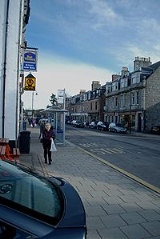
Banchory

Encyclopedia
Banchory is a burgh
or town in Aberdeenshire
, Scotland
, lying approximately 18 miles west of Aberdeen
, near where the Feugh River meets the River Dee
.
, of similar meaning, and also the site of a monastery, in Northern Ireland
. Relics associated with St. Ternan were preserved by hereditary keepers at Banchory until the Scottish Reformation
. Two early Christian cross-slabs survive in or near the old churchyard on the site of the early church. One is built into a corner of the 'mort house' in the churchyard, and shows two crosses incised in a worn pink granite slab. The other is a ringed cross in relief built into the wall facing the main road outside the churchyard.
Banchory is the largest town in the area and has a High Street. There are a number of hotels and restaurants including the Stag Hotel, Scott Skinners Bar and Restaurant, the Burnett Arms, and the Douglas Arms. The shops include newsagents, sports shops and chemists. Since the 1970s, the town has grown steadily. Since 2001 there has been rapid expansion. A large forested area 'the Hill of Banchory', owned by the Burnett family (owners of Crathes Castle), to the north east of the town has been replaced by a large housing estate and an influx of new residents. The Hill of Banchory primary school was opened in 2006 to cater for the increased population.
Banchory Academy
is a state (public) secondary school, with a school roll of over 950. Despite strong opposition from the local community, a retirement home 'Dalvenie Home' was built on land next to the Academy in the 1990s. The planning process was taken to the Scottish Office where local opposition was overruled. The retirement home opened in 2001 and has restricted expansion of the Academy and the adjacent sports centre.
The pressure for development and the value of land in Banchory means that the Primary and Secondary School Campus area is being considered for sale to housing developers, with sites for a new Academy and a new Primary being investigated.
Parish Churches of Banchory Ternan East Church
on Station Road and Banchory Ternan West Church on the High Street. There is a small Episcopal Church
of St Ternan also on the High Street, founded in 1851 and a Roman Catholic Church, St Columba's, at the west end of High Street. Banchory Christian Fellowship Church, a non-denominational evangelical church, is at the east end of Banchory.
and Drum
- both run by the National Trust for Scotland
. The Bridge of Feugh offers the chance to see salmon
leaping and there are numerous fine golf courses nearby.
The small town museum
recognises that this is the birthplace of James Scott Skinner
. Local landmarks include Scolty hill
; a hill topped by a tower monument, a memorial to General Burnett who fought alongside Wellington.
Local sports teams include Banchory St Ternan football club, Banchory Boys Club(Football), Banchory Amateurs(Football), Deeside RFC (Rugby), the Banchory Beavers swimming team and the Banchory Stags Basketball Club. Banchory has three summer league football teams (Banchory thistle, Banchory youngstars and Banchory stoats) which compete in the mid-Deeside summer league.
Despite an inadequate and shallow 20metre swimming pool, which cannot be used for swimming competitions, Banchory Beavers swim team achieves national success. Despite the local community raising over £100,000 towards the building of a new pool, efforts to bring a respectable swimming pool to the town have so far been unsuccessful.
The Banchory show is held every July and attracts a good sized crowd to King George V Park. There is an Agricultural Show, Dog Show, Craft Fair, Highland Dancing Competition and the Scolty Hill Race, as well as traditional fairground stalls and games.
The Royal Deeside Railway
originating at Milton of Crathes will shortly run to Banchory; this line is part of the original line to Ballater
.
Burgh
A burgh was an autonomous corporate entity in Scotland and Northern England, usually a town. This type of administrative division existed from the 12th century, when King David I created the first royal burghs. Burgh status was broadly analogous to borough status, found in the rest of the United...
or town in Aberdeenshire
Aberdeenshire
Aberdeenshire is one of the 32 unitary council areas in Scotland and a lieutenancy area.The present day Aberdeenshire council area does not include the City of Aberdeen, now a separate council area, from which its name derives. Together, the modern council area and the city formed historic...
, Scotland
Scotland
Scotland is a country that is part of the United Kingdom. Occupying the northern third of the island of Great Britain, it shares a border with England to the south and is bounded by the North Sea to the east, the Atlantic Ocean to the north and west, and the North Channel and Irish Sea to the...
, lying approximately 18 miles west of Aberdeen
Aberdeen
Aberdeen is Scotland's third most populous city, one of Scotland's 32 local government council areas and the United Kingdom's 25th most populous city, with an official population estimate of ....
, near where the Feugh River meets the River Dee
River Dee, Aberdeenshire
The River Dee is a river in Aberdeenshire, Scotland. It rises in the Cairngorms and flows through Strathdee to reach the North Sea at Aberdeen...
.
Overview
The name is thought to be derived from an early Christian settlement founded by St Ternan. It is claimed that Ternan was a follower of St Ninian. He established a college on the banks of the River Dee to teach Christianity and agriculture to the local Picts. The village and parish was called Banchory Ternan until the 1970s. The original Gaelic form is almost identical to that of BangorBangor, County Down
Bangor is a large town in County Down, Northern Ireland. It is a seaside resort on the southern side of Belfast Lough and within the Belfast Metropolitan Area. Bangor Marina is one of the largest in Ireland, and holds Blue Flag status...
, of similar meaning, and also the site of a monastery, in Northern Ireland
Northern Ireland
Northern Ireland is one of the four countries of the United Kingdom. Situated in the north-east of the island of Ireland, it shares a border with the Republic of Ireland to the south and west...
. Relics associated with St. Ternan were preserved by hereditary keepers at Banchory until the Scottish Reformation
Scottish Reformation
The Scottish Reformation was Scotland's formal break with the Papacy in 1560, and the events surrounding this. It was part of the wider European Protestant Reformation; and in Scotland's case culminated ecclesiastically in the re-establishment of the church along Reformed lines, and politically in...
. Two early Christian cross-slabs survive in or near the old churchyard on the site of the early church. One is built into a corner of the 'mort house' in the churchyard, and shows two crosses incised in a worn pink granite slab. The other is a ringed cross in relief built into the wall facing the main road outside the churchyard.
Banchory is the largest town in the area and has a High Street. There are a number of hotels and restaurants including the Stag Hotel, Scott Skinners Bar and Restaurant, the Burnett Arms, and the Douglas Arms. The shops include newsagents, sports shops and chemists. Since the 1970s, the town has grown steadily. Since 2001 there has been rapid expansion. A large forested area 'the Hill of Banchory', owned by the Burnett family (owners of Crathes Castle), to the north east of the town has been replaced by a large housing estate and an influx of new residents. The Hill of Banchory primary school was opened in 2006 to cater for the increased population.
Land use
As a small rural town, surrounded by forestry and agricultural land, Banchory has seen considerable expansion in recent years. Development pressure continues to be strong and the town's population now exceeds 8,000. As Banchory expands, more demands are placed on local infrastructure such as doctors, dentists, sports facilities, swimming pool and schools. In recent years, the Bellfield Doctor's Surgery, the Fountain Dental Surgery, the Morrisons Supermarket and Banchory Academy have all undergone extended and upgraded facilities. In 2010, Tesco built an eco-store to the west of the town, it is hoped this will encourage further residential development to this end of the village.Banchory Academy
Banchory Academy
Banchory Academy is a secondary school serving Banchory, Scotland and surroundings, including the neighbouring communities of Raemoir, Crathes, Strachan, Drumoak, Durris, Inchmarlo and Glassel. It accommodates roughly 945 pupils.-Rector:...
is a state (public) secondary school, with a school roll of over 950. Despite strong opposition from the local community, a retirement home 'Dalvenie Home' was built on land next to the Academy in the 1990s. The planning process was taken to the Scottish Office where local opposition was overruled. The retirement home opened in 2001 and has restricted expansion of the Academy and the adjacent sports centre.
The pressure for development and the value of land in Banchory means that the Primary and Secondary School Campus area is being considered for sale to housing developers, with sites for a new Academy and a new Primary being investigated.
Churches
There are a number of churches in Banchory, including the Church of ScotlandChurch of Scotland
The Church of Scotland, known informally by its Scots language name, the Kirk, is a Presbyterian church, decisively shaped by the Scottish Reformation....
Parish Churches of Banchory Ternan East Church
Banchory Ternan East Church
Banchory Ternan East Parish Church is a congregation of the Church of Scotland, a member of the Presbyterian Church. The church building is located in Station Road, Banchory, Kincardineshire, Scotland...
on Station Road and Banchory Ternan West Church on the High Street. There is a small Episcopal Church
Scottish Episcopal Church
The Scottish Episcopal Church is a Christian church in Scotland, consisting of seven dioceses. Since the 17th century, it has had an identity distinct from the presbyterian Church of Scotland....
of St Ternan also on the High Street, founded in 1851 and a Roman Catholic Church, St Columba's, at the west end of High Street. Banchory Christian Fellowship Church, a non-denominational evangelical church, is at the east end of Banchory.
Tourism and culture
Banchory is a tourist destination as the gateway to Royal Deeside. It is surrounded by lovely rural countryside and attractive hills. For the visitor, the town has much to offer with two famous castles nearby, CrathesCrathes Castle
Crathes Castle is a 16th century castle near Banchory in the Aberdeenshire region of Scotland. This harled castle was built by the Burnetts of Leys and was held in that family for almost 400 years...
and Drum
Drum Castle
Drum Castle is a castle near Drumoak in Aberdeenshire, Scotland. For centuries it was the seat of the chief of Clan Irvine. The place-name Drum is derived from Gaelic druim, 'ridge'....
- both run by the National Trust for Scotland
National Trust for Scotland
The National Trust for Scotland for Places of Historic Interest or Natural Beauty, commonly known as the National Trust for Scotland describes itself as the conservation charity that protects and promotes Scotland's natural and cultural heritage for present and future generations to...
. The Bridge of Feugh offers the chance to see salmon
Salmon
Salmon is the common name for several species of fish in the family Salmonidae. Several other fish in the same family are called trout; the difference is often said to be that salmon migrate and trout are resident, but this distinction does not strictly hold true...
leaping and there are numerous fine golf courses nearby.
The small town museum
Museum
A museum is an institution that cares for a collection of artifacts and other objects of scientific, artistic, cultural, or historical importance and makes them available for public viewing through exhibits that may be permanent or temporary. Most large museums are located in major cities...
recognises that this is the birthplace of James Scott Skinner
James Scott Skinner
James Scott Skinner was a Scottish dancing master, violinist, fiddler, and composer.Skinner was born in Banchory, near Aberdeen. His father was a dancing master on Deeside. James was only eighteen months old when his father died. When James was seven, his elder brother, Sandy, gave him lessons in...
. Local landmarks include Scolty hill
Scolty hill
Scolty Hill is a small hill south of the Deeside town, Banchory. Its best known feature is the 20m tall tower monument, a memorial to General Burnett who fought alongside Wellington. It enjoys splendid views over Banchory, the Dee Valley and the Grampian Mountains, which surround the hill. This...
; a hill topped by a tower monument, a memorial to General Burnett who fought alongside Wellington.
Local sports teams include Banchory St Ternan football club, Banchory Boys Club(Football), Banchory Amateurs(Football), Deeside RFC (Rugby), the Banchory Beavers swimming team and the Banchory Stags Basketball Club. Banchory has three summer league football teams (Banchory thistle, Banchory youngstars and Banchory stoats) which compete in the mid-Deeside summer league.
Despite an inadequate and shallow 20metre swimming pool, which cannot be used for swimming competitions, Banchory Beavers swim team achieves national success. Despite the local community raising over £100,000 towards the building of a new pool, efforts to bring a respectable swimming pool to the town have so far been unsuccessful.
The Banchory show is held every July and attracts a good sized crowd to King George V Park. There is an Agricultural Show, Dog Show, Craft Fair, Highland Dancing Competition and the Scolty Hill Race, as well as traditional fairground stalls and games.
The Royal Deeside Railway
Royal Deeside Railway
The Royal Deeside Railway was formed in 1996 with the intention of reclaiming part of the former branch line from Aberdeen to Ballater, constructed between 1853 and 1856 by the Deeside Railway company and closed by British Railways in 1966...
originating at Milton of Crathes will shortly run to Banchory; this line is part of the original line to Ballater
Ballater
Ballater is a burgh in Aberdeenshire, Scotland on the River Dee, immediately east of the Cairngorm Mountains. Situated at a height of 123m in elevation, Ballater is a centre for hikers and known for its spring water, once said to cure scrofula.-History:The medieval pattern of development along...
.
See also
- Banchory Ternan East Parish Church
- 2367 (Banchory) Squadron Air Training CorpsAir Training CorpsThe Air Training Corps , commonly known as the Air Cadets, is a cadet organisation based in the United Kingdom. It is a voluntary youth group which is part of the Air Cadet Organisation and the Royal Air Force . It is supported by the Ministry of Defence, with a regular RAF Officer, currently Air...
- Aberdeenshire Cricket Association
- Banchory Army Cadet Force (Royal Regiment of Scotland)
- Glen O'Dee HospitalGlen O'Dee HospitalGlen O' Dee Hospital is situated in the west end of Banchory, Aberdeenshire. The hospital provides services for the population of Royal Deeside supported by the General Practitioners from the local GP practices.-History:...