
All Topics  
Balalaika


   Email Print
   Bookmark   Link


Balalaika


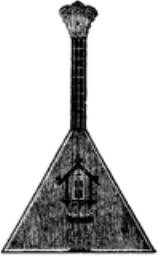
The balalaika () (also Balabaika, ??????´???) - is a stringed instrument of Russia
Russia

Russia , or the Russian Federation , is a list of countries spanning more than one continent country extending over much of northern Eurasia....
n origin, with a characteristic triangular
Triangle

A triangle is one of the basic shapes of geometry: a polygon with three corners or wikt:vertex and three sides or edges which are line segments....
 body and 3 strings (or sometimes 6, in 3 courses).

The Balalaika family of instruments includes, from the highest-pitched to the lowest, the prima balalaika, sekunda balalaika, alto balalaika, bass balalaika and contrabass balalaika. All have three-sided bodies, spruce or fir tops and backs made of from three to nine wooden sections, and all have three strings.


Discussion
Ask a question about 'Balalaika'
Start a new discussion about 'Balalaika'
Answer questions from other users
Full Discussion Forum


Recent Posts


Encyclopedia


The balalaika () (also Balabaika, ??????´???) - is a stringed instrument of Russia
Russia

Russia , or the Russian Federation , is a list of countries spanning more than one continent country extending over much of northern Eurasia....
n origin, with a characteristic triangular
Triangle

A triangle is one of the basic shapes of geometry: a polygon with three corners or wikt:vertex and three sides or edges which are line segments....
 body and 3 strings (or sometimes 6, in 3 courses).

The Balalaika family of instruments includes, from the highest-pitched to the lowest, the prima balalaika, sekunda balalaika, alto balalaika, bass balalaika and contrabass balalaika. All have three-sided bodies, spruce or fir tops and backs made of from three to nine wooden sections, and all have three strings. The prima balalaika is played with the fingers, the sekunda and alto either with the fingers or a pick depending on the music being played, and the basses and contrabasses (equipped with extension legs which rest on the floor) are played with leather picks.

Etymology

The term first appeared in the Ukrainian language in the 18th century in documents from 1717-1732. It is thought that the term was borrowed into Russian where it first appeared a poem by V. Maikov "Elysei" in 1771. The instrument was developed from a 2-stringed chordophone originally used by Jews living in the Pale
Pale

A pale is:* a wooden stake used with others to make a fence - from Old French pal, from Latin palus ?stake?* a boundary* an area within set boundaries a territory or jurisdiction under a given authority, or the limits of such a jurisdiction....
 in Little Russia
Little Russia

Little Russia, sometimes Little or Lesser Etymology of Rus and derivatives , was the name for a part of the historically settled territory of modern-day Ukraine before the twentieth century, at the time of the Russian Empire and earlier....
.

Types


The modern balalaika is found in the following sizes:

  • piccolo (rare)
  • prima
  • sekunda
  • alto
  • bass
  • contrabass


The most common solo
Solo (music)

In music, a solo is a piece or a section of a piece played or sung by a single performer. In practice this means a number of different things, depending on the type of music and the context....
 instrument is the prima
Prima

Prima may refer to:...
, tuned E-E-A (the two lower strings
Strings (music)

A string is the Vibrating string that is the source of vibration in string instruments, such as the guitar, harp, piano, and members of the violin family....
 being tune
Tune

Tune can refer to:* A melody or tune-family* A tune , a short piece of instrumental music, usually with repeating sections, and often played a number of times....
d to the same pitch). Sometimes the balalaika is tuned "guitar style" to G-B-D (mimicking the three highest strings of the Russian guitar
Russian guitar

The Russian guitar is a seven-string acoustic guitar that arrived in Russia toward the end of the 18th century and the beginning of the 19th century, most probably as an evolution of the cittern, kobza, and torban....
), making it easier to play for Russian guitar players, although balalaika purists frown on this tuning.

Six string balalaikas are also in use. These have three courses (two strings for each one on a regular, three-stringed instrument tuned EE-EE-AA), similar to the stringing of the mandolin
Mandolin

A mandolin is a musical instrument in the lute family . It is descended from the Mandora, a soprano member of the lute family. It has a body with a teardrop-shaped soundboard, or one which is essentially oval in shape, with a soundhole, or soundholes, of varying shapes which are open and are not decorated with an intricately carved grille lik...
, and are popular in Ukraine. Four string alto balalaikas are also to be found and are used in the orchestra of the Piatnistky Folk Choir.

The piccolo, prima, and secunda balalaikas used to be strung with gut strings
Strings (music)

A string is the Vibrating string that is the source of vibration in string instruments, such as the guitar, harp, piano, and members of the violin family....
 on the lower pegs and a wire string on the top peg. Today, nylon
Nylon

Nylon is a generic designation for a family of synthetic polymers known generically as polyamides and first produced on February 28, 1935 by Wallace Carothers at DuPont....
 strings are usually used in place of gut.

Technique


An important part of balalaika technique is the use of the left thumb to fret notes on the lower string, particularly on the prima, where it is used to form chord
Chord (music)

In music and music theory a chord is a set of two or more different note that sound simultaneously. Most often, in European-influenced music, chords are tertian Sonority that can be constructed as stacks of thirds relative to some underlying musical scale....
s. The side of the index finger
Index finger

The index finger, also referred to as, pointer finger, forefinger, trigger finger, digitus secundus, or digitus II, is the second finger of a human hand....
 of the right hand is used to sound notes on the prima, while a plectrum
Plectrum

A plectrum is a small flat tool used to pluck or strum a string instrument. For guitars and similar instruments, the plectrum is a separate tool held in the player's hand....
 is used on the larger sizes. One can play the prima with a plectrum, but it is considered rather heterodox to do so.

Due to the gigantic size of the contrabass's strings, it is not uncommon for the plectrum to be made of a leather shoe or boot heel
Heel (shoe)

A heel is the projection at the back of a shoe which rests below the Calcaneus. The shoe heel is used to improve the balance of the shoe or for decorative purposes....
. The bass and contrabass balalaika rest on the ground on a wooden or metal pin drilled into one of its corners.

History


The pre-Andreyev period

Early representations of the balalaika show it with anywhere from two to six strings, which resembles certain Central Asian instruments. Similarly, fret
Fret

A fret is a raised portion on the neck of a stringed instrument, that extends generally across the full width of the neck. On most modern western culture instruments, frets are metal strips inserted into the fingerboard....
s on earlier balalaikas were made of animal gut and tied to the neck so that they could be moved around by the player at will (as is the case with the modern saz
Saz

Saz may refer to:* Baglama* The rap artist Sameh Zakout...
, which allows for the microtonal playing distinctive to Turkish and Central Asian music).

The term first appeared in the Ukrainian language in the 18th century in documents from 1717-1732. It is thought that the term was borrowed into Russian where it first appeared a poem by V. Maikov "Elysei" in 1771. In the 19th century the balalaika evolved into a triangular instrument with a neck substantially shorter than its Asian counterparts. It was popular as a village instrument for centuries, particularly with the skomorokh
Skomorokh

The skomorokhs were medieval East Slavic harlequins, i.e., actors, who could also sing, dance, play musical instruments, and compose most of the scores for their oral/musical and dramatic performances....
s
, sort of free-lance musical jesters whose tunes ridiculed the Tsar
Tsar

Tsar or czar , occasionally spelled csar or tzar in English language, is a slavs term designating certain monarchs.Originally, the title Czar meant Emperor in the European medieval sense of the term, that is, a ruler who has the same rank as a Ancient Rome or Byzantine emperor due to recognition by another emperor or...
, the Russian Orthodox Church
Russian Orthodox Church

The Russian Orthodox Church ; or The Moscow Patriarchate , also known as the Orthodox Christian Church of Russia, is a body of Christianity who constitute an Autocephaly Eastern Orthodox Church under the jurisdiction of the List of Metropolitans and Patriarchs of Moscow, in full communion with the other Eastern Orthodox Churches....
, and Russian society in general.

A popular notion is that the three sides and strings of the balalaika are supposed to represent the Holy Trinity. This idea, while whimsical, is quite difficult to reconcile when one is confronted with the fact that at various times in Russian history, the playing of the balalaika was banned because of its use by the skomorokhi, who were generally highly irritating to both Church and State. Musical instruments are not allowed in Russian Orthodox liturgy. A likelier reason for the triangular shape is given by the writer and historian Nikolai Gogol
Nikolai Gogol

Nikolai Vasilievich Gogol was a Ukrainians-born Russian people writer. Although his early works, such as Evenings on a Farm Near Dikanka, were heavily influenced by his Ukraine upbringing and identity, he wrote in Russian and his works belong to the tradition of Russian literature; often called the "father of modern Russian realism" he...
 in his unfinished novel Dead Souls. He states that a balalaika was made by peasants out of a pumpkin. If you quarter a pumpkin, you are left with a balalaika shape. Another theory is: Before Tsar Peter The Great, instruments were not allowed in Russia. When Peter allowed them, only the boat builders knew how to work with wood. The balalaika looks a little like the front of a boat, if held horizontally. Another theory comes from a Russian tale: during the Mongol invasion of Rus
Mongol invasion of Rus

The Mongol invasion of Rus' was heralded by the Battle of the Kalka River in 1223 between the Mongolian general Subutai's reconnaissance unit and the combined force of several Rus' princes....
, a Russian man from Nizhny Novgorod
Nizhny Novgorod

Nizhny Novgorod , colloquially shortened as Nizhny, is the fourth largest types of inhabited localities in Russia in Russia, ranking after Moscow, Saint Petersburg, and Novosibirsk....
 was captured by Mongols, but the Mongol Khan liked him because of his musical talent, released him and gave him a guitar. When the Russian man returned home, he took 3 of the strings out of the guitar, so that he would be able to repair his guitar if he breaks one of the strings, and that way he was left with a 3-string guitar.

The Andreyev period

In the 1880s Vassily Vassilievich Andreyev developed a standardized balalaika made with the assistance of violin maker V. Ivanov. A few years later St. Petersburg craftsman Paserbsky made a balalika with a chromatic set of frets and also a number of balalaikas in orchestral sizes with the same tunings found in modern instruments. Andreyev arranged many traditional Russian folk songs and melodies for the orchestra and also composed many tunes of his own.

The balalaika outside of Russia

Interest in Russian folk instruments has grown outside of Russia. Orchestras of Russian folk instruments exist in many countries of western Europe, Scandinavia, USA, Canada, Australia and Japan. Some of the groups include ethnic Russians, however in recent times the growth in interest in the Balalaika by non-ethnic Russians has been considerable.

Interests in the balalaika first started after Andreyev's tour of North America in the early 20th century. A number of Andreyev's students also toured the west in 1909-12. In 1957 the Scandinavian Balalaika Association was formed. In 1977 a similar organization was formed in the USA.

Oleg Bernov of the Russian-American rock band the Red Elvises
Red Elvises

The Red Elvises are a Russians-United States band that performs rock & roll, surf music, rockabilly, reggae, lounge and traditional Russian styles of music....
 plays a red electrified contrabass balalaika during the band's North American tours.

Balalaika orchestra

Balalaika
The end result of Andreyev's labours was the development of a strong orchestral tradition in Tsarist Russia, and, later, the Soviet Union
Soviet Union

The Union of Soviet Socialist Republics was a Constitution of the Soviet Union socialist state that existed in Eurasia from 1922 to 1991.The name is a translation of the , romanization of Russian Soyuz Sovetskikh Sotsialisticheskikh Respublik, abbreviated ????, SSSR....
. The balalaika orchestra in its full form -- balalaikas, domra
Domra

The domra is a long-necked Ukrainian string instrument of the lute family with a round body and three or four metal strings....
s, gusli
Gusli

Gusli }} is the oldest Russian multi-string plucked Psaltery instrument of the Zither family. Its exact history is unknown, but it may have derived from a Byzantium form of the Cithara, which in turn derived from the ancient lyre....
, bayan, kugiklas, Vladimir Shepherd's Horns
Vladimir Shepherd's Horns

The Vladmir Shepherd's horn is a close relative of the cornett a woodwind instrument played with a brass mouthpiece. It is also known as the rozhok....
, garmoshkas and several types of percussion instrument
Percussion instrument

A percussion instrument is any object which produces a sound by being hit with an implement, shaken, rubbed, scraped, or by any other action which sets the object into vibration....
s -- has a distinctive sound: strangely familiar to the ear, yet decidedly not entirely Western.

Russian folk music had its roots in the village. With the establishment of the Soviet system Proletarian culture - the culture of the working classes - was supported by the Soviet establishment. Folk music and folk musical instruments was considered the music of the working classes and as a result it was heavily supported by the Soviet establishment. Not surprisingly, the concept of the balalaika orchestra was adopted wholeheartedly by the Soviet government as something distinctively proletarian (that is, from the working classes). Enormous amounts of energy and time were devoted by the Soviet government to foster conservatory study of the balalaika, from which highly skilled ensemble groups such as the Osipov State Balalaika Orchestra emerged. Balalaika virtuosi such as Boris Feoktistov and Pavel Necheporenko
Pavel Necheporenko

Pavel Necheporenko is a virtuoso performer of the balalaika.Pavel Ivanovich Necheporenko was born on August 31, 1916, the son of a mariner. By the time of the Second World War, Necheporenko was already a distinguished balalaikist....
 became stars both inside and outside the Soviet Union. The world-famous Red Army Choir
Red Army Choir

The A. V. Alexandrov Russian army twice red-bannered academic song and dance ensemble , shortly the Alexandrov ensemble is a performing ensemble that serves as the official army choir of the Armed Forces of the Russian Federation....
 used a normal orchestra, except that the violin
Violin

The violin is a Bow string instrument with four strings usually tuned in perfect fifths. It is the smallest and highest-pitched member of the violin family of string instruments, which also includes the viola and cello....
s, viola
Viola

The viola is a bowed string instrument. It is the middle voice of the violin family, between the violin and the cello.The casual observer may mistake the viola for the violin because of their similarity in size, closeness in pitch range , and nearly identical playing position....
s and violoncellos were replaced with orchestral balalaikas and domra
Domra

The domra is a long-necked Ukrainian string instrument of the lute family with a round body and three or four metal strings....
s.

Cabaret

In addition to orchestra, a cabaret
Cabaret

Cabaret is a form of entertainment featuring comedy, song, dance, and theatre, distinguished mainly by the performance venue — a restaurant or nightclub with a stage for performances and the audience sitting at tables watching the performance being introduced by a master of ceremonies, or MC....
 style of playing existed in Soviet times, and the balalaika was also played by some Russian Gypsies. The cabaret/gypsy tradition was brought over to the United States by Russian immigrants in the early 20th Century. One notable U.S. cabaret-style player was New York's Sasha Polinoff. In Paris a notable exponent was Mark De Louchek - a former concertmaster of Ivan Rebroff
Ivan Rebroff

Ivan Rebroff, born as Hans-Rolf Rippert, , was a Germany singer, allegedly of Russian people, with an extraordinary vocal range of four and a half octaves, ranging from the soprano to impressive bass registers....
's orchestral entourage.

Use of the name

In 1989 Kramer Guitars
Kramer Guitars

Kramer Guitars is an United States of America manufacturer of electric guitars and basses. Kramer produced aluminum-necked electric guitars and basses in the 1970s and wooden-necked guitars catering to hard rock musicians in the 1980s; Kramer is currently a division of Gibson Guitar Corporation....
 released an "Electric Balalaika": the Kramer Gorky Park. This was just before the fall of the Berlin wall and the Soviet Union. Actually was just an electric guitar with a triangular shape based on the original instrument.

The MiG-21
Mikoyan-Gurevich MiG-21

The Mikoyan-Gurevich MiG-21 is a supersonic jet fighter aircraft, designed and built by the Mikoyan Design Bureau in the Soviet Union. It was popularly nicknamed "balalaika", from the aircraft's planform-view resemblance to the Balalaika or ol?wek by Polish pilots due to the shape of its fuselage....
 is nicknamed Balalaika for its shape.

Sources


  • Blok, V. - Orkestr russkikh narodnykh instrumentov - Moscow, 1986
  • Imkhatsky, M. - V. V. Andreyev - - Moscow, 1986
  • Imkhatsky, M. - U istokov russkoj narodnoj orkestrovoj kultury - Moscow 1987
  • Imkhatsky, M. - Istoriya ispolnitelstva na russkikh narodnykh instrumentax - Moscow 2002
  • Peresada, A. - Balalaika - Moscow, 1990
  • Poponov, V. - Orkestr khora imeni Piatnitskogo - Moscow, 1979
  • Poponov, V. - Russkaya narodnaya instrumentalnaya muzyka - Moscow, 1984
  • Vetkov, K. - Russkie narodnye muzykalnye instrumenty - Muzyka, Leningrad, 1975


External links

  • (en)
  • , by Georgy Nefyodov