
|
|
|
|
Bagel
|
| |
|
| |
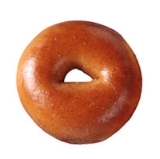
A bagel (also: ?????????, beguel, ????, beigel, ?????, ????, bajgiel, ?? and ??? ) is a bread product, traditionally shaped by hand into the form of a ring from yeasted wheat dough, roughly hand-sized, which is first boiled for a short time in water and then baked. The result is a dense, chewy, doughy interior with a browned and sometimes crisp exterior.

Nutrition Facts
Discussion
Ask a question about 'Bagel'
Start a new discussion about 'Bagel'
Answer questions from other users
|
Encyclopedia
A bagel (also: ?????????, beguel, ????, beigel, ?????, ????, bajgiel, ?? and ??? ) is a bread product, traditionally shaped by hand into the form of a ring from yeasted wheat dough, roughly hand-sized, which is first boiled for a short time in water and then baked. The result is a dense, chewy, doughy interior with a browned and sometimes crisp exterior. Bagels are often topped with seeds baked on the outer crust, with the traditional being poppy or sesame seeds. Some have salt sprinkled on their surface, and there are also a number of different dough types such as whole-grain or rye.
Bagels have become a popular bread product in the United States, Canada and the United Kingdom especially in cities with large Jewish populations, such as Boston, Chicago, New York, Los Angeles, Montreal, Toronto, London and Leeds, each with different ways of making the bagel. Like English muffins and other bakery products, bagels are available (either fresh or frozen, and often in many flavour varieties) in practically all major supermarkets in Canada, the United States and the U.K.
The basic roll-with-a-hole design is hundreds of years old and has other practical advantages besides providing for a more even cooking and baking of the dough: the hole could be used to thread string or dowels through groups of bagels, allowing for easier handling and transportation and more appealing seller displays.
History
Contrary to legend, the bagel was not created in the shape of a stirrup to commemorate the victory of Poland’s King Jan Sobieski over the Ottoman Turks in 1683. It was invented much earlier in Krakow, Poland, as a competitor to the obwarzanek, a lean bread of wheat flour designed for Lent. In the 16th and first half of the 17th centuries, the bajgiel became a staple of the Polish national diet.
There was a tradition among many observant Jewish families to make bagels on Saturday evenings at the conclusion of the Sabbath. Due to Jewish Sabbath restrictions, they were not permitted to cook during the period of the Sabbath and, compared with other types of bread, bagels could be baked very quickly as soon as it ended.
That the name originated from beugal (old spelling of Bügel, meaning bail/bow or bale) is considered plausible by many, both from the similarities of the word and because traditional handmade bagels are not perfectly circular but rather slightly stirrup-shaped. (This, however, may be due to the way the boiled bagels are pressed together on the baking sheet before baking.) Also, variants of the word beugal are used in Yiddish and Austrian German to refer to a round loaf of bread (see Gugelhupf for an Austrian cake with a similar ring shape), or in southern German dialects (where beuge refers to a pile, e.g.: holzbeuge, or woodpile).
In the Brick Lane district and surrounding area of London, England, bagels, or as locally spelled "beigels" have been sold since the middle of the 19th century. They were often displayed in the windows of bakeries on vertical wooden dowels, up to a metre in length, on racks.
The bagel came into more general use throughout North America in the last quarter of the 20th century, at least partly due to the efforts of bagel baker Harry Lender and Florence Sender, who pioneered the frozen bagel in the 1960s.
In modern times Canadian-born astronaut Gregory Chamitoff brought the first known batch of bagels into space on his 2008 Space Shuttle mission to the International Space Station. His shipment was comprised of 18 sesame seed bagels.
Varieties The two most prominent styles of traditional bagel in North America are the Montreal-style bagel and the New York-style bagel. The Montreal bagel contains malt and sugar with no salt; it is boiled in honey-sweetened water before baking in a wood-fired oven; and it is predominantly either of the poppy "black" or sesame "white" seeds variety. The New York bagel contains salt and malt and is boiled in water prior to baking in a standard oven. The resulting New York bagel is puffy with a moist crust, while the Montreal bagel is smaller (though with a larger hole), crunchier, and sweeter. Poppy seeds are sometimes called by their Yiddish name, spelled either mun or mon (written ????) which is very similar to the German word for poppy, Mohn, as used in Mohnbrötchen. The traditional London bagel (or beigel as it is spelled) is harder and has a coarser texture with air bubbles.
Non-traditional doughs and shapes
While normally and traditionally made of yeasted wheat, in the late 20th century, many variations on the bagel flourished. Non-traditional versions which change the dough recipe include pumpernickel, rye, sourdough, bran, whole wheat, and multigrain. Other variations change the flavor of the dough, often using salt, onion, garlic, egg, cinnamon, raisin, blueberry, chocolate chip, cheese, or some combination of the above. Green bagels are sometimes created for St. Patrick's Day. Many corporate chains now offer bagels in such flavors as chocolate chip and French toast.
Sandwich bagels, which are essentially dinner rolls with holes in them, have been popularized since the late 1990s by fast food chains such as Bruegger's, Einstein's, and McDonald's. As nondescript breadstuffs, they are often shipped to retailers pre-baked, and then filled with any typical sandwich filling.
Breakfast bagels, a softer, sweeter variety usually sold in fruity or sweet flavors (e.g., cherry, strawberry, cheese, blueberry, cinnamon-raisin, chocolate chip, maple syrup, banana and nuts) are commonly sold by large supermarket chains; these are usually sold sliced and are intended to be prepared in a toaster. A flat bagel, known as a flagel, can be found in a few locations in and around New York City and Toronto. It was initially developed by Robert "BagelBob" Slutsky and slowly started to expand due to preferred sandwich sizes. A trademarked, sweet variant of the bagel known as the “Fragel" is produced by the Ann Arbor, Michigan, based Bagel Factory, Inc. A special, bagel-based dough is fried and coated with cinnamon sugar. A sandwich chain called Così has created square bagels, or "squagels", as an alternative to round bagels in crafting bagel sandwiches which are often filled with luncheon meats; square bagels are also sold by the Target chain in the United States.
Preparation
At its most basic, traditional bagel dough contains wheat flour (without germ or bran), salt, water, and yeast leavening. Bread flour or other high gluten flours are preferred to create the firm and dense but spongy bagel shape and chewy texture. Most bagel recipes call for the addition of a sweetener to the dough, often barley malt (syrup or crystals), honey, sugar, with or without eggs, milk or butter. Leavening can be accomplished using either a sourdough technique or using commercially produced yeast.
Bagels are traditionally made by:
- mixing and kneading the ingredients to form the dough
- shaping the dough into the traditional bagel shape, round with a hole in the middle
- proofing the bagels for at least 12 hours at low temperature (40-50 degrees F = 4.5-10°C)
- boiling each bagel in water that may or may not contain additives such as lye, baking soda, barley malt syrup, or honey
- baking at between 175°C and 315°C (about 350 to 600 degrees F)
It is this unusual production method which is said to give bagels their distinctive taste, chewy texture, and shiny appearance. In the context of Jewish culture, this process provided an additional advantage in that it could be followed without breaking the no-work rule of the Sabbath. The dough would be prepared on the day before, chilled during the day, and boiled and baked only after the end of the Sabbath, therefore using the Sabbath as a productive time in the bagel-making process (as the dough needs to slowly rise in a chilled environment for a time before cooking).
In recent years, a variant of this process has emerged, producing what is sometimes called the steam
bagel. To make a steam bagel, the process of boiling is skipped, and the bagels are instead baked in an oven equipped with a steam injection system. In commercial bagel production, the steam bagel process requires less labor, since bagels need only be directly handled once, at the shaping stage. Thereafter, the bagels need never be removed from their pans as they are refrigerated and then steam-baked. The steam-bagel is not considered to be a genuine bagel by purists, as it results in a fluffier, softer, less chewy product more akin to a finger roll that happens to be shaped like a bagel.
Bagels around the world Bagels were derived from the similarly shaped doughnuts and from the similarly textured bialys, primarily because of the cooking method amongst other differences. Russian bubliks are very similar to bagels, but are somewhat bigger, have a wider hole, and are drier and chewier. Pretzels, especially the large soft ones, are also similar to bagels, the main exceptions being the shape and the alkaline water bath that makes the surface dark and glossy.
In Russia, Belarus and Ukraine, the bublik is essentially a much larger bagel. Other ring-shaped breads known among East Slavs are baranki (smaller and drier) and sushki (even smaller and drier).
In Lithuania bagels are called riestainiai and sometimes the Slavic name baronkos.
, China]]
The Uyghurs of Xinjiang, China enjoy a form of bagel known as girdeh nan (from Persian, meaning round bread) , which is one of several types of nan, the bread eaten in Xinjiang. It is uncertain if the Uyghur version of the bagel was developed independently of Europe or was the actual origin of the bagels that appeared in Central Europe.
In Turkey, a salty and fattier form is called açma. The ring-shaped simit is sometimes marketed as a Turkish Bagel, and is very similar to the twisted sesame-sprinkled bagels pictured being sold in early 20th century Poland. Simit are also sold on the street in baskets or carts, like bagels were then.
In some parts of Austria, ring-shaped pastries called beugel are sold in the weeks before Easter. Like a bagel, the yeasted wheat dough, usually flavored with caraway, is boiled before baking. However, the beugel is crispy and can be stored for weeks. Traditionally it has to be torn apart by two individuals before eating.
The pronunciation and spelling of "bagel" varies among communities. In Canada, for instance, people from Toronto and Montreal, pronounce it like bay-gel, (the correct Yiddish pronunciation) -whereas people from the smaller towns of Northern Ontario and the East coast of Canada tend to pronounce the first syllable as bag-el, as in in 'shopping bag' . In addition, some American bagel makers (particularly New England producer Zeppy's) spell the word "baigel", while maintaining the typical pronunciation.
In the UK, bagels are popular in London, Leeds and Manchester. On Brick Lane in East London there are two long established bagel shops in which the item is spelled beigel, with pronunciation to match. Bagel Nash is a growing national Bagel chain that originated in Moortown, a largely Jewish suburb of Leeds.
In Romania, bagels are popular topped with sesame seeds or large salt grains, especially in the central area of the country, and the recipe does not contain any added sweetener. They are sold as covrigi.
"Bagel" is also a Yeshivish term for 'one who sleeps 12 hours straight', a reference to the fact that bagel dough has to "rest" for at least 12 hours between mixing and baking.
See also
Bibliography
- Balinska, Maria (2008). The Bagel: The Surprising History of a Modest Bread , Yale University Press, November 2008, ISBN 0300112297, ISBN 978-0300112290
External links
|
| |
|
|