
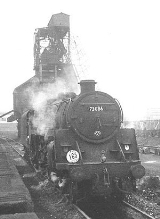
The British Railways
Standard Class 5MT 4-6-0Under the Whyte notation for the classification of steam locomotives, 4-6-0 represents the wheel arrangement of four leading wheels on two axles in a leading truck, six powered and coupled driving wheels on three axles, and no trailing wheels. This wheel arrangement became the second-most popular...
was one of the standard classes of steam locomotives built by British Railways in the 1950s. 172 were built, essentially being a development of the
LMS Stanier Class 5 4-6-0The London Midland and Scottish Railway's Class 5 4-6-0, almost universally known as the Black Five, is a class of steam locomotive. It was introduced by William Stanier in 1934 and 842 were built between then and 1951...
("Black Five").
Background
William StanierSir William Arthur Stanier, FRS was Chief Mechanical Engineer of the London, Midland and Scottish Railway.- Biography :...
's
Black FiveThe London Midland and Scottish Railway's Class 5 4-6-0, almost universally known as the Black Five, is a class of steam locomotive. It was introduced by William Stanier in 1934 and 842 were built between then and 1951...
had been the most successful mixed-traffic type in Great Britain. Construction of the Black Fives had started in 1934 and continued past nationalisation to 1951. A new set of 'standard' locomotives was to be built by British Railways, based on LMS designs and incorporating modern ideas.
In particular, the Standard design incorporated features designed to make disposal easier: a self-cleaning smokebox and a rocking grate removed the necessity for crews to undertake dirty and strenuous duties at the end of a long shift.
Design and construction
The design work was done at the ex-LNER
Doncaster WorksDoncaster railway works is in the town of Doncaster, South Yorkshire, England.Always referred to as "the Plant", it was established by the Great Northern Railway in 1853, replacing the previous works in Boston and Peterborough...
but the bulk of the construction was done at
Derby WorksThe Midland Railway Locomotive Works, known locally as "the loco" comprised a number of British manufacturing facilities in Derby building locomotives and, initially, rolling stock in Derby, UK.-Early days:...
. The locomotive featured a Type 3B
boilerA boiler is a closed vessel in which water or other fluid is heated. The heated or vaporized fluid exits the boiler for use in various processes or heating applications.-Materials:...
almost identical to that of the Black Fives. A higher running plate, slightly enlarged driving wheels (from 6 in 0 in (1.83 m) to 6 in 2 in (1.88 m)) and a standard cab were the most obvious visible changes.
The first of the class, 73000, was outshopped from Derby in April 1951 and 30 were in service by January 1952. There was then a gap in construction before Derby resumed building its remaining 100 engines. 42 were built at Doncaster, starting in August 1955 and finishing in May 1957, with Derby's last engine following a month later.
Thirty engines, numbers 73125 to 73154, were built with
Caprotti valve gearThe Caprotti valve gear is a type of steam engine valve gear invented in the early 1920's by Italian architect and engineer Arturo Caprotti. It uses camshafts and poppet valves rather than the piston valves used in other valve gear...
and
poppet valveA poppet valve is a valve consisting of a hole, usually round or oval, and a tapered plug, usually a disk shape on the end of a shaft also called a valve stem. The shaft guides the plug portion by sliding through a valve guide...
s. One of these engines (73129) survives today at Butterley, and along with BR Standard Class 8 are the only engines with Caprotti gear left in Britain.
In service
In 1959 20 of the Southern Region locomotives were named, the names being transferred from
SR King Arthur classThe LSWR N15 class was a British 2–cylinder 4-6-0 express passenger steam locomotive designed by Robert W. Urie. The class has a complex build history spanning three sub-classes and eight years of construction from 1919 to 1926...
locos that were then being withdrawn. These were:
- 73080 Merlin
Merlin is a legendary figure best known as the wizard featured in the Arthurian legend. The standard depiction of the character first appears in Geoffrey of Monmouth's Historia Regum Britanniae, written c. 1136, and is based on an amalgamation of previous historical and legendary figures...
- 73081 Excalibur
Excalibur is the legendary sword of King Arthur, sometimes attributed with magical powers or associated with the rightful sovereignty of Great Britain. Sometimes Excalibur and the Sword in the Stone are said to be the same weapon, but in most versions they are considered separate. The sword was...
- 73082 Camelot
Camelot is a castle and court associated with the legendary King Arthur. Absent in the early Arthurian material, Camelot first appeared in 12th-century French romances and eventually came to be described as the fantastic capital of Arthur's realm and a symbol of the Arthurian world...
- 73083 Pendragon
Pendragon or Pen Draig, meaning "head dragon" or "chief dragon" , is the name of several traditional Kings of the Britons:...
- 73084 Tintagel
Tintagel is a civil parish and village situated on the Atlantic coast of Cornwall, United Kingdom. The population of the parish is 1,820 people, and the area of the parish is ....
- 73085 Melisande
Melisande can refer to:* Melisande of Jerusalem, the daughter of Baldwin II* Melisande , a painting* Melisande Shahrizai, the primary villainess of Jacqueline Carey's Kushiel's Legacy series...
- 73086 The Green Knight
The Green Knight is a character in the 14th-century Arthurian poem Sir Gawain and the Green Knight and the related work The Greene Knight. His true name is revealed to be Bercilak de Hautdesert in Sir Gawain, while The Greene Knight names him "Bredbeddle"...
- 73087 Linette
- 73088 Joyous Gard
- 73089 Maid of Astolat
Elaine of Astolat or Ascolat is a figure in Arthurian legend who dies of her unrequited love for Lancelot. Also referred to as Elaine the White and Elaine the Fair, she is the daughter of Bernard of Astolat. Versions of her story appear in Thomas Malory's Le Morte d'Arthur and Alfred Tennyson's...
- 73110 The Red Knight
Red Knight is a title borne by several characters in Arthurian legend. The first is likely the Red Knight of the Forest of Quinqeroi in Chrétien de Troyes' Perceval, the Story of the Grail; he steals a cup from King Arthur and is killed by the protagonist Perceval, who wears his armor and comes to...
- 73111 King Uther
Uther Pendragon is a legendary king of sub-Roman Britain and the father of King Arthur.A few minor references to Uther appear in Old Welsh poems, but his biography was first written down by Geoffrey of Monmouth in his Historia Regum Britanniae , and Geoffrey's account of the character was used in...
- 73112 Morgan Le Fay
Morgan le Fay , alternatively known as Morgane, Morgaine, Morgana and other variants, is a powerful sorceress in the Arthurian legend. Early works featuring Morgan do not elaborate her character beyond her role as a fay or magician...
- 73113 Lyonnesse
- 73114 Etarre
- 73115 King Pellinore
King Pellinore is the king of Listenoise or of "the Isles" , according to the Arthurian legend. Son of King Pellam and brother of Kings Pelles and Alain, he is most famous for his endless hunt of the Questing Beast, which he is tracking when King Arthur first meets him...
- 73116 Iseult
Iseult is the name of several characters in the Arthurian story of Tristan and Iseult. The most prominent is Iseult of Ireland, wife of Mark of Cornwall and adulterous lover of Sir Tristan. Her mother, the Queen of Ireland, is also named Iseult...
- 73117 Vivien
The Lady of the Lake is the name of several related characters who play parts in the Arthurian legend. These characters' roles include giving King Arthur his sword Excalibur, enchanting Merlin, and raising Lancelot after the death of his father...
- 73118 King Leodegrance
King Leodegrance is the father of Queen Guinevere in Arthurian legend. His kingdom of Carmelide is sometimes identified with a location somewhere in the southwest of England, but may be located in Breton Cornouaille near the town of Carhaix, which is the Carhaise of L'Histoire de Merlin King...
- 73119 Elaine
Elaine is a name shared by several different female characters in Arthurian legend.-Elaine of Astolat:Elaine of Astolat, also known in some texts as Elaine the Fair or the Fair Maid of Astolat and as The Lady of Shalott in Lord Alfred Tennyson's same-titled poem, is a maiden who falls in unrequited...

73020 is known to have been used on Southern Region, photographed departing Southampton Terminus on 18 September 1965.
73022 has also been photographed in service on the Southern Region, pulling a Boat Train across Canute Road in Southampton on 29 September 1966.
73114
Etarre has been photographed in service on 20 March 1966, pulling a Boat Train through Fareham while diverted due to electrification work on the Southern Region mainline from Southampton to London Waterloo.
Preservation
Five have survived:
| Number |
Name |
Home |
Notes |
| 73050 British Railways Standard Class 5 No. 73050 is a preserved British steam locomotive. Unnamed in service, it has been named City of Peterborough; it is owned by Peterborough City Council and operated by the Nene Valley Railway on a 99 year lease....
|
- |
Nene Valley RailwayThe Nene Valley Railway is a preserved railway in Cambridgeshire, England, running between Peterborough Nene Valley and Yarwell Junction. The line is currently seven and a half miles in length...
|
Operational. Named City of Peterborough in preservation. |
| 73082 No. 73082 Camelot is a preserved British Railways Standard Class 5 4-6-0 based on the Bluebell Railway in Sussex, England, and owned by the 73082 Camelot Locomotive Society. She was outshopped from Derby Works in 1955, and worked on the Southern Region of British Railways until 1966, when she was...
|
Camelot |
Bluebell Railway The Bluebell Railway is a heritage line running for nine miles along the border between East and West Sussex, England. Steam trains are operated between and , with an intermediate station at .The railway is managed and run largely by volunteers...
|
In early stages of overhaul. Featured in 102 Dalmatians 102 Dalmatians is a 2000 live-action film, produced by Walt Disney Pictures and starring Glenn Close as Cruella de Vil. It is the sequel to 101 Dalmatians, a live-action remake of the 1961 Disney animated feature of the same name. In the film, Cruella de Vil attempts to steal puppies for her... . |
| 73096 British Railways Standard Class 5 No. 73096 is a preserved British steam locomotive. Unnamed in service, it is now operated by the Mid-Hants Railway on the Watercress Line between Alresford and Alton....
|
- |
Mid Hants Railway |
Boiler ticket expired September 2011 |
| 73129 British Railways Standard Class 5 No. 73129 is a preserved British steam locomotive. It is the only surviving Standard Class 5 built by British Railways which was fitted with Caprotti valve gear.- Locomotive History :...
|
- |
Midland Railway - ButterleyThe Midland Railway – Butterley is a heritage railway, formerly known until 2004 as the Midland Railway Centre, at Butterley, near Ripley in Derbyshire.-Overview:...
|
Operational, currently visiting the East Lancashire RailwayThe East Lancashire Railway is a heritage railway in Lancashire and Greater Manchester, England.-Overview:After formal closure by British Rail in 1982, the line was reopened on 25 July 1987. The initial service operated between Bury and Ramsbottom, via Summerseat. In 1991 the service was extended... . One of only 2 engines left in Britain with Caprotti valve gearThe Caprotti valve gear is a type of steam engine valve gear invented in the early 1920's by Italian architect and engineer Arturo Caprotti. It uses camshafts and poppet valves rather than the piston valves used in other valve gear... . |
| 73156 British Railways Standard Class 5 No. 73156 is a preserved British steam locomotive. It is presently undergoing restoration at Loughborough on the Great Central Railway...
|
- |
Great Central RailwayThe Great Central Railway is a heritage railway split into two adjacent sections, one in Leicestershire and the other Nottinghamshire.The Leicestershire section is currently Britain's only double track mainline heritage railway, with of working double track, period signalling, locomotives and...
|
Undergoing restoration which includes a new tender and motion. |
External links