


BBC Light Programme

Encyclopedia
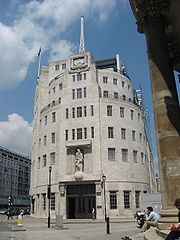
BBC
The British Broadcasting Corporation is a British public service broadcaster. Its headquarters is at Broadcasting House in the City of Westminster, London. It is the largest broadcaster in the world, with about 23,000 staff...
radio station
Radio station
Radio broadcasting is a one-way wireless transmission over radio waves intended to reach a wide audience. Stations can be linked in radio networks to broadcast a common radio format, either in broadcast syndication or simulcast or both...
which broadcast mainstream light entertainment
Light entertainment
Light entertainment is a term used to describe a broad range of usually televisual performances. These include comedies, variety shows, quiz/game shows, sketch shows and people/surprise shows.-Light entertainment in Britain:...
and music from 1945 until 1967, when it was rebranded as BBC Radio 2
BBC Radio 2
BBC Radio 2 is one of the BBC's national radio stations and the most popular station in the United Kingdom. Much of its daytime playlist-based programming is best described as Adult Contemporary or AOR, although the station is also noted for its specialist broadcasting of other musical genres...
. It opened on 29 July 1945, taking over the longwave
Longwave
In radio, longwave refers to parts of radio spectrum with relatively long wavelengths. The term is a historic one dating from the early 20th century, when the radio spectrum was considered to consist of long, medium and short wavelengths...
frequency used before 1939 by the BBC National Programme
BBC National Programme
The BBC National Programme was a BBC radio station from the 1920s until the outbreak of World War II.-Foundation:When the BBC first began transmissions on 14 November 1922, the technology for both national coverage and joint programming between transmitters did not exist – transmitter powers were...
.
The service was intended as the domestic replacement for the wartime
World War II
World War II, or the Second World War , was a global conflict lasting from 1939 to 1945, involving most of the world's nations—including all of the great powers—eventually forming two opposing military alliances: the Allies and the Axis...
BBC Forces Programme
BBC Forces Programme
The BBC Forces Programme was a BBC radio station which operated from 7 January 1940 until 26 February 1944.-Foundation:Upon the outbreak of World War II, the BBC closed the existing BBC National Programme and BBC Regional Programme, combining the two to form a single channel known as the BBC Home...
(later, the General Forces Programme
BBC General Forces Programme
The BBC General Forces Programme was a BBC radio station from 27 February 1944 until 31 December 1946.-Foundation:Upon the outbreak of World War II, the BBC closed the existing BBC National Programme and BBC Regional Programme, combining the two to form a single channel known as the BBC Home...
) which had proved popular with civilian audiences in Britain as well as members of the forces.
The longwave
Longwave
In radio, longwave refers to parts of radio spectrum with relatively long wavelengths. The term is a historic one dating from the early 20th century, when the radio spectrum was considered to consist of long, medium and short wavelengths...
signal on 1500 metres was transmitted from Droitwich in the Midlands
English Midlands
The Midlands, or the English Midlands, is the traditional name for the area comprising central England that broadly corresponds to the early medieval Kingdom of Mercia. It borders Southern England, Northern England, East Anglia and Wales. Its largest city is Birmingham, and it was an important...
(as it still is now for Radio 4
BBC Radio 4
BBC Radio 4 is a British domestic radio station, operated and owned by the BBC, that broadcasts a wide variety of spoken-word programmes, including news, drama, comedy, science and history. It replaced the BBC Home Service in 1967. The station controller is currently Gwyneth Williams, and the...
) and gave fairly good coverage of most of the UK, but some medium-wave frequencies were added later, using low-power transmitters to fill in local blank spots. In the 1950s and 1960s, the Light Programme (along with the BBC's two other national programmes, the Home Service
BBC Home Service
The BBC Home Service was a British national radio station which broadcast from 1939 until 1967.-Development:Between the 1920s and the outbreak of The Second World War, the BBC had developed two nationwide radio services, the BBC National Programme and the BBC Regional Programme...
and the Third Programme
BBC Third Programme
The BBC Third Programme was a national radio network broadcast by the BBC. The network first went on air on 29 September 1946 and became one of the leading cultural and intellectual forces in Britain, playing a crucial role in disseminating the arts...
) gradually became available also on what was known at the time as VHF, as the BBC developed a network of local FM
Frequency modulation
In telecommunications and signal processing, frequency modulation conveys information over a carrier wave by varying its instantaneous frequency. This contrasts with amplitude modulation, in which the amplitude of the carrier is varied while its frequency remains constant...
transmitters.
The Light Programme closed at 02:02 on 30 September 1967. At 05:30 on the same day it was replaced by Radio 1
BBC Radio 1
BBC Radio 1 is a British national radio station operated by the British Broadcasting Corporation which also broadcasts internationally, specialising in current popular music and chart hits throughout the day. Radio 1 provides alternative genres after 7:00pm including electronic dance, hip hop, rock...
on its mediumwave
Mediumwave
Medium wave is the part of the medium frequency radio band used mainly for AM radio broadcasting. For Europe the MW band ranges from 526.5 kHz to 1606.5 kHz...
frequencies, and by Radio 2
BBC Radio 2
BBC Radio 2 is one of the BBC's national radio stations and the most popular station in the United Kingdom. Much of its daytime playlist-based programming is best described as Adult Contemporary or AOR, although the station is also noted for its specialist broadcasting of other musical genres...
(the renamed Light Programme) on its longwave
Longwave
In radio, longwave refers to parts of radio spectrum with relatively long wavelengths. The term is a historic one dating from the early 20th century, when the radio spectrum was considered to consist of long, medium and short wavelengths...
frequency. The FM
Frequency modulation
In telecommunications and signal processing, frequency modulation conveys information over a carrier wave by varying its instantaneous frequency. This contrasts with amplitude modulation, in which the amplitude of the carrier is varied while its frequency remains constant...
frequencies were mainly used by Radio 2 but sometimes leased to Radio 1 until that station acquired its own FM frequencies in the late 1980s.
The long-running soap opera
Soap opera
A soap opera, sometimes called "soap" for short, is an ongoing, episodic work of dramatic fiction presented in serial format on radio or as television programming. The name soap opera stems from the original dramatic serials broadcast on radio that had soap manufacturers, such as Procter & Gamble,...
The Archers
The Archers
The Archers is a long-running British soap opera broadcast on the BBC's main spoken-word channel, Radio 4. It was originally billed as "an everyday story of country folk", but is now described on its Radio 4 web site as "contemporary drama in a rural setting"...
was first heard nationally on the Light Programme, on 1 January 1951, although it had previously been broadcast in the Midlands Home Service
BBC Home Service
The BBC Home Service was a British national radio station which broadcast from 1939 until 1967.-Development:Between the 1920s and the outbreak of The Second World War, the BBC had developed two nationwide radio services, the BBC National Programme and the BBC Regional Programme...
in 1950.
Announcers
- Roy Williams
- Franklin EngelmannFranklin EngelmannFranklin Engelmann was a radio personality popular in Britain in the 1950s and 1960s, nicknamed "Jingle". He was best known for hosting Down Your Way , Gardeners' Question Time and the quiz show What Do You Know?, which later became Brain of Britain. In 1955 he was also the original host of Pick...
- Robert DougallRobert DougallRobert Dougall MBE was a British broadcaster and ornithologist, mainly known as a newsreader and announcer.-Television news:...
- Peter Fettes
- Dennis Drower
- John Webster
- Jean MetcalfeJean MetcalfeJean Metcalfe was an English radio broadcaster.-Early life:She was the eldest child of Guy Vivian Metcalfe, a railway clerk with the Southern Railway at Waterloo station, and Gwendoline Annie, née Reed...
- Michael Brooke
- Marjorie AndersonMarjorie AndersonMarjorie Anderson was a leading BBC radio broadcaster for over thirty years. From 1940 to 1945 she presented Forces Favourites on the World War II BBC Forces Programme and BBC General Forces Programmes and then its peacetime successor Family Favourites on the BBC Light Programme...
- David Dunhill
- Phillip Slessor
- Colin Hamilton
- John Dunn
- Roger Moffat
- Bruce Wyndham
- Paul HollingdalePaul HollingdalePaul Hollingdale is a British radio presenter who presented the first ever programme broadcast on BBC Radio 2, Breakfast Special...
- Bill Crozier
- Douglas Smith
- Barry AlldisBarry AlldisBarry Alldis was an Australian-born presenter on British radio, most notably on the English service of Radio Luxembourg, otherwise known as "208, Your Station of the Stars"...
- Sam CostaSam CostaSamuel Gabriel 'Sam' Costa was a singer and a voice actor on the show Much Binding In The Marsh. He was also a Radio Luxembourg and BBC disc jockey.-Life:...
- Pete Murray
Notable programmes
- The Adventures of PC 49
- The Al Read Show
- The ArchersThe ArchersThe Archers is a long-running British soap opera broadcast on the BBC's main spoken-word channel, Radio 4. It was originally billed as "an everyday story of country folk", but is now described on its Radio 4 web site as "contemporary drama in a rural setting"...
- Beyond Our KenBeyond Our KenBeyond Our Ken was a radio comedy programme, the predecessor to Round the Horne . Both programmes starred Kenneth Horne, Kenneth Williams, Hugh Paddick, Betty Marsden and Bill Pertwee, with announcer Douglas Smith. Musical accompaniment was provided by the BBC Revue Orchestra...
- Billy Cotton Bandshow
- Breakfast Special
- Children's FavouritesChildren's FavouritesChildren's Favourites was a BBC Radio programme from 1954 broadcast on the Light Programme on Saturday mornings from 9:00. A precursor had been called Children's Choice after the style of Housewives' Choice....
- The Clitheroe KidThe Clitheroe KidThe Clitheroe Kid was a long-running BBC radio comedy show featuring diminutive Northern comedian Jimmy Clitheroe in the role of a cheeky schoolboy, who lived with his family at 33 Lilac Avenue in an un-named town in the north of England. Jimmy's best friend was Ozzie, alias Oswald Higginbottom, a...
- Dick BartonDick BartonDick Barton - Special Agent was a popular radio programme on the BBC Light Programme. Between 1946 to 1951 it aired at 6.45 each weekday evening and at its peak it had an audience of 15 million listeners. Despite popular belief, it was not actually the BBC's first daily serial...
- Does The Team Think?
- Educating ArchieEducating ArchieEducating Archie was a BBC Light Programme comedy show broadcast from June 1950 to February 1958 on Sunday lunchtimes featuring ventriloquist Peter Brough and his doll Archie Andrews. The programme was successful despite a ventriloquist on radio seeming strange, though in the United States, Edgar...
- Family FavouritesFamily FavouritesSuccessor to the wartime show Forces Favourites, Family Favourites was broadcast at Sunday lunchtimes on the BBC Light Programme, BBC Radio 2 and the British Forces Broadcasting Service until 1980...
- Friday Night is Music NightFriday Night is Music NightFriday Night is Music Night is a long running live BBC radio concert programme featuring the BBC Concert Orchestra, broadcast most Fridays on BBC Radio 2 at 8.00pm. It is the world's longest-running live music radio programme....
- The Goon ShowThe Goon ShowThe Goon Show was a British radio comedy programme, originally produced and broadcast by the BBC Home Service from 1951 to 1960, with occasional repeats on the BBC Light Programme...
(repeats from BBC Home ServiceBBC Home ServiceThe BBC Home Service was a British national radio station which broadcast from 1939 until 1967.-Development:Between the 1920s and the outbreak of The Second World War, the BBC had developed two nationwide radio services, the BBC National Programme and the BBC Regional Programme...
) - Hancock's Half HourHancock's Half HourHancock's Half Hour was a BBC radio comedy, and later television comedy, series of the 1950s and 60s written by Ray Galton and Alan Simpson. The series starred Tony Hancock, with Sid James; the radio version also co-starred, at various times, Moira Lister, Andrée Melly, Hattie Jacques, Bill Kerr...
- Have a Go
- Housewives' ChoiceHousewives' ChoiceHousewives' Choice was a BBC radio record request programme broadcast every morning from 1946 to 1967 on the BBC Light Programme. It played a wide range of music designed to appeal to housewives at home during the day...
- Ignorance is Bliss
- ITMAIt's That Man AgainIt's That Man Again was a BBC radio comedy programme which ran from 1939 to 1949. The title was a contemporary phrase referring to ever more frequent news-stories about Hitler in the lead-up to World War II, and specifically a headline in the Daily Express written by Bert Gunn...
- Journey Into SpaceJourney Into SpaceJourney Into Space is a BBC Radio science fiction programme, written by BBC producer Charles Chilton. It was the last radio programme in the UK to attract a bigger evening audience than television...
- Junior Choice
- Life With The LyonsLife With The LyonsLife with The Lyons was a British radio and television domestic sitcom dating from the 1950s .-Overview:Life with The Lyons was unusual in that it featured a real-life American family...
- Listen with Mother
- The Man in Black
- Meet the Huggetts
- Merry-Go-RoundMerry-Go-Round (radio programme)Merry-Go-Round, also known as Mediterranean Merry-Go-Round and Middle East Merry-Go-Round, was a BBC comedy-variety radio show introduced as entertainment for British troops during World War II. It led to several spin-offs, such as Much-Binding-in-the-Marsh, Waterlogged Spa and Puffney Post Office...
- Mrs Dale's DiaryMrs Dale's DiaryMrs Dale's Diary was the first significant BBC radio serial drama. It was first broadcast on the BBC Light Programme on 5 January 1948, and subsequently transferred to the newly formed Radio 2 in 1967, where it ran until 25 April 1969...
- Much Binding in the MarshMuch Binding in the MarshMuch-Binding-in-the-Marsh was the title of a comedy BBC radio and Radio Luxembourg show broadcast from 1944 to 1954, starring Kenneth Horne and Richard Murdoch as senior staff in a fictional RAF station battling red tape and wartime inconvenience...
- Music on the Move
- Music While You WorkMusic While You WorkMusic While You Work was a daytime radio programme of continuous live popular music broadcast in the United Kingdom twice daily on workdays from June 1940 until September 1967 by the BBC, initially in the Forces / General Forces Programme, and after the war in the BBC Light Programme and, in the...
- The Navy LarkThe Navy LarkThe Navy Lark was a radio sit-com about life aboard a British Royal Navy frigate named HMS Troutbridge, based in HMNB Portsmouth, though in series 1 and 2 the ship and crew were stationed offshore at an unnamed location known simply as "The Island." In series 2 this island was revealed to be...
- Orbiter X
- Pick of the PopsPick of the PopsPick of the Pops is a BBC Radio programme, originally based on the Top 20 UK singles chart and first broadcast on the BBC Light Programme in 1955. It transferred to BBC Radio 1 from 1967...
- Ray's a Laugh
- Riders of the Range
- Round the HorneRound the HorneRound the Horne was a BBC Radio comedy programme, transmitted in four series of weekly episodes from 1965 until 1968. The series was created by Barry Took and Marty Feldman - with others contributing to later series after Feldman returned to performing — and starred Kenneth Horne, with Kenneth...
- Roundabout
- Shadow of SumuruSumuru (literary character)Sumuru is a female supervillain created by Sax Rohmer, author of the Fu Manchu series of novels. She leads a secret organisation known as the Order of Our Lady.-Radio:...
- Sing Something SimpleSing Something SimpleSing Something Simple was a half-hour radio programme, which featured Cliff Adams and The Cliff Adams Singers, with Jack Emblow on accordion...
- The Showband Show
- Sports ReportSports ReportSports Report is one of the longest-running programmes on British radio. It started in the first week of 1948, and has always been aired from 5.00 to 6.00 p.m...
- Take It From HereTake It From HereTake It From Here was a British radio comedy programme broadcast by the BBC between 1948 and 1960. It was written by Frank Muir and Denis Norden, and starred Jimmy Edwards, Dick Bentley and Joy Nichols...
- Variety BandboxVariety BandboxVariety Bandbox was a British radio variety show transmitted by BBC Radio on the Light Programme. Featuring a mixture of comic performances and music, the show helped to launch the careers of a number of leading British performers....
- Waggoner's Walk
- Waterlogged Spa
- Welsh RarebitWelsh Rarebit (radio programme)Welsh Rarebit was a Welsh radio variety show broadcasted from Cardiff by the BBC. First transmitted in 1938 by the Welsh Home Service, it became the main English language entertainment programme from the BBC in Wales during Second World War...
- Woman's HourWoman's HourWoman's Hour is a radio magazine programme broadcast on BBC Radio 4 in the United Kingdom.-History:Created by Norman Collins and originally presented by Alan Ivimey the programme was first broadcast on 7 October 1946 on the BBC's Light Programme . It was transferred to its current home in 1973...
- Workers' Playtime