

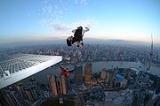
BASE jumping

Encyclopedia

Parachute
A parachute is a device used to slow the motion of an object through an atmosphere by creating drag, or in the case of ram-air parachutes, aerodynamic lift. Parachutes are usually made out of light, strong cloth, originally silk, now most commonly nylon...
to jump from fixed objects. "BASE" is an acronym that stands for four categories of fixed objects from which one can jump: building
Building
In architecture, construction, engineering, real estate development and technology the word building may refer to one of the following:...
s, antenna
Antenna (radio)
An antenna is an electrical device which converts electric currents into radio waves, and vice versa. It is usually used with a radio transmitter or radio receiver...
s, spans (bridge
Bridge
A bridge is a structure built to span physical obstacles such as a body of water, valley, or road, for the purpose of providing passage over the obstacle...
s), and earth (cliff
Cliff
In geography and geology, a cliff is a significant vertical, or near vertical, rock exposure. Cliffs are formed as erosion landforms due to the processes of erosion and weathering that produce them. Cliffs are common on coasts, in mountainous areas, escarpments and along rivers. Cliffs are usually...
s).
History
The acronym "B.A.S.E." (now more commonly "BASE") was coined by filmmaker Carl BoenishCarl Boenish
Carl Boenish considered the father of modern BASE jumping, was a freefall cinematographer, who in 1978 filmed the first jumps from El Capitan using ram-air parachutes. These jumps were repeated, not as a publicity exercise or as a movie stunt, but as a true, recurring recreational activity. This...
, his wife Jean Boenish, Phil Smith, and Phil Mayfield. Carl Boenish was the real catalyst behind modern BASE jumping, and in 1978, he filmed the first BASE jumps to be made using ram-air parachutes and the freefall tracking technique
Tracking (freeflying)
Tracking, one of the first freefall skills learnt by a novice skydiver, is the technique of assuming a body position that allows the skydiver to move horizontally while freefalling....
(from El Capitan
El Capitan
El Capitan is a vertical rock formation in Yosemite National Park, located on the north side of Yosemite Valley, near its western end. The granite monolith extends about from base to summit along its tallest face, and is one of the world's favorite challenges for rock climbers.The formation was...
, in Yosemite National Park
Yosemite National Park
Yosemite National Park is a United States National Park spanning eastern portions of Tuolumne, Mariposa and Madera counties in east central California, United States. The park covers an area of and reaches across the western slopes of the Sierra Nevada mountain chain...
). While BASE jumps had been made prior to that time, the El Capitan activity was the effective birth of what is now called BASE jumping. BASE jumping is significantly more dangerous than similar sports such as skydiving from aircraft, and is currently regarded by many as a fringe extreme sport
Extreme sport
An extreme sport is a popular term for certain activities perceived as having a high level of inherent danger...
or stunt
Stunt
A stunt is an unusual and difficult physical feat, or any act requiring a special skill, performed for artistic purposes in TV, theatre, or cinema...
.
BASE numbers are awarded to those who have made at least one jump from each of the four categories (buildings, antennas, spans and earth). When Phil Smith and Phil Mayfield jumped together from a Houston skyscraper on 18 January 1981, they became the first to attain the exclusive BASE numbers (BASE #1 and #2, respectively), having already jumped from an antenna, spans
Span (architecture)
Span is the distance between two intermediate supports for a structure, e.g. a beam or a bridge.A span can be closed by a solid beam or of a rope...
, and earthen objects. Jean and Carl Boenish qualified for BASE numbers 3 and 4 soon after. A separate "award" was soon enacted for Night BASE jumping when Mayfield completed each category at night, becoming Night BASE #1, with Smith qualifying a few weeks later.
During the early eighties, nearly all BASE jumps were made using standard skydiving equipment, including two parachutes (main and reserve), and deployment components. Later on, specialized equipment and techniques were developed that were designed specifically for the unique needs of BASE jumping.
Timeline of notable jumps
- In 1912, Franz ReicheltFranz ReicheltFranz Reichelt, also known as Frantz Reichelt or François Reichelt , was an Austrian-born French tailor, inventor and parachuting pioneer, now sometimes referred to as the Flying Tailor, who is remembered for his accidental death by jumping from the Eiffel Tower while testing a wearable parachute...
, tailor, jumped from the first deck of the Eiffel TowerEiffel TowerThe Eiffel Tower is a puddle iron lattice tower located on the Champ de Mars in Paris. Built in 1889, it has become both a global icon of France and one of the most recognizable structures in the world...
testing his invention, the coat parachute. He died. It was his first ever attempt with the parachute and he had told the authorities in advance he would test it first with a dummy. - In 1913, Štefan BaničŠtefan BanicŠtefan Banič was a Slovak inventor who devised a military parachute, the first parachute ever deployed in actual use....
jumped from a building in order to demonstrate his new parachuteParachuteA parachute is a device used to slow the motion of an object through an atmosphere by creating drag, or in the case of ram-air parachutes, aerodynamic lift. Parachutes are usually made out of light, strong cloth, originally silk, now most commonly nylon...
to the U. S. Patent Office and military. - In 1913, a Russian student Vladimir Ossovski (Владимир Оссовский), from the Saint-Petersburg Conservatory, jumped from the 53-meter high bridge over the river Seine in Rouen (France), using the parachute RK-1, invented a year before that by Gleb KotelnikovGleb KotelnikovGleb Yevgeniyevich Kotelnikov , was the Russian-Soviet inventor of the knapsack parachute , and braking parachute....
(1872–1944). Ossovski planned jumping from the Eiffel TowerEiffel TowerThe Eiffel Tower is a puddle iron lattice tower located on the Champ de Mars in Paris. Built in 1889, it has become both a global icon of France and one of the most recognizable structures in the world...
too, but the Paris authorities didn’t allow that. - In 1965, Erich Felbermayr from WelsWelsWels is the second largest city of the state of Upper Austria, located in the north of Austria, on the Traun River near Linz. It is not part of its surrounding Wels County , but a so-called Statutarstadt . However, Wels is the county seat of Wels-Land.- Geography :Wels is located in the...
jumped from the Kleine Zinne / Cima piccola di LavaredoTre Cime di LavaredoThe Tre Cime di Lavaredo are three distinctive battlement-like peaks, in the Sexten Dolomites of northeastern Italy. They are probably one of the best-known mountain groups in the Alps...
in the DolomitesDolomitesThe Dolomites are a mountain range located in north-eastern Italy. It is a part of Southern Limestone Alps and extends from the River Adige in the west to the Piave Valley in the east. The northern and southern borders are defined by the Puster Valley and the Sugana Valley...
. - In 1966, Michael PelkeyMichael PelkeyMichael Pelkey and Brian Schubert are considered the founders of BASE jumping.-El Capitan jump:On 24 July 1966 Pelkey and Brian Schubert, two 26-year-old skydivers from Barstow, California, made the first parachute jumps from the top of the El Capitan mountain in Yosemite National Park...
and Brian Schubert jumped from the cliff "El CapitanEl CapitanEl Capitan is a vertical rock formation in Yosemite National Park, located on the north side of Yosemite Valley, near its western end. The granite monolith extends about from base to summit along its tallest face, and is one of the world's favorite challenges for rock climbers.The formation was...
" in Yosemite ValleyYosemite ValleyYosemite Valley is a glacial valley in Yosemite National Park in the western Sierra Nevada mountains of California, carved out by the Merced River. The valley is about long and up to a mile deep, surrounded by high granite summits such as Half Dome and El Capitan, and densely forested with pines...
. - On 9 November 1975, the first person to parachute off the CN TowerCN TowerThe CN Tower is a communications and observation tower in Downtown Toronto, Ontario, Canada. Standing tall, it was completed in 1976, becoming the world's tallest free-standing structure and world's tallest tower at the time. It held both records for 34 years until the completion of the Burj...
in TorontoTorontoToronto is the provincial capital of Ontario and the largest city in Canada. It is located in Southern Ontario on the northwestern shore of Lake Ontario. A relatively modern city, Toronto's history dates back to the late-18th century, when its land was first purchased by the British monarchy from...
, Canada, was Bill Eustace, a member of the tower's construction crew. He was fired. - In 1975, Owen J. QuinnOwen J. QuinnOwen J. Quinn was the first person to successfully parachute off one of the World Trade Center towers.-The beginning:...
, a jobless man, parachuted from the south tower of the World Trade CenterWorld Trade CenterThe original World Trade Center was a complex with seven buildings featuring landmark twin towers in Lower Manhattan, New York City, United States. The complex opened on April 4, 1973, and was destroyed in 2001 during the September 11 attacks. The site is currently being rebuilt with five new...
to publicize the plight of the unemployed. - In 1976 Rick SylvesterRick SylvesterRick Sylvester is a Hollywood stuntman, most famous for his BASE jump using skis and a Union Flag parachute from Canada's Mount Asgard for the James Bond movie The Spy Who Loved Me in July 1976. In 1973, he skied off the top of El Capitan and descended approximately 914 metres by parachute. This...
skied off Canada's Mount AsgardMount AsgardMount Asgard is a twin peaked mountain with two flat-topped cylindrical rock towers, separated by a saddle. It is located in Auyuittuq National Park, on the Cumberland Peninsula of Baffin Island, Nunavut, Canada. The peak is named after Asgard, the realm of the gods in Norse mythology...
for the ski chase sequence of the James Bond movie The Spy Who Loved MeThe Spy Who Loved Me (film)The Spy Who Loved Me is a spy film, the tenth film in the James Bond series, and the third to star Roger Moore as the fictional secret agent James Bond. It was directed by Lewis Gilbert and the screenplay was written by Christopher Wood and Richard Maibaum...
, giving the wider world its first look at BASE jumping. - In 1982, on the 22nd of February, Wayne Allwood, an Australian skydiving accuracy champion, parachuted from a helicopter over the Sydney CBD and landed on the small top area of Sydney's Centrepoint Tower approximately 300m above the ground. Within a couple of minutes of landing Allwood had discarded and secured his parachute and with spectacular style threw himself off the Tower using a full-sized reserve parachute to BASE jump into Hyde Park below. Video is available by searching 'Centrepoint Tower BASE jump 1982'
- In 1987 Steve Dines (Australian) BASE 157 Made the first jump from the top of the Sydney Harbour Bridge. The jump can be seen on YouTube.
- In 1990 Russell Powell (British) BASE 230 illegally jumped from the Whispering GalleryWhispering galleryA whispering gallery is a gallery beneath a dome, vault, or enclosed in a circular or elliptical area in which whispers can be heard clearly in other parts of the building....
inside St Paul's CathedralSt Paul's CathedralSt Paul's Cathedral, London, is a Church of England cathedral and seat of the Bishop of London. Its dedication to Paul the Apostle dates back to the original church on this site, founded in AD 604. St Paul's sits at the top of Ludgate Hill, the highest point in the City of London, and is the mother...
London. It was the lowest indoor BASE Jump in the world at 102ft. - In 1990 Australian Mark Scott BASE# 165 / OZ BASE # 13 / SA BASE #1 made the first BASE Jump off London's Canary Wharf Tower 4 days before the topping out ceremony. "
- On August 26, 1992 Nic Feteris and Glenn Singleman (two Australians) made a BASE jump from an altitude of 20,600 feet (6286 meters) jump off Great Trango TowersTrango TowersThe Trango Towers are a group of dramatic granite spires located on the north side of the Baltoro Glacier, in Baltistan, a district of the Gilgit-Baltistan region of Pakistan . They are part of the Baltoro Muztagh, a subrange of the Karakoram range. The Towers offer some of the largest cliffs and...
Pakistan. It is the world's highest natural BASE jump off the earth and the most dangerous one as well. - In 2000, Hannes Arch and Ueli Gegenschatz were the first to dare a BASE jump from the imposing 1800-metre high north face of the Eiger, one of the most daunting peaks in the Swiss Alps.
- In May 2008, Hervé Le Gallou and a British man Darren Bull twice infiltrated Burj Khalifa, the tallest man-made structure in the world (around 650m at the time while still under construction), and jumped off a balcony situated a couple of floors below the 160th floor.
- In 2009, three women, 20 year old Melody Morin, 28-year-old Venezuelan Ana Isabel Dao, and 32-year-old Norwegian Anniken Binz base jumped from the highest waterfall in the world with a height of 979 metres (3,211.9 ft) and a clear drop of 807 metres (2,647.6 ft), Angel Falls, located in the Gran Sabana region of Bolivar State in VenezuelaVenezuelaVenezuela , officially called the Bolivarian Republic of Venezuela , is a tropical country on the northern coast of South America. It borders Colombia to the west, Guyana to the east, and Brazil to the south...
. Ana Isabel Dao was the first Venezuelan woman to jump off Angel Falls. - On 8 January 2010, Nasr Al Niyadi and Omar Al Hegelan, from the Emirates Aviation Society, broke the world record for the highest building BASE jump after they leapt from a crane suspended platform attached to Burj Khalifa's 160th floor at 672 metres (2,204.7 ft).
However, these and other sporadic incidents were one-time experiments, not the systematic pursuit of a new form of parachuting. After 1978, the filmed jumps from El Capitan were repeated, not as a publicity exercise or as a movie stunt, but as a true recreational activity. It was this that popularised BASE jumping more widely among parachutists. Carl Boenish continued to publish films and informational magazines on BASE jumping until his death in 1984 after a BASE-jump off of the Troll Wall
Troll Wall
The Troll Wall is part of the mountain massif Trolltindene in the Romsdalen valley, near Åndalsnes and Molde, on the Norwegian west coast. Trollveggen is part of the Reinheimen National Park in the municipality of Rauma in Møre og Romsdal county. The Troll Wall is the tallest vertical rock face...
. By this time, the concept had spread among skydivers worldwide, with hundreds of participants making fixed-object jumps.
Comparison with skydiving
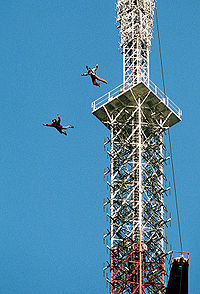
Terminal velocity
In fluid dynamics an object is moving at its terminal velocity if its speed is constant due to the restraining force exerted by the fluid through which it is moving....
. Because higher airspeeds enable jumpers more aerodynamic control of their bodies, as well as more positive and quick parachute openings, the longer the delay, the better.
Skydivers use the air flow to stabilize their position, allowing the parachute to deploy cleanly. BASE jumpers, falling at lower speeds, have less aerodynamic control, and may tumble. The attitude of the body at the moment of jumping determines the stability of flight in the first few seconds, before sufficient airspeed has built up to enable aerodynamic stability. On low BASE jumps, parachute deployment takes place during this early phase of flight, so if a poor "launch" leads into a tumble, the jumper may not be able to correct this before the opening. If the parachute is deployed while the jumper is tumbling, there is a high risk of entanglement or malfunction. The jumper may also not be facing the right direction. Such an off-heading opening is not as problematic in skydiving, but an off-heading opening that results in object strike has caused many serious injuries and deaths in BASE jumping.
At an altitude of 600m (2,000 feet), having been in free-fall for at least 300m (1,000 feet), the jumper is falling at approximately 55 m/s (190 km/h, 120 mph), and is approximately 10.9 seconds from the ground. Most BASE jumps are made from less than 600m (2,000 feet). For example, a BASE jump from a 150m (500 foot) object is about 5.6 seconds from the ground if the jumper remains in free fall. On a BASE jump, the parachute must open at about half the airspeed of a similar skydive, and more quickly (in a shorter distance fallen). Standard skydiving parachute systems are not designed for this situation, so BASE jumpers often use specially designed harnesses and parachute containers, with extra large pilot chutes, and many jump with only one parachute, since there would be little time to utilize a reserve parachute. If modified, by removing the bag and slider, stowing the lines in a tail pocket, and fitting a large pilot chute, standard skydiving gear can be used for lower BASE jumps, but is then prone to kinds of malfunction that are rare in normal skydiving (such as "line-overs" and broken lines).
Another risk is that most BASE jumping venues have very small areas in which to land. A beginner skydiver, after parachute deployment, may have a three minute or more parachute ride to the ground. A BASE jump from 150m (500 foot) will have a parachute ride of only 10 to 15 seconds.
One way to make a parachute open very quickly is to use a static line
Static line
A static line is a fixed cord attached to a large, stable object. It is used for safety in construction andto open parachutes automatically for paratroopers and novice parachutists.-Use in parachuting:...
or direct bag. These devices form an attachment between the parachute and the jump platform, which stretches out the parachute and suspension lines as the jumper falls, before separating and allowing the parachute to inflate. This method enables the very lowest jumps (below 60m / 200 ft) to be made, although most BASE jumpers are more motivated to make higher jumps involving free fall. This method is similar to the paratrooper
Paratrooper
Paratroopers are soldiers trained in parachuting and generally operate as part of an airborne force.Paratroopers are used for tactical advantage as they can be inserted into the battlefield from the air, thereby allowing them to be positioned in areas not accessible by land...
's deployment system, also called a PCA (Pilot Chute Assist).
Legal issues
The legal issues that a BASE jumper must consider concern permissions to use the object from which the jump is initiated and the area used for landing.Surreptitious BASE jumps are often made from tall buildings and antenna towers. The general reluctance of the owners of these objects to allow their object to be used as a platform means many such BASE jumps are attempted covertly. While BASE jumping itself is generally not illegal; making events such as the "Go Fast Games" at the Royal Gorge Bridge
Royal Gorge Bridge
The Royal Gorge Bridge is a tourist attraction near Cañon City, Colorado, within a theme park. The bridge deck hangs above the Arkansas River, and held the record of highest bridge in the world from 1929 until 2003, when it was surpassed by the Beipanjiang River 2003 Bridge in China. It is a...
possible; the covert nature of accessing objects usually necessitates trespassing on an object. Jumpers who are caught can expect to be charged with trespassing, as well as having charges like breaking and entering, reckless endangerment, vandalism, or other such charges pressed against them. Other people accompanying the jumper, such as ground crew, may also face charges. In some jurisdictions it may be permissible to use land until specifically told not to. Perrine Bridge
Perrine Bridge
The I. B. Perrine Bridge at Twin Falls, Idaho, United States is a truss arch four-lane bridge carrying U.S. Highway 93 over the Snake River Canyon. Perrine Bridge is approximately long and above the Snake River...
in Twin Falls, Idaho
Twin Falls, Idaho
Twin Falls is the county seat and largest city of Twin Falls County, Idaho, United States. The population was 44,125 at the 2010 censusTwin Falls is the largest city of Idaho's Magic Valley region...
, is an example of a man-made structure in the United States where BASE jumping is allowed year-round without a permit.
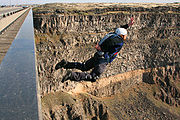
Bridge Day
Bridge Day is an annual one-day festival in Fayetteville, West Virginia, sponsored by the Fayette County Chamber of Commerce. The event, held on the third Saturday every October, commemorates the 1977 completion of the New River Gorge Bridge. On this day, all four lanes of the bridge are closed to...
"), permission to BASE jump has explicitly been granted at the New River Gorge Bridge
New River Gorge Bridge
The New River Gorge Bridge is a steel arch bridge long over the New River Gorge near Fayetteville, West Virginia, in the Appalachian Mountains of the eastern United States. With an arch long, the New River Gorge Bridge was for many years the world's longest arch bridge; it is now the third...
in Fayetteville, West Virginia
Fayetteville, West Virginia
Fayetteville is a town in and the county seat of Fayette County, West Virginia, United States. The population was 2,754 at the 2000 census.Fayetteville was listed as one of the 2006 "Top 10 Coolest Small Towns in America" by Budget Travel Magazine ....
. The New River Gorge Bridge deck is 876 feet (297 m) above the river. This annual event attracts about 450 BASE jumpers, and nearly 200,000 spectators. If the conditions are good, in the six hours that it is legal, there may be over 1100 jumps. For many skydivers who would like to try BASE jumping, this will be the only fixed object from which they ever jump. On 21 October 2006, veteran BASE jumper Brian Lee Schubert of Alta Loma, California
Alta Loma, Rancho Cucamonga, California
Alta Loma is one of three formerly unincorporated areas that became part of the city of Rancho Cucamonga, California, United States in 1977. The community is located in the foothills of the south face of the San Gabriel Mountain range, near Cucamonga Peak and Mount Baldy. It is located in the...
was killed jumping from the New River Gorge Bridge during Bridge Day activities. His parachute opened late and he plummeted to his death in the waters below. Jumps continued following the recovery of his body. He and his friend Michael Pelkey
Michael Pelkey
Michael Pelkey and Brian Schubert are considered the founders of BASE jumping.-El Capitan jump:On 24 July 1966 Pelkey and Brian Schubert, two 26-year-old skydivers from Barstow, California, made the first parachute jumps from the top of the El Capitan mountain in Yosemite National Park...
were the first to make a BASE jump from El Capitan
El Capitan
El Capitan is a vertical rock formation in Yosemite National Park, located on the north side of Yosemite Valley, near its western end. The granite monolith extends about from base to summit along its tallest face, and is one of the world's favorite challenges for rock climbers.The formation was...
in Yosemite National Park
Yosemite National Park
Yosemite National Park is a United States National Park spanning eastern portions of Tuolumne, Mariposa and Madera counties in east central California, United States. The park covers an area of and reaches across the western slopes of the Sierra Nevada mountain chain...
in 1966.
The National Park Service has the authority to ban specific activities in US National Parks, and has done so for BASE jumping. The authority comes from 36 CFR 2.17(3), which prohibits, "Delivering or retrieving a person or object by parachute, helicopter, or other airborne means, except in emergencies involving public safety or serious property loss, or pursuant to the terms and conditions of a permit." Under that Regulation, BASE is not banned, but is allowable if a permit is issued by the Superintendent, which means that a mechanism to allow BASE in National Parks was always in place. However, National Park Service Management Policies have stated that BASE "is not an appropriate public use activity within national park areas ..." (2001 Management Policy 8.2.2.7.) This meant that there could be no permitted air delivery. It is noted, however, that this policy has a proposed change that strikes the language banning it outright and replacing it with a different test. Whether this will be approved, and whether this will make the granting of permits easier, is open to speculation.
In the early days of BASE jumping, the Service issued permits under which jumpers could get authorization to jump from El Capitan. This program ran for three months in 1980 and then collapsed amid allegations of abuse by unauthorised jumpers. Since then, the Service has vigorously enforced the ban, charging jumpers with "aerial delivery into a National Park". One jumper drowned in the Merced River
Merced River
The Merced River , in the central part of the U.S. state of California, is a -long tributary of the San Joaquin River flowing from the Sierra Nevada into the Central Valley. It is most well known for its swift and steep course through the southern part of Yosemite National Park, and the...
while being chased by Park Rangers intent on arresting him. Despite this, illegal jumps continue in Yosemite at a rate estimated at a few hundred per year, often at night or dawn. El Capitan, Half Dome
Half Dome
Half Dome is a granite dome in Yosemite National Park, located in northeastern Mariposa County, California, at the eastern end of Yosemite Valley — possibly Yosemite's most familiar rock formation. The granite crest rises more than above the valley floor....
and Glacier Point
Glacier Point
thumb|right|upright|Glacier Point, as seen from [[Yosemite Valley]]. In springtime, this cliff face is covered with dozens of freshets and tiny waterfalls from the snowmelt, the largest being [[Staircase Falls]]....
have been used as jump sites.
Other US public land, including land controlled by the Bureau of Land Management, does not ban air delivery, and there are numerous jumpable objects on BLM land.
The legal position is better at other sites and in other countries. For example, in Norway's Lysefjord
Lysefjord
Lysefjord is a fjord located in Forsand in Ryfylke in south-western Norway...
(from the mountain Kjerag
Kjerag
Kjerag or Kiragg is a Norwegian mountain, located in Lysefjorden, in Forsand municipality, Ryfylke, Rogaland. Its highest point is 1110 m above sea level, but its northern drop to Lysefjorden attracts most visitors. The drop is and is just by the famous Kjeragbolten, a 5 m³ big stone...
), BASE jumpers are made welcome. Many sites in the European Alps, near Chamonix and on the Eiger, are also open to jumpers. Some other Norwegian places, like the Troll Wall
Troll Wall
The Troll Wall is part of the mountain massif Trolltindene in the Romsdalen valley, near Åndalsnes and Molde, on the Norwegian west coast. Trollveggen is part of the Reinheimen National Park in the municipality of Rauma in Møre og Romsdal county. The Troll Wall is the tallest vertical rock face...
, are banned because of dangerous rescue missions in the past.
BASE jumping today
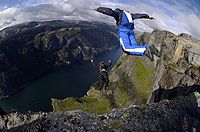
BASE jumping is often featured in action movies. The 2002 Vin Diesel
Vin Diesel
Vin Diesel is an American actor, writer, director and producer. He became known in the early 2000s, appearing in several successful Hollywood films, including The Fast and the Furious and xXx...
film xXx
XXX
XXX may refer to:* The number 30 in Roman numerals* The year 30 AD* Games of the XXX Olympiad, the 2012 Summer Olympic Games in London, England* Super Bowl XXX, held on January 28, 1996* A mark indicating "extra strong"* Alcoholic beverages...
includes a scene where Diesel's character catapults himself off the Foresthill Bridge
Foresthill Bridge
The Foresthill Bridge over the North Fork of the American River is the highest bridge in the U.S. state of California. It is sometimes referred to as the Auburn-Foresthill Bridge or the Auburn Bridge....
in an open-topped car, landing safely as the car crashes on the ground. In the movie Lara Croft Tomb Raider: The Cradle of Life
Lara Croft Tomb Raider: The Cradle of Life
Lara Croft Tomb Raider: The Cradle of Life is a 2003 action film directed by Jan de Bont, and starring Angelina Jolie as Lara Croft. It is a sequel to the 2001 film Lara Croft: Tomb Raider...
, includes the scene in which the main characters jump with wing suits from the IFC Tower in Hong Kong
Hong Kong
Hong Kong is one of two Special Administrative Regions of the People's Republic of China , the other being Macau. A city-state situated on China's south coast and enclosed by the Pearl River Delta and South China Sea, it is renowned for its expansive skyline and deep natural harbour...
and fly over the Bank of China, finally opening their parachutes to land on a moving freighter. The stunt was done in reality with no special effects by the stunt base jumpers Martin Rosén and Per Eriksson, members of the Swedish "Team Bautasten". The scene was filmed by air-to-air camera man Mikael Nordqvist from the same team. Since the 1976 Mount Asgard
Mount Asgard
Mount Asgard is a twin peaked mountain with two flat-topped cylindrical rock towers, separated by a saddle. It is located in Auyuittuq National Park, on the Cumberland Peninsula of Baffin Island, Nunavut, Canada. The peak is named after Asgard, the realm of the gods in Norse mythology...
jump featured in the pre-credits sequence to The Spy Who Loved Me
The Spy Who Loved Me (film)
The Spy Who Loved Me is a spy film, the tenth film in the James Bond series, and the third to star Roger Moore as the fictional secret agent James Bond. It was directed by Lewis Gilbert and the screenplay was written by Christopher Wood and Richard Maibaum...
, James Bond movies have featured several BASE jumps, including one from the Eiffel Tower
Eiffel Tower
The Eiffel Tower is a puddle iron lattice tower located on the Champ de Mars in Paris. Built in 1889, it has become both a global icon of France and one of the most recognizable structures in the world...
in 1985's A View to a Kill
A View to a Kill
A View to a Kill is the fourteenth spy film of the James Bond series, and the seventh and last to star Roger Moore as the fictional MI6 agent James Bond. Although the title is adapted from Ian Fleming's short story "From a View to a Kill", the film is the fourth Bond film after The Spy Who Loved...
, the Rock of Gibraltar
Rock of Gibraltar
The Rock of Gibraltar is a monolithic limestone promontory located in Gibraltar, off the southwestern tip of Europe on the Iberian Peninsula. It is high...
in 1987's The Living Daylights
The Living Daylights
The Living Daylights is the fifteenth entry in the James Bond series and the first to star Timothy Dalton as the fictional MI6 agent 007. The film's title is taken from Ian Fleming's short story, "The Living Daylights"...
, and in Die Another Day
Die Another Day
Die Another Day is the 20th spy film in the James Bond series, and the fourth and last film to star Pierce Brosnan as the fictional MI6 agent James Bond; it is also the last Bond film of the original timeline with the series being rebooted with Casino Royale...
, 2002, Pierce Brosnan
Pierce Brosnan
Pierce Brendan Brosnan, OBE is an Irish actor, film producer and environmentalist. After leaving school at 16, Brosnan began training in commercial illustration, but trained at the Drama Centre in London for three years...
as James Bond
James Bond
James Bond, code name 007, is a fictional character created in 1953 by writer Ian Fleming, who featured him in twelve novels and two short story collections. There have been a six other authors who wrote authorised Bond novels or novelizations after Fleming's death in 1964: Kingsley Amis,...
jumps from a melting iceberg. Of the James Bond jumps only the Mt Asgard and Eiffel Tower jumps were filmed in reality; the rest were special effects.
Guinness World Records
Guinness World Records
Guinness World Records, known until 2000 as The Guinness Book of Records , is a reference book published annually, containing a collection of world records, both human achievements and the extremes of the natural world...
first listed a BASE jumping record with Carl Boenish
Carl Boenish
Carl Boenish considered the father of modern BASE jumping, was a freefall cinematographer, who in 1978 filmed the first jumps from El Capitan using ram-air parachutes. These jumps were repeated, not as a publicity exercise or as a movie stunt, but as a true, recurring recreational activity. This...
's 1984 leap from Trollveggen (Troll Wall
Troll Wall
The Troll Wall is part of the mountain massif Trolltindene in the Romsdalen valley, near Åndalsnes and Molde, on the Norwegian west coast. Trollveggen is part of the Reinheimen National Park in the municipality of Rauma in Møre og Romsdal county. The Troll Wall is the tallest vertical rock face...
) in Norway. It was described as the highest BASE jump. (The jump was made two days before Boenish's death at the same site.) This record category is still in the Guinness book and is currently held by Australians Glenn Singleman
Glenn Singleman
Dr Glenn SIngleman is an Australian basejumper who currently holds four world records, including highest altitude BASEjump . He is also a documentary filmmaker ; and practicing medical doctor.-References:...
and Heather Swan with a jump from Meru Peak
Meru Peak
Meru Peak is a mountain which lies in the Himalayas, in the Uttarakhand region of India. It is within the Nanda Devi National Park, and is high. It is the site of the world's highest BASE Jump from 'Earth', by Glenn Singleman and Heather Swan from a height of in June 2006.The mountain has three...
in northern India at a starting elevation of 6604 metres (21,666.7 ft). On July 8, 2006 Captain Daniel G. Schilling set the Guinness World Record for the most BASE jumps in a twenty-four hour period. Schilling jumped off the Perrine Bridge
Perrine Bridge
The I. B. Perrine Bridge at Twin Falls, Idaho, United States is a truss arch four-lane bridge carrying U.S. Highway 93 over the Snake River Canyon. Perrine Bridge is approximately long and above the Snake River...
in Twin Falls, Idaho a record 201 times.
BASE competitions have been held since the early 1980s, with accurate landings or free fall aerobatics used as the judging criteria. Recent years have seen a formal competition held at the 452 metres (1,482.9 ft) high Petronas Towers in Kuala Lumpur, Malaysia, judged on landing accuracy.
In 2010 Northern Norway celebrated with a world record with 53 Base jumpers jumping from a cliff.
Fatalities
BASE jumping is one of the world's most dangerous recreational activities, with overall fatalities in 2002 estimated at about one fatality per sixty participants.Another study reported the fatality risk as 1 in 2,317 jumps over the period 1995-2005 in Norway only..
Further reading
- "The Great Book of BASE". BirdBrain Publishing. July, 2010.
- "The Ground's the Limit". Texas Monthly. December 1981.
- "BASE Fatality Statistics". BLiNC Magazine. July 2011.