


B. Gratz Brown

Encyclopedia
Benjamin Gratz Brown was an American
politician. He was a Senator
, the 20th Governor of Missouri, and the Liberal Republican
and Democratic Party
Vice presidential
candidate in the presidential election of 1872.
, in 1826. He was the grandson of Senators John Brown
and Jesse Bledsoe
of Kentucky. He graduated from Transylvania University
in Lexington in 1845 and from Yale College
in New Haven, Connecticut
, in 1847. He studied law, and later settled in St. Louis
, Missouri
. There he joined his cousin, Francis P. Blair, Jr., and Senator Thomas Hart Benton
in a struggle against the pro-slavery
faction for control of Missouri's Democratic Party
.
and served there between 1852 and 1858. An able lawyer in St. Louis, Brown made a speech in 1857 against a joint resolution opposing emancipation. The speech marked the beginning of the Free Soil movement in Missouri. He was a leader of the movement. After that, he edited the Missouri Democrat between 1854 and 1859. He was an unsuccessful candidate for Governor of Missouri in 1857.
On August 26, 1856 he fought a duel
on Bloody Island (Mississippi River) with Thomas C. Reynolds (then the St. Louis District Attorney) over the slavery issue. Reynolds was not hurt but Brown was shot in the leg and limped for the rest of his life.
Brown became a founding member of the Republican Party
in Missouri. Throughout the 1860s, he and Blair contested control of the state's Republican party. He tried to prevent Missouri from seceding
from the Union in 1861. After that, he served as an officer in the Union Army
during the first half of the Civil War
, raising a regiment (the 4th U.S. Reserves) and serving as its colonel
. He recruited over 1,100 soldiers for his regiment, many of which were St. Louis-area German-Americans
, a key constituency that Brown courted for his political advantage.
Brown resigned from the Army after he was elected in late 1863 as an Unconditional Unionist
to the U.S. Senate to fill the vacancy caused by the expulsion of Waldo P. Johnson
. Brown opposed Abraham Lincoln
's moderation and objected to the Emancipation Proclamation
because it did not free slaves in Missouri and other loyal border states. He was a key figure in the move to replace Lincoln with John C. Frémont
in the presidential election of 1864
. In the Senate, Brown was chairman of the Public Buildings and Grounds committee and of the Committee to Audit and Control the Contingent Expense
. Following Lincoln's assassination, Brown was vehemently opposed to new President Andrew Johnson
's moderate plan of Reconstruction. He also supported the Radical-sponsored Civil Rights Bill and Freedmen's Bureau Bill. Brown left the Senate in 1867 because of ill health.
In 1870, dissatisfied with the Missouri Republicans, he joined the new Liberal Republican Party
. The party nominated Brown for governor, and he defeated Republican incumbent Joseph W. McClurg
. Brown served as the Governor between 1871 and 1873.
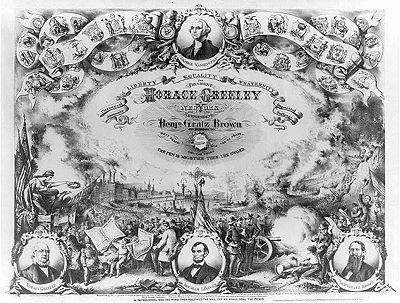 Brown was one of the contenders for the Liberal Republican presidential nomination, but lost to newspaper editor Horace Greeley
. Brown was the vice presidential candidate under Greeley in the presidential election of 1872
for the Liberal Republican and Democratic parties. Greeley died on November 29 of illness, before the results came out in the electoral college
, and the electoral votes that were to have been for Greeley were split between many candidates. Eighteen of those electoral votes went to Brown. The Republicans, incumbent president
Ulysses S. Grant
and the vice presidential candidate, U.S. Senator Henry Wilson
of Massachusetts
, won the election anyway.
Brown returned to his law practice, quit the Republican Party and resumed his ties to the Democrats. He died in Kirkwood, Missouri
and is interred there at Oak Hill Cemetery.
United States
The United States of America is a federal constitutional republic comprising fifty states and a federal district...
politician. He was a Senator
United States Senate
The United States Senate is the upper house of the bicameral legislature of the United States, and together with the United States House of Representatives comprises the United States Congress. The composition and powers of the Senate are established in Article One of the U.S. Constitution. Each...
, the 20th Governor of Missouri, and the Liberal Republican
Liberal Republican Party (United States)
The Liberal Republican Party of the United States was a political party that was organized in Cincinnati in May 1872, to oppose the reelection of President Ulysses S. Grant and his Radical Republican supporters. The party's candidate in that year's presidential election was Horace Greeley, longtime...
and Democratic Party
Democratic Party (United States)
The Democratic Party is one of two major contemporary political parties in the United States, along with the Republican Party. The party's socially liberal and progressive platform is largely considered center-left in the U.S. political spectrum. The party has the lengthiest record of continuous...
Vice presidential
Vice President of the United States
The Vice President of the United States is the holder of a public office created by the United States Constitution. The Vice President, together with the President of the United States, is indirectly elected by the people, through the Electoral College, to a four-year term...
candidate in the presidential election of 1872.
Early life
Brown was born in Frankfort, KentuckyFrankfort, Kentucky
Frankfort is a city in Kentucky that serves as the state capital and the county seat of Franklin County. The population was 27,741 at the 2000 census; by population it is the 5th smallest state capital in the United States...
, in 1826. He was the grandson of Senators John Brown
John Brown (Kentucky)
John Brown was an American lawyer and statesman heavily involved with creating the State of Kentucky.Brown represented Virginia in the Continental Congress and the U.S. Congress . While in Congress, he introduced the bill granting Statehood to Kentucky. Once that was accomplished, he was elected...
and Jesse Bledsoe
Jesse Bledsoe
Jesse Bledsoe was a Senator from Kentucky.He was born in Culpeper County, Virginia in 1776. When he was very young, his family migrated with a Baptist congregation through Cumberland Gap into Kentucky. Many of the adults in this traveling congregation were property: Negro slaves...
of Kentucky. He graduated from Transylvania University
Transylvania University
Transylvania University is a private, undergraduate liberal arts college in Lexington, Kentucky, United States, affiliated with the Christian Church . The school was founded in 1780. It offers 38 majors, and pre-professional degrees in engineering and accounting...
in Lexington in 1845 and from Yale College
Yale College
Yale College was the official name of Yale University from 1718 to 1887. The name now refers to the undergraduate part of the university. Each undergraduate student is assigned to one of 12 residential colleges.-Residential colleges:...
in New Haven, Connecticut
New Haven, Connecticut
New Haven is the second-largest city in Connecticut and the sixth-largest in New England. According to the 2010 Census, New Haven's population increased by 5.0% between 2000 and 2010, a rate higher than that of the State of Connecticut, and higher than that of the state's five largest cities, and...
, in 1847. He studied law, and later settled in St. Louis
St. Louis, Missouri
St. Louis is an independent city on the eastern border of Missouri, United States. With a population of 319,294, it was the 58th-largest U.S. city at the 2010 U.S. Census. The Greater St...
, Missouri
Missouri
Missouri is a US state located in the Midwestern United States, bordered by Iowa, Illinois, Kentucky, Tennessee, Arkansas, Oklahoma, Kansas and Nebraska. With a 2010 population of 5,988,927, Missouri is the 18th most populous state in the nation and the fifth most populous in the Midwest. It...
. There he joined his cousin, Francis P. Blair, Jr., and Senator Thomas Hart Benton
Thomas Hart Benton (senator)
Thomas Hart Benton , nicknamed "Old Bullion", was a U.S. Senator from Missouri and a staunch advocate of westward expansion of the United States. He served in the Senate from 1821 to 1851, becoming the first member of that body to serve five terms...
in a struggle against the pro-slavery
History of slavery in the United States
Slavery in the United States was a form of slave labor which existed as a legal institution in North America for more than a century before the founding of the United States in 1776, and continued mostly in the South until the passage of the Thirteenth Amendment to the United States Constitution in...
faction for control of Missouri's Democratic Party
Democratic Party (United States)
The Democratic Party is one of two major contemporary political parties in the United States, along with the Republican Party. The party's socially liberal and progressive platform is largely considered center-left in the U.S. political spectrum. The party has the lengthiest record of continuous...
.
Political career
Brown became a member of the Missouri House of RepresentativesMissouri House of Representatives
The Missouri House of Representatives is the lower chamber of the Missouri General Assembly. It has 163 members, representing districts with an average size of 31,000 residents. House members are elected for two-year terms during general elections held in even-numbered years.In 1992 Missouri...
and served there between 1852 and 1858. An able lawyer in St. Louis, Brown made a speech in 1857 against a joint resolution opposing emancipation. The speech marked the beginning of the Free Soil movement in Missouri. He was a leader of the movement. After that, he edited the Missouri Democrat between 1854 and 1859. He was an unsuccessful candidate for Governor of Missouri in 1857.
On August 26, 1856 he fought a duel
Duel
A duel is an arranged engagement in combat between two individuals, with matched weapons in accordance with agreed-upon rules.Duels in this form were chiefly practised in Early Modern Europe, with precedents in the medieval code of chivalry, and continued into the modern period especially among...
on Bloody Island (Mississippi River) with Thomas C. Reynolds (then the St. Louis District Attorney) over the slavery issue. Reynolds was not hurt but Brown was shot in the leg and limped for the rest of his life.
Brown became a founding member of the Republican Party
Republican Party (United States)
The Republican Party is one of the two major contemporary political parties in the United States, along with the Democratic Party. Founded by anti-slavery expansion activists in 1854, it is often called the GOP . The party's platform generally reflects American conservatism in the U.S...
in Missouri. Throughout the 1860s, he and Blair contested control of the state's Republican party. He tried to prevent Missouri from seceding
Secession
Secession is the act of withdrawing from an organization, union, or especially a political entity. Threats of secession also can be a strategy for achieving more limited goals.-Secession theory:...
from the Union in 1861. After that, he served as an officer in the Union Army
Union Army
The Union Army was the land force that fought for the Union during the American Civil War. It was also known as the Federal Army, the U.S. Army, the Northern Army and the National Army...
during the first half of the Civil War
American Civil War
The American Civil War was a civil war fought in the United States of America. In response to the election of Abraham Lincoln as President of the United States, 11 southern slave states declared their secession from the United States and formed the Confederate States of America ; the other 25...
, raising a regiment (the 4th U.S. Reserves) and serving as its colonel
Colonel
Colonel , abbreviated Col or COL, is a military rank of a senior commissioned officer. It or a corresponding rank exists in most armies and in many air forces; the naval equivalent rank is generally "Captain". It is also used in some police forces and other paramilitary rank structures...
. He recruited over 1,100 soldiers for his regiment, many of which were St. Louis-area German-Americans
German-Americans in the Civil War
German-Americans in the American Civil War were the largest ethnic contingent to fight for the Union. More than 200,000 native Germans served in the Union Army, with New York and Ohio each providing ten divisions dominated by German-born men....
, a key constituency that Brown courted for his political advantage.
Brown resigned from the Army after he was elected in late 1863 as an Unconditional Unionist
Unconditional Union Party
The Unconditional Union Party was a loosely organized political entity during the American Civil War and the early days of Reconstruction. First established in 1861 in Missouri, where secession talk was strong, the party fully supported the preservation of the Union at all costs...
to the U.S. Senate to fill the vacancy caused by the expulsion of Waldo P. Johnson
Waldo P. Johnson
Waldo Porter Johnson was a United States Senator from Missouri, and later a member of the Confederate Congress during the American Civil War....
. Brown opposed Abraham Lincoln
Abraham Lincoln
Abraham Lincoln was the 16th President of the United States, serving from March 1861 until his assassination in April 1865. He successfully led his country through a great constitutional, military and moral crisis – the American Civil War – preserving the Union, while ending slavery, and...
's moderation and objected to the Emancipation Proclamation
Emancipation Proclamation
The Emancipation Proclamation is an executive order issued by United States President Abraham Lincoln on January 1, 1863, during the American Civil War using his war powers. It proclaimed the freedom of 3.1 million of the nation's 4 million slaves, and immediately freed 50,000 of them, with nearly...
because it did not free slaves in Missouri and other loyal border states. He was a key figure in the move to replace Lincoln with John C. Frémont
John C. Frémont
John Charles Frémont , was an American military officer, explorer, and the first candidate of the anti-slavery Republican Party for the office of President of the United States. During the 1840s, that era's penny press accorded Frémont the sobriquet The Pathfinder...
in the presidential election of 1864
United States presidential election, 1864
In the United States Presidential election of 1864, Abraham Lincoln was re-elected as president. The election was held during the Civil War. Lincoln ran under the National Union ticket against Democratic candidate George B. McClellan, his former top general. McClellan ran as the "peace candidate",...
. In the Senate, Brown was chairman of the Public Buildings and Grounds committee and of the Committee to Audit and Control the Contingent Expense
United States Senate Committee to Audit and Control the Contingent Expenses of the Senate
This committee of the United States Senate was created November 4, 1807. On January 2, 1947 its functions were transferred to the Committee on Rules and Administration....
. Following Lincoln's assassination, Brown was vehemently opposed to new President Andrew Johnson
Andrew Johnson
Andrew Johnson was the 17th President of the United States . As Vice-President of the United States in 1865, he succeeded Abraham Lincoln following the latter's assassination. Johnson then presided over the initial and contentious Reconstruction era of the United States following the American...
's moderate plan of Reconstruction. He also supported the Radical-sponsored Civil Rights Bill and Freedmen's Bureau Bill. Brown left the Senate in 1867 because of ill health.
In 1870, dissatisfied with the Missouri Republicans, he joined the new Liberal Republican Party
Liberal Republican Party (United States)
The Liberal Republican Party of the United States was a political party that was organized in Cincinnati in May 1872, to oppose the reelection of President Ulysses S. Grant and his Radical Republican supporters. The party's candidate in that year's presidential election was Horace Greeley, longtime...
. The party nominated Brown for governor, and he defeated Republican incumbent Joseph W. McClurg
Joseph W. McClurg
Joseph Washington McClurg was the 19th Governor of Missouri in the decade following the American Civil War. His stepfather was William Murphy.-Biography:...
. Brown served as the Governor between 1871 and 1873.
Presidential election of 1872
Horace Greeley
Horace Greeley was an American newspaper editor, a founder of the Liberal Republican Party, a reformer, a politician, and an outspoken opponent of slavery...
. Brown was the vice presidential candidate under Greeley in the presidential election of 1872
United States presidential election, 1872
In the United States presidential election of 1872, incumbent President Ulysses S. Grant was easily elected to a second term in office with Senator Henry Wilson of Massachusetts as his running mate, despite a split within the Republican Party that resulted in a defection of many Liberal Republicans...
for the Liberal Republican and Democratic parties. Greeley died on November 29 of illness, before the results came out in the electoral college
United States Electoral College
The Electoral College consists of the electors appointed by each state who formally elect the President and Vice President of the United States. Since 1964, there have been 538 electors in each presidential election...
, and the electoral votes that were to have been for Greeley were split between many candidates. Eighteen of those electoral votes went to Brown. The Republicans, incumbent president
President of the United States
The President of the United States of America is the head of state and head of government of the United States. The president leads the executive branch of the federal government and is the commander-in-chief of the United States Armed Forces....
Ulysses S. Grant
Ulysses S. Grant
Ulysses S. Grant was the 18th President of the United States as well as military commander during the Civil War and post-war Reconstruction periods. Under Grant's command, the Union Army defeated the Confederate military and ended the Confederate States of America...
and the vice presidential candidate, U.S. Senator Henry Wilson
Henry Wilson
Henry Wilson was the 18th Vice President of the United States and a Senator from Massachusetts...
of Massachusetts
Massachusetts
The Commonwealth of Massachusetts is a state in the New England region of the northeastern United States of America. It is bordered by Rhode Island and Connecticut to the south, New York to the west, and Vermont and New Hampshire to the north; at its east lies the Atlantic Ocean. As of the 2010...
, won the election anyway.
Brown returned to his law practice, quit the Republican Party and resumed his ties to the Democrats. He died in Kirkwood, Missouri
Kirkwood, Missouri
Kirkwood is an inner-ring suburb of St. Louis, located in St. Louis County, Missouri. As of the 2010 census, the city population was 27,540. Founded in 1853, the city is named for James Pugh Kirkwood, builder of the Pacific Railroad through that town. It was the first planned suburb located west...
and is interred there at Oak Hill Cemetery.