
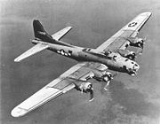
The following is an extensive catalogue of the variants and specific unique elements of each variant and/or design stage of the
BoeingThe Boeing Company is a major aerospace and defense corporation, founded by William E. Boeing in Seattle, Washington. Boeing has expanded over the years, merging with McDonnell Douglas in 1997. Its international headquarters has been in Chicago, Illinois, since 2001...
B-17 Flying Fortress heavy bomber. For a broader article on the history of the B-17, see
B-17 Flying FortressThe Boeing B-17 Flying Fortress is a four-engine heavy bomber aircraft developed for the United States Army Air Corps , introduced in the 1930s. Competing against Douglas and Martin for a contract to build 200 bombers, the Boeing entry outperformed both competitors and more than met the Air Corps'...
.
Boeing Model 299 (XB-17)
The Boeing 299 was the original bomber design made by Boeing to fulfill a request by the
United States Army Air CorpsThe United States Army Air Corps was the predecessor of the U.S. Army Air Forces from 1926-41, which in turn was the forerunner of today's U.S. Air Force , established in 1947...
for a bomber capable of carrying 2,000 lb (907 kg) of bombs 2,000 mi (3,218 km) at 200 mph (322 km/h). In 1935, the Boeing 299 competed with several entries by other companies at an evaluation at
Wright FieldWright-Patterson Air Force Base is a United States Air Force base located in Greene and Montgomery counties, eight miles northeast of the central business district of Dayton, Ohio, United States. Part of the base is located along the city limits of Riverside and is also adjacent to Fairborn and...
.
On its flight from Seattle to Wright Field for the competition, the 299 set a nonstop speed record of 252 mph (406 km/h). Though it crashed during the demonstration, the crash was due to pilot error, not any flaw in the airplane. Despite the crash (and more importantly, its much higher cost per unit), Air Corps leaders were impressed by the 299. Boeing was awarded with a development contract. The aircraft has been since been referred to as the XB-17 but the designation is not contemporary or official.
Y1B-17 (YB-17)
Though still enthusiastic about the design, the Army Air Corps decided to cut the order for service test YB-17s from 65 to 13 after the original 299 crashed. On 1936 November 20, they changed the source of funding from normal funding to 'F-1' procurement, and redesignated the plane Y1B-17 before it even flew.
Unlike its predecessor, which had used
Pratt & Whitney R-1690The Pratt & Whitney R-1690 Hornet was a widely-used aircraft engine. Developed by Pratt & Whitney, 2,944 were produced from 1926 through 1942. It first flew in 1927. It was a single-row, 9-cylinder air-cooled radial design. Displacement was 1,690 cubic inches . It was built under licence in Italy...
radial engines, the Y1B-17 used the Wright R-1830 that would become standard on the B-17. Several changes were made in the armament, and the crew was reduced from seven to six. Most changes were minor: the most notable was switching from double-arm to single-arm landing gear.
On 1936 December 7, five days after the first flight of the Y1B-17, the brakes of the aircraft fused during landing, and it nosed over. Though damage was minimal, the cumulative impact of this event and the crash of the 299 triggered a Congressional investigation. After the crash the Army Air Corps was on its toes; another crash would mean the end of the program.
Though they were meant for testing, the commander of Army General Head Quarters (Air Force), Major General Frank Andrews, decided to assign twelve Y1B-17s to the 2nd Bomb Group at
Langley FieldLangley Air Force Base is located three nautical miles north of the central business district of the city of Hampton, Virginia, United States. It is the home of the United States Air Force's 1st Fighter Wing and the 480th Intelligence Surveillance and Reconnaissance Wing . It also hosts...
,
VirginiaThe Commonwealth of Virginia is a U.S. state on the Atlantic Coast of the Southern United States. Virginia is nicknamed the "Old Dominion" and sometimes the "Mother of Presidents" because it is the birthplace of eight U.S. presidents. The geography and climate of the state are shaped by the Blue...
. Andrews reasoned that it was best to develop heavy bombing techniques as quickly as possible. Of the thirteen, only one was used for flight testing.
In 1937, the twelve Y1B-17s with the 2nd Bombardment Group at Langley Field represented the entire American fleet of Heavy Bombers. Most of the time they spent with the planes entailed eliminating problems with the aircraft. The most important development they made was the use of a
checklistA checklist is used as an aid to memory. It helps to ensure consistency and completeness in carrying out a task. A basic example is the "to do list." A more advanced checklist would be a schedule, which lays out tasks to be done according to time of day or other factors.-Applications:* a popular...
, to be reviewed by the pilot and copilot before takeoff. It was hoped that this system would prevent accidents similar to that that led to the loss of the 299.
In 1938 May, the Y1B-17s (now redesignated B-17) of the 2nd Bombardment Group took part in a demonstration in which they
intercepted the Italian liner RexThe interception of the Rex was a training exercise and military aviation achievement of the United States Army Air Corps prior to World War II. The tracking and location of an ocean going vessel by B-17 Flying Fortresses in May 1938 was a milestone in the development of a doctrine that led to a...
. Coming into contact with the liner while it was still 610 mi (982 km) out at sea, the demonstration was meant to prove the range and navigational superiority of the B-17. It also showed that the bomber would be an effective tool for attacking an invasion force before reaching the United States. The Navy was furious about Army intrusion into their mission, and forced the
War DepartmentThe United States Department of War, also called the War Office, was the cabinet department originally responsible for the operation and maintenance of the US Army...
to issue an order restricting the Army Air Force from operations more than a hundred miles from the American coast.
After three years of flight, no serious incidents occurred with the B-17s. In October 1940, they were transferred to the 19th Bombardment Group at
March FieldMarch Joint Air Reserve Base is located in Riverside County, California between the cities of Riverside and Moreno Valley. It is the home to the Air Force Reserve Command's largest air mobility wing of the 4th Air Force...
.
B-17A (Y1B-17A)
The aircraft that became the sole Y1B-17A was originally ordered as a static test bed. However, when one of the Y1B-17s survived an inadvertent violent spin during a flight in a
thunderheadCumulonimbus is a type of cloud that is tall, dense, and involved in thunderstorms and other intense weather. It is a result of atmospheric instability. These clouds can form alone, in clusters, or along a cold front in a squall line. They create lightning through the heart of the cloud...
, Air Corps leaders decided that the plane was exceptionally robust and that there would be no need for static testing. Instead, it was used as a testbed for engine types. After studying a variety of configurations, use of a bottom-mounted turbo-supercharger was settled on. This turbo-supercharge became standard on the first production model, and allowed it to fly higher and faster than the Y1B-17. When testing was complete the Y1B-17A was renamed the
B-17A.
B-17B
The B-17B (299M) was the first production model of the B-17, and was essentially a B-17A with a larger
rudderA rudder is a device used to steer a ship, boat, submarine, hovercraft, aircraft,or other conveyance that moves through a fluid . On an aircraft the rudder is used primarily to counter adverse yaw and p-factor and is not the primary control used to turn the airplane...
, larger
flapsFlaps are hinged surfaces on the trailing edge of the wings of a fixed-wing aircraft. As flaps are extended, the stalling speed of the aircraft is reduced, which means that the aircraft can fly safely at slower speeds...
, and a redesigned nose and 1,200 hp (895 kW) R-1820-51 engines. The gun turret in the upper nose was replaced with a flexible .30 in (7.62 mm) machine gun at its extreme tip, and the bomb-aiming window was replaced with an optical flat in the lower part of the nose fairing.
In the interior of the plane, crew members were rearranged. Many internal systems were revised. Most notable of these was a switch from
pneumaticPneumatics is the use of pressurized gas to effect mechanical motion.Pneumatics is that branch of technology,which deals with the study and application of use of pressurised gas to affect mechanical motion....
to
hydraulicHydraulics is a topic in applied science and engineering dealing with the mechanical properties of liquids. Fluid mechanics provides the theoretical foundation for hydraulics, which focuses on the engineering uses of fluid properties. In fluid power, hydraulics is used for the generation, control,...
brakes.
In October 1942 all planes of the B-17B designation were redesignated RB-17B,
R- indicating 'restricted'. The RB-17B was used for training, transport, messenger, and liaison duties. It was in effect a designation of obsolescence.
The "B" series made its maiden flight on June 27 1939. 39 were built in a single production run, but Army Air Corps serial numbers were scattered over several batches. This was because of limited funding: the Army Air Corps could only buy a few B-17Bs at a time.
B-17C
The B-17C was a B-17B with a number of improvements, including more powerful R-1820-65 engines. To boost crew safety, the waist-mounted gun blisters were replaced with teardrop-shaped sliding panels flush with the fuselage, and the ventral gun blister by a metal housing dubbed a 'bathtub turret'. Some of the most important additions were
self-sealing fuel tankIn aviation, self-sealing fuel tank is a fuel tank technology in wide use since World War II that prevents fuel tanks primarily on aircraft from leaking fuel and igniting after being damaged by enemy fire....
s and defensive armor.
With the passage of the
Lend-leaseLend-Lease was the name of the program under which the United States of America supplied the United Kingdom, the Soviet Union, China, France and other Allied nations with vast amounts of war material between 1941 and 1945 in return for, in the case of Britain, military bases in Newfoundland,...
Act in 1941, the
Royal Air ForceThe Royal Air Force is the United Kingdom's air force, the oldest independent air force in the world. Formed on 1 April 1918, the RAF has taken a significant role in British military history ever since, playing a large part in World War II and in more recent conflicts.The RAF operates almost 1,109...
began clamoring for use of the B-17. At that time, the Army Air Corps was suffering from shortages of the B-17, but hesitantly agreed to provide 20 planes to the RAF. Though the Army Air Corps did not consider the B-17C ready for combat, it was desperately needed in Britain. The twenty planes were placed immediately into frontline service as the
Fortress Mk I.
In Britain, the plane performed unremarkably. By 1941 September, 22 attacks had been flown using a total of 39 planes. Eight of the twenty were destroyed by the end of the war, largely because their guns tended to freeze at high altitude and were generally unable to effectively protect the Fortresses. Their success as a bomber was also limited, largely because they were unable to hit anything from the altitudes at which they flew.
The first "C" series flew in July 1940, 38 were built. The eighteen remaining after twenty were transferred to the RAF were modified to the configuration used in the B-17D. However, one of these, B-17C 40-2047, crashed while being ferried from Salt Lake City, UT, to Mather Army Air Base, CA, on November 2, 1941.
http://www.check-six.com/Crash_Sites/Sierras_B-17C_crash_site.htm
B-17D
Though changes in the design made the Army Air Corps decide that the B-17D was worthy of a new subdesignation, the B-17C and B-17D were very similar. In fact, both were given the same subdesignation (299H) by Boeing.
Several minor changes were made, both internally and externally. Outside, the engines received a set of cowling flaps for better cooling, and the external bomb racks were removed. On the inside, the electrical system was revised, and another crew member added. In the dorsal turret and bathtub turret, the guns were doubled, bringing the total armament to one 0.30 in (7.62 mm) and six 0.50 in (12.7 mm) machine guns. The B-17D also featured more extensive armor protection. A total of 42 were built, and the 18 remaining B-17Cs were also converted to B-17D format. The sole surviving example of this model of the Flying Fortress is undergoing refurbishment at the
National Museum of the United States Air ForceThe National Museum of the United States Air Force is the official National Museum of the United States Air Force and is located at Wright-Patterson Air Force Base, near Dayton, Ohio. The NMUSAF is the world's largest and oldest military aviation museum. More than 400 aircraft and missiles are on...
in
DaytonDayton is a city in and the county seat of Montgomery County, Ohio, United States, in the southwestern part of the state. The population was 166,179 at the 2000 census. The Dayton Metropolitan Statistical Area had a population of 848,153 in the 2000 census. Dayton is the fourth largest...
,
OhioOhio is a Midwestern state of the United States. The thirty-fourth largest state by area in the U.S., it is the seventh-most populous with nearly 11.5 million residents...
, and is known as "
The SwooseThe Swoose is a Boeing B-17 Flying Fortress D-BO, USAAF 40-3097, that saw extensive use in the Southwest Pacific theatre of World War II, and survived to become the oldest B-17 still intact...
"...former crew member Frank Kurtz named his daughter
Swoosie KurtzSwoosie Kurtz is an American actress. She began her career in theater during the 1970s and shortly thereafter began a career in television, garnering ten nominations and winning one Emmy Award. Her most famous television project was her role on the 1990s NBC drama Sisters...
after this aircraft.
B-17E
The B-17E (299-O) was an extensive redesign of that used in previous models up to the B-17D. The most obvious change was a redesigned vertical stabilizer, originally developed for the
Boeing 307The Boeing Model 307 Stratoliner was the first commercial transport aircraft with a pressurized cabin. This feature allowed the plane to cruise at an altitude of 20,000 ft , well above weather disturbances. The pressure differential was 2.5 psi , so at 14,700 ft the cabin altitude...
by George Schairer. The new fin had a distinctive shape for the time.
Because experience had shown that the plane would be vulnerable to attack from behind, a tail gunner and powered two gun turret behind the cockpit were added to the B-17E design. (Before this, crews had to devise elaborate maneuvers, to deal with a direct attack from behind, including jerking the aircraft laterally, allowing the waist gunners to alternate shots at it.) The configuration with 3-window box would also appear on the
B-29The Boeing B-29 Superfortress was a four-engine propeller-driven heavy bomber that was flown by the United States Military in World War II and the Korean War, and by other nations afterwards...
, and also adopted by Soviet bombers as late as the
Tupolev Tu-16The Tupolev Tu-16 was a twin-engine jet bomber used by the Soviet Union. It has flown for more than 50 years and remains in service with the Chinese air force.-Development:...
Badger, and in different form on the
B-52The Boeing B-52 Stratofortress is a long-range, subsonic, jet-powered, strategic bomber operated by the United States Air Force since 1955....
. The teardrop-shaped sliding panels of the waist gunners were replaced by larger rectangular windows for better visibility. In the initial fifth of the production run, the ventral bathtub turret was replaced by a remote-sighted
BendixThe Bendix Corporation was an American manufacturing and engineering company which during various times in its 60 year existence made brake systems, aeronautical hydraulics, avionics, radios, televisions and computers, and which licensed its name for use on home washing machines.-History:Bendix was...
turret. Aircraft built after that used a
SperrySperry Corporation was a major American equipment and electronics company whose existence spanned more than seven decades of the twentieth century. Through a series of mergers they exist today as a portion of Unisys...
ball turretA ball turret was a particular form of aircraft gun turret mounted on aircraft during World War II. The most common one was manufactured by the Sperry Corporation.- Sperry Ball Turret :...
.
A total of 512 were built, making the B-17E the first mass-produced version of the B-17. One of these was later converted to the
XB-38 Flying FortressThe XB-38 Flying Fortress was a prototype United States bomber aircraft of World War II.-Design and development:The XB-38 was the result of a modification project undertaken by Boeing and Vega on a B-17 Flying Fortress to fit it with liquid-cooled Allison V-1710-89 inline engines...
. Since production this size was too large for Boeing alone to handle, they were assisted by the Vega division of
LockheedThe Lockheed Corporation was an American aerospace company founded in 1912 which merged with Martin Marietta in 1995 to form Lockheed Martin.-Origins:...
and
DouglasThe Douglas Aircraft Company was an American aerospace manufacturer, based in Long Beach, California. It was founded in 1921 by Donald Wills Douglas, Sr. and later merged with McDonnell Aircraft in 1967 to form McDonnell Douglas. It is currently a part of Boeing's Commercial Airplanes...
. Boeing also built a new plant, and Douglas added one specifically for production of the B-17.
In the middle of 1942, 45 B-17Es were transferred to the RAF, where they served under the designation
Fortress IIA. Likely because of the shortcomings of the Fortress I (B-17C), the RAF decided not to use the Fortress IIA as a daylight high-altitude bomber, the role for which it had been designed. Rather, they were transferred to the Coastal Command for anti-
submarineA submarine is a watercraft capable of independent operation below the surface of the water. It differs from a submersible, which has only limited underwater capability...
patrol.
B-17F
The B-17F was an upgrade of the B-17E, although outwardly the types were distinguished only by exchanging the framed nose-glass for a molded one-piece plexiglas cone. Late production "F" series aircraft received a cheek-mounted gun on either side of the nose, and fully-feathering paddle-bladed propellers. Numerous internal changes were made to improve the effectiveness, range, and load capacity of the B-17. However, once placed in combat service, the "F" series was found to be tail heavy. The weight of gunners and ammunition when combat-loaded moved the center of gravity rearward from its design point and forced the constant use of
elevatorElevators are control surfaces, usually at the rear of an aircraft, which control the aircraft's orientation by changing the pitch of the aircraft, and so also the angle of attack of the wing. In simplified terms, they make the aircraft nose-up or nose-down...
trim tab, stressing this component. In combat the B-17F proved almost immediately to have inadequate defensive protection when attacked from the front. Various armament configurations were tested in the field, but the problem was not adequately addressed until the production of the B-17G.
By using a stronger undercarriage, the maximum bomb capacity was increased from 4,200 lb ( kg) to 8,000 lb ( kg). Though this modification reduced cruise speed by 70 mph (100 km/h), the increase in bomb capacity was a decided advantage. A number of other modifications were made, including re-integrating external bomb racks, but because of its negative impact on both rate-of-climb and high altitude flight the configuration was rarely used and the racks were removed.
Range and combat radius were extended with the installation in mid-production of additional fuel cells in the wings. Called "
Tokyo tanksTokyo tanks were internally-mounted self-sealing fuel tanks used in the B-17 Flying Fortress bomber during World War II. Although nicknamed "Tokyo" tanks to dramatically illustrate the significant range they added to the B-17 , it was also an exaggeration in that no B-17 ever had the range to bomb...
", nine self-sealing rubber-composition tanks were mounted inside each wing on either side of the
jointA joint is the location at which two or more bones make contact. They are constructed to allow movement and provide mechanical support, and are classified structurally and functionally.-Classification:...
between the inner and outer wing sections. With an extra 1,080 gal (4,088 l) to the 1,700 gal (6,435 l) available on the first B-17Fs, the Tokyo tanks added approximately 900 mi (1,448 km) to the bomber's range.
3,405 were built: 2,300 by Boeing, 605 by Douglas, and 500 by Lockheed (Vega). These included the famous
Memphis BelleMemphis Belle was the nickname of a B-17F Flying Fortress during the Second World War that inspired the making of two motion pictures: a 1944 documentary film: Memphis Belle: A Story of a Flying Fortress and a 1990 Hollywood feature film: Memphis Belle. In May 1943 it became the first U.S. Army...
. 19 were transferred to the RAF, where they served with
RAF Coastal CommandRAF Coastal Command was a formation within the Royal Air Force. The service came to prominence during the Second World War. It defended the United Kingdom from naval threats and countered them by air. Coastal Command was often referred to as the "Cinderella Service" as a result of the comments made...
as the
Fortress II.
B-17G
Generally considered the defining B-17 design, all changes made in the B-17F production run were incorporated into the final version. It also included a
BendixThe Bendix Corporation was an American manufacturing and engineering company which during various times in its 60 year existence made brake systems, aeronautical hydraulics, avionics, radios, televisions and computers, and which licensed its name for use on home washing machines.-History:Bendix was...
chin-turret, an innovation derived from the unsuccessful
YB-40The Boeing YB-40 Flying Fortress was a modification of the United States B-17 Flying Fortress bomber aircraft, converted to act as a heavily-armed escort for other bombers during World War II...
escort version, bringing defensive armament to 13 .50 caliber (half-inch or 12.7 mm) machine guns. Some 8,680 were built, and dozens were converted for several different uses:
- CB-17G. Troop transport version, capable of carrying 64 troops.
- DB-17G. Drone variant.
- JB-17G. Engine test-bed.
- QB-17L. Target drone.
- QB-17N. Target drone.
- RB-17G. Reconnaissance variant.
- SB-17G. Rescue version, originally designated B-17H. Featured A-1 lifeboat under fuselage. After World War II, armament on the SB-17Gs was removed; it was reinstated when the Korean conflict began.
- TB-17G. Special duty training version.
- VB-17G. VIP transport.
- PB-1. This designation was given to one B-17F and one B-17G. They were used by the US Navy for various test projects.
- PB-1G. This designation was given to 17 B-17Gs used by US Coast Guard as air-sea rescue aircraft.
- PB-1W. This designation was given to 31 B-17Gs used by the US Navy as the first airborne early warning aircraft/ AWACS.
Eighty-five B-17Gs were transferred to the
Royal Air ForceThe Royal Air Force is the United Kingdom's air force, the oldest independent air force in the world. Formed on 1 April 1918, the RAF has taken a significant role in British military history ever since, playing a large part in World War II and in more recent conflicts.The RAF operates almost 1,109...
, where they were used as the
Fortress III. They operated with two squadrons of
Bomber CommandRAF Bomber Command was the organisation that controlled the RAF's bomber forces from 1936 to 1968. During World War II, the command destroyed a significant proportion of Nazi Germany's industries and many German cities, and in the 1960s was at the peak of its postwar power with the V bombers and a...
's
No. 100 Group RAFNo. 100 Group was a special duties group within RAF Bomber Command.It was formed on 11 November 1943 to consolidate the increasingly complex business of electronic warfare and countermeasures within one organisation. The group was responsible for the development, operational trial and use of...
at
RAF SculthorpeRAF Sculthorpe is a helicopter training facility for the United Kingdom's Royal Air Force, situated about 3 miles west of Fakenham in Norfolk, England...
, where they were used for electronic
countermeasureA countermeasure is a system designed to prevent sensor-based weapons from acquiring and/or destroying a target....
s missions to confuse and jam enemy radar. They were also used as decoys during night bombing attacks. They took part in various such operations until they were disbanded in 1945 July.
XB-38
The XB-38 was a modification project undertaken primarily by the
VegaThe Vega Aircraft Corporation was a subsidiary of the Lockheed Aircraft Company responsible for much of its parent company's production in World War II. The company was first formed in August 1937 as the AiRover Company to produce a new lightplane design...
division of
LockheedThe Lockheed Corporation was an American aerospace company founded in 1912 which merged with Martin Marietta in 1995 to form Lockheed Martin.-Origins:...
on the ninth B-17E built. Its primary purpose was testing the feasibility of liquid-cooled
Allison V-1710The Allison V-1710 aircraft engine was the only indigenous US-developed V-12 liquid-cooled engine to see service during WWII. A sturdy and trustworthy design, it unfortunately lacked an advanced and efficient mechanical centrifugal supercharger...
-89 engines. It was meant as an improved version of the B-17, and a variant that could be used if the
Wright R-1820The Wright R-1820 Cyclone 9 was an American radial engine developed by Curtiss-Wright and widely used on 1930s through 1950s aircraft.-Design and development:...
engine became scarce. Completing the modifications took less than a year, and the XB-38 made its first flight on 1943 May 19. While it showed a slightly higher top speed, after a few flights it had to be grounded due to a problem with engine manifold joints leaking exhaust. Following the fixing of this problem, testing continued until the ninth flight on 1943 June 16. During this flight, the third (right inboard) engine caught fire, and the crew was forced to bail out. The XB-38 was destroyed and the project cancelled. The gains in modification were minimal and would have been disruptive to production of existing models. Allison engines were also considered to be more badly needed for constructing fighter aircraft.
YB-40
Prior to the introduction of the
P-51 MustangThe North American Aviation P-51 Mustang was a long-range single-seat World War II fighter aircraft. Designed, built and airborne in just 117 days, the Mustang first flew in RAF service as a fighter-bomber and reconnaissance aircraft before conversion to a bomber escort, employed in raids over...
, a B-17 escort variant called the YB-40 was introduced. This aircraft differed from the standard B-17 in that a second dorsal turret was installed between the top turret and the waist guns; and the single 0.50 in (12.7 mm)
machine gunA machine gun is a fully automatic mounted or portable firearm, usually designed to fire rifle bullets in quick succession from an ammunition belt or large-capacity magazine, typically at a rate of several hundred rounds per minute...
at each waist station was replaced by a pair of 0.50 in (12.7 mm) guns. In addition, the
bombardierBombardier is a rank used in artillery units in the armies of Commonwealth countries instead of Corporal. Lance-Bombardier is used instead of Lance-Corporal....
’s equipment was replaced with two 0.50 in (12.7 mm) machine guns in a ‘chin’ turret to augment the existing ‘cheek’ machine guns, and the bomb bay itself was converted to a
magazineA magazine is an ammunition storage and feeding device within or attached to a repeating firearm. Magazines may be integral to the firearm or removable . The magazine functions by moving the cartridges stored in the magazine into a position where they may be loaded into the chamber by the ...
. The YB-40 would provide a heavily-gunned escort capable of accompanying the bombers all the way to the target and back. The aircraft was deemed a failure because it could not keep up with standard B-17Fs once they had dropped bombs. It was withdrawn from service after fourteen missions. (26 built: 1
XB-40 prototype, 21
YB-40 pre-production aircraft, 4
TB-40 training aircraft.)
C-108 Flying Fortress
Four B-17s were converted to serve as cargo carriers and V.I.P. transports under the designation
C-108 Flying Fortress. (Many more served in the same roles under the designations CB-17 and VB-17, respectively.) The first of them, designated
XC-108 was a B-17E partially stripped of military equipment and outfitted with various living accommodations. It served as a V.I.P. transport for General
Douglas MacArthurGeneral of the Army Douglas MacArthur was an American general, United Nations general, and Field Marshal of the Philippine Army. He was a Chief of Staff of the United States Army during the 1930s and later played a prominent role in the Pacific theater of World War II...
. A similar conversion was made on a B-17F, which was redesignated
YC-108. The third plane, designated
XC-108A, was made to test the feasibility of converting obsolete bombers to cargo aircraft. B-17E 41-2595 was chosen for the conversion. Based in
IndiaIndia, officially the Republic of India , is a country in South Asia. It is the seventh-largest country by geographical area, the second-most populous country, and the most populous democracy in the world. Bounded by the Indian Ocean on the south, the Arabian Sea on the west, and the Bay of Bengal...
, it ferried supplies over the Himalaya to the base for the
B-29 SuperfortressThe Boeing B-29 Superfortress was a four-engine propeller-driven heavy bomber that was flown by the United States Military in World War II and the Korean War, and by other nations afterwards...
in
ChengduChengdu , located in southwest People's Republic of China, is the capital of Sichuan province and a sub-provincial city. Chengdu is also one of the most important economic centers, transportation and communication hubs in Southwestern China...
,
ChinaChina is a cultural region, an ancient civilization, and, depending on perspective, a national or multinational entity extending over a large area in East Asia....
. It proved a difficult plane to maintain, due to lack of spare parts for the Cyclone engines, and was sent back to the United States, where it was based in Bangor, Maine, and flew a cargo route to Scotland until the end of the war. It was sold to a local dealer for scrap, but the airframe survived, and is currently being restored in Illinois. The final one was built under the designation
XC-108B, and was used as a tanker to transport fuel from India to Chengdu.
F-9 Flying Fortress
Several B-17s were converted to long-range photographic reconnaissance aircraft, designated
F-9 Flying Fortress. (The
F- here stands for 'fotorecon' and must not be confused with
F- for 'fighter', which was not introduced until after the war.)
The first F-9 aircraft were sixteen B-17Fs, with bombing equipment replaced by photographic equipment. Some of the defensive armament was kept. An uncertain number more were converted to a similar configuration to the F-9, but differed in minor details of their cameras, and received the designation
F-9A. Some of these, along with more B-17Fs, received further camera alterations and became the
F-9B. The last variants was the
F-9C, which was given to ten B-17G, converted in a similar fashion to the previous planes. Those surviving in 1948 were at first redesignated later
RB-17G (
R indicating 'reconnaissance').
- FB-17. Post-war redesignation of all F-9 photo-reconnaissance aircraft.
BQ-7 Aphrodite
Late in World War II, at least 25 B-17s were fitted with radio controls to be used as drones designated
BQ-7 missiles, constructed under the auspices of
Operation AphroditeOperation Aphrodite was the World War II code name of a secret USAAF program that began in 1944. The United States Eighth Air Force used 'Aphrodite' both as an experimental method of destroying V-weapon facilities and as a way to dispose of B-17 and PB4Y bombers that had outlived their operational...
. Loaded with up to 20,000 lb (9,070 kg) of
TorpexTorpex is a secondary explosive 50% more powerful than TNT by mass. Torpex is composed of 42% RDX, 40% TNT and 18% powdered aluminium. It was used in the Second World War from late 1942. The name is short for Torpedo Explosive', having been originally developed for use in torpedoes...
high explosive and enough fuel for a range of 350 mi (563 km) they were used to attack
U-boatU-boat is the anglicized version of the German word , itself an abbreviation of Unterseeboot , and refers to military submarines operated by Germany, particularly in World War I and World War II...
pens,
V-1The Fieseler Fi 103, better known as V-1 , colloquially know in Britain as the 'Doodlebug', was an early cruise missile used during World War II. The V-1 was developed at Peenemünde by the German Luftwaffe during the Second World War. Between 13 June 1944 and 29 March 1945, it was fired at...
missile sites, and other bomb-resistant
fortificationFortifications are military constructions and buildings designed for defense in warfare and military bases. Humans have constructed defensive works for many thousands of years, in a variety of increasingly complex designs...
s.
The BQ-7s would be taken aloft by two volunteer crew members, who would take it up to 2,000 ft (610 m), point it toward the target, and transfer control to another B-17. They would then bail out through the open cockpit while still safely over England. The controlling B-17 would follow the BQ-7, and lock its controls into a collision course with its target, then turn around to escape.
Because remote-control hardware available at the time was insufficient for the task, Operation Aphrodite was riddled with problems. Between August 1944 and January 1945 15 BQ-7 were launched against Germany, none ever hit its target, and several crew were killed in various parachuting accidents. One bomber left a 100 ft (30 m) crater in British soil and another circled an English city out of control. It was cancelled in early 1945.
PB-1 and PB-1W
The U.S. Navy received 48 B-17's towards the end of World War II, renamed PB-1.
Post-war, the Navy acquired 31 B-17G's. Renamed PB-1W, these aircraft were fitted with AN/APS-20 radar and used to develop Airborne Early Warning equipment and procedures. They were the precursors of today's Airborne Warning & Control (AWACS) aircraft.
These were later replaced by Lockheed WV-2's.
SB-17G and PB-1G
From 1943-1948, as part of
Dumbo missionsDumbo was the code name used by the United States Navy during the 1940s and 1950s to signify search and rescue missions, conducted in conjunction with military operations, by long-range aircraft flying over the ocean. The purpose of Dumbo missions was to rescue downed American aviators as well as...
, 12 B-17G's were converted to B-17H's equipped with an airborne lifeboat and ASV radar for USAAF air-sea rescue duties. The US Coast Guard flew 17 similar aircraft as PB-1G's.
See also
External links