


Aztlán

Encyclopedia

Mesoamerica
Mesoamerica is a region and culture area in the Americas, extending approximately from central Mexico to Belize, Guatemala, El Salvador, Honduras, Nicaragua, and Costa Rica, within which a number of pre-Columbian societies flourished before the Spanish colonization of the Americas in the 15th and...
. And, by extension, is the mythical homeland of the Uto-Aztecan peoples. Aztec
Aztec
The Aztec people were certain ethnic groups of central Mexico, particularly those groups who spoke the Nahuatl language and who dominated large parts of Mesoamerica in the 14th, 15th and 16th centuries, a period referred to as the late post-classic period in Mesoamerican chronology.Aztec is the...
is the Nahuatl word for "people from Aztlan".
Legend
Nahuatl legends relate that seven tribes lived in ChicomoztocChicomoztoc
Chicomoztoc is the name for the mythical origin place of the Aztec Mexicas, Tepanecs, Acolhuas, and other Nahuatl-speaking peoples of the central Mexico region of Mesoamerica, in the Postclassic period....
, or "the place of the seven caves". Each cave represented a different Nahua group: the Xochimilca, Tlahuica, Acolhua
Acolhua
The Acolhua are a Mesoamerican people who arrived in the Valley of Mexico in or around the year 1200 CE. The Acolhua were a sister culture of the Aztecs as well as the Tepanec, Chalca, Xochimilca and others....
, Tlaxcalan, Tepanec
Tepanec
The Tepanecs or Tepaneca are a Mesoamerican people who arrived in the Valley of Mexico in the late 12th or early 13th centuries. The Tepanec were a sister culture of the Aztecs as well as the Acolhua and others—these tribes spoke the Nahuatl language and shared the same general pantheon, with...
a, Chalca, and Mexica
Mexica
The Mexica were a pre-Columbian people of central Mexico.Mexica may also refer to:*Mexica , a board game designed by Wolfgang Kramer and Michael Kiesling*Mexica , a 2005 novel by Norman Spinrad...
. Because of a common linguistic origin, those groups also are called "Nahuatlaca" (Nahua people). These tribes subsequently left the caves and settled "near" Aztlán, or Aztatlan.
The various descriptions of Aztlán are seemingly contradictory. While some legends describe Aztlán as a paradise, the Aubin Codex says that the Aztecs were subject to a tyrannical elite called the Azteca Chicomoztoca. Guided by their priest, the Aztec fled, and, on the road, their god Huitzilopochtli
Huitzilopochtli
In Aztec mythology, Huitzilopochtli, also spelled Uitzilopochtli , was a god of war, a sun god, and the patron of the city of Tenochtitlan. He was also the national god of the Mexicas of Tenochtitlan.- Genealogy :...
forbade them to call themselves Azteca, telling them that they should be known as Mexica. Ironically, scholars of the 19th century—in particular Alexander von Humboldt
Alexander von Humboldt
Friedrich Wilhelm Heinrich Alexander Freiherr von Humboldt was a German naturalist and explorer, and the younger brother of the Prussian minister, philosopher and linguist Wilhelm von Humboldt...
and William H. Prescott
William H. Prescott
William Hickling Prescott was an American historian and Hispanist, who is widely recognized by historiographers to have been the first American scientific historian...
—would name them Aztec. Humboldt's suggestion was widely adopted in the 19th century as a way to distance "modern" Mexicans from pre-conquest Mexicans.
The role of Aztlán is slightly less important to Aztec legendary histories than the migration
Human migration
Human migration is physical movement by humans from one area to another, sometimes over long distances or in large groups. Historically this movement was nomadic, often causing significant conflict with the indigenous population and their displacement or cultural assimilation. Only a few nomadic...
to Tenochtitlán itself. According to the legend, the southward migration began on May 24, 1064 CE; 1064 is also the year of a volcanic explosion at Sunset Crater
Sunset Crater
Sunset Crater is a volcanic cinder cone located north of Flagstaff in U.S. State of Arizona. The crater is within the Sunset Crater Volcano National Monument....
in Arizona and the first Aztec solar year, beginning on May 24, after the Crab Nebula
Crab Nebula
The Crab Nebula is a supernova remnant and pulsar wind nebula in the constellation of Taurus...
events from May to July of 1054. Each of the seven groups is credited with founding a different major city-state
City-state
A city-state is an independent or autonomous entity whose territory consists of a city which is not administered as a part of another local government.-Historical city-states:...
in Central Mexico. The city-states reputed to have an Aztec foundation were:
- Tepaneca (now AzcapotzalcoAzcapotzalcoAzcapotzalco is one of the 16 delegaciones into which Mexico's Federal District is divided. Azcapotzalco is in the northwestern part of Mexico City...
, a delegaciónBoroughs of the Mexican Federal DistrictMexico City — politically and administratively constituted as the Federal District — is divided into sixteen boroughs for administrative purposes. They constitute second-level administrative divisions, on par with the municipalities of Mexico. However, unlike municipalities, they do not have...
of the Mexican Federal District), and - MatlatzincaMatlatzincaMatlatzinca is a name used to refer to different indigenous ethnic groups in the Toluca Valley in the state of México, located in the central highlands of Mexico. The term is applied to the ethnic group inhabiting the valley of Toluca and to their language, Matlatzinca.When used as an ethnonym,...
(whose language was OtomianOto-Manguean languagesOto-Manguean languages are a large family comprising several families of Native American languages. All of the Oto-Manguean languages that are now spoken are indigenous to Mexico, but the Manguean branch of the family, which is now extinct, was spoken as far south as Nicaragua and Costa Rica.The...
and not of the Uto-Aztecan familyUto-Aztecan languagesUto-Aztecan or Uto-Aztekan is a Native American language family consisting of over 30 languages. Uto-Aztecan languages are found from the Great Basin of the Western United States , through western, central and southern Mexico Uto-Aztecan or Uto-Aztekan is a Native American language family...
).
These city-states formed during the Late Postclassic period of Mesoamerican chronology
Mesoamerican chronology
Mesoamerican chronology divides the history of pre-Columbian Mesoamerica into several periods: the Paleo-Indian , the Archaic , the Preclassic , the Classic , and the Postclassic...
(ca. 1300–1521 CE).
According to Aztec legends, the Mexica were the last tribe to emigrate. When they arrived at their ancestral homeland, the present-day Valley of Mexico
Valley of Mexico
The Valley of Mexico is a highlands plateau in central Mexico roughly coterminous with the present-day Distrito Federal and the eastern half of the State of Mexico. Surrounded by mountains and volcanoes, the Valley of Mexico was a centre for several pre-Columbian civilizations, including...
, all available land had been taken, and they were forced to squat
Squatting
Squatting consists of occupying an abandoned or unoccupied space or building, usually residential, that the squatter does not own, rent or otherwise have permission to use....
on the edge of Lake Texcoco
Lake Texcoco
Lake Texcoco was a natural lake formation within the Valley of Mexico. The Aztecs built the city of Tenochtitlan on an island in the lake. The Spaniards built Mexico City over Tenochtitlan...
.
After the Spanish conquest of Mexico
Spanish conquest of Mexico
The Spanish conquest of the Aztec Empire was one of the most important campaigns in the Spanish colonization of the Americas. The invasion began in February 1519 and was acclaimed victorious on August 13, 1521, by a coalition army of Spanish conquistadors and Tlaxcalan warriors led by Hernán Cortés...
, the story of Aztlán gained importance and was reported by Fray Diego Durán
Diego Durán
Diego Durán was a Dominican friar best known for his authorship of one of the earliest Western books on the history and culture of the Aztecs, The History of the Indies of New Spain, a book that was much criticized in his lifetime for helping the "heathen" maintain their culture.Also known as the...
in 1581 and others to be a kind of Eden
Garden of Eden
The Garden of Eden is in the Bible's Book of Genesis as being the place where the first man, Adam, and his wife, Eve, lived after they were created by God. Literally, the Bible speaks about a garden in Eden...
-like paradise, free of disease and death, which existed somewhere in the far north. These stories helped fuel Spanish expeditions to what is now the U.S. state of California.
Places postulated as Aztlán
Chicomoztoc
Chicomoztoc is the name for the mythical origin place of the Aztec Mexicas, Tepanecs, Acolhuas, and other Nahuatl-speaking peoples of the central Mexico region of Mesoamerica, in the Postclassic period....
, Tollan
Tollan
Tollan, Tolan, or Tolán is a name used for the capital cities of two empires of Pre-Columbian Mesoamerica; first for Teotihuacan, and later for the Toltec capital, Tula-Hidalgo, both in Mexico...
and Cibola
Quivira and Cíbola
Quivira is a place first mentioned by Francisco Vazquez de Coronado in 1541, who visited it during his searches for the mythical "Seven Cities of Gold". The location and identity of the "Quivirans" has been much debated over a wide area, including Kansas, Nebraska, and Missouri...
, archaeologists have nonetheless attempted to identify the geographic place of origin for the Mexica.
Friar Diego Durán
Diego Durán
Diego Durán was a Dominican friar best known for his authorship of one of the earliest Western books on the history and culture of the Aztecs, The History of the Indies of New Spain, a book that was much criticized in his lifetime for helping the "heathen" maintain their culture.Also known as the...
(c. 1537–1588), who chronicled the history of the Aztecs, wrote of Aztec emperor Moctezuma I
Moctezuma I
Moctezuma I , also known as Motecuhzoma Ilhuicamina, Huehuemotecuhzoma or Montezuma I , was the fifth Aztec emperor - king of Tenochtitlan...
's attempt to recover the history of the Mexica by congregating warriors and wise men on an expedition to locate Aztlán. According to Durán, the expedition was successful in finding a place that offered characteristics unique to Aztlán. However, his accounts were written shortly after the conquest of Tenochtitlan and before an accurate mapping of the American continent was made, therefore, he was unable to provide a precise location. Durán, himself, considered Aztlán, Colhuacan, and Chicomoztoc
Chicomoztoc
Chicomoztoc is the name for the mythical origin place of the Aztec Mexicas, Tepanecs, Acolhuas, and other Nahuatl-speaking peoples of the central Mexico region of Mesoamerica, in the Postclassic period....
to be different names for the same place of origin which he believed to be located to the north of New Spain
New Spain
New Spain, formally called the Viceroyalty of New Spain , was a viceroyalty of the Spanish colonial empire, comprising primarily territories in what was known then as 'América Septentrional' or North America. Its capital was Mexico City, formerly Tenochtitlan, capital of the Aztec Empire...
, near present-day Florida
Florida
Florida is a state in the southeastern United States, located on the nation's Atlantic and Gulf coasts. It is bordered to the west by the Gulf of Mexico, to the north by Alabama and Georgia and to the east by the Atlantic Ocean. With a population of 18,801,310 as measured by the 2010 census, it...
.
In 1789, Francisco Javier Clavijero
Francisco Javier Clavijero
Francisco Javier Clavijero Echegaray , was a Novohispano Jesuit teacher, scholar and historian...
, a Jesuit priest and historian, deduced that Aztlán lay north of the Colorado River
Colorado River
The Colorado River , is a river in the Southwestern United States and northwestern Mexico, approximately long, draining a part of the arid regions on the western slope of the Rocky Mountains. The watershed of the Colorado River covers in parts of seven U.S. states and two Mexican states...
.
The name of Aztalan, Wisconsin
Aztalan State Park
Aztalan State Park is a Wisconsin state park located just south of the town of Aztalan, Wisconsin at latitude N 43° 4' and longitude W 88° 52', and established in 1952. It was also designated a National Historic Landmark in 1964 and added to the National Register of Historic Places in 1966...
(a Mississippian
Mississippian culture
The Mississippian culture was a mound-building Native American culture that flourished in what is now the Midwestern, Eastern, and Southeastern United States from approximately 800 CE to 1500 CE, varying regionally....
site), was proposed by N. F. Hyer in 1837, because he thought it might have been Aztlán, following a suggested etymology of Aztatlan by Alexander von Humboldt
Alexander von Humboldt
Friedrich Wilhelm Heinrich Alexander Freiherr von Humboldt was a German naturalist and explorer, and the younger brother of the Prussian minister, philosopher and linguist Wilhelm von Humboldt...
. This is outdated information with modern scholarship's matching of chroniclers' accounts taken in Tenochtitlan directly after the Spanish conquest.
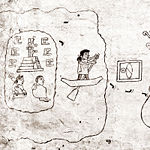
There is a lake around Cerro Culiacan, Lake Yuriria, that makes the mountain look very much like an island when photographed from the water, and similar to the illustration at right.
In the mid-19th century, fringe theorist Ignatius L. Donnelly, in his book Atlantis: The Antediluvian World
Atlantis: The Antediluvian World
Atlantis: The Antediluvian World is a book published during 1882 by Minnesota populist politician Ignatius L. Donnelly, who was born in Philadelphia, Pennsylvania during 1831...
, sought to establish a connection between Aztlán and the fabled "lost continent" of Atlantis
Atlantis
Atlantis is a legendary island first mentioned in Plato's dialogues Timaeus and Critias, written about 360 BC....
of Greek mythology; Donnelly's views, however, have never been recognised as credible by mainstream scholarship.
In 1887, Mexican anthropologist Alfredo Chavero claimed that Aztlán was located on the Pacific coast in the state of Nayarit
Nayarit
Nayarit officially Estado Libre y Soberano de Nayarit is one of the 31 states which, with the Federal District, comprise the 32 Federal Entities of Mexico. It is divided in 20 municipalities and its capital city is Tepic.It is located in Western Mexico...
. While this was disputed by contemporary scholars, it achieved some popular acceptance. In the early 1980s, Mexican
Mexico
The United Mexican States , commonly known as Mexico , is a federal constitutional republic in North America. It is bordered on the north by the United States; on the south and west by the Pacific Ocean; on the southeast by Guatemala, Belize, and the Caribbean Sea; and on the east by the Gulf of...
President
President of Mexico
The President of the United Mexican States is the head of state and government of Mexico. Under the Constitution, the president is also the Supreme Commander of the Mexican armed forces...
José López Portillo
José López Portillo
José López Portillo y Pacheco was the President of Mexico from 1976 to 1982.Born in Mexico City, López Portillo studied Law at the National Autonomous University of Mexico before beginning his political career with the Institutional Revolutionary Party in 1959.He held several positions in the...
suggested that Mexcaltitán
Mexcaltitán
Mexcaltitán de Uribe, also known simply as Mexcaltitán, is a small man-made island-city off the coast in the municipality of Santiago Ixcuintla in the Mexican state of Nayarit...
, also in Nayarit, was the true location of Aztlán, but this was denounced by Mexican historians as a political move. Even so, the state of Nayarit incorporated the symbol of Aztlán in its coat of arms with the legend "Nayarit, cradle of Mexicans". All kinds of new scholarly articles now prove this artificial claim to be a political ploy for increased tourism to this coastal area.
Eduardo Matos Moctezuma
Eduardo Matos Moctezuma
Eduardo Matos Moctezuma is a prominent Mexican archaeologist. Since 1978 he has directed excavations at the Templo Mayor, the remains of a major Aztec pyramid in central Mexico City....
presumes Aztlán to be somewhere in the modern-day states of Guanajuato
Guanajuato
Guanajuato officially Estado Libre y Soberano de Guanajuato is one of the 31 states which, with the Federal District, comprise the 32 Federal Entities of Mexico. It is divided in 46 municipalities and its capital city is Guanajuato....
, Jalisco
Jalisco
Jalisco officially Estado Libre y Soberano de Jalisco is one of the 31 states which, with the Federal District, comprise the 32 Federal Entities of Mexico. It is located in Western Mexico and divided in 125 municipalities and its capital city is Guadalajara.It is one of the more important states...
, and Michoacán
Michoacán
Michoacán officially Estado Libre y Soberano de Michoacán de Ocampo is one of the 31 states which, with the Federal District, comprise the 32 Federal Entities of Mexico. It is divided in 113 municipalities and its capital city is Morelia...
. Indeed, scholars are all consistent in naming the measures of "150 leagues" from Tenochtitlan that were documented by the Spanish scribes taking notes from conquered Mexica as the distance to the place of origin, coinciding in all ways at Chicomoztoc, "Cerro del Culiacan", which is indeed a humped mountain when seen from the south face.
It has also been proposed that the original site of Aztlán was the area around what is now Lake Powell
Lake Powell
Lake Powell is a huge reservoir on the Colorado River, straddling the border between Utah and Arizona . It is the second largest man-made reservoir in the United States behind Lake Mead, storing of water when full...
. Part of the migration legend also describes a stay at Culhuacán ("leaning hill" or "curved hill"). Proponents of the Lake Powell theory equate this Culhuacán with the ancient home of the Anasazi at Cliff Palace
Cliff Palace
The Cliff Palace is the largest cliff dwelling in North America. The structure built by the Ancient Pueblo Peoples is located in Mesa Verde National Park in their former homeland region...
, Mesa Verde National Park
Mesa Verde National Park
Mesa Verde National Park is a U.S. National Park and UNESCO World Heritage Site located in Montezuma County, Colorado, United States. It was created in 1906 to protect some of the best-preserved cliff dwellings in the world...
. Researchers who believe Aztlán was located in the Lake Powell region also cite the fact that the language spoken by the Aztecs and the Ute people belong to the same Uto-Aztecan linguistic group.
Archaeologist Kelley Hays-Gilpin from Northern Arizona University
Northern Arizona University
Northern Arizona University is a public university located in Flagstaff, Arizona, United States. It is accredited by the North Central Association of Colleges and Schools, and has 39 satellite campuses in the state of Arizona. The university offers both undergraduate and graduate degrees.As of...
acknowledges the linguistic connection between Mesoamerican and North American peoples. However, she theorizes that the Aztec's ancestors may have traveled north before returning south. Hayes-Gilpin believes Uto-Aztecan speaking people spread north to an area of the American West that could have included Utah. Out of those cultures, some groups could have migrated south to northern Mexico, and some could have, as she says, moved to the Valley of Mexico where they subjugated tribes in that region.
Primary sources
The primary sources for Aztlán are the Boturini Codex, the Codex Telleriano-RemensisCodex Telleriano-Remensis
The Codex Telleriano-Remensis, produced in sixteenth century Mexico and printed on European paper, is one of the finest surviving examples of Aztec manuscript painting...
, and the Aubin Codex
Aubin Codex
The Aubin Codex is a textual and pictorial history of the Aztecs from their departure from Aztlán through the Spanish conquest to the early Spanish colonial period, ending in 1607...
. Aztlán is also mentioned in the History of Tlaxcala
History of Tlaxcala
History of Tlaxcala is an illustrated codex written by and under the supervision of Diego Muñoz Camargo in the years leading up to 1585. Also known as Lienzo Tlaxcala and by its Spanish title, Historia de Tlaxcala, this manuscript highlights the religious, cultural, and military history of the...
(by Diego Muñoz Camargo
Diego Muñoz Camargo
Diego Muñoz Camargo was the author of History of Tlaxcala, an illustrated codex that highlights the religious, cultural, and military history of the Tlaxcalan people.-Life:...
, a Tlaxcalan mestizo
Mestizo
Mestizo is a term traditionally used in Latin America, Philippines and Spain for people of mixed European and Native American heritage or descent...
from the 17th century), as well as Historia Tolteca-Chichimeca
Historia Tolteca-Chichimeca
The Historia Tolteca-Chichimeca is a 16th century Nahuatl-language manuscript, dealing with the history of Cuauhtinchan. It is currently located in the Bibliothèque nationale in Paris. It is written by Fernando De Alva Ixtlixóchitl....
.
Etymology
The meaning of the name Aztlan is uncertain. One suggested meaning is "place of egretEgret
An egret is any of several herons, most of which are white or buff, and several of which develop fine plumes during the breeding season. Many egrets are members of the genera Egretta or Ardea which contain other species named as herons rather than egrets...
s"—the explanation given in the Crónica Mexicáyotl
Crónica Mexicayotl
The Crónica Mexicayotl is a chronicle of the Aztec empire that was written in the Nahuatl language by Fernando Alvarado Tezozómoc around 1598. Given that its author belonged to the Aztec royal lineage, the manuscript documents the Aztec version of the history of central Mexico. It was written in...
—but this is not possible under Nahuatl morphology
Morphology (linguistics)
In linguistics, morphology is the identification, analysis and description, in a language, of the structure of morphemes and other linguistic units, such as words, affixes, parts of speech, intonation/stress, or implied context...
: "place of egrets" would be Aztatlan. Other proposed derivations include "place of whiteness" and "at the place in the vicinity of tools", sharing the āz- element of words such as teponāztli, "drum" (from tepontli, "log").
Aztlán [asˈtlan] is the Spanish language
Spanish language
Spanish , also known as Castilian , is a Romance language in the Ibero-Romance group that evolved from several languages and dialects in central-northern Iberia around the 9th century and gradually spread with the expansion of the Kingdom of Castile into central and southern Iberia during the...
spelling and pronunciation of Nahuatl Aztlān [ˈas.tɬaːn]. The spelling Aztlán and its matching last-syllable stress cannot be Nahuatl, which always stresses words on the second-to-last syllable. The accent mark on the second a added in Spanish marks stress shift (from oxytone
Oxytone
An oxytone is a word with the stress on the last syllable, such as the English words correct and reward. A paroxytone is stressed on the penultimate syllable. A proparoxytone is stressed on the antepenultimate syllable.-See also:*Barytone...
to paroxytone
Paroxytone
Paroxytone is a linguistic term for a word with stress on the penultimate syllable, that is, the syllable before the last syllable, e.g, the English word potato...
), typical of several Nahuatl words when loaned
Loanword
A loanword is a word borrowed from a donor language and incorporated into a recipient language. By contrast, a calque or loan translation is a related concept where the meaning or idiom is borrowed rather than the lexical item itself. The word loanword is itself a calque of the German Lehnwort,...
into Mexican Spanish.
Use by the Chicano movement

The name Aztlán was first taken up by a group of Chicano independence activists led by Oscar Zeta Acosta
Oscar Zeta Acosta
Oscar Zeta Acosta was an American attorney, politician, minor novelist and Chicano Movement activist, perhaps best known for his friendship with the American author Hunter S. Thompson, who characterized him as his Samoan Attorney, Dr...
during the Chicano movement of the 1960s and 1970s. They used the name Aztlán to refer to the lands of Northern Mexico that were annexed by the United States as a result of the Mexican-American War. Combined with the claim of some historical linguists and anthropologists that the original homeland of the Aztecan peoples was located in the southwestern United States
Southwestern United States
The Southwestern United States is a region defined in different ways by different sources. Broad definitions include nearly a quarter of the United States, including Arizona, California, Colorado, Nevada, New Mexico, Oklahoma, Texas and Utah...
, Aztlán, in this sense, became a symbol for mestizo activists who believe they have a legal and primordial right to the land. In order to exercise this right, some members of the Chicano movement propose that a new nation be created, a Republica del Norte.
Groups who have used the name Aztlán in this manner include Plan Espiritual de Aztlán
Plan Espiritual de Aztlán
The Plan Espiritual de Aztlán is a manifesto advocating Chicano nationalism and self-determination for Mexican Americans...
, MEChA
MEChA
M.E.Ch.A. is an organization that seeks to promote Chicano unity and empowerment through political action. The acronym of the organization's name is the Spanish word mecha, which means "fuse"...
(Movimiento Estudiantil Chicano de Aztlán, "Chicano Student Movement of Aztlán"), and the Nation of Aztlán (NOA).
Many in the Chicano movement attribute poet Alurista
Alurista
Alurista is the nom de plume of Alberto Baltazar Urista Heredia , a Chicano poet and activist.-Youth and education:...
for popularizing the term Aztlán in a poem presented during the Chicano Youth Liberation Conference in Denver, Colorado, in March 1969.
In fiction
Aztlán has been used as the name of speculative fictional future states that emerge in the southwest US or Mexico after the central US government suffers collapse or major setback; examples appear in such works as the novels WardayWarday
Warday is a novel by Whitley Strieber and James Kunetka, first published in 1984. It is a fictionalized account of the authors traveling across America five years after a limited nuclear attack in order to assess how the nation had changed after the war. The novel takes the form of a research...
, The Peace War
The Peace War
The Peace War is a science fiction novel by American writer Vernor Vinge, about authoritarianism and technological progress. It was first published as a serial in Analog in 1984, and then appeared in book form shortly afterward. It was nominated for the Hugo Award for Best Novel in 1985...
, The House of the Scorpion
The House of the Scorpion
The House of the Scorpion is a science fiction novel by Nancy Farmer. It is about a young boy named Matteo Alacrán who is being raised by a drug lord of the same name, usually referred to by his assumed title "El Patrón" throughout the text. It is a story about the struggle to survive as a free...
, and World War Z
World War Z
World War Z: An Oral History of the Zombie War is a 2006 post-apocalyptic horror novel by Max Brooks. It is a follow-up to his 2003 book The Zombie Survival Guide. Rather than a grand overview or narrative, World War Z is a collection of individual accounts in the form of first-person anecdote...
, as well as the role-playing game Shadowrun
Shadowrun
Shadowrun is a role-playing game set in a near-future fictional universe in which cybernetics, magic and fantasy creatures co-exist. It combines genres of cyberpunk, urban fantasy and crime, with occasional elements of conspiracy fiction, horror, and detective fiction.The original game has spawned...
. In Gary Jennings
Gary Jennings
Gary Jennings was an American author who wrote children's and adult novels. In 1980, after the successful novel Aztec, he specialized in writing adult historical fiction novels.-Biography:...
' novel Aztec
Aztec (book)
Aztec is a historical fiction novel by Gary Jennings. It is the first of five novels in the Aztec series.The book is written as a series of letters from the Bishop of the See of New Spain to King Carlos of Spain containing a transcribed biography of Mixtli , an elderly Aztec man, by Spanish Catholic...
, the protagonist resides in Aztlan for a while, later facilitating contact between Aztlán and the Aztec Triple Alliance just before Hernán Cortés
Hernán Cortés
Hernán Cortés de Monroy y Pizarro, 1st Marquis of the Valley of Oaxaca was a Spanish Conquistador who led an expedition that caused the fall of the Aztec Empire and brought large portions of mainland Mexico under the rule of the King of Castile in the early 16th century...
' arrival.
In Michael Flynn's alternate history
Alternate history (fiction)
Alternate history or alternative history is a genre of fiction consisting of stories that are set in worlds in which history has diverged from the actual history of the world. It can be variously seen as a sub-genre of literary fiction, science fiction, and historical fiction; different alternate...
story "The Forest of Time
The Forest of Time
The Forest of Time is an alternate history novella by science-fiction writer Michael Flynn. It was originally published in the June 1987 issue of Analog magazine...
", Colorado
Colorado
Colorado is a U.S. state that encompasses much of the Rocky Mountains as well as the northeastern portion of the Colorado Plateau and the western edge of the Great Plains...
is part of a nation-state called Nuevo Aztlán.
Thomas Pynchon
Thomas Pynchon
Thomas Ruggles Pynchon, Jr. is an American novelist. For his most praised novel, Gravity's Rainbow, Pynchon received the National Book Award, and is regularly cited as a contender for the Nobel Prize in Literature...
refers to Aztlan as the "mythic ancestral home of the Mexican people" in Against the Day
Against the Day
Against the Day is a novel by Thomas Pynchon. The narrative takes place between the 1893 Chicago World's Fair and the time immediately following World War I and features more than a hundred characters spread across the United States, Europe, Mexico, Central Asia, and "one or two places not strictly...
:
Charles de Lint
Charles de Lint
Charles de Lint is a Canadian fantasy author and folk musician. He is also the chief book critic for The Magazine of Fantasy & Science Fiction....
in his novel "The Painted Boy", refers to the ancestral spirit world as Aztlán.
In music
Colombian heavy metalHeavy metal music
Heavy metal is a genre of rock music that developed in the late 1960s and early 1970s, largely in the Midlands of the United Kingdom and the United States...
band Kraken
Kraken (band)
Kraken is a heavy metal band founded in Medellín, Colombia, in 1983. The current lineup consists of Andrés Leiva , Julian Puerto , Luis Alberto Ramírez , Rubén Gelvez , and Elkin Ramírez...
mentions "the old Aztlán" as the place where the Aztek governors (Uey Tlatoani) reside, in the song "Méxica", from their albums Kraken IV: Piel de Cobre and Kraken Filarmónico. American rock band Los Lobos
Los Lobos
Los Lobos are a multiple Grammy Award–winning American Chicano rock band from East Los Angeles, California. Their music is influenced by rock and roll, Tex-Mex, country, folk, R&B, blues, brown-eyed soul, and traditional Spanish and Mexican music such as cumbia, boleros and norteños.-History:The...
released an album titled Good Morning Aztlán
Good Morning Aztlán (album)
Good Morning Aztlán is the tenth studio album from the American band Los Lobos. It was reissued in 2004 .-Track listing:#Done Gone Blue – 3:50...
in 2002.
Los Angeles-based Ozomatli
Ozomatli
Ozomatli is a seven to ten piece band playing primarily Latin, hip hop, and rock music, formed in 1995 in Los Angeles. They are known both for their vocal activist viewpoints and their wide array of musical styles - including salsa, jazz, funk, reggae, rap, and others.In a 2007 NPR interview, band...
penned a standout song on 2004's Street Signs
Street Signs (album)
Street Signs is an album by Ozomatli, released in 2004. Street Signs was included in Robert Dimery's 1001 Albums You Must Hear Before You Die....
in solidarity with the Chicano movement called "Santiago", alluding to Uncle Sam
Uncle Sam
Uncle Sam is a common national personification of the American government originally used during the War of 1812. He is depicted as a stern elderly man with white hair and a goatee beard...
as "Santiago de Aztlán."
On his 1994 album Graciasland, Mexican-American rock and roll artist El Vez
El Vez
El Vez is the stage name of Robert Lopez, a Mexican-American rock and roll artist, who performs and records original material and covers classic rock songs...
recorded "Aztlan," a version of Paul Simon's "Graceland (song)
Graceland (song)
"Graceland" is the title song of the album Graceland, released in 1986 by Paul Simon. The song features vocals by The Everly Brothers.The lyrics deal with the singer's thoughts during a road trip to Graceland after the failure of his marriage to actress and author Carrie Fisher.-Reception:It was...
" with lyrics like "For reasons I have explained/I'm not a part of Spain/I'm part of Aztlan."
External links
- Sanderson, Susana, "Tenotchtitlan and Templo Mayor", California State University, Chico.
- Aztlan Listserv (hosted by the Foundation for the Advancement of Mesoamerican Studies, Inc.)
- League of Revolutionary Struggle, "The Struggle for Chicano Liberation" (an examination of Aztlan and the Chicano national movement from a Marxist point of view)
- Los Angeles artist protesting walls in Berlin, Palestine and Aztlán