

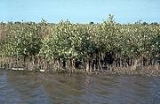
Avicennia

Encyclopedia
Avicennia is a genus
of flowering plant
s currently placed in the bear's breeches family, Acanthaceae
. It contains mangrove
tree
s, which occur in the intertidal zone
s of estuarine
areas and are characterized by aerial root
s. Species of Avicennia occur worldwide south of the Tropic of Cancer
.
The taxonomic placement of Avicennia is contentious. In some classifications it has been placed in the family Verbenaceae
, but more recently has been placed by some botanists in the monogeneric family Avicenniaceae. Recent phylogenetic
studies have suggested that Avicennia is derived from within Acanthaceae
, and the genus is included in that family in the Angiosperm Phylogeny Group
system.
Designation of species is made difficult by the great variations in form of Avicennia marina
. Between eight and ten species are usually recognised, with Avicennia marina further divided into a number of subspecies
.
The generic name honours Persian
physician
Avicenna
(980-1037).
Genus
In biology, a genus is a low-level taxonomic rank used in the biological classification of living and fossil organisms, which is an example of definition by genus and differentia...
of flowering plant
Flowering plant
The flowering plants , also known as Angiospermae or Magnoliophyta, are the most diverse group of land plants. Angiosperms are seed-producing plants like the gymnosperms and can be distinguished from the gymnosperms by a series of synapomorphies...
s currently placed in the bear's breeches family, Acanthaceae
Acanthaceae
The family Acanthaceae is a taxon of dicotyledonous flowering plants containing almost 250 genera and about 2500 species....
. It contains mangrove
Mangrove
Mangroves are various kinds of trees up to medium height and shrubs that grow in saline coastal sediment habitats in the tropics and subtropics – mainly between latitudes N and S...
tree
Tree
A tree is a perennial woody plant. It is most often defined as a woody plant that has many secondary branches supported clear of the ground on a single main stem or trunk with clear apical dominance. A minimum height specification at maturity is cited by some authors, varying from 3 m to...
s, which occur in the intertidal zone
Intertidal zone
The intertidal zone is the area that is above water at low tide and under water at high tide . This area can include many different types of habitats, with many types of animals like starfish, sea urchins, and some species of coral...
s of estuarine
Estuary
An estuary is a partly enclosed coastal body of water with one or more rivers or streams flowing into it, and with a free connection to the open sea....
areas and are characterized by aerial root
Aerial root
Aerial roots are roots above the ground. They are almost always adventitious. They are found in diverse plant species, including epiphytes such as orchids, tropical coastal swamp trees such as mangroves, the resourceful banyan trees, the warm-temperate rainforest rātā and pōhutukawa Aerial roots...
s. Species of Avicennia occur worldwide south of the Tropic of Cancer
Tropic of Cancer
The Tropic of Cancer, also referred to as the Northern tropic, is the circle of latitude on the Earth that marks the most northerly position at which the Sun may appear directly overhead at its zenith...
.
The taxonomic placement of Avicennia is contentious. In some classifications it has been placed in the family Verbenaceae
Verbenaceae
Verbenaceae, commonly known as the verbena family or vervain family, is a family of mainly tropical flowering plants. It contains trees, shrubs and herbs notable for heads, spikes, or clusters of small flowers, many of which have an aromatic smell.Recent phylogenetic studies have shown that...
, but more recently has been placed by some botanists in the monogeneric family Avicenniaceae. Recent phylogenetic
Phylogenetics
In biology, phylogenetics is the study of evolutionary relatedness among groups of organisms , which is discovered through molecular sequencing data and morphological data matrices...
studies have suggested that Avicennia is derived from within Acanthaceae
Acanthaceae
The family Acanthaceae is a taxon of dicotyledonous flowering plants containing almost 250 genera and about 2500 species....
, and the genus is included in that family in the Angiosperm Phylogeny Group
Angiosperm Phylogeny Group
The Angiosperm Phylogeny Group, or APG, refers to an informal international group of systematic botanists who came together to try to establish a consensus on the taxonomy of flowering plants that would reflect new knowledge about plant relationships discovered through phylogenetic studies., three...
system.
Designation of species is made difficult by the great variations in form of Avicennia marina
Avicennia marina
Avicennia marina, commonly known as grey mangrove or white mangrove, is a species of mangrove tree classified in the plant family Acanthaceae...
. Between eight and ten species are usually recognised, with Avicennia marina further divided into a number of subspecies
Subspecies
Subspecies in biological classification, is either a taxonomic rank subordinate to species, ora taxonomic unit in that rank . A subspecies cannot be recognized in isolation: a species will either be recognized as having no subspecies at all or two or more, never just one...
.
The generic name honours Persian
Persian people
The Persian people are part of the Iranian peoples who speak the modern Persian language and closely akin Iranian dialects and languages. The origin of the ethnic Iranian/Persian peoples are traced to the Ancient Iranian peoples, who were part of the ancient Indo-Iranians and themselves part of...
physician
Islamic medicine
In the history of medicine, Islamic medicine, Arabic medicine or Arabian medicine refers to medicine developed in the Islamic Golden Age, and written in Arabic, the lingua franca of Islamic civilization....
Avicenna
Avicenna
Abū ʿAlī al-Ḥusayn ibn ʿAbd Allāh ibn Sīnā , commonly known as Ibn Sīnā or by his Latinized name Avicenna, was a Persian polymath, who wrote almost 450 treatises on a wide range of subjects, of which around 240 have survived...
(980-1037).
Selected species
- Avicennia africana P.Beauv.Palisot de BeauvoisAmbroise Marie François Joseph Palisot, Baron de Beauvois 27 July 1752 Arras - 21 January 1820 Paris, was a French naturalist.Palisot collected insects in Oware, Benin, Saint Domingue, and the United States, during the period 1786 – 1797. Trained as a botanist, Palisot published a significant...
- Avicennia albaAvicennia albaAvicennia alba forms a low, dense bushy crown often branching near the base of the trunk. The shrub does not grow more than 20 m. The dark green leaves, 15 cm long by 5 cm wide, have a silvery gray under leaf and grow in opposites. Orange yellow flowers, borne in a racemose inflorescence, have a...
BlumeCarl Ludwig BlumeCharles Ludwig de Blume or Karl Ludwig von Blume was a German-Dutch botanist.He was born at Braunschweig in Germany, but studied at Leiden University and spent his professional life working in the Dutch East Indies and in the Netherlands, where he was Director of the Rijksherbarium at Leiden... - Avicennia bicolor Standl.Paul Carpenter StandleyPaul Carpenter Standley was an American botanist.Standley was born in Avalon, Missouri...
- Avicennia eucalyptifolia (Valeton) MoldenkeHarold Norman MoldenkeHarold Norman Moldenke, also known as simply Moldenke was an American botanist/taxonomist. His expertise is largely in the study of Verbenaceae, Avicenniaceae, Stilbaceae, Dicrastylidaceae, Symphoremaceae, Nyctanthaceae and Eriocaulaceae....
- Avicennia germinansAvicennia germinansAvicennia germinans, commonly known as the black mangrove, is a species of flowering plant in the acanthus family, Acanthaceae.A. germinans grows in tropical and subtropical regions of the Americas, on both Atlantic and Pacific coasts, and on the Atlantic coast of tropical Africa, where it thrives...
(L.) L. – Black Mangrove - Avicennia integra N.C. Duke
- Avicennia marinaAvicennia marinaAvicennia marina, commonly known as grey mangrove or white mangrove, is a species of mangrove tree classified in the plant family Acanthaceae...
(Forssk.Peter ForsskålPeter Forsskål, sometimes spelled Pehr Forsskål, Peter Forskaol, Petrus Forskål or Pehr Forsskåhl, was a Swedish explorer, orientalist, naturalist and an apostle of Carl Linnaeus.-Early life:...
) Vierh.Friedrich VierhapperFriedrich Vierhapper, 1876-1932, was an Austrian plant collector and botanist.- External links :...
– White or Grey Mangrove - Avicennia nitida Jacq.Nikolaus Joseph von JacquinNikolaus Joseph Freiherr von Jacquin or Baron Nikolaus von Jacquin. was a scientist who studied medicine, chemistry and botany....
- Avicennia officinalisAvicennia officinalisAvicennia officinalis is a species of mangrove. The young tree forms a low, dense bushy crown. When it matures, it forms a columnar tree up to 15 m and may grow up to 30 m. The shiny green leaves, 10 cm long by 5 cm wide, have rounded apexes and golden-brown under leaf and grow in opposites...
L. - Avicennia rumphiana Hallier f.Johannes Gottfried HallierJohannes Gottfried Hallier was a German botanist who was a native of Jena.He studied botany and zoology at the University of Jena under Christian Ernst Stahl and Ernst Haeckel , and continued his studies at the University of Munich under Ludwig Radlkofer and Richard Hertwig...
- Avicennia schaueriana