

Aveyron

Encyclopedia
Aveyron is a département in southern France named after the Aveyron River
.
on 4 March 1790.
The first known historical inhabitants of the region were the Rutenii tribe, but the area was inhabited previously to this, boasting many prehistoric ruins.
During the medieval and early modern periods, and until the 1790s, the territory covered by Aveyron was a province
known as Rouergue
.
In 1817, a local prosecutor Antoine Bernardin Fualdès was assassinated. The sordid circumstances of his death, following which his body was found floating in the Aveyron River
, led to the matter becoming publicised as a cause célèbre. Recent studies have indicated that he met his end on the initiative of a right wing royalist organisation known as the Chevaliers de la Foi (Knights of the Faith).
region
. It is surrounded by the départements of Tarn, Tarn-et-Garonne
, Lot, Hérault
, Gard
, Lozère
, and Cantal
.
The highest point in the department is the summit of Le Signal de Mailhebiau at 1469 m (Plateau of Aubrac
).
Lac de Villefranche-de-Panat
is used as a reservoir to provide drinking water supplies for the region.
.
 Aveyron contains a part of the Cévennes National Park
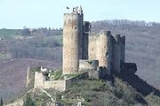
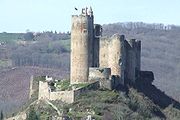
. Well-known tourist attractions are the castle of Najac
, a medieval ruin perched high on a hill, and the many beautiful old castles and monasteries such as Conques Abbey, Sylvanès Abbey
, Bonneval Abbey
and Loc-Dieu Abbey
, located near Martiel
in a region with many dolmen
s. The small city of Millau
is the site of the world's tallest bridge, the Millau viaduct
, opened by President Chirac
in December 2004.
Activities include horseriding, fishing, swimming in the Lacs du Lévézou and hiking/camping. The inhabitants are also very good craftsmen, and Aveyron is full of various craft objects, handmade, that can be found locally. Examples include the couteau de Laguiole
, the world famous Roquefort
cheese, from the village of the same name and other local produce. Markets take place every Saturday on market places around the region.
Saint-Sernin-sur-Rance
is the commune where the feral child Victor of Aveyron
was found in the late 18th century.
Aveyron River
The Aveyron is a 291 km long river in southern France, right tributary of the Tarn River. It rises in the southern Massif Central, near Sévérac-le-Château....
.
History
Aveyron is one of the original 83 departments created during the French RevolutionFrench Revolution
The French Revolution , sometimes distinguished as the 'Great French Revolution' , was a period of radical social and political upheaval in France and Europe. The absolute monarchy that had ruled France for centuries collapsed in three years...
on 4 March 1790.
The first known historical inhabitants of the region were the Rutenii tribe, but the area was inhabited previously to this, boasting many prehistoric ruins.
During the medieval and early modern periods, and until the 1790s, the territory covered by Aveyron was a province
Provinces of France
The Kingdom of France was organised into provinces until March 4, 1790, when the establishment of the département system superseded provinces. The provinces of France were roughly equivalent to the historic counties of England...
known as Rouergue
Rouergue
Rouergue is a former province of France, bounded on the north by Auvergne, on the south and southwest by Languedoc, on the east by Gévaudan and on the west by Quercy...
.
In 1817, a local prosecutor Antoine Bernardin Fualdès was assassinated. The sordid circumstances of his death, following which his body was found floating in the Aveyron River
Aveyron River
The Aveyron is a 291 km long river in southern France, right tributary of the Tarn River. It rises in the southern Massif Central, near Sévérac-le-Château....
, led to the matter becoming publicised as a cause célèbre. Recent studies have indicated that he met his end on the initiative of a right wing royalist organisation known as the Chevaliers de la Foi (Knights of the Faith).
Geography
The department is part of the current Midi-PyrénéesMidi-Pyrénées
Midi-Pyrénées is the largest region of metropolitan France by area, larger than the Netherlands or Denmark.Midi-Pyrénées has no historical or geographical unity...
region
Régions of France
France is divided into 27 administrative regions , 22 of which are in Metropolitan France, and five of which are overseas. Corsica is a territorial collectivity , but is considered a region in mainstream usage, and is even shown as such on the INSEE website...
. It is surrounded by the départements of Tarn, Tarn-et-Garonne
Tarn-et-Garonne
Tarn-et-Garonne is a French department in the southwest of France. It is traversed by the Rivers Tarn and Garonne, from which it takes its name.-History:...
, Lot, Hérault
Hérault
Hérault is a department in the south of France named after the Hérault river.-History:Hérault is one of the original 83 departments created during the French Revolution on 4 March 1790...
, Gard
Gard
Gard is a département located in southern France in the Languedoc-Roussillon region.The department is named after the River Gard, although the formerly Occitan name of the River Gard, Gardon, has been replacing the traditional French name in recent decades, even among French speakers.- History...
, Lozère
Lozère
Lozère , is a department in southeast France near the Massif Central, named after Mont Lozère.- History :Lozère is one of the original 83 departments created during the French Revolution on March 4, 1790...
, and Cantal
Cantal
Cantal is a department in south-central France. It is named after the Cantal mountain range, a group of extinct, eroded volcanic peaks, which covers much of the department. Residents are known as Cantaliens or Cantalous....
.
The highest point in the department is the summit of Le Signal de Mailhebiau at 1469 m (Plateau of Aubrac
Aubrac
Aubrac is a town in the southern Massif Central of France. The name is also applied to the surrounding landscape, which is properly called L'Aubrac in French. The Aubrac region has been a member of the Natura 2000 network since August 2006...
).
Lac de Villefranche-de-Panat
Lac de Villefranche-de-Panat
Lac de Villefranche-de-Panat is a lake in Aveyron, France. At an elevation of 727 m, its surface area is 1.92 km².It lies in the communes of Villefranche-de-Panat and Alrance....
is used as a reservoir to provide drinking water supplies for the region.
Demographics
The inhabitants of the department are called Aveyronnais, inhabitants of Rodez are called Ruthénois, based on the first Celtic settlers, the rutenii.Politics
The President of the General Council is Jean-Claude Luche of the Union for a Popular MovementUnion for a Popular Movement
The Union for a Popular Movement is a centre-right political party in France, and one of the two major contemporary political parties in the country along with the center-left Socialist Party...
.
| Party | seats | |
|---|---|---|
| Socialist Party Socialist Party (France) The Socialist Party is a social-democratic political party in France and the largest party of the French centre-left. It is one of the two major contemporary political parties in France, along with the center-right Union for a Popular Movement... |
14 | |
| • | Union for a Popular Movement Union for a Popular Movement The Union for a Popular Movement is a centre-right political party in France, and one of the two major contemporary political parties in the country along with the center-left Socialist Party... |
13 |
| • | Miscellaneous Right Miscellaneous Right Miscellaneous Right in France refers to right-wing candidates that are not member of any large party. They either include small right-wing parties, dissidents expelled from their parties for running against their party's candidate, as well as candidates who were never formal members of a party... |
11 |
| Miscellaneous Left Miscellaneous Left Miscellaneous Left in France refers to left-wing candidates that are not member of any large party. They either include small left-wing parties or dissidents expelled from their parties for running against their party's candidate. Numerous DVG candidates are elected at a local level, and a smaller... |
3 | |
| Left Radical Party Left Radical Party The Radical Party of the Left is a minor social-liberal, and in opposition to its common understanding of its name, a moderate centre-left political party in France advocating radicalism, secularism to its french extend known as laïcité, progressivism, pro-Europeanism, individual freedom and... |
2 | |
| Left Party Left Party (France) The Left Party is a French democratic socialist political party. It seeks to emulate the German political party Die Linke led by Gesine Lötzsch and Klaus Ernst.- History :... |
1 | |
| The Greens The Greens (France) The Greens were a Green political party to the centre-left of the political spectrum in France. They had officially been in existence since 1984, but their spiritual roots could be traced as far back as René Dumont’s candidacy for the presidency in 1974... |
1 | |
Tourism
Cévennes National Park
The Cévennes National Park is a national park located in southern France, in the mountainous area of Cévennes.Created in 1970, the park has its administrative seat in Florac at Florac Castle. It is located mainly in the départements of Lozère and Gard, and covers some parts of Ardèche and Aveyron...
. Well-known tourist attractions are the castle of Najac
Château de Najac
Château de Najac or the royal fortress of Najac is located in Najac, in the Aveyron département, in southern France.The castle was built in 1253 by the villagers on the orders of Alphonse de Poitiers, brother of Saint Louis, on the site of an older castle built in 1100 by Bertrand of St Gilles,...
, a medieval ruin perched high on a hill, and the many beautiful old castles and monasteries such as Conques Abbey, Sylvanès Abbey
Sylvanès
Sylvanès is a commune in the Aveyron department in southern France.-Population:-External links:**...
, Bonneval Abbey
Bonneval Abbey (Aveyron)
Bonneval Abbey was founded as a monastery of Cistercian monks, which is located in Le Cayrol, in the Department of Aveyron, in the south of France. It is now inhabited by Trappistine nuns.-History:...
and Loc-Dieu Abbey
Loc-Dieu Abbey
Loc-Dieu Abbey is a Cistercian abbey located near Martiel, 9 km west from Villefranche-de-Rouergue, in the department of Aveyron in France....
, located near Martiel
Martiel
Martiel is a commune in the Aveyron department in southern France.- Gallery : -References:*...
in a region with many dolmen
Dolmen
A dolmen—also known as a portal tomb, portal grave, dolmain , cromlech , anta , Hünengrab/Hünenbett , Adamra , Ispun , Hunebed , dös , goindol or quoit—is a type of single-chamber megalithic tomb, usually consisting of...
s. The small city of Millau
Millau
Millau is a commune in the Aveyron department in southern France. It is located at the confluence of the Tarn and Dourbie rivers.-History:...
is the site of the world's tallest bridge, the Millau viaduct
Millau Viaduct
The Millau Viaduct is a cable-stayed road-bridge that spans the valley of the river Tarn near Millau in southern France. Designed by the British architect Norman Foster and French structural engineer Michel Virlogeux, it is the tallest bridge in the world, with one mast's summit at . It is the...
, opened by President Chirac
Jacques Chirac
Jacques René Chirac is a French politician who served as President of France from 1995 to 2007. He previously served as Prime Minister of France from 1974 to 1976 and from 1986 to 1988 , and as Mayor of Paris from 1977 to 1995.After completing his studies of the DEA's degree at the...
in December 2004.
Activities include horseriding, fishing, swimming in the Lacs du Lévézou and hiking/camping. The inhabitants are also very good craftsmen, and Aveyron is full of various craft objects, handmade, that can be found locally. Examples include the couteau de Laguiole
Laguiole knife
The Laguiole knife is a high-quality traditional Occitan pocket-knife, originally produced in the town of Laguiole in the Aveyron region of southern France....
, the world famous Roquefort
Roquefort (cheese)
Roquefort , sometimes spelled Rochefort in English, is a sheep milk blue cheese from the south of France, and together with Bleu d'Auvergne, Stilton and Gorgonzola is one of the world's best-known blue cheeses...
cheese, from the village of the same name and other local produce. Markets take place every Saturday on market places around the region.
Saint-Sernin-sur-Rance
Saint-Sernin-sur-Rance
Saint-Sernin-sur-Rance is a commune in the Aveyron department in southern France.-Population:-References:*...
is the commune where the feral child Victor of Aveyron
Victor of Aveyron
Victor of Aveyron was a feral child who apparently lived his entire childhood naked and alone in the woods before being found wandering the woods near Saint-Sernin-sur-Rance, France, in 1797. He was captured, but soon escaped after being displayed in the town...
was found in the late 18th century.
See also
- Cantons of the Aveyron department
- Communes of the Aveyron department
- Arrondissements of the Aveyron department