
All Topics  
Automated Clearing House

 
Automated Clearing House

   Email Print
   Bookmark   Link


Automated Clearing House


Automated Clearing House (ACH) is an electronic network for financial transactions in the United States
United States

The United States of America is a Federal government constitutional republic comprising U.S. state and a federal district. The country is situated mostly in central North America, where its Contiguous United States and Washington, D.C., the Capital districts and territories, lie between the Pacific Ocean and Atlantic Oceans, Borders of the U...
. ACH processes large volumes of both credit and debit transactions, which are originated in batches. Rules and regulations governing the ACH network are established by NACHA-The Electronic Payments Association
NACHA-The Electronic Payments Association

NACHA-The Electronic Payments Association, formerly the National Automated Clearing House Association, is an organization that develops computer file solutions to improve the Automated Clearing House payment system in the United States....
 (formerly the National Automated Clearing House Association) and the Federal Reserve (Fed). In 2002, this network processed an estimated 8.05 billion ACH transactions with a total value of $21.7 trillion.


Discussion
Ask a question about 'Automated Clearing House'
Start a new discussion about 'Automated Clearing House'
Answer questions from other users
Full Discussion Forum


Encyclopedia


Automated Clearing House (ACH) is an electronic network for financial transactions in the United States
United States

The United States of America is a Federal government constitutional republic comprising U.S. state and a federal district. The country is situated mostly in central North America, where its Contiguous United States and Washington, D.C., the Capital districts and territories, lie between the Pacific Ocean and Atlantic Oceans, Borders of the U...
. ACH processes large volumes of both credit and debit transactions, which are originated in batches. Rules and regulations governing the ACH network are established by NACHA-The Electronic Payments Association
NACHA-The Electronic Payments Association

NACHA-The Electronic Payments Association, formerly the National Automated Clearing House Association, is an organization that develops computer file solutions to improve the Automated Clearing House payment system in the United States....
 (formerly the National Automated Clearing House Association) and the Federal Reserve (Fed). In 2002, this network processed an estimated 8.05 billion ACH transactions with a total value of $21.7 trillion. (Credit card
Credit card

A credit card is part of a system of payments named after the small plastic card issued to users of the system. It is a card entitling its holder to buy goods and services based on the holders promise to pay for these goods and services....
 payments are handled by separate networks.)

ACH credit transfers include direct deposit
Direct deposit

Direct deposit is a banking term used to refer to certain systems used to transfer money, namely:* In Europe, the giro system* In the United States, the Automated Clearing House...
 payroll and vendor payments. ACH direct debit
Direct debit

A direct debit or direct withdrawal is an instruction that a bank account holder gives to his or her bank to collect an amount directly from another account....
 transfers include consumer payments on insurance premiums, mortgage loans, and other kinds of bills. Businesses are also increasingly using ACH to collect from customers online, rather than accepting credit or debit cards.

Debit transfers also include new applications such as the Point-of-Purchase (POP) check conversion pilot program sponsored by NACHA
NACHA-The Electronic Payments Association

NACHA-The Electronic Payments Association, formerly the National Automated Clearing House Association, is an organization that develops computer file solutions to improve the Automated Clearing House payment system in the United States....
. FedACH is the Federal Reserve's centralized application software used to process ACH transactions. Both the government and the commercial sectors use ACH payments. The Electronic Payments Network
Electronic Payments Network

The Electronic Payments Network is an electronic Automated Clearing House that provides functions similar to those provided by Federal Reserve Banks....
(EPN) is the only private sector ACH Operator in the United States.

The Federal Reserve Banks are collectively the nation's largest automated clearinghouse operator and in 2005 processed 60% of commercial interbank ACH transactions. The EPN processed the remaining 40%. EPN and the Reserve Banks rely on each other for the processing of some transactions in which either the Originating Depository Financial Institution (ODFI) or Receiving Depository Financial Institution (RDFI) is not their customer. These interoperator transactions are settled by the Reserve Banks.

Uses of the ACH payment system

  • Debit card
    Debit card

    A debit card is a plastic card which provides an alternative payment method to cash when making purchases. Functionally, it can be called an electronic check, as the funds are withdrawn directly from either the bank account , or from the remaining balance on the card....
     transactions
  • Direct deposit
    Direct deposit

    Direct deposit is a banking term used to refer to certain systems used to transfer money, namely:* In Europe, the giro system* In the United States, the Automated Clearing House...
     of payroll, Social Security
    Social security

    Social security primarily refers to a social insurance program providing social protection, or protection against socially recognized conditions, including poverty, old age, disability, unemployment and others....
     and other government payments, and tax refunds
  • Direct debit
    Direct debit

    A direct debit or direct withdrawal is an instruction that a bank account holder gives to his or her bank to collect an amount directly from another account....
     payment of consumer bills such as mortgages, loans, utility bills, and insurance premiums, rents, and any other regular payment.
  • Business-to-business (B2B) payments
  • E-commerce payments
  • Federal, state, and local tax payments
  • Bank Treasury management
    Treasury management

    Treasury management includes management of an enterprise' holdings in and Trader in government and corporate bonds, currencies, financial futures, Option and derivatives, payment systems and the associated financial risk management....
     departments sell this service to business and government customers


ACH process

In accordance with the rules and regulations of ACH, no financial institution may simply issue an ACH transaction (whether it be debit or credit) towards an account without prior authorization from the account holder (known as the Receiver in ACH terminology).

An ACH entry starts with a Receiver authorizing an Originator to issue ACH debit or credit to an account. An Originator can be a person or a company (such as the gas company, a local cable company, or one's employer). Depending on the ACH transaction, the Originator must receive written (ARC, POP, PPD), verbal (TEL), or electronic (WEB) authorization from the Receiver. Written authorization constitutes a signed form giving consent on the amount, date, or even frequency of the transaction. Verbal authorization needs to be either audio recorded or the "Originator" must send a receipt of the transaction details before or on the date of the transaction. A WEB authorization must include a customer reading the terms of the agreement and typing or selecting some form of an "I agree" statement.

Once authorization is acquired, the Originator then creates an ACH entry to be given to an Originating Depository Financial Institution (ODFI), which can be any financial institution that does ACH origination. This ACH entry is then sent to an ACH Operator (usually the Fed) and is passed on to the Receiving Depository Financial Institution (RDFI), where the Receiver's account is issued either a credit or debit, depending on the ACH transaction.

The RDFI may, however, reject the ACH transaction and return it to the ODFI if, for example, the account had insufficient funds or the account holder indicated that the transaction was unauthorized. An RDFI has a prescribed amount of time in which to perform returns, ranging from 2 to 60 days from the receipt of the ACH transaction. However, the majority of returned transactions are completed within 24 hours from midnight of the day the RDFI receives the transaction.

An ODFI receiving a return of an ACH entry may re-present the ACH entry two more times (three attempts is the maximum allowed) for settlement. Again, the RDFI may reject the transaction. After which, the ODFI may no longer represent the transaction via ACH.

CBR
Corporate Cross-border Payment. Used for cross-border corporate transactions.
CCD
Corporate Cash Disbursement. Primarily used for business to business transactions.
CTX
Corporate Trade Exchange.
DNE
Death Notification Entry. Issued by the Federal Government.
IAT
International ACH Transaction. This is a new SEC code for international cross-border payment traffic. The code will replace the PBR and CBR codes. The new code will be implemented September 18, 2009.
PBR
Consumer Cross-border Payment. Used for cross-border consumer transactions.
POP
Point-of-Purchase. A check presented in-person to a merchant for purchase is presented as an ACH entry instead of a physical check.
POS
Point-of-Sale. A debit at electronic terminal initiated by use of a plastic card. An example is using your Debit card to purchase gas.
PPD
Prearranged Payment and Deposits. Used to credit or debit a consumer account. Popularly used for payroll direct deposits and preauthorized bill payments.
RCK
Represented Check Entries. A physical check that was presented but returned because of insufficient funds may be represented as an ACH entry.
TEL
Telephone Initiated-Entry. Verbal authorization by telephone to issue an ACH entry such as checks by phone. (TEL code allowed for inbound telephone orders only. NACHA disallows the use of this code for outbound telephone solicitations calls. )
WEB
Web Initiated-Entry. Electronic authorization through the Internet to create an ACH entry.
XCK
Destroyed Check Entry. A physical check that was destroyed because of a disaster can be presented as an ACH entry.


Some problems with ACH

ACH payments have been around for some time now, but people are just getting used to them, especially with the ARC, POP, and RCK, where the original instrument was a physical check. One problem occurs when the account holder issues a stop payment on a physical check not knowing that the check was presented as an ACH entry.

A time frame problem can cause potential loss towards an RDFI due to irregular time frames provided for the return of ACH entries that are subject to Electronic Funds Transfer Act
Electronic Funds Transfer Act

The 'Electronic Funds Transfer Act', also known as , was implemented in the US in 1978 to establish the rights and liabilities of consumers as well as the responsibilities of all participants in EFT activities ....
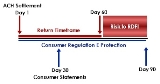
 (Regulation E). An example is a POP and ARC entry, where an RDFI has only 60 days from the date of settlement to return an unauthorized debit, and the consumer has 60 days upon notification to dispute a transaction in his statement under Regulation E. With these time frames, it is possible that the 60-day period allowed for ACH return would expire even before the consumer's 60-day protection (under Regulation E) would expire.

Achregerisk
Another problem deals with compliance where the merchant causes an ODFI to issue an ARC or POP entry (for check presentment) and then fails to comply with the handling of the physical check and presents the physical check for payment as well. This causes a double-debit against a consumer account.

See also

  • Pan-European Automated Clearing House
    Pan-European Automated Clearing House

    A Pan-European Automated Clearing House is an Automated Clearing House that is able to settle Single Euro Payments Area compliant credit transfers and direct debits across the euro....
  • Electronic Check Processing
    Electronic Check Processing

    Electronic Check Processing is an electronic payment process designed to accommodate the requirements of various consumer and Corporation payment applications without the need for a paper Cheque....
  • ODFI
    ODFI

    ODFI is a banking term for Originating Depository Financial Institution, used in connection with Automated Clearing Houses . In the ACH flow, the ODFI acts as the interface between the Federal Reserve or ACH network and the originator of the transaction....
     (Originating Depository Financial Institution)


External links

  • (outdated, needs to be updated)