


Australia and the United Nations

Encyclopedia
Australia
was a founding member of the United Nations
(UN) in 1945 and has been actively engaged in the organisation since its formation. The UN is seen by the Australian Government as a means to influence events which directly affect Australia's interests but over which they have little unilateral control.
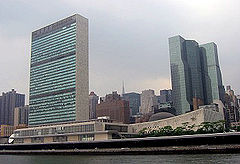 Australia has a permanent diplomatic mission
to the UN in New York City
along with missions in Geneva
, Vienna
and Nairobi
. The Australian Mission is headed by an Ambassador and Permanent Representative and staffed by officers from the Department of Foreign Affairs, AusAid, the Australian Defence Force
, the Australian Federal Police
, as well as local employees. The Mission provides the core of Australia's delegation to UN conferences and meetings in New York, including regular and special sessions of the United Nations General Assembly
. It also participates in the ongoing work of the UN's other organisations, such as the Security Council
and the Economic and Social Council
, and follows the activities of the UN's specialised agencies and programs.
Australia is the thirteenth largest financial contributor to the UN. Australia contributed more than US$87 million in the years 2004 to 2006, with a regular budget of US$22.9 million, peacekeeping costs of approximately US$60 million, and over US$4 million contribution to International Tribunal
s.
Australia has been an elected member of the United Nations Security Council
on four occasions, 1946-7, 1956-7, 1973-4, and 1985-6. H. V. Evatt
, a former Opposition Leader of Australia and prominent figure in the Australian Labor Party
, was President of the United Nations General Assembly
in 1948.
in 1947 during the independence struggle. About 15,000 Australians have taken part in more than forty peacekeeping operations, in about 25 different conflicts. Operations include military observation, monitoring cease-fires, clearing landmines, humanitarian aid and the repatriation of refugees.
Since 1947 Australians have joined peacekeeping operations in Cambodia
, Korea
, Namibia
, Rwanda
, and Somalia
among others. All three services of the Australian Defence Force
, as well as police officers and civilians, have been involved in peacekeeping activities.
The most significant recent involvement from Australian peacekeeping troops is in the newly formed country of East Timor
. Australia initially offered between 1,000 and 1,300 infantry, three Royal Australian Navy
ships (HMAS Manoora and HMAS Kanimbla already stationed nearby, and HMAS Tobruk) along with other support capabilities. Australia's involvement in East Timor is through UNMISET, the United Nations Mission of Support to East Timor, and UNOTIL, the United Nations Office in Timor Leste and UNMIT, the United Nations Integrated Mission in Timor-Leste.
Australia also has peacekeepers from the Australian Defence Force participating in the United Nations Mission in Sudan
, to support the African Union
's Mission in Darfur
.
Seven Australians have commanded or led multinational peacekeeping operations. Nine Australian peacekeepers have died on UN missions.
to meet Prime Minister Kevin Rudd
, elected three months earlier. According to The Age, the aim was to "repair relations". Hilde Johnson, deputy director of UNICEF, stated that Rudd was showing "stronger support" for the United Nations and multilateralism than his predecessor John Howard
had. During Howard's Prime Ministership, UN high commissioner for human rights Mary Robinson
had criticised Australia's human rights
record. Johnson stated that the new Australian government had "explicitly said there's going to be a change, that the government will engage strongly and pro-actively with the UN". For the Australian government, Bob McMullan
said that his country's "relationship with the major multi-lateral organisations has deteriorated in a manner that is quite contrary to Australia's long-term interests and needs to be repaired".
Australia
Australia , officially the Commonwealth of Australia, is a country in the Southern Hemisphere comprising the mainland of the Australian continent, the island of Tasmania, and numerous smaller islands in the Indian and Pacific Oceans. It is the world's sixth-largest country by total area...
was a founding member of the United Nations
United Nations
The United Nations is an international organization whose stated aims are facilitating cooperation in international law, international security, economic development, social progress, human rights, and achievement of world peace...
(UN) in 1945 and has been actively engaged in the organisation since its formation. The UN is seen by the Australian Government as a means to influence events which directly affect Australia's interests but over which they have little unilateral control.
Diplomatic representation
Diplomatic mission
A diplomatic mission is a group of people from one state or an international inter-governmental organisation present in another state to represent the sending state/organisation in the receiving state...
to the UN in New York City
United Nations headquarters
The headquarters of the United Nations is a complex in New York City. The complex has served as the official headquarters of the United Nations since its completion in 1952. It is located in the Turtle Bay neighborhood of Manhattan, on spacious grounds overlooking the East River...
along with missions in Geneva
United Nations Office at Geneva
The United Nations Office at Geneva is the second-largest of the four major office sites of the United Nations...
, Vienna
United Nations Office at Vienna
The United Nations Office in Vienna is one of the four major UN office sites where several different UN agencies have a joint presence. The office complex is located in Vienna, the capital of Austria, and is part of the Vienna International Centre, a cluster of several major international...
and Nairobi
United Nations Office at Nairobi
The United Nations Office at Nairobi is one of the four major UN office sites where several different UN agencies have a joint presence. The office complex is located in Nairobi, Kenya...
. The Australian Mission is headed by an Ambassador and Permanent Representative and staffed by officers from the Department of Foreign Affairs, AusAid, the Australian Defence Force
Australian Defence Force
The Australian Defence Force is the military organisation responsible for the defence of Australia. It consists of the Royal Australian Navy , Australian Army, Royal Australian Air Force and a number of 'tri-service' units...
, the Australian Federal Police
Australian Federal Police
The Australian Federal Police is the federal police agency of the Commonwealth of Australia. Although the AFP was created by the amalgamation in 1979 of three Commonwealth law enforcement agencies, it traces its history from Commonwealth law enforcement agencies dating back to the federation of...
, as well as local employees. The Mission provides the core of Australia's delegation to UN conferences and meetings in New York, including regular and special sessions of the United Nations General Assembly
United Nations General Assembly
For two articles dealing with membership in the General Assembly, see:* General Assembly members* General Assembly observersThe United Nations General Assembly is one of the five principal organs of the United Nations and the only one in which all member nations have equal representation...
. It also participates in the ongoing work of the UN's other organisations, such as the Security Council
United Nations Security Council
The United Nations Security Council is one of the principal organs of the United Nations and is charged with the maintenance of international peace and security. Its powers, outlined in the United Nations Charter, include the establishment of peacekeeping operations, the establishment of...
and the Economic and Social Council
United Nations Economic and Social Council
The Economic and Social Council of the United Nations constitutes one of the six principal organs of the United Nations and it is responsible for the coordination of the economic, social and related work of 14 UN specialized agencies, its functional commissions and five regional commissions...
, and follows the activities of the UN's specialised agencies and programs.
Australia is the thirteenth largest financial contributor to the UN. Australia contributed more than US$87 million in the years 2004 to 2006, with a regular budget of US$22.9 million, peacekeeping costs of approximately US$60 million, and over US$4 million contribution to International Tribunal
Tribunal
A tribunal in the general sense is any person or institution with the authority to judge, adjudicate on, or determine claims or disputes—whether or not it is called a tribunal in its title....
s.
Australia has been an elected member of the United Nations Security Council
United Nations Security Council
The United Nations Security Council is one of the principal organs of the United Nations and is charged with the maintenance of international peace and security. Its powers, outlined in the United Nations Charter, include the establishment of peacekeeping operations, the establishment of...
on four occasions, 1946-7, 1956-7, 1973-4, and 1985-6. H. V. Evatt
H. V. Evatt
Herbert Vere Evatt, QC KStJ , was an Australian jurist, politician and writer. He was President of the United Nations General Assembly in 1948–49 and helped draft the United Nations Universal Declaration of Human Rights...
, a former Opposition Leader of Australia and prominent figure in the Australian Labor Party
Australian Labor Party
The Australian Labor Party is an Australian political party. It has been the governing party of the Commonwealth of Australia since the 2007 federal election. Julia Gillard is the party's federal parliamentary leader and Prime Minister of Australia...
, was President of the United Nations General Assembly
President of the United Nations General Assembly
The President of the United Nations General Assembly is a position voted for by representatives in the United Nations General Assembly on a yearly basis.- Election :...
in 1948.
Australian involvement in UN peacekeeping operations
Australians were the first peacekeepers to serve under United Nations auspices when they sent military observers to IndonesiaIndonesia
Indonesia , officially the Republic of Indonesia , is a country in Southeast Asia and Oceania. Indonesia is an archipelago comprising approximately 13,000 islands. It has 33 provinces with over 238 million people, and is the world's fourth most populous country. Indonesia is a republic, with an...
in 1947 during the independence struggle. About 15,000 Australians have taken part in more than forty peacekeeping operations, in about 25 different conflicts. Operations include military observation, monitoring cease-fires, clearing landmines, humanitarian aid and the repatriation of refugees.
Since 1947 Australians have joined peacekeeping operations in Cambodia
Cambodia
Cambodia , officially known as the Kingdom of Cambodia, is a country located in the southern portion of the Indochina Peninsula in Southeast Asia...
, Korea
Korea
Korea ) is an East Asian geographic region that is currently divided into two separate sovereign states — North Korea and South Korea. Located on the Korean Peninsula, Korea is bordered by the People's Republic of China to the northwest, Russia to the northeast, and is separated from Japan to the...
, Namibia
Namibia
Namibia, officially the Republic of Namibia , is a country in southern Africa whose western border is the Atlantic Ocean. It shares land borders with Angola and Zambia to the north, Botswana to the east and South Africa to the south and east. It gained independence from South Africa on 21 March...
, Rwanda
Rwanda
Rwanda or , officially the Republic of Rwanda , is a country in central and eastern Africa with a population of approximately 11.4 million . Rwanda is located a few degrees south of the Equator, and is bordered by Uganda, Tanzania, Burundi and the Democratic Republic of the Congo...
, and Somalia
Somalia
Somalia , officially the Somali Republic and formerly known as the Somali Democratic Republic under Socialist rule, is a country located in the Horn of Africa. Since the outbreak of the Somali Civil War in 1991 there has been no central government control over most of the country's territory...
among others. All three services of the Australian Defence Force
Australian Defence Force
The Australian Defence Force is the military organisation responsible for the defence of Australia. It consists of the Royal Australian Navy , Australian Army, Royal Australian Air Force and a number of 'tri-service' units...
, as well as police officers and civilians, have been involved in peacekeeping activities.
The most significant recent involvement from Australian peacekeeping troops is in the newly formed country of East Timor
East Timor
The Democratic Republic of Timor-Leste, commonly known as East Timor , is a state in Southeast Asia. It comprises the eastern half of the island of Timor, the nearby islands of Atauro and Jaco, and Oecusse, an exclave on the northwestern side of the island, within Indonesian West Timor...
. Australia initially offered between 1,000 and 1,300 infantry, three Royal Australian Navy
Royal Australian Navy
The Royal Australian Navy is the naval branch of the Australian Defence Force. Following the Federation of Australia in 1901, the ships and resources of the separate colonial navies were integrated into a national force: the Commonwealth Naval Forces...
ships (HMAS Manoora and HMAS Kanimbla already stationed nearby, and HMAS Tobruk) along with other support capabilities. Australia's involvement in East Timor is through UNMISET, the United Nations Mission of Support to East Timor, and UNOTIL, the United Nations Office in Timor Leste and UNMIT, the United Nations Integrated Mission in Timor-Leste.
Australia also has peacekeepers from the Australian Defence Force participating in the United Nations Mission in Sudan
United Nations Mission in Sudan
The United Nations Mission in the Sudan was established by the UN Security Council under Resolution 1590 of 24 March 2005, in response to the signing of the Comprehensive Peace Agreement between the government of the Sudan and the Sudan People's Liberation Movement on January 9, 2005 in Nairobi,...
, to support the African Union
African Union
The African Union is a union consisting of 54 African states. The only all-African state not in the AU is Morocco. Established on 9 July 2002, the AU was formed as a successor to the Organisation of African Unity...
's Mission in Darfur
Darfur
Darfur is a region in western Sudan. An independent sultanate for several hundred years, it was incorporated into Sudan by Anglo-Egyptian forces in 1916. The region is divided into three federal states: West Darfur, South Darfur, and North Darfur...
.
Seven Australians have commanded or led multinational peacekeeping operations. Nine Australian peacekeepers have died on UN missions.
| UN Operation name | UN Operation title | Location | Dates of Australian involvement | Number of Australians involved | Australian role |
|---|---|---|---|---|---|
| None | UN Consular Commission | Indonesia Indonesia Indonesia , officially the Republic of Indonesia , is a country in Southeast Asia and Oceania. Indonesia is an archipelago comprising approximately 13,000 islands. It has 33 provinces with over 238 million people, and is the world's fourth most populous country. Indonesia is a republic, with an... |
1947 | 4 | Military observers |
| UNGOC | UN Good Offices Commission | Indonesia | 1947–1949 | About 45 ADF Australian Defence Force The Australian Defence Force is the military organisation responsible for the defence of Australia. It consists of the Royal Australian Navy , Australian Army, Royal Australian Air Force and a number of 'tri-service' units... personnel |
Monitor ceasefire Ceasefire A ceasefire is a temporary stoppage of a war in which each side agrees with the other to suspend aggressive actions. Ceasefires may be declared as part of a formal treaty, but they have also been called as part of an informal understanding between opposing forces... s and ensure the peace between Dutch and Indonesian nationalists |
| UNCI | UN Commission for Indonesia | Indonesia | 1949–1951 | About 45 ADF personnel | Monitor ceasefires and ensure the peace between Dutch and Indonesian nationalists |
| UNCOK UNCOK UNCOK refers to the 1950 UN Commission on Korea, preceding the events of the Korean War. Many of the participating nations include those who participated in the United Nations Command.-See also:*UNCMAC – the UN Command Military Armistice Commission... |
UN Commission on Korea | Korea Korea Korea ) is an East Asian geographic region that is currently divided into two separate sovereign states — North Korea and South Korea. Located on the Korean Peninsula, Korea is bordered by the People's Republic of China to the northwest, Russia to the northeast, and is separated from Japan to the... |
1950 | 2 | Military observers |
| UNMOGIP United Nations in Kashmir The United Nations has played an important role in maintaining peace and order in Jammu and Kashmir since the transfer of Power to India and independence to Pakistan in 1947. Immediately after the freedom a dispute erupted between India and the successor nation-state of Pakistan on the question of... |
UN Military Observer Group in India India India , officially the Republic of India , is a country in South Asia. It is the seventh-largest country by geographical area, the second-most populous country with over 1.2 billion people, and the most populous democracy in the world... and Pakistan Pakistan Pakistan , officially the Islamic Republic of Pakistan is a sovereign state in South Asia. It has a coastline along the Arabian Sea and the Gulf of Oman in the south and is bordered by Afghanistan and Iran in the west, India in the east and China in the far northeast. In the north, Tajikistan... |
Kashmir Kashmir Kashmir is the northwestern region of the Indian subcontinent. Until the mid-19th century, the term Kashmir geographically denoted only the valley between the Great Himalayas and the Pir Panjal mountain range... |
1950–1985 | Up to 18 | Military observers and air transport |
| UNCURK UNCURK UNCURK refers to the 1951 UN Commission for the Unification and Rehabilitation of Korea. It occurred as part of the Korean War. Many of the participating nations include those who participated in the United Nations Command.-See also:... |
UN Commission for the Unification and Rehabilitation of Korea | Korea | 1951 | 1 | Military observer |
| UNCMAC UNCMAC UNCMAC refers to the United Nations Command Military Armistice Commission, established in July 1953 at the end of the Korean War to supervise the Korean Armistice Agreement, and which has been operating ever since.-History:... |
UN Command Military Armistice Commission | Korea | 1953–present | Originally 6, with 2 continually serving. Estimated 68 total | Armistice monitoring |
| UNTSO | UN Truce Supervision Organization | Israel Israel The State of Israel is a parliamentary republic located in the Middle East, along the eastern shore of the Mediterranean Sea... and neighbouring Middle East Middle East The Middle East is a region that encompasses Western Asia and Northern Africa. It is often used as a synonym for Near East, in opposition to Far East... countries |
1956–present | Up to 13. Estimated 700 total | Military observers |
| ONUC | Operation des Nations Unies au Congo (UN Operation in the Congo) | Congo Republic of the Congo (Léopoldville) The Republic of the Congo was an independent republic established following the independence granted to the former colony of the Belgian Congo in 1960... |
1960–1961 | Army medical team of 3 seconded to the International Red Cross | Medical team |
| UNTEA | UN Temporary Executive Authority | Western New Guinea Western New Guinea West Papua informally refers to the Indonesian western half of the island of New Guinea and other smaller islands to its west. The region is officially administered as two provinces: Papua and West Papua. The eastern half of New Guinea is Papua New Guinea.The population of approximately 3 million... |
1962–1963 | 4 Army Australian Army The Australian Army is Australia's military land force. It is part of the Australian Defence Force along with the Royal Australian Navy and the Royal Australian Air Force. While the Chief of Defence commands the Australian Defence Force , the Army is commanded by the Chief of Army... pilots, 7 RAAF ground crew and 2 Sioux helicopters Bell 47 The Bell 47 is a two-bladed, single engine, light helicopter manufactured by Bell Helicopter. Based on the third Model 30 prototype, Bell's first helicopter designed by Arthur M. Young, the Bell 47 became the first helicopter certified for civilian use on 8 March 1946... |
Cholera Cholera Cholera is an infection of the small intestine that is caused by the bacterium Vibrio cholerae. The main symptoms are profuse watery diarrhea and vomiting. Transmission occurs primarily by drinking or eating water or food that has been contaminated by the diarrhea of an infected person or the feces... eradication program |
| UNYOM | UN Yemen Observation Mission | Yemen Yemen The Republic of Yemen , commonly known as Yemen , is a country located in the Middle East, occupying the southwestern to southern end of the Arabian Peninsula. It is bordered by Saudi Arabia to the north, the Red Sea to the west, and Oman to the east.... |
1963 | 2 | Military observers |
| UNFICYP | UN Peacekeeping Force in Cyprus | Cyprus Cyprus Cyprus , officially the Republic of Cyprus , is a Eurasian island country, member of the European Union, in the Eastern Mediterranean, east of Greece, south of Turkey, west of Syria and north of Egypt. It is the third largest island in the Mediterranean Sea.The earliest known human activity on the... |
1964–present | 15 Australian Federal Police Australian Federal Police The Australian Federal Police is the federal police agency of the Commonwealth of Australia. Although the AFP was created by the amalgamation in 1979 of three Commonwealth law enforcement agencies, it traces its history from Commonwealth law enforcement agencies dating back to the federation of... officers. Estimated 1000 in total |
Law and order Law and order (politics) In politics, law and order refers to demands for a strict criminal justice system, especially in relation to violent and property crime, through harsher criminal penalties... |
| UNIPOM | UN India-Pakistan Observation Mission | India India India , officially the Republic of India , is a country in South Asia. It is the seventh-largest country by geographical area, the second-most populous country with over 1.2 billion people, and the most populous democracy in the world... and Pakistan Pakistan Pakistan , officially the Islamic Republic of Pakistan is a sovereign state in South Asia. It has a coastline along the Arabian Sea and the Gulf of Oman in the south and is bordered by Afghanistan and Iran in the west, India in the east and China in the far northeast. In the north, Tajikistan... |
1965–1966 | 3; 1 seconded from UNTSO, 2 seconded from UNMOGIP | Military observers |
| UNDOF | UN Disengagement Observer Force | Israel Israel The State of Israel is a parliamentary republic located in the Middle East, along the eastern shore of the Mediterranean Sea... and Syria Syria Syria , officially the Syrian Arab Republic , is a country in Western Asia, bordering Lebanon and the Mediterranean Sea to the West, Turkey to the north, Iraq to the east, Jordan to the south, and Israel to the southwest.... |
1974 | Several redeployed from UNTSO. None currently | Military observers |
| UNEF II | UN Emergency Force II | Sinai | 1976–1979 | 46 RAAF detachment operating 4 UH-1 helicopters UH-1 Iroquois The Bell UH-1 Iroquois is a military helicopter powered by a single, turboshaft engine, with a two-bladed main rotor and tail rotor. The helicopter was developed by Bell Helicopter to meet the United States Army's requirement for a medical evacuation and utility helicopter in 1952, and first flew... |
Ceasefire monitoring between Israel and Egypt Egypt Egypt , officially the Arab Republic of Egypt, Arabic: , is a country mainly in North Africa, with the Sinai Peninsula forming a land bridge in Southwest Asia. Egypt is thus a transcontinental country, and a major power in Africa, the Mediterranean Basin, the Middle East and the Muslim world... |
| UNIFIL | UN Interim Force in Lebanon | Lebanon Lebanon Lebanon , officially the Republic of LebanonRepublic of Lebanon is the most common term used by Lebanese government agencies. The term Lebanese Republic, a literal translation of the official Arabic and French names that is not used in today's world. Arabic is the most common language spoken among... |
1978 | A few through detachment from UNTSO | Military observers |
| UNIIMOG | UN Iran-Iraq Military Observer Group | Iran Iran Iran , officially the Islamic Republic of Iran , is a country in Southern and Western Asia. The name "Iran" has been in use natively since the Sassanian era and came into use internationally in 1935, before which the country was known to the Western world as Persia... and Iraq Iraq Iraq ; officially the Republic of Iraq is a country in Western Asia spanning most of the northwestern end of the Zagros mountain range, the eastern part of the Syrian Desert and the northern part of the Arabian Desert.... |
1988–1990 | Up to 16 in Iran only | Military observers |
| UNBRO UNBRO The United Nations Border Relief Operation was a donor-nation funded relief effort for Cambodian refugees and others affected by years of warfare along the Thai-Cambodian border... |
UN Border Relief Operation | Thailand Thailand Thailand , officially the Kingdom of Thailand , formerly known as Siam , is a country located at the centre of the Indochina peninsula and Southeast Asia. It is bordered to the north by Burma and Laos, to the east by Laos and Cambodia, to the south by the Gulf of Thailand and Malaysia, and to the... /Cambodia Cambodia Cambodia , officially known as the Kingdom of Cambodia, is a country located in the southern portion of the Indochina Peninsula in Southeast Asia... border |
1989–1993 | 2 Federal Police Australian Federal Police The Australian Federal Police is the federal police agency of the Commonwealth of Australia. Although the AFP was created by the amalgamation in 1979 of three Commonwealth law enforcement agencies, it traces its history from Commonwealth law enforcement agencies dating back to the federation of... |
Law and order, and police training |
| UNTAG | UN Transition Assistance Group | Namibia Namibia Namibia, officially the Republic of Namibia , is a country in southern Africa whose western border is the Atlantic Ocean. It shares land borders with Angola and Zambia to the north, Botswana to the east and South Africa to the south and east. It gained independence from South Africa on 21 March... |
1989–1990 | 613 in two rotations; 28 electoral supervisors | Engineering support and election supervision |
| UNMCTT | UN Mine Clearance Training Team | Afghanistan Afghanistan Afghanistan , officially the Islamic Republic of Afghanistan, is a landlocked country located in the centre of Asia, forming South Asia, Central Asia and the Middle East. With a population of about 29 million, it has an area of , making it the 42nd most populous and 41st largest nation in the world... and Pakistan Pakistan Pakistan , officially the Islamic Republic of Pakistan is a sovereign state in South Asia. It has a coastline along the Arabian Sea and the Gulf of Oman in the south and is bordered by Afghanistan and Iran in the west, India in the east and China in the far northeast. In the north, Tajikistan... |
1989–1993 | 10 teams of 6-9 Army field engineers. Estimated 95 total | Demining Demining Demining or mine clearance is the process of removing either land mines, or naval mines, from an area, while minesweeping describes the act of detecting of mines. There are two distinct types of mine detection and removal: military and humanitarian.Minesweepers use many tools in order to accomplish... |
| UNSCOM | UN Special Commission | Iraq Iraq Iraq ; officially the Republic of Iraq is a country in Western Asia spanning most of the northwestern end of the Zagros mountain range, the eastern part of the Syrian Desert and the northern part of the Arabian Desert.... |
1991–1999 | Between 2-6 ADF personnel on 3-6 month tours. Estimated total 96 | Inspection of Iraqi chemical, biological and nuclear weapons capabilities |
| MINURSO | Mission des Nations Unies pour un Referendum au Sahara Occidental (UN Mission for the Referendum in Western Sahara) | Western Sahara Western Sahara Western Sahara is a disputed territory in North Africa, bordered by Morocco to the north, Algeria to the northeast, Mauritania to the east and south, and the Atlantic Ocean to the west. Its surface area amounts to . It is one of the most sparsely populated territories in the world, mainly... |
1991–1994 | 5 45 person contingents. Total 225 | Communications |
| UNAMIC | UN Advance Mission in Cambodia | Cambodia Cambodia Cambodia , officially known as the Kingdom of Cambodia, is a country located in the southern portion of the Indochina Peninsula in Southeast Asia... |
1991–1992 | 65 | Military observers, signals and support |
| UNTAC | UN Transitional Authority in Cambodia | Cambodia Cambodia Cambodia , officially known as the Kingdom of Cambodia, is a country located in the southern portion of the Indochina Peninsula in Southeast Asia... |
1992–1993 | Up to 1,215 ADF personnel | Force Communications Unit |
| UNOSOM I UNOSOM I United Nations Operation in Somalia I was the first part of a United Nations sponsored effort to provide, facilitate, and secure humanitarian relief in Somalia, as well as to monitor the first UN-brokered ceasefire of the Somali Civil War conflict in the early 1990s.The operation was established... |
UN Operation in Somalia | Somalia Somalia Somalia , officially the Somali Republic and formerly known as the Somali Democratic Republic under Socialist rule, is a country located in the Horn of Africa. Since the outbreak of the Somali Civil War in 1991 there has been no central government control over most of the country's territory... |
1992–1993 | 30 | Movement control unit |
| UNITAF UNITAF Unified Task Force was a United States-led, United Nations-sanctioned multinational force which operated in Somalia between 5 December 1992 – 4 May 1993... |
Unified Task Force | Somalia Somalia Somalia , officially the Somali Republic and formerly known as the Somali Democratic Republic under Socialist rule, is a country located in the Horn of Africa. Since the outbreak of the Somali Civil War in 1991 there has been no central government control over most of the country's territory... |
1992–1993 | About 1,200. 1 Royal Australian Regiment Royal Australian Regiment The Royal Australian Regiment is the parent regiment for regular infantry battalions of the Australian Army and is the senior infantry regiment of the Royal Australian Infantry Corps... Battalion Group, HQ group, and HMAS Tobruk |
Protecting delivery of humanitarian aid, law and order, and establishing functional legal, social and economic systems |
| UNPROFOR | UN Protection Force in Croatia, Bosnia-Herzegovina and Macedonia | Former Yugoslavia Former Yugoslavia The former Yugoslavia is a term used to describe the present day states which succeeded the collapse of the Socialist Federal Republic of Yugoslavia.... |
1992 | Several | Military observers and liaison |
| UNOSOM II UNOSOM II United Nations Operation in Somalia II was the second phase of the United Nations intervention in Somalia, from March 1993 until March 1995.... |
UN Operation in Somalia II | Somalia | 1993–1995 | 36 Movements and Air Traffic Control Staff, 12 man Ready Reaction Security Team (mainly SAS) and HQ staff. 50 personnel per tour, about 250 in total | Movement control unit, HQ staff, security |
| UNAMIR II | UN Assistance Mission for Rwanda | Rwanda Rwanda Rwanda or , officially the Republic of Rwanda , is a country in central and eastern Africa with a population of approximately 11.4 million . Rwanda is located a few degrees south of the Equator, and is bordered by Uganda, Tanzania, Burundi and the Democratic Republic of the Congo... |
1994–1995 | More than 600 in 2 contingents | Medical, infantry protection, support troops |
| ONUMOZ | UN Operation in Mozambique | Mozambique Mozambique Mozambique, officially the Republic of Mozambique , is a country in southeastern Africa bordered by the Indian Ocean to the east, Tanzania to the north, Malawi and Zambia to the northwest, Zimbabwe to the west and Swaziland and South Africa to the southwest... |
1994 | 15 police, 4 ADF | Police and demining |
| MINUGUA MINUGUA MINUGUA was a ten-year United Nations humanitarian mission in Guatemala that involved, at the most critical point in the peace process, a three-month peacekeeping mission.... |
UN Verification Mission in Guatemala | Guatemala Guatemala Guatemala is a country in Central America bordered by Mexico to the north and west, the Pacific Ocean to the southwest, Belize to the northeast, the Caribbean to the east, and Honduras and El Salvador to the southeast... |
1997 | 1 | Military observer |
| UNAMET | UN Mission in East Timor | East Timor East Timor The Democratic Republic of Timor-Leste, commonly known as East Timor , is a state in Southeast Asia. It comprises the eastern half of the island of Timor, the nearby islands of Atauro and Jaco, and Oecusse, an exclave on the northwestern side of the island, within Indonesian West Timor... |
1999 | 50 police, 6 military liaison officers | Facilitating referendum |
| INTERFET INTERFET The International Force for East Timor was a multinational peacekeeping taskforce, mandated by the United Nations to address the humanitarian and security crisis which took place in East Timor from 1999–2000 until the arrival of United Nations peacekeepers... |
International Force East Timor under UN mandate | East Timor East Timor The Democratic Republic of Timor-Leste, commonly known as East Timor , is a state in Southeast Asia. It comprises the eastern half of the island of Timor, the nearby islands of Atauro and Jaco, and Oecusse, an exclave on the northwestern side of the island, within Indonesian West Timor... |
1999–2000 | 5,500 | Establishing security, facilitating humanitarian aid and reconstruction |
| UNTAET | UN Transitional Administration in East Timor | East Timor | 2000–2002 | Up to 2,000 | maintaining security, facilitating reconstruction |
| UNMEE | United Nations Mission in Ethiopia and Eritrea | Ethiopia Ethiopia Ethiopia , officially known as the Federal Democratic Republic of Ethiopia, is a country located in the Horn of Africa. It is the second-most populous nation in Africa, with over 82 million inhabitants, and the tenth-largest by area, occupying 1,100,000 km2... and Eritrea Eritrea Eritrea , officially the State of Eritrea, is a country in the Horn of Africa. Eritrea derives it's name from the Greek word Erethria, meaning 'red land'. The capital is Asmara. It is bordered by Sudan in the west, Ethiopia in the south, and Djibouti in the southeast... |
2000–present | 2 ADF officers, 16 in total | Training mission personnel and mapping |
| UNMISET | UN Mission of Support in East Timor | East Timor | 2002–2005 | Up to 1,600 | Maintaining security, facilitating reconstruction |
| UNMOVIC | UN Monitoring, Verification and Inspection Commission for Iraq | Iraq | 2002–2003 | A few trained, not deployed | Weapons inspectors |
| UNAMA | UN Assistance Mission in Afghanistan | Afghanistan Afghanistan Afghanistan , officially the Islamic Republic of Afghanistan, is a landlocked country located in the centre of Asia, forming South Asia, Central Asia and the Middle East. With a population of about 29 million, it has an area of , making it the 42nd most populous and 41st largest nation in the world... |
2003–2004 | 1 | Military advisor |
| UNMIS (Operation Azure Operation Azure Operation Azure is the name given to the Australian Defence Force's contribution to the United Nations Mission in Sudan .The United Nations Mission in the Sudan was established by the United Nations under UN Security Council Resolution 1590 of the UN Security Council on 24 March 2005, in response... ) |
United Nations Mission in the Sudan | Sudan Sudan Sudan , officially the Republic of the Sudan , is a country in North Africa, sometimes considered part of the Middle East politically. It is bordered by Egypt to the north, the Red Sea to the northeast, Eritrea and Ethiopia to the east, South Sudan to the south, the Central African Republic to the... |
2005–present | 15 | Military observers, logistics, air movement controllers |
| UNOTIL (Operation Tower Operation Tower Operation Tower is the Australian Defence Force's contribution to the United Nations Integrated Mission in East Timor .UNMIT was established on 25 August 2006 by UN Security Council Resolution 1704... ) |
United Nations Office in Timor-Leste | East Timor East Timor The Democratic Republic of Timor-Leste, commonly known as East Timor , is a state in Southeast Asia. It comprises the eastern half of the island of Timor, the nearby islands of Atauro and Jaco, and Oecusse, an exclave on the northwestern side of the island, within Indonesian West Timor... |
2005–present | About 17 | Military and police support |
Australia-UN relations in 2008
In March 2008, senior United Nations officials travelled to CanberraCanberra
Canberra is the capital city of Australia. With a population of over 345,000, it is Australia's largest inland city and the eighth-largest city overall. The city is located at the northern end of the Australian Capital Territory , south-west of Sydney, and north-east of Melbourne...
to meet Prime Minister Kevin Rudd
Kevin Rudd
Kevin Michael Rudd is an Australian politician who was the 26th Prime Minister of Australia from 2007 to 2010. He has been Minister for Foreign Affairs since 2010...
, elected three months earlier. According to The Age, the aim was to "repair relations". Hilde Johnson, deputy director of UNICEF, stated that Rudd was showing "stronger support" for the United Nations and multilateralism than his predecessor John Howard
John Howard
John Winston Howard AC, SSI, was the 25th Prime Minister of Australia, from 11 March 1996 to 3 December 2007. He was the second-longest serving Australian Prime Minister after Sir Robert Menzies....
had. During Howard's Prime Ministership, UN high commissioner for human rights Mary Robinson
Mary Robinson
Mary Therese Winifred Robinson served as the seventh, and first female, President of Ireland from 1990 to 1997, and the United Nations High Commissioner for Human Rights, from 1997 to 2002. She first rose to prominence as an academic, barrister, campaigner and member of the Irish Senate...
had criticised Australia's human rights
Human rights
Human rights are "commonly understood as inalienable fundamental rights to which a person is inherently entitled simply because she or he is a human being." Human rights are thus conceived as universal and egalitarian . These rights may exist as natural rights or as legal rights, in both national...
record. Johnson stated that the new Australian government had "explicitly said there's going to be a change, that the government will engage strongly and pro-actively with the UN". For the Australian government, Bob McMullan
Bob McMullan
Robert Francis McMullan is an Australian former politician who represented the Australian Labor Party in both the Senate and the House of Representatives....
said that his country's "relationship with the major multi-lateral organisations has deteriorated in a manner that is quite contrary to Australia's long-term interests and needs to be repaired".
See also
- 2006 East Timor crisis
- International Force for East Timor (INTERFET)
External links
- Australia and the United Nations, Department of Foreign Affairs and Trade (Australia)Department of Foreign Affairs and Trade (Australia)The Department of Foreign Affairs and Trade is a department of the government of Australia charged with advancing the interests of Australia and its citizens internationally...
- Australian Permanent Mission to the United Nations
- United Nations Information Centre for Australia, New Zealand and the South Pacific
- Australia and the United Nations, National Archives of AustraliaNational Archives of AustraliaThe National Archives of Australia is a body established by the Government of Australia for the purpose of preserving Commonwealth Government records. It is an Executive Agency of the Department of the Prime Minister and Cabinet and reports to the Cabinet Secretary, Senator Joe Ludwig.The national...