

Aubergine

Encyclopedia
The eggplant, aubergine, melongene, brinjal or guinea squash (Solanum melongena) is a plant of the family Solanaceae
(also known as the nightshades) and genus Solanum
. It bears a fruit
of the same name, commonly used in cooking. As a nightshade, it is closely related to the tomato
and potato
and is native to India
.
It is a delicate perennial
often cultivated as an annual
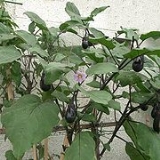
. It grows 40 to 150 cm (16 to 57 in) tall, with large coarsely lobed leaves
that are 10 to 20 cm (4–8 in) long and 5 to 10 cm (2–4 in) broad. Semiwild types can grow much larger, to 225 cm (7 ft) with large leaves over 30 cm (12 in) long and 15 cm (6 in) broad. The stem is often spiny. The flower
s are white to purple, with a five-lobed corolla and yellow stamen
s. The fruit
is fleshy, has a meaty texture, and is less than 3 cm (1.2 in) in diameter on wild plants, but much larger in cultivated forms.
The fruit is botanically classified as a berry
, and contains numerous small, soft seed
s, which are edible, but have a bitter taste because they contain nicotinoid
alkaloid
s; this is unsurprising as it is a close relative of tobacco
.
.jpg) The plant is native to the Indian subcontinent
The plant is native to the Indian subcontinent
. It has been cultivated in southern and eastern Asia
since prehistory, but appears to have become known to the Western world no earlier than ca. 1500. The first known written record of the plant is found in Qí mín yào shù
, an ancient Chinese agricultural treatise completed in 544. The numerous Arabic
and North African names for it, along with the lack of the ancient Greek and Roman names, indicate it was introduced throughout the Mediterranean area by the Arabs in the early Middle Ages
. The scientific name Solanum melongena is derived from a 16th century Arabic term for one variety.
The name aubergine is from the French, a diminutive of auberge, variant of alberge ‘a kind of peach’ or from the Spanish alberchigo, alverchiga, ‘an apricocke’ (Minsheu 1623). It may be also be derived from Catalan
albergínia, from Arabic
al-baðinjān from Persian
bâdenjân, from Sanskrit
vātiga-gama).
Aubergine is also the name of the purple color resembling that of the fruit and is a commonly known color scheme applied to articles as diverse as cloth or bathroom suites.
The name eggplant, rather than aubergine, is used in the United States
, Australia
, New Zealand
, and Canada
, and refers to the fruits of some 18th century European cultivars which were yellow or white and resembled goose or hen's eggs.
In Indian, South African, Malaysian and Singaporean English, the fruit is known as a "vengan", "baingan" or brinjal, with the latter being derived directly from the Portuguese
beringela. A less common British English word is melongene, which is also from French (derived) from Italian "melanzana" from Greek "μελιτζάνα". In the Caribbean Trinidad
, it also goes by "meloongen" from melongene.
Because of the plant's relationship with the Solanaceae (nightshade) family
, the fruit was at one time believed to be extremely poisonous.
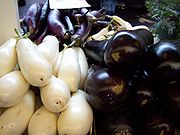
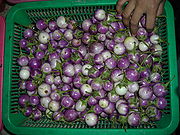 Different varieties of the plant produce fruit of different size, shape and color, though typically purple. There are even orange varieties.
The most widely cultivated varieties (cultivar
s) in Europe
and North America
today are elongated ovoid, 12–25 cm long (4½ to 9 in) and 6–9 cm broad (2 to 4 in) in a dark purple skin.
A much wider range of shapes, sizes and colors is grown in India and elsewhere in Asia. Larger varieties weighing up to a kilogram (2.2 pounds) grow in the region between the Ganges and Yamuna
rivers, while smaller varieties are found elsewhere. Colors vary from white to yellow or green as well as reddish-purple and dark purple. Some cultivars have a color gradient, from white at the stem to bright pink to deep purple or even black. Green or purple cultivars in white striping also exist. Chinese varieties are commonly shaped like a narrower, slightly pendulous cucumber
, and were sometimes called Japanese eggplants in North America.
Oval or elongated oval-shaped and black-skinned cultivars include Harris Special Hibush, Burpee Hybrid, Black Magic, Classic, Dusky, and Black Beauty. Slim cultivars in purple-black skin include Little Fingers, Ichiban, Pingtung Long, and Tycoon; in green skin Louisiana Long Green and Thai (Long) Green; in white skin Dourga. Traditional, white-skinned, egg-shaped cultivars include Casper and Easter Egg. Bicolored cultivars with color gradient include Rosa Bianca, Violetta di Firenze, Bianca Smufata di Rosa (heirloom), and Prosperosa (heirloom). Bicolored cultivars in striping include Listada de Gandia and Udumalapet. In some parts of India, miniature varieties (most commonly called vengan) are popular. A particular variety of green brinjal known as Matti Gulla is grown in Matti village of Udupi district in Karnataka state in India.
, the numerous seed
s are soft and edible along with the rest of the fruit. The thin skin is also edible, so peeling is not required.
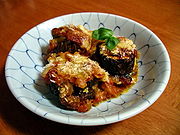 The plant is used in cuisines from Japan
to Spain
. It is often stewed, as in the French ratatouille
, the Italian
parmigiana di melanzane
, the Turkish musakka, and Middle-Eastern
and South Asian
dishes. Eggplants can also be battered before deep-frying and served with a sauce made of tahini and tamarind. In Iranian cuisine, it can be blended with whey as kashk
e-bademjan, tomatoes as mirza ghasemi or made into stew as khoresh-e-bademjan. It can be sliced and deep-fried, then served with plain yoghurt
, (optionally) topped with a tomato and garlic sauce, such as in the Turkish dish
patlıcan kızartması or without yoghurt as in patlıcan şakşuka. However, arguably the most famous Turkish eggplant dish is İmam bayıldı
.
It may also be roasted in its skin until charred, so the pulp can be removed and blended with other ingredients, such as lemon, tahini, and garlic, as in the Middle Eastern dish baba ghanoush
and the similar Greek dish melitzanosalata. Grilled, mashed and mixed with onion
s, tomato
es and spice
s make the Indian
dish baingan ka Bhartha
or gojju, similar to salată de vinete in Romania
, while a mix of roasted eggplant, roasted red peppers, chopped onions, tomatoes, mushrooms, carrots, celery and spices is called zacuscă
in Romania or ajvar
in Serbia
and the Balkans
. A simpler version of the dish, Begun-Pora (eggplant-charred or burnt), is popular in the east Indian state of Bengal and Bangladesh where the charred pulp is mixed with raw chopped onions, green chillies, salt and mustard oil.
The fruit can also be stuffed with meat
, rice
, or other fillings and then baked. In the Caucasus
, for example, it is fried and stuffed with walnut paste to make nigvziani badrijani
. It can also be found in Chinese cuisine, braised (紅燒茄子), stewed (魚香茄子), steamed (凉拌茄子), or stuffed (釀茄子).
As a native plant, it is widely used in Indian cuisine
, for example in sambhar, dalma
(a dal preparation with vegetables, native to Orissa), chutney
, curry
, and achaar
. Owing to its versatile nature and wide use in both everyday and festive Indian food, it is often described (under the name brinjal) as the 'King of Vegetables'. In one dish, brinjal is stuffed with ground coconut
, peanut
s, and masala
, and then cooked in oil.
 In tropical
and subtropical climates, eggplant can be sown directly into the garden. Eggplant grown in temperate
climates fares better when transplanted into the garden after all danger of frost
is passed. Seeds are typically started eight to ten weeks prior to the anticipated frost-free date.
Many pests and diseases which afflict other solanaceous plants, such as tomato, pepper (capsicum), and potato, are also troublesome to eggplants. For this reason, it should not be planted in areas previously occupied by its close relatives. Four years should separate successive crops of eggplants. Common North America
n pests include the potato beetle
s, flea beetle
s, aphid
s, and spider mites
. (Adults can be removed by hand, though flea beetles can be especially difficult to control.) Good sanitation and crop rotation practices are extremely important for controlling fungal disease, the most serious of which is Verticillium
.
Spacing should be 45 cm (18 in.) to 60 cm (24 in.) between plants, depending on cultivar, and 60 cm to 90 cm (24 to 36 in.) between rows, depending on the type of cultivation equipment being used. Mulch
ing will help conserve moisture and prevent weeds and fungal diseases. The flowers are relatively unattractive to bee
s and the first blossoms often do not set fruit. Hand pollination
will improve the set of the first blossoms. Fruits are typically cut from the vine just above the calyx owing to the somewhat woody stems. Flowers are complete, containing both female and male structures, and may be self pollinated
or cross pollinated.
 Production of eggplant is highly concentrated, with 85 percent of output coming from five countries. China is the top producer (56% of world output) and India is second (26%); Egypt, Turkey and Indonesia round out the top producing nations. More than 4 million acres (2,043,788 hectares) are devoted to the cultivation of eggplant in the world. In the United States, Georgia is the largest producing state.
. Another study from Heart Institute of the University of São Paulo found no effects at all and does not recommend eggplant as a replacement to statin
s.
It helps to block the formation of free radicals
and is also a source of folic acid
and potassium
.
Eggplant is richer in nicotine
than any other edible plant, with a concentration of 100 ng/g (or 0.01 mg/100g). However, the amount of nicotine from eggplant or any other food is negligible compared to passive smoking
. On average, 20 lbs (9 kg) of eggplant contains about the same amount of nicotine as a cigarette
.
). A recent (2008) study of a sample of 741 people in India (where eggplant is commonly consumed) found nearly 10% reported some allergic symptoms after consuming eggplant, while 1.4% showed symptoms in less than 2 hours.
Contact dermatitis from eggplant leaves and allergy to eggplant flower pollen have also been reported. Individuals who are atopic (genetically predisposed to hypersensitivity, such as hayfever) are more likely to have a reaction to eggplant, which may be because eggplant is high in histamine
s. A few proteins and at least one secondary metabolite have been identified as potential allergens. Cooking eggplant thoroughly seems to preclude reactions in some individuals, but at least one of the allergenic proteins survives the cooking process.
is a transgenic
eggplant which has a gene from the soil bacterium Bacillus thuringiensis
inserted into it. This variety was designed to give the plant resistance against lepidoptera
n insects like the brinjal fruit and shoot borer (Leucinodes orbonalis
) and fruit borer (Helicoverpa armigera
).
On 9 February 2010, the Indian Environment Minister, Jairam Ramesh, imposed a moratorium on the cultivation of Bt brinjal. His decision was made after protest from several groups responding to regulatory approval of the cultivation of Bt brinjal in October, 2009. Ramesh stated the moratorium will last "for as long as it is needed to establish public trust and confidence".
A number of subspecies
and varieties have been named, mainly by Dikii, Dunal, and (invalidly) by Sweet. Names for various eggplant types, such as agreste, album, divaricatum, esculentum, giganteum, globosi, inerme, insanum, leucoum, luteum, multifidum, oblongo-cylindricum, ovigera, racemiflorum, racemosum, ruber, rumphii, sinuatorepandum, stenoleucum, subrepandum, tongdongense, variegatum, violaceum and viride, are not considered to refer to anything more than cultivar
groups at best. On the other hand, Solanum incanum
and cockroach berry (S. capsicoides), other eggplant-like nightshades described by Linnaeus and Allioni
respectively, were occasionally considered eggplant varieties, but this is not correct.
The eggplant has a long history of taxonomic confusion with the scarlet and Ethiopian eggplants, known as gilo and nakati and described by Linnaeus as S. aethiopicum. The eggplant was sometimes considered a variety violaceum of that species. S. violaceum of de Candolle
applies to Linnaeus' S. aethiopicum. There is an actual S. violaceum, an unrelated plant described by Ortega, which used to include Dunal's S. amblymerum and was often confused with the same author's S. brownii.
Like the potato
and Solanum lichtensteinii—but unlike the tomato
which then was generally put in a different genus—the eggplant was also described as S. esculentum, in this case once more in the course of Dunal
's work. He also recognized varieties aculeatum, inerme and subinerme at that time. Similarly, H.C.F. Schuhmacher
and Peter Thonning
named the eggplant as S. edule, which is also a junior synonym of sticky nightshade (S. sisymbriifolium). Scopoli
's S. zeylanicum refers to the eggplant, and that of Blanco to S. lasiocarpum
.
Solanaceae
Solanaceae are a family of flowering plants that include a number of important agricultural crops as well as many toxic plants. The name of the family comes from the Latin Solanum "the nightshade plant", but the further etymology of that word is unclear...
(also known as the nightshades) and genus Solanum
Solanum
Solanum, the nightshades, horsenettles and relatives, is a large and diverse genus of annual and perennial plants. They grow as forbs, vines, subshrubs, shrubs, and small trees, and often have attractive fruit and flowers. Many formerly independent genera like Lycopersicon or Cyphomandra are...
. It bears a fruit
Fruit
In broad terms, a fruit is a structure of a plant that contains its seeds.The term has different meanings dependent on context. In non-technical usage, such as food preparation, fruit normally means the fleshy seed-associated structures of certain plants that are sweet and edible in the raw state,...
of the same name, commonly used in cooking. As a nightshade, it is closely related to the tomato
Tomato
The word "tomato" may refer to the plant or the edible, typically red, fruit which it bears. Originating in South America, the tomato was spread around the world following the Spanish colonization of the Americas, and its many varieties are now widely grown, often in greenhouses in cooler...
and potato
Potato
The potato is a starchy, tuberous crop from the perennial Solanum tuberosum of the Solanaceae family . The word potato may refer to the plant itself as well as the edible tuber. In the region of the Andes, there are some other closely related cultivated potato species...
and is native to India
India
India , officially the Republic of India , is a country in South Asia. It is the seventh-largest country by geographical area, the second-most populous country with over 1.2 billion people, and the most populous democracy in the world...
.
It is a delicate perennial
Perennial plant
A perennial plant or simply perennial is a plant that lives for more than two years. The term is often used to differentiate a plant from shorter lived annuals and biennials. The term is sometimes misused by commercial gardeners or horticulturalists to describe only herbaceous perennials...
often cultivated as an annual
Annual plant
An annual plant is a plant that usually germinates, flowers, and dies in a year or season. True annuals will only live longer than a year if they are prevented from setting seed...
. It grows 40 to 150 cm (16 to 57 in) tall, with large coarsely lobed leaves
Leaf
A leaf is an organ of a vascular plant, as defined in botanical terms, and in particular in plant morphology. Foliage is a mass noun that refers to leaves as a feature of plants....
that are 10 to 20 cm (4–8 in) long and 5 to 10 cm (2–4 in) broad. Semiwild types can grow much larger, to 225 cm (7 ft) with large leaves over 30 cm (12 in) long and 15 cm (6 in) broad. The stem is often spiny. The flower
Flower
A flower, sometimes known as a bloom or blossom, is the reproductive structure found in flowering plants . The biological function of a flower is to effect reproduction, usually by providing a mechanism for the union of sperm with eggs...
s are white to purple, with a five-lobed corolla and yellow stamen
Stamen
The stamen is the pollen producing reproductive organ of a flower...
s. The fruit
Fruit
In broad terms, a fruit is a structure of a plant that contains its seeds.The term has different meanings dependent on context. In non-technical usage, such as food preparation, fruit normally means the fleshy seed-associated structures of certain plants that are sweet and edible in the raw state,...
is fleshy, has a meaty texture, and is less than 3 cm (1.2 in) in diameter on wild plants, but much larger in cultivated forms.
The fruit is botanically classified as a berry
Berry
The botanical definition of a berry is a fleshy fruit produced from a single ovary. Grapes are an example. The berry is the most common type of fleshy fruit in which the entire ovary wall ripens into an edible pericarp. They may have one or more carpels with a thin covering and fleshy interiors....
, and contains numerous small, soft seed
Seed
A seed is a small embryonic plant enclosed in a covering called the seed coat, usually with some stored food. It is the product of the ripened ovule of gymnosperm and angiosperm plants which occurs after fertilization and some growth within the mother plant...
s, which are edible, but have a bitter taste because they contain nicotinoid
Nicotine
Nicotine is an alkaloid found in the nightshade family of plants that constitutes approximately 0.6–3.0% of the dry weight of tobacco, with biosynthesis taking place in the roots and accumulation occurring in the leaves...
alkaloid
Alkaloid
Alkaloids are a group of naturally occurring chemical compounds that contain mostly basic nitrogen atoms. This group also includes some related compounds with neutral and even weakly acidic properties. Also some synthetic compounds of similar structure are attributed to alkaloids...
s; this is unsurprising as it is a close relative of tobacco
Tobacco
Tobacco is an agricultural product processed from the leaves of plants in the genus Nicotiana. It can be consumed, used as a pesticide and, in the form of nicotine tartrate, used in some medicines...
.
History
Indian subcontinent
The Indian subcontinent, also Indian Subcontinent, Indo-Pak Subcontinent or South Asian Subcontinent is a region of the Asian continent on the Indian tectonic plate from the Hindu Kush or Hindu Koh, Himalayas and including the Kuen Lun and Karakoram ranges, forming a land mass which extends...
. It has been cultivated in southern and eastern Asia
Asia
Asia is the world's largest and most populous continent, located primarily in the eastern and northern hemispheres. It covers 8.7% of the Earth's total surface area and with approximately 3.879 billion people, it hosts 60% of the world's current human population...
since prehistory, but appears to have become known to the Western world no earlier than ca. 1500. The first known written record of the plant is found in Qí mín yào shù
Qi Min Yao Shu
Qí mín yào shù Qí mín yào shù Qí mín yào shù (TC: 齊民要術; SC: 齐民要术; Literal translation: Main techniques for the welfare of the people) is the most completely preserved of the Ancient Chinese agricultural texts, and was written by the Northern Wei Dynasty official Jia Sixie. The book is believed to...
, an ancient Chinese agricultural treatise completed in 544. The numerous Arabic
Arabic language
Arabic is a name applied to the descendants of the Classical Arabic language of the 6th century AD, used most prominently in the Quran, the Islamic Holy Book...
and North African names for it, along with the lack of the ancient Greek and Roman names, indicate it was introduced throughout the Mediterranean area by the Arabs in the early Middle Ages
Middle Ages
The Middle Ages is a periodization of European history from the 5th century to the 15th century. The Middle Ages follows the fall of the Western Roman Empire in 476 and precedes the Early Modern Era. It is the middle period of a three-period division of Western history: Classic, Medieval and Modern...
. The scientific name Solanum melongena is derived from a 16th century Arabic term for one variety.
The name aubergine is from the French, a diminutive of auberge, variant of alberge ‘a kind of peach’ or from the Spanish alberchigo, alverchiga, ‘an apricocke’ (Minsheu 1623). It may be also be derived from Catalan
Catalan language
Catalan is a Romance language, the national and only official language of Andorra and a co-official language in the Spanish autonomous communities of Catalonia, the Balearic Islands and Valencian Community, where it is known as Valencian , as well as in the city of Alghero, on the Italian island...
albergínia, from Arabic
Arabic language
Arabic is a name applied to the descendants of the Classical Arabic language of the 6th century AD, used most prominently in the Quran, the Islamic Holy Book...
al-baðinjān from Persian
Persian language
Persian is an Iranian language within the Indo-Iranian branch of the Indo-European languages. It is primarily spoken in Iran, Afghanistan, Tajikistan and countries which historically came under Persian influence...
bâdenjân, from Sanskrit
Sanskrit
Sanskrit , is a historical Indo-Aryan language and the primary liturgical language of Hinduism, Jainism and Buddhism.Buddhism: besides Pali, see Buddhist Hybrid Sanskrit Today, it is listed as one of the 22 scheduled languages of India and is an official language of the state of Uttarakhand...
vātiga-gama).
Aubergine is also the name of the purple color resembling that of the fruit and is a commonly known color scheme applied to articles as diverse as cloth or bathroom suites.
The name eggplant, rather than aubergine, is used in the United States
United States
The United States of America is a federal constitutional republic comprising fifty states and a federal district...
, Australia
Australia
Australia , officially the Commonwealth of Australia, is a country in the Southern Hemisphere comprising the mainland of the Australian continent, the island of Tasmania, and numerous smaller islands in the Indian and Pacific Oceans. It is the world's sixth-largest country by total area...
, New Zealand
New Zealand
New Zealand is an island country in the south-western Pacific Ocean comprising two main landmasses and numerous smaller islands. The country is situated some east of Australia across the Tasman Sea, and roughly south of the Pacific island nations of New Caledonia, Fiji, and Tonga...
, and Canada
Canada
Canada is a North American country consisting of ten provinces and three territories. Located in the northern part of the continent, it extends from the Atlantic Ocean in the east to the Pacific Ocean in the west, and northward into the Arctic Ocean...
, and refers to the fruits of some 18th century European cultivars which were yellow or white and resembled goose or hen's eggs.
In Indian, South African, Malaysian and Singaporean English, the fruit is known as a "vengan", "baingan" or brinjal, with the latter being derived directly from the Portuguese
Portuguese language
Portuguese is a Romance language that arose in the medieval Kingdom of Galicia, nowadays Galicia and Northern Portugal. The southern part of the Kingdom of Galicia became independent as the County of Portugal in 1095...
beringela. A less common British English word is melongene, which is also from French (derived) from Italian "melanzana" from Greek "μελιτζάνα". In the Caribbean Trinidad
Trinidad
Trinidad is the larger and more populous of the two major islands and numerous landforms which make up the island nation of Trinidad and Tobago. It is the southernmost island in the Caribbean and lies just off the northeastern coast of Venezuela. With an area of it is also the fifth largest in...
, it also goes by "meloongen" from melongene.
Because of the plant's relationship with the Solanaceae (nightshade) family
Solanaceae
Solanaceae are a family of flowering plants that include a number of important agricultural crops as well as many toxic plants. The name of the family comes from the Latin Solanum "the nightshade plant", but the further etymology of that word is unclear...
, the fruit was at one time believed to be extremely poisonous.
Cultivated varieties
The most widely cultivated varieties (cultivar
Cultivar
A cultivar'Cultivar has two meanings as explained under Formal definition. When used in reference to a taxon, the word does not apply to an individual plant but to all those plants sharing the unique characteristics that define the cultivar. is a plant or group of plants selected for desirable...
s) in Europe
Europe
Europe is, by convention, one of the world's seven continents. Comprising the westernmost peninsula of Eurasia, Europe is generally 'divided' from Asia to its east by the watershed divides of the Ural and Caucasus Mountains, the Ural River, the Caspian and Black Seas, and the waterways connecting...
and North America
North America
North America is a continent wholly within the Northern Hemisphere and almost wholly within the Western Hemisphere. It is also considered a northern subcontinent of the Americas...
today are elongated ovoid, 12–25 cm long (4½ to 9 in) and 6–9 cm broad (2 to 4 in) in a dark purple skin.
A much wider range of shapes, sizes and colors is grown in India and elsewhere in Asia. Larger varieties weighing up to a kilogram (2.2 pounds) grow in the region between the Ganges and Yamuna
Yamuna
The Yamuna is the largest tributary river of the Ganges in northern India...
rivers, while smaller varieties are found elsewhere. Colors vary from white to yellow or green as well as reddish-purple and dark purple. Some cultivars have a color gradient, from white at the stem to bright pink to deep purple or even black. Green or purple cultivars in white striping also exist. Chinese varieties are commonly shaped like a narrower, slightly pendulous cucumber
Cucumber
The cucumber is a widely cultivated plant in the gourd family Cucurbitaceae, which includes squash, and in the same genus as the muskmelon. The plant is a creeping vine which bears cylindrical edible fruit when ripe. There are three main varieties of cucumber: "slicing", "pickling", and...
, and were sometimes called Japanese eggplants in North America.
Oval or elongated oval-shaped and black-skinned cultivars include Harris Special Hibush, Burpee Hybrid, Black Magic, Classic, Dusky, and Black Beauty. Slim cultivars in purple-black skin include Little Fingers, Ichiban, Pingtung Long, and Tycoon; in green skin Louisiana Long Green and Thai (Long) Green; in white skin Dourga. Traditional, white-skinned, egg-shaped cultivars include Casper and Easter Egg. Bicolored cultivars with color gradient include Rosa Bianca, Violetta di Firenze, Bianca Smufata di Rosa (heirloom), and Prosperosa (heirloom). Bicolored cultivars in striping include Listada de Gandia and Udumalapet. In some parts of India, miniature varieties (most commonly called vengan) are popular. A particular variety of green brinjal known as Matti Gulla is grown in Matti village of Udupi district in Karnataka state in India.
Cooking
The raw fruit can have a somewhat bitter taste, but becomes tender when cooked and develops a rich, complex flavor. Traditionally, recipes would advise the salting, rinsing and draining of the sliced fruit (known as "degorging") to soften it and to reduce the amount of fat absorbed during cooking, but mainly to remove the bitterness of the earlier cultivars. Some modern varieties - including those large, purple varieties commonly imported into western Europe - do not need this treatment. The fruit is capable of absorbing large amounts of cooking fats and sauces, allowing for very rich dishes, but the salting process will reduce the amount of oil absorbed. The fruit flesh is smooth; as in the related tomatoTomato
The word "tomato" may refer to the plant or the edible, typically red, fruit which it bears. Originating in South America, the tomato was spread around the world following the Spanish colonization of the Americas, and its many varieties are now widely grown, often in greenhouses in cooler...
, the numerous seed
Seed
A seed is a small embryonic plant enclosed in a covering called the seed coat, usually with some stored food. It is the product of the ripened ovule of gymnosperm and angiosperm plants which occurs after fertilization and some growth within the mother plant...
s are soft and edible along with the rest of the fruit. The thin skin is also edible, so peeling is not required.
Japanese cuisine
Japanese cuisine has developed over the centuries as a result of many political and social changes throughout Japan. The cuisine eventually changed with the advent of the Medieval age which ushered in a shedding of elitism with the age of shogun rule...
to Spain
Spanish cuisine
Spanish cuisine consists of a variety of dishes, which stem from differences in geography, culture and climate. It is heavily influenced by seafood available from the waters that surround the country, and reflects the country's deep maritime roots...
. It is often stewed, as in the French ratatouille
Ratatouille
Ratatouille is a traditional French Provençal stewed vegetable dish, originating in Nice. The full name of the dish is ratatouille niçoise.- Origin :...
, the Italian
Italian cuisine
Italian cuisine has developed through centuries of social and political changes, with roots as far back as the 4th century BCE. Italian cuisine in itself takes heavy influences, including Etruscan, ancient Greek, ancient Roman, Byzantine, Jewish and Arab cuisines...
parmigiana di melanzane
Parmigiana
Parmigiana is a Southern Italian dish made with a shallow-fried sliced filling, layered with cheese and tomato sauce, then baked. Parmigiana made with a filling of aubergine is the earliest version...
, the Turkish musakka, and Middle-Eastern
Middle Eastern cuisine
Middle-Eastern cuisine, West Asian cuisine, or in some place in the United States, Persian-Mediterranean cuisine is the cuisine of the various countries and peoples of the Middle East . The cuisine of the region is diverse while having a degree of homogeneity...
and South Asian
South Asian cuisine
South Asian cuisine, also known as Desi cuisine, includes the cuisines from the Indian subcontinent. It has roots in South Asia, including practices taken from the Hindu beliefs practiced by the large population found in the region, alongside influences from neighbouring regions and cultures,...
dishes. Eggplants can also be battered before deep-frying and served with a sauce made of tahini and tamarind. In Iranian cuisine, it can be blended with whey as kashk
Kashk
Kashk , keshk, kishk, or kishik is a large family of foods found in Iranian, Lebanese and Syrian cuisines. There are three main kinds of food with this name: foods based on curdled milk products like yoghurt or cheese; foods based on barley broth, bread, or flour; and foods based on cereals...
e-bademjan, tomatoes as mirza ghasemi or made into stew as khoresh-e-bademjan. It can be sliced and deep-fried, then served with plain yoghurt
Yoghurt
Yoghurt, yogurt or yogourt is a dairy product produced by bacterial fermentation of milk. The bacteria used to make yoghurt are known as "yoghurt cultures"...
, (optionally) topped with a tomato and garlic sauce, such as in the Turkish dish
Turkish cuisine
Turkish cuisine is largely the heritage of Ottoman cuisine, which can be described as a fusion and refinement of Central Asian, Middle Eastern and Balkan cuisines. Turkish cuisine has in turn influenced those and other neighbouring cuisines, including that of western Europe...
patlıcan kızartması or without yoghurt as in patlıcan şakşuka. However, arguably the most famous Turkish eggplant dish is İmam bayıldı
Imam bayildi
Imam bayildi one of the most notable Turkish zeytinyağlı dishes, is braised eggplant stuffed with onion, garlic and tomatoes...
.
It may also be roasted in its skin until charred, so the pulp can be removed and blended with other ingredients, such as lemon, tahini, and garlic, as in the Middle Eastern dish baba ghanoush
Baba ghanoush
Baba ghanoush, baba ganush, baba ghannouj or baba ghannoug is a Levantine dish of aubergine mashed and mixed with virgin olive oil and various seasonings. A popular preparation method is for the eggplant to be baked or broiled over an open flame before peeling, so that the pulp is soft and has a...
and the similar Greek dish melitzanosalata. Grilled, mashed and mixed with onion
Onion
The onion , also known as the bulb onion, common onion and garden onion, is the most widely cultivated species of the genus Allium. The genus Allium also contains a number of other species variously referred to as onions and cultivated for food, such as the Japanese bunching onion The onion...
s, tomato
Tomato
The word "tomato" may refer to the plant or the edible, typically red, fruit which it bears. Originating in South America, the tomato was spread around the world following the Spanish colonization of the Americas, and its many varieties are now widely grown, often in greenhouses in cooler...
es and spice
Spice
A spice is a dried seed, fruit, root, bark, or vegetative substance used in nutritionally insignificant quantities as a food additive for flavor, color, or as a preservative that kills harmful bacteria or prevents their growth. It may be used to flavour a dish or to hide other flavours...
s make the Indian
Indian cuisine
Indian cuisine consists of thousands of regional cuisines which date back thousands of years. The dishes of India are characterised by the extensive use of various Indian spices, herbs, vegetables and fruit. Indian cuisine is also known for the widespread practice of vegetarianism in Indian society...
dish baingan ka Bhartha
Baingan Bartha
Baingan Bartha or Baingan ka Bhurta is a vegetarian dish from Indian and Pakistani cuisine. It is a Bhurta made from eggplant , which is grilled over charcoal or direct fire to impart a smoky flavour to the flesh of the eggplant and then cooked with spices and vegetables.-Overview:It is popular...
or gojju, similar to salată de vinete in Romania
Romanian cuisine
Romanian cuisine is a diverse blend of different dishes from several traditions with which it has come into contact, but it also maintains its own character...
, while a mix of roasted eggplant, roasted red peppers, chopped onions, tomatoes, mushrooms, carrots, celery and spices is called zacuscă
Zacusca
Zacuscă is a vegetable spread very popular in Romania. Similar spreads are found in other countries throughout, or bordering, the Balkans.-Recipe:...
in Romania or ajvar
Ajvar
Ajvar and aijvar is relish, made principally from red bell peppers, with eggplant, garlic and chili pepper. Ajvar originates in the Serbian cuisine, and was therefore long known as "Serbian salad" or "Serbian vegetable caviar"...
in Serbia
Serbian cuisine
Serbian cuisine is a heterogeneous cuisine, sharing characteristics of the Balkans , the Mediterranean , Turkish, and Central European cuisines....
and the Balkans
Balkans
The Balkans is a geopolitical and cultural region of southeastern Europe...
. A simpler version of the dish, Begun-Pora (eggplant-charred or burnt), is popular in the east Indian state of Bengal and Bangladesh where the charred pulp is mixed with raw chopped onions, green chillies, salt and mustard oil.
The fruit can also be stuffed with meat
Meat
Meat is animal flesh that is used as food. Most often, this means the skeletal muscle and associated fat and other tissues, but it may also describe other edible tissues such as organs and offal...
, rice
Rice
Rice is the seed of the monocot plants Oryza sativa or Oryza glaberrima . As a cereal grain, it is the most important staple food for a large part of the world's human population, especially in East Asia, Southeast Asia, South Asia, the Middle East, and the West Indies...
, or other fillings and then baked. In the Caucasus
Caucasus
The Caucasus, also Caucas or Caucasia , is a geopolitical region at the border of Europe and Asia, and situated between the Black and the Caspian sea...
, for example, it is fried and stuffed with walnut paste to make nigvziani badrijani
Nigvziani badrijani
Nigvziani badrijani is a Georgian dish made with fried eggplant stuffed with spiced walnut paste....
. It can also be found in Chinese cuisine, braised (紅燒茄子), stewed (魚香茄子), steamed (凉拌茄子), or stuffed (釀茄子).
As a native plant, it is widely used in Indian cuisine
Indian cuisine
Indian cuisine consists of thousands of regional cuisines which date back thousands of years. The dishes of India are characterised by the extensive use of various Indian spices, herbs, vegetables and fruit. Indian cuisine is also known for the widespread practice of vegetarianism in Indian society...
, for example in sambhar, dalma
Dâlma
Dâlma may refer to several villages in Romania:* Dâlma, a village in Scorţoasa Commune, Buzău County, Romania* Dâlma, a village in Bala, Mehedinţi, Romania* Dalma , an island off the coast of Abu Dhabi, United Arab Emirates...
(a dal preparation with vegetables, native to Orissa), chutney
Chutney
Chutney is a a condiment used in South Asian cuisine that usually contains a spice and vegetable mix.Chutneys are wet or dry, having a coarse to fine texture. The Anglo-Indian loan word refers to fresh and pickled preparations indiscriminately, with preserves often sweetened. At least several...
, curry
Curry
Curry is a generic description used throughout Western culture to describe a variety of dishes from Indian, Pakistani, Bangladeshi, Sri Lankan, Thai or other Southeast Asian cuisines...
, and achaar
Indian pickle
Indian pickles are made from certain individual varieties of vegetables and fruits that are chopped into small pieces and cooked in edible oils like sesame oil or brine with many different Indian spices like asafetida, red chili powder, turmeric, fenugreek and plenty of salt. Some regions also...
. Owing to its versatile nature and wide use in both everyday and festive Indian food, it is often described (under the name brinjal) as the 'King of Vegetables'. In one dish, brinjal is stuffed with ground coconut
Coconut
The coconut palm, Cocos nucifera, is a member of the family Arecaceae . It is the only accepted species in the genus Cocos. The term coconut can refer to the entire coconut palm, the seed, or the fruit, which is not a botanical nut. The spelling cocoanut is an old-fashioned form of the word...
, peanut
Peanut
The peanut, or groundnut , is a species in the legume or "bean" family , so it is not a nut. The peanut was probably first cultivated in the valleys of Peru. It is an annual herbaceous plant growing tall...
s, and masala
Masala
Masala or massala is a term used in South Asian cuisines to mostly describe a mixture of spices. A masala can either be a combination of dried spices, or a paste made from a mixture of spices and other ingredients—often garlic, ginger, onions and chilli paste...
, and then cooked in oil.
Cultivation
Tropical climate
A tropical climate is a climate of the tropics. In the Köppen climate classification it is a non-arid climate in which all twelve months have mean temperatures above...
and subtropical climates, eggplant can be sown directly into the garden. Eggplant grown in temperate
Temperate
In geography, temperate or tepid latitudes of the globe lie between the tropics and the polar circles. The changes in these regions between summer and winter are generally relatively moderate, rather than extreme hot or cold...
climates fares better when transplanted into the garden after all danger of frost
Frost
Frost is the solid deposition of water vapor from saturated air. It is formed when solid surfaces are cooled to below the dew point of the adjacent air as well as below the freezing point of water. Frost crystals' size differ depending on time and water vapour available. Frost is also usually...
is passed. Seeds are typically started eight to ten weeks prior to the anticipated frost-free date.
Many pests and diseases which afflict other solanaceous plants, such as tomato, pepper (capsicum), and potato, are also troublesome to eggplants. For this reason, it should not be planted in areas previously occupied by its close relatives. Four years should separate successive crops of eggplants. Common North America
North America
North America is a continent wholly within the Northern Hemisphere and almost wholly within the Western Hemisphere. It is also considered a northern subcontinent of the Americas...
n pests include the potato beetle
Colorado potato beetle
The Colorado potato beetle , also known as the Colorado beetle, the ten-striped spearman, the ten-lined potato beetle or the potato bug, is an important pest of potato crops. It is approximately 10 mm long, with a bright yellow/orange body and five bold brown stripes along the length of each...
s, flea beetle
Flea beetle
Flea beetles is a general name applied to the small, jumping beetles of the leaf beetle family . They make up the tribe Alticini, which is a part of the subfamily Galerucinae, though they were historically classified as a subfamily in their own right...
s, aphid
Aphid
Aphids, also known as plant lice and in Britain and the Commonwealth as greenflies, blackflies or whiteflies, are small sap sucking insects, and members of the superfamily Aphidoidea. Aphids are among the most destructive insect pests on cultivated plants in temperate regions...
s, and spider mites
Tetranychus urticae
Tetranychus urticae is one of many species of plant-feeding mites found in dry environments across the world, and generally considered a pest. It is the most widely known member of the family Tetranychidae or spider mites...
. (Adults can be removed by hand, though flea beetles can be especially difficult to control.) Good sanitation and crop rotation practices are extremely important for controlling fungal disease, the most serious of which is Verticillium
Verticillium
Verticillium is a genus of fungi in the division Ascomycota, and are an anamorphic form of the Plectosphaerellaceae family. The genus used to include diverse groups comprising saprobes and parasites of higher plants, insects, nematodes, mollusc eggs and other fungi thus it can be seen that the...
.
Spacing should be 45 cm (18 in.) to 60 cm (24 in.) between plants, depending on cultivar, and 60 cm to 90 cm (24 to 36 in.) between rows, depending on the type of cultivation equipment being used. Mulch
Mulch
In agriculture and gardening, is a protective cover placed over the soil to retain moisture, reduce erosion, provide nutrients, and suppress weed growth and seed germination. Mulching in gardens and landscaping mimics the leaf cover that is found on forest floors....
ing will help conserve moisture and prevent weeds and fungal diseases. The flowers are relatively unattractive to bee
Bee
Bees are flying insects closely related to wasps and ants, and are known for their role in pollination and for producing honey and beeswax. Bees are a monophyletic lineage within the superfamily Apoidea, presently classified by the unranked taxon name Anthophila...
s and the first blossoms often do not set fruit. Hand pollination
Hand pollination
Hand pollination is a technique used when natural, or open pollination is insufficient or undesirable. The most common techniques are for crops such as cucurbits, which may exhibit poor pollination by fruit abortion, fruit deformity or poor maturation...
will improve the set of the first blossoms. Fruits are typically cut from the vine just above the calyx owing to the somewhat woody stems. Flowers are complete, containing both female and male structures, and may be self pollinated
Self-pollination
Self-pollination is a form of pollination that can occur when a flower has both stamen and a carpel in which the cultivar or species is self fertile and the stamens and the sticky stigma of the carpel contact each other in order to accomplish pollination...
or cross pollinated.
Statistics
| Top ten eggplant/aubergine producers — 2009 | ||||
|---|---|---|---|---|
| Country | Production (Tonne Tonne The tonne, known as the metric ton in the US , often put pleonastically as "metric tonne" to avoid confusion with ton, is a metric system unit of mass equal to 1000 kilograms. The tonne is not an International System of Units unit, but is accepted for use with the SI... s) |
Footnote | ||
| 19 026 154 | F | |||
| 10 378 000 | ||||
| 1 250 000 | F | |||
| 816 134 | ||||
| 449 997 | F | |||
| 396 155 | F | |||
| 349 200 | F | |||
| 245 300 | ||||
| 200 942 | ||||
| 175 000 | F | |||
| World | 35 326 379 | A | ||
| No symbol = official figure, P = official figure, F = FAO estimate, * = Unofficial/Semi-official/mirror data, C = Calculated figure A = Aggregate (may include official, semi-official or estimates); Source: Food And Agricultural Organization of United Nations: Economic And Social Department: The Statistical Division |
||||
Health properties
Studies of the Institute of Biology of São Paulo State University, Brazil, have shown eggplant is effective in the treatment of high blood cholesterolHypercholesterolemia
Hypercholesterolemia is the presence of high levels of cholesterol in the blood. It is not a disease but a metabolic derangement that can be caused by many diseases, notably cardiovascular disease...
. Another study from Heart Institute of the University of São Paulo found no effects at all and does not recommend eggplant as a replacement to statin
Statin
Statins are a class of drugs used to lower cholesterol levels by inhibiting the enzyme HMG-CoA reductase, which plays a central role in the production of cholesterol in the liver. Increased cholesterol levels have been associated with cardiovascular diseases, and statins are therefore used in the...
s.
It helps to block the formation of free radicals
Radical (chemistry)
Radicals are atoms, molecules, or ions with unpaired electrons on an open shell configuration. Free radicals may have positive, negative, or zero charge...
and is also a source of folic acid
Folic acid
Folic acid and folate , as well as pteroyl-L-glutamic acid, pteroyl-L-glutamate, and pteroylmonoglutamic acid are forms of the water-soluble vitamin B9...
and potassium
Potassium
Potassium is the chemical element with the symbol K and atomic number 19. Elemental potassium is a soft silvery-white alkali metal that oxidizes rapidly in air and is very reactive with water, generating sufficient heat to ignite the hydrogen emitted in the reaction.Potassium and sodium are...
.
Eggplant is richer in nicotine
Nicotine
Nicotine is an alkaloid found in the nightshade family of plants that constitutes approximately 0.6–3.0% of the dry weight of tobacco, with biosynthesis taking place in the roots and accumulation occurring in the leaves...
than any other edible plant, with a concentration of 100 ng/g (or 0.01 mg/100g). However, the amount of nicotine from eggplant or any other food is negligible compared to passive smoking
Passive smoking
Passive smoking is the inhalation of smoke, called secondhand smoke or environmental tobacco smoke , from tobacco products used by others. It occurs when tobacco smoke permeates any environment, causing its inhalation by people within that environment. Exposure to secondhand tobacco smoke causes...
. On average, 20 lbs (9 kg) of eggplant contains about the same amount of nicotine as a cigarette
Cigarette
A cigarette is a small roll of finely cut tobacco leaves wrapped in a cylinder of thin paper for smoking. The cigarette is ignited at one end and allowed to smoulder; its smoke is inhaled from the other end, which is held in or to the mouth and in some cases a cigarette holder may be used as well...
.
Allergies
Case reports of itchy skin and/or mouth after handling and/or eating eggplant have been reported anecdotally and published in medical journals (see also oral allergy syndromeOral allergy syndrome
Oral allergy syndrome or OAS is a type of food allergy classified by a cluster of allergic reactions in the mouth in response to eating certain fruits, nuts, and vegetables that typically develops in adult hay fever sufferers....
). A recent (2008) study of a sample of 741 people in India (where eggplant is commonly consumed) found nearly 10% reported some allergic symptoms after consuming eggplant, while 1.4% showed symptoms in less than 2 hours.
Contact dermatitis from eggplant leaves and allergy to eggplant flower pollen have also been reported. Individuals who are atopic (genetically predisposed to hypersensitivity, such as hayfever) are more likely to have a reaction to eggplant, which may be because eggplant is high in histamine
Histamine
Histamine is an organic nitrogen compound involved in local immune responses as well as regulating physiological function in the gut and acting as a neurotransmitter. Histamine triggers the inflammatory response. As part of an immune response to foreign pathogens, histamine is produced by...
s. A few proteins and at least one secondary metabolite have been identified as potential allergens. Cooking eggplant thoroughly seems to preclude reactions in some individuals, but at least one of the allergenic proteins survives the cooking process.
Varieties
- Solanum melongena var. esculentum common eggplant, with many cultivars
- Solanum melongena var. depressum dwarf eggplant
- Solanum melongena var. serpentium snake eggplant
Genetically engineered variety
Bt brinjalBt brinjal
The Bt brinjal is a suite of transgenic brinjals created by inserting a crystal protein gene from the soil bacterium Bacillus thuringiensis into the genome of various brinjal cultivars...
is a transgenic
Genetically modified food
Genetically modified foods are foods derived from genetically modified organisms . Genetically modified organisms have had specific changes introduced into their DNA by genetic engineering techniques...
eggplant which has a gene from the soil bacterium Bacillus thuringiensis
Bacillus thuringiensis
Bacillus thuringiensis is a Gram-positive, soil-dwelling bacterium, commonly used as a biological pesticide; alternatively, the Cry toxin may be extracted and used as a pesticide. B...
inserted into it. This variety was designed to give the plant resistance against lepidoptera
Lepidoptera
Lepidoptera is a large order of insects that includes moths and butterflies . It is one of the most widespread and widely recognizable insect orders in the world, encompassing moths and the three superfamilies of butterflies, skipper butterflies, and moth-butterflies...
n insects like the brinjal fruit and shoot borer (Leucinodes orbonalis
Leucinodes orbonalis
The Eggplant Fruit and Shoot Borer or Brinjal Fruit and Shoot Borer is a moth species in the genus Leucinodes. It is found throughout the tropics in Asia and Africa and is a minor pest in the Americas....
) and fruit borer (Helicoverpa armigera
Helicoverpa armigera
The cotton bollworm, corn earworm or Old World bollworm, Helicoverpa armigera, is a moth, the larvae of which feed on a wide range of plants, including many important cultivated crops. It is a major pest in cotton and one of the most polyphagous and cosmopolitan pest species...
).
On 9 February 2010, the Indian Environment Minister, Jairam Ramesh, imposed a moratorium on the cultivation of Bt brinjal. His decision was made after protest from several groups responding to regulatory approval of the cultivation of Bt brinjal in October, 2009. Ramesh stated the moratorium will last "for as long as it is needed to establish public trust and confidence".
Synonyms
The eggplant is quite often featured in the older scientific literature under the junior synonyms S. ovigerum and S. trongum. A list of other now-invalid names have been uniquely applied to it:- Melongena ovata Mill.
- Solanum album Noronha
- Solanum insanum L.
- Solanum longum Roxb.
- Solanum melanocarpum Dunal
- Solanum melongenum St.-Lag.
- Solanum oviferum Salisb.
A number of subspecies
Subspecies
Subspecies in biological classification, is either a taxonomic rank subordinate to species, ora taxonomic unit in that rank . A subspecies cannot be recognized in isolation: a species will either be recognized as having no subspecies at all or two or more, never just one...
and varieties have been named, mainly by Dikii, Dunal, and (invalidly) by Sweet. Names for various eggplant types, such as agreste, album, divaricatum, esculentum, giganteum, globosi, inerme, insanum, leucoum, luteum, multifidum, oblongo-cylindricum, ovigera, racemiflorum, racemosum, ruber, rumphii, sinuatorepandum, stenoleucum, subrepandum, tongdongense, variegatum, violaceum and viride, are not considered to refer to anything more than cultivar
Cultivar
A cultivar'Cultivar has two meanings as explained under Formal definition. When used in reference to a taxon, the word does not apply to an individual plant but to all those plants sharing the unique characteristics that define the cultivar. is a plant or group of plants selected for desirable...
groups at best. On the other hand, Solanum incanum
Solanum incanum
Solanum incanum is a species of nightshade that is native to northwestern Africa and the Middle East. Common names include Thorn Apple and Bitter Apple.-External links:...
and cockroach berry (S. capsicoides), other eggplant-like nightshades described by Linnaeus and Allioni
Carlo Allioni
Carlo Allioni was an Italian physician and professor of botany at the University of Turin. His most important work was Flora Pedemontana, sive enumeratio methodica stirpium indigenarum Pedemontii 1755, a study of the plant world in Piedmont, in which he listed 2813 species of plants, of which 237...
respectively, were occasionally considered eggplant varieties, but this is not correct.
The eggplant has a long history of taxonomic confusion with the scarlet and Ethiopian eggplants, known as gilo and nakati and described by Linnaeus as S. aethiopicum. The eggplant was sometimes considered a variety violaceum of that species. S. violaceum of de Candolle
A. P. de Candolle
Augustin Pyramus de Candolle also spelled Augustin Pyrame de Candolle was a Swiss botanist. René Louiche Desfontaines launched Candolle's botanical career by recommending him at an herbarium...
applies to Linnaeus' S. aethiopicum. There is an actual S. violaceum, an unrelated plant described by Ortega, which used to include Dunal's S. amblymerum and was often confused with the same author's S. brownii.
Like the potato
Potato
The potato is a starchy, tuberous crop from the perennial Solanum tuberosum of the Solanaceae family . The word potato may refer to the plant itself as well as the edible tuber. In the region of the Andes, there are some other closely related cultivated potato species...
and Solanum lichtensteinii—but unlike the tomato
Tomato
The word "tomato" may refer to the plant or the edible, typically red, fruit which it bears. Originating in South America, the tomato was spread around the world following the Spanish colonization of the Americas, and its many varieties are now widely grown, often in greenhouses in cooler...
which then was generally put in a different genus—the eggplant was also described as S. esculentum, in this case once more in the course of Dunal
Michel Félix Dunal
Michel Felix Dunal was a French botanist. He was professor of botany in Montpellier, France. He held the chair of Medical Natural History from 1816 to 1819...
's work. He also recognized varieties aculeatum, inerme and subinerme at that time. Similarly, H.C.F. Schuhmacher
Heinrich Christian Friedrich Schumacher
Heinrich Christian Friedrich Schumacher , was a Danish surgeon, botanist and professor of anatomy at the University of Copenhagen...
and Peter Thonning
Peter Thonning
Peter Thonning was a Danish physician and botanist.He was sent to Ghana by the Danish government to supervise the plantations of that colony, and he lived there from 1799 to 1803. His herbarium was destroyed during the shelling of Copenhagen by the British in 1807...
named the eggplant as S. edule, which is also a junior synonym of sticky nightshade (S. sisymbriifolium). Scopoli
Giovanni Antonio Scopoli
Giovanni Antonio Scopoli was an Italian physician and naturalist.-Biography:...
's S. zeylanicum refers to the eggplant, and that of Blanco to S. lasiocarpum
Solanum lasiocarpum
Solanum lasiocarpum, otherwise known as Indian nightshade, is a plant that produces edible fruit. Its flowers are white and its fruits are pale yellow. S. lasiocarpum is native to temperate Asia, tropical Asia and the pacific....
.
External links
- Growing eggplant in your garden
- Aubergine: Plants for a Future database
- Solanum melongena L. on Solanaceae Source: Images, specimens and a full list of scientific synonyms previously used to refer to the eggplant.
- Eggplant's Nutritional Values Eggplant nutritional values and best ways to consume