

Attacotti

Encyclopedia
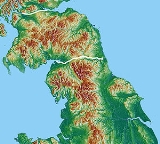
Attacotti refers to a people who despoiled Roman Britain
between 364 and 368, along with Scotti
, Picts
, Saxons
, Roman military deserters, and the indigenous Britons themselves. The marauders were defeated by Count Theodosius
in 368. Units of Attacotti are recorded about 400 AD in the Notitia Dignitatum
, and one tombstone of a soldier of the Atecutti is known. Their existence as a distinct people is given additional credence by two incidental references to them, as cannibals and as having wives in common, in the writings of Saint Jerome
.
There is no other information available on the Attacotti other than their brief mention in these sources, and based on historical evidence, there is nothing more to be said of them. This article discusses the historical Attacotti of Roman Britain, their likely service as Roman auxiliaries, and their possible link to Ireland.
 The historian Ammianus
provides an account of the tumultuous situation in Britain between 364 and 369, and he describes a corrupt and treasonous administration, native British troops (the Areani
) in collaboration with the barbarians, and a Roman military whose troops had deserted and joined in the general banditry. The situation was a consequence of the failed imperial power-grab by Magnentius
a decade earlier, followed by a bloody and arbitrary purge conducted by Paulus Catena
in an attempt to root out potential sympathisers of Magnentius in Britain, and aggravated by the political machinations of the Roman administrator Valentinus
.
Ammianus describes the marauders as bands moving from place to place in search of loot. Nevertheless, one Roman commander was killed in a pitched battle and another was taken prisoner in an ambush and killed. As there was no longer an effective military force in the province, a substantial one was sent from Gaul
under Count Theodosius
, who quickly and ruthlessly restored order. His efforts were then focused on the repair of political problems within the province.
There is nothing to suggest that the Attacotti, Scotti, Picts, and Saxons (all mentioned in passing by Ammianus) were more than incidental participants in these events.
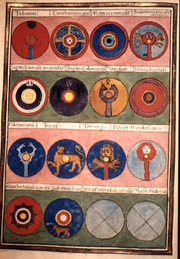 The Notitia Dignitatum
is a list of offices of the early fifth century Roman Empire
, and includes the locations of the offices and the staff (including military units) assigned to them. The names of several units resembled that of the Attacotti who were mentioned by Ammianus, and in an 1876 publication Otto Seeck assigned the name Atecotti to various spellings ("acecotti", "atecocti", "attecotti", "attcoetti", "[illegible]ti", and "arecotti") in the Notitia Dignitatum, and documented his assignments within the publication. This produced four conjectural occurrences of Atecotti-related units:
The discovery of a contemporary funerary dedication to a soldier of the "unit of Ate[g,c]utti" in the Roman Diocese of Illyricum
supports this reconstruction, as the Notitia Dignitatum places one Atecotti unit in that diocese
.
 St. Jerome
was a Christian apologist whose writings contain two incidental references to the Attacotti. His account is particularly noteworthy because he was in Roman Gaul
c.365-369/70, while the Attacotti were known to be in Britain until 368 and may have entered Roman military service soon after. Thus it is credible that Jerome had seen Attacotti soldiers, and he would certainly have heard Roman accounts of the recent fighting in Britain.
In his Letter to Oceanus, he is urging a responsible attitude towards marriage, at one point saying that one should not be like the promiscuous Atacotti, Scotti, and the people of Plato's Republic
.
The Attacotti are also mentioned in his Treatise Against Jovinianus
, in a passage which has been the topic of much debate, scholarly and otherwise. In a passage where he notes that the peoples of different regions have different dietary preferences because the food available varies from region to region, he is quoted as saying:
Disagreements continue over nuances (such as where to place punctuation marks), but disagreements over the major point of cannibalism
divide up as:
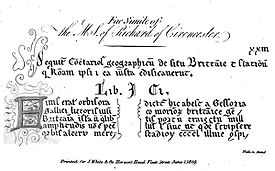 De Situ Britanniae
was a fictitious account of the peoples and places of Roman Britain
. It was published in 1757, after having been made available in London
in 1749. Accepted as genuine for more than one hundred years, it was virtually the only source of information for northern Britain (i.e., modern Scotland
) for the time period, and historians eagerly incorporated its spurious information into their own accounts of history. The Attacotti were mentioned in De Situ Britanniae, and their homeland was specified as just north of the Firth of Clyde
, near southern Loch Lomond
, in the region of Dumbartonshire.
This information was combined with legitimate historical mentions of the Attacotti to produce inaccurate histories and to make baseless conjectures. For example, Edward Gibbon
combined De Situ Britanniae with St. Jerome's description of the Attacotti by musing on the possibility that a ‘race of cannibals’ had once dwelt in the neighbourhood of Glasgow
.

 Perhaps as early as the seventeenth century, and certainly in the eighteenth century, some Irish
scholars had suggested that the origin of the Attacotti might lie in Ireland
. This was based on the perceived similarity between Latin
Attacotti and the Old Irish term aithechthúatha, a generic designation for certain Irish population-groups, usually translated "rent-paying tribes", "vassal communities" or "tributary peoples". Combined with the knowledge of Irish raids on the coast of Britain in the late Roman period, it was suggested that one group of raiders had stayed to become the historically attested people mentioned by Ammianus.
The thesis was given great impetus when the influential Charles O'Conor
promoted it in the late eighteenth century. The issue was still undecided in the late nineteenth century, with respected scholars either accepting or rejecting it, but with neither side able to put the matter to rest.
Later scholarship has diminished the notability of these early arguments by criticising the possible connection between Latin Attacotti and aithechthúatha (or rather, its hypothetical Primitive Irish antecedent) on etymological
grounds. In the fifth and sixth centuries, the language of interest here was not the Old Irish known to early scholars, but Primitive Irish (which was unknown to them, and of necessity, a largely hypothetical construct).
It is difficult to exaggerate the degree to which knowledge and understanding of the history of the Irish language were revolutionised from the end of the nineteenth century, largely owing to the efforts of Rudolf Thurneysen
(1857 – 1940), who is considered the father of the modern discipline. As an aside in a rather obscure article on a largely unrelated theme, Thurneysen expressed the view that Attacotti and aithechthúatha are unconnected. He hypothesised that the Primitive Irish equivalent to aithechthúatha would be *Ateûiācotōtās, which, in his opinion, is too far removed from the form Attacotti in late Roman sources.
. He notes that early medieval Irish and Welsh (British) literature variously report the migration of certain Irish groups who were certainly tributary population-groups in this period, namely the Déisi
, and who therefore, in some contexts and linguistic registers, would have been classed as “aithechthúatha”. The historical horizons of these population movements are ca. 350 – 450 (compare Attacotti attested in Roman sources ca. 360s – 400). This does not confirm that the Attacotti and aithechthúatha were the same people, but it is a new departure and seems to offer relevant circumstantial evidence.
Roman Britain
Roman Britain was the part of the island of Great Britain controlled by the Roman Empire from AD 43 until ca. AD 410.The Romans referred to the imperial province as Britannia, which eventually comprised all of the island of Great Britain south of the fluid frontier with Caledonia...
between 364 and 368, along with Scotti
Scoti
Scoti or Scotti was the generic name used by the Romans to describe those who sailed from Ireland to conduct raids on Roman Britain. It was thus synonymous with the modern term Gaels...
, Picts
Picts
The Picts were a group of Late Iron Age and Early Mediaeval people living in what is now eastern and northern Scotland. There is an association with the distribution of brochs, place names beginning 'Pit-', for instance Pitlochry, and Pictish stones. They are recorded from before the Roman conquest...
, Saxons
Saxons
The Saxons were a confederation of Germanic tribes originating on the North German plain. The Saxons earliest known area of settlement is Northern Albingia, an area approximately that of modern Holstein...
, Roman military deserters, and the indigenous Britons themselves. The marauders were defeated by Count Theodosius
Count Theodosius
Flavius Theodosius or Theodosius the Elder was a senior military officer serving in the Western Roman Empire. He achieved the rank of Comes Britanniarum and as such, he is usually referred to as Comes Theodosius...
in 368. Units of Attacotti are recorded about 400 AD in the Notitia Dignitatum
Notitia Dignitatum
The Notitia Dignitatum is a unique document of the Roman imperial chanceries. One of the very few surviving documents of Roman government, it details the administrative organisation of the eastern and western empires, listing several thousand offices from the imperial court down to the provincial...
, and one tombstone of a soldier of the Atecutti is known. Their existence as a distinct people is given additional credence by two incidental references to them, as cannibals and as having wives in common, in the writings of Saint Jerome
Jerome
Saint Jerome was a Roman Christian priest, confessor, theologian and historian, and who became a Doctor of the Church. He was the son of Eusebius, of the city of Stridon, which was on the border of Dalmatia and Pannonia...
.
There is no other information available on the Attacotti other than their brief mention in these sources, and based on historical evidence, there is nothing more to be said of them. This article discusses the historical Attacotti of Roman Britain, their likely service as Roman auxiliaries, and their possible link to Ireland.
Ammianus: Roman Britain in 364–369
Ammianus Marcellinus
Ammianus Marcellinus was a fourth-century Roman historian. He wrote the penultimate major historical account surviving from Antiquity...
provides an account of the tumultuous situation in Britain between 364 and 369, and he describes a corrupt and treasonous administration, native British troops (the Areani
Areani
The areani were agents for the Roman Empire, based in Roman Britain during the later part of the Roman occupation of the island. They helped to instigate the Great Conspiracy...
) in collaboration with the barbarians, and a Roman military whose troops had deserted and joined in the general banditry. The situation was a consequence of the failed imperial power-grab by Magnentius
Magnentius
Flavius Magnus Magnentius was a usurper of the Roman Empire .-Early life and career:...
a decade earlier, followed by a bloody and arbitrary purge conducted by Paulus Catena
Paulus Catena
Paulus was the name of an imperial notary, or senior civil servant, who served under the Roman Emperor Constantius II in the middle of the 4th century. He is described by the historian Ammianus Marcellinus, who probably met him. According to Marcellinus, his cruelty was infamous throughout the...
in an attempt to root out potential sympathisers of Magnentius in Britain, and aggravated by the political machinations of the Roman administrator Valentinus
Valentinus (rebel)
Valentinus was a Roman figure of the later fourth century AD.In 369 AD he committed an unrecorded but very serious crime. His brother in law, Maximinus was close to the emperor Valentinian I and was able to have Valentinus' sentence commuted from execution to exile and he was sent to Roman...
.
Ammianus describes the marauders as bands moving from place to place in search of loot. Nevertheless, one Roman commander was killed in a pitched battle and another was taken prisoner in an ambush and killed. As there was no longer an effective military force in the province, a substantial one was sent from Gaul
Gaul
Gaul was a region of Western Europe during the Iron Age and Roman era, encompassing present day France, Luxembourg and Belgium, most of Switzerland, the western part of Northern Italy, as well as the parts of the Netherlands and Germany on the left bank of the Rhine. The Gauls were the speakers of...
under Count Theodosius
Count Theodosius
Flavius Theodosius or Theodosius the Elder was a senior military officer serving in the Western Roman Empire. He achieved the rank of Comes Britanniarum and as such, he is usually referred to as Comes Theodosius...
, who quickly and ruthlessly restored order. His efforts were then focused on the repair of political problems within the province.
There is nothing to suggest that the Attacotti, Scotti, Picts, and Saxons (all mentioned in passing by Ammianus) were more than incidental participants in these events.
Notitia Dignitatum: Roman auxiliaries
Notitia Dignitatum
The Notitia Dignitatum is a unique document of the Roman imperial chanceries. One of the very few surviving documents of Roman government, it details the administrative organisation of the eastern and western empires, listing several thousand offices from the imperial court down to the provincial...
is a list of offices of the early fifth century Roman Empire
Roman Empire
The Roman Empire was the post-Republican period of the ancient Roman civilization, characterised by an autocratic form of government and large territorial holdings in Europe and around the Mediterranean....
, and includes the locations of the offices and the staff (including military units) assigned to them. The names of several units resembled that of the Attacotti who were mentioned by Ammianus, and in an 1876 publication Otto Seeck assigned the name Atecotti to various spellings ("acecotti", "atecocti", "attecotti", "attcoetti", "[illegible]ti", and "arecotti") in the Notitia Dignitatum, and documented his assignments within the publication. This produced four conjectural occurrences of Atecotti-related units:
The discovery of a contemporary funerary dedication to a soldier of the "unit of Ate[g,c]utti" in the Roman Diocese of Illyricum
Diocese of Pannonia
The Diocese of Pannonia , from 379 known as the Diocese of Illyricum, was a diocese of the Late Roman Empire. The seat of the vicarius was Sirmium.-History:...
supports this reconstruction, as the Notitia Dignitatum places one Atecotti unit in that diocese
Roman diocese
A Roman or civil diocese was one of the administrative divisions of the later Roman Empire, starting with the Tetrarchy. It formed the intermediate level of government, grouping several provinces and being in turn subordinated to a praetorian prefecture....
.
Saint Jerome: incidental references
Jerome
Saint Jerome was a Roman Christian priest, confessor, theologian and historian, and who became a Doctor of the Church. He was the son of Eusebius, of the city of Stridon, which was on the border of Dalmatia and Pannonia...
was a Christian apologist whose writings contain two incidental references to the Attacotti. His account is particularly noteworthy because he was in Roman Gaul
Gaul
Gaul was a region of Western Europe during the Iron Age and Roman era, encompassing present day France, Luxembourg and Belgium, most of Switzerland, the western part of Northern Italy, as well as the parts of the Netherlands and Germany on the left bank of the Rhine. The Gauls were the speakers of...
c.365-369/70, while the Attacotti were known to be in Britain until 368 and may have entered Roman military service soon after. Thus it is credible that Jerome had seen Attacotti soldiers, and he would certainly have heard Roman accounts of the recent fighting in Britain.
In his Letter to Oceanus, he is urging a responsible attitude towards marriage, at one point saying that one should not be like the promiscuous Atacotti, Scotti, and the people of Plato's Republic
Republic (Plato)
The Republic is a Socratic dialogue written by Plato around 380 BC concerning the definition of justice and the order and character of the just city-state and the just man...
.
The Attacotti are also mentioned in his Treatise Against Jovinianus
Against Jovinianus
Against Jovinianus is a two-volume treatise by the Church Father Saint Jerome.-Jovinianus' propositions:Jovinianus, about whom little more is known than what is to be found in Jerome's treatise, published a Latin treatise outlining several opinions:...
, in a passage which has been the topic of much debate, scholarly and otherwise. In a passage where he notes that the peoples of different regions have different dietary preferences because the food available varies from region to region, he is quoted as saying:
Quid loquor de ceteris nationibus, cum ipse adolescentulus in Gallia viderim Atticotos, gentem Brittanicam humanis vesci carnibus et cum per silvas porcorum greges et armentorum pecudumque reperiant, pastorum nates et feminarum papillas solere abscindere et has solas ciborum delicias arbitrari? |
Why should I speak of other nations when I, a youth, in Gaul beheld the Attacotti, a British tribe, eat human flesh, and when they find herds of swine, cattle, and sheep in the woods, they are accustomed to cut off the buttocks of the shepherds, and the paps of the shepherdesses, and to consider them as the only delicacies of food. |
Disagreements continue over nuances (such as where to place punctuation marks), but disagreements over the major point of cannibalism
Cannibalism
Cannibalism is the act or practice of humans eating the flesh of other human beings. It is also called anthropophagy...
divide up as:
- This passage is an assertion by Jerome that he witnessed cannibalism.
- "vidirem" should be read in the sense of "understood" rather than "saw", so it is an implication rather than an assertion.
- This passage is out of context with the rest of the text and makes no sense, so perhaps there is a transcription corruption; likely the single word "humanis" should be "inhumanis" (meaning animal flesh, not human flesh), in which case "pastorum nates" means "haunches of fatted animals" (not "buttocks of shepherds") and "fœminarum papillas" means "sow belly" or "cow udder" (not "paps of shepherdesses"); and then the passage makes sense and becomes as innocuous as the other dietary habits that Jerome mentions. The passage then also becomes an accurate description of the preferences of pastoral peoples, such as those who lived in northern Roman Britain at that time.
De Situ Britanniae: a spurious reference
De Situ Britanniae
De Situ Britanniae is a fictional description of the peoples and places of ancient Britain. Purported to contain the account of a Roman general preserved in the manuscript of a fourteenth century English monk, it was considered the premier source of information on Roman Britain for more than a...
was a fictitious account of the peoples and places of Roman Britain
Roman Britain
Roman Britain was the part of the island of Great Britain controlled by the Roman Empire from AD 43 until ca. AD 410.The Romans referred to the imperial province as Britannia, which eventually comprised all of the island of Great Britain south of the fluid frontier with Caledonia...
. It was published in 1757, after having been made available in London
London
London is the capital city of :England and the :United Kingdom, the largest metropolitan area in the United Kingdom, and the largest urban zone in the European Union by most measures. Located on the River Thames, London has been a major settlement for two millennia, its history going back to its...
in 1749. Accepted as genuine for more than one hundred years, it was virtually the only source of information for northern Britain (i.e., modern Scotland
Scotland
Scotland is a country that is part of the United Kingdom. Occupying the northern third of the island of Great Britain, it shares a border with England to the south and is bounded by the North Sea to the east, the Atlantic Ocean to the north and west, and the North Channel and Irish Sea to the...
) for the time period, and historians eagerly incorporated its spurious information into their own accounts of history. The Attacotti were mentioned in De Situ Britanniae, and their homeland was specified as just north of the Firth of Clyde
Firth of Clyde
The Firth of Clyde forms a large area of coastal water, sheltered from the Atlantic Ocean by the Kintyre peninsula which encloses the outer firth in Argyll and Ayrshire, Scotland. The Kilbrannan Sound is a large arm of the Firth of Clyde, separating the Kintyre Peninsula from the Isle of Arran.At...
, near southern Loch Lomond
Loch Lomond
Loch Lomond is a freshwater Scottish loch, lying on the Highland Boundary Fault. It is the largest lake in Great Britain by surface area. The lake contains many islands, including Inchmurrin, the largest fresh-water island in the British Isles, although the lake itself is smaller than many Irish...
, in the region of Dumbartonshire.
This information was combined with legitimate historical mentions of the Attacotti to produce inaccurate histories and to make baseless conjectures. For example, Edward Gibbon
Edward Gibbon
Edward Gibbon was an English historian and Member of Parliament...
combined De Situ Britanniae with St. Jerome's description of the Attacotti by musing on the possibility that a ‘race of cannibals’ had once dwelt in the neighbourhood of Glasgow
Glasgow
Glasgow is the largest city in Scotland and third most populous in the United Kingdom. The city is situated on the River Clyde in the country's west central lowlands...
.
Early efforts
Irish people
The Irish people are an ethnic group who originate in Ireland, an island in northwestern Europe. Ireland has been populated for around 9,000 years , with the Irish people's earliest ancestors recorded having legends of being descended from groups such as the Nemedians, Fomorians, Fir Bolg, Tuatha...
scholars had suggested that the origin of the Attacotti might lie in Ireland
Ireland
Ireland is an island to the northwest of continental Europe. It is the third-largest island in Europe and the twentieth-largest island on Earth...
. This was based on the perceived similarity between Latin
Latin
Latin is an Italic language originally spoken in Latium and Ancient Rome. It, along with most European languages, is a descendant of the ancient Proto-Indo-European language. Although it is considered a dead language, a number of scholars and members of the Christian clergy speak it fluently, and...
Attacotti and the Old Irish term aithechthúatha, a generic designation for certain Irish population-groups, usually translated "rent-paying tribes", "vassal communities" or "tributary peoples". Combined with the knowledge of Irish raids on the coast of Britain in the late Roman period, it was suggested that one group of raiders had stayed to become the historically attested people mentioned by Ammianus.
The thesis was given great impetus when the influential Charles O'Conor
Charles O'Conor (historian)
Charles O'Conor Don, The O'Conor Don, Prince of Connacht of Belanagare was an Irish writer and antiquarian who was enormously influential as a protagonist for the preservation of Irish culture and history in the eighteenth century...
promoted it in the late eighteenth century. The issue was still undecided in the late nineteenth century, with respected scholars either accepting or rejecting it, but with neither side able to put the matter to rest.
Later scholarship has diminished the notability of these early arguments by criticising the possible connection between Latin Attacotti and aithechthúatha (or rather, its hypothetical Primitive Irish antecedent) on etymological
Etymology
Etymology is the study of the history of words, their origins, and how their form and meaning have changed over time.For languages with a long written history, etymologists make use of texts in these languages and texts about the languages to gather knowledge about how words were used during...
grounds. In the fifth and sixth centuries, the language of interest here was not the Old Irish known to early scholars, but Primitive Irish (which was unknown to them, and of necessity, a largely hypothetical construct).
It is difficult to exaggerate the degree to which knowledge and understanding of the history of the Irish language were revolutionised from the end of the nineteenth century, largely owing to the efforts of Rudolf Thurneysen
Rudolf Thurneysen
Eduard Rudolf Thurneysen was a Swiss linguist and Celticist.Born in Basel, Thurneysen studied classical philology in Basel, Leipzig, Berlin and Paris. His teachers included Ernst Windisch and Heinrich Zimmer...
(1857 – 1940), who is considered the father of the modern discipline. As an aside in a rather obscure article on a largely unrelated theme, Thurneysen expressed the view that Attacotti and aithechthúatha are unconnected. He hypothesised that the Primitive Irish equivalent to aithechthúatha would be *Ateûiācotōtās, which, in his opinion, is too far removed from the form Attacotti in late Roman sources.
Modern efforts
A new dimension to the Irish origin thesis has been opened by Philip Rance. In his attempt to resolve the identity of the Attacotti, Rance avoids arguing from etymology. Rather, he investigates whether the historical and broader literary evidence offers any corroboration to this thesis, in particular in relation to historically attested Irish raiding and settlement of parts of western Britain, especially southern WalesWales
Wales is a country that is part of the United Kingdom and the island of Great Britain, bordered by England to its east and the Atlantic Ocean and Irish Sea to its west. It has a population of three million, and a total area of 20,779 km²...
. He notes that early medieval Irish and Welsh (British) literature variously report the migration of certain Irish groups who were certainly tributary population-groups in this period, namely the Déisi
Déisi
The Déisi were a class of peoples in ancient and medieval Ireland. The term is Old Irish, and derives from the word déis, meaning "vassal" or "subject"; in its original sense, it designated groups who were vassals or rent-payers to a landowner. Later, it became a proper name for certain septs and...
, and who therefore, in some contexts and linguistic registers, would have been classed as “aithechthúatha”. The historical horizons of these population movements are ca. 350 – 450 (compare Attacotti attested in Roman sources ca. 360s – 400). This does not confirm that the Attacotti and aithechthúatha were the same people, but it is a new departure and seems to offer relevant circumstantial evidence.
Further study
- Freeman, Philip (2002), 'Who Were the Atecotti?' in J.F. Nagy (ed.), Identifying the "Celtic" ([Celtic Studies Association of North America Yearbook 2] Dublin, 2002), 111-114.
- MacNeill, EoinEoin MacNeillEoin MacNeill was an Irish scholar, nationalist, revolutionary and politician. MacNeill is regarded as the father of the modern study of early Irish medieval history. He was a co-founder of the Gaelic League, to preserve Irish language and culture, going on to establish the Irish Volunteers...
, "Early Irish Population Groups: their nomenclature, classification and chronology", in Proceedings of the Royal Irish Academy (C) 29. 1911. pp. 59–114