
All Topics  
Atrazine


   Email Print
   Bookmark   Link


Atrazine


Atrazine, 2-chloro-4-(ethylamine)-6-(isopropylamine)-s-triazine, an organic compound
Organic compound

An organic compound is any member of a large class of chemical compounds whose molecules contain carbon. For historical reasons discussed below, a few types of compounds such as carbonates, simple oxides of carbon and cyanides, as well as the allotropes of carbon, are considered Inorganic compound....
 consisting of an s-triazine
Triazine

A triazine is one of three organic chemicals, isomeric with each other, whose empirical formula is 333....
-ring is a widely used herbicide
Herbicide

A herbicide is used to kill unwanted plants. Selective herbicides kill specific targets while leaving the desired crop relatively unharmed. Some of these act by interfering with the growth of the weed and are often synthetic "imitations" of plant hormones....
. Its use is controversial due to its effects on nontarget species, such as on amphibians. Like many commercial products, it is sold under numerous trade names. Its use is banned in the European Union
European Union

The European Union is an economic and political union of 27 European Union member state, located primarily in Europe. It was established by the Treaty of Maastricht on 1 November 1993 upon the foundations of the pre-existing European Economic Community....
 but is still one of the most widely used herbicides in the U.S. with 77 million lb
Pound (mass)

The pound or pound-mass is a Units of measurement of massused in the Imperial unit, United States customary units and other systems of measurement....
 applied in 2003.

zine is used to stop pre- and post-emergence broadleaf and grassy weed
WEED

WEED is a radio station broadcasting a Gospel format. Licensed to Rocky Mount, North Carolina, USA, it serves the area. The station is currently owned by Northstar Broadcasting Corporation....
s in major crops by binding to the plastoquinone
Plastoquinone

Plastoquinone is a quinone molecule involved in the electron transport chain in the light-dependent reactions of photosynthesis. Plastoquinone is reduced , forming plastoquinol....
-binding protein
Protein

Proteins are organic compounds made of amino acids arranged in a linear chain and joined together by peptide bonds between the carboxyl and amino groups of adjacent amino acid Residue ....
 in photosystem II
Photosystem II

Photosystem II is the first protein complex in the Light-dependent reactions. It is located in the thylakoid membrane of plants, algae and cyanobacteria....
, inhibiting electron transport.


Discussion
Ask a question about 'Atrazine'
Start a new discussion about 'Atrazine'
Answer questions from other users
Full Discussion Forum


Encyclopedia


Atrazine, 2-chloro-4-(ethylamine)-6-(isopropylamine)-s-triazine, an organic compound
Organic compound

An organic compound is any member of a large class of chemical compounds whose molecules contain carbon. For historical reasons discussed below, a few types of compounds such as carbonates, simple oxides of carbon and cyanides, as well as the allotropes of carbon, are considered Inorganic compound....
 consisting of an s-triazine
Triazine

A triazine is one of three organic chemicals, isomeric with each other, whose empirical formula is 333....
-ring is a widely used herbicide
Herbicide

A herbicide is used to kill unwanted plants. Selective herbicides kill specific targets while leaving the desired crop relatively unharmed. Some of these act by interfering with the growth of the weed and are often synthetic "imitations" of plant hormones....
. Its use is controversial due to its effects on nontarget species, such as on amphibians. Like many commercial products, it is sold under numerous trade names. Its use is banned in the European Union
European Union

The European Union is an economic and political union of 27 European Union member state, located primarily in Europe. It was established by the Treaty of Maastricht on 1 November 1993 upon the foundations of the pre-existing European Economic Community....
 but is still one of the most widely used herbicides in the U.S. with 77 million lb
Pound (mass)

The pound or pound-mass is a Units of measurement of massused in the Imperial unit, United States customary units and other systems of measurement....
 applied in 2003.

Uses

Atrazine is used to stop pre- and post-emergence broadleaf and grassy weed
WEED

WEED is a radio station broadcasting a Gospel format. Licensed to Rocky Mount, North Carolina, USA, it serves the area. The station is currently owned by Northstar Broadcasting Corporation....
s in major crops by binding to the plastoquinone
Plastoquinone

Plastoquinone is a quinone molecule involved in the electron transport chain in the light-dependent reactions of photosynthesis. Plastoquinone is reduced , forming plastoquinol....
-binding protein
Protein

Proteins are organic compounds made of amino acids arranged in a linear chain and joined together by peptide bonds between the carboxyl and amino groups of adjacent amino acid Residue ....
 in photosystem II
Photosystem II

Photosystem II is the first protein complex in the Light-dependent reactions. It is located in the thylakoid membrane of plants, algae and cyanobacteria....
, inhibiting electron transport. Atrazine and its derivatives are also used in many industrial processes, including the production of some dye
Dye

A dye can generally be described as a colored substance that has an Chemical affinity to the Wiktionary:substrate to which it is being applied....
s and explosives. Atrazine is the most widely used herbicide in conservation tillage systems, which are designed to prevent soil erosion.

Its effect on yields has been estimated from 6% to 1%, with 3-4% being the conclusion of an extensive review.

Biodegradation

The half-life
Half-life

The half-life of a quantity whose value decreases with time is the interval required for the quantity to decay to half of its initial value. The concept originated in describing how long it takes atoms to undergo radioactive decay but also applies in a wide variety of other situations....
 of atrazine in soil is 13 to 261 days. Atrazine biodegradation
Biodegradation

Biodegradation is the process by which organic compound substances are decomposition by the enzymes produced by living organisms. The term is often used in relation to ecology, waste management and natural environmental environmental remediation ....
 can occur by two known pathways:

1) Atrazine can be dechlorinated
Chlorination

Chlorination is the process of adding the element chlorine to water as a method of water purification to make it fit for human consumption as drinking water....
 followed by removal the other ring substituents via amidohydrolases
Hydrolase

In biochemistry, a hydrolase is an enzyme that catalyzes the hydrolysis of a chemical bond. For example, an enzyme that catalyzed the following reaction is a hydrolase:...
 by the enzyme
Enzyme

Enzymes are biomolecules that catalysis chemical reactions. Almost all enzymes are proteins. In enzymatic reactions, the molecules at the beginning of the process are called Substrate , and the enzyme converts them into different molecules, the products....
s AtzA, AtzB, and AtzC. The end product is cyanuric acid
Cyanuric acid

Cyanuric acid or 1,3,5-triazine-2,4,6-triol is a chemical compound with the chemical formula 3. Like many industrially useful chemicals, this triazine has many synonyms....
. The best characterized organism that performs this pathway is Pseudomonas
Pseudomonas

Pseudomonas is a genus of gamma proteobacteria, belonging to the larger family of pseudomonads.Recently, 16S ribosomal RNA sequence analysis has redefined the taxonomy of many bacterial species....
 sp. strain ADP.

2) The other pathway involves dealkylation of the amino groups. Subsequent dechlorination yields cyanuric acid. The end result is 2-chloro-4-hydroxy-6-amino-1,3,5-triazine, which currently has no known path to further degradation. This path occurs in Pseudomonas species and a number of bacteria.

Atrazine degrades in soil
Soil

Soil is the naturally occurring, unconsolidated or loose covering on the Earth's surface. Soil is composed of particles of broken rock that have been altered by chemical and environmental processes including weathering and erosion....
 by the action of microbes. Rates of biodegradation are affected by atrazine's low solubility, thus surfactant
Surfactant

Surfactants are wetting agents that lower the surface tension of a liquid, allowing easier spreading, and lower the interfacial tension between two liquids....
s increase the degradation rate. Atrazine itself is a poor energy source due to the highly oxidized carbons in the ring. It is catabolized
Catabolism

Catabolism is the set of metabolic pathways which break down molecules into smaller units and release energy. In catabolism, large molecules such as polysaccharides, lipids, nucleic acids and proteins are broken down into smaller units such as monosaccharides, fatty acids, nucleotides and amino acids, respectively....
 as a carbon and nitrogen source in reducing environments. Inorganic nitrogen accelerates atrazine catabolism whereas organic nitrogen decreases it. Low concentrations of glucose
Glucose

Glucose , a monosaccharide also known as grape sugar, blood sugar, or corn sugar, is a very important carbohydrate in biology....
 can decrease the bioavailability, whereas higher concentrations promote the catabolism of atrazine.

The gene
Gene

A gene is the basic unit of heredity in a living organism. All living things depend on genes. Genes hold the information to build and maintain their cell and pass genetic trait to offspring....
s for enzymes AtzA-C have been found to be highly conserved in atrazine-degrading organisms worldwide. The prevalence of these genes could be due to the mass transfer of AtzA-C on a global scale. In Pseudomonas sp. ADP, the Atz genes are located non-contiguously on a plasmid
Plasmid

File:plasmid .svgA plasmid is an extra-chromosomal DNA molecule separate from the chromosome which is capable of replicating independently of the chromosomal DNA....
 with the genes for mercury
Mercury (element)

Mercury , also called quicksilver or hydrargyrum , is a chemical element with the symbol Hg and atomic number 80. A heavy, silvery d-block metal, mercury is one of six elements that are liquid at or near room temperature and pressure....
 catabolism. This plasmid is conjugatable
Bacterial conjugation

Bacterial conjugation is the transfer of genetic material between bacteria through direct cell-to-cell contact. Discovered in 1946 by Joshua Lederberg and Edward Tatum, conjugation is a mechanism of horizontal gene transfer—as are Transformation and Transduction —although these mechanisms do not involve cell-to-cell contact....
 to Gram negative bacteria in the laboratory and could lead to the worldwide distribution, in view of the extensive release of atrazine and mercury. AtzA-C have also been found in a Gram positive bacterium but are chromosomally located. The insertion elements flanking each gene suggests that they are involved in the assembly of this specialized catabolic pathway. Two options exist for degradation of atrazine using microbes: bioaugmentation
Bioaugmentation

Bioaugmentation is the introduction of a group of natural microbial strains or a genetically engineered variant to treat contaminated soil or water....
 or biostimulation
Biostimulation

Biostimulation involves the modification of the environment to stimulate existing bacteria capable of bioremediation. This can be done by addition of various forms of rate limiting nutrients and electron acceptors, such as phosphorus, nitrogen, oxygen, or carbon ....
.

Controversy

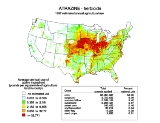
Atrazine Use Map 1997
Atrazine was banned in the European Union
European Union

The European Union is an economic and political union of 27 European Union member state, located primarily in Europe. It was established by the Treaty of Maastricht on 1 November 1993 upon the foundations of the pre-existing European Economic Community....
 (EU) in 2004 because of its persistent groundwater contamination In the United States
United States

The United States of America is a Federal government constitutional republic comprising U.S. state and a federal district. The country is situated mostly in central North America, where its Contiguous United States and Washington, D.C., the Capital districts and territories, lie between the Pacific Ocean and Atlantic Oceans, Borders of the U...
, however, atrazine is one of the most widely used herbicides, with 76 million pounds of it applied each year. It is probably the most commonly used herbicide in the world, and is used in about 80 countries worldwide. Its endocrine effects, possible carcinogenic effect, and epidemiological connection to low sperm levels in men has led several researchers to call for banning it in the US.

Tyrone Hayes, a scientist at UC Berkeley, found evidence that it is a teratogen, causing demasculinization in male frogs
Northern Leopard Frog

The Northern Leopard Frog is a species of Leopard frog from the true frog family native to parts of Canada and United States. It is the List of U.S....
 even at low concentrations, and an estrogen disruptor. Male frogs affected by atrazine could reach testosterone levels below females. However, at least one study was unable to reproduce the results.

The U.S. Environmental Protection Agency
United States Environmental Protection Agency

The U.S. Environmental Protection Agency is an List of United States federal agencies of the federal government of the United States charged to Regulation of chemicals and protect human health by safeguarding the natural environment: air, water, and land....
 (EPA) and its independent Scientific Advisory Panel (SAP) examined all available studies on this topic — including Hayes' work — and concluded that there is "currently insufficient data" to determine if atrazine affects amphibian development. Hayes, formerly part of the SAP panel, resigned in 2000 to continue studies independently. Hayes notes that all of the studies that failed to conclude that atrazine caused hermaphroditism were plagued by poor experimental controls and were funded by Syngenta
Syngenta

Syngenta AG is a large global agribusiness which markets seeds and crop protection products . Syngenta is involved in biotechnology and genomic research....
, the company that produces the chemical. In 2006 the U.S. EPA considered re-registration of Atrazine final when it issued a cumulative risk assessments on the triazine herbicides, and concluded that they posed "no harm that would result to the general U.S. population, infants, children or other...consumers." A former scientist working for the Minnesota Pollution Control Agency believes he was fired for attempting to testify against atrazine.

In a Tufts University study published in February 2008 it was reported that young tadpoles undergoing organ morphogenesis were found to develop deformed hearts and impaired kidneys and digestive systems when exposed to atrazine. Tissue malformation may be induced by ectopic programmed cell death, although a mechanism was not identified.

Toxicity

According to Extension Toxicology Network, "The oral LD50
LD50

In toxicology, the median lethal dose, LD50 , or LCt50 of a toxic substance or radiation is the Dose required to kill half the members of a tested population....
 for atrazine is 3090 mg/kg in rat
Rat

Rats are various medium sized, long-tailed rodents of the Family Muroidea. "True rats" are members of the genus Rattus, the most important of which to humans are the black rat, Rattus rattus, and the brown rat, Rattus norvegicus....
s, 1750 mg/kg in mice
Mouse

A mouse is a small animal that belongs to one of numerous species of rodents. The best known mouse species is the House Mouse . It is also a popular pet....
, 750 mg/kg in rabbit
Rabbit

Rabbits are small mammals in the family Leporidae of the order Lagomorpha, found in several parts of the world. There are seven different genus in the family taxonomy as rabbits, including the European rabbit , Cottontail rabbit , and the Amami rabbit ....
s, and 1000 mg/kg in hamsters. The dermal LD50 in rabbits is 7500 mg/kg and greater than 3000 mg/kg in rats. The 1-hour inhalation LC50 is greater than 0.7 mg/L in rats. The 4-hour inhalation LC50 is 5.2 mg/L in rats."

Further reading

  • Tyrone Hayes' page about his research on Atrazine: