
Home      Discussion      Topics      Dictionary      Almanac
Signup       Login
Atlantic Conveyor

Atlantic Conveyor

Overview
Discussion
Ask a question about 'Atlantic Conveyor'
Start a new discussion about 'Atlantic Conveyor'
Answer questions from other users
Full Discussion Forum
 
Unanswered Questions
Encyclopedia


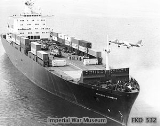
The Atlantic Conveyor was a British
United Kingdom
The United Kingdom of Great Britain and Northern IrelandIn the United Kingdom and Dependencies, other languages have been officially recognised as legitimate autochthonous languages under the European Charter for Regional or Minority Languages...

 merchant navy
Merchant Navy
The Merchant Navy is the maritime register of the United Kingdom, and describes the seagoing commercial interests of UK-registered ships and their crews. Merchant Navy vessels fly the Red Ensign and are regulated by the Maritime and Coastguard Agency...

 ship, registered in Liverpool, that was requisitioned during the Falklands War
Falklands War
The Falklands War , also called the Falklands Conflict or Falklands Crisis, was fought in 1982 between Argentina and the United Kingdom over the disputed Falkland Islands and South Georgia and the South Sandwich Islands...

 and sunk on 25 May 1982 after being hit by two Argentine Exocet missiles
Exocet
The Exocet is a French-built anti-ship missile whose various versions can be launched from surface vessels, submarines, helicopters and fixed wing aircraft. Hundreds were fired in combat during the 1980s.-Etymology:...

, killing 12 sailors. The wrecksite is designated under the Protection of Military Remains Act 1986
Protection of Military Remains Act 1986
The Protection of Military Remains Act 1986 is an Act of Parliament in the United Kingdom which provides protection for the wreckage of military aircraft and designated military vessels. The Act provides for two types of protection: protected places and controlled sites. Military aircraft are...

.

History


The Atlantic Conveyor was a 14,950 ton roll-on, roll-off
RORO
Roll-on/roll-off ships are vessels designed to carry wheeled cargo such as automobiles, trucks, semi-trailer trucks, trailers or railroad cars that are driven on and off the ship on their own wheels...

 container ship
Container ship
Container ships are cargo ships that carry all of their load in truck-size intermodal containers, in a technique called containerization. They form a common means of commercial intermodal freight transport.-History:...

 owned by Cunard
Cunard Line
Cunard Line is a British-American owned shipping company based at Carnival House in Southampton, England and operated by Carnival UK. It has been a leading operator of passenger ships on the North Atlantic for over a century...

. She was built along with six other container ships, each named Atlantic and flown under different national flags for different companies.

Along with her sister ship, Atlantic Causeway
Atlantic Causeway
The Atlantic Causeway was a container ship, operated by Cunard, and one of the merchant vessels requisitioned by the British government to support British forces in the Falklands War in 1982.-Pre-war:...

, the Atlantic Conveyor was requisitioned by the Ministry of Defence
Ministry of Defence (United Kingdom)
The Ministry of Defence is the United Kingdom government department responsible for implementation of government defence policy and is the headquarters of the British Armed Forces....

 at the beginning of the Falklands War
Falklands War
The Falklands War , also called the Falklands Conflict or Falklands Crisis, was fought in 1982 between Argentina and the United Kingdom over the disputed Falkland Islands and South Georgia and the South Sandwich Islands...

 through the STUFT
STUFT
STUFT is a nautical acronym for Ship Taken Up From Trade, and applies to civilian ships requisitioned for government use.The Falklands conflict of 1982 saw a diversity of Ships Taken Up From Trade...

 system (Ships Taken Up From Trade). Due to the short timescales, the decision that the ship was not "a high-value unit" and a controversy over whether arming auxiliaries was legal, Atlantic Conveyor was not fitted with either an active, or passive defence system.

The ships were used to carry supplies for the Task Force sent by the British government to retake the Falkland Islands
Falkland Islands
The Falkland Islands are an archipelago in the South Atlantic Ocean, located about from the coast of mainland South America. The archipelago consists of East Falkland, West Falkland and 776 lesser islands. The capital, Stanley, is on East Falkland...

 from Argentine
Argentina
Argentina , officially the Argentine Republic , is the second largest country in South America by land area, after Brazil. It is constituted as a federation of 23 provinces and an autonomous city, Buenos Aires...

 occupation. Sailing for Ascension Island
Ascension Island
Ascension Island is an isolated volcanic island in the equatorial waters of the South Atlantic Ocean, around from the coast of Africa and from the coast of South America, which is roughly midway between the horn of South America and Africa...

 on 25 April 1982, Atlantic Conveyor carried a cargo of six Wessex
Westland Wessex
The Westland Wessex is a British turbine-powered version of the Sikorsky S-58 "Choctaw", developed under license by Westland Aircraft , initially for the Royal Navy, and later for the Royal Air Force...

 helicopters from 848 Naval Air Squadron and five RAF
Royal Air Force
The Royal Air Force is the aerial warfare service branch of the British Armed Forces. Formed on 1 April 1918, it is the oldest independent air force in the world...

 HC.1 Chinooks
RAF Chinook
The Boeing Chinook is a tandem rotor helicopter operated by the Royal Air Force. A series of variants based on the United States Army's Boeing CH-47 Chinook, the RAF Chinook fleet is the largest outside the United States...

 from No. 18 Squadron RAF
No. 18 Squadron RAF
No. 18 Squadron of the Royal Air Force operates the CH-47 Chinook HC.2 from RAF Odiham. No. 18 Squadron was the first and is currently the largest RAF operator of the Chinook.-First World War:...

. At Ascension, she picked up eight Fleet Air Arm
Fleet Air Arm
The Fleet Air Arm is the branch of the British Royal Navy responsible for the operation of naval aircraft. The Fleet Air Arm currently operates the AgustaWestland Merlin, Westland Sea King and Westland Lynx helicopters...

 Sea Harriers
BAE Sea Harrier
The British Aerospace Sea Harrier is a naval VTOL/STOVL jet fighter, reconnaissance and attack aircraft, a development of the Hawker Siddeley Harrier. It first entered service with the Royal Navy in April 1980 as the Sea Harrier FRS1 and became informally known as the "Shar"...

 (809 Squadron
809 Naval Air Squadron
-WWII:Formed in January 1941 at St Merryn with 12 Fairey Fulmars, the squadron embarked in HMS Victorious in July 1941. At first involved in operations against Petsamo and Bodø, and then the convoys to North Russia, Victorious and her air group fought in the Mediterranean from July 1942, including...

) and six RAF Harrier GR.3 jump jets. One Chinook of B flight No. 18 Squadron RAatlantic conveyorF left the Atlantic Conveyor to support operations on Ascension. With its aircraft stored she then set sail for the South Atlantic. On arrival off the Falklands in mid-May, the Harriers were off-loaded to the carriers; the GR.3s going to HMS Hermes
HMS Hermes (R12)
HMS Hermes was a Centaur-class British aircraft carrier, the last of the postwar conventional aircraft carriers commissioned into the Royal Navy.-Construction and modifications:...

 while the Sea Harriers were divided amongst the existing squadrons on Hermes and HMS Invincible
HMS Invincible (R05)
HMS Invincible was a British light aircraft carrier, the lead ship of three in her class in the Royal Navy. She was launched on 3 May 1977 and is the seventh ship to carry the name. She saw action in the Falklands War when she was deployed with , she took over as flagship of the British fleet when...

.
On 25 May 1982 (the same day as the loss of HMS Coventry
HMS Coventry (D118)
HMS Coventry was a Type 42 destroyer of the Royal Navy. Laid down by Cammell Laird and Company, Limited, at Birkenhead on 29 January 1973, she was launched on 21 June 1974 and accepted into service on 20 October 1978 at a cost of £37,900,000.She was sunk by Argentine Air Force A-4 Skyhawks on 25...

) the Atlantic Conveyor was hit by two Exocet missiles fired by a pair of Argentine Super Étendard jet fighters. The Argentine leader, Corvette Captain Roberto Curilovic, (call sign 'Tito') flew the Super Etendard 0753/3-A-203, and the wingman, Warship Lieutenant Julio Barraza, (call sign 'Leo') did so with the 0754/3-A-204 http://www.britains-smallwars.com/Falklands/Exocet.html. The ship caught fire, the fire then became uncontrollable. When the fire had burnt out, the ship was boarded but nothing was recoverable and so the decision was made to sink her. The warhead exploded after penetrating the ship's hull to where trucks and fuel were stored resulting in an uncontrollable fire. All the helicopters but one Chinook, callsign Bravo November
Bravo November
Bravo November is the original identification code painted on a British Royal Air Force Boeing Chinook HC2 serial number ZA718. It was one of the original 30 aircraft ordered by the RAF in 1978 and has been in service ever since. It has been upgraded several times in its history, now being...

airborne at the time, were destroyed in the fire. The loss of these helicopters meant that British troops had to march across the Falklands to recapture Stanley
Stanley, Falkland Islands
Stanley is the capital and only true cityin the Falkland Islands. It is located on the isle of East Falkland, on a north-facing slope in one of the wettest parts of the islands. At the 2006 census, the city had a population of 2,115...

.

Twelve men died in the Atlantic Conveyor, including the vessel's commander, Captain Ian North, who was posthumously awarded the Distinguished Service Cross (DSC). The ship was the first British merchant vessel lost at sea to enemy fire since World War II
World War II
World War II, or the Second World War , was a global conflict lasting from 1939 to 1945, involving most of the world's nations—including all of the great powers—eventually forming two opposing military alliances: the Allies and the Axis...

.

The ship's replacement was built on Tyneside
Tyneside
Tyneside is a conurbation in North East England, defined by the Office of National Statistics, which is home to over 80% of the population of Tyne and Wear. It includes the city of Newcastle upon Tyne and the Metropolitan Boroughs of Gateshead, North Tyneside and South Tyneside — all settlements on...

.

Piloting a Sea King helicopter of 820 Naval Air Squadron
820 Naval Air Squadron
820 Naval Air Squadron is a Royal Navy Fleet Air Arm carrier based squadron formed in April 1933 with the transferral of the Fairey III aircraft from 405 Flight Royal Air Force to the Fleet Air Arm...

, The Prince Andrew
Prince Andrew, Duke of York
Prince Andrew, Duke of York KG GCVO , is the second son, and third child of Queen Elizabeth II and Prince Philip, Duke of Edinburgh...

 (then second in line to the throne) was first to lift off survivors.

Techniques to defeat anti-ship missiles


A dangerous task, carried out by Sea Kings was to act as decoys, to deflect sea-skimming missiles away from surface ships. This was achieved by hovering close to the ship and as the radar seeker could not resolve targets in azimuth the ship/helicopter combination appeared as a single target. If the helicopter was not too high the missile guidance system would aim for the centroid of its apparent target and hopefully pass between the two. The Prince Andrew
Prince Andrew, Duke of York
Prince Andrew, Duke of York KG GCVO , is the second son, and third child of Queen Elizabeth II and Prince Philip, Duke of Edinburgh...

 at one point flew his helicopter as an Exocet missile decoy. Chaff rockets aim to seduce a missile with a similar technique by increasing the apparent length of the target.

It is often suggested that cost savings prevented the fitting of chaff rockets to Atlantic Conveyor and that this could have saved the ship. However, the size of the ship's radar cross section
Radar cross section
Radar cross section is a measure of how detectable an object is with a radar. A larger RCS indicates that an object is more easily detected.An object reflects a limited amount of radar energy...

 (RCS) was too great to allow chaff decoys to be effective and their employment would have been unlikely to have affected the outcome. It has also been claimed—incorrectly—that the ship acted as a decoy against a subsequent Exocet attack.

Deaths


The 12 men killed in the sinking of the Atlantic Conveyor were:
Merchant Navy
Merchant Navy
The Merchant Navy is the maritime register of the United Kingdom, and describes the seagoing commercial interests of UK-registered ships and their crews. Merchant Navy vessels fly the Red Ensign and are regulated by the Maritime and Coastguard Agency...

  • Bosun John B. Dobson
  • Mechanic Frank Foulkes
  • Steward David R. S. Hawkins
  • Mechanic James Hughes
  • Captain Ian H. North, DSC
  • Mechanic Ernest M. Vickers


Royal Fleet Auxiliary
The Royal Fleet Auxiliary is a civilian-manned fleet owned by the British Ministry of Defence. The RFA enables ships of the United Kingdom Royal Navy to maintain operations around the world. Its primary role is to supply the Royal Navy with fuel, ammunition and supplies, normally by replenishment...

  • 1st Radio Officer Ronald Hoole
  • Seaman Ng Por
  • Seaman Chan Chi Shing


Royal Navy
Royal Navy
The Royal Navy is the naval warfare service branch of the British Armed Forces. Founded in the 16th century, it is the oldest service branch and is known as the Senior Service...

  • Chief Petty Officer Edmund Flanagan
  • Air Engineering Mechanic (R) Adrian J. Anslow
  • Leading Air Engineering Mechanic (L) Don L. Price


As the last resting place of the remains of those who died, the wreck is designated as a protected place under the Protection of Military Remains Act 1986.

Cultural references

  • Pink Floyd's
    Pink Floyd
    Pink Floyd were an English rock band that achieved worldwide success with their progressive and psychedelic rock music. Their work is marked by the use of philosophical lyrics, sonic experimentation, innovative album art, and elaborate live shows. Pink Floyd are one of the most commercially...

     1983 album, "The Final Cut
    The Final Cut (album)
    The Final Cut is the twelfth studio album by English progressive rock group Pink Floyd. It was released in March 1983 by Harvest Records in the United Kingdom, and several weeks later by Columbia Records in the United States. A concept album, The Final Cut is the last of the band's releases to...

    ," included an excerpt from a news broadcast about the replacement of the Atlantic Conveyor in track 1, "The Post-war Dream". The news broadcast states that the replacement was due to be built in Japan, although it was eventually built in the UK.

Further reading