

Atchafalaya National Wildlife Refuge

Encyclopedia
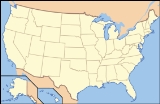
The Atchafalaya National Wildlife Refuge is located about 30 miles (48.3 km) west of Baton Rouge, Louisiana
and one mile (1.6 km) east of Krotz Springs, Louisiana
lies just east of the Atchafalaya River
. In 1988 under the administration of Governor Foster
the "Atchafalaya Basin Master Plan" was implemented that combined the 11780 acres (4,767.2 ha) Sherburne Wildlife Management Area (WMA), the 15220 acre Atchafalaya National Wildlife Refuge, and the 17000 acres (6,879.7 ha) U.S. Army Corps of Engineers, Bayou Des Ourses (Bayou of the Bears) into the Sherburne Complex Wildlife Management Area
.
 The National Wildlife refuge system began in 1903, by executive order of President Theodore Roosevelt
, with the designation of Pelican Island National Wildlife Refuge
in Florida
. The Atchafalaya NWR became part of a system that includes more than 150 million acres (607,029 km²) in 552 national wildlife refuges, along with other units of the refuge system, and 37 wetland management districts. The refuge was established in 1986, to provide for 1) conservation and management of all fish and wildlife within the refuge, 2) to fulfill the international treaty obligations of the United States with respect to fish and wildlife, and 3) to provide opportunities for scientific research, environmental education, and fish and wildlife oriented recreation, including hunting, fishing and trapping, birdwatching, nature photography, and others.
swamp
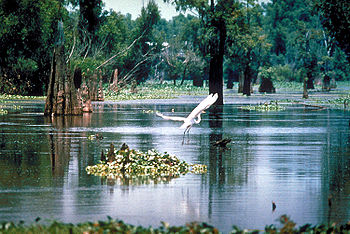
s, lakes and bayous. The natural floodplain
of the Atchafalaya River
flows for 140 miles (225.3 km) south from its junction with the Mississippi River
to the Gulf of Mexico
. The basin's dense bottomland hardwoods, Bald Cypress
-Tupelo
swamps, overflow lakes, and meandering bayous provide a tremendous diversity of habitat for more than 200 species of resident and migratory birds and numerous other wildlife and the area has been recognized as an Internationally Important Bird Area.
The basin's wooded wetlands also provide vital nesting habitat for Wood Duck
, and support the nation's largest concentration of American Woodcock
. Bald Eagle
s, Osprey
s, Swallow-tailed Kite
s, and Mississippi Kite
s can occasionally be seen soaring overhead. Wild Turkey
s, White-tailed deer
, Eastern Gray
and Fox Squirrel
s, Eastern Cottontail
, Swamp Rabbit
, Gray
and Red Fox
, Coyote
, Striped Skunk
, and Virginia Opossum
inhabit the refuge, as do a small remnant population of Louisiana Black Bears
. Furbearers found in this great swamp are Raccoon
, Mink
, Bobcat
, Coypu
, Muskrat
, North American River Otter, and American Beaver
.
The lifeblood of the fishery is the basin's annual flooding and dewatering cycle. Overflows occur during the winter and spring rains, with many areas gradually becoming dewatered during the summer and fall. Sportfishing is popular throughout the basin. Largemouth bass
, White crappie, Black crappie, Warmouth
, Bluegill
, Redear sunfish
, and Channel catfish
are the primary species sought. More than 85 species of fish occur in the basin, and their populations frequently exceed 1,000 pounds per acre (100 g/m²). Red Swamp
and White River Crayfish
are also important for both a sport and commercial harvest.
(Sugarberry or Sugar Hackberry), ash (Swamp or water ash), (3)- willow (Black Willow), bald cypress
, pumpkin ash
, (4)- overcup oak, and bitter pecan
or water hickory..
Baton Rouge, Louisiana
Baton Rouge is the capital of the U.S. state of Louisiana. It is located in East Baton Rouge Parish and is the second-largest city in the state.Baton Rouge is a major industrial, petrochemical, medical, and research center of the American South...
and one mile (1.6 km) east of Krotz Springs, Louisiana
Krotz Springs, Louisiana
Krotz Springs is a town in St. Landry Parish, Louisiana on the Atchafalaya River. The population was 1,219 at the 2000 census. It is part of the Opelousas–Eunice Micropolitan Statistical Area.-History:...
lies just east of the Atchafalaya River
Atchafalaya River
The Atchafalaya River is a distributary of the Mississippi River and Red River in south central Louisiana in the United States. It flows south, just west of the Mississippi River....
. In 1988 under the administration of Governor Foster
Murphy J. Foster, Jr.
Murphy James "Mike" Foster, Jr. served as 53rd Governor of Louisiana from January 1996 until January 2004. Foster's father was Murphy J. Foster, Jr., but Mike Foster uses "Jr." even though he is technically Murphy J. Foster, III. Foster is a businessman, landowner, and sportsman in St...
the "Atchafalaya Basin Master Plan" was implemented that combined the 11780 acres (4,767.2 ha) Sherburne Wildlife Management Area (WMA), the 15220 acre Atchafalaya National Wildlife Refuge, and the 17000 acres (6,879.7 ha) U.S. Army Corps of Engineers, Bayou Des Ourses (Bayou of the Bears) into the Sherburne Complex Wildlife Management Area
Sherburne Complex Wildlife Management Area (Louisiana)
The Sherburne Complex is a joint land management venture of the U.S. Fish and Wildlife Service, the Louisiana Department of Wildlife and Fisheries , and the U.S. Army Corps of Engineers that began in 1983. The area consists of , and is managed by the Louisiana Department of Wildlife and Fisheries...
.
History
Theodore Roosevelt
Theodore "Teddy" Roosevelt was the 26th President of the United States . He is noted for his exuberant personality, range of interests and achievements, and his leadership of the Progressive Movement, as well as his "cowboy" persona and robust masculinity...
, with the designation of Pelican Island National Wildlife Refuge
Pelican Island National Wildlife Refuge
Pelican Island National Wildlife Refuge is a United States National Wildlife Refuge located just off the western coast of Orchid Island in the Indian River Lagoon east of Sebastian, Florida. The refuge consists of a island that includes an additional of surrounding water and is located off the...
in Florida
Florida
Florida is a state in the southeastern United States, located on the nation's Atlantic and Gulf coasts. It is bordered to the west by the Gulf of Mexico, to the north by Alabama and Georgia and to the east by the Atlantic Ocean. With a population of 18,801,310 as measured by the 2010 census, it...
. The Atchafalaya NWR became part of a system that includes more than 150 million acres (607,029 km²) in 552 national wildlife refuges, along with other units of the refuge system, and 37 wetland management districts. The refuge was established in 1986, to provide for 1) conservation and management of all fish and wildlife within the refuge, 2) to fulfill the international treaty obligations of the United States with respect to fish and wildlife, and 3) to provide opportunities for scientific research, environmental education, and fish and wildlife oriented recreation, including hunting, fishing and trapping, birdwatching, nature photography, and others.
Wildlife and Habitat
The refuge is encompassed within 1500000 acres (6,070.3 km²) of hardwoodHardwood
Hardwood is wood from angiosperm trees . It may also be used for those trees themselves: these are usually broad-leaved; in temperate and boreal latitudes they are mostly deciduous, but in tropics and subtropics mostly evergreen.Hardwood contrasts with softwood...
swamp
Swamp
A swamp is a wetland with some flooding of large areas of land by shallow bodies of water. A swamp generally has a large number of hammocks, or dry-land protrusions, covered by aquatic vegetation, or vegetation that tolerates periodical inundation. The two main types of swamp are "true" or swamp...
s, lakes and bayous. The natural floodplain
Floodplain
A floodplain, or flood plain, is a flat or nearly flat land adjacent a stream or river that stretches from the banks of its channel to the base of the enclosing valley walls and experiences flooding during periods of high discharge...
of the Atchafalaya River
Atchafalaya River
The Atchafalaya River is a distributary of the Mississippi River and Red River in south central Louisiana in the United States. It flows south, just west of the Mississippi River....
flows for 140 miles (225.3 km) south from its junction with the Mississippi River
Mississippi River
The Mississippi River is the largest river system in North America. Flowing entirely in the United States, this river rises in western Minnesota and meanders slowly southwards for to the Mississippi River Delta at the Gulf of Mexico. With its many tributaries, the Mississippi's watershed drains...
to the Gulf of Mexico
Gulf of Mexico
The Gulf of Mexico is a partially landlocked ocean basin largely surrounded by the North American continent and the island of Cuba. It is bounded on the northeast, north and northwest by the Gulf Coast of the United States, on the southwest and south by Mexico, and on the southeast by Cuba. In...
. The basin's dense bottomland hardwoods, Bald Cypress
Taxodium distichum
Taxodium distichum is a species of conifer native to the southeastern United States.-Characteristics:...
-Tupelo
Tupelo
The tupelo , black gum, or pepperidge tree, genus Nyssa , is a small genus of about 9 to 11 species of trees with alternate, simple leaves...
swamps, overflow lakes, and meandering bayous provide a tremendous diversity of habitat for more than 200 species of resident and migratory birds and numerous other wildlife and the area has been recognized as an Internationally Important Bird Area.
The basin's wooded wetlands also provide vital nesting habitat for Wood Duck
Wood Duck
The Wood Duck or Carolina Duck is a species of duck found in North America. It is one of the most colourful of North American waterfowl.-Description:...
, and support the nation's largest concentration of American Woodcock
American Woodcock
The American Woodcock , sometimes colloquially referred to as the Timberdoodle, is a small chunky shorebird species found primarily in the eastern half of North America...
. Bald Eagle
Bald Eagle
The Bald Eagle is a bird of prey found in North America. It is the national bird and symbol of the United States of America. This sea eagle has two known sub-species and forms a species pair with the White-tailed Eagle...
s, Osprey
Osprey
The Osprey , sometimes known as the sea hawk or fish eagle, is a diurnal, fish-eating bird of prey. It is a large raptor, reaching more than in length and across the wings...
s, Swallow-tailed Kite
Swallow-tailed Kite
The Swallow-tailed Kite is an elanid kite which breeds from the southeastern United States to eastern Peru and northern Argentina. Most North and Central American breeders winter in South America where the species is resident year round...
s, and Mississippi Kite
Mississippi Kite
The Mississippi Kite is a small bird of prey in the family Accipitridae. It is 12 to 15 inches beak to tail and has a wingspan averaging 3 feet . Weight is from 214 to 388 grams . Adults are gray with darker gray on their tail feathers and outer wings and lighter gray on their heads...
s can occasionally be seen soaring overhead. Wild Turkey
Wild Turkey
The Wild Turkey is native to North America and is the heaviest member of the Galliformes. It is the same species as the domestic turkey, which derives from the South Mexican subspecies of wild turkey .Adult wild turkeys have long reddish-yellow to grayish-green...
s, White-tailed deer
White-tailed Deer
The white-tailed deer , also known as the Virginia deer or simply as the whitetail, is a medium-sized deer native to the United States , Canada, Mexico, Central America, and South America as far south as Peru...
, Eastern Gray
Eastern Gray Squirrel
The eastern gray squirrel is a tree squirrel in the genus Sciurus native to the eastern and midwestern United States, and to the southerly portions of the eastern provinces of Canada...
and Fox Squirrel
Fox Squirrel
The fox squirrel is the largest species of tree squirrel native to North America...
s, Eastern Cottontail
Eastern Cottontail
The eastern cottontail is a New World cottontail rabbit, a member of the family Leporidae. It is one of the most common rabbit species in North America.-Distribution:...
, Swamp Rabbit
Swamp Rabbit
The Swamp Rabbit is a large cottontail rabbit found in the swamps and wetlands of the Southern United States.- Appearance :...
, Gray
Gray Fox
The gray fox is a mammal of the order Carnivora ranging throughout most of the southern half of North America from southern Canada to the northern part of South America...
and Red Fox
Red Fox
The red fox is the largest of the true foxes, as well as being the most geographically spread member of the Carnivora, being distributed across the entire northern hemisphere from the Arctic Circle to North Africa, Central America, and the steppes of Asia...
, Coyote
Coyote
The coyote , also known as the American jackal or the prairie wolf, is a species of canine found throughout North and Central America, ranging from Panama in the south, north through Mexico, the United States and Canada...
, Striped Skunk
Striped Skunk
The striped skunk, Mephitis mephitis, is an omnivorous mammal of the skunk family Mephitidae. Found over most of the North American continent north of Mexico, it is one of the best-known mammals in Canada and the United States.-Description:...
, and Virginia Opossum
Virginia Opossum
The Virginia opossum , commonly known as the North American opossum or tlacuache in Mexico, is the only marsupial found in North America north of Mexico. A solitary and nocturnal animal about the size of a domestic cat, and thus the largest opossum, it is a successful opportunist...
inhabit the refuge, as do a small remnant population of Louisiana Black Bears
American black bear
The American black bear is a medium-sized bear native to North America. It is the continent's smallest and most common bear species. Black bears are omnivores, with their diets varying greatly depending on season and location. They typically live in largely forested areas, but do leave forests in...
. Furbearers found in this great swamp are Raccoon
Raccoon
Procyon is a genus of nocturnal mammals, comprising three species commonly known as raccoons, in the family Procyonidae. The most familiar species, the common raccoon , is often known simply as "the" raccoon, as the two other raccoon species in the genus are native only to the tropics and are...
, Mink
Mink
There are two living species referred to as "mink": the European Mink and the American Mink. The extinct Sea Mink is related to the American Mink, but was much larger. All three species are dark-colored, semi-aquatic, carnivorous mammals of the family Mustelidae, which also includes the weasels and...
, Bobcat
Bobcat
The bobcat is a North American mammal of the cat family Felidae, appearing during the Irvingtonian stage of around 1.8 million years ago . With twelve recognized subspecies, it ranges from southern Canada to northern Mexico, including most of the continental United States...
, Coypu
Coypu
The coypu , , also known as the river rat, and nutria, is a large, herbivorous, semiaquatic rodent and the only member of the family Myocastoridae. Originally native to subtropical and temperate South America, it has since been introduced to North America, Europe, Asia, and Africa, primarily by...
, Muskrat
Muskrat
The muskrat , the only species in genus Ondatra, is a medium-sized semi-aquatic rodent native to North America, and introduced in parts of Europe, Asia, and South America. The muskrat is found in wetlands and is a very successful animal over a wide range of climates and habitats...
, North American River Otter, and American Beaver
American Beaver
The North American Beaver is the only species of beaver in the Americas, native to North America and introduced to South America. In the United States and Canada, where no other species of beaver occurs, it is usually simply referred to as "beaver"...
.
The lifeblood of the fishery is the basin's annual flooding and dewatering cycle. Overflows occur during the winter and spring rains, with many areas gradually becoming dewatered during the summer and fall. Sportfishing is popular throughout the basin. Largemouth bass
Largemouth bass
The largemouth bass is a species of black bass in the sunfish family native to North America . It is also known as widemouth bass, bigmouth, black bass, bucketmouth, Potter's fish, Florida bass, Florida largemouth, green bass, green trout, linesides, Oswego bass, southern largemouth...
, White crappie, Black crappie, Warmouth
Warmouth
The common name of Lepomis gulosus is the warmouth. It is one of the 324 fish species found in Tennessee.-Introduction:The following is a description of a monitoring plan for the Warmouth . One of the eleven species in the Lepomis genus, the species name gulosus refers to the warmouths big eyes...
, Bluegill
Bluegill
The Bluegill is a species of freshwater fish sometimes referred to as bream, brim, or copper nose. It is a member of the sunfish family Centrarchidae of the order Perciformes.-Range and distribution:...
, Redear sunfish
Redear sunfish
The redear sunfish , also known as the shellcracker, Georgia bream, cherry gill, chinquapin, improved bream, rouge ear sunfish and sun perch, is native to the southeastern United States, but since it is a popular sport fish it has been introduced to bodies of water all over North America...
, and Channel catfish
Channel catfish
Channel catfish, Ictalurus punctatus, is North America's most numerous catfish species. It is the official fish of Missouri, Iowa, Nebraska, Kansas, and Tennessee, and is informally referred to as a "channel cat". In the United States they are the most fished catfish species with approximately 8...
are the primary species sought. More than 85 species of fish occur in the basin, and their populations frequently exceed 1,000 pounds per acre (100 g/m²). Red Swamp
Procambarus clarkii
Procambarus clarkii is a freshwater crayfish species, native to the Southeastern United States, but found also on other continents, where it is often an invasive pest. It is known variously as the red swamp crawfish, red swamp crayfish, Louisiana crawfish, Louisiana crayfish or mudbug.-Range and...
and White River Crayfish
Procambarus
Procambarus is a genus of crayfish in the family Cambaridae, all native to North and Central America. It includes a number of troglobitic species, and the parthenogenetic Marmorkrebs...
are also important for both a sport and commercial harvest.
Refuge area
The combined area of the refuge, totaling 44000 acres, classified as bottomland hardwoods, contains four dominant tree species associations: (1)- cottonwood and sycamore, (2)- oak, gum (American Sweetgum or Redgum), hackberryCeltis laevigata
Celtis laevigata is a medium-sized tree native to North America. Common names include Sugarberry, Southern Hackberry, or in the southern U.S. Sugar Hackberry or just Hackberry....
(Sugarberry or Sugar Hackberry), ash (Swamp or water ash), (3)- willow (Black Willow), bald cypress
Taxodium
Taxodium is a genus of one to three species of extremely flood-tolerant conifers in the cypress family, Cupressaceae...
, pumpkin ash
Fraxinus profunda
Fraxinus profunda is a species of Fraxinus native to eastern North America, primarily in the United States, with a scattered distribution on the Atlantic coastal plain and interior lowland river valleys from southern Maryland northwest to Indiana, southeast to northern Florida, and southwest to...
, (4)- overcup oak, and bitter pecan
Carya aquatica
Carya aquatica is a large tree, that can grow over 30 meters tall of the Juglandaceae or walnut family. In the American South it is a dominant plant species found on clay flats and backwater areas near streams and rivers. The species reproduces aggressively both by seed and sprouts from roots and...
or water hickory..
Flood of 2011
Due to the flooding of the Mississippi River and the opening of the Morganza Floodway the refuge was closed to the public May 14, 2011. This was the first time since 1973, and prior to the refuge opening, that the Mississippi was diverted through the basin. Although most of the refuge remains closed the South Farm (Iberville Parish) portion of the Sherburne WMA was open July 1, 2011, to walk-in and ATV traffic. The rest of the area will be closed until further notice.See also
- List of National Wildlife Refuges: Louisiana