

Assos

Encyclopedia
Assos also known as Behramkale or for short Behram, is a small historically rich town in the Ayvacık district of the Çanakkale Province
, Turkey
.
After leaving the Platonic Academy
in Athens, Aristotle
(joined by Xenocrates
) went to Assos, where he was welcomed by King Hermias, and opened an Academy in this city. Aristotle also married Pythias, the adopted daughter of Hermias. In the Academy of Assos, Aristotle became a chief to a group of philosophers, and together with them, he made innovative observations on zoology
and biology
. When the Persians
attacked Assos, King Hermias was caught and put to death. Aristotle fled to Macedonia, which was ruled by his friend King Philip II of Macedon
. There, he tutored Philip's son, Alexander the Great.
Assos was also visited by St. Paul
. Today, Assos is an Aegean
-coast seaside retreat amid ancient ruins.
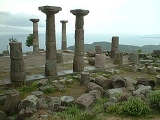
It is possible to see much of the surrounding area from the ancient Temple of Athena
, built on top of a trachyte
crag. From this temple, it is possible on a clear day to see nearby Lesbos in the south, Pergamum in the southeast, and Mount Ida of Phrygia in the east. To the north, the Tuzla River
flows. To the northwest, there is the gate to the city of two massive Hellenic columns that still exist today.
Assos had a harbour, which was the only good harbour on the 80 kilometres (49.7 mi) of the north coast of the Adramyttian Gulf. This made Assos a key shipping station through the Troad.
colonists from Lesbos, who specifically are said to have come from Methymna. The settlers built a Doric Temple to Athena
on top of the crag in 530 BC. From this temple Hermias of Atarneus
, a student of Plato
, ruled Assos, the Troad and Lesbos for a period of time, under which the city experienced its greatest prosperity. (Strangely, Hermias was actually the slave of the ruler of Atarneus.) Under his rule, he encouraged philosophers to move to the city. As part of this, in 348 BC Aristotle came here and married King Hermeias's niece, Pythia, before leaving for Lesbos three years later in 345 BC. This 'golden period' of Assos ended several years later when the Persians arrived, and subsequently tortured Hermias to death.
The Persians were driven out by Alexander the Great in 334 BC. Between 241 and 133 BC, the city was ruled by the Kings of Pergamon
. However, in 133 BC, the Pergamons lost control of the city as it was absorbed by the Roman empire.
St. Paul
also visited the city during his third missionary journey through Asia Minor, which was between 53-57 AD, on his way to Lesbos. From this period onwards, Assos shrunk to a small village, as it has remained ever since. Ruins around Assos continue to be excavated.
The pillars from the ancient port lay in the harbor for over a millennia. Eventually they were probably sold.
In the early 1900s an attempt was made to move the contents of the Temple of Athena. Much of the art has been moved to museums like the Louvre
. The art found includes pictures both of mythical creatures and heraldic events.
Down the steep seaward side of the hill at the water's edge is the hamlet
called Iskele (meaning Dock or Wharf), with old stone houses now serving as inns, pensions and restaurants.
There is a small pebbly beach. There are boat tours and tours of the hamlet itself. Although the one lane road to the hamlet is steep with sheer drops, the sea front has a constant stream of cars and minibuses arriving from dawn to dusk.
Çanakkale Province
Çanakkale Province is a province of Turkey, located in the northwestern part of the country. It takes its name from the town of Çanakkale.Like Istanbul, Çanakkale province has a European and an Asian part. The European part is formed by the Gallipoli peninsula, while the Asian part is largely...
, Turkey
Turkey
Turkey , known officially as the Republic of Turkey , is a Eurasian country located in Western Asia and in East Thrace in Southeastern Europe...
.
After leaving the Platonic Academy
Platonic Academy
The Academy was founded by Plato in ca. 387 BC in Athens. Aristotle studied there for twenty years before founding his own school, the Lyceum. The Academy persisted throughout the Hellenistic period as a skeptical school, until coming to an end after the death of Philo of Larissa in 83 BC...
in Athens, Aristotle
Aristotle
Aristotle was a Greek philosopher and polymath, a student of Plato and teacher of Alexander the Great. His writings cover many subjects, including physics, metaphysics, poetry, theater, music, logic, rhetoric, linguistics, politics, government, ethics, biology, and zoology...
(joined by Xenocrates
Xenocrates
Xenocrates of Chalcedon was a Greek philosopher, mathematician, and leader of the Platonic Academy from 339/8 to 314/3 BC. His teachings followed those of Plato, which he attempted to define more closely, often with mathematical elements...
) went to Assos, where he was welcomed by King Hermias, and opened an Academy in this city. Aristotle also married Pythias, the adopted daughter of Hermias. In the Academy of Assos, Aristotle became a chief to a group of philosophers, and together with them, he made innovative observations on zoology
Zoology
Zoology |zoölogy]]), is the branch of biology that relates to the animal kingdom, including the structure, embryology, evolution, classification, habits, and distribution of all animals, both living and extinct...
and biology
Biology
Biology is a natural science concerned with the study of life and living organisms, including their structure, function, growth, origin, evolution, distribution, and taxonomy. Biology is a vast subject containing many subdivisions, topics, and disciplines...
. When the Persians
Achaemenid Empire
The Achaemenid Empire , sometimes known as First Persian Empire and/or Persian Empire, was founded in the 6th century BCE by Cyrus the Great who overthrew the Median confederation...
attacked Assos, King Hermias was caught and put to death. Aristotle fled to Macedonia, which was ruled by his friend King Philip II of Macedon
Philip II of Macedon
Philip II of Macedon "friend" + ἵππος "horse" — transliterated ; 382 – 336 BC), was a king of Macedon from 359 BC until his assassination in 336 BC. He was the father of Alexander the Great and Philip III.-Biography:...
. There, he tutored Philip's son, Alexander the Great.
Assos was also visited by St. Paul
Paul of Tarsus
Paul the Apostle , also known as Saul of Tarsus, is described in the Christian New Testament as one of the most influential early Christian missionaries, with the writings ascribed to him by the church forming a considerable portion of the New Testament...
. Today, Assos is an Aegean
Aegean Sea
The Aegean Sea[p] is an elongated embayment of the Mediterranean Sea located between the southern Balkan and Anatolian peninsulas, i.e., between the mainlands of Greece and Turkey. In the north, it is connected to the Marmara Sea and Black Sea by the Dardanelles and Bosporus...
-coast seaside retreat amid ancient ruins.
Geography
Though officially named Behramkale (behˈramkale), most people still call the town by its ancient name of Assos. The town is on the southern side of Biga Peninsula, better known by its ancient name, Troad. The town is located on the coast of the Adramyttian Gulf (Turkish: Edremit Körfezi).It is possible to see much of the surrounding area from the ancient Temple of Athena
Athena
In Greek mythology, Athena, Athenê, or Athene , also referred to as Pallas Athena/Athene , is the goddess of wisdom, courage, inspiration, civilization, warfare, strength, strategy, the arts, crafts, justice, and skill. Minerva, Athena's Roman incarnation, embodies similar attributes. Athena is...
, built on top of a trachyte
Trachyte
Trachyte is an igneous volcanic rock with an aphanitic to porphyritic texture. The mineral assemblage consists of essential alkali feldspar; relatively minor plagioclase and quartz or a feldspathoid such as nepheline may also be present....
crag. From this temple, it is possible on a clear day to see nearby Lesbos in the south, Pergamum in the southeast, and Mount Ida of Phrygia in the east. To the north, the Tuzla River
Tuzla
Tuzla is a city and municipality in Bosnia and Herzegovina. At the time of the 1991 census, it had 83,770 inhabitants, while the municipality 131,318. Taking the influx of refugees into account, the city is currently estimated to have 174,558 inhabitants...
flows. To the northwest, there is the gate to the city of two massive Hellenic columns that still exist today.
Assos had a harbour, which was the only good harbour on the 80 kilometres (49.7 mi) of the north coast of the Adramyttian Gulf. This made Assos a key shipping station through the Troad.
History
The city was founded from 1000-900 BC by AeolianAeolians
The Aeolians were one of the four major ancient Greek tribes comprising Ancient Greeks. Their name derives from Aeolus, the mythical ancestor of the Aeolic branch and son of Hellen, the mythical patriarch of the Greek nation...
colonists from Lesbos, who specifically are said to have come from Methymna. The settlers built a Doric Temple to Athena
Athena
In Greek mythology, Athena, Athenê, or Athene , also referred to as Pallas Athena/Athene , is the goddess of wisdom, courage, inspiration, civilization, warfare, strength, strategy, the arts, crafts, justice, and skill. Minerva, Athena's Roman incarnation, embodies similar attributes. Athena is...
on top of the crag in 530 BC. From this temple Hermias of Atarneus
Hermias of Atarneus
Hermias of Atarneus , who lived in Atarneus, was Aristotle's father-in-law.The first mention of Hermias is as a slave to Eubulus, a Bithynian banker who ruled Atarneus. Hermias eventually won his freedom and inherited the rule of Atarneus...
, a student of Plato
Plato
Plato , was a Classical Greek philosopher, mathematician, student of Socrates, writer of philosophical dialogues, and founder of the Academy in Athens, the first institution of higher learning in the Western world. Along with his mentor, Socrates, and his student, Aristotle, Plato helped to lay the...
, ruled Assos, the Troad and Lesbos for a period of time, under which the city experienced its greatest prosperity. (Strangely, Hermias was actually the slave of the ruler of Atarneus.) Under his rule, he encouraged philosophers to move to the city. As part of this, in 348 BC Aristotle came here and married King Hermeias's niece, Pythia, before leaving for Lesbos three years later in 345 BC. This 'golden period' of Assos ended several years later when the Persians arrived, and subsequently tortured Hermias to death.
The Persians were driven out by Alexander the Great in 334 BC. Between 241 and 133 BC, the city was ruled by the Kings of Pergamon
Pergamon
Pergamon , or Pergamum, was an ancient Greek city in modern-day Turkey, in Mysia, today located from the Aegean Sea on a promontory on the north side of the river Caicus , that became the capital of the Kingdom of Pergamon during the Hellenistic period, under the Attalid dynasty, 281–133 BC...
. However, in 133 BC, the Pergamons lost control of the city as it was absorbed by the Roman empire.
St. Paul
Paul of Tarsus
Paul the Apostle , also known as Saul of Tarsus, is described in the Christian New Testament as one of the most influential early Christian missionaries, with the writings ascribed to him by the church forming a considerable portion of the New Testament...
also visited the city during his third missionary journey through Asia Minor, which was between 53-57 AD, on his way to Lesbos. From this period onwards, Assos shrunk to a small village, as it has remained ever since. Ruins around Assos continue to be excavated.
The pillars from the ancient port lay in the harbor for over a millennia. Eventually they were probably sold.
In the early 1900s an attempt was made to move the contents of the Temple of Athena. Much of the art has been moved to museums like the Louvre
Louvre
The Musée du Louvre – in English, the Louvre Museum or simply the Louvre – is one of the world's largest museums, the most visited art museum in the world and a historic monument. A central landmark of Paris, it is located on the Right Bank of the Seine in the 1st arrondissement...
. The art found includes pictures both of mythical creatures and heraldic events.
Present day
Many of the old buildings of Assos are in ruins today, but Behramkale (the city's modern name) is still active. It still serves as a port for Troad. Temple ruins remain.Down the steep seaward side of the hill at the water's edge is the hamlet
Hamlet (place)
A hamlet is usually a rural settlement which is too small to be considered a village, though sometimes the word is used for a different sort of community. Historically, when a hamlet became large enough to justify building a church, it was then classified as a village...
called Iskele (meaning Dock or Wharf), with old stone houses now serving as inns, pensions and restaurants.
There is a small pebbly beach. There are boat tours and tours of the hamlet itself. Although the one lane road to the hamlet is steep with sheer drops, the sea front has a constant stream of cars and minibuses arriving from dawn to dusk.