


Assault weapon

Encyclopedia
Assault weapon is a non-technical term referring to any of a broad category of firearm
s with certain features, including some semiautomatic rifles, some pistol
s, and some shotgun
s. There are a variety of different statutory definitions of assault weapons in local, state, and federal laws in the United States that define them by a set of characteristics they possess. Using lists of physical features or specific firearms in defining assault weapons in the U.S. was first codified by the language of the now-expired 1994 Federal Assault Weapons Ban
.
Very generally speaking, a semi-automatic firearm
is defined by these laws as an assault weapon if it has both a detachable magazine and a pistol grip
, sometimes in conjunction with other features such as a folding stock
or a muzzle break. Assault weapons are often similar in appearance to military firearms, but are capable of firing only once each time the trigger is pulled.
Whether or not assault weapons should be legally restricted more than other firearms, how they should be defined, and even whether or not the term assault weapon should be used at all, are questions subject to considerable debate as part of the arguments of gun politics in the United States
.
and SRAW used to breach obstacles or destroy structures. Historical examples include the Bangalore torpedo
, the APOBS
, and even the flame thrower. Assault rifles and shotguns capable of fully automatic fire, such as the Heckler & Koch CAWS, the XM8, and the Russian 7.62mm/40mm Assault Weapon System are also classified as assault weapon systems. This definition differs from the current variety of legal definitions used in the United States of America.
, itself a translation of the German word Sturmgewehr, literally "storm-rifle". There is no technical military definition of an assault weapon, but in a general sense, the term assault weapon can refer to a military weapon used to aid in military assault operations, that is, attacking a fortified position (as referenced in multiple uses in military terminology below). Legislators and political lobbyists have adopted the term to refer to specific semi-automatic firearm
s and other firearms listed by specific characteristics for statutory purposes. The legislative usage follows usage by political groups seeking to limit the individual's right to keep and bear arms, who have sought to extend the meaning to include a semi-automatic firearm
that is similar in name or appearance to a fully automatic firearm
or military weapon.
Note that this term is not synonymous with assault rifle
, which has an established technical definition. The US Army defines assault rifles as "short, compact, selective-fire weapons that fire a cartridge intermediate in power between submachinegun and rifle cartridges". Advocates for the right to keep and bear arms, commonly referred to as gun rights supporters, generally consider these uses of the phrase assault weapon to be pejorative
and politically motivated when used to describe civilian firearms. This term is seldom used outside of the United States in this context.
The first use of the term is uncertain, but it gained notoriety in 1986 when Gun Digest published its first edition of the book, The Gun Digest Book of Assault Weapons. This book used the term to describe a variety of firearms including bolt-action rifles, revolvers, and semi-autos.
Recently terminology variants such as "Semi-Automatic Assault Weapon" or "High-Powered Assault Weapon" have been gaining in use by political leaders and groups who seek to limit or ban these firearms.
, the primary characteristics of the U.S. M16 and M4 assault rifles, other than fully automatic fire, were chosen to define what makes a semi-automatic rifle an assault weapon - many other regulations in the United States have adopted similar defining characteristics.
 The close similarity to the term assault rifle
and wide variety of definitions has led to considerable confusion over this term. In addition, inaccurate media reporting and political propaganda have created a common public misconception that this term covers many items regulated in the United States by the National Firearms Act
(NFA) of 1934.
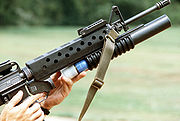
For instance, a "grenade launcher" is listed as a classifying characteristic in many of the assault weapons laws. This frequently creates confusion between grenade launcher
s, such as the M203
that the general public is familiar with seeing in video games and in the media used by soldiers, and the actual classifying feature being described, which is a muzzle grenade launcher—an adapter or muzzle device that allows the launching of rifle grenade
s. While barreled grenade launchers such as the M203, the Russian GP-30
, and the HK69 are strictly regulated as Destructive Devices
under federal law by the NFA, rifle grenade launchers and other muzzle device launchers (like golf ball launchers) are only regulated in a handful of areas by state or local laws (such as California and New York City).
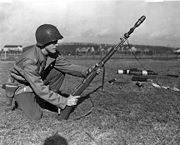 Furthermore, regardless of the launcher's regulatory status, each individual grenade, both cartridge types such as the 40mm grenades used in the M203 and rifle grenades such as the WWII-era M9A1, are already strictly controlled, registered, and taxed as a Destructive Device under the NFA. Consequently, because of their status as Destructive Devices, all grenades as well as barreled launchers such as the M203 are prohibited by state laws in several states. The complex technical and legal distinctions are not commonly known, and frequently lead to misrepresentation in the media of what is actually being described.
The Seattle Times made one such error during their reporting of the investigation of the DC sniper
, in an article discussing the Bushmaster rifle used in the shootings and what aspects of the then-soon to expire 1994 Assault Weapons Ban
might have applied to it or prohibited it (the article concluded that the XM-15 rifle used was not prohibited or affected by the ban). In a sidebar image illustrating different classifying features that were restricted by the Assault Weapon Ban, an image of a M4A1 carbine with a mounted underbarrel M203 grenade launcher was depicted; the M203 was incorrectly described as the type of "grenade launcher" feature restricted by the ban.
Perhaps the largest area of confusion surrounding this term is the difference between a machine-gun, assault rifle and an assault weapon (non-military definition). A machine-gun is universally recognized as a fully automatic weapon, while the current statutory definitions for assault weapons describe them as semi-automatic.
A key concept in defining the military assault rifle is the ability to provide a large volume of fire through fully automatic or burst fire modes. Every nation that uses the term assault rifle refers to a rifle with said capability. A semi-automatic rifle does not have the capability to lay down large volumes of fire required for modern military assault operations and has not been defined as an assault rifle by any nation. The term assault weapon is more encompassing and fluid than the term assault rifle and leads to confusion that these semi-automatic weapons are fully automatic or would be used by militaries in assault operations.
Further, the National Firearms Act
of 1934 specifically addresses fully automatic weapons, and the private ownership and usage of them is extremely regulated. To add to the confusion, the media often refers to these semi-automatic rifles as military-style assault weapons. Military assault rifles are also designated under the heading of assault weapon systems by several countries but are capable of full automatic fire creating more confusion.
There is also the perception that firearms that fall under this category can be easily modified for fully automatic fire. This is not the case since the U.S. Bureau of Alcohol, Tobacco, Firearms, and Explosives (ATF) regulations for manufacturers place certain restrictions on firearm product design to comply with the provisions of the National Firearms Act
(NFA) of 1934 and the amendments to the McClure-Volkmer Act of 1986 that pertain to machine-gun ownership. These regulations require that semi-automatic firearms sold in the United States be especially difficult to convert to fully automatic operation. While it is theoretically possible for a skilled machinist with extensive firearms knowledge to perform such a conversion, this scenario contrasts sharply with claims of "easy convertibility." The few fully automatic firearms which police seize in the United States are overwhelmingly illegally imported weapons, rather than converted semi-automatics.
The use of the term assault weapon and its similar appearance to military rifles has led to a misconception that they are more dangerous or powerful than other semi-automatic firearms. In fact, the rifles designated assault weapon most often fire small-caliber bullets which, in hunting, are generally reserved for small game such as squirrels and prairie dogs. The bullet fired by an average "deer rifle" is significantly more powerful and longer-ranged. Military forces use these small cartridges primarily because they allow troops to carry large quantities of ammunition for their automatic weapons, and because the smaller powder charge in an intermediate cartridge reduces recoil, allowing for better control of bursts of automatic fire, not because each of the individual bullets is particularly deadly. Wounding an enemy can be expected to take them off the battlefield, delivering the same strategic benefit as killing them.
In semi-automatic civilian weapons, which have a much slower rate of fire, this advantage in lethality is significantly reduced. Some states ban the use of the most common chambering, .223 Remington
/ 5.56 x 45 mm NATO
, for hunting deer as it is underpowered for that purpose.
Some groups that advocate stricter gun control, including groups such as the Brady Campaign
and the Coalition to Stop Gun Violence
, support restrictions on ownership of these firearms. They hold that assault weapons are designed to maximize lethal effects through a rapid rate of fire and by being "spray fired from the hip
," although the latter is, in practice, inefficient and inaccurate beyond very short ranges. They further contend that because of their design, a shooter can maintain control of an assault weapon even while firing many rounds in rapid succession, and thus, assault weapons pose an especially serious threat to public safety and should be banned. They also believe that all Americans have the right to be safe from gun violence; the availability and lethality of guns, and especially assault weapons, make death or severe injury more likely in domestic violence, criminal activity, suicide attempts, and unintentional shootings; and that it is possible to reduce the number of deaths and injuries caused by gun violence
in general with stricter gun control laws, but especially through banning assault weapons. Many who oppose firearms of all kinds, but especially assault weapons, contend that there is no need in modern society for them, and that they only serve to escalate hostile situations, such as in hostage-taking or spree killings.
Those who oppose attempts to ban assault weapons, including groups such as the National Rifle Association
and Gun Owners of America
, hold that the statutory laws defining assault weapons describe cosmetic appearances only. As such, the operating characteristics, and capacity of these firearms is not significantly different from many other more typical rifles and pistols having a different appearance. To bolster this argument, it is often pointed out that many firearms commonly classified as assault weapons, such as semi-automatic versions of military assault rifle
s, use smaller calibers and less-powerful ammunition than many legal hunting rifles. They also suggest that these firearms are generally suitable for target shooting, collecting, and when necessary, civil and self defense (for example, to defend life and property during civil disturbances and emergencies when law enforcement services are not available, as evidenced in their successful usage by Korean-American store owners during the 1992 Los Angeles riots
).
They further contend that these types of firearms are not frequently used in crime, as evidenced by US Department of Justice statistics. Authors supporting gun rights such as Kenneth W. Royce
additionally counter the "rapid rate of fire and spray-fired from the hip" beliefs by stating that rapid rates of fire do not necessarily increase the lethal effects, but all too often serve only to "convert money into noise" at a more rapid rate. Features that gun control advocates say allow "spray-fire from the hip", such as pistol grips, were actually designed to facilitate a more stable and ergonomic shoulder-firing position, and that a weapon with a pistol grip is actually less conducive to firing "from the hip" because of the extreme wrist bend. The end result, according to such authors, is that "assault weapons" only pose an apparent threat to public safety through their appearance, and banning them is for purely political reasons, and not for increasing public safety. Many who oppose attempts to ban firearms based on features alone also assert that the right of Americans to possess them is guaranteed by the Second Amendment
. The Supreme Court case United States v. Miller
held that the purpose of the Second Amendment is specifically to protect civilian ownership of firearms suitable for military use.
Certain women's groups, such as Second Amendment Sisters
and Women Against Gun Control, do not support any legislation or policy that limits the rights they contend are guaranteed by the Second Amendment
and that they consider self defense to be a basic human right.
Firearm
A firearm is a weapon that launches one, or many, projectile at high velocity through confined burning of a propellant. This subsonic burning process is technically known as deflagration, as opposed to supersonic combustion known as a detonation. In older firearms, the propellant was typically...
s with certain features, including some semiautomatic rifles, some pistol
Pistol
When distinguished as a subset of handguns, a pistol is a handgun with a chamber that is integral with the barrel, as opposed to a revolver, wherein the chamber is separate from the barrel as a revolving cylinder. Typically, pistols have an effective range of about 100 feet.-History:The pistol...
s, and some shotgun
Shotgun
A shotgun is a firearm that is usually designed to be fired from the shoulder, which uses the energy of a fixed shell to fire a number of small spherical pellets called shot, or a solid projectile called a slug...
s. There are a variety of different statutory definitions of assault weapons in local, state, and federal laws in the United States that define them by a set of characteristics they possess. Using lists of physical features or specific firearms in defining assault weapons in the U.S. was first codified by the language of the now-expired 1994 Federal Assault Weapons Ban
Federal assault weapons ban
The Federal Assault Weapons Ban was a subtitle of the Violent Crime Control and Law Enforcement Act of 1994, a federal law in the United States that included a prohibition on the manufacture for civilian use of certain semi-automatic firearms, so called "assault weapons"...
.
Very generally speaking, a semi-automatic firearm
Semi-automatic firearm
A semi-automatic, or self-loading firearm is a weapon which performs all steps necessary to prepare the weapon to fire again after firing—assuming cartridges remain in the weapon's feed device or magazine...
is defined by these laws as an assault weapon if it has both a detachable magazine and a pistol grip
Pistol grip
On a firearm or other tool, the pistol grip is that portion of the mechanism that is held by the hand and orients the hand in a forward, vertical orientation, similar to the position one would take with a conventional pistol such as the M1911....
, sometimes in conjunction with other features such as a folding stock
Stock (firearm)
A stock, also known as a buttstock or shoulder stock, is a part of a rifle or other firearm, to which the barrel and firing mechanism are attached, that is held against one's shoulder when firing the gun. Stocks are also found on crossbows though a crossbow stock is more properly referred to as a...
or a muzzle break. Assault weapons are often similar in appearance to military firearms, but are capable of firing only once each time the trigger is pulled.
Whether or not assault weapons should be legally restricted more than other firearms, how they should be defined, and even whether or not the term assault weapon should be used at all, are questions subject to considerable debate as part of the arguments of gun politics in the United States
Gun politics in the United States
Gun politics in the United States refers to an ongoing political and social debate regarding both the restriction and availability of firearms within the United States. It has long been among the most controversial and intractable issues in American politics...
.
Historical uses
In United States military parlance assault weapon is often found as part of a system name of weapons designed for and used in assault operations. Current examples include the SMAWShoulder-Launched Multipurpose Assault Weapon
The Shoulder-Launched Multipurpose Assault Weapon is a shoulder-launched rocket weapon, based on the Israeli B-300, with the primary function of being a portable assault weapon and a secondary anti-armor rocket launcher. It was introduced to the United States armed forces in 1984...
and SRAW used to breach obstacles or destroy structures. Historical examples include the Bangalore torpedo
Bangalore torpedo
A Bangalore torpedo is an explosive charge placed on the end of a long, extendible tube. It is used by combat engineers to clear obstacles that would otherwise require them to approach directly, possibly under fire...
, the APOBS
Antipersonnel Obstacle Breaching System
The Anti-Personnel Obstacle Breaching System is an explosive line charge system that allows safe breaching through complex antipersonnel obstacles, particularly fields of land mines. The Anti-Personnel Obstacle Breaching System is joint DOD program for the U.S. Army and the United States Marine...
, and even the flame thrower. Assault rifles and shotguns capable of fully automatic fire, such as the Heckler & Koch CAWS, the XM8, and the Russian 7.62mm/40mm Assault Weapon System are also classified as assault weapon systems. This definition differs from the current variety of legal definitions used in the United States of America.
Modern usage
The term assault weapon is often confused with the term assault rifleAssault rifle
An assault rifle is a selective fire rifle that uses an intermediate cartridge and a detachable magazine. Assault rifles are the standard infantry weapons in most modern armies...
, itself a translation of the German word Sturmgewehr, literally "storm-rifle". There is no technical military definition of an assault weapon, but in a general sense, the term assault weapon can refer to a military weapon used to aid in military assault operations, that is, attacking a fortified position (as referenced in multiple uses in military terminology below). Legislators and political lobbyists have adopted the term to refer to specific semi-automatic firearm
Semi-automatic firearm
A semi-automatic, or self-loading firearm is a weapon which performs all steps necessary to prepare the weapon to fire again after firing—assuming cartridges remain in the weapon's feed device or magazine...
s and other firearms listed by specific characteristics for statutory purposes. The legislative usage follows usage by political groups seeking to limit the individual's right to keep and bear arms, who have sought to extend the meaning to include a semi-automatic firearm
Semi-automatic firearm
A semi-automatic, or self-loading firearm is a weapon which performs all steps necessary to prepare the weapon to fire again after firing—assuming cartridges remain in the weapon's feed device or magazine...
that is similar in name or appearance to a fully automatic firearm
Automatic firearm
An automatic firearm is a firearm that loads another round mechanically after the first round has been fired.The term can be used to refer to semi-automatic firearms, which fire one shot per single pull of the trigger , or fully automatic firearms, which will continue to load and fire ammunition...
or military weapon.
Note that this term is not synonymous with assault rifle
Assault rifle
An assault rifle is a selective fire rifle that uses an intermediate cartridge and a detachable magazine. Assault rifles are the standard infantry weapons in most modern armies...
, which has an established technical definition. The US Army defines assault rifles as "short, compact, selective-fire weapons that fire a cartridge intermediate in power between submachinegun and rifle cartridges". Advocates for the right to keep and bear arms, commonly referred to as gun rights supporters, generally consider these uses of the phrase assault weapon to be pejorative
Pejorative
Pejoratives , including name slurs, are words or grammatical forms that connote negativity and express contempt or distaste. A term can be regarded as pejorative in some social groups but not in others, e.g., hacker is a term used for computer criminals as well as quick and clever computer experts...
and politically motivated when used to describe civilian firearms. This term is seldom used outside of the United States in this context.
The first use of the term is uncertain, but it gained notoriety in 1986 when Gun Digest published its first edition of the book, The Gun Digest Book of Assault Weapons. This book used the term to describe a variety of firearms including bolt-action rifles, revolvers, and semi-autos.
Recently terminology variants such as "Semi-Automatic Assault Weapon" or "High-Powered Assault Weapon" have been gaining in use by political leaders and groups who seek to limit or ban these firearms.
Federal Assault Weapon Ban characteristics
Under the now-defunct Federal Assault Weapons BanFederal assault weapons ban
The Federal Assault Weapons Ban was a subtitle of the Violent Crime Control and Law Enforcement Act of 1994, a federal law in the United States that included a prohibition on the manufacture for civilian use of certain semi-automatic firearms, so called "assault weapons"...
, the primary characteristics of the U.S. M16 and M4 assault rifles, other than fully automatic fire, were chosen to define what makes a semi-automatic rifle an assault weapon - many other regulations in the United States have adopted similar defining characteristics.
Common misconceptions
Assault rifle
An assault rifle is a selective fire rifle that uses an intermediate cartridge and a detachable magazine. Assault rifles are the standard infantry weapons in most modern armies...
and wide variety of definitions has led to considerable confusion over this term. In addition, inaccurate media reporting and political propaganda have created a common public misconception that this term covers many items regulated in the United States by the National Firearms Act
National Firearms Act
The National Firearms Act , 73rd Congress, Sess. 2, ch. 757, , enacted on June 26, 1934, currently codified as amended as , is an Act of Congress that, in general, imposes a statutory excise tax on the manufacture and transfer of certain firearms and mandates the registration of those firearms. The...
(NFA) of 1934.
For instance, a "grenade launcher" is listed as a classifying characteristic in many of the assault weapons laws. This frequently creates confusion between grenade launcher
Grenade launcher
A grenade launcher or grenade discharger is a weapon that launches a grenade with more accuracy, higher velocity, and to greater distances than a soldier could throw it by hand....
s, such as the M203
M203 grenade launcher
The M203 is a single shot 40 mm grenade launcher designed to attach to a rifle. It uses the same rounds as the older M79 break-action grenade launcher, which utilize the High-Low Propulsion System to keep recoil forces low. Though versatile, and compatible with many rifle models, the M203 was...
that the general public is familiar with seeing in video games and in the media used by soldiers, and the actual classifying feature being described, which is a muzzle grenade launcher—an adapter or muzzle device that allows the launching of rifle grenade
Rifle grenade
A rifle grenade is a grenade that uses a rifle-based launcher to permit a longer effective range than would be possible if the grenade was thrown by hand...
s. While barreled grenade launchers such as the M203, the Russian GP-30
GP-30
The GP-30 Obuvka , GP-25 Kostyor and BG-15 Mukha are Russian under barrel grenade launchers for the AK-series of assault rifle. They were first seen by the west in 1984 during the Soviet Invasion of Afghanistan. The initial version was designated BG-15, and was fitted under the barrel of AK-74...
, and the HK69 are strictly regulated as Destructive Devices
Destructive device
In the United States, a destructive device is a firearm or explosive device regulated by the National Firearms Act of 1934.Examples of destructive devices include grenades, and firearms with a bore over one half of an inch, including some semi-automatic shotguns. While current federal laws allow...
under federal law by the NFA, rifle grenade launchers and other muzzle device launchers (like golf ball launchers) are only regulated in a handful of areas by state or local laws (such as California and New York City).
The Seattle Times made one such error during their reporting of the investigation of the DC sniper
Beltway sniper attacks
The Washington sniper attacks took place during three weeks in October 2002 in Washington, D.C., Maryland, and Virginia. Ten people were killed and three others critically injured in various locations throughout the Washington Metropolitan Area and along Interstate 95 in Virginia...
, in an article discussing the Bushmaster rifle used in the shootings and what aspects of the then-soon to expire 1994 Assault Weapons Ban
Federal assault weapons ban
The Federal Assault Weapons Ban was a subtitle of the Violent Crime Control and Law Enforcement Act of 1994, a federal law in the United States that included a prohibition on the manufacture for civilian use of certain semi-automatic firearms, so called "assault weapons"...
might have applied to it or prohibited it (the article concluded that the XM-15 rifle used was not prohibited or affected by the ban). In a sidebar image illustrating different classifying features that were restricted by the Assault Weapon Ban, an image of a M4A1 carbine with a mounted underbarrel M203 grenade launcher was depicted; the M203 was incorrectly described as the type of "grenade launcher" feature restricted by the ban.
Perhaps the largest area of confusion surrounding this term is the difference between a machine-gun, assault rifle and an assault weapon (non-military definition). A machine-gun is universally recognized as a fully automatic weapon, while the current statutory definitions for assault weapons describe them as semi-automatic.
A key concept in defining the military assault rifle is the ability to provide a large volume of fire through fully automatic or burst fire modes. Every nation that uses the term assault rifle refers to a rifle with said capability. A semi-automatic rifle does not have the capability to lay down large volumes of fire required for modern military assault operations and has not been defined as an assault rifle by any nation. The term assault weapon is more encompassing and fluid than the term assault rifle and leads to confusion that these semi-automatic weapons are fully automatic or would be used by militaries in assault operations.
Further, the National Firearms Act
National Firearms Act
The National Firearms Act , 73rd Congress, Sess. 2, ch. 757, , enacted on June 26, 1934, currently codified as amended as , is an Act of Congress that, in general, imposes a statutory excise tax on the manufacture and transfer of certain firearms and mandates the registration of those firearms. The...
of 1934 specifically addresses fully automatic weapons, and the private ownership and usage of them is extremely regulated. To add to the confusion, the media often refers to these semi-automatic rifles as military-style assault weapons. Military assault rifles are also designated under the heading of assault weapon systems by several countries but are capable of full automatic fire creating more confusion.
There is also the perception that firearms that fall under this category can be easily modified for fully automatic fire. This is not the case since the U.S. Bureau of Alcohol, Tobacco, Firearms, and Explosives (ATF) regulations for manufacturers place certain restrictions on firearm product design to comply with the provisions of the National Firearms Act
National Firearms Act
The National Firearms Act , 73rd Congress, Sess. 2, ch. 757, , enacted on June 26, 1934, currently codified as amended as , is an Act of Congress that, in general, imposes a statutory excise tax on the manufacture and transfer of certain firearms and mandates the registration of those firearms. The...
(NFA) of 1934 and the amendments to the McClure-Volkmer Act of 1986 that pertain to machine-gun ownership. These regulations require that semi-automatic firearms sold in the United States be especially difficult to convert to fully automatic operation. While it is theoretically possible for a skilled machinist with extensive firearms knowledge to perform such a conversion, this scenario contrasts sharply with claims of "easy convertibility." The few fully automatic firearms which police seize in the United States are overwhelmingly illegally imported weapons, rather than converted semi-automatics.
The use of the term assault weapon and its similar appearance to military rifles has led to a misconception that they are more dangerous or powerful than other semi-automatic firearms. In fact, the rifles designated assault weapon most often fire small-caliber bullets which, in hunting, are generally reserved for small game such as squirrels and prairie dogs. The bullet fired by an average "deer rifle" is significantly more powerful and longer-ranged. Military forces use these small cartridges primarily because they allow troops to carry large quantities of ammunition for their automatic weapons, and because the smaller powder charge in an intermediate cartridge reduces recoil, allowing for better control of bursts of automatic fire, not because each of the individual bullets is particularly deadly. Wounding an enemy can be expected to take them off the battlefield, delivering the same strategic benefit as killing them.
In semi-automatic civilian weapons, which have a much slower rate of fire, this advantage in lethality is significantly reduced. Some states ban the use of the most common chambering, .223 Remington
.223 Remington
The .223 Remington is a sporting cartridge with almost the same external dimensions as the 5.56×45mm NATO military cartridge. The name is commonly pronounced either two-two-three or two-twenty-three. It is loaded with a diameter, jacketed bullet, with weights ranging from , though the most common...
/ 5.56 x 45 mm NATO
5.56 x 45 mm NATO
5.56×45mm NATO is a rifle cartridge developed in the United States and originally chambered in the M16 rifle. Under STANAG 4172, it is a standard cartridge for NATO forces as well as many non-NATO countries. It is derived from, but not identical to, the .223 Remington cartridge...
, for hunting deer as it is underpowered for that purpose.
Supporters and detractors
There are a wide variety of opinions concerning the appropriateness of legislative attempts to ban assault weapons and the suitability of these firearms for private ownership. This section merely attempts to provide the reader with some of the more widely held viewpoints for further consideration.Some groups that advocate stricter gun control, including groups such as the Brady Campaign
Brady Campaign
The Brady Campaign to Prevent Gun Violence and the Brady Center to Prevent Gun Violence are affiliated non-profit organizations in the United States. They are named after James Brady who was permanently disabled as a result of an assassination attempt on U.S. President Ronald Reagan in 1981...
and the Coalition to Stop Gun Violence
Coalition to Stop Gun Violence
The Coalition to Stop Gun Violence , and the Educational Fund to Stop Gun Violence , its sister organization, are two parts of a national, non-profit gun control advocacy organization.-History:...
, support restrictions on ownership of these firearms. They hold that assault weapons are designed to maximize lethal effects through a rapid rate of fire and by being "spray fired from the hip
Point shooting
Point shooting, also called threat focused shooting, is a method of shooting a firearm that relies on a shooter's instinctive reactions, kinematics, and the use of biomechanics that can be employed effectively in life-threatening emergencies to quickly engage close targets.This method of shooting...
," although the latter is, in practice, inefficient and inaccurate beyond very short ranges. They further contend that because of their design, a shooter can maintain control of an assault weapon even while firing many rounds in rapid succession, and thus, assault weapons pose an especially serious threat to public safety and should be banned. They also believe that all Americans have the right to be safe from gun violence; the availability and lethality of guns, and especially assault weapons, make death or severe injury more likely in domestic violence, criminal activity, suicide attempts, and unintentional shootings; and that it is possible to reduce the number of deaths and injuries caused by gun violence
Gun violence
Gun violence defined literally means the use of a firearm to threaten or inflict violence or harm. Gun violence may be broadly defined as a category of violence and crime committed with the use of a firearm; it may or may not include actions ruled as self-defense, actions for law enforcement, or...
in general with stricter gun control laws, but especially through banning assault weapons. Many who oppose firearms of all kinds, but especially assault weapons, contend that there is no need in modern society for them, and that they only serve to escalate hostile situations, such as in hostage-taking or spree killings.
Those who oppose attempts to ban assault weapons, including groups such as the National Rifle Association
National Rifle Association
The National Rifle Association of America is an American non-profit 501 civil rights organization which advocates for the protection of the Second Amendment of the United States Bill of Rights and the promotion of firearm ownership rights as well as marksmanship, firearm safety, and the protection...
and Gun Owners of America
Gun Owners of America
Gun Owners of America is a gun rights organization in the United States with over 300,000 members. They make efforts to differentiate themselves from the larger National Rifle Association , and have publicly criticized the NRA on multiple occasions for what the GOA considers to be the selling out...
, hold that the statutory laws defining assault weapons describe cosmetic appearances only. As such, the operating characteristics, and capacity of these firearms is not significantly different from many other more typical rifles and pistols having a different appearance. To bolster this argument, it is often pointed out that many firearms commonly classified as assault weapons, such as semi-automatic versions of military assault rifle
Assault rifle
An assault rifle is a selective fire rifle that uses an intermediate cartridge and a detachable magazine. Assault rifles are the standard infantry weapons in most modern armies...
s, use smaller calibers and less-powerful ammunition than many legal hunting rifles. They also suggest that these firearms are generally suitable for target shooting, collecting, and when necessary, civil and self defense (for example, to defend life and property during civil disturbances and emergencies when law enforcement services are not available, as evidenced in their successful usage by Korean-American store owners during the 1992 Los Angeles riots
1992 Los Angeles riots
The 1992 Los Angeles Riots or South Central Riots, also known as the 1992 Los Angeles Civil Unrest were sparked on April 29, 1992, when a jury acquitted three white and one hispanic Los Angeles Police Department officers accused in the videotaped beating of black motorist Rodney King following a...
).
They further contend that these types of firearms are not frequently used in crime, as evidenced by US Department of Justice statistics. Authors supporting gun rights such as Kenneth W. Royce
Kenneth W. Royce
Kenneth W. Royce is an American author who primarily writes under the pen-name of Boston T. Party.He has written non-fiction books that offer a libertarian stance on privacy, police encounters, tax resistance and gun politics...
additionally counter the "rapid rate of fire and spray-fired from the hip" beliefs by stating that rapid rates of fire do not necessarily increase the lethal effects, but all too often serve only to "convert money into noise" at a more rapid rate. Features that gun control advocates say allow "spray-fire from the hip", such as pistol grips, were actually designed to facilitate a more stable and ergonomic shoulder-firing position, and that a weapon with a pistol grip is actually less conducive to firing "from the hip" because of the extreme wrist bend. The end result, according to such authors, is that "assault weapons" only pose an apparent threat to public safety through their appearance, and banning them is for purely political reasons, and not for increasing public safety. Many who oppose attempts to ban firearms based on features alone also assert that the right of Americans to possess them is guaranteed by the Second Amendment
Second Amendment to the United States Constitution
The Second Amendment to the United States Constitution is the part of the United States Bill of Rights that protects the right of the people to keep and bear arms. It was adopted on December 15, 1791, along with the rest of the Bill of Rights.In 2008 and 2010, the Supreme Court issued two Second...
. The Supreme Court case United States v. Miller
United States v. Miller
United States v. Miller, 307 U.S. 174 , was the first Supreme Court of the United States decision to involve the Second Amendment to the United States Constitution. Miller is a controversial decision in the ongoing American gun politics debate, as both sides claim that it supports their...
held that the purpose of the Second Amendment is specifically to protect civilian ownership of firearms suitable for military use.
Certain women's groups, such as Second Amendment Sisters
Second Amendment Sisters
Second Amendment Sisters, Inc. is a non-partisan women's advocacy group in the United States dedicated to the protection of gun rights, specifically for the purpose of self defense...
and Women Against Gun Control, do not support any legislation or policy that limits the rights they contend are guaranteed by the Second Amendment
Second Amendment to the United States Constitution
The Second Amendment to the United States Constitution is the part of the United States Bill of Rights that protects the right of the people to keep and bear arms. It was adopted on December 15, 1791, along with the rest of the Bill of Rights.In 2008 and 2010, the Supreme Court issued two Second...
and that they consider self defense to be a basic human right.
See also
- Assault rifleAssault rifleAn assault rifle is a selective fire rifle that uses an intermediate cartridge and a detachable magazine. Assault rifles are the standard infantry weapons in most modern armies...
- Federal Assault Weapons BanFederal assault weapons banThe Federal Assault Weapons Ban was a subtitle of the Violent Crime Control and Law Enforcement Act of 1994, a federal law in the United States that included a prohibition on the manufacture for civilian use of certain semi-automatic firearms, so called "assault weapons"...
- National Firearms ActNational Firearms ActThe National Firearms Act , 73rd Congress, Sess. 2, ch. 757, , enacted on June 26, 1934, currently codified as amended as , is an Act of Congress that, in general, imposes a statutory excise tax on the manufacture and transfer of certain firearms and mandates the registration of those firearms. The...
- Military-Style Semi-AutomaticMilitary-Style Semi-AutomaticMilitary-style semi-automatic is a term in New Zealand firearms law. The category was introduced after the 1990 Aramoana massacre, in which firearms fitting this definition were used....