

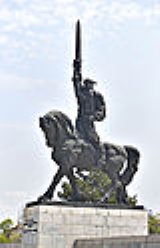
Asparukh of Bulgaria

Encyclopedia
Asparuh was ruler of a Bulgar
tribe in the second half of the 7th century and is credited with the establishment of the First Bulgarian Empire
in 680/681. The accuracy of the Turkic title khan
commonly applied to him and his successors is a subject of some dispute.
states that Asparuh belonged to the Dulo clan
and reigned for 61 years. This long period cannot be accepted as accurate due to chronological constraints, and may indicate the length of Asparuh's life. According to the chronology developed by Moskov, Asparuh would have reigned 668–695. Other chronologies frequently end his reign in 700 or 701 but cannot be reconciled with the testimony of the Namelist. According to the Byzantine sources, Asparuh was a younger son of Kubrat
, who had established a spacious state ("Great Bulgaria") in the steppes of modern Ukraine
. Asparuh may have gained experience in politics and statesmanship during the long reign of his father, who probably died in 665
(apud Moskov). After his father's death, Asparuh would have acknowledged the rule of his older brother Bat Bayan, but the state disintegrated under Khazar
attack in 668
, and he and his brothers parted ways, leading their people to seek a more secure home in other lands.
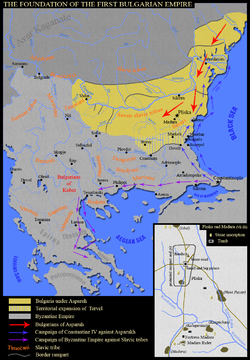
. He reached the Danube
and while the Byzantine
capital Constantinople
was besieged by Muawiyah I
, Caliph
of the Arabs (674–678), he and his people settled in the Danube delta
, probably on the extinct Peuce Island
. After the Arab siege of Constantinople ended, the Byzantine Emperor Constantine IV
marched against the Bulgars and their Slav allies in 680 and forced his opponents to seek shelter in a fortified encampment. Forced to abandon the leadership of his army in order to seek medical treatment for his ailments, the emperor sabotaged the morale of his troops, who gave in to rumours that their emperor had fled. With segments of the Byzantine army starting to desert, the Bulgars and their allies broke through the blockade and routed the enemy troops at the battle of Ongala in 680. Asparuh then swiftly moved from the Danubian delta down to the Balkan range.
and the establishment of some sort of alliance between the Bulgars and the local Slavic groups (described as the Severi
and Seven Slavic tribes
). As Asparuh commenced to raid across the mountains into Byzantine Thrace
in 681, Constantine IV decided to cut his losses and conclude a treaty, whereby the Byzantine Empire paid the Bulgars an annual tribute as protection money. These events are seen in retrospect as the establishment of the Bulgarian state and its recognition by the Byzantine Empire. In later tradition Asparuh is credited with building the major centers of Pliska
and Drăstăr, as well as at least one of the Bulgarian limes walls from the Danube to the Black Sea
. Recent scholarship has questioned whether it was Asparuh that established Pliska as the capital, suggesting that the original capital of Bulgaria was in the vicinity of Varna
. While the multi-tribal and hegemonic character of the Bulgarian state in the first century or two after its establishment is readily apparent, Bulgarian historians have stressed the establishment of a capital and of a state tradition that could be viewed retrospectively as national. According to a late tradition, Asparuh died fighting the Khazars on the Danube. According to one theory, advanced by the Bulgarian historian Vaklinov, his grave is located near Voznesenka ("Ascension") on the Dnieper in Ukraine. The 17th century Volga Bulgar compilation Ja'far Tarikh (a work of disputed authenticity) represents Atil'kese (i.e., Asparuh) as the son and successor of Kurbat (i.e., Kubrat), and as the father and predecessor of Tarvil (i.e., Tervel
) and Ajjar
(otherwise unknown, but possibly the first of two lost names in the Imennik).
Asparuh Peak
on Livingston Island in the South Shetland Islands
, Antarctica is named after Asparuh of Bulgaria.
name
attested in ancient
Georgia
and early medieval
Bulgaria
. It is a compound with the two elements: aspa- “horse” and rauk presumably meaning “shine”, i.e., "he who has shining horses."
The two historically attested persons bearing this name are Asparukh of Bulgaria and Asparukh, a viceroy of Armazi
in Iberia
(Georgia), contemporary of the Roman emperor
Hadrian
(117-38 A.D.).
Bulgars
The Bulgars were a semi-nomadic who flourished in the Pontic Steppe and the Volga basin in the 7th century.The Bulgars emerge after the collapse of the Hunnic Empire in the 5th century....
tribe in the second half of the 7th century and is credited with the establishment of the First Bulgarian Empire
First Bulgarian Empire
The First Bulgarian Empire was a medieval Bulgarian state founded in the north-eastern Balkans in c. 680 by the Bulgars, uniting with seven South Slavic tribes...
in 680/681. The accuracy of the Turkic title khan
Khan (title)
Khan is an originally Altaic and subsequently Central Asian title for a sovereign or military ruler, widely used by medieval nomadic Turko-Mongol tribes living to the north of China. 'Khan' is also seen as a title in the Xianbei confederation for their chief between 283 and 289...
commonly applied to him and his successors is a subject of some dispute.
Early life
The Nominalia of the Bulgarian khansNominalia of the Bulgarian khans
The Nominalia of the Bulgarian khans is a short manuscript containing the names of some early Bulgar rulers, their clans, the year of their ascending to the throne according to the cyclic Bulgar calendar and the length of their rule, including the times of joint rule and civil war...
states that Asparuh belonged to the Dulo clan
Dulo clan
The Dulo Clan or the House of Dulo was the name of the ruling dynasty of the early Bulgars.This was the clan of Kubrat who founded Old Great Bulgaria, and his sons Batbayan, Kuber and Asparuh, the latter of which founded Danube Bulgaria....
and reigned for 61 years. This long period cannot be accepted as accurate due to chronological constraints, and may indicate the length of Asparuh's life. According to the chronology developed by Moskov, Asparuh would have reigned 668–695. Other chronologies frequently end his reign in 700 or 701 but cannot be reconciled with the testimony of the Namelist. According to the Byzantine sources, Asparuh was a younger son of Kubrat
Kubrat
Kubrat or Kurt was a Bulgar ruler credited with establishing the confederation of Old Great Bulgaria in 632. He is said to have achieved this by conquering the Avars and uniting all the Bulgar tribes under one rule....
, who had established a spacious state ("Great Bulgaria") in the steppes of modern Ukraine
Ukraine
Ukraine is a country in Eastern Europe. It has an area of 603,628 km², making it the second largest contiguous country on the European continent, after Russia...
. Asparuh may have gained experience in politics and statesmanship during the long reign of his father, who probably died in 665
665
Year 665 was a common year starting on Wednesday of the Julian calendar. The denomination 665 for this year has been used since the early medieval period, when the Anno Domini calendar era became the prevalent method in Europe for naming years.- Europe :* Swithelm is succeeded by Sighere and...
(apud Moskov). After his father's death, Asparuh would have acknowledged the rule of his older brother Bat Bayan, but the state disintegrated under Khazar
Khazars
The Khazars were semi-nomadic Turkic people who established one of the largest polities of medieval Eurasia, with the capital of Atil and territory comprising much of modern-day European Russia, western Kazakhstan, eastern Ukraine, Azerbaijan, large portions of the northern Caucasus , parts of...
attack in 668
668
Year 668 was a leap year starting on Saturday of the Julian calendar. The denomination 668 for this year has been used since the early medieval period, when the Anno Domini calendar era became the prevalent method in Europe for naming years.- Europe :* Childeric II succeeds Clotaire III as King...
, and he and his brothers parted ways, leading their people to seek a more secure home in other lands.
Establishment of the First Bulgarian Empire
Asparukh was followed by 30,000 to 50,000 BulgarsBulgars
The Bulgars were a semi-nomadic who flourished in the Pontic Steppe and the Volga basin in the 7th century.The Bulgars emerge after the collapse of the Hunnic Empire in the 5th century....
. He reached the Danube
Danube
The Danube is a river in the Central Europe and the Europe's second longest river after the Volga. It is classified as an international waterway....
and while the Byzantine
Byzantine Empire
The Byzantine Empire was the Eastern Roman Empire during the periods of Late Antiquity and the Middle Ages, centred on the capital of Constantinople. Known simply as the Roman Empire or Romania to its inhabitants and neighbours, the Empire was the direct continuation of the Ancient Roman State...
capital Constantinople
Constantinople
Constantinople was the capital of the Roman, Eastern Roman, Byzantine, Latin, and Ottoman Empires. Throughout most of the Middle Ages, Constantinople was Europe's largest and wealthiest city.-Names:...
was besieged by Muawiyah I
Muawiyah I
Muawiyah I was the first Caliph of the Umayyad Dynasty. After the conquest of Mecca by the Muslims, Muawiyah's family converted to Islam. Muawiyah is brother-in-law to Muhammad who married his sister Ramlah bint Abi-Sufyan in 1AH...
, Caliph
Caliph
The Caliph is the head of state in a Caliphate, and the title for the ruler of the Islamic Ummah, an Islamic community ruled by the Shari'ah. It is a transcribed version of the Arabic word which means "successor" or "representative"...
of the Arabs (674–678), he and his people settled in the Danube delta
Danube Delta
The Danube Delta is the second largest river delta in Europe, after the Volga Delta, and is the best preserved on the continent. The greater part of the Danube Delta lies in Romania , while its northern part, on the left bank of the Chilia arm, is situated in Ukraine . The approximate surface is...
, probably on the extinct Peuce Island
Peuce Island
Peuce in ancient geography was an island located in the Danube Delta, in Scythia Minor . Its name came from the ancient Greek word peuke, 'pine tree'. It was about the size of the island of Rhodes...
. After the Arab siege of Constantinople ended, the Byzantine Emperor Constantine IV
Constantine IV
Constantine IV , , sometimes incorrectly called Pogonatos, "the Bearded", by confusion with his father; was Byzantine emperor from 668 to 685...
marched against the Bulgars and their Slav allies in 680 and forced his opponents to seek shelter in a fortified encampment. Forced to abandon the leadership of his army in order to seek medical treatment for his ailments, the emperor sabotaged the morale of his troops, who gave in to rumours that their emperor had fled. With segments of the Byzantine army starting to desert, the Bulgars and their allies broke through the blockade and routed the enemy troops at the battle of Ongala in 680. Asparuh then swiftly moved from the Danubian delta down to the Balkan range.
Reign
Asparuh's victory led to the Bulgarian conquest of MoesiaMoesia
Moesia was an ancient region and later Roman province situated in the Balkans, along the south bank of the Danube River. It included territories of modern-day Southern Serbia , Northern Republic of Macedonia, Northern Bulgaria, Romanian Dobrudja, Southern Moldova, and Budjak .-History:In ancient...
and the establishment of some sort of alliance between the Bulgars and the local Slavic groups (described as the Severi
Severi
Severi may refer to:*Francesco Severi, Italian mathematician and geometer of the early 20th century*Severan dynasty, a dynasty of Roman emperors, ruling in the late 2nd and early 3rd century...
and Seven Slavic tribes
Seven Slavic tribes
The Seven Slavic tribes were a union of Slavic tribes of Moesia that was established around the middle of the 7th century and took part in the formation of the First Bulgarian Empire together with the Bulgars in 680-681....
). As Asparuh commenced to raid across the mountains into Byzantine Thrace
Thrace
Thrace is a historical and geographic area in southeast Europe. As a geographical concept, Thrace designates a region bounded by the Balkan Mountains on the north, Rhodope Mountains and the Aegean Sea on the south, and by the Black Sea and the Sea of Marmara on the east...
in 681, Constantine IV decided to cut his losses and conclude a treaty, whereby the Byzantine Empire paid the Bulgars an annual tribute as protection money. These events are seen in retrospect as the establishment of the Bulgarian state and its recognition by the Byzantine Empire. In later tradition Asparuh is credited with building the major centers of Pliska
Pliska
Pliska is the name of both the first capital of Danubian Bulgaria and a small town which was renamed after the historical Pliska after its site was determined and excavations began....
and Drăstăr, as well as at least one of the Bulgarian limes walls from the Danube to the Black Sea
Black Sea
The Black Sea is bounded by Europe, Anatolia and the Caucasus and is ultimately connected to the Atlantic Ocean via the Mediterranean and the Aegean seas and various straits. The Bosphorus strait connects it to the Sea of Marmara, and the strait of the Dardanelles connects that sea to the Aegean...
. Recent scholarship has questioned whether it was Asparuh that established Pliska as the capital, suggesting that the original capital of Bulgaria was in the vicinity of Varna
Varna
Varna is the largest city and seaside resort on the Bulgarian Black Sea Coast and third-largest in Bulgaria after Sofia and Plovdiv, with a population of 334,870 inhabitants according to Census 2011...
. While the multi-tribal and hegemonic character of the Bulgarian state in the first century or two after its establishment is readily apparent, Bulgarian historians have stressed the establishment of a capital and of a state tradition that could be viewed retrospectively as national. According to a late tradition, Asparuh died fighting the Khazars on the Danube. According to one theory, advanced by the Bulgarian historian Vaklinov, his grave is located near Voznesenka ("Ascension") on the Dnieper in Ukraine. The 17th century Volga Bulgar compilation Ja'far Tarikh (a work of disputed authenticity) represents Atil'kese (i.e., Asparuh) as the son and successor of Kurbat (i.e., Kubrat), and as the father and predecessor of Tarvil (i.e., Tervel
Tervel of Bulgaria
Khan Tervel also called Tarvel, or Terval, or Terbelis in some Byzantine sources, was the Emperor of the Bulgarians at the beginning of the 8th century. In 705 he received the title Caesar which was a precedent in history. He was probably a Christian like his grandfather Khan Kubrat...
) and Ajjar
Ajjar of Bulgaria
Ajjar or Ayyar , is the name assigned by the 17th century Volga Bulgar source Ja'far Tarikh , to the successor of Tervel on the throne of Bulgaria....
(otherwise unknown, but possibly the first of two lost names in the Imennik).
Asparuh Peak
Asparuh Peak
Asparuh Peak is a peak situated on Livingston Island, Antarctica. The peak rises to 760m in Bowles Ridge and is linked to the Melnik Ridge by the 575m high Yankov Gap...
on Livingston Island in the South Shetland Islands
South Shetland Islands
The South Shetland Islands are a group of Antarctic islands, lying about north of the Antarctic Peninsula, with a total area of . By the Antarctic Treaty of 1959, the Islands' sovereignty is neither recognized nor disputed by the signatories and they are free for use by any signatory for...
, Antarctica is named after Asparuh of Bulgaria.
Name
Asparukh is a Middle Iranian maleMale
Male refers to the biological sex of an organism, or part of an organism, which produces small mobile gametes, called spermatozoa. Each spermatozoon can fuse with a larger female gamete or ovum, in the process of fertilization...
name
Proper name
"A proper name [is] a word that answers the purpose of showing what thing it is that we are talking about" writes John Stuart Mill in A System of Logic , "but not of telling anything about it"...
attested in ancient
Classical antiquity
Classical antiquity is a broad term for a long period of cultural history centered on the Mediterranean Sea, comprising the interlocking civilizations of ancient Greece and ancient Rome, collectively known as the Greco-Roman world...
Georgia
Georgia (country)
Georgia is a sovereign state in the Caucasus region of Eurasia. Located at the crossroads of Western Asia and Eastern Europe, it is bounded to the west by the Black Sea, to the north by Russia, to the southwest by Turkey, to the south by Armenia, and to the southeast by Azerbaijan. The capital of...
and early medieval
Early Middle Ages
The Early Middle Ages was the period of European history lasting from the 5th century to approximately 1000. The Early Middle Ages followed the decline of the Western Roman Empire and preceded the High Middle Ages...
Bulgaria
Bulgaria
Bulgaria , officially the Republic of Bulgaria , is a parliamentary democracy within a unitary constitutional republic in Southeast Europe. The country borders Romania to the north, Serbia and Macedonia to the west, Greece and Turkey to the south, as well as the Black Sea to the east...
. It is a compound with the two elements: aspa- “horse” and rauk presumably meaning “shine”, i.e., "he who has shining horses."
The two historically attested persons bearing this name are Asparukh of Bulgaria and Asparukh, a viceroy of Armazi
Armazi
Armazi was, according to the medieval Georgian chronicles, the supreme deity in a pre-Christian pantheon of ancient Georgians of Kartli ....
in Iberia
Caucasian Iberia
Iberia , also known as Iveria , was a name given by the ancient Greeks and Romans to the ancient Georgian kingdom of Kartli , corresponding roughly to the eastern and southern parts of the present day Georgia...
(Georgia), contemporary of the Roman emperor
Roman Emperor
The Roman emperor was the ruler of the Roman State during the imperial period . The Romans had no single term for the office although at any given time, a given title was associated with the emperor...
Hadrian
Hadrian
Hadrian , was Roman Emperor from 117 to 138. He is best known for building Hadrian's Wall, which marked the northern limit of Roman Britain. In Rome, he re-built the Pantheon and constructed the Temple of Venus and Roma. In addition to being emperor, Hadrian was a humanist and was philhellene in...
(117-38 A.D.).
Sources and references
- John V.A. Fine, The Early Medieval Balkans, Ann Arbor, 1983.
- Mosko Moskov, Imennik na bălgarskite hanove (novo tălkuvane), Sofia 1988.
- Jordan Andreev, Ivan Lazarov, Plamen Pavlov, Koj koj e v srednovekovna Bălgarija, Sofia 1999.
- (primary source), Bahši Iman, Džagfar Tarihy, vol. III, Orenburg 1997.
- (primary source), Nikephoros Patriarch of Constantinople, Short History, C. Mango, ed., Dumbarton Oaks Texts 10, 1990.
- (primary source), The Chronicle of Theophanes Confessor, C. Mango and R. Scott, trans., Oxford University Press, 1997.
- Васил Н. Златарски, История на българската държава през средните векове, Част I, II изд., Наука и изкуство, София 1970, pp. 176 – 209.
See also
- Asparukh (name)Asparukh (name)Asparukh is a Middle Iranian male name attested in ancient Georgia and early medieval Bulgaria. It is a compound with the two elements: "aspa"- “horse” and "rukh" meaning “soul, spirit”, i.e., "he who has spirit of horse"....
- AszparuhAszparuhAszparuh is a 1981 Bulgarian film about the establishment of the First Bulgarian Empire in AD 681.This film was directed by Ludmil Staikov.-Cast:* Stoyko Peev as "Khan Asparukh of Bulgaria"* Antony Genov as "Velizariy"...
- the film - BulgarsBulgarsThe Bulgars were a semi-nomadic who flourished in the Pontic Steppe and the Volga basin in the 7th century.The Bulgars emerge after the collapse of the Hunnic Empire in the 5th century....
- History of BulgariaHistory of BulgariaThe history of Bulgaria spans from the first settlements on the lands of modern Bulgaria to its formation as a nation-state and includes the history of the Bulgarian people and their origin. The first traces of human presence on what is today Bulgaria date from 44,000 BC...
- List of Bulgarian monarchs.