


Ashanti

Encyclopedia
Ashanti, or Asante, are an Akan people
who live predominantly in Ghana
and Ivory Coast
. They speak Twi
, an Akan dialect
.
Prior to European colonization, the Ashanti people developed a large and influential empire in West Africa
. The Ashanti later developed the powerful Ashanti Confederacy or Asanteman and became the dominant presence in the region.
 Ghana
Ghana
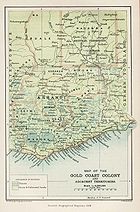
has a variable terrain, coasts and mountains, forests and grassland
s, lush agricultural areas and near deserts. The Ashanti settled in the central part of present-day Ghana, about three hundred kilometres from the coast. The territory is densely forested, mostly fertile and to some extent mountainous. There are two seasons—the rainy season (April to November) and the dry season
(December to March). The land has several streams
; the dry season, however is extremely desiccated. It is hot year round.
Today Ashanti number close to 7 million people (roughly 19% of the Ghanaian population, speaking Asante, also referred to as Twi
, a member of the Niger–Congo language family.) Their political power has fluctuated since Ghana's independence, but they remain largely influential. The former president of Ghana, John Agyekum Kufuor is Ashanti. Kofi Annan, the past U.N secretary General was also raised and brought up in Kumasi, the capital of the Ashanti region. The majority of the Ashanti reside in the Ashanti Region
, one of the administrative regions of the country. Kumasi, the capital of the current Ashanti region, has also been the historic capital of the Ashanti Kingdom. Currently, the Ashanti region of Ghana has a population of 3,812,950, making it Ghana's most populous administrative district.
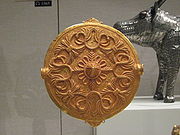 Ashanti are one of Africa's matrilineal societies where line of descent is traced through the female. Historically, this mother progeny relationship determined land rights
, inheritance of property, offices and titles. It is also true that the Ashanti inherit from the paternal side of the family. Property is defined as something inherited from the father, hence the name "agyapade", meaning inheritance from a good father. Normally, a poor father has nothing to give their children, and often marry into a family which has wealth from ancestors.
The father
's role was to help the conception and provide the nkra or the soul of the child; that is, the child received its life force, character, and personality traits from the father
. Though not considered as important as the mother
, the male interaction continues in the place of birth after marriage.
Historically, an Ashanti girl was betrothed with a golden ring called "petia" (I love you), if not in childhood, immediately after the puberty
ceremony. They did not regard marriage
"awade" as an important ritual
event, but as a state that follows soon and normally after the puberty ritual. The puberty rite was and is important as it signifies passage from childhood to adulthood in that chastity
is encouraged before marriage. The Ashanti required that various goods be given by the boy's family to that of the girl, not as a 'bride price,' but to signify an agreement between the two families.
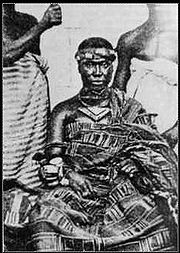 The Ashanti went from being a tributary state
to a centralized hierarchical kingdom. Osei Tutu, military leader and head of the Oyoko clan, founded the Ashanti kingdom in the 1670s. He obtained the support of other clan chiefs and using Kumasi as the central base, subdued surrounding Akan states. He challenged and eventually defeated Denkyira
in 1701.
Realizing the weakness of a loose confederation of Akan states, Osei Tutu strengthened centralization of the surrounding Akan groups and expanded the powers judiciary system within the centralized government. Thus, this loose confederation of small city-states grew into a kingdom or empire looking to expand its land. Newly conquered areas had the option of joining the empire or becoming tributary states. Opoku Ware I
, Osei Tutu's successor, extended the borders, embracing much of present day Ghana's territory.
' (sika 'dwa) actually tells of the birth of the Ashanti kingdom itself. In the seventeenth century, in order for the Ashanti to win their independence from Denkyira, then another powerful Akan
state, a meeting of all the clan heads of each of the Ashanti settlements was called. In this meeting, the Golden Stool was commanded down from the heaven
s by Okomfo Anokye, the Priest, or sage advisor, to the very first Asantehene (Ashanti king), Osei Tutu I. The Golden Stool floated down from the heavens straight into the lap of Osei Tutu I. Okomfo Anokye declared the stool to be the symbol of the new Ashanti union ('Asanteman'), and allegiance was sworn to the Golden Stool and to Osei Tutu as the Asantehene. The newly founded Ashanti union went to war with Denkyira and defeated it.
The Golden Stool is sacred to the Ashanti, as it is believed that it contains the 'Sunsum' — spirit or soul of the Ashanti people. Just as man cannot live without a soul, so the Ashanti would cease to exist if the Golden Stool were to be taken from them. The Golden Stool is not just sacred; it is a symbol of nation
hood, a symbol that binds or unifies all Ashanti.the stool was believed to be so sacred not even the king was allowed to sit on it.
The Golden Stool is a curved seat 46 cm high with a platform 61 cm wide and 30 cm deep. Its entire surface is inlaid with gold, and hung with bells to warn the king of impending danger. It has not been seen by many and only the king and trusted advisers know the hiding place. Replicas of the stool have been produced for the chiefs and at their funerals are ceremonially blackened with animal blood, a symbol of their power for generations.
The Ashanti have always defended their Golden Stool when it was at risk. In 1896, the Ashanti allowed their King, Prempeh I, to be exiled rather than risk losing a war and the Golden Stool in the process. The Governor of the Gold Coast
, Sir Frederick Hodgson, demanded to sit on the stool in 1900. The Ashanti remained silent and when the assembly ended, they went home and prepared for war
. Although they lost on the battle field, they claimed victory because they fought only to preserve the sanctity of the Golden Stool, and they had. Then in 1920, a group of African road builders accidentally found the Golden Stool and stripped it of its gold ornaments. They were tried by an Ashanti court, found guilty, and the death penalty was imposed. But the British intervened and the sentence was commuted to perpetual banishment
.
The Ashanti have always been proud of the uniqueness of their Golden Stool, and it was a symbol of not only their independence, but a common bond between their people. When the King of Gyaaman
, Adinkra, made a Golden Stool for himself, the Asantehene was so annoyed that he led a massive army against him. Adinkra was completely destroyed near Bondoukou
, and he was decapitated. The Asantehene then proceeded to order the melt down of Adinkra's golden stool, and for it to be made into two masks, to represent his "ugly" face. These masks remain hanging on each side of the Ashanti Golden Stool to this day.
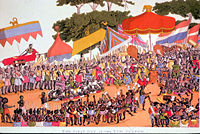 The Ashanti strongly resisted attempts by European
s, mainly the British
, to subjugate them. The Ashanti aligned themselves with the Dutch
to limit British influence in the region. Britain
annexed neighbouring areas. The Ashanti were described as a fierce organized people whose king "can bring 200,000 men into the field and whose warriors are evidently not cowed by Snider rifles and 7-pounder guns"
Ashanti was one of the few African states able to offer serious resistance to European colonizers. Between 1823 and 1896, Britain
fought four wars against the Ashanti kings (the Anglo-Ashanti Wars). In 1900, the British finally defeated the kingdom and incorporated it into the Gold Coast
colony as a protectorate
.
Because of the long history of mutual interaction between Ashanti and European powers, the Ashanti have the greatest amount of historiography
in sub-Saharan Africa. The British touted the Ashanti as one of the more civilized African peoples, cataloguing their religious, familial, and legal systems in works like R.S. Rattray's Ashanti Law and Constitution.
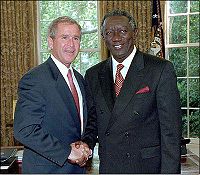
 In modern Ghana, there is no cultural group which comprises a majority of the population of the country of Ghana. While the entire Akan population make a plurality 49% of the population, Ashanti, Fante and other Akans make up that percentage. However, it is estimated that Ashanti are 19% of Ghana's population which makes it the largest of the cultural groups in Ghana, followed by Fante, the Ewe and Ga. The former president John Kufuor
is an Ashanti and was elected in part with their support.
Ashanti are largely Protestant
and Catholic
Christians; the major denominations represented are Methodist
, Catholic and Anglican
, although Pentecostalism
is growing in popularity.
Akan people
The Akan people are an ethnic group found predominately in Ghana and The Ivory Coast. Akans are the majority in both of these countries and overall have a population of over 20 million people.The Akan speak Kwa languages-Origin and ethnogenesis:...
who live predominantly in Ghana
Ghana
Ghana , officially the Republic of Ghana, is a country located in West Africa. It is bordered by Côte d'Ivoire to the west, Burkina Faso to the north, Togo to the east, and the Gulf of Guinea to the south...
and Ivory Coast
Côte d'Ivoire
The Republic of Côte d'Ivoire or Ivory Coast is a country in West Africa. It has an area of , and borders the countries Liberia, Guinea, Mali, Burkina Faso and Ghana; its southern boundary is along the Gulf of Guinea. The country's population was 15,366,672 in 1998 and was estimated to be...
. They speak Twi
Twi
Asante, or Ashanti, is one of three literary dialects of the Akan language of southern Ghana, and the prestige dialect of that language. It is spoken in and around Kumasi, the capital of the former Ashanti Empire and current subnational Asante Kingdom within Ghana.Along with the Akuapem dialect,...
, an Akan dialect
Akan language
Akan, also known as Twi and Fante, is an Akan language that is the principal native language of Ghana, spoken over much of the southern half of that country, by about 52% of the population, and to a lesser extent across the border in eastern Côte d'Ivoire...
.
Prior to European colonization, the Ashanti people developed a large and influential empire in West Africa
West Africa
West Africa or Western Africa is the westernmost region of the African continent. Geopolitically, the UN definition of Western Africa includes the following 16 countries and an area of approximately 5 million square km:-Flags of West Africa:...
. The Ashanti later developed the powerful Ashanti Confederacy or Asanteman and became the dominant presence in the region.
Geography
Ghana
Ghana , officially the Republic of Ghana, is a country located in West Africa. It is bordered by Côte d'Ivoire to the west, Burkina Faso to the north, Togo to the east, and the Gulf of Guinea to the south...
has a variable terrain, coasts and mountains, forests and grassland
Grassland
Grasslands are areas where the vegetation is dominated by grasses and other herbaceous plants . However, sedge and rush families can also be found. Grasslands occur naturally on all continents except Antarctica...
s, lush agricultural areas and near deserts. The Ashanti settled in the central part of present-day Ghana, about three hundred kilometres from the coast. The territory is densely forested, mostly fertile and to some extent mountainous. There are two seasons—the rainy season (April to November) and the dry season
Dry season
The dry season is a term commonly used when describing the weather in the tropics. The weather in the tropics is dominated by the tropical rain belt, which oscillates from the northern to the southern tropics over the course of the year...
(December to March). The land has several streams
STREAMS
In computer networking, STREAMS is the native framework in Unix System V for implementing character devices.STREAMS was designed as a modular architecture for implementing full-duplex I/O between kernel or user space processes and device drivers. Its most frequent uses have been in developing...
; the dry season, however is extremely desiccated. It is hot year round.
Today Ashanti number close to 7 million people (roughly 19% of the Ghanaian population, speaking Asante, also referred to as Twi
Twi
Asante, or Ashanti, is one of three literary dialects of the Akan language of southern Ghana, and the prestige dialect of that language. It is spoken in and around Kumasi, the capital of the former Ashanti Empire and current subnational Asante Kingdom within Ghana.Along with the Akuapem dialect,...
, a member of the Niger–Congo language family.) Their political power has fluctuated since Ghana's independence, but they remain largely influential. The former president of Ghana, John Agyekum Kufuor is Ashanti. Kofi Annan, the past U.N secretary General was also raised and brought up in Kumasi, the capital of the Ashanti region. The majority of the Ashanti reside in the Ashanti Region
Ashanti Region
The Ashanti Region is the third largest of 10 administrative regions in Ghana, occupying a total land surface of 24389 square kilometers or 10.2 per cent of the total land area of Ghana. In terms of population, however, it is the most populated region with a population of 3,612,950 in 2000,...
, one of the administrative regions of the country. Kumasi, the capital of the current Ashanti region, has also been the historic capital of the Ashanti Kingdom. Currently, the Ashanti region of Ghana has a population of 3,812,950, making it Ghana's most populous administrative district.
Family
Land rights
Land law is the form of law that deals with the rights to use, alienate, or exclude others from land. In many jurisdictions, these species of property are referred to as real estate or real property, as distinct from personal property. Land use agreements, including renting, are an important...
, inheritance of property, offices and titles. It is also true that the Ashanti inherit from the paternal side of the family. Property is defined as something inherited from the father, hence the name "agyapade", meaning inheritance from a good father. Normally, a poor father has nothing to give their children, and often marry into a family which has wealth from ancestors.
The father
Father
A father, Pop, Dad, or Papa, is defined as a male parent of any type of offspring. The adjective "paternal" refers to father, parallel to "maternal" for mother...
's role was to help the conception and provide the nkra or the soul of the child; that is, the child received its life force, character, and personality traits from the father
Father
A father, Pop, Dad, or Papa, is defined as a male parent of any type of offspring. The adjective "paternal" refers to father, parallel to "maternal" for mother...
. Though not considered as important as the mother
Mother
A mother, mum, mom, momma, or mama is a woman who has raised a child, given birth to a child, and/or supplied the ovum that grew into a child. Because of the complexity and differences of a mother's social, cultural, and religious definitions and roles, it is challenging to specify a universally...
, the male interaction continues in the place of birth after marriage.
Historically, an Ashanti girl was betrothed with a golden ring called "petia" (I love you), if not in childhood, immediately after the puberty
Puberty
Puberty is the process of physical changes by which a child's body matures into an adult body capable of reproduction, as initiated by hormonal signals from the brain to the gonads; the ovaries in a girl, the testes in a boy...
ceremony. They did not regard marriage
Marriage
Marriage is a social union or legal contract between people that creates kinship. It is an institution in which interpersonal relationships, usually intimate and sexual, are acknowledged in a variety of ways, depending on the culture or subculture in which it is found...
"awade" as an important ritual
Ritual
A ritual is a set of actions, performed mainly for their symbolic value. It may be prescribed by a religion or by the traditions of a community. The term usually excludes actions which are arbitrarily chosen by the performers....
event, but as a state that follows soon and normally after the puberty ritual. The puberty rite was and is important as it signifies passage from childhood to adulthood in that chastity
Chastity
Chastity refers to the sexual behavior of a man or woman acceptable to the moral standards and guidelines of a culture, civilization, or religion....
is encouraged before marriage. The Ashanti required that various goods be given by the boy's family to that of the girl, not as a 'bride price,' but to signify an agreement between the two families.
Ashanti Kingdom
Tributary state
The term tributary state refers to one of the two main ways in which a pre-modern state might be subordinate to a more powerful neighbour. The heart of the relationship was that the tributary would send a regular token of submission to the superior power...
to a centralized hierarchical kingdom. Osei Tutu, military leader and head of the Oyoko clan, founded the Ashanti kingdom in the 1670s. He obtained the support of other clan chiefs and using Kumasi as the central base, subdued surrounding Akan states. He challenged and eventually defeated Denkyira
Denkyira
Denkyira was a powerful nation of Akan people that existed in southern present-day Ghana from 1620. Like all Akans they originated from Bono state. Before 1620 Denkyira was called Agona. The ruler of the Denkyira was called Denkyirahene and the capital was Jukwaa...
in 1701.
Realizing the weakness of a loose confederation of Akan states, Osei Tutu strengthened centralization of the surrounding Akan groups and expanded the powers judiciary system within the centralized government. Thus, this loose confederation of small city-states grew into a kingdom or empire looking to expand its land. Newly conquered areas had the option of joining the empire or becoming tributary states. Opoku Ware I
Opoku Ware I
Katakyie Opoku Ware I was an Oyoko king or Asantehene - the ruler of the Ashanti - in the now-disbanded Ashanti Confederacy which occupied parts of what is now Ghana...
, Osei Tutu's successor, extended the borders, embracing much of present day Ghana's territory.
The Golden Stool
The legend of 'Golden StoolAsante royal thrones
According to legend, Okomfo Anokye caused the famous Asante royal throne known as the Golden Stool to descend from the heavens and land on the lap of the first Asante king, Osei Tutu...
' (sika 'dwa) actually tells of the birth of the Ashanti kingdom itself. In the seventeenth century, in order for the Ashanti to win their independence from Denkyira, then another powerful Akan
Akan people
The Akan people are an ethnic group found predominately in Ghana and The Ivory Coast. Akans are the majority in both of these countries and overall have a population of over 20 million people.The Akan speak Kwa languages-Origin and ethnogenesis:...
state, a meeting of all the clan heads of each of the Ashanti settlements was called. In this meeting, the Golden Stool was commanded down from the heaven
Heaven
Heaven, the Heavens or Seven Heavens, is a common religious cosmological or metaphysical term for the physical or transcendent place from which heavenly beings originate, are enthroned or inhabit...
s by Okomfo Anokye, the Priest, or sage advisor, to the very first Asantehene (Ashanti king), Osei Tutu I. The Golden Stool floated down from the heavens straight into the lap of Osei Tutu I. Okomfo Anokye declared the stool to be the symbol of the new Ashanti union ('Asanteman'), and allegiance was sworn to the Golden Stool and to Osei Tutu as the Asantehene. The newly founded Ashanti union went to war with Denkyira and defeated it.
The Golden Stool is sacred to the Ashanti, as it is believed that it contains the 'Sunsum' — spirit or soul of the Ashanti people. Just as man cannot live without a soul, so the Ashanti would cease to exist if the Golden Stool were to be taken from them. The Golden Stool is not just sacred; it is a symbol of nation
Nation
A nation may refer to a community of people who share a common language, culture, ethnicity, descent, and/or history. In this definition, a nation has no physical borders. However, it can also refer to people who share a common territory and government irrespective of their ethnic make-up...
hood, a symbol that binds or unifies all Ashanti.the stool was believed to be so sacred not even the king was allowed to sit on it.
The Golden Stool is a curved seat 46 cm high with a platform 61 cm wide and 30 cm deep. Its entire surface is inlaid with gold, and hung with bells to warn the king of impending danger. It has not been seen by many and only the king and trusted advisers know the hiding place. Replicas of the stool have been produced for the chiefs and at their funerals are ceremonially blackened with animal blood, a symbol of their power for generations.
The Ashanti have always defended their Golden Stool when it was at risk. In 1896, the Ashanti allowed their King, Prempeh I, to be exiled rather than risk losing a war and the Golden Stool in the process. The Governor of the Gold Coast
Gold Coast (British colony)
The Gold Coast was a British colony on the Gulf of Guinea in west Africa that became the independent nation of Ghana in 1957.-Overview:The first Europeans to arrive at the coast were the Portuguese in 1471. They encountered a variety of African kingdoms, some of which controlled substantial...
, Sir Frederick Hodgson, demanded to sit on the stool in 1900. The Ashanti remained silent and when the assembly ended, they went home and prepared for war
War of the Golden Stool
The War of the Golden Stool, also known as the Yaa Asantewaa War, the Third Ashanti Expedition, the Ashanti Uprising, or variations thereof, was the final war in a series of conflicts between the British Imperial government of the Gold Coast and the Empire of Ashanti, a powerful, semi-autonomous...
. Although they lost on the battle field, they claimed victory because they fought only to preserve the sanctity of the Golden Stool, and they had. Then in 1920, a group of African road builders accidentally found the Golden Stool and stripped it of its gold ornaments. They were tried by an Ashanti court, found guilty, and the death penalty was imposed. But the British intervened and the sentence was commuted to perpetual banishment
Exile
Exile means to be away from one's home , while either being explicitly refused permission to return and/or being threatened with imprisonment or death upon return...
.
The Ashanti have always been proud of the uniqueness of their Golden Stool, and it was a symbol of not only their independence, but a common bond between their people. When the King of Gyaaman
Gyaaman
Gyaman also spelled Jamang was a medieval African state of the Akan people, located in what is now Ghana and Côte d'Ivoire. Gyaman was founded by the Abron, a branch of the Akan, in the late 15th century...
, Adinkra, made a Golden Stool for himself, the Asantehene was so annoyed that he led a massive army against him. Adinkra was completely destroyed near Bondoukou
Bondoukou
Bondoukou is a town in Bondoukou Department of Côte d'Ivoire, located in the Zanzan Region, 420 km Northeast of Abidjan...
, and he was decapitated. The Asantehene then proceeded to order the melt down of Adinkra's golden stool, and for it to be made into two masks, to represent his "ugly" face. These masks remain hanging on each side of the Ashanti Golden Stool to this day.
European colonization
European ethnic groups
The ethnic groups in Europe are the various ethnic groups that reside in the nations of Europe. European ethnology is the field of anthropology focusing on Europe....
s, mainly the British
Kingdom of Great Britain
The former Kingdom of Great Britain, sometimes described as the 'United Kingdom of Great Britain', That the Two Kingdoms of Scotland and England, shall upon the 1st May next ensuing the date hereof, and forever after, be United into One Kingdom by the Name of GREAT BRITAIN. was a sovereign...
, to subjugate them. The Ashanti aligned themselves with the Dutch
Netherlands
The Netherlands is a constituent country of the Kingdom of the Netherlands, located mainly in North-West Europe and with several islands in the Caribbean. Mainland Netherlands borders the North Sea to the north and west, Belgium to the south, and Germany to the east, and shares maritime borders...
to limit British influence in the region. Britain
British Empire
The British Empire comprised the dominions, colonies, protectorates, mandates and other territories ruled or administered by the United Kingdom. It originated with the overseas colonies and trading posts established by England in the late 16th and early 17th centuries. At its height, it was the...
annexed neighbouring areas. The Ashanti were described as a fierce organized people whose king "can bring 200,000 men into the field and whose warriors are evidently not cowed by Snider rifles and 7-pounder guns"
Ashanti was one of the few African states able to offer serious resistance to European colonizers. Between 1823 and 1896, Britain
United Kingdom of Great Britain and Ireland
The United Kingdom of Great Britain and Ireland was the formal name of the United Kingdom during the period when what is now the Republic of Ireland formed a part of it....
fought four wars against the Ashanti kings (the Anglo-Ashanti Wars). In 1900, the British finally defeated the kingdom and incorporated it into the Gold Coast
Gold Coast (British colony)
The Gold Coast was a British colony on the Gulf of Guinea in west Africa that became the independent nation of Ghana in 1957.-Overview:The first Europeans to arrive at the coast were the Portuguese in 1471. They encountered a variety of African kingdoms, some of which controlled substantial...
colony as a protectorate
Protectorate
In history, the term protectorate has two different meanings. In its earliest inception, which has been adopted by modern international law, it is an autonomous territory that is protected diplomatically or militarily against third parties by a stronger state or entity...
.
Because of the long history of mutual interaction between Ashanti and European powers, the Ashanti have the greatest amount of historiography
Historiography
Historiography refers either to the study of the history and methodology of history as a discipline, or to a body of historical work on a specialized topic...
in sub-Saharan Africa. The British touted the Ashanti as one of the more civilized African peoples, cataloguing their religious, familial, and legal systems in works like R.S. Rattray's Ashanti Law and Constitution.
Independence
Relations improved, however, and in 1926 the Asantehene was restored ceremonial control over Kumasi. In 1935 the full role of leader of the Ashanti people was restored.Modern Ashantis
John Kufuor
John Kofi Agyekum Kufuor was the second president of the 4th Republic of Ghana and Chairperson of the African Union...
is an Ashanti and was elected in part with their support.
Ashanti are largely Protestant
Protestantism
Protestantism is one of the three major groupings within Christianity. It is a movement that began in Germany in the early 16th century as a reaction against medieval Roman Catholic doctrines and practices, especially in regards to salvation, justification, and ecclesiology.The doctrines of the...
and Catholic
Catholicism
Catholicism is a broad term for the body of the Catholic faith, its theologies and doctrines, its liturgical, ethical, spiritual, and behavioral characteristics, as well as a religious people as a whole....
Christians; the major denominations represented are Methodist
Methodism
Methodism is a movement of Protestant Christianity represented by a number of denominations and organizations, claiming a total of approximately seventy million adherents worldwide. The movement traces its roots to John Wesley's evangelistic revival movement within Anglicanism. His younger brother...
, Catholic and Anglican
Anglicanism
Anglicanism is a tradition within Christianity comprising churches with historical connections to the Church of England or similar beliefs, worship and church structures. The word Anglican originates in ecclesia anglicana, a medieval Latin phrase dating to at least 1246 that means the English...
, although Pentecostalism
Pentecostalism
Pentecostalism is a diverse and complex movement within Christianity that places special emphasis on a direct personal experience of God through the baptism in the Holy Spirit, has an eschatological focus, and is an experiential religion. The term Pentecostal is derived from Pentecost, the Greek...
is growing in popularity.
See also
- Ashanti EmpireAshanti EmpireThe Ashanti Empire , also Asanteman was a West Africa state of the Ashanti people, the Akan people of the Ashanti Region, now in Ghana. The Ashanti or Asante are a major ethnic group in Ghana, a powerful, militaristic and highly disciplined people of West Africa...
- Akan peopleAkan peopleThe Akan people are an ethnic group found predominately in Ghana and The Ivory Coast. Akans are the majority in both of these countries and overall have a population of over 20 million people.The Akan speak Kwa languages-Origin and ethnogenesis:...
- History of GhanaHistory of GhanaThe Republic of Ghana is named after the medieval West African Ghana Empire, known to the dominant ethnic group the Soninke, as Wagadugu, which roughly translates to "Land of Herds." The Empire became known in Europe and Arabia as the Ghana Empire by the title of its emperor, the Ghana. The Empire...
- Asanteman
- Fante ConfederacyFante ConfederacyThe Fante Confederacy can refer either to the loose alliance of the Fante states in existence at least since the sixteenth century, or it can refer to the briefly lived Confederation formed in 1868 and dissolved in 1874...
- Rulers of the Akan state of AsanteRulers of the Akan state of AsanteThe Akan state of Asanteman comprised part of present-day southern Ghana and portions of present-day eastern Côte d'Ivoire....
- War of the Golden StoolWar of the Golden StoolThe War of the Golden Stool, also known as the Yaa Asantewaa War, the Third Ashanti Expedition, the Ashanti Uprising, or variations thereof, was the final war in a series of conflicts between the British Imperial government of the Gold Coast and the Empire of Ashanti, a powerful, semi-autonomous...
Literature
- Robert B. Edgerton, 1995, The Fall of the Asante Empire. The Hundred-Year War for Africa's Gold Coast. New York, ISBN 0-02-908926-3
- N. Kyeremateng, K. Nkansa, 1996, The Akans of Ghana: their history & culture, Accra, Sebewie Publishers
- Alan Lloyd, 1964, The Drums of Kumasi, Panther, London
- Ernest E. Obeng, 1986, Ancient Ashanti Chieftaincy, Ghana Publishing Corporation, ISBN 9964-1-0329-8
- Quarcoo, Alfred Kofi, 1972, 1994 The Language of Adinkra Symbols Legon, Ghana: Sebewie Ventures (Publications) PO Box 222, Legon. ISBN 9988-7533-0-6
- Kevin Shillington, 1995 (1989), History of Africa, St. Martin's Press, New York
- D. Warren, The Akan of Ghana
External links
- Ashanti People hand History Profiles history and other aspects of the Ashanti.
- Ashanti Page at the Ethnographic Atlas, maintained at Centre for Social Anthropology and Computing, University of KentUniversity of KentThe University of Kent, previously the University of Kent at Canterbury, is a public research university based in Kent, United Kingdom...
, CanterburyCanterburyCanterbury is a historic English cathedral city, which lies at the heart of the City of Canterbury, a district of Kent in South East England. It lies on the River Stour.... - Ashanti Kingdom at the Wonders of the African World, at PBSPublic Broadcasting ServiceThe Public Broadcasting Service is an American non-profit public broadcasting television network with 354 member TV stations in the United States which hold collective ownership. Its headquarters is in Arlington, Virginia....
- Ashanti Culture contains a selected list of Internet sources on the topic, especially sites that serve as comprehensive lists or gateways
- Africa Guide contains information about the culture of the Ashanti
- Historical Notes and Memorial Inscriptions from Ghana