

Ascension

Encyclopedia
The Ascension of Jesus is the Christian teaching found in the New Testament
when the resurrected
Jesus was taken up to heaven in his resurrected body, in the presence of eleven of his apostles, occurring 40 days after the resurrection. In the biblical narrative, an angel
tells the watching disciples
that Jesus' second coming
will take place in the same manner as his ascension.
The Ascension of Jesus is professed in the Nicene Creed
and in the Apostles' Creed
. The Ascension implies Jesus' humanity being taken into heaven. The Feast of the Ascension
, celebrated 40 days after Easter
, is one of the chief feasts of the Christian year. The feast dates back at least to the later 4th century, as is widely attested.
The account of Jesus ascending bodily into the clouds is given fully only in the Acts of the Apostles
, but is briefly described also in the Gospel of Luke
(often considered to be by the same author) at and in the ending of Mark 16
at .
The original Gospel of Luke and the Acts were both written by the same author and were thus very unlikely to contain such discrepancies in their original form.
Not only is the Ascension related in the passages of Scripture cited above, but it is also elsewhere predicted and spoken of as an established fact. Thus, Christ asks the Jews: "What if then you shall see the Son of Man
ascend up where He was before?" and to Mary Magdalene
Jesus said, "Do not hold on to Me, for I have not yet returned to the Father. Go instead to my brothers and tell them, 'I am returning to my Father and your Father, to My God and your God.' " In Acts, Ephesians, and 1 Timothy the Ascension of Christ is spoken of as an accepted fact, while Hebrews describes Jesus as seated in heaven
.
The Gospel of Matthew
ends at a mountain in Galilee
with Jesus commanding the Disciples to spread the Gospel to the ends of the world, baptizing
in the name of the Father, the Son, and the Holy Spirit
(the "Great Commission
"). No mention is made there of the Ascension.
The Catholic and Eastern Orthodox traditional view is that Mary
was also present at the Ascension, following her mention in .
 The place of the Ascension is not distinctly mentioned in the Gospel of Mark. states that the event took place in Bethany while it appears from Acts that it took place on the Mount Olivet (the "Mount of Olives"). After the Ascension the apostles are described as returning to Jerusalem from the mount that is called Olivet, which is near Jerusalem, within a Sabbath
day's journey. Tradition has consecrated this site as the Mount of Ascension.
Before the conversion of Constantine in 312 AD, early Christians honored the Ascension of Christ in a cave on the Mount of Olives. By 384, the place of the Ascension was venerated on the present open site, uphill from the cave.
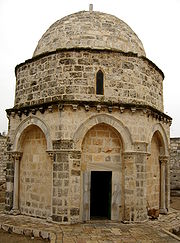
The Chapel of the Ascension
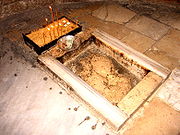
in Jerusalem today is a Christian and Muslim holy site now believed to mark the place where Jesus ascended into heaven. In the small round church/mosque is a stone imprinted with what some claim to be the very footprints of Jesus.
Around the year 390 a wealthy Roman
woman named Poimenia financed construction of the original church
called "Eleona Basilica" (elaion in Greek means "olive garden", from elaia "olive tree," and has an oft-mentioned similarity to eleos meaning "mercy"). This church was destroyed by Sassanid Persians
in 614. It was subsequently rebuilt, destroyed, and rebuilt again by the Crusaders
. This final church was later also destroyed by Muslims, leaving only a 12x12 meter octagonal structure (called a martyrium—"memorial"—or "Edicule") that remains to this day. The site was ultimately acquired by two emissaries of Saladin
in the year 1198 and has remained in the possession of the Islamic Waqf
of Jerusalem ever since. The Russian Orthodox Church
also maintains a Convent
of the Ascension on the top of the Mount of Olives.
and Oriental Orthodox
theology
, the Ascension is interpreted as the culmination of the Mystery
of the Incarnation
, in that it not only marked the completion of Jesus' physical presence among his apostles, but consummated the union of God and man when Jesus ascended in his glorified
human body to sit at the right hand
of God the Father
. The Ascension and the Transfiguration
both figure prominently in the Orthodox doctrine of theosis
. The bodily Ascension into heaven is also understood as the final token of Christ's two natures
: divine and human.
The Orthodox doctrine of salvation
points to the Ascension to indicate that the state of redeemed man is higher than the state of man in Paradise
before the fall.
The Orthodox understand Christ's physical presence to continue in the Church
, which is the "Body of Christ". Jesus' promise that he will be "with you always" is understood not only in terms of his active, divine grace, but also in the divine institution of the church (human sinfulness notwithstanding).
Christ's Ascension into heaven is understood as a necessary prerequisite for the sending of the Holy Spirit
at Pentecost
. The biblical texts regarding the Ascension also prophesy the Second Coming
of Christ, stating that Jesus will return not only in the same glorious manner, but in the same place. In other words, the Second Coming and Last Judgment
will take place on the Mount of Olives, with the Valley of Hinnom (Gehenna
) below and to the left.
(part of the Reformed
tradition in Calvinism
and influential in the Presbyterian church), in Article four of Chapter eight, states: "On the third day He arose from the dead, with the same body in which He suffered, with which also he ascended into heaven, and there sits at the right hand of His Father, making intercession, and shall return, to judge men and angels, at the end of the world."
Article 46 of the Heidelberg Catechism
answers the question What do you confess when you say, He ascended into heaven? by stating "That Christ, before the eyes of His disciples, was taken up from the earth into heaven, and that He is there for our benefit until He comes again to judge the living and the dead."
The Catechism also asks: How does Christ's ascension into heaven benefit us?, replying, "First, He is our Advocate in heaven before His Father. Second, we have our flesh in heaven as a sure pledge that He, our Head, will also take us, His members, up to Himself. Third, He sends us His Spirit [...]"
The Second Helvetic Confession addresses the purpose and character of Christ's ascension in Chapter 11:
considers the New Testament
accounts of Jesus' ascension as inventions of the Christian community in the Apostolic Age
. They describe the Ascension as a convenient device to discredit ongoing appearance claims
within the Christian community.
is one of the great feasts in the Christian liturgical calendar
, and commemorates the bodily Ascension of Jesus into heaven. Ascension Day is traditionally celebrated on a Thursday, the fortieth day from Easter
day. However, some Roman Catholic provinces have moved the observance to the following Sunday. The feast is one of the ecumenical feasts (i.e., universally celebrated), ranking with the feasts of the Passion
, of Easter
, and Pentecost
.
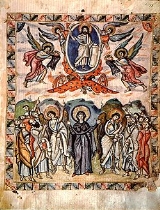
, as well as a theme in theological writings. By the 6th century the iconography of the Ascension had been established and by the 9th century Ascension scenes were being depicted on domes of churches. The Rabbula Gospels (c. 586) include some of the earliest images of the Ascension.
Many ascension scenes have two parts, an upper (Heavenly) part and a lower (earthly) part. The ascending Christ may be carrying a resurrection banner or make a sign of benediction with his right hand. The blessing gesture by Christ with his right hand is directed towards the earthly group below him and signifies that he is blessing the entire Church. In the left hand, he may be holding a Gospel or a scroll, signifying teaching and preaching.
The Eastern Orthodox portrayal of the Ascension is a major metaphor for the mystical nature of the Church. In many Eastern icons the Virgin Mary is placed at the center of the scene in the earthly part of the depiction, with her hands raised towards Heaven, often accompanied by various Apostles. The upwards looking depiction of the earthly group matches the Eastern liturgy on the Feast of the Ascension
: "Come, let us rise and turn our eyes and thoughts high..."
New Testament
The New Testament is the second major division of the Christian biblical canon, the first such division being the much longer Old Testament....
when the resurrected
Resurrection of Jesus
The Christian belief in the resurrection of Jesus states that Jesus returned to bodily life on the third day following his death by crucifixion. It is a key element of Christian faith and theology and part of the Nicene Creed: "On the third day he rose again in fulfillment of the Scriptures"...
Jesus was taken up to heaven in his resurrected body, in the presence of eleven of his apostles, occurring 40 days after the resurrection. In the biblical narrative, an angel
Angel
Angels are mythical beings often depicted as messengers of God in the Hebrew and Christian Bibles along with the Quran. The English word angel is derived from the Greek ἄγγελος, a translation of in the Hebrew Bible ; a similar term, ملائكة , is used in the Qur'an...
tells the watching disciples
Disciple (Christianity)
In Christianity, the disciples were the students of Jesus during his ministry. While Jesus attracted a large following, the term disciple is commonly used to refer specifically to "the Twelve", an inner circle of men whose number perhaps represented the twelve tribes of Israel...
that Jesus' second coming
Second Coming
In Christian doctrine, the Second Coming of Christ, the Second Advent, or the Parousia, is the anticipated return of Jesus Christ from Heaven, where he sits at the Right Hand of God, to Earth. This prophecy is found in the canonical gospels and in most Christian and Islamic eschatologies...
will take place in the same manner as his ascension.
The Ascension of Jesus is professed in the Nicene Creed
Nicene Creed
The Nicene Creed is the creed or profession of faith that is most widely used in Christian liturgy. It is called Nicene because, in its original form, it was adopted in the city of Nicaea by the first ecumenical council, which met there in the year 325.The Nicene Creed has been normative to the...
and in the Apostles' Creed
Apostles' Creed
The Apostles' Creed , sometimes titled Symbol of the Apostles, is an early statement of Christian belief, a creed or "symbol"...
. The Ascension implies Jesus' humanity being taken into heaven. The Feast of the Ascension
Feast of the Ascension
The Solemnity of the Ascension of the Lord is one of the great solemnities, in the Christian liturgical calendar, and commemorates the bodily Ascension of Jesus into heaven. Ascension Day is traditionally celebrated on a Thursday, the fortieth day from Easter day...
, celebrated 40 days after Easter
Easter
Easter is the central feast in the Christian liturgical year. According to the Canonical gospels, Jesus rose from the dead on the third day after his crucifixion. His resurrection is celebrated on Easter Day or Easter Sunday...
, is one of the chief feasts of the Christian year. The feast dates back at least to the later 4th century, as is widely attested.
The account of Jesus ascending bodily into the clouds is given fully only in the Acts of the Apostles
Acts of the Apostles
The Acts of the Apostles , usually referred to simply as Acts, is the fifth book of the New Testament; Acts outlines the history of the Apostolic Age...
, but is briefly described also in the Gospel of Luke
Gospel of Luke
The Gospel According to Luke , commonly shortened to the Gospel of Luke or simply Luke, is the third and longest of the four canonical Gospels. This synoptic gospel is an account of the life and ministry of Jesus of Nazareth. It details his story from the events of his birth to his Ascension.The...
(often considered to be by the same author) at and in the ending of Mark 16
Mark 16
Mark 16 is the final chapter of the Gospel of Mark in the New Testament of the Christian Bible. It begins with the discovery of the empty tomb by Mary Magdalene, Mary the mother of James, and Salome — there they encounter a man dressed in white who announces the Resurrection of Jesus.Verse 8 ends...
at .
Biblical accounts
- In the Epistle to the RomansEpistle to the RomansThe Epistle of Paul to the Romans, often shortened to Romans, is the sixth book in the New Testament. Biblical scholars agree that it was composed by the Apostle Paul to explain that Salvation is offered through the Gospel of Jesus Christ...
(c. 56-57), Paul of TarsusPaul of TarsusPaul the Apostle , also known as Saul of Tarsus, is described in the Christian New Testament as one of the most influential early Christian missionaries, with the writings ascribed to him by the church forming a considerable portion of the New Testament...
describes ChristChristChrist is the English term for the Greek meaning "the anointed one". It is a translation of the Hebrew , usually transliterated into English as Messiah or Mashiach...
as in heaven and as having descended into the abyssHarrowing of HellThe Harrowing of Hell is a doctrine in Christian theology referenced in the Apostles' Creed and the Athanasian Creed that states that Jesus Christ "descended into Hell"...
─the earliest Christian reference to Jesus in heaven. The fuller account of the Ascension, the earliest account, according to the two-source hypothesisTwo-source hypothesisThe Two-Source Hypothesis is an explanation for the synoptic problem, the pattern of similarities and differences between the three Gospels of Matthew, Mark, and Luke. It posits that the Gospel of Matthew and the Gospel of Luke were based on the Gospel of Mark and a lost, hypothetical sayings...
, is in Acts of the ApostlesActs of the ApostlesThe Acts of the Apostles , usually referred to simply as Acts, is the fifth book of the New Testament; Acts outlines the history of the Apostolic Age...
where Jesus is taken up bodily into heaven forty days after his resurrection as witnessed by his apostles, after giving the Great CommissionGreat CommissionThe Great Commission, in Christian tradition, is the instruction of the resurrected Jesus Christ to his disciples, that they spread his teachings to all the nations of the world. It has become a tenet in Christian theology emphasizing missionary work, evangelism, and baptism...
with a prophecy to returnSecond ComingIn Christian doctrine, the Second Coming of Christ, the Second Advent, or the Parousia, is the anticipated return of Jesus Christ from Heaven, where he sits at the Right Hand of God, to Earth. This prophecy is found in the canonical gospels and in most Christian and Islamic eschatologies...
. - In the Gospel of LukeGospel of LukeThe Gospel According to Luke , commonly shortened to the Gospel of Luke or simply Luke, is the third and longest of the four canonical Gospels. This synoptic gospel is an account of the life and ministry of Jesus of Nazareth. It details his story from the events of his birth to his Ascension.The...
, there is no time marker to say when the Ascension took place. Some read the text of Luke literally and take the final four verses of the last chapter as if events were contiguous on the same day─i.e., the Ascension taking place on Easter Sunday evening. Others hold the Ascension took place 40 days after the Resurrection based on . - The Gospel of JohnGospel of JohnThe Gospel According to John , commonly referred to as the Gospel of John or simply John, and often referred to in New Testament scholarship as the Fourth Gospel, is an account of the public ministry of Jesus...
(c. 90-100) refers to Jesus returning to the Father. Some interpret 'Receive the Spirit' of as a possibly meaning that Jesus was then already ascended and glorified on the late Sunday of resurrection. - In the First Epistle of PeterFirst Epistle of PeterThe First Epistle of Peter, usually referred to simply as First Peter and often written 1 Peter, is a book of the New Testament. The author claims to be Saint Peter the apostle, and the epistle was traditionally held to have been written during his time as bishop of Rome or Bishop of Antioch,...
(c. 90-110), Jesus has ascended to heaven and is at God's right side. The Epistle to the EphesiansEpistle to the EphesiansThe Epistle of Paul to the Ephesians, often shortened to Ephesians, is the tenth book of the New Testament. Its authorship has traditionally been credited to Paul, but it is considered by some scholars to be "deutero-Pauline," that is, written in Paul's name by a later author strongly influenced by...
(c. 90-100) refers to Jesus ascending higher than all the heavens. - The First Epistle to TimothyFirst Epistle to TimothyThe First Epistle of Paul to Timothy, usually referred to simply as First Timothy and often written 1 Timothy, is one of three letters in the New Testament of the Bible often grouped together as the Pastoral Epistles, the others being Second Timothy and Titus...
(c. 90-140) describes Jesus as taken up in glory. - The appended ending of Mark includes a summary of Luke's resurrection material and describes Jesus as being taken up into heaven and sitting at God's right handRight Hand of GodThe Right Hand of God or God's Right Hand may refer to the Hand of God often referred to in the Bible and common speech as a metaphor for the omnipotence of God and as a motif in art...
. The imagery of Jesus' Ascension is related to the broader theme of his exaltation and heavenly welcome, derived from the Hebrew BibleHebrew BibleThe Hebrew Bible is a term used by biblical scholars outside of Judaism to refer to the Tanakh , a canonical collection of Jewish texts, and the common textual antecedent of the several canonical editions of the Christian Old Testament...
. The image of Jesus rising bodily into the heavens reflects the ancient view that heaven was above the earth. - One mention of the Ascension found in the Christian BibleBibleThe Bible refers to any one of the collections of the primary religious texts of Judaism and Christianity. There is no common version of the Bible, as the individual books , their contents and their order vary among denominations...
is in the Gospel of Mark—but see article on Mark 16Mark 16Mark 16 is the final chapter of the Gospel of Mark in the New Testament of the Christian Bible. It begins with the discovery of the empty tomb by Mary Magdalene, Mary the mother of James, and Salome — there they encounter a man dressed in white who announces the Resurrection of Jesus.Verse 8 ends...
. In one segment of the account, JesusJesusJesus of Nazareth , commonly referred to as Jesus Christ or simply as Jesus or Christ, is the central figure of Christianity...
and the remaining eleven apostles are seated at a table. The passage summarizes a number of teachings attributed to Jesus: they are to spread the GospelGospelA gospel is an account, often written, that describes the life of Jesus of Nazareth. In a more general sense the term "gospel" may refer to the good news message of the New Testament. It is primarily used in reference to the four canonical gospels of Matthew, Mark, Luke, and John...
(see also Great CommissionGreat CommissionThe Great Commission, in Christian tradition, is the instruction of the resurrected Jesus Christ to his disciples, that they spread his teachings to all the nations of the world. It has become a tenet in Christian theology emphasizing missionary work, evangelism, and baptism...
) and those who believe will be known by their ability to handle venomous snakesSnake handlingSnake handling or serpent handling is a religious ritual in a small number of Pentecostal churches in the U.S., usually characterized as rural and Holiness. The practice began in the early 20th century in Appalachia, spreading to mostly coal mining towns. The practice plays only a small part of...
without ill effects, to heal the sickFaith healingFaith healing is healing through spiritual means. The healing of a person is brought about by religious faith through prayer and/or rituals that, according to adherents, stimulate a divine presence and power toward correcting disease and disability. Belief in divine intervention in illness or...
, to cast out demonsExorcismExorcism is the religious practice of evicting demons or other spiritual entities from a person or place which they are believed to have possessed...
, to speak in "new tongues,"GlossolaliaGlossolalia or speaking in tongues is the fluid vocalizing of speech-like syllables, often as part of religious practice. The significance of glossolalia has varied with time and place, with some considering it a part of a sacred language...
and the like. The next segment in the most common, later ordering of the account states that after teaching these things, Jesus was received into heavenHeavenHeaven, the Heavens or Seven Heavens, is a common religious cosmological or metaphysical term for the physical or transcendent place from which heavenly beings originate, are enthroned or inhabit...
to sit at the right hand of GodRight Hand of GodThe Right Hand of God or God's Right Hand may refer to the Hand of God often referred to in the Bible and common speech as a metaphor for the omnipotence of God and as a motif in art...
. No description of the Ascension itself is given; Mark simply states that it happened. This traditional but possibly non-canonical ending of Mark is considered a summary of Luke's resurrection appearances, commission, and ascension, plus miracles from the apostolic tradition. - The Gospel of Luke is even more brief in its description. Jesus led the eleven to Bethany, not far from JerusalemJerusalem in ChristianityFor Christians, Jerusalem's place in the ministry of Jesus and the Apostolic Age gives it great importance, in addition to its place in the Old Testament, the Hebrew Bible.-Jerusalem in the New Testament and early Christianity:...
. While in the act of blessing them, Jesus was carried up to heaven. Since Luke was once the first part of Luke-ActsLuke-ActsLuke-Acts is the name usually given by Biblical scholars to the hypothetical composite work of the Gospel of Luke and the Acts of the Apostles in the New Testament. Together they describe the Ministry of Jesus and the subsequent lives of the Apostles and the Apostolic Age.Both the books of Luke and...
, scholars surmise that this Ascension, less detailed than that in , is from a different hand, perhaps created when Luke-ActsLuke-ActsLuke-Acts is the name usually given by Biblical scholars to the hypothetical composite work of the Gospel of Luke and the Acts of the Apostles in the New Testament. Together they describe the Ministry of Jesus and the subsequent lives of the Apostles and the Apostolic Age.Both the books of Luke and...
was divided into Luke and Acts. - The Acts of the Apostles reports that for forty days after the Resurrection, Jesus continued to teach His followers. Jesus and the eleven were gathered near Mount Olivet, to the northeast of Bethany. Jesus tells His apostles that they will receive the power of the Holy SpiritHoly SpiritHoly Spirit is a term introduced in English translations of the Hebrew Bible, but understood differently in the main Abrahamic religions.While the general concept of a "Spirit" that permeates the cosmos has been used in various religions Holy Spirit is a term introduced in English translations of...
, the "Comforter," see also ParacleteParacleteParaclete means advocate or helper. In Christianity, the term most commonly refers to the Holy Spirit.-Etymology:...
, and that they will spread His message the world over, i.e., the Great CommissionGreat CommissionThe Great Commission, in Christian tradition, is the instruction of the resurrected Jesus Christ to his disciples, that they spread his teachings to all the nations of the world. It has become a tenet in Christian theology emphasizing missionary work, evangelism, and baptism...
. Jesus is taken up and received by a cloud. Two men clothed in white (i.e., angels, see also Two witnessesTwo WitnessesThe two witnesses are two of God's prophets who are seen in a vision by John of Patmos, who appear during the Second woe in the Book of Revelation 11:1-14....
) appear and tell the apostles that Jesus will returnSecond ComingIn Christian doctrine, the Second Coming of Christ, the Second Advent, or the Parousia, is the anticipated return of Jesus Christ from Heaven, where he sits at the Right Hand of God, to Earth. This prophecy is found in the canonical gospels and in most Christian and Islamic eschatologies...
in the same manner as he was taken.
The original Gospel of Luke and the Acts were both written by the same author and were thus very unlikely to contain such discrepancies in their original form.
Not only is the Ascension related in the passages of Scripture cited above, but it is also elsewhere predicted and spoken of as an established fact. Thus, Christ asks the Jews: "What if then you shall see the Son of Man
Son of man
The phrase son of man is a primarily Semitic idiom that originated in Ancient Mesopotamia, used to denote humanity or self. The phrase is also used in Judaism and Christianity. The phrase used in the Greek, translated as Son of man is ὁ υἱὸς τοὺ ἀνθρώπου...
ascend up where He was before?" and to Mary Magdalene
Mary Magdalene
Mary Magdalene was one of Jesus' most celebrated disciples, and the most important woman disciple in the movement of Jesus. Jesus cleansed her of "seven demons", conventionally interpreted as referring to complex illnesses...
Jesus said, "Do not hold on to Me, for I have not yet returned to the Father. Go instead to my brothers and tell them, 'I am returning to my Father and your Father, to My God and your God.' " In Acts, Ephesians, and 1 Timothy the Ascension of Christ is spoken of as an accepted fact, while Hebrews describes Jesus as seated in heaven
Session of Christ
The Christian doctrine of the Session of Christ or heavenly session says that Jesus Christ is seated at the right hand of God the Father in Heaven—the word "session" is an archaic noun meaning "sitting." Although the word formerly meant "the act of sitting down," it no longer has that meaning in...
.
The Gospel of Matthew
Gospel of Matthew
The Gospel According to Matthew is one of the four canonical gospels, one of the three synoptic gospels, and the first book of the New Testament. It tells of the life, ministry, death, and resurrection of Jesus of Nazareth...
ends at a mountain in Galilee
Galilee
Galilee , is a large region in northern Israel which overlaps with much of the administrative North District of the country. Traditionally divided into Upper Galilee , Lower Galilee , and Western Galilee , extending from Dan to the north, at the base of Mount Hermon, along Mount Lebanon to the...
with Jesus commanding the Disciples to spread the Gospel to the ends of the world, baptizing
Baptism
In Christianity, baptism is for the majority the rite of admission , almost invariably with the use of water, into the Christian Church generally and also membership of a particular church tradition...
in the name of the Father, the Son, and the Holy Spirit
Trinity
The Christian doctrine of the Trinity defines God as three divine persons : the Father, the Son , and the Holy Spirit. The three persons are distinct yet coexist in unity, and are co-equal, co-eternal and consubstantial . Put another way, the three persons of the Trinity are of one being...
(the "Great Commission
Great Commission
The Great Commission, in Christian tradition, is the instruction of the resurrected Jesus Christ to his disciples, that they spread his teachings to all the nations of the world. It has become a tenet in Christian theology emphasizing missionary work, evangelism, and baptism...
"). No mention is made there of the Ascension.
The Catholic and Eastern Orthodox traditional view is that Mary
Mary (mother of Jesus)
Mary , commonly referred to as "Saint Mary", "Mother Mary", the "Virgin Mary", the "Blessed Virgin Mary", or "Mary, Mother of God", was a Jewish woman of Nazareth in Galilee...
was also present at the Ascension, following her mention in .
Location
Shabbat
Shabbat is the seventh day of the Jewish week and a day of rest in Judaism. Shabbat is observed from a few minutes before sunset on Friday evening until a few minutes after when one would expect to be able to see three stars in the sky on Saturday night. The exact times, therefore, differ from...
day's journey. Tradition has consecrated this site as the Mount of Ascension.
Before the conversion of Constantine in 312 AD, early Christians honored the Ascension of Christ in a cave on the Mount of Olives. By 384, the place of the Ascension was venerated on the present open site, uphill from the cave.
The Chapel of the Ascension
Chapel of the Ascension (Jerusalem)
The Chapel of the Ascension is a shrine located on the Mount of Olives, in the at-Tur district of Jerusalem. Part of a larger complex consisting first of a Christian church and monastery, then an Islamic mosque, it is located on a site the faithful traditionally believe to be the earthly spot...
in Jerusalem today is a Christian and Muslim holy site now believed to mark the place where Jesus ascended into heaven. In the small round church/mosque is a stone imprinted with what some claim to be the very footprints of Jesus.
Around the year 390 a wealthy Roman
Roman Empire
The Roman Empire was the post-Republican period of the ancient Roman civilization, characterised by an autocratic form of government and large territorial holdings in Europe and around the Mediterranean....
woman named Poimenia financed construction of the original church
Church
In the Christian religion, a church building is a building or structure whose primary purpose is to facilitate the meeting of a church. Originally, Jewish Christians met in synagogues, such as the Cenacle, and in one another's homes, known as house churches...
called "Eleona Basilica" (elaion in Greek means "olive garden", from elaia "olive tree," and has an oft-mentioned similarity to eleos meaning "mercy"). This church was destroyed by Sassanid Persians
Sassanid Empire
The Sassanid Empire , known to its inhabitants as Ērānshahr and Ērān in Middle Persian and resulting in the New Persian terms Iranshahr and Iran , was the last pre-Islamic Persian Empire, ruled by the Sasanian Dynasty from 224 to 651...
in 614. It was subsequently rebuilt, destroyed, and rebuilt again by the Crusaders
Crusaders
The Crusaders are a New Zealand professional rugby union team based in Christchurch that competes in the Super Rugby competition. They are the most successful team in Super Rugby history with seven titles...
. This final church was later also destroyed by Muslims, leaving only a 12x12 meter octagonal structure (called a martyrium—"memorial"—or "Edicule") that remains to this day. The site was ultimately acquired by two emissaries of Saladin
Saladin
Ṣalāḥ ad-Dīn Yūsuf ibn Ayyūb , better known in the Western world as Saladin, was an Arabized Kurdish Muslim, who became the first Sultan of Egypt and Syria, and founded the Ayyubid dynasty. He led Muslim and Arab opposition to the Franks and other European Crusaders in the Levant...
in the year 1198 and has remained in the possession of the Islamic Waqf
Waqf
A waqf also spelled wakf formally known as wakf-alal-aulad is an inalienable religious endowment in Islamic law, typically denoting a building or plot of land for Muslim religious or charitable purposes. The donated assets are held by a charitable trust...
of Jerusalem ever since. The Russian Orthodox Church
Russian Orthodox Church
The Russian Orthodox Church or, alternatively, the Moscow Patriarchate The ROC is often said to be the largest of the Eastern Orthodox churches in the world; including all the autocephalous churches under its umbrella, its adherents number over 150 million worldwide—about half of the 300 million...
also maintains a Convent
Convent
A convent is either a community of priests, religious brothers, religious sisters, or nuns, or the building used by the community, particularly in the Roman Catholic Church and in the Anglican Communion...
of the Ascension on the top of the Mount of Olives.
Eastern and Oriental Christianity
In Eastern OrthodoxEastern Orthodox Church
The Orthodox Church, officially called the Orthodox Catholic Church and commonly referred to as the Eastern Orthodox Church, is the second largest Christian denomination in the world, with an estimated 300 million adherents mainly in the countries of Belarus, Bulgaria, Cyprus, Georgia, Greece,...
and Oriental Orthodox
Oriental Orthodoxy
Oriental Orthodoxy is the faith of those Eastern Christian Churches that recognize only three ecumenical councils — the First Council of Nicaea, the First Council of Constantinople and the First Council of Ephesus. They rejected the dogmatic definitions of the Council of Chalcedon...
theology
Theology
Theology is the systematic and rational study of religion and its influences and of the nature of religious truths, or the learned profession acquired by completing specialized training in religious studies, usually at a university or school of divinity or seminary.-Definition:Augustine of Hippo...
, the Ascension is interpreted as the culmination of the Mystery
Sacred Mysteries
The term sacred mysteries generally denotes the area of supernatural phenomena associated with a divinity or a religious ideology.-Pre-Christian religious mysteries:...
of the Incarnation
Incarnation (Christianity)
The Incarnation in traditional Christianity is the belief that Jesus Christ the second person of the Trinity, also known as God the Son or the Logos , "became flesh" by being conceived in the womb of a woman, the Virgin Mary, also known as the Theotokos .The Incarnation is a fundamental theological...
, in that it not only marked the completion of Jesus' physical presence among his apostles, but consummated the union of God and man when Jesus ascended in his glorified
Glory (religion)
Glory is used to denote the manifestation of God's presence in the Judeo-Christian religious tradition. God's glory is often associated with visible displays of light, e.g. thunderbolts, fire, brightness....
human body to sit at the right hand
Session of Christ
The Christian doctrine of the Session of Christ or heavenly session says that Jesus Christ is seated at the right hand of God the Father in Heaven—the word "session" is an archaic noun meaning "sitting." Although the word formerly meant "the act of sitting down," it no longer has that meaning in...
of God the Father
God the Father
God the Father is a gendered title given to God in many monotheistic religions, particularly patriarchal, Abrahamic ones. In Judaism, God is called Father because he is the creator, life-giver, law-giver, and protector...
. The Ascension and the Transfiguration
Transfiguration of Jesus
The Transfiguration of Jesus is an event reported in the New Testament in which Jesus is transfigured and becomes radiant upon a mountain. The Synoptic Gospels describe it, and 2 Peter 1:16-18 refers to it....
both figure prominently in the Orthodox doctrine of theosis
Theosis
In Christian theology, divinization, deification, making divine or theosis is the transforming effect of divine grace. This concept of salvation is historical and fundamental for Christian understanding that is prominent in the Eastern Orthodox Church and also in the Catholic Church, and is a...
. The bodily Ascension into heaven is also understood as the final token of Christ's two natures
Hypostatic union
Hypostatic union is a technical term in Christian theology employed in mainstream Christology to describe the union of Christ's humanity and divinity in one hypostasis.The First Council of Ephesus recognised this doctrine and affirmed its importance, stating that the...
: divine and human.
The Orthodox doctrine of salvation
Salvation
Within religion salvation is the phenomenon of being saved from the undesirable condition of bondage or suffering experienced by the psyche or soul that has arisen as a result of unskillful or immoral actions generically referred to as sins. Salvation may also be called "deliverance" or...
points to the Ascension to indicate that the state of redeemed man is higher than the state of man in Paradise
Paradise
Paradise is a place in which existence is positive, harmonious and timeless. It is conceptually a counter-image of the miseries of human civilization, and in paradise there is only peace, prosperity, and happiness. Paradise is a place of contentment, but it is not necessarily a land of luxury and...
before the fall.
The Orthodox understand Christ's physical presence to continue in the Church
Christian Church
The Christian Church is the assembly or association of followers of Jesus Christ. The Greek term ἐκκλησία that in its appearances in the New Testament is usually translated as "church" basically means "assembly"...
, which is the "Body of Christ". Jesus' promise that he will be "with you always" is understood not only in terms of his active, divine grace, but also in the divine institution of the church (human sinfulness notwithstanding).
Christ's Ascension into heaven is understood as a necessary prerequisite for the sending of the Holy Spirit
Holy Spirit
Holy Spirit is a term introduced in English translations of the Hebrew Bible, but understood differently in the main Abrahamic religions.While the general concept of a "Spirit" that permeates the cosmos has been used in various religions Holy Spirit is a term introduced in English translations of...
at Pentecost
Pentecost
Pentecost is a prominent feast in the calendar of Ancient Israel celebrating the giving of the Law on Sinai, and also later in the Christian liturgical year commemorating the descent of the Holy Spirit upon the disciples of Christ after the Resurrection of Jesus...
. The biblical texts regarding the Ascension also prophesy the Second Coming
Second Coming
In Christian doctrine, the Second Coming of Christ, the Second Advent, or the Parousia, is the anticipated return of Jesus Christ from Heaven, where he sits at the Right Hand of God, to Earth. This prophecy is found in the canonical gospels and in most Christian and Islamic eschatologies...
of Christ, stating that Jesus will return not only in the same glorious manner, but in the same place. In other words, the Second Coming and Last Judgment
Last Judgment
The Last Judgment, Final Judgment, Day of Judgment, Judgment Day, or The Day of the Lord in Christian theology, is the final and eternal judgment by God of every nation. The concept is found in all the Canonical gospels, particularly the Gospel of Matthew. It will purportedly take place after the...
will take place on the Mount of Olives, with the Valley of Hinnom (Gehenna
Gehenna
Gehenna , Gehinnom and Yiddish Gehinnam, are terms derived from a place outside ancient Jerusalem known in the Hebrew Bible as the Valley of the Son of Hinnom ; one of the two principal valleys surrounding the Old City.In the Hebrew Bible, the site was initially where apostate Israelites and...
) below and to the left.
Reformed tradition in Protestantism
The Westminster Confession of FaithWestminster Confession of Faith
The Westminster Confession of Faith is a Reformed confession of faith, in the Calvinist theological tradition. Although drawn up by the 1646 Westminster Assembly, largely of the Church of England, it became and remains the 'subordinate standard' of doctrine in the Church of Scotland, and has been...
(part of the Reformed
Reformed churches
The Reformed churches are a group of Protestant denominations characterized by Calvinist doctrines. They are descended from the Swiss Reformation inaugurated by Huldrych Zwingli but developed more coherently by Martin Bucer, Heinrich Bullinger and especially John Calvin...
tradition in Calvinism
Calvinism
Calvinism is a Protestant theological system and an approach to the Christian life...
and influential in the Presbyterian church), in Article four of Chapter eight, states: "On the third day He arose from the dead, with the same body in which He suffered, with which also he ascended into heaven, and there sits at the right hand of His Father, making intercession, and shall return, to judge men and angels, at the end of the world."
Article 46 of the Heidelberg Catechism
Heidelberg Catechism
The Heidelberg Catechism is a Protestant confessional document taking the form of a series of questions and answers, for use in teaching Reformed Christian doctrine...
answers the question What do you confess when you say, He ascended into heaven? by stating "That Christ, before the eyes of His disciples, was taken up from the earth into heaven, and that He is there for our benefit until He comes again to judge the living and the dead."
The Catechism also asks: How does Christ's ascension into heaven benefit us?, replying, "First, He is our Advocate in heaven before His Father. Second, we have our flesh in heaven as a sure pledge that He, our Head, will also take us, His members, up to Himself. Third, He sends us His Spirit [...]"
The Second Helvetic Confession addresses the purpose and character of Christ's ascension in Chapter 11:
- Christ Is Truly Ascended Into Heaven. We believe that our Lord Jesus Christ, in his same flesh, ascended above all visible heavens into the highest heaven, that is, the dwelling-place of God and the blessed ones, at the right hand of God the Father. Although it signifies an equal participation in glory and majesty, it is also taken to be a certain place about which the Lord, speaking in the Gospel, says: 'I go to prepare a place for you' (John 14:2). The apostle Peter also says: 'Heaven must receive Christ until the time of restoring all things' (Acts 3:21).
Critical analysis
The Jesus SeminarJesus Seminar
The Jesus Seminar is a group of about 150 critical scholars and laymen founded in 1985 by Robert Funk under the auspices of the Westar Institute....
considers the New Testament
New Testament
The New Testament is the second major division of the Christian biblical canon, the first such division being the much longer Old Testament....
accounts of Jesus' ascension as inventions of the Christian community in the Apostolic Age
Apostolic Age
The Apostolic Age of the history of Christianity is traditionally the period of the Twelve Apostles, dating from the Crucifixion of Jesus and the Great Commission in Jerusalem until the death of John the Apostle in Anatolia...
. They describe the Ascension as a convenient device to discredit ongoing appearance claims
Resurrection appearances of Jesus
The major Resurrection appearances of Jesus in the Canonical gospels are reported to have occurred after his death, burial and resurrection, but prior to his Ascension. Among these primary sources, most scholars believe First Corinthians was written first, authored by Paul of Tarsus along with...
within the Christian community.
Feast
The Feast of the AscensionFeast of the Ascension
The Solemnity of the Ascension of the Lord is one of the great solemnities, in the Christian liturgical calendar, and commemorates the bodily Ascension of Jesus into heaven. Ascension Day is traditionally celebrated on a Thursday, the fortieth day from Easter day...
is one of the great feasts in the Christian liturgical calendar
Liturgical year
The liturgical year, also known as the church year, consists of the cycle of liturgical seasons in Christian churches which determines when feast days, including celebrations of saints, are to be observed, and which portions of Scripture are to be read. Distinct liturgical colours may appear in...
, and commemorates the bodily Ascension of Jesus into heaven. Ascension Day is traditionally celebrated on a Thursday, the fortieth day from Easter
Easter
Easter is the central feast in the Christian liturgical year. According to the Canonical gospels, Jesus rose from the dead on the third day after his crucifixion. His resurrection is celebrated on Easter Day or Easter Sunday...
day. However, some Roman Catholic provinces have moved the observance to the following Sunday. The feast is one of the ecumenical feasts (i.e., universally celebrated), ranking with the feasts of the Passion
Passion (Christianity)
The Passion is the Christian theological term used for the events and suffering – physical, spiritual, and mental – of Jesus in the hours before and including his trial and execution by crucifixion...
, of Easter
Easter
Easter is the central feast in the Christian liturgical year. According to the Canonical gospels, Jesus rose from the dead on the third day after his crucifixion. His resurrection is celebrated on Easter Day or Easter Sunday...
, and Pentecost
Pentecost
Pentecost is a prominent feast in the calendar of Ancient Israel celebrating the giving of the Law on Sinai, and also later in the Christian liturgical year commemorating the descent of the Holy Spirit upon the disciples of Christ after the Resurrection of Jesus...
.
Artistic depictions
The Ascension has been a frequent subject in Christian artChristian art
Christian art is sacred art produced in an attempt to illustrate, supplement and portray in tangible form the principles of Christianity, though other definitions are possible. Most Christian groups use or have used art to some extent, although some have had strong objections to some forms of...
, as well as a theme in theological writings. By the 6th century the iconography of the Ascension had been established and by the 9th century Ascension scenes were being depicted on domes of churches. The Rabbula Gospels (c. 586) include some of the earliest images of the Ascension.
Many ascension scenes have two parts, an upper (Heavenly) part and a lower (earthly) part. The ascending Christ may be carrying a resurrection banner or make a sign of benediction with his right hand. The blessing gesture by Christ with his right hand is directed towards the earthly group below him and signifies that he is blessing the entire Church. In the left hand, he may be holding a Gospel or a scroll, signifying teaching and preaching.
The Eastern Orthodox portrayal of the Ascension is a major metaphor for the mystical nature of the Church. In many Eastern icons the Virgin Mary is placed at the center of the scene in the earthly part of the depiction, with her hands raised towards Heaven, often accompanied by various Apostles. The upwards looking depiction of the earthly group matches the Eastern liturgy on the Feast of the Ascension
Feast of the Ascension
The Solemnity of the Ascension of the Lord is one of the great solemnities, in the Christian liturgical calendar, and commemorates the bodily Ascension of Jesus into heaven. Ascension Day is traditionally celebrated on a Thursday, the fortieth day from Easter day...
: "Come, let us rise and turn our eyes and thoughts high..."
See also
- Assumption of MaryAssumption of MaryAccording to the belief of Christians of the Roman Catholic Church, Eastern Orthodoxy, Oriental Orthodoxy, and parts of the Anglican Communion and Continuing Anglicanism, the Assumption of Mary was the bodily taking up of the Virgin Mary into Heaven at the end of her life...
- Chronology of JesusChronology of JesusThe chronology of Jesus aims to establish a historical order for some of the events of the life of Jesus in the four canonical gospels. The Christian gospels were primarily written as theological documents rather than historical chronicles and their authors showed little interest in an absolute...
- Church of the AscensionChurch of the Ascension-England:*The Ascension, Lavender Hill*Church of the Ascension, Hall Green*Church of the Ascension, Hulme-Israel:*Chapel of the Ascension , claimed to the early tradition...
- Feast of the AscensionFeast of the AscensionThe Solemnity of the Ascension of the Lord is one of the great solemnities, in the Christian liturgical calendar, and commemorates the bodily Ascension of Jesus into heaven. Ascension Day is traditionally celebrated on a Thursday, the fortieth day from Easter day...
- Two witnessesTwo WitnessesThe two witnesses are two of God's prophets who are seen in a vision by John of Patmos, who appear during the Second woe in the Book of Revelation 11:1-14....
External links
- Ascension of Jesus Christ
- Catholic Encyclopedia: Ascension
- The Ascension of our Lord Orthodox IconIconAn icon is a religious work of art, most commonly a painting, from Eastern Christianity and in certain Eastern Catholic churches...
and Synaxarion - The Ascension of the Lord S. V. Bulgakov, Manual for Church Servers (theology and symbolism of the Feast)
- The Chapel of the Ascension Studium Biblicum Franciscanum, Jerusalem
- Chapel of the Ascension, Jerusalem Detailed description, history and photos
- Convent of the Ascension Jerusalem Mission, Russian Orthodox Church