
| |
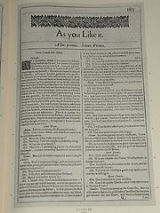
As You Like It is a pastoral comedy by William Shakespeare believed to have been written in 1599 or early 1600 and first published in the folio of 1623. The work was based upon the novel Rosalynde by Thomas Lodge. The play's first performance is uncertain, though a performance at Wilton House in 1603 has been suggested as a possibility. As You Like It follows its heroine Rosalind as she flees persecution in her uncle's court to find safety and eventually love in the Forest of Arden.

Discussion
Ask a question about 'As You Like It'
Start a new discussion about 'As You Like It'
Answer questions from other users
|
Quotations
Blow, blow, thou winter wind,Thou art not so unkindAs man's ingratitude.
Amiens, scene vii
Hereafter, in a better world than this,I shall desire more love and knowledge of you.
Le Beau scene iii
I am ambitious for a motley coat.
Jaques, scene vii
If thou rememberst not the slightest follyThat ever love did make thee run into,Thou hast not lovd.
Silvius, scene iv
Live a little; comfort a little; cheer thyself a little.
Orlando, scene vi
The fool doth think he is wise, but the wise man knows himself to be a fool.
Touchstone, scene i

Encyclopedia
As You Like It is a pastoral comedy by William Shakespeare believed to have been written in 1599 or early 1600 and first published in the folio of 1623. The work was based upon the novel Rosalynde by Thomas Lodge. The play's first performance is uncertain, though a performance at Wilton House in 1603 has been suggested as a possibility. As You Like It follows its heroine Rosalind as she flees persecution in her uncle's court to find safety and eventually love in the Forest of Arden. Historically, critical response has varied, with some critics finding the work of lesser quality than other Shakespearean works and some finding the play a work of great merit. The play features one of Shakespeare's most famous and oft-quoted soliloquies, "All the world's a stage" and the phrase "too much of a good thing." The play remains a favorite among audiences and has been adapted for radio, film, and musical theatre.
Date and text
The play was entered into the Register of the Stationers Company on August 4, 1600; but it was not printed until its inclusion in the First Folio in 1623.
Performance
There is no certain record of any performance before the Restoration. There is one possible performance, however, at Wilton House in Wiltshire, the country seat of the Earls of Pembroke. William Herbert, 3rd Earl of Pembroke hosted James I and his Court at Wilton House from October to December 1603, while Jacobean London was suffering an epidemic of bubonic plague. The King's Men were paid £30 to come to Wilton House and perform for the King and Court on December 2, 1603. A Herbert family tradition holds that the play acted that night was As You Like It.
During the English Restoration, the King's Company was assigned the play by royal warrant in 1669. It is known to have been acted at Drury Lane in 1723, in an adapted form called Love in a Forest; Colley Cibber played Jaques. Another Drury Lane production seventeen years later returned to the Shakespearean text (1740).
Notable recent productions of As You Like It include the 1936 Old Vic Theatre production starring Edith Evans and the 1961 Shakespeare Memorial Theatre production starring Vanessa Redgrave. The longest running Broadway production starred Katharine Hepburn as Rosalind, Cloris Leachman as Celia, William Prince as Orlando, and Ernest Thesiger as Jacques, and was directed by Michael Benthall. It ran for 145 performances in 1950. Another notable production was at the 2005 Stratford Festival in Stratford, Ontario, which was set in the 1960s and featured Shakespeare's lyrics set to music written by Barenaked Ladies.
Characters
The Court of Duke Frederick:
- Duke Frederick, Duke Senior's younger brother and his usurper, Celia's father
- Rosalind, Duke Senior's daughter
- Celia, Duke Frederick's daughter and Rosalind's cousin
- Touchstone, a court fool
- Le Beau, a courtier
- Charles, a wrestler
The Exiled Court of Duke Senior in the Forest of Arden:
- Duke Senior, Duke Frederick's older brother and Rosalind's father
- Jaques, a discontented, melancholy lord
- Amiens, an attending lord and musician
The Household of the deceased Sir Roland de Boys:
- Oliver, the eldest son and heir
- Jacques, the second son briefly appearing at the end of the play
- Orlando, youngest son
- Adam, a faithful old servant who follows Orlando into exile
- Dennis, Oliver's servant
Country folk in the Forest of Arden:
- Phoebe, a shepherdess
- Silvius, a shepherd
- Audrey, a country girl
- Corin, an elderly shepherd
- William, a country man
- Sir Oliver Martext, a curate
Other characters:
- Lords and ladies in Duke Frederick's court
- Lords in Duke Senior's forest court
- Pages and musicians
- Hymen, a character appearing in a play-within-the-play
Setting
Arden is most likely a toponym for a forest close to Shakespeare's home town of Stratford-upon-Avon. The Oxford Shakespeare edition rationalizes this geographical discrepancy by assuming that 'Arden' is an anglicisation of the forested Ardennes region of Belgium, and alters the spelling to reflect this. Other editions keep Shakespeare's 'Arden' spelling, since it can be argued that the pastoral mode depicts a fantastical world in which geographical details are irrelevant. The Arden edition of Shakespeare makes the suggestion that the name 'Arden' comes from a combination of the classical region of Arcadia and the biblical garden of Eden, as there is a strong interplay of classical and Christian belief systems and philosophies within the play. Furthermore, Shakespeare's mother's name was Mary Arden, and the name of the forest may also be a pun on that.
Synopsis
The play is set in a duchy in France, but most of the action takes place in a location called the 'Forest of Arden.'
Frederick has usurped the Duchy and exiled his older brother, Duke Senior. The Duke's daughter Rosalind has been permitted to remain at court because she is the closest friend and cousin of Frederick's only child, Celia. Orlando, a young gentleman of the kingdom who has fallen in love at first sight of Rosalind, is forced to flee his home after being persecuted by his older brother, Oliver. Frederick becomes angry and banishes Rosalind from court. Celia and Rosalind decide to flee together accompanied by the jester Touchstone, with Rosalind disguised as a young man.
Rosalind, now disguised as Ganymede ("Jove's own page"), and Celia, now disguised as Aliena (Latin for "stranger"), arrive in the Arcadian Forest of Arden, where the exiled Duke now lives with some supporters, including "the melancholy Jaques," who is introduced to us weeping over the slaughter of a deer. "Ganymede" and "Aliena" do not immediately encounter the Duke and his companions, as they meet up with Corin, an impoverished tenant, and offer to buy his master's rude cottage.
Orlando and his servant Adam (a role possibly played by Shakespeare himself, though this story may be apocryphal), meanwhile, find the Duke and his men and are soon living with them and posting simplistic love poems for Rosalind on the trees. Rosalind, also in love with Orlando, meets him as Ganymede and pretends to counsel him to cure him of being in love. Ganymede says he will take Rosalind's place and he and Orlando can act out their relationship.
Meanwhile, the shepherdess Phebe, with whom Silvius is in love, has fallen in love with Ganymede (actually Rosalind), though "Ganymede" continually shows that "he" is not interested in Phebe. The cynical Touchstone has also made an amorous advance on the dull-witted goat-herd girl Audrey, and attempts to marry her before his plans are thwarted by the intrusive Jaques.
Finally, Silvius, Phebe, Ganymede, and Orlando are brought together in an argument with each other over who will get whom. Ganymede says he will solve the problem, having Orlando promise to marry Rosalind, and Phebe promise to marry Silvius if she cannot marry Ganymede. The next day, Ganymede reveals himself to be Rosalind, and since Phebe has found her love to be false, she ends up with Silvius.
Orlando sees Oliver in the forest and rescues him from a lioness, causing Oliver to repent for mistreating Orlando. Oliver meets Aliena (Celia's false identity) and falls in love with her, and they agree to marry. Orlando and Rosalind, Oliver and Celia, Silvius and Phebe, and Touchstone and Audrey all are married in the final scene, after which they discover that Frederick has also repented his faults, deciding to restore his legitimate brother to the dukedom and adopt a religious life. Jaques, ever melancholy, declines their invitation to stay in the forest with them and also decides to adopt a religious life.
Critical response
Scholars have long disagreed about the merits of the play. Critics from Samuel Johnson to George Bernard Shaw have complained that As You Like It is lacking in the high artistry of which Shakespeare was capable. Shaw liked to think that Shakespeare wrote the play as a mere crowdpleaser, and signalled his own middling opinion of the work by calling it As You Like It — as if the playwright did not agree. Tolstoy objected to the immorality of the characters, and Touchstone's constant clowning. Other critics have found great literary value in the work. Harold Bloom has written that Rosalind is among Shakespeare's greatest and most fully realized female characters. Despite critical disputes, the play remains one of Shakespeare's most frequently performed comedies.
The elaborate gender reversals in the story are of particular interest to modern critics interested in gender studies. Through four acts of the play, Rosalind — who in Shakespeare's day would have been played by a boy — finds it necessary to disguise herself as a boy, whereupon the rustic Phebe (also played by a boy), becomes infatuated with this "Ganymede," a name with homoerotic overtones. In fact, the epilogue, spoken by Rosalind to the audience, states rather explicitly that she (or at least the actor playing her) is not a woman.
Themes
Religious Allegory University of Wisconsin professor Richard Knowles, the editor of the 1977 New Variorum edition of this play, described in his article "Myth and Type in As You Like It" how the play contains mythological references in particular to Eden, to Hercules and to Christ. However, he was unable to determine any sustained allegorical meaning and concluded therefore that it could not be an allegorical play. Other scholars, however, have argued that the play indeed contains a consistent allegorical meaning and that this can be translated into production.
Language
Act II, Scene 7, features one of Shakespeare's most famous monologues, which states:
- "All the world's a stage
- And all the men and women merely players;
- They have their exits and their entrances,
- And one man in his time plays many parts,
- His acts being seven ages."
This famous monologue is spoken by Jaques. It contains arresting imagery and figures of speech to develop the central metaphor: a person's lifespan being a play in seven acts. These acts, "seven ages," begin with "the infant/Mewling and puking in the nurse's arms" and work through six further vivid verbal sketches, culminating in "second childishness and mere oblivion,/Sans teeth, sans eyes, sans taste, sans everything."
In the mouth of a skillful actor, the speech is a powerful depiction of common humanity.
As You Like It also features a lot of humorous and clever wordplay (e.g. Jaques's attribution of "").
Pastoral mode
The theme of pastoral comedy is love in all its guises in a rustic setting, the genuine love embodied by Rosalind contrasted with the sentimentalized affectations of Orlando, and the improbable happenings that set the urban courtiers wandering to find exile, solace or freedom in a woodland setting are no more unrealistic than the string of chance encounters in the forest, provoking witty banter, which require no subtleties of plotting and character development. The main action of the first act is no more than a wrestling match, and the action throughout is often interrupted by a song. At the end, Hymen himself arrives to bless the wedding festivities.
William Shakespeare’s play As You Like It clearly falls into the Pastoral Romance genre; but Shakespeare does not merely use the genre, he develops it. Shakespeare also used the Pastoral genre in As You Like It to ‘cast a critical eye on social practices that produce injustice and unhappiness, and to make fun of anti-social, foolish and self-destructive behaviour’, most obviously through the theme of love, culminating in a rejection of the notion of the traditional Petrarchan lovers.
The stock characters in conventional situations were familiar material for Shakespeare and his audience; it is the light repartee and the breadth of the subjects that provide texts for wit that put a fresh stamp on the proceedings. At the centre the optimism of Rosalind is contrasted with the misogynistic melancholy of Jaques. Shakespeare would take up some of the themes more seriously later: the usurper Duke and the Duke in exile provide themes for Measure for Measure and The Tempest.
A play which turns upon chance encounters in the forest and several entangled love affairs, all in a serene pastoral setting has been found, by many directors, to be especially effective staged outdoors in a park or similar site.
Adaptations
Music
In the song Limelight by Rush, released in 1981, Geddy Lee says, "all the world's indeed a stage, and we are merely players," which also references one of their live albums All the World's a Stage.
Donovan Leitch set "Under The Greenwood Tree" to music and recorded it for A Gift from a Flower to a Garden in 1968.
Radio
According to the history of radio station WCAL in the U.S. state of Minnesota, As You Like It may have been the first play ever broadcast. It went over the air in 1922.
Film As You Like It was Laurence Olivier's first Shakespeare film, though he only acted in it, rather than producing and directing. Made in the UK and released in 1936, the film also starred director Paul Czinner's wife Elizabeth Bergner, who played Rosalind with a thick German accent. Although it is much less "Hollywoody" than the 1930s versions of A Midsummer Night's Dream and Romeo and Juliet, and although its cast was made up entirely of Shakespearean actors, it was not considered a success by either Olivier or the critics.
Helen Mirren starred as Rosalind in the 1978 BBC version of As You Like It, directed by Basil Coleman.
In 1992, Christine Edzard made another film adaptation of the play. It features James Fox, Cyril Cusack, Andrew Tiernan, Griff Rhys Jones and Ewen Bremner. The action is transposed to a modern and bleak urban world.
A 19th Century Japan version of As You Like It was released in 2006, directed by Kenneth Branagh. It stars Bryce Dallas Howard, David Oyelowo, Romola Garai, Alfred Molina, Kevin Kline, and Brian Blessed. Although it was actually made for cinemas, it was released to theatres only in Europe, and had its U.S. premiere on HBO in 2007.
Musical Theatre
Daniel Aquisito and Sammy Buck adapted this play into an 80's themed musical entitled "Like You Like It."
Stage
Gwyneth Paltrow and Katherine Moennig both appeared in a stage version of As You Like It in the Williamstown Theatre Festival in 1999.
Graphic Novel
A Manga style graphic novel was released in January 2009, by Self-Made Hero publishers, where the setting of the forest of Arden has been transposed to modern-day China. The story has been adapted by Richard Appignanesi and features the illustrations of Chie Kutsuwada.
Gallery
External links
- - searchable e-text
- - HTML version of this title.
- - plain vanilla text from Project Gutenberg
- - scene-indexed, searchable version of the play
- on Humanscience wikia
- an introduction to the play and to pastoral comedy as a genre
- at Web English Teacher
|