

Artificial membrane

Encyclopedia
An artificial membrane, or synthetic membrane, is a synthetically created membrane which is usually intended for separation purposes in laboratory or in industry. Synthetic membranes have been successfully used for small and large-scale industrial processes since the middle of twentieth century. A wide variety of synthetic membranes is known. They can be produced from organic
materials such as polymers and liquids, as well as inorganic materials. The most of commercially utilized synthetic membranes in separation industry are made of polymeric structures. They can be classified based on their surface chemistry, bulk structure, morphology
, and production method. The chemical and physical properties of synthetic membranes and separated particles as well as a choice of driving force define a particular membrane separation process. The most commonly used driving forces of a membrane process in industry are pressure
and concentration gradients. The respective membrane process is therefore known as filtration
. Synthetic membranes utilized in a separation process can be of different geometry and the respective flow configuration. They can be also categorized based on their application and separation regime. The best known synthetic membrane separation processes include water purification
, reverse osmosis
, dehydrogenation
of natural gas, removal of cell particles by microfiltration
and ultrafiltration
, removal of microorganisms from dairy products, and dialysis
.
or ceramic
, homogeneous films (polymers), heterogeneous solids (polymeric mixes, mixed glasses), and liquids. Ceramic membranes are produced from inorganic materials such as aluminium
oxides, silicon carbide
, and zirconium
oxide. Ceramic membranes are very resistant to the action of aggressive media (acids, strong solvents). They are very stable chemically, thermally, and mechanically, and biologically inert
. Even though ceramic membranes have a high weight and substantial production costs, they are ecologically friendly and have long working life. Ceramic membranes are generally made as monolithic shapes of tubular capillaries.
salts, and hollow-fiber contained liquid membranes. Liquid membranes are being extensively studied but have limited commercial applications.
for separated molecules (as in the case of biotechnology applications), and has to withstand the harsh cleaning conditions. It has to be compatible with chosen membrane fabrication technology. The polymer has to be a suitable membrane former in terms of its chains rigidity, chain interactions, stereoregularity, and polarity
of its functional groups. The polymers can form amorphous and semicrystalline structures (can also have different glass transition
temperatures), affecting the membrane performance characteristics. The polymer has to be obtainable and reasonably priced to comply with the low cost criteria of membrane separation process. Many membrane polymers are grafted, custom-modified, or produced as copolymers to improve their properties. The most common polymers in membrane synthesis are cellulose acetate
, Nitrocellulose
, and cellulose
esters (CA, CN, and CE), polysulfone
(PS), polyether sulfone
(PES), polyacrilonitrile (PAN), polyamide
, polyimide
, polyethylene
and polypropylene
(PE and PP), polytetrafluoroethylene
(PTFE), polyvinylidene fluoride
(PVDF), polyvinylchloride (PVC).
s are made from inorganic materials (such as alumina, titania
, zirconia
oxides or some glassy materials).
By contrast with polymeric membranes, they can used in separations where aggressive media (acids, strong solvents) are present. They also have excellent thermal stability which make them usable in high temperature membrane operations
.
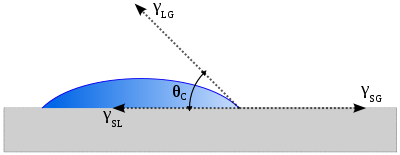 One of the critical characteristics of a synthetic membrane is its chemistry. Synthetic membrane chemistry usually refers to the chemical nature and composition of the surface in contact with a separation process stream. The chemical nature of a membrane’s surface can be quite different from its bulk composition. This difference can result from material partitioning at some stage of the membrane's fabrication, or from an intended surface postformation modification. Membrane surface chemistry creates very important properties such as hydrophilicity or hydrophobicity (related to surface free energy), presence of ionic charge, membrane chemical or thermal resistance, binding affinity
for particles in a solution, and biocompatibility
(in case of bioseparations). Hydrophilicity and hydrophobicity of membrane surfaces can be expressed in terms of water (liquid) contact angle
θ. Hydrophilic membrane surfaces have a contact angle in the range of 0o<θ<90o (closer to 0o), where hydrophobic materials have θ in the range of 90o<θ<180o.
The contact angle is determined by solving the Young’s equation for the interfacial force balance. At equilibrium three interfacial tensions corresponding to solid/gas (γSG), solid/liquid (γSL), and liquid/gas (γLG) interfaces are counterbalanced. The consequence of the contact angle's magnitudes is known as wetting
phenomena, which is important to characterize the capillary
(pore) intrusion behavior. Degree of membrane surface wetting is determined by the contact angle. The surface with smaller contact angle has better wetting properties (θ=0o-perfect wetting). In some cases low surface tension
liquids such as alcohols or surfactant
solutions are used to enhance wetting of non-wetting membrane surfaces. The membrane surface free energy
(and related hydrophilicity/hydrophobicity) influences membrane particle adsorption
or fouling
phenomena. In most membrane separation processes (especially bioseparations), higher surface hydrophilicity corresponds to the lower fouling. Synthetic membrane fouling impairs membrane performance. As a consequence, a wide variety of membrane cleaning techniques have been developed. Sometimes fouling is irreversible
, and the membrane needs to be replaced. Another feature of membrane surface chemistry is surface charge. The presence of the charge changes the properties of the membrane-liquid interface. The membrane surface may develop an electrochemical potential and induce the formation of layers of solution particles which tend to neutralize the charge.
Dense membranes can be synthesized as amorphous or heterogeneous structures. Polymeric dense membranes such as polytetrafluoroethylene
and cellulose
esters are usually fabricated by compression molding
, solvent casting
, and spraying of a polymer solution. The membrane structure of a dense membrane can be in a rubbery or a glassy state at a given temperature depending on its glass transition temperature . Porous membranes are intended on separation of larger molecules such as solid colloidal particles, large biomolecules (proteins, DNA
, RNA
) and cells from the filtering media. Porous membranes find use in the microfiltration
, ultrafiltration
, and dialysis
applications. There is some controversy in defining a “membrane pore”. The most commonly used theory assumes a cylindrical pore for simplicity. This model assumes that pores have the shape of parallel, nonintersecting cylindrical capillaries. But in reality a typical pore is a random network of the unevenly shaped structures of different sizes. The formation of a pore can be induced by the dissolution of a "better" solvent
into a "poorer" solvent in a polymer solution. Other types of pore structure can be produced by stretching of crystalline structure polymers. The structure of porous membrane is related to the characteristics of the interacting polymer and solvent, components concentration, molecular weight, temperature, and storing time in solution. The thicker porous membranes sometimes provide support for the thin dense membrane layers, forming the asymmetric membrane structures. The latter are usually produced by a lamination of dense and porous membranes.
Organic compound
An organic compound is any member of a large class of gaseous, liquid, or solid chemical compounds whose molecules contain carbon. For historical reasons discussed below, a few types of carbon-containing compounds such as carbides, carbonates, simple oxides of carbon, and cyanides, as well as the...
materials such as polymers and liquids, as well as inorganic materials. The most of commercially utilized synthetic membranes in separation industry are made of polymeric structures. They can be classified based on their surface chemistry, bulk structure, morphology
Morphology (biology)
In biology, morphology is a branch of bioscience dealing with the study of the form and structure of organisms and their specific structural features....
, and production method. The chemical and physical properties of synthetic membranes and separated particles as well as a choice of driving force define a particular membrane separation process. The most commonly used driving forces of a membrane process in industry are pressure
Pressure
Pressure is the force per unit area applied in a direction perpendicular to the surface of an object. Gauge pressure is the pressure relative to the local atmospheric or ambient pressure.- Definition :...
and concentration gradients. The respective membrane process is therefore known as filtration
Filtration
Filtration is commonly the mechanical or physical operation which is used for the separation of solids from fluids by interposing a medium through which only the fluid can pass...
. Synthetic membranes utilized in a separation process can be of different geometry and the respective flow configuration. They can be also categorized based on their application and separation regime. The best known synthetic membrane separation processes include water purification
Water purification
Water purification is the process of removing undesirable chemicals, materials, and biological contaminants from contaminated water. The goal is to produce water fit for a specific purpose...
, reverse osmosis
Reverse osmosis
Reverse osmosis is a membrane technical filtration method that removes many types of large molecules and ions from solutions by applying pressure to the solution when it is on one side of a selective membrane. The result is that the solute is retained on the pressurized side of the membrane and...
, dehydrogenation
Dehydrogenation
Dehydrogenation is a chemical reaction that involves the elimination of hydrogen . It is the reverse process of hydrogenation. Dehydrogenation reactions may be either large scale industrial processes or smaller scale laboratory procedures....
of natural gas, removal of cell particles by microfiltration
Microfiltration
Microfiltration is a membrane technical filtration process which removes contaminants from a fluid by passage through a microporous membrane. A typical microfiltration membrane pore size range is 0.1 to 10 micrometres...
and ultrafiltration
Ultrafiltration
Ultrafiltration is a variety of membrane filtration in which hydrostatic pressure forces a liquid against a semipermeable membrane. Suspended solids and solutes of high molecular weight are retained, while water and low molecular weight solutes pass through the membrane...
, removal of microorganisms from dairy products, and dialysis
Dialysis
In medicine, dialysis is a process for removing waste and excess water from the blood, and is primarily used to provide an artificial replacement for lost kidney function in people with renal failure...
.
Membrane types and structure
Synthetic membrane can be fabricated from a large number of different materials. It can be made from organic or inorganic materials including solids such as metalMetal
A metal , is an element, compound, or alloy that is a good conductor of both electricity and heat. Metals are usually malleable and shiny, that is they reflect most of incident light...
or ceramic
Ceramic
A ceramic is an inorganic, nonmetallic solid prepared by the action of heat and subsequent cooling. Ceramic materials may have a crystalline or partly crystalline structure, or may be amorphous...
, homogeneous films (polymers), heterogeneous solids (polymeric mixes, mixed glasses), and liquids. Ceramic membranes are produced from inorganic materials such as aluminium
Aluminium
Aluminium or aluminum is a silvery white member of the boron group of chemical elements. It has the symbol Al, and its atomic number is 13. It is not soluble in water under normal circumstances....
oxides, silicon carbide
Silicon carbide
Silicon carbide , also known as carborundum, is a compound of silicon and carbon with chemical formula SiC. It occurs in nature as the extremely rare mineral moissanite. Silicon carbide powder has been mass-produced since 1893 for use as an abrasive...
, and zirconium
Zirconium
Zirconium is a chemical element with the symbol Zr and atomic number 40. The name of zirconium is taken from the mineral zircon. Its atomic mass is 91.224. It is a lustrous, grey-white, strong transition metal that resembles titanium...
oxide. Ceramic membranes are very resistant to the action of aggressive media (acids, strong solvents). They are very stable chemically, thermally, and mechanically, and biologically inert
Inert
-Chemistry:In chemistry, the term inert is used to describe a substance that is not chemically reactive.The noble gases were previously known as inert gases because of their perceived lack of participation in any chemical reactions...
. Even though ceramic membranes have a high weight and substantial production costs, they are ecologically friendly and have long working life. Ceramic membranes are generally made as monolithic shapes of tubular capillaries.
Liquid membrane
Liquid membrane refers to synthetic membranes made of non-rigid material. Several types of liquid membranes can be encountered in industry: emulsion liquid membranes, immobilized (supported) liquid membranes, moltenMölten
Mölten is a comune in South Tyrol in the Italian region Trentino-Alto Adige/Südtirol, located about 60 km north of Trento and about 12 km northwest of Bolzano .-Geography:...
salts, and hollow-fiber contained liquid membranes. Liquid membranes are being extensively studied but have limited commercial applications.
Polymeric membranes
Polymeric membranes lead the membrane separation industry market because they are very competitive in performance and economics. Many polymers are available, but the choice of membrane polymer is not a trivial task. A polymer has to have appropriate characteristics for the intended application. The polymer sometimes has to offer a low binding affinityChemical affinity
In chemical physics and physical chemistry, chemical affinity is the electronic property by which dissimilar chemical species are capable of forming chemical compounds...
for separated molecules (as in the case of biotechnology applications), and has to withstand the harsh cleaning conditions. It has to be compatible with chosen membrane fabrication technology. The polymer has to be a suitable membrane former in terms of its chains rigidity, chain interactions, stereoregularity, and polarity
Chemical polarity
In chemistry, polarity refers to a separation of electric charge leading to a molecule or its chemical groups having an electric dipole or multipole moment. Polar molecules interact through dipole–dipole intermolecular forces and hydrogen bonds. Molecular polarity is dependent on the difference in...
of its functional groups. The polymers can form amorphous and semicrystalline structures (can also have different glass transition
Glass transition
The liquid-glass transition is the reversible transition in amorphous materials from a hard and relatively brittle state into a molten or rubber-like state. An amorphous solid that exhibits a glass transition is called a glass...
temperatures), affecting the membrane performance characteristics. The polymer has to be obtainable and reasonably priced to comply with the low cost criteria of membrane separation process. Many membrane polymers are grafted, custom-modified, or produced as copolymers to improve their properties. The most common polymers in membrane synthesis are cellulose acetate
Cellulose acetate
Cellulose acetate , first prepared in 1865, is the acetate ester of cellulose. Cellulose acetate is used as a film base in photography, as a component in some adhesives, and as a frame material for eyeglasses; it is also used as a synthetic fiber and in the manufacture of cigarette filters and...
, Nitrocellulose
Nitrocellulose
Nitrocellulose is a highly flammable compound formed by nitrating cellulose through exposure to nitric acid or another powerful nitrating agent. When used as a propellant or low-order explosive, it is also known as guncotton...
, and cellulose
Cellulose
Cellulose is an organic compound with the formula , a polysaccharide consisting of a linear chain of several hundred to over ten thousand β linked D-glucose units....
esters (CA, CN, and CE), polysulfone
Polysulfone
Polysulfone describes a family of thermoplastic polymers. These polymers are known for their toughness and stability at high temperatures. They contain the subunit aryl-SO2-aryl, the defining feature of which is the sulfone group. Polysulfones were introduced in 1965 by Union Carbide...
(PS), polyether sulfone
Sulfone
A sulfone is a chemical compound containing a sulfonyl functional group attached to two carbon atoms. The central hexavalent sulfur atom is double bonded to each of two oxygen atoms and has a single bond to each of two carbon atoms, usually in two separate hydrocarbon substituents.-IUPAC name and...
(PES), polyacrilonitrile (PAN), polyamide
Polyamide
A polyamide is a polymer containing monomers of amides joined by peptide bonds. They can occur both naturally and artificially, examples being proteins, such as wool and silk, and can be made artificially through step-growth polymerization or solid-phase synthesis, examples being nylons, aramids,...
, polyimide
Polyimide
Polyimide is a polymer of imide monomers. The structure of imide is as shown. Polyimides have been in mass production since 1955...
, polyethylene
Polyethylene
Polyethylene or polythene is the most widely used plastic, with an annual production of approximately 80 million metric tons...
and polypropylene
Polypropylene
Polypropylene , also known as polypropene, is a thermoplastic polymer used in a wide variety of applications including packaging, textiles , stationery, plastic parts and reusable containers of various types, laboratory equipment, loudspeakers, automotive components, and polymer banknotes...
(PE and PP), polytetrafluoroethylene
Polytetrafluoroethylene
Polytetrafluoroethylene is a synthetic fluoropolymer of tetrafluoroethylene that finds numerous applications. PTFE is most well known by the DuPont brand name Teflon....
(PTFE), polyvinylidene fluoride
Polyvinylidene fluoride
Polyvinylidene fluoride, or PVDF is a highly non-reactive and pure thermoplastic fluoropolymer.PVDF is a specialty plastic material in the fluoropolymer family; it is used generally in applications requiring the highest purity, strength, and resistance to solvents, acids, bases and heat and low...
(PVDF), polyvinylchloride (PVC).
Ceramic membranes
Ceramic membraneCeramic membrane
Ceramic membranes are a type of artificial membranes made from inorganic materials . They are used in membrane operations....
s are made from inorganic materials (such as alumina, titania
Titanium dioxide
Titanium dioxide, also known as titanium oxide or titania, is the naturally occurring oxide of titanium, chemical formula . When used as a pigment, it is called titanium white, Pigment White 6, or CI 77891. Generally it comes in two different forms, rutile and anatase. It has a wide range of...
, zirconia
Zirconium dioxide
Zirconium dioxide , sometimes known as zirconia , is a white crystalline oxide of zirconium. Its most naturally occurring form, with a monoclinic crystalline structure, is the rare mineral baddeleyite. The high temperature cubic crystalline form is rarely found in nature as mineral tazheranite O2...
oxides or some glassy materials).
By contrast with polymeric membranes, they can used in separations where aggressive media (acids, strong solvents) are present. They also have excellent thermal stability which make them usable in high temperature membrane operations
Membrane technology
The membrane technology covers all process engineering measures for the transport of substances between two fractions with the help of permeable membranes...
.
Surface chemistry
Chemical affinity
In chemical physics and physical chemistry, chemical affinity is the electronic property by which dissimilar chemical species are capable of forming chemical compounds...
for particles in a solution, and biocompatibility
Biocompatibility
Biocompatibility is related to the behavior of biomaterials in various contexts. The term may refer to specific properties of a material without specifying where or how the material is used , or to more empirical clinical success of a whole device in...
(in case of bioseparations). Hydrophilicity and hydrophobicity of membrane surfaces can be expressed in terms of water (liquid) contact angle
Contact angle
The contact angle is the angle at which a liquid/vapor interface meets a solid surface. The contact angle is specific for any given system and is determined by the interactions across the three interfaces. Most often the concept is illustrated with a small liquid droplet resting on a flat...
θ. Hydrophilic membrane surfaces have a contact angle in the range of 0o<θ<90o (closer to 0o), where hydrophobic materials have θ in the range of 90o<θ<180o.
The contact angle is determined by solving the Young’s equation for the interfacial force balance. At equilibrium three interfacial tensions corresponding to solid/gas (γSG), solid/liquid (γSL), and liquid/gas (γLG) interfaces are counterbalanced. The consequence of the contact angle's magnitudes is known as wetting
Wetting
Wetting is the ability of a liquid to maintain contact with a solid surface, resulting from intermolecular interactions when the two are brought together. The degree of wetting is determined by a force balance between adhesive and cohesive forces.Wetting is important in the bonding or adherence of...
phenomena, which is important to characterize the capillary
Capillary
Capillaries are the smallest of a body's blood vessels and are parts of the microcirculation. They are only 1 cell thick. These microvessels, measuring 5-10 μm in diameter, connect arterioles and venules, and enable the exchange of water, oxygen, carbon dioxide, and many other nutrient and waste...
(pore) intrusion behavior. Degree of membrane surface wetting is determined by the contact angle. The surface with smaller contact angle has better wetting properties (θ=0o-perfect wetting). In some cases low surface tension
Surface tension
Surface tension is a property of the surface of a liquid that allows it to resist an external force. It is revealed, for example, in floating of some objects on the surface of water, even though they are denser than water, and in the ability of some insects to run on the water surface...
liquids such as alcohols or surfactant
Surfactant
Surfactants are compounds that lower the surface tension of a liquid, the interfacial tension between two liquids, or that between a liquid and a solid...
solutions are used to enhance wetting of non-wetting membrane surfaces. The membrane surface free energy
Thermodynamic free energy
The thermodynamic free energy is the amount of work that a thermodynamic system can perform. The concept is useful in the thermodynamics of chemical or thermal processes in engineering and science. The free energy is the internal energy of a system less the amount of energy that cannot be used to...
(and related hydrophilicity/hydrophobicity) influences membrane particle adsorption
Adsorption
Adsorption is the adhesion of atoms, ions, biomolecules or molecules of gas, liquid, or dissolved solids to a surface. This process creates a film of the adsorbate on the surface of the adsorbent. It differs from absorption, in which a fluid permeates or is dissolved by a liquid or solid...
or fouling
Fouling
Fouling refers to the accumulation of unwanted material on solid surfaces, most often in an aquatic environment. The fouling material can consist of either living organisms or a non-living substance...
phenomena. In most membrane separation processes (especially bioseparations), higher surface hydrophilicity corresponds to the lower fouling. Synthetic membrane fouling impairs membrane performance. As a consequence, a wide variety of membrane cleaning techniques have been developed. Sometimes fouling is irreversible
Irreversibility
In science, a process that is not reversible is called irreversible. This concept arises most frequently in thermodynamics, as applied to processes....
, and the membrane needs to be replaced. Another feature of membrane surface chemistry is surface charge. The presence of the charge changes the properties of the membrane-liquid interface. The membrane surface may develop an electrochemical potential and induce the formation of layers of solution particles which tend to neutralize the charge.
Membrane morphology
Synthetic membranes can be also categorized based on their structure (morphology). Three such types of synthetic membranes are commonly used in separation industry: dense membranes, porous membranes, and asymmetric membranes. Dense and porous membranes are distinct from each other based on the size of separated molecules. Dense membrane is usually a thin layer of dense material utilized in the separation processes of small molecules (usually in gas or liquid phase). Dense membranes are widely used in industry for gas separations and reverse osmosis applications.Dense membranes can be synthesized as amorphous or heterogeneous structures. Polymeric dense membranes such as polytetrafluoroethylene
Polytetrafluoroethylene
Polytetrafluoroethylene is a synthetic fluoropolymer of tetrafluoroethylene that finds numerous applications. PTFE is most well known by the DuPont brand name Teflon....
and cellulose
Cellulose
Cellulose is an organic compound with the formula , a polysaccharide consisting of a linear chain of several hundred to over ten thousand β linked D-glucose units....
esters are usually fabricated by compression molding
Compression molding
Compression molding is a method of molding in which the molding material, generally preheated, is first placed in an open, heated mold cavity. The mold is closed with a top force or plug member, pressure is applied to force the material into contact with all mold areas, while heat and pressure are...
, solvent casting
Solvent casting and particulate leaching
In solvent casting and particulate leaching , a polymer is dissolved in an organic solvent. Particles, mainly salts, with specific dimensions are then added to the solution. The mixture is shaped into its final geometry. For example, it can be cast onto a glass plate to produce a membrane or in a...
, and spraying of a polymer solution. The membrane structure of a dense membrane can be in a rubbery or a glassy state at a given temperature depending on its glass transition temperature . Porous membranes are intended on separation of larger molecules such as solid colloidal particles, large biomolecules (proteins, DNA
DNA
Deoxyribonucleic acid is a nucleic acid that contains the genetic instructions used in the development and functioning of all known living organisms . The DNA segments that carry this genetic information are called genes, but other DNA sequences have structural purposes, or are involved in...
, RNA
RNA
Ribonucleic acid , or RNA, is one of the three major macromolecules that are essential for all known forms of life....
) and cells from the filtering media. Porous membranes find use in the microfiltration
Microfiltration
Microfiltration is a membrane technical filtration process which removes contaminants from a fluid by passage through a microporous membrane. A typical microfiltration membrane pore size range is 0.1 to 10 micrometres...
, ultrafiltration
Ultrafiltration
Ultrafiltration is a variety of membrane filtration in which hydrostatic pressure forces a liquid against a semipermeable membrane. Suspended solids and solutes of high molecular weight are retained, while water and low molecular weight solutes pass through the membrane...
, and dialysis
Dialysis
In medicine, dialysis is a process for removing waste and excess water from the blood, and is primarily used to provide an artificial replacement for lost kidney function in people with renal failure...
applications. There is some controversy in defining a “membrane pore”. The most commonly used theory assumes a cylindrical pore for simplicity. This model assumes that pores have the shape of parallel, nonintersecting cylindrical capillaries. But in reality a typical pore is a random network of the unevenly shaped structures of different sizes. The formation of a pore can be induced by the dissolution of a "better" solvent
Solvent
A solvent is a liquid, solid, or gas that dissolves another solid, liquid, or gaseous solute, resulting in a solution that is soluble in a certain volume of solvent at a specified temperature...
into a "poorer" solvent in a polymer solution. Other types of pore structure can be produced by stretching of crystalline structure polymers. The structure of porous membrane is related to the characteristics of the interacting polymer and solvent, components concentration, molecular weight, temperature, and storing time in solution. The thicker porous membranes sometimes provide support for the thin dense membrane layers, forming the asymmetric membrane structures. The latter are usually produced by a lamination of dense and porous membranes.