


Artes Mechanicae

Encyclopedia
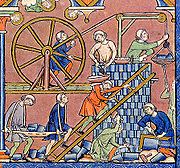
Already Johannes Scotus Eriugena
Johannes Scotus Eriugena
Johannes Scotus Eriugena was an Irish theologian, Neoplatonist philosopher, and poet. He is known for having translated and made commentaries upon the work of Pseudo-Dionysius.-Name:...
(9th century) divides them somewhat arbitrarily into seven parts:
- vestiaria (tailorTailorA tailor is a person who makes, repairs, or alters clothing professionally, especially suits and men's clothing.Although the term dates to the thirteenth century, tailor took on its modern sense in the late eighteenth century, and now refers to makers of men's and women's suits, coats, trousers,...
ing, weavingWeavingWeaving is a method of fabric production in which two distinct sets of yarns or threads are interlaced at right angles to form a fabric or cloth. The other methods are knitting, lace making and felting. The longitudinal threads are called the warp and the lateral threads are the weft or filling...
) - agricultura (agricultureAgricultureAgriculture is the cultivation of animals, plants, fungi and other life forms for food, fiber, and other products used to sustain life. Agriculture was the key implement in the rise of sedentary human civilization, whereby farming of domesticated species created food surpluses that nurtured the...
) - architectura (architectureArchitectureArchitecture is both the process and product of planning, designing and construction. Architectural works, in the material form of buildings, are often perceived as cultural and political symbols and as works of art...
, masonryMasonryMasonry is the building of structures from individual units laid in and bound together by mortar; the term masonry can also refer to the units themselves. The common materials of masonry construction are brick, stone, marble, granite, travertine, limestone; concrete block, glass block, stucco, and...
) - militia and venatoria (warWarWar is a state of organized, armed, and often prolonged conflict carried on between states, nations, or other parties typified by extreme aggression, social disruption, and usually high mortality. War should be understood as an actual, intentional and widespread armed conflict between political...
fare and huntingHuntingHunting is the practice of pursuing any living thing, usually wildlife, for food, recreation, or trade. In present-day use, the term refers to lawful hunting, as distinguished from poaching, which is the killing, trapping or capture of the hunted species contrary to applicable law...
, "martial artsMartial artsMartial arts are extensive systems of codified practices and traditions of combat, practiced for a variety of reasons, including self-defense, competition, physical health and fitness, as well as mental and spiritual development....
") - mercatura (tradeTradeTrade is the transfer of ownership of goods and services from one person or entity to another. Trade is sometimes loosely called commerce or financial transaction or barter. A network that allows trade is called a market. The original form of trade was barter, the direct exchange of goods and...
, commerceCommerceWhile business refers to the value-creating activities of an organization for profit, commerce means the whole system of an economy that constitutes an environment for business. The system includes legal, economic, political, social, cultural, and technological systems that are in operation in any...
) - coquinaria (cookingCookingCooking is the process of preparing food by use of heat. Cooking techniques and ingredients vary widely across the world, reflecting unique environmental, economic, and cultural traditions. Cooks themselves also vary widely in skill and training...
) - metallaria (blacksmithing, metallurgyMetallurgyMetallurgy is a domain of materials science that studies the physical and chemical behavior of metallic elements, their intermetallic compounds, and their mixtures, which are called alloys. It is also the technology of metals: the way in which science is applied to their practical use...
)
In his "Didascalicon", Hugh of St Victor
Hugh of St Victor
Hugh of Saint Victor was born perhaps in France, or more probably in Saxony. His origins and early life are rather obscure. He studied and taught at the Augustinian Abbey of Saint Victor in Paris after which he is named. His writings include works of theology, mysticism, philosophy and the arts...
includes navigation
Navigation
Navigation is the process of monitoring and controlling the movement of a craft or vehicle from one place to another. It is also the term of art used for the specialized knowledge used by navigators to perform navigation tasks...
, medicine
Medicine
Medicine is the science and art of healing. It encompasses a variety of health care practices evolved to maintain and restore health by the prevention and treatment of illness....
and theatrical arts
Theatre
Theatre is a collaborative form of fine art that uses live performers to present the experience of a real or imagined event before a live audience in a specific place. The performers may communicate this experience to the audience through combinations of gesture, speech, song, music or dance...
instead of commerce, agriculture and cooking. Hugh's treatment somewhat elevates the mechanical arts as ordained to the improvement of humanity, a promotion which was to represent a growing trend among late medievals.
The classification of the Artes Mechanicae as applied geometry
Geometry
Geometry arose as the field of knowledge dealing with spatial relationships. Geometry was one of the two fields of pre-modern mathematics, the other being the study of numbers ....
was introduced to Western Europe by Dominicus Gundissalinus
Dominicus Gundissalinus
Dominicus Gundissalinus also known as Domingo Gundisalvo may have been a converted Jew and was the archdeacon of Segovia, Spain and a scholastic philosopher...
under the influence of his readings in Arabic scholarship.