


Art film

Encyclopedia
Filmmaking
Filmmaking is the process of making a film, from an initial story, idea, or commission, through scriptwriting, casting, shooting, directing, editing, and screening the finished product before an audience that may result in a theatrical release or television program...
which is typically a serious, independent film
Independent film
An independent film, or indie film, is a professional film production resulting in a feature film that is produced mostly or completely outside of the major film studio system. In addition to being produced and distributed by independent entertainment companies, independent films are also produced...
aimed at a niche market
Niche market
A niche market is the subset of the market on which a specific product is focusing; therefore the market niche defines the specific product features aimed at satisfying specific market needs, as well as the price range, production quality and the demographics that is intended to impact...
rather than a mass market
Mass market
The mass market is a general business term describing the largest group of consumers for a specified industry product. It is the opposite extreme of the term niche market.-General:...
audience
Audience
An audience is a group of people who participate in a show or encounter a work of art, literature , theatre, music or academics in any medium...
. Film critics and film studies
Film studies
Film studies is an academic discipline that deals with various theoretical, historical, and critical approaches to films. It is sometimes subsumed within media studies and is often compared to television studies...
scholars typically define an "art film" using a "...canon of films and those formal qualities that mark them as different from mainstream Hollywood films", which includes, among other elements: a social realism
Social realism
Social Realism, also known as Socio-Realism, is an artistic movement, expressed in the visual and other realist arts, which depicts social and racial injustice, economic hardship, through unvarnished pictures of life's struggles; often depicting working class activities as heroic...
style; an emphasis on the authorial expressivity of the director; and a focus on the thoughts and dreams of characters, rather than presenting a clear, goal-driven story. Film scholar David Bordwell
David Bordwell
David Bordwell is an American film theorist and film historian. Since receiving his PhD from the University of Iowa in 1974, he has written more than fifteen volumes on the subject of cinema including Narration in the Fiction Film , Ozu and the Poetics of Cinema , Making Meaning , and On the...
claims that "art cinema itself is a film genre, with its own distinct conventions."
Art film producer
Film producer
A film producer oversees and delivers a film project to all relevant parties while preserving the integrity, voice and vision of the film. They will also often take on some financial risk by using their own money, especially during the pre-production period, before a film is fully financed.The...
s usually present their films at specialty theatres (repertory cinemas, or in the U.S. "arthouse cinemas") and film festivals. The term art film is much more widely used in the United States and the UK than in Europe, where the term is more associated with "auteur" films
Auteur theory
In film criticism, auteur theory holds that a director's film reflects the director's personal creative vision, as if they were the primary "auteur"...
and "national cinema
National cinema
Like other film theory or film criticism terms , the term "national cinema" is hard to define, and its meaning is debated by film scholars and critics. National cinema is a term sometimes used in film theory and film criticism to describe the films associated with a specific country...
" (e.g., German national cinema). Art films are aimed at small niche market
Niche market
A niche market is the subset of the market on which a specific product is focusing; therefore the market niche defines the specific product features aimed at satisfying specific market needs, as well as the price range, production quality and the demographics that is intended to impact...
audiences, which means they can rarely get the financial backing which will permit large production budgets, expensive special effect
Special effect
The illusions used in the film, television, theatre, or entertainment industries to simulate the imagined events in a story are traditionally called special effects ....
s, costly celebrity
Celebrity
A celebrity, also referred to as a celeb in popular culture, is a person who has a prominent profile and commands a great degree of public fascination and influence in day-to-day media...
actors, or huge advertising campaigns, as are used in widely-released
Wide release
Wide release is a term in the American motion picture industry for a motion picture that is playing nationally . Specifically, a movie is considered to be in wide release when it is on 600 screens or more in the United States and Canada.In the US, films holding an NC-17 rating almost never have a...
mainstream blockbuster
Blockbuster (entertainment)
Blockbuster, as applied to film or theatre, denotes a very popular or successful production. The entertainment industry use was originally theatrical slang referring to a particularly successful play but is now used primarily by the film industry...
films. Art film directors make up for these constraints by creating a different type of film, which typically uses lesser-known film actors (or even amateur actors) and modest sets to make films which focus much more on developing ideas or exploring new narrative techniques or filmmaking conventions.
Furthermore, a certain degree of experience and intellect are required to understand or appreciate such films; one late 1990s art film was called "largely a cerebral experience" which you enjoy "because of what you know about film". This contrasts sharply with mainstream "blockbuster" films, which are geared more towards escapism
Escapism
Escapism is mental diversion by means of entertainment or recreation, as an "escape" from the perceived unpleasant or banal aspects of daily life...
and pure entertainment. For promotion, art films rely on the publicity generated from film critics' reviews, discussion of their film by arts columnists, commentators, and blog
Blog
A blog is a type of website or part of a website supposed to be updated with new content from time to time. Blogs are usually maintained by an individual with regular entries of commentary, descriptions of events, or other material such as graphics or video. Entries are commonly displayed in...
gers, and "word-of-mouth" promotion by audience members. Since art films have small initial investment costs, they only need to appeal to a small portion of the mainstream viewing audiences to become financially viable.
Antecedents: 1910–1920s
D. W. Griffith
David Llewelyn Wark Griffith was a premier pioneering American film director. He is best known as the director of the controversial and groundbreaking 1915 film The Birth of a Nation and the subsequent film Intolerance .Griffith's film The Birth of a Nation made pioneering use of advanced camera...
's film Intolerance
Intolerance (film)
Intolerance is a 1916 American silent film directed by D. W. Griffith and is considered one of the great masterpieces of the Silent Era. The three-and-a-half hour epic intercuts four parallel storylines each separated by several centuries: A contemporary melodrama of crime and redemption; a...
(1916) and the works of Sergei Eisenstein
Sergei Eisenstein
Sergei Mikhailovich Eisenstein , né Eizenshtein, was a pioneering Soviet Russian film director and film theorist, often considered to be the "Father of Montage"...
.
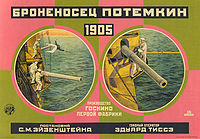
Eisenstein's film Battleship Potemkin (1925) was a revolutionary propaganda
Revolutionary propaganda
Revolutionary propaganda means dissemination of revolutionary ideas.While the term propaganda bears a mostly negative connotation in modern English language, this did not exist in the early 20th century, when the word "propaganda" was first coined...
film which he used to test his theories of using "montage
Film editing
Film editing is part of the creative post-production process of filmmaking. It involves the selection and combining of shots into sequences, and ultimately creating a finished motion picture. It is an art of storytelling...
" (editing) in a manner which would produce the greatest emotion
Emotion
Emotion is a complex psychophysiological experience of an individual's state of mind as interacting with biochemical and environmental influences. In humans, emotion fundamentally involves "physiological arousal, expressive behaviors, and conscious experience." Emotion is associated with mood,...
al response in the audience. The international critical renown Eisenstein garnered from this film enabled Eisenstein to direct October (aka Ten Days That Shook The World) as part of a grand tenth anniversary celebration of the October Revolution
October Revolution
The October Revolution , also known as the Great October Socialist Revolution , Red October, the October Uprising or the Bolshevik Revolution, was a political revolution and a part of the Russian Revolution of 1917...
of 1917, and then The General Line
The General Line
The General Line aka Old and New is a 1929 Soviet film directed by Sergei Eisenstein.The General Line was begun in 1927 as a celebration of the collectivization of agriculture, as championed by old-line Bolshevik Leon Trotsky. Hoping to reach a wide audience, the director forsook his usual...
(aka Old and New). The critics of the outside world praised these films. However, in Russia, Eisenstein's focus on structural issues such as camera angles, crowd movements, and montage brought him and like-minded others, such as Vsevolod Pudovkin
Vsevolod Pudovkin
Vsevolod Illarionovich Pudovkin was a Russian and Soviet film director, screenwriter and actor who developed influential theories of montage...
and Alexander Dovzhenko
Alexander Dovzhenko
Aleksandr Petrovich Dovzhenko , was a Soviet screenwriter, film producer and director of Ukrainian descent. He is often cited as one of the most important early Soviet filmmakers, alongside Sergei Eisenstein and Vsevolod Pudovkin.- Biography :...
, under fire from the Soviet film community.
Art films were also influenced by films by Spanish avant-garde creators such as Luis Buñuel
Luis Buñuel
Luis Buñuel Portolés was a Spanish-born filmmaker — later a naturalized citizen of Mexico — who worked in Spain, Mexico, France and the US..-Early years:...
and Salvador Dalí
Salvador Dalí
Salvador Domènec Felip Jacint Dalí i Domènech, Marquis de Púbol , commonly known as Salvador Dalí , was a prominent Spanish Catalan surrealist painter born in Figueres,Spain....
(e.g., L'Age d'Or
L'Âge d'Or
L'Âge d'or is a 1930 surrealist film directed by Spanish filmmaker Luis Buñuel and written by him and Salvador Dalí.The film began as a second collaboration with Dalí, but, by the time the film went into production, Buñuel and Dalí had had a falling-out, and so Dalí actually had nothing to do with...
from 1930) and by the French playwright and filmmaker Jean Cocteau
Jean Cocteau
Jean Maurice Eugène Clément Cocteau was a French poet, novelist, dramatist, designer, playwright, artist and filmmaker. His circle of associates, friends and lovers included Kenneth Anger, Pablo Picasso, Jean Hugo, Jean Marais, Henri Bernstein, Marlene Dietrich, Coco Chanel, Erik Satie, María...
(e.g., The Blood of a Poet
The Blood of a Poet
The Blood of a Poet is an avant-garde film directed by Jean Cocteau and financed by Charles de Noailles. Photographer Lee Miller made her only film appearance in this movie, and it also features an appearance by the famed aerialist Barbette...
, also from 1930). In the 1920s, film societies began advocating the notion that films could be divided into an "...entertainment cinema directed towards a mass audience and a serious art cinema aimed at an intellectual audience". In England, Alfred Hitchcock
Alfred Hitchcock
Sir Alfred Joseph Hitchcock, KBE was a British film director and producer. He pioneered many techniques in the suspense and psychological thriller genres. After a successful career in British cinema in both silent films and early talkies, Hitchcock moved to Hollywood...
and Ivor Montagu
Ivor Montagu
The Honorable Ivor Goldsmid Samuel Montagu was a British filmmaker, screenwriter, producer, film critic, writer, table tennis player and apparent Soviet spy...
formed a Film Society and imported films that they thought were "artistic achievements", such as "Soviet films of dialectical montage, and the expressionist films of the Universum Film A. G. (UFA) studios in Germany."
Cinéma Pur
Cinema pur
Cinéma Pur was an avant-garde film movement birthed in Paris in the 1920s and 30s. The term was first coined by Henri Chomette to define a cinema that focused on the pure elements of film like form, light, motion, visual composition, and rhythm, something he accomplished in his shorts Reflets de...
, a 1920s and 1930s French avant-garde
Avant-garde
Avant-garde means "advance guard" or "vanguard". The adjective form is used in English to refer to people or works that are experimental or innovative, particularly with respect to art, culture, and politics....
film movement also influenced the development of the idea of "art film." The cinema pur film movement included Dada
Dada
Dada or Dadaism is a cultural movement that began in Zurich, Switzerland, during World War I and peaked from 1916 to 1922. The movement primarily involved visual arts, literature—poetry, art manifestoes, art theory—theatre, and graphic design, and concentrated its anti-war politics through a...
artists, such as Man Ray
Man Ray
Man Ray , born Emmanuel Radnitzky, was an American artist who spent most of his career in Paris, France. Perhaps best described simply as a modernist, he was a significant contributor to both the Dada and Surrealist movements, although his ties to each were informal...
(Emak-Bakia
Emak-Bakia
Emak-Bakia is a 1926 film directed by Man Ray. Subtitled as a cinépoéme, it features many filming techniques used by Man Ray, including Rayographs, double exposures, soft focus and ambiguous features.-Synopsis:...
, Return to Reason), René Clair
René Clair
René Clair born René-Lucien Chomette, was a French filmmaker.-Biography:He was born in Paris and grew up in the Les Halles quarter. He attended the Lycée Montaigne and the Lycée Louis-le-Grand. During World War I, he served as an ambulance driver. After the war, he started a career as a journalist...
(Entr'acte
Entr'acte (film)
Entr'acte is a 1924 French short film directed by René Clair, which premiered as an entr'acte for the Ballets Suédois production Relâche at the Théâtre des Champs-Élysées in Paris. Relâche is based on a book and with settings by Francis Picabia, produced by Rolf de Maré, and with choreography by...
), and Marcel Duchamp
Marcel Duchamp
Marcel Duchamp was a French artist whose work is most often associated with the Dadaist and Surrealist movements. Considered by some to be one of the most important artists of the 20th century, Duchamp's output influenced the development of post-World War I Western art...
(Anemic Cinema
Anemic Cinema
Anemic Cinema or Anémic Cinéma is a Dadaist, surrealist, or experimental film made by Marcel Duchamp. The film depicts whirling animated drawings -- which Duchamp called Rotoreliefs -- alternated with puns in French. Duchamp signed the film with his alter ego name of Rrose Sélavy.Rotoreliefs were...
). The Dadaists used film to transcend narrative (storytelling) conventions, bourgeois traditions, and conventional Aristotelian notions of time and space by creating a flexible montage of time and space.
Pure Cinema was influenced by such German "absolute" filmmakers as Hans Richter
Hans Richter (artist)
Hans Richter was a painter, graphic artist, avant-gardist, film-experimenter and producer. He was born in Berlin into a well-to-do family and died in Minusio, near Locarno, Switzerland.-Germany:...
, Walter Ruttmann
Walter Ruttmann
Walter Ruttmann was a German film director and along with Hans Richter and Viking Eggeling was an early German practitioner of experimental film....
, and Viking Eggeling
Viking Eggeling
Viking Eggeling was a Swedish artist and filmmaker. His work is of significance in the area of experimental film, and has been described as absolute film and Visual Music....
. Richter claimed that his 1921 film, Rhythmus 21, was the first abstract film
Abstract film
Abstract film is a subgenre of experimental film. Its history often overlaps with the concerns and history of visual music. Some of the earliest abstract motion pictures known to survive are those produced by a group of German artists working in the early 1920s, a movement referred to as Absolute...
ever created. This claim is not true: he was preceded by the Italian Futurists
Futurism (art)
Futurism was an artistic and social movement that originated in Italy in the early 20th century. It emphasized and glorified themes associated with contemporary concepts of the future, including speed, technology, youth and violence, and objects such as the car, the airplane and the industrial city...
Bruno Corra and Arnaldo Ginna between 1911 and 1912 (as they report in the Futurist Manifesto of Cinema ), as well as by fellow German artist Walter Ruttmann
Walter Ruttmann
Walter Ruttmann was a German film director and along with Hans Richter and Viking Eggeling was an early German practitioner of experimental film....
who produced Lichtspiel Opus 1 in 1920. Nevertheless, Richter's film Rhythmus 21 is considered an important early abstract film.

1930s–1950s
In the 1930s and 1940s, Hollywood films could be divided into the artistic aspirations of literary adaptations like John FordJohn Ford
John Ford was an American film director. He was famous for both his westerns such as Stagecoach, The Searchers, and The Man Who Shot Liberty Valance, and adaptations of such classic 20th-century American novels as The Grapes of Wrath...
's The Informer (1935) and Eugene O'Neill
Eugene O'Neill
Eugene Gladstone O'Neill was an American playwright and Nobel laureate in Literature. His poetically titled plays were among the first to introduce into American drama techniques of realism earlier associated with Russian playwright Anton Chekhov, Norwegian playwright Henrik Ibsen, and Swedish...
's The Long Voyage Home
The Long Voyage Home
The Long Voyage Home is an American drama film and directed by John Ford. It features John Wayne, Thomas Mitchell, Ian Hunter, Barry Fitzgerald, Wilfrid Lawson, John Qualen, Mildred Natwick, Ward Bond, among others....
(1940), and the money-making "popular genre films" such as gangster thrillers. William Siska argues that Italian neorealist
Neorealism (art)
In art, neorealism was established by the ex-Camden Town Group painters Charles Ginner and Harold Gilman at the beginning of World War I. They set out to explore the spirit of their age through the shapes and colours of daily life...
films from the mid- to late-1940s, such as Open City
Rome, open city
Rome, Open City is a 1945 Italian war drama film, directed by Roberto Rossellini. The picture features Aldo Fabrizi, Anna Magnani and Marcello Pagliero, and is set in Rome during the Nazi occupation in 1944...
(1945), Paisa
Paisà
Paisà is a 1946 Italian film directed by Roberto Rossellini, the second of a trilogy by Rossellini. It is divided into six episodes. They are set in the Italian Campaign during World War II when Nazi Germany was losing the war against the Allies, using themes such as the difficulty of communication...
(1946), and The Bicycle Thief can be deemed as another "conscious art film movement".
In the late 1940s, the U.S. public's perception that Italian neorealist films and other serious European fare were different from mainstream Hollywood films was reinforced by the development of "arthouse cinemas" in major U.S. cities and college towns. After the Second World War, "...a growing segment of the American filmgoing public was wearying of mainstream Hollywood films", and they went to the newly-created art film theaters to see "...alternatives to the films playing in main-street movie palaces".
Films shown in these art cinemas included "... British, foreign-language, and independent American films, as well as documentaries and revivals of Hollywood classics." Films such as Rossellini's Open City and Mackendrick's Tight Little Island
Whisky Galore! (film)
Whisky Galore! was a 1949 Ealing comedy film based on the novel of the same name by Compton MacKenzie. Both the movie and the novel are based on the real-life 1941 shipwreck of the S.S. Politician near the island of Eriskay and the unauthorized taking of its cargo of whisky...
(Whisky Galore!), The Bicycle Thief
Bicycle Thieves
Bicycle Thieves , also known as The Bicycle Thief, is a 1948 Italian neorealist film directed by Vittorio De Sica. It tells the story of a poor man searching the streets of Rome for his stolen bicycle, which he needs to be able to work. The film is based on the novel of the same name by Luigi...
and The Red Shoes were shown to substantial U.S. audiences.
In the late 1950s, French filmmakers
Cinema of France
The Cinema of France comprises the art of film and creative movies made within the nation of France or by French filmmakers abroad.France is the birthplace of cinema and was responsible for many of its early significant contributions. Several important cinematic movements, including the Nouvelle...
of the late 1950s began to produce films that were influenced by Italian Neorealism
Italian neorealism
Italian neorealism is a style of film characterized by stories set amongst the poor and working class, filmed on location, frequently using nonprofessional actors...
and classical Hollywood cinema
Classical Hollywood cinema
Classical Hollywood cinema or the classical Hollywood narrative, are terms used in film history which designates both a visual and sound style for making motion pictures and a mode of production used in the American film industry between roughly the 1910s and the early 1960s.Classical style is...
, a style that critics called the French New Wave
French New Wave
The New Wave was a blanket term coined by critics for a group of French filmmakers of the late 1950s and 1960s, influenced by Italian Neorealism and classical Hollywood cinema. Although never a formally organized movement, the New Wave filmmakers were linked by their self-conscious rejection of...
. Although never a formally organized movement, the New Wave filmmakers were linked by their self-conscious rejection of classical cinematic form and their spirit of youthful iconoclasm
Iconoclasm
Iconoclasm is the deliberate destruction of religious icons and other symbols or monuments, usually with religious or political motives. It is a frequent component of major political or religious changes...
and is an example of European art cinema
European art cinema
European art cinema is a branch of cinema that was popular in the 1960s. The formal system that this cinema uses is based on the classical Hollywood cinema; particular a rejection of all tenets and rules of classical Hollywood cinema.-History:...
. Many also engaged in their work with the social and political upheavals of the era, making their radical experiments with editing, visual style and narrative part of a general break with the conservative paradigm. Some of the most prominent pioneers among the group, including François Truffaut
François Truffaut
François Roland Truffaut was an influential film critic and filmmaker and one of the founders of the French New Wave. In a film career lasting over a quarter of a century, he remains an icon of the French film industry. He was also a screenwriter, producer, and actor working on over twenty-five...
, Jean-Luc Godard
Jean-Luc Godard
Jean-Luc Godard is a French-Swiss film director, screenwriter and film critic. He is often identified with the 1960s French film movement, French Nouvelle Vague, or "New Wave"....
, Éric Rohmer
Éric Rohmer
Éric Rohmer was a French film director, film critic, journalist, novelist, screenwriter and teacher. A figure in the post-war New Wave cinema, he was a former editor of Cahiers du cinéma....
, Claude Chabrol
Claude Chabrol
Claude Chabrol was a French film director, a member of the French New Wave group of filmmakers who first came to prominence at the end of the 1950s...
, and Jacques Rivette
Jacques Rivette
Jacques Rivette is a French film director. His most well known films include Celine and Julie Go Boating, La Belle Noiseuse and the cult film Out 1....
, began as critics for the famous film magazine Cahiers du cinéma
Cahiers du cinéma
Cahiers du Cinéma is an influential French film magazine founded in 1951 by André Bazin, Jacques Doniol-Valcroze and Joseph-Marie Lo Duca. It developed from the earlier magazine Revue du Cinéma involving members of two Paris film clubs — Objectif 49 and...
. Auteur theory holds that the director
Film director
A film director is a person who directs the actors and film crew in filmmaking. They control a film's artistic and dramatic nathan roach, while guiding the technical crew and actors.-Responsibilities:...
is the "author" of his films, with a personal signature visible from film to film.
1960s–1970s
The French New Wave movement continued into the 1960s. During the 1960s, the term "art film" began to be much more widely used in the United States than in Europe. In the U.S., the term is often defined very broadly, to include foreign-language (non-English) "auteur"Auteur theory
In film criticism, auteur theory holds that a director's film reflects the director's personal creative vision, as if they were the primary "auteur"...
films, independent film
Independent film
An independent film, or indie film, is a professional film production resulting in a feature film that is produced mostly or completely outside of the major film studio system. In addition to being produced and distributed by independent entertainment companies, independent films are also produced...
s, experimental film
Experimental film
Experimental film or experimental cinema is a type of cinema. Experimental film is an artistic practice relieving both of visual arts and cinema. Its origins can be found in European avant-garde movements of the twenties. Experimental cinema has built its history through the texts of theoreticians...
s, documentaries and short films. In the 1960s "art film" became a euphemism
Euphemism
A euphemism is the substitution of a mild, inoffensive, relatively uncontroversial phrase for another more frank expression that might offend or otherwise suggest something unpleasant to the audience...
in the U.S. for racy Italian and French B-movies. By the 1970s, the term was used to describe sexually explicit
Pornography
Pornography or porn is the explicit portrayal of sexual subject matter for the purposes of sexual arousal and erotic satisfaction.Pornography may use any of a variety of media, ranging from books, magazines, postcards, photos, sculpture, drawing, painting, animation, sound recording, film, video,...
European films with artistic structure such as the Swedish film I Am Curious (Yellow)
I Am Curious (Yellow)
I Am Curious is a 1967 Swedish drama film written and directed by Vilgot Sjöman and starring Sjöman and Lena Nyman. It is a companion film to 1968's I Am Curious ; the two were initially intended to be one 3½ hour film...
. In the U.S., the term "art film" is sometimes used very loosely to refer to the broad range of films shown in repertory theaters or "arthouse cinemas." With this approach, a broad range of films, such as a 1960s Hitchcock
Alfred Hitchcock
Sir Alfred Joseph Hitchcock, KBE was a British film director and producer. He pioneered many techniques in the suspense and psychological thriller genres. After a successful career in British cinema in both silent films and early talkies, Hitchcock moved to Hollywood...
film, a 1970s experimental underground film, a European auteur film, a U.S. "Independent" film, and even a mainstream foreign-language film (with subtitles) might all fall under the rubric of "art house films."
1980s–2000s
By the 1980s and 1990s, the term became conflated with "independent filmIndependent film
An independent film, or indie film, is a professional film production resulting in a feature film that is produced mostly or completely outside of the major film studio system. In addition to being produced and distributed by independent entertainment companies, independent films are also produced...
" in the U.S., which shares many of the same stylistic traits with "art film." Companies such as Miramax Films
Miramax Films
Miramax Films is an American entertainment company known for distributing independent and foreign films. For its first 14 years the company was privately owned by its founders, Bob and Harvey Weinstein...
distributed independent films which were deemed commercially unviable at the major studios. When major motion picture studios noted the niche appeal of independent films, they created special divisions dedicated to non-mainstream fare, such as the Fox Searchlight division of Twentieth Century Fox, the Focus Features
Focus Features
Focus Features is the art house films division of NBC Universal's Universal Pictures, and acts as both a producer and distributor for its own films and a distributor for foreign films....
division of Universal
Universal Studios
Universal Pictures , a subsidiary of NBCUniversal, is one of the six major movie studios....
, and the Sony Pictures Classics
Sony Pictures Classics
Sony Pictures Classics is an art-house film division of Sony Pictures Entertainment founded in December 1991 that distributes, produces and acquires specialty films from the United States and around the world. Its co-presidents are Michael Barker and Tom Bernard...
division of Sony Pictures Entertainment
Sony Pictures Entertainment
Sony Pictures Entertainment, Inc. is the television and film production/distribution unit of Japanese multinational technology and media conglomerate Sony...
. Film critics have debated whether the films from these special divisions can truly be considered to be "independent films", given that they have financial backing from major studios.
In 2007, Professor Camille Paglia
Camille Paglia
Camille Anna Paglia , is an American author, teacher, and social critic. Paglia, a self-described dissident feminist, has been a Professor at The University of the Arts in Philadelphia, Pennsylvania since 1984...
argued in her article "Art movies: R.I.P." that "[a]side from Francis Ford Coppola
Francis Ford Coppola
Francis Ford Coppola is an American film director, producer and screenwriter. He is widely acclaimed as one of Hollywood's most innovative and influential film directors...
's Godfather
The Godfather
The Godfather is a 1972 American epic crime film directed by Francis Ford Coppola, based on the 1969 novel by Mario Puzo. With a screenplay by Puzo, Coppola and an uncredited Robert Towne, the film stars Marlon Brando, Al Pacino, James Caan, Robert Duvall, Sterling Hayden, John Marley, Richard...
series, with its deft flashbacks and gritty social realism, ...[there is not]...a single film produced over the past 35 years that is arguably of equal philosophical weight or virtuosity of execution to Bergman
Ingmar Bergman
Ernst Ingmar Bergman was a Swedish director, writer and producer for film, stage and television. Described by Woody Allen as "probably the greatest film artist, all things considered, since the invention of the motion picture camera", he is recognized as one of the most accomplished and...
's
The Seventh Seal
The Seventh Seal
The Seventh Seal is a 1957 Swedish film written and directed by Ingmar Bergman. Set during the Black Death, it tells of the journey of a medieval knight and a game of chess he plays with the personification of Death , who has come to take his life. Bergman developed the film from his own play...
or Persona
Persona (film)
Persona is a film by Swedish director Ingmar Bergman, released in 1966, and starring Bibi Andersson and Liv Ullmann. Bergman held this film to be one of his most important; in his book Images, he writes: "Today I feel that in Persona—and later in Cries and Whispers—I had gone as far as I could go...
". Paglia states that young people from the 2000s do not "...have patience for the long, slow take that deep-think European directors once specialized in", an approach which gave "...luxurious scrutiny of the tiniest facial expressions or the chilly sweep of a sterile room or bleak landscape".
Deviations from mainstream film norms
Film scholar David BordwellDavid Bordwell
David Bordwell is an American film theorist and film historian. Since receiving his PhD from the University of Iowa in 1974, he has written more than fifteen volumes on the subject of cinema including Narration in the Fiction Film , Ozu and the Poetics of Cinema , Making Meaning , and On the...
outlined the academic definition of "art film" in a 1979 article entitled The Art Cinema as a Mode of Film Practice, which contrasts art films against the mainstream films of classical Hollywood cinema
Classical Hollywood cinema
Classical Hollywood cinema or the classical Hollywood narrative, are terms used in film history which designates both a visual and sound style for making motion pictures and a mode of production used in the American film industry between roughly the 1910s and the early 1960s.Classical style is...
. Mainstream Hollywood-style films use a clear narrative
Narrative
A narrative is a constructive format that describes a sequence of non-fictional or fictional events. The word derives from the Latin verb narrare, "to recount", and is related to the adjective gnarus, "knowing" or "skilled"...
form to organize the film into a series of "...causally related events taking place in space and time", with every scene driving towards a goal. The plot for mainstream films is driven by a well-defined protagonist, fleshed out with clear characters, and strengthened with "...question-and-answer logic, problem-solving routines, (and) deadline plot structures." The film is then tied together with fast pacing, musical soundtracks to cue the appropriate audience emotions, and tight, seamless editing
Editing
Editing is the process of selecting and preparing written, visual, audible, and film media used to convey information through the processes of correction, condensation, organization, and other modifications performed with an intention of producing a correct, consistent, accurate, and complete...
. Mainstream films tend to use a small palette of familiar, generic images, plots, verbal expressions, and archetypal
Archetype
An archetype is a universally understood symbol or term or pattern of behavior, a prototype upon which others are copied, patterned, or emulated...
"stock" characters.
In contrast, Bordwell states that "...the art cinema motivates its narrative by two principles: realism
Social realism
Social Realism, also known as Socio-Realism, is an artistic movement, expressed in the visual and other realist arts, which depicts social and racial injustice, economic hardship, through unvarnished pictures of life's struggles; often depicting working class activities as heroic...
and authorial expressivity." Art films deviate from the mainstream, "classical" norms of filmmaking in that they typically deal with more episodic narrative structures with a "...loosening of the chain of cause and effect". As well, art films often deal with an inner drama that takes place in a character's psyche, such as psychological issues dealing with individual identity, transgressive sexual or social issues, moral dilemmas, or personal crises.
Mainstream films also deal with moral dilemmas or identity crises, but these issues are usually resolved by the end of the film. In art films, the dilemmas are probed and investigated in a pensive fashion, but usually without a clear resolution at the end of the film. The protagonists in art films are often facing doubt, anomie or alienation, and the art film often depicts their internal dialogue of thoughts, dream sequences
Oneiric (film theory)
In a film theory context, the term oneiric refers to the depiction of dream-like states in films, or to the use of the metaphor of a dream or the dream-state to analyze a film. The connection between dreams and films has been long established; "The dream factory" “...has become a household...
, and fantasies. In some art films, the director uses a depiction of absurd or seemingly meaningless actions to express a philosophical viewpoint such as existentialism
Existentialism
Existentialism is a term applied to a school of 19th- and 20th-century philosophers who, despite profound doctrinal differences, shared the belief that philosophical thinking begins with the human subject—not merely the thinking subject, but the acting, feeling, living human individual...
.
The story in an art film often has a secondary role to character development and an exploration of ideas through lengthy sequences of dialogue. If an art film has a story, it is usually a drifting sequence of vaguely defined or ambiguous episodes. There may be unexplained gaps in the film, deliberately unclear sequences, or extraneous sequences that are not related to previous scenes, which force the viewer to subjectively make their own interpretation of the film's message. Art films often "...bear the marks of a distinctive visual style" and authorial
Auteur theory
In film criticism, auteur theory holds that a director's film reflects the director's personal creative vision, as if they were the primary "auteur"...
approach of the director. An art cinema film often refuses to provide a "...readily answered conclusion", instead putting to the cinema viewer the task of thinking about "...how is the story being told? Why tell the story in this way?"
Bordwell claims that "art cinema itself is a [film] genre, with its own distinct conventions." Film theorist Robert Stam
Robert Stam
Robert Stam is University Professor at New York University, where he teaches about the French New Wave filmmakers. Stam has published widely on French literature, comparative literature, and on film topics such as film history and film theory.-Books:* *...
also argues that "art film" is a film genre. He claims that a film is considered to be an art film based on artistic status, in the same way that film genres can be based on aspects of films such as their budgets (blockbuster
Blockbuster (entertainment)
Blockbuster, as applied to film or theatre, denotes a very popular or successful production. The entertainment industry use was originally theatrical slang referring to a particularly successful play but is now used primarily by the film industry...
films or B-movies) or their star performers (Adam Sandler films).
Timeline of notable films
The following list is a small, partial sample of films with "art film" qualities, compiled to give a general sense of what directors and films are considered to have "art film" characteristics. The films in this list demonstrate one or more of the characteristics of art films: a serious, noncommercial, or independently made film that is not aimed at a mass audience. Some of the films on this list are also considered to be "auteur" films, independent films, or experimental filmExperimental film
Experimental film or experimental cinema is a type of cinema. Experimental film is an artistic practice relieving both of visual arts and cinema. Its origins can be found in European avant-garde movements of the twenties. Experimental cinema has built its history through the texts of theoreticians...
s. In some cases, critics disagree over whether a film is mainstream or not. For example, while some critics called Gus Van Sant
Gus Van Sant
Gus Green Van Sant, Jr. is an American director, screenwriter, painter, photographer, musician, and author. He is a two time nominee of the Academy Award for Best Director for his 1997 film Good Will Hunting and his 2008 film Milk, both of which were also nominated for Best Picture, and won the...
's My Own Private Idaho
My Own Private Idaho
My Own Private Idaho is a 1991 independent drama film written and directed by Gus Van Sant, loosely based on Shakespeare's Henry IV, Part 1, Henry IV, Part 2, and Henry V, and starring River Phoenix and Keanu Reeves...
(1991) an "exercise in film experimentation" of "high artistic quality", the Washington Post called it an ambitious mainstream film.
Some films in this list have most of these characteristics; other films are commercially-made films produced by mainstream studios that nevertheless bear the hallmarks of a director's "auteur" style, or which have an experimental character. The films in this list are notable either because they won major awards or critical praise from influential film critics or because they introduced an innovative narrative or filmmaking technique.
.jpg)
1920s–1940s
In the 1920s and 1930s, filmmakers did not set out to make "art films", and film critics did not use the term "art film". However, there were films that had more sophisticated aesthetic objectives, such as Carl Theodor DreyerCarl Theodor Dreyer
Carl Theodor Dreyer, Jr. was a Danish film director. He is regarded by many critics and filmmakers as one of the greatest directors in cinema.-Life:Dreyer was born illegitimate in Copenhagen, Denmark...
's The Passion of Joan of Arc
The Passion of Joan of Arc
The Passion of Joan of Arc is a silent film produced in France in 1928. It is based on the record of the trial of Joan of Arc. The film was directed by Carl Theodor Dreyer and stars Renée Jeanne Falconetti...
(1928) and Vampyr
Vampyr
Vampyr is a 1932 horror film directed by Danish director Carl Theodor Dreyer. The film was written by Dreyer and Christen Jul based on elements from J. Sheridan Le Fanu's collection of supernatural stories In a Glass Darkly. Vampyr was funded by Nicolas de Gunzburg who starred in the film under...
(1932), surrealist films such as Luis Buñuel
Luis Buñuel
Luis Buñuel Portolés was a Spanish-born filmmaker — later a naturalized citizen of Mexico — who worked in Spain, Mexico, France and the US..-Early years:...
's Un chien andalou
Un chien andalou
Un Chien Andalou is a 1929 silent surrealist short film by the Spanish director Luis Buñuel and artist Salvador Dalí. It was Buñuel's first film and was initially released in 1929 to a limited showing in Paris, but became popular and ran for eight months....
(1929) and L'Âge d'Or
L'Âge d'Or
L'Âge d'or is a 1930 surrealist film directed by Spanish filmmaker Luis Buñuel and written by him and Salvador Dalí.The film began as a second collaboration with Dalí, but, by the time the film went into production, Buñuel and Dalí had had a falling-out, and so Dalí actually had nothing to do with...
(1930), or even films dealing with political and current-event relevance such as Sergei Eisenstein
Sergei Eisenstein
Sergei Mikhailovich Eisenstein , né Eizenshtein, was a pioneering Soviet Russian film director and film theorist, often considered to be the "Father of Montage"...
's famed and influential masterpiece Battleship Potemkin. The U.S. film Sunrise: A Song of Two Humans (1927) by German Expressionist
German Expressionism
German Expressionism refers to a number of related creative movements beginning in Germany before the First World War that reached a peak in Berlin, during the 1920s...
director F. W. Murnau uses distorted art design and groundbreaking cinematography to create an exaggerated, fairy-tale-like world that was rich with symbolism and imagery. Jean Renoir
Jean Renoir
Jean Renoir was a French film director, screenwriter, actor, producer and author. As a film director and actor, he made more than forty films from the silent era to the end of the 1960s...
's film The Rules of the Game
The Rules of the Game
The Rules of the Game is a 1939 French film directed by Jean Renoir about upper-class French society just before the start of World War II...
(1939) was a comedy of manners
Comedy of manners
The comedy of manners is a genre of play/television/film which satirizes the manners and affectations of a social class, often represented by stock characters, such as the miles gloriosus in ancient times, the fop and the rake during the Restoration, or an old person pretending to be young...
that transcended the conventions of the "comedy of manners" genre by creating a biting and tragic satire of French upper class society in the years before WW II; a poll of critics from the British Film Institute
British Film Institute
The British Film Institute is a charitable organisation established by Royal Charter to:-Cinemas:The BFI runs the BFI Southbank and IMAX theatre, both located on the south bank of the River Thames in London...
ranked it as the third greatest film ever, placing behind Citizen Kane
Citizen Kane
Citizen Kane is a 1941 American drama film, directed by and starring Orson Welles. Many critics consider it the greatest American film of all time, especially for its innovative cinematography, music and narrative structure. Citizen Kane was Welles' first feature film...
and Vertigo
Vertigo (film)
Vertigo is a 1958 psychological thriller film directed by Alfred Hitchcock and starring James Stewart, Kim Novak, and Barbara Bel Geddes. The screenplay was written by Alec Coppel and Samuel A...
.
Some of these early artistically-oriented films were financed by wealthy individuals rather than film companies, particularly in cases where the content of the film was controversial or unlikely to attract an audience. In the late 1940s, UK director Michael Powell
Michael Powell (director)
Michael Latham Powell was a renowned English film director, celebrated for his partnership with Emeric Pressburger...
and Emeric Pressburger
Emeric Pressburger
Emeric Pressburger was a Hungarian-British screenwriter, film director, and producer. He is best known for his series of film collaborations with Michael Powell, in a multiple-award-winning partnership known as The Archers and produced a series of classic British films, notably 49th Parallel , The...
made The Red Shoes (1948), a film about ballet that stood out from mainstream genre films of the era. In 1945, David Lean
David Lean
Sir David Lean CBE was an English film director, producer, screenwriter, and editor best remembered for big-screen epics such as The Bridge on the River Kwai , Lawrence of Arabia ,...
would direct Brief Encounter
Brief Encounter
Brief Encounter is a 1945 British film directed by David Lean about the conventions of British suburban life, centring on a housewife for whom real love brings unexpectedly violent emotions. The film stars Celia Johnson, Trevor Howard, Stanley Holloway and Joyce Carey...
, an adaptation of Noël Coward
Noël Coward
Sir Noël Peirce Coward was an English playwright, composer, director, actor and singer, known for his wit, flamboyance, and what Time magazine called "a sense of personal style, a combination of cheek and chic, pose and poise".Born in Teddington, a suburb of London, Coward attended a dance academy...
's play Still Life
Still life
A still life is a work of art depicting mostly inanimate subject matter, typically commonplace objects which may be either natural or man-made...
, which observes a passionate love affair between an upper class man and a middle class woman amidst the social and economical issues that Britain faced at the time.
1950s
In the 1950s, some of the well-known films with artistic sensibilities include La StradaLa Strada
La Strada is a 1954 Italian neorealist drama directed by Federico Fellini in which a naïve young woman is sold to a brutish man and goes on the road as a part of his itinerant show....
(1954), a film about a young woman who is forced to go to work for a cruel and inhumane circus performer in order to support her family and eventually coming to terms with her situation, Carl Theodor Dreyer
Carl Theodor Dreyer
Carl Theodor Dreyer, Jr. was a Danish film director. He is regarded by many critics and filmmakers as one of the greatest directors in cinema.-Life:Dreyer was born illegitimate in Copenhagen, Denmark...
's Ordet
Ordet
Ordet is a 1955 Danish drama film, directed by Carl Theodor Dreyer. It is based on a play by Kaj Munk, a Danish pastor, first performed in 1932...
(1956), centering around family with a lack of faith amongst it but with a son who believes that he is Jesus Christ and convinced that he is capable of performing miracles, Federico Fellini
Federico Fellini
Federico Fellini, Cavaliere di Gran Croce OMRI , was an Italian film director and scriptwriter. Known for a distinct style that blends fantasy and baroque images, he is considered one of the most influential and widely revered filmmakers of the 20th century...
's Nights of Cabiria
Nights of Cabiria
Nights of Cabiria is a 1957 Italian film directed by Federico Fellini. Fellini's wife, Giulietta Masina, plays Cabiria Ceccarelli, a feisty but naive prostitute in Ostia, then a seedy section of Rome...
(1957), which deals with a prostitute's failed attempts to find love, and her suffering and rejections, and Wild Strawberries
Wild Strawberries (film)
Wild Strawberries is a 1957 Swedish film written and directed by Ingmar Bergman, about an old man recalling his past. The original Swedish title is Smultronstället, which literally means "the wild strawberry patch", but idiomatically means an underrated gem of a place...
(1957), by Ingmar Bergman
Ingmar Bergman
Ernst Ingmar Bergman was a Swedish director, writer and producer for film, stage and television. Described by Woody Allen as "probably the greatest film artist, all things considered, since the invention of the motion picture camera", he is recognized as one of the most accomplished and...
, whose narrative concerns an elderly medical doctor and professor whose nightmares lead him to re-evaluate his life, and The 400 Blows
The 400 Blows
The 400 Blows is a 1959 French film directed by François Truffaut. One of the defining films of the French New Wave, it displays many of the characteristic traits of the movement. The story revolves around Antoine Doinel, an ordinary adolescent in Paris, who is thought by his parents and teachers...
(1959) by François Truffaut, whose main character is a young man trying to come of age despite the abuse from his parents, schoolteachers, and society in general. In Poland, the Khrushchev Thaw
Khrushchev Thaw
The Khrushchev Thaw refers to the period from the mid 1950s to the early 1960s, when repression and censorship in the Soviet Union were partially reversed and millions of Soviet political prisoners were released from Gulag labor camps, due to Nikita Khrushchev's policies of de-Stalinization and...
permitted some relaxation of the regime's cultural policies, and productions such as A Generation
A Generation
A Generation is a 1955 Polish film directed by Andrzej Wajda. It is based on the novel Pokolenie by Bohdan Czeszko, who also wrote the script, and it was Wajda's first film and the opening installment of what became his Three War Films trilogy set in the Second World War, completed by Kanal and...
, Kanal
Kanal (film)
Kanał is a 1956 Polish film directed by Andrzej Wajda. It was the first film made about the Warsaw Uprising, telling the story of a company of Home Army resistance fighters escaping the Nazi onslaught through the city's sewers...
, Ashes and Diamonds
Ashes and Diamonds
Ashes and Diamonds is a 1948 novel by the Polish writer Jerzy Andrzejewski. It was adapted into a film by the same title in 1958 by the Polish film director Andrzej Wajda. English translation, entitled Ashes and Diamonds, appeared in 1962...
, Lotna
Lotna
Lotna is a Polish war film released in 1959 and directed by Andrzej Wajda.-Overview:This highly symbolic movie is both the director's tribute to the long and glorious history of the Polish cavalry, as well as a more ambiguous portrait of the passing of an era...
(1954–1959), all directed by Andrzej Wajda
Andrzej Wajda
Andrzej Wajda is a Polish film director. Recipient of an honorary Oscar, he is possibly the most prominent member of the unofficial "Polish Film School"...
, showed the Polish Film School
Polish Film School
Polish Film School refers to an informal group of Polish film directors and screenplay writers active between 1955 and approximately 1963.The group was under heavy influence of Italian neorealists. It took advantage of the liberal changes in Poland after the 1956 to portray the complexity of...
style.
Asia
Bengali cinema
Bengali cinema refers to the Bengali language filmmaking industries in the Bengal region of South Asia. There are two major film-making hubs in the region: one in Kolkata, West Bengal, India and the other in Dhaka, Bangladesh .The history of cinema in Bengal dates back to the 1890s, when the first...
known as "Parallel Cinema
Parallel Cinema
The Indian New Wave, commonly known in India as Art Cinema or Parallel Cinema as an alternative to the mainstream commercial cinema, is a specific movement in Indian cinema, known for its serious content, realism and naturalism, with a keen eye on the sociopolitical climate of the times...
" or the "Indian New Wave". It was an alternative to the mainstream commercial cinema known for its serious content, realism
Realism (arts)
Realism in the visual arts and literature refers to the general attempt to depict subjects "in accordance with secular, empirical rules", as they are considered to exist in third person objective reality, without embellishment or interpretation...
and naturalism, with a keen eye on the social-political climate of the times. This movement is distinct from mainstream Bollywood
Bollywood
Bollywood is the informal term popularly used for the Hindi-language film industry based in Mumbai , Maharashtra, India. The term is often incorrectly used to refer to the whole of Indian cinema; it is only a part of the total Indian film industry, which includes other production centers producing...
cinema and began around the same time as the French New Wave
French New Wave
The New Wave was a blanket term coined by critics for a group of French filmmakers of the late 1950s and 1960s, influenced by Italian Neorealism and classical Hollywood cinema. Although never a formally organized movement, the New Wave filmmakers were linked by their self-conscious rejection of...
and Japanese New Wave. The most influential filmmaker involved in this movement was Satyajit Ray
Satyajit Ray
Satyajit Ray was an Indian Bengali filmmaker. He is regarded as one of the greatest auteurs of 20th century cinema. Ray was born in the city of Kolkata into a Bengali family prominent in the world of arts and literature...
. His most famous films were The Apu Trilogy (1955–1959), which tells the story of a poor country boy's growth to adulthood. Bimal Roy
Bimal Roy
Bimal Roy was one of the most acclaimed Indian film directors of all time. He is particularly noted for his realistic and socialistic films like Do Bigha Zamin, Parineeta, Biraj Bahu, Madhumati, Sujata, and Bandini, making him an important director of Hindi cinema...
's Two Acres of Land (1953) tells the story of a farmer during a famine in Bengal
Bengal famine
There have been a number of significant famines in the history of Bengal including:*Bengal famine of 1770*Bengal famine of 1943*Bangladesh famine of 1974*Bengal Famine , a movie by Bimal Roy...
. Other acclaimed Bengali
Bengali people
The Bengali people are an ethnic community native to the historic region of Bengal in South Asia. They speak Bengali , which is an Indo-Aryan language of the eastern Indian subcontinent, evolved from the Magadhi Prakrit and Sanskrit languages. In their native language, they are referred to as বাঙালী...
filmmakers involved in this movement include Mrinal Sen
Mrinal Sen
Mrinal Sen is a Bengali Indian filmmaker. He was born on 14 May 1923, in the town of Faridpur, now in Bangladesh in a Hindu family. After finishing his high school there, he left home to come to Calcutta as a student and studied physics at the well-known Scottish Church College and at the...
and Ritwik Ghatak.
Japanese filmmakers
Cinema of Japan
The has a history that spans more than 100 years. Japan has one of the oldest and largest film industries in the world – as of 2009 the fourth largest by number of feature films produced. Movies have been produced in Japan since 1897, when the first foreign cameramen arrived...
produced a number of films that broke with convention. Akira Kurosawa's Rashomon
Rashomon (film)
The bandit's storyTajōmaru, a notorious brigand , claims that he tricked the samurai to step off the mountain trail with him and look at a cache of ancient swords he discovered. In the grove he tied the samurai to a tree, then brought the woman there. She initially tried to defend herself with a...
(1950), the first Japanese film to be widely screened in the West, depicts four witnesses' contradictory accounts of a rape and murder. In 1952, Kurosawa directed Ikiru
Ikiru
is a 1952 Japanese film co-written and directed by Akira Kurosawa. The film examines the struggles of a minor Tokyo bureaucrat and his final quest for meaning. The film stars Takashi Shimura as Kanji Watanabe.-Plot:...
, a film about a Tokyo bureaucrat struggling to find a meaning for his life. Tokyo Story
Tokyo Story
is a 1953 Japanese film directed by Yasujirō Ozu. It tells the story of an aging couple who travel to Tokyo to visit their grown children. The film contrasts the behavior of their biological children, who are too busy to pay them much attention, and their daughter-in-law, who treats them with...
(1953) by Yasujirō Ozu
Yasujiro Ozu
was a prominent Japanese film director and script writer. He is known for his distinctive technical style, developed during the silent era. Marriage and family, especially the relationships between the generations, are among the most persistent themes in his body of work...
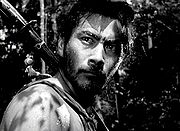
explores social changes of the era by telling the story of an aging couple who travel to Tokyo to visit their grown children, but find the children are too self-absorbed to spend much time with them. Seven Samurai (1954) by Kurosawa, tells the story of a farming village that hire seven masterless samurai to combat bandits. Fires on the Plain
Fires on the Plain (film)
is a 1959 Japanese war film directed by Kon Ichikawa, starring Eiji Funakoshi. The screenplay, written by, Natto Wada, is based on the novel Nobi by Shohei Ooka, translated as Fires on the Plain. It initially received mixed reviews from both Japanese and international critics concerning its...
(1959) by Kon Ichikawa
Kon Ichikawa
was a Japanese film director.-Early life and career:Ichikawa was born in Ise, Mie Prefecture. In the 1930s Ichikawa attended a technical school in Osaka. Upon graduation, in 1933, he found a job with a local rental film studio, J.O. Studio, in their animation department...
explores the Japanese experience in World War II by depicting a sick Japanese soldier struggling to stay alive. Ugetsu
Ugetsu
Ugetsu is a 1953 Japanese film directed by Kenji Mizoguchi. Set in 16th century Japan, it stars Masayuki Mori and Machiko Kyō, and is inspired by short stories by Ueda Akinari and Guy de Maupassant...
(1953) by Kenji Mizoguchi
Kenji Mizoguchi
Kenji Mizoguchi was a Japanese film director and screenwriter. His film Ugetsu won the Silver Lion at the Venice Film Festival, and appeared in the Sight & Sound Critics' Top Ten Poll in 1962 and 1972. Mizoguchi is renowned for his mastery of the long take and mise-en-scène...
is a ghost story set in the late 16th century which tells the story of peasants whose village is in the path of an advancing army. A year later, Mizoguchi directed Sansho the Bailiff
Sansho the Bailiff
-External links:* at the Japanese Movie Database* * and QuickTime trailer* essay by Mark Le Fanu...
(1954), which tells the story of two aristocratic children sold into slavery; in addition to dealing with serious themes such as the loss of freedom, the film features features beautiful images and long and complicated shots.
1960s
The 1960s was an important period in art film; the release of a number of groundbreaking films giving rise to the European art cinemaEuropean art cinema
European art cinema is a branch of cinema that was popular in the 1960s. The formal system that this cinema uses is based on the classical Hollywood cinema; particular a rejection of all tenets and rules of classical Hollywood cinema.-History:...
. Jean-Luc Godard's Breathless (1960) used innovative visual and editing techniques such as jump cuts and hand-held camera work. Godard, a leading figure of the French New Wave
French New Wave
The New Wave was a blanket term coined by critics for a group of French filmmakers of the late 1950s and 1960s, influenced by Italian Neorealism and classical Hollywood cinema. Although never a formally organized movement, the New Wave filmmakers were linked by their self-conscious rejection of...
, would continue to make innovative films throughout the decade, proposing a whole new style of filmmaking. Jules et Jim by François Truffaut deconstructed a complex relationship of three individuals through innovative screenwriting, editing, and camera techniques. Italian director Michelangelo Antonioni
Michelangelo Antonioni
Michelangelo Antonioni, Cavaliere di Gran Croce OMRI was an Italian modernist film director, screenwriter, editor and short story writer.- Personal life :...
helped revolutionize filmmaking, with such films as La Notte
La Notte
La Notte is a 1961 Italian film directed by Michelangelo Antonioni. It is considered the central film of a trilogy beginning with L'avventura and ending with L'Eclisse.- Plot :...
(1961), a complex examination of a failed marriage that dealt with issues such as anomie and sterility; Eclipse (1962), about a young woman who is unable to form a solid relationship with her boyfriend because of his materialistic nature; Red Desert (1964), his first color film, which deals with the need to adapt to the modern world; and Blowup
Blowup
Blowup is a 1966 film directed by Michelangelo Antonioni, his first English-language film.It tells of a British photographer's accidental involvement with a murder, inspired by Julio Cortázar's short story, "Las babas del diablo" or "The Devil's Drool" , translated also as Blow-Up, and by the life...
(1966), his first English-language film, which examines issues of perception and reality as it follows a young photographer's attempt to discover whether he had photographed a murder.
Swedish director Ingmar Bergman
Ingmar Bergman
Ernst Ingmar Bergman was a Swedish director, writer and producer for film, stage and television. Described by Woody Allen as "probably the greatest film artist, all things considered, since the invention of the motion picture camera", he is recognized as one of the most accomplished and...
started off the 1960s with chamber pieces like Winter Light
Winter Light
Winter Light is a 1962 Swedish drama film written and directed by Ingmar Bergman and starring Bergman regulars Gunnar Björnstrand, Ingrid Thulin and Max von Sydow. The film follows Tomas Ericsson , pastor of a small rural Swedish church, as he deals with existential crisis and his...
(1963) and The Silence
The Silence (1963 film)
The Silence is a 1963 Swedish film written and directed by Ingmar Bergman and starring Ingrid Thulin and Gunnel Lindblom. The plot focuses on two sisters – the younger a sensuous woman with a young son, the elder more intellectually orientated and seriously ill — and their tense relationship as...
(1963), which deal with such themes as emotional isolation and a lack of communication. His films from the later half of the decade, such as Persona
Persona (film)
Persona is a film by Swedish director Ingmar Bergman, released in 1966, and starring Bibi Andersson and Liv Ullmann. Bergman held this film to be one of his most important; in his book Images, he writes: "Today I feel that in Persona—and later in Cries and Whispers—I had gone as far as I could go...
(1966), Shame (1968), and A Passion
The Passion of Anna
The Passion of Anna is a 1969 Swedish drama film written and directed by Ingmar Bergman. Bergman was awarded Best Director at the 1971 National Society of Film Critics Awards for the film.-Plot:...
(1969), deal with the idea of film as an artifice. The intellectual and visually expressive films of Tadeusz Konwicki
Tadeusz Konwicki
Tadeusz Konwicki is a Polish writer and film director, a member of the Polish Language Council.-Life:Konwicki was born in 1926 in Nowa Wilejka near Wilno, where he spent his early childhood. He spent his adolescence in Wilno, attending a local gymnasium...
, such as All Souls' Day
All Souls' Day (film)
All Souls' Day is the English title for Zaduszki, a film released in 1962, directed by the Polish film director Tadeusz Konwicki.Much like Konwicki's 1958 film The Last Day of Summer, All Souls' Day is a story of survivors and the lasting psychic damage of World War II...
(Zaduszki, 1961), and especially Salto
Salto (film)
Salto is a film drama by written and directed by Polish director Tadeusz Konwicki. It was released on 11 June 1965 in Poland. The director of photography is Kurt Weber and the music was by Wojciech Kilar. The title can be translated as "somersault" in English, or it can be seen as a reference to a...
(1962) inspired discussions about war and raised existential questions on behalf of their everyman protagonists.
Federico Fellini's La Dolce Vita
La Dolce Vita
La Dolce Vita is a 1960 comedy-drama film written and directed by the critically acclaimed director Federico Fellini. The film is a story of a passive journalist's week in Rome, and his search for both happiness and love that will never come...
(1960) depicts a succession of nights and dawns in Rome as witnessed by a cynical journalist. In 1963, Fellini made 8½
8½
8½ is a 1963 Italian fantasy film directed by Federico Fellini. Co-scripted by Fellini, Tullio Pinelli, Ennio Flaiano, and Brunello Rondi, it stars Marcello Mastroianni as Guido Anselmi, a famous Italian film director...
, an exploration of creative, marital and spiritual difficulties shot in sumptuous black-and-white by cinematographer Gianni di Venanzo
Gianni di Venanzo
Gianni di Venanzo , was a distinguished Italian cinematographer.He collaborated with several notable directors, working on films directed by Michelangelo Antonioni such as L'amore in città , Le amiche , Il grido , La notte and L'eclisse...
. The 1961 film Last Year at Marienbad
Last Year at Marienbad
L'Année dernière à Marienbad is a 1961 French film directed by Alain Resnais from a screenplay by Alain Robbe-Grillet....
by director Alain Resnais
Alain Resnais
Alain Resnais is a French film director whose career has extended over more than six decades. After training as a film editor in the mid-1940s, he went on to direct a number of short films which included Nuit et Brouillard , an influential documentary about the Nazi concentration camps.He began...
examines perception and reality, using grand tracking shots that became widely influential. Robert Bresson
Robert Bresson
-Life and career:Bresson was born at Bromont-Lamothe, Puy-de-Dôme, the son of Marie-Élisabeth and Léon Bresson. Little is known of his early life and the year of his birth, 1901 or 1907, varies depending on the source. He was educated at Lycée Lakanal in Sceaux, Hauts-de-Seine, close to Paris, and...
's Au Hasard Balthazar
Au hasard Balthazar
Au hasard Balthazar, , also known as Balthazar, is a 1966 French film directed by Robert Bresson, starring Anne Wiazemsky.-Plot:...
(1966) and Mouchette
Mouchette
Mouchette is a 1967 French film directed by Robert Bresson, starring Nadine Nortier, and Jean-Claude Guilbert. It is based on the novel by Georges Bernanos. "Mouchette" means "little fly" in French...
(1967) are notable for their naturalistic, elliptical style. Spanish director Luis Buñuel
Luis Buñuel
Luis Buñuel Portolés was a Spanish-born filmmaker — later a naturalized citizen of Mexico — who worked in Spain, Mexico, France and the US..-Early years:...
also contributed heavily to the art of film, with shocking, surrealist satires like Viridiana
Viridiana
Viridiana is a 1961 Spanish-Mexican motion picture, directed by Luis Buñuel and produced by Mexican Gustavo Alatriste. It is loosely based on Halma, a novel by Benito Pérez Galdós....
(1961) and The Exterminating Angel (1962).
Andrei Tarkovsky
Andrei Arsenyevich Tarkovsky was a Soviet and Russian filmmaker, writer, film editor, film theorist, theatre and opera director, widely regarded as one of the finest filmmakers of the 20th century....
's film Andrei Rublev
Andrei Rublev (film)
Andrei Rublev , also known as The Passion According to Andrei, is a 1966 Russian film directed by Andrei Tarkovsky from a screenplay written by Andrei Konchalovsky and Andrei Tarkovsky. The film is loosely based on the life of Andrei Rublev, the great 15th century Russian icon painter...
(1966) is a portrait of the medieval Russian icon painter
Iconography
Iconography is the branch of art history which studies the identification, description, and the interpretation of the content of images. The word iconography literally means "image writing", and comes from the Greek "image" and "to write". A secondary meaning is the painting of icons in the...
of the same name. The film is also about artistic freedom and the possibility and necessity of making art for, and in the face of, a repressive authority. A cut version of the film was shown at the 1969 Cannes Film Festival
1969 Cannes Film Festival
The 22nd Cannes Film Festival was held on May 8 - 23, 1969. At this festival a new non-competitive section called "Directors' Fortnight" is added, in response to the cancellation of the 1968 festival.-Jury:*Luchino Visconti...
, where it won the FIPRESCI prize
FIPRESCI
The International Federation of Film Critics is an association of national organizations of professional film critics and film journalists from around the world for "the promotion and development of film culture and for the safeguarding of professional interests." It was founded in June 1930 in...
. At the end of the decade, Stanley Kubrick
Stanley Kubrick
Stanley Kubrick was an American film director, writer, producer, and photographer who lived in England during most of the last four decades of his career...
's 2001: A Space Odyssey
2001: A Space Odyssey (film)
2001: A Space Odyssey is a 1968 epic science fiction film produced and directed by Stanley Kubrick, and co-written by Kubrick and Arthur C. Clarke, partially inspired by Clarke's short story The Sentinel...
(1968) wowed audiences with its scientific realism, pioneering use of special effects, and unusual visual imagery. In Soviet Armenia
Armenia
Armenia , officially the Republic of Armenia , is a landlocked mountainous country in the Caucasus region of Eurasia...
, Sergei Parajanov's The Color of Pomegranates
The Color of Pomegranates
The Color of Pomegranates is a 1968 Armenian film directed by Sergei Parajanov.-Overview:The Color of Pomegranates is a biography of the Armenian ashug Sayat-Nova that attempts to reveal the poet's life visually and poetically rather than literally...
, which was banned by Soviet authorities, and also long unavailable in the west, was praised by critic Mikhail Vartanov
Mikhail Vartanov
Mikhail Vartanov . Film director, cinematographer, documentarian, essayist, photographer and artist who developed a style of documentary filmmaking termed the “direction of undirected action.”...
as "revolutionary" and in the early 1980s, Les Cahiers du Cinéma placed the film in its top 10 list. In Iran, Dariush Mehrjui's The Cow
Gaav
The Cow is a 1969 Iranian film directed by Dariush Mehrjui, written by Gholam-Hossein Saedi based on his own play and novel, and starring Ezatolah Entezami as Masht Hassan. Some believe that "New Wave" of Persian cinema emerged after this film.-Plot:...
(1969), about a man who becomes insane after the death of his beloved cow, sparked the new wave of Iranian cinema.
1970s
In the early 1970s, directors shocked audiences with violent films such as A Clockwork OrangeA Clockwork Orange (film)
A Clockwork Orange is a 1971 film adaptation of Anthony Burgess's 1962 novel of the same name. It was written, directed and produced by Stanley Kubrick...
(1971), Stanley Kubrick
Stanley Kubrick
Stanley Kubrick was an American film director, writer, producer, and photographer who lived in England during most of the last four decades of his career...
's brutal exploration of futuristic youth gangs and Last Tango in Paris
Last Tango in Paris
Last Tango in Paris is a 1972 Italian romantic drama film directed by Bernardo Bertolucci which portrays a recent American widower who takes up an anonymous sexual relationship with a young, soon-to-be-married Parisian woman...
(1972), Bernardo Bertolucci
Bernardo Bertolucci
Bernardo Bertolucci is an Italian film director and screenwriter, whose films include The Conformist, Last Tango in Paris, 1900, The Last Emperor and The Dreamers...
's taboo-breaking, sexually-explicit and controversial film. Nevertheless, other directors did more introspective films, such as Andrei Tarkovsky
Andrei Tarkovsky
Andrei Arsenyevich Tarkovsky was a Soviet and Russian filmmaker, writer, film editor, film theorist, theatre and opera director, widely regarded as one of the finest filmmakers of the 20th century....
's meditative science fiction film Solaris
Solaris (1972 film)
Solaris is a 1972 film adaptation of the novel Solaris , directed by Andrei Tarkovsky. The film is a meditative psychological drama occurring mostly aboard a space station orbiting the fictional planet Solaris. The scientific mission has stalled, because the scientist crew have fallen to...
(1972), supposedly intended as a Soviet riposte to 2001. In 1975, Tarkovsky directed another two films which garnered critical acclaim overseas, The Mirror
The Mirror (1975 film)
The Mirror is a 1975 Russian film directed by Andrei Tarkovsky. It is loosely autobiographical, blending childhood memories, newsreel footage and poems by his father Arseny Tarkovsky...
and Stalker
Stalker (film)
Stalker is a 1979 science fiction film directed by Andrei Tarkovsky, with a screenplay written by Boris and Arkady Strugatsky, loosely based on their novel Roadside Picnic...
. Terrence Malick
Terrence Malick
Terrence Frederick Malick is a U.S. film director, screenwriter, and producer. In a career spanning almost four decades, Malick has directed five feature films....
, who directed Badlands
Badlands (film)
Badlands is a 1973 American crime drama film written and directed by Terrence Malick, starring Martin Sheen and Sissy Spacek. Warren Oates and Ramon Bieri are also featured. Malick has a small speaking part although he does not receive an acting credit...
(1973) and Days of Heaven
Days of Heaven
Days of Heaven is a 1978 American romantic drama film written and directed by Terrence Malick and starring Richard Gere, Brooke Adams, Sam Shepard and Linda Manz. Set in the early 20th century, it tells the story of two poor lovers, Bill and Abby, as they travel to the Texas Panhandle to harvest...
(1978) shared many traits with Tarkovsky, such as his long, lingering shots of natural beauty, evocative imagery, and poetic narrative style.
Another feature of 1970s art films was the return to prominence of bizarre characters and imagery, which abound in the tormented, obsessed title character in German New Wave director Werner Herzog
Werner Herzog
Werner Herzog Stipetić , known as Werner Herzog, is a German film director, producer, screenwriter, actor, and opera director.He is often considered as one of the greatest figures of the New German Cinema, along with Rainer Werner Fassbinder, Margarethe von Trotta, Volker Schlöndorff, Werner...
's Aguirre, the Wrath of God
Aguirre, the Wrath of God
Aguirre, the Wrath of God is a 1972 West German adventure film written and directed by Werner Herzog. Klaus Kinski stars in the title role. The soundtrack was composed and performed by German progressive/Krautrock band Popol Vuh...
(1973), and in cult film
Cult film
A cult film, also commonly referred to as a cult classic, is a film that has acquired a highly devoted but specific group of fans. Often, cult movies have failed to achieve fame outside the small fanbases; however, there have been exceptions that have managed to gain fame among mainstream audiences...
s such as Alejandro Jodorowsky
Alejandro Jodorowsky
Alejandro Jodorowsky Prullansky, known as Alejandro Jodorowsky, is a Chilean filmmaker, playwright, actor, author, comic book writer and spiritual guru...
's psychedelic The Holy Mountain (1973) about a footless, handless dwarf and an alchemist seeking the mythical Lotus Island
Lotus Island
Lotus Island is a 0.2-mile-long island in the Aleutian Islands chain of the U.S. state of Alaska. Located at in the Semichi Islands group of the Near Islands, it is the least prominent of the two islands in Shemya Pass, which separates Nizki and Shemya islands...
The film Taxi Driver
Taxi Driver
Taxi Driver is a 1976 American drama film directed by Martin Scorsese and written by Paul Schrader. The film is set in New York City, soon after the Vietnam War. The film stars Robert De Niro and features Jodie Foster, Harvey Keitel, and Cybill Shepherd. The film was nominated for four Academy...
(1976) by Martin Scorsese
Martin Scorsese
Martin Charles Scorsese is an American film director, screenwriter, producer, actor, and film historian. In 1990 he founded The Film Foundation, a nonprofit organization dedicated to film preservation, and in 2007 he founded the World Cinema Foundation...
continues the themes that A Clockwork Orange explored: an alienated population living in a violent, decaying society. The gritty violence and seething rage of Scorsese's film contrasts other films released in the same period, such as David Lynch
David Lynch
David Keith Lynch is an American filmmaker, television director, visual artist, musician and occasional actor. Known for his surrealist films, he has developed his own unique cinematic style, which has been dubbed "Lynchian", and which is characterized by its dream imagery and meticulous sound...
's dreamlike, surreal Eraserhead
Eraserhead
Eraserhead is a 1977 American surrealist film and the first feature film of David Lynch, who wrote, produced and directed. Lynch began working on the film at the AFI Conservatory, which gave him a $10,000 grant to make the film after he had begun working there following his 1971 move to Los Angeles...
(1977). In 1974 John Cassavetes
John Cassavetes
John Nicholas Cassavetes was an American actor, screenwriter and filmmaker. He acted in many Hollywood films, notably Rosemary's Baby and The Dirty Dozen...
would offer a sharp commentary on American blue-collar life in A Woman Under the Influence
A Woman Under the Influence
A Woman Under the Influence is a 1974 American drama film written and directed by John Cassavetes. It focuses on a woman whose psychotic behavior leads her husband to commit her for psychiatric treatment and the effect this has on their family. It received two Academy Award nominations for Best...
, which features an eccentric housewife slowly descending into madness.
1980s
In 1980, director Martin ScorseseMartin Scorsese
Martin Charles Scorsese is an American film director, screenwriter, producer, actor, and film historian. In 1990 he founded The Film Foundation, a nonprofit organization dedicated to film preservation, and in 2007 he founded the World Cinema Foundation...
shocked audiences who had become used to the escapist blockbuster adventures of Steven Spielberg
Steven Spielberg
Steven Allan Spielberg KBE is an American film director, screenwriter, producer, video game designer, and studio entrepreneur. In a career of more than four decades, Spielberg's films have covered many themes and genres. Spielberg's early science-fiction and adventure films were seen as an...
and George Lucas
George Lucas
George Walton Lucas, Jr. is an American film producer, screenwriter, and director, and entrepreneur. He is the founder, chairman and chief executive of Lucasfilm. He is best known as the creator of the space opera franchise Star Wars and the archaeologist-adventurer character Indiana Jones...
with the gritty, harsh realism of his film Raging Bull. In this film, actor Robert De Niro
Robert De Niro
Robert De Niro, Jr. is an American actor, director and producer. His first major film roles were in Bang the Drum Slowly and Mean Streets, both in 1973...
took method acting
Method acting
Method acting is a phrase that loosely refers to a family of techniques used by actors to create in themselves the thoughts and emotions of their characters, so as to develop lifelike performances...
to an extreme to portray a boxer's decline from a prizewinning young fighter to an overweight, "has-been" nightclub owner. Ridley Scott
Ridley Scott
Sir Ridley Scott is an English film director and producer. His most famous films include The Duellists , Alien , Blade Runner , Legend , Thelma & Louise , G. I...
's Blade Runner
Blade Runner
Blade Runner is a 1982 American science fiction film directed by Ridley Scott and starring Harrison Ford, Rutger Hauer, and Sean Young. The screenplay, written by Hampton Fancher and David Peoples, is loosely based on the novel Do Androids Dream of Electric Sheep? by Philip K...
(1982), while labeled as a fast-paced action film, could rather be seen as a science fiction art film, along with 2001: A Space Odyssey (1968). Blade Runner explores themes of existentialism
Existentialism
Existentialism is a term applied to a school of 19th- and 20th-century philosophers who, despite profound doctrinal differences, shared the belief that philosophical thinking begins with the human subject—not merely the thinking subject, but the acting, feeling, living human individual...
: what it means to be human. A box office failure, the film became popular in the arthouse circuit as a cult oddity
Cult film
A cult film, also commonly referred to as a cult classic, is a film that has acquired a highly devoted but specific group of fans. Often, cult movies have failed to achieve fame outside the small fanbases; however, there have been exceptions that have managed to gain fame among mainstream audiences...
after the release of a "Director's cut" became successful on VHS
VHS
The Video Home System is a consumer-level analog recording videocassette standard developed by Victor Company of Japan ....
. In the middle of the decade, Japanese director Akira Kurosawa used realism to portray the brutal, bloody violence of Japanese samurai warfare of the 16th century in Ran
Ran (film)
is a 1985 Japanese-French jidaigeki film written and directed by Akira Kurosawa. The film starred Tatsuya Nakadai as Hidetora Ichimonji, an aging Sengoku-era warlord who decides to abdicate as ruler in favor of his three sons. It also stars Mieko Harada as the wife of Ichimonji's eldest son...
(1985). Ran followed the plot of King Lear
King Lear
King Lear is a tragedy by William Shakespeare. The title character descends into madness after foolishly disposing of his estate between two of his three daughters based on their flattery, bringing tragic consequences for all. The play is based on the legend of Leir of Britain, a mythological...
, in which an elderly king is betrayed by his children. Sergio Leone
Sergio Leone
Sergio Leone was an Italian film director, producer and screenwriter most associated with the "Spaghetti Western" genre.Leone's film-making style includes juxtaposing extreme close-up shots with lengthy long shots...
also contrasted brutal violence with emotional substance in his epic tale of a mobster's life in Once Upon a Time in America
Once Upon a Time in America
Once Upon a Time in America is a 1984 Italian epic crime film co-written and directed by Sergio Leone and starring Robert De Niro and James Woods. The story chronicles the lives of Jewish ghetto youths who rise to prominence in New York City's world of organized crime...
.

Andrzej Wajda
Andrzej Wajda is a Polish film director. Recipient of an honorary Oscar, he is possibly the most prominent member of the unofficial "Polish Film School"...
's Man of Iron
Man of Iron
Man of Iron is a 1981 film directed by Andrzej Wajda. It depicts the Solidarity labour movement and its first success in persuading the Polish government to recognize the workers' right to an independent union....
(1981) is a critique of the Polish communist government which won the 1981 Palme d'Or at the Cannes Film Festival
Cannes Film Festival
The Cannes International Film Festival , is an annual film festival held in Cannes, France, which previews new films of all genres including documentaries from around the world. Founded in 1946, it is among the world's most prestigious and publicized film festivals...
. Another Polish director, Krzysztof Kieślowski
Krzysztof Kieslowski
Krzysztof Kieślowski was an Academy Award nominated influential Polish film director and screenwriter, known internationally for The Double Life of Veronique and his film cycles The Decalogue and Three Colors.-Early life:...
made The Decalogue
The Decalogue
The Decalogue is a 1989 Polish television drama series directed by Krzysztof Kieślowski and co-written by Kieślowski with Krzysztof Piesiewicz, with music by Zbigniew Preisner...
for television in 1988, a largely melancholic film series that explores ethical issues and moral puzzles. Two of these films were released theatrically as A Short Film About Love
A Short Film About Love
A Short Film About Love is an expanded film version of the sixth episode of director Krzysztof Kieślowski's 1988 Polish language ten-part television series, The Decalogue...
and A Short Film About Killing
A Short Film About Killing
A Short Film About Killing is a 1988 film directed by Krzysztof Kieślowski expanded from the fifth episode in the Polish television series Dekalog...
. In 1989 Woody Allen
Woody Allen
Woody Allen is an American screenwriter, director, actor, comedian, jazz musician, author, and playwright. Allen's films draw heavily on literature, sexuality, philosophy, psychology, Jewish identity, and the history of cinema...
would make, in the words of The New York Times
The New York Times
The New York Times is an American daily newspaper founded and continuously published in New York City since 1851. The New York Times has won 106 Pulitzer Prizes, the most of any news organization...
critic Vincent Canby
Vincent Canby
Vincent Canby was an American film critic who became the chief film critic for The New York Times in 1969 and reviewed more than 1000 films during his tenure there.-Life and career:...
his most "securely serious and funny film to date" in Crimes and Misdemeanors
Crimes and Misdemeanors
Crimes and Misdemeanors is a 1989 black comedy written, directed by and co-starring Woody Allen, alongside Martin Landau, Mia Farrow, Anjelica Huston, Jerry Orbach, Alan Alda, Sam Waterston and Joanna Gleason....
, which deals with multiple stories of people trying to find a moral and spiritual simplicity in life facing dire issues and thoughts surrounding the choices they make. French director Louis Malle
Louis Malle
Louis Malle was a French film director, screenwriter, and producer. He worked in both French cinema and Hollywood. His films include Ascenseur pour l'échafaud , Atlantic City , and Au revoir, les enfants .- Early years in France :Malle was born into a wealthy industrialist family in Thumeries,...
chose another moral path to explore with the dramatization of his real-life childhood experiences in Au revoir, les enfants
Au revoir, les enfants
Au revoir les enfants is a 1987 film written, produced and directed by Louis Malle. The screenplay was published by Gallimard in the same year...
, which depicts the Nazi occupation government's deportation of French Jews to concentration camps during World War II.
Kieślowski was not the only director to transcend the distinction between the cinema and television: Ingmar Bergman
Ingmar Bergman
Ernst Ingmar Bergman was a Swedish director, writer and producer for film, stage and television. Described by Woody Allen as "probably the greatest film artist, all things considered, since the invention of the motion picture camera", he is recognized as one of the most accomplished and...
made Fanny and Alexander
Fanny and Alexander
Fanny and Alexander is a 1982 Swedish fantasy drama film written and directed by Ingmar Bergman. It was originally conceived as a four-part TV movie and cut in that version, spanning 312 minutes. A 188-minute version was created later for cinematic release, although this version was in fact the...
(1982) which was shown on television in an extended five-hour version. In the UK, Channel 4
Channel 4
Channel 4 is a British public-service television broadcaster which began working on 2 November 1982. Although largely commercially self-funded, it is ultimately publicly owned; originally a subsidiary of the Independent Broadcasting Authority , the station is now owned and operated by the Channel...
, a new television channel, financed in whole or part many films released theatrically via its Film 4
Film4 Productions
Film4 Productions is a British film production company owned by Channel 4. The company has been responsible for backing a large number of films made in the United Kingdom. The company's first production was Walter, directed by Stephen Frears, which was released in 1982.- History :Before 1998, the...
subsidiary. Wim Wenders
Wim Wenders
Ernst Wilhelm "Wim" Wenders is a German film director, playwright, author, photographer and producer.-Early life:Wenders was born in Düsseldorf. He graduated from high school in Oberhausen in the Ruhr area. He then studied medicine and philosophy in Freiburg and Düsseldorf...
offered another approach on life from a spiritual standpoint in his 1987 film Wings of Desire
Wings of Desire
Wings of Desire is a 1987 Franco-German romantic fantasy film directed by Wim Wenders. The film is about invisible, immortal angels who populate Berlin and listen to the thoughts of the human inhabitants and comfort those who are in distress...
, a depiction of a "fallen angel" who lives among men, which won the Palme d'Or
Palme d'Or
The Palme d'Or is the highest prize awarded at the Cannes Film Festival and is presented to the director of the best feature film of the official competition. It was introduced in 1955 by the organising committee. From 1939 to 1954, the highest prize was the Grand Prix du Festival International du...
at the Cannes Film Festival
Cannes Film Festival
The Cannes International Film Festival , is an annual film festival held in Cannes, France, which previews new films of all genres including documentaries from around the world. Founded in 1946, it is among the world's most prestigious and publicized film festivals...
. In 1982, experimental director Godfrey Reggio
Godfrey Reggio
Godfrey Reggio is an American director of experimental documentary films.-Life:Born and raised in New Orleans, Louisiana. Reggio co-founded La Clinica de la Gente, a facility that provided medical care to 12,000 community members in Santa Fe, and La Gente, a community-organizing project in...
released Koyaanisqatsi
Koyaanisqatsi
Koyaanisqatsi also known as Koyaanisqatsi: Life Out of Balance, is a 1982 film directed by Godfrey Reggio with music composed by Philip Glass and cinematography by Ron Fricke....
, a film without dialogue which emphasizes cinematography and philosophical ideology. It consists primarily of slow motion
Slow motion
Slow motion is an effect in film-making whereby time appears to be slowed down. It was invented by the Austrian priest August Musger....
and time-lapse
Time-lapse
Time-lapse photography is a cinematography technique whereby the frequency at which film frames are captured is much lower than that which will be used to play the sequence back. When replayed at normal speed, time appears to be moving faster and thus lapsing...
photography of cities and natural landscapes which creates a visual tone poem
Symphonic poem
A symphonic poem or tone poem is a piece of orchestral music in a single continuous section in which the content of a poem, a story or novel, a painting, a landscape or another source is illustrated or evoked. The term was first applied by Hungarian composer Franz Liszt to his 13 works in this vein...
.
Another approach used by directors in the 1980s was to create bizarre, surreal alternate worlds. Martin Scorsese
Martin Scorsese
Martin Charles Scorsese is an American film director, screenwriter, producer, actor, and film historian. In 1990 he founded The Film Foundation, a nonprofit organization dedicated to film preservation, and in 2007 he founded the World Cinema Foundation...
's After Hours
After Hours (film)
After Hours is a 1985 American black comedy film, written by Joseph Minion and directed by Martin Scorsese. Paul Hackett , a New Yorker, experiences a series of adventures and perils in trying to make his way home from SoHo.-Plot:...
(1985) is a comedy-thriller that depicts a man's baffling adventures in a surreal nighttime world of chance encounters with mysterious characters. David Lynch
David Lynch
David Keith Lynch is an American filmmaker, television director, visual artist, musician and occasional actor. Known for his surrealist films, he has developed his own unique cinematic style, which has been dubbed "Lynchian", and which is characterized by its dream imagery and meticulous sound...
's Blue Velvet (1986), is a film noir
Film noir
Film noir is a cinematic term used primarily to describe stylish Hollywood crime dramas, particularly those that emphasize cynical attitudes and sexual motivations. Hollywood's classic film noir period is generally regarded as extending from the early 1940s to the late 1950s...
-style thriller mystery filled with symbolism and metaphors about polarized worlds and inhabited by distorted characters that are hidden in the seamy underworld of a small town became surprisingly successful considering its highy distubing subject matter. Peter Greenaway
Peter Greenaway
Peter Greenaway, CBE is a British film director. His films are noted for the distinct influence of Renaissance and Baroque painting, and Flemish painting in particular...
's The Cook, the Thief, His Wife & Her Lover
The Cook, the Thief, His Wife & Her Lover
The Cook, the Thief, His Wife & Her Lover is a 1989 romantic crime drama written and directed by Peter Greenaway, starring Richard Bohringer, Michael Gambon, Helen Mirren, and Alan Howard in the titular roles...
(1989) is an outlandish fantasy/black comedy
Black comedy
A black comedy, or dark comedy, is a comic work that employs black humor or gallows humor. The definition of black humor is problematic; it has been argued that it corresponds to the earlier concept of gallows humor; and that, as humor has been defined since Freud as a comedic act that anesthetizes...
about cannibalism
Cannibalism
Cannibalism is the act or practice of humans eating the flesh of other human beings. It is also called anthropophagy...
and extreme violence with an intellectual theme: a critique of 'elite
Elite
Elite refers to an exceptional or privileged group that wields considerable power within its sphere of influence...
culture' in Thatcherian
Margaret Thatcher
Margaret Hilda Thatcher, Baroness Thatcher, was Prime Minister of the United Kingdom from 1979 to 1990...
Britain.
1990s
In the 1990s, directors took inspiration from the success of 1986's Blue Velvet and The Cook, the Thief, His Wife & Her LoverThe Cook, the Thief, His Wife & Her Lover
The Cook, the Thief, His Wife & Her Lover is a 1989 romantic crime drama written and directed by Peter Greenaway, starring Richard Bohringer, Michael Gambon, Helen Mirren, and Alan Howard in the titular roles...
by creating films with bizarre alternate worlds and elements of surrealism. In 1990, Japanese director Akira Kurosawa's Dreams
Dreams (1990 film)
is a 1990 magical realism film based on actual dreams of the film's director, Akira Kurosawa at different stages of his life. The film is more imagery than dialogue. The alternative titles are a translation of the opening line of Ten Nights of Dreams, by Natsume Sōseki, which begins:...
depicted his imaginative reveries in a series of vignettes that range from idyllic pastoral country landscapes to horrific visions of tormented demons and a blighted post-nuclear war landscape. In 1991, director Joel Coen's Barton Fink
Barton Fink
Barton Fink is a 1991 American film, written, directed, and produced by the Coen brothers. Set in 1941, it stars John Turturro in the title role as a young New York City playwright who is hired to write scripts for a movie studio in Hollywood, and John Goodman as Charlie, the insurance salesman who...
, which won the Palme d'or
Palme d'Or
The Palme d'Or is the highest prize awarded at the Cannes Film Festival and is presented to the director of the best feature film of the official competition. It was introduced in 1955 by the organising committee. From 1939 to 1954, the highest prize was the Grand Prix du Festival International du...
at the Cannes Film Festival
Cannes Film Festival
The Cannes International Film Festival , is an annual film festival held in Cannes, France, which previews new films of all genres including documentaries from around the world. Founded in 1946, it is among the world's most prestigious and publicized film festivals...
, told an enigmatic story about a writer who encounters a range of bizarre characters including an alcoholic, abusive novelist and a serial killer. David Lynch
David Lynch
David Keith Lynch is an American filmmaker, television director, visual artist, musician and occasional actor. Known for his surrealist films, he has developed his own unique cinematic style, which has been dubbed "Lynchian", and which is characterized by its dream imagery and meticulous sound...
's 1997 film Lost Highway is a psychological thriller that explores fantasy worlds, bizarre time-space transformations, and mental breakdowns using surreal imagery.
Other directors in the 1990s explored philosophical issues and themes such as identity, chance, death, and existentialism. The 1990s films My Own Private Idaho
My Own Private Idaho
My Own Private Idaho is a 1991 independent drama film written and directed by Gus Van Sant, loosely based on Shakespeare's Henry IV, Part 1, Henry IV, Part 2, and Henry V, and starring River Phoenix and Keanu Reeves...
and Chungking Express
Chungking Express
Chungking Express is a 1994 Hong Kong film written and directed by Wong Kar-wai. The film consists of two stories told in sequence, each about a lovesick Hong Kong policeman mulling over his relationship with a woman...
explored the theme of identity. Gus Van Sant
Gus Van Sant
Gus Green Van Sant, Jr. is an American director, screenwriter, painter, photographer, musician, and author. He is a two time nominee of the Academy Award for Best Director for his 1997 film Good Will Hunting and his 2008 film Milk, both of which were also nominated for Best Picture, and won the...
's My Own Private Idaho
My Own Private Idaho
My Own Private Idaho is a 1991 independent drama film written and directed by Gus Van Sant, loosely based on Shakespeare's Henry IV, Part 1, Henry IV, Part 2, and Henry V, and starring River Phoenix and Keanu Reeves...
(1991) is an independent road movie/buddy film about two young street hustlers which explores the theme of the search for home and identity. It was called a "high-water mark in '90s independent film", a "stark, poetic rumination", and an "exercise in film experimentation" of "high artistic quality". Wong Kar-wai
Wong Kar-wai
Wong Kar-wai BBS is a Hong Kong Second Wave filmmaker, internationally renowned as an auteur for his visually unique, highly stylized, emotionally resonant work, including Days of Being Wild , Ashes of Time , Chungking Express , Fallen Angels , Happy Together and 2046...
's Chungking Express
Chungking Express
Chungking Express is a 1994 Hong Kong film written and directed by Wong Kar-wai. The film consists of two stories told in sequence, each about a lovesick Hong Kong policeman mulling over his relationship with a woman...
(1994) explores the themes of identity, disconnection, loneliness, and isolation in the "metaphoric concrete jungle" of modern Hong Kong. The film uses a visual style that could be seen as music video
Music video
A music video or song video is a short film integrating a song and imagery, produced for promotional or artistic purposes. Modern music videos are primarily made and used as a marketing device intended to promote the sale of music recordings...
-influenced, and also bears similarities to the French New Wave
French New Wave
The New Wave was a blanket term coined by critics for a group of French filmmakers of the late 1950s and 1960s, influenced by Italian Neorealism and classical Hollywood cinema. Although never a formally organized movement, the New Wave filmmakers were linked by their self-conscious rejection of...
. While the British Film Institute
British Film Institute
The British Film Institute is a charitable organisation established by Royal Charter to:-Cinemas:The BFI runs the BFI Southbank and IMAX theatre, both located on the south bank of the River Thames in London...
called it one of the best Asian films of contemporary cinema, it is considered to be a film for cineophiles, because it is "largely a cerebral experience" which you enjoy "because of what you know about film".
Daryush Shokof
Daryush Shokof
Daryush Shokof is an Iranian artist, film director, philosopher, writer, art director, and film producer, and singer...
's film Seven Servants
Seven Servants
Seven Servants is a USA - Germany co-production 1996 German drama -comedy film made by Daryush Shokof. The movie is about a man who wants to unite and "connect" the races until his last breath.-Plot:...
(1996), makes a most original high art cinema piece about a man who wants to "unite" the world races until his last breath. The film remains a surprising visionary experience both in form and concept for anyone who sees it for the first time ever.
One year after Seven Servants
Seven Servants
Seven Servants is a USA - Germany co-production 1996 German drama -comedy film made by Daryush Shokof. The movie is about a man who wants to unite and "connect" the races until his last breath.-Plot:...
, Abbas Kiarostami
Abbas Kiarostami
Abbas Kiarostami is an internationally acclaimed Iranian film director, screenwriter, photographer and film producer. An active filmmaker since 1970, Kiarostami has been involved in over forty films, including shorts and documentaries...
's film Taste of Cherry
Taste of Cherry
Taste of Cherry is a 1997 film by the Iranian filmmaker Abbas Kiarostami. It is a minimalist film about a man who drives through a city suburb looking for someone who can carry out the task to bury him after he has died.-Plot:...
(1997), which won the Palme d'Or at the Cannes Film Festival, tells a similar tale as in the Seven Servants
Seven Servants
Seven Servants is a USA - Germany co-production 1996 German drama -comedy film made by Daryush Shokof. The movie is about a man who wants to unite and "connect" the races until his last breath.-Plot:...
with a different twist in which it is about a man trying to hire a person to bury him after he commits suicide. The film was shot in a minimalist style, with long takes, a leisurely pace, and long periods of silence. The film was also notable for its use of long shots and overhead shots which creates a sense of distance between the audience and the characters. Zhang Yimou
Zhang Yimou
Zhang Yimou is a Chinese film director, producer, writer and actor, and former cinematographer. He is counted amongst the Fifth Generation of Chinese filmmakers, having made his directorial debut in 1987 with Red Sorghum....
's early 1990s works such as Ju Dou
Ju Dou
Ju Dou is a 1990 Chinese film directed by Zhang Yimou and Yang Fengliang and starring Gong Li as the title character. It is notable for being shot in vivid Technicolor long after the process had been abandoned in the United States...
(1990), Raise the Red Lantern
Raise the Red Lantern
Raise the Red Lantern is a 1991 film directed by Zhang Yimou and starring Gong Li. It is an adaption by Ni Zhen of the 1990 novel Wives and Concubines by Su Tong...
(1991), The Story of Qiu Ju
The Story of Qiu Ju
The Story of Qiu Ju is a 1992 Chinese comedy-drama film. The film was directed by Zhang Yimou and, as in many of his films, stars Gong Li in the title role. The screenplay is an adaption of Chen Yuanbin's novella The Wan Family's Lawsuit....
(1992) and To Live (1994) explore human emotions through a poignant narrative. To Live won the Grand Jury Prize.
Several 1990s films explored existentialist-oriented themes related to life, chance, and death. Robert Altman
Robert Altman
Robert Bernard Altman was an American film director and screenwriter known for making films that are highly naturalistic, but with a stylized perspective. In 2006, the Academy of Motion Picture Arts and Sciences recognized his body of work with an Academy Honorary Award.His films MASH , McCabe and...
's Short Cuts
Short Cuts
Short Cuts is a 1993 American drama film directed by Robert Altman. Filmed from a screenplay by Robert Altman and Frank Barhydt, it is inspired by nine short stories and a poem by Raymond Carver...
(1993) explored themes of chance, death, and infidelity by tracing ten parallel and interwoven stories. The film, which won the Golden Lion and the Volpi Cup at the Venice Film Festival
Venice Film Festival
The Venice International Film Festival is the oldest international film festival in the world. Founded by Count Giuseppe Volpi in 1932 as the "Esposizione Internazionale d'Arte Cinematografica", the festival has since taken place every year in late August or early September on the island of the...
, was called a "many-sided, many mooded, dazzlingly structured eclectic jazz mural" by Chicago Tribune critic Michael Wilmington. Krzysztof Kieślowski
Krzysztof Kieslowski
Krzysztof Kieślowski was an Academy Award nominated influential Polish film director and screenwriter, known internationally for The Double Life of Veronique and his film cycles The Decalogue and Three Colors.-Early life:...
's The Double Life of Véronique
The Double Life of Véronique
The Double Life of Véronique is a 1991 French- and Polish-language film directed by Krzysztof Kieślowski, co-written by Kieślowski and Krzysztof Piesiewicz, starring Irène Jacob, with original music by Zbigniew Preisner. The film was Kieślowski's first to be produced partly outside Poland.A...
(1991) is a drama about the theme of identity and a political allegory about the East/West split in Europe which features stylized cinematography, an ethereal atmosphere, and unexplained supernatural elements. Abbas Kiarostami
Abbas Kiarostami
Abbas Kiarostami is an internationally acclaimed Iranian film director, screenwriter, photographer and film producer. An active filmmaker since 1970, Kiarostami has been involved in over forty films, including shorts and documentaries...
's film Taste of Cherry
Taste of Cherry
Taste of Cherry is a 1997 film by the Iranian filmmaker Abbas Kiarostami. It is a minimalist film about a man who drives through a city suburb looking for someone who can carry out the task to bury him after he has died.-Plot:...
(1997) about a man trying to hire a person to bury him after he commits suicide. The film, which was shot in a minimalist style, with long takes, won the Palme d'Or at the Cannes Film Festival.
Darren Aronofsky
Darren Aronofsky
Darren Aronofsky is an American film director, screenwriter and film producer. He attended Harvard University to study film theory and the American Film Institute to study both live-action and animation filmmaking...
's film Pi (1998) is a dream-like "...incredibly complex and ambiguous film filled with both incredible style and substance" about a paranoid math genius' "search for peace." The film creates a David Lynch
David Lynch
David Keith Lynch is an American filmmaker, television director, visual artist, musician and occasional actor. Known for his surrealist films, he has developed his own unique cinematic style, which has been dubbed "Lynchian", and which is characterized by its dream imagery and meticulous sound...
-inspired,"... eerie Eraserhead
Eraserhead
Eraserhead is a 1977 American surrealist film and the first feature film of David Lynch, who wrote, produced and directed. Lynch began working on the film at the AFI Conservatory, which gave him a $10,000 grant to make the film after he had begun working there following his 1971 move to Los Angeles...
-like world" shot in "black-and-white, which lends a dream-like atmosphere to all of the proceedings", which explore issues such as "metaphysics and spirituality" Matthew Barney
Matthew Barney
Matthew Barney is an American artist who works in sculpture, photography, drawing and film. His early works were sculptural installations combined with performance and video...
's The Cremaster Cycle
The Cremaster Cycle
The Cremaster Cycle is an art project consisting of five feature length films, together with related sculptures, photographs, drawings, and artist's books; it is the best-known work of American visual artist and filmmaker Matthew Barney....
(1994–2002) is a cycle of five symbolic, allegorical films that create a self-enclosed aesthetic system that aims to explore the process of creation. The films are filled with allusions to reproductive organs and sexual development, and they use narrative models drawn from biography, mythology, and geology.
Some 1990s films mixed an ethereal or surreal visual atmosphere with the exploration of philosophical issues. Satantango
Satantango
Sátántangó is a film directed by Hungarian filmmaker Béla Tarr. Shot in black-and-white, completed in 1994, it runs 7 hours and 12 minutes. It is based on the novel Sátántangó by Hungarian novelist László Krasznahorkai, who has been providing Tarr with stories since his 1988 film Kárhozat...
(1994), by the Hungarian director Bela Tarr
Béla Tarr
-Life:Tarr was born in Pécs, but grew up in Budapest. Both of his parents were close to theatre and film: his father was a scenery designer, while his mother has been working as a prompter at a theater for more than 50 years now...
is a 7½ hour long film, shot in black and white, that deals with Tarr's favorite theme, that of inadequacy, as con man
Confidence trick
A confidence trick is an attempt to defraud a person or group by gaining their confidence. A confidence artist is an individual working alone or in concert with others who exploits characteristics of the human psyche such as dishonesty and honesty, vanity, compassion, credulity, irresponsibility,...
Irimias comes back to a village at an unspecified location in Hungary, setting himself up as leader and as a Messiah figure
False messiah
-Judaism:Armilus is an anti-Messiah figure in late-period Jewish eschatology, comparable to the Christian Antichrist and Muslim Dajjal, who will conquer Jerusalem and persecute the Jews until his final defeat at the hands of God or the true Messiah...
to the gullible villagers. Kieslowski's Three Colors
Three Colors
The Three Colours Trilogy is the collective title of three films – a trilogy – directed by Krzysztof Kieślowski, two made in French and one primarily in Polish: Trois couleurs: Bleu , Trzy kolory: Biały , and Trois couleurs: Rouge...
trilogy (1993–4), particularly Blue
Three Colors: Blue
Three Colors: Blue is a 1993 French drama film written, produced, and directed by the acclaimed Polish director Krzysztof Kieślowski. Blue is the first of three films that comprise The Three Colors Trilogy, themed on the French Revolutionary ideals of liberty, equality, and fraternity; it is...
(1993) and Red (1994) deal with human relationships, and how people cope with them alongside their day-to-day lives. The trilogy was called an exploration of "...unabashedly spiritual and existential issues" that created a "truly transcendent experience".
2000s
A number of films from the 2000s with art film qualities were notable due to their use of innovative filmmaking or editing techniques. Memento (2001), a psychological thriller directed by Christopher NolanChristopher Nolan
Christopher Jonathan James Nolan is a British-American film director, screenwriter and producer.He received serious notice after his second feature Memento , which he wrote and directed based on a story idea by his brother, Jonathan Nolan. Jonathan went to co-write later scripts with him,...
is about a man suffering from short-term memory loss. The film is edited so that the plot is revealed backwards in ten-minute chunks, simulating the condition of memory loss. Eternal Sunshine of the Spotless Mind
Eternal Sunshine of the Spotless Mind
Eternal Sunshine of the Spotless Mind is a 2004 American romantic science fiction film about an estranged couple who have each other erased from their memories, scripted by Charlie Kaufman and directed by the French director, Michel Gondry. The film uses elements of science fiction, psychological...
(2004) is a romance film directed by Michel Gondry
Michel Gondry
Michel Gondry is an Academy Award winning filmmaker, whose works include being a commercial director, music video director, and a screenwriter. He is noted for his inventive visual style and manipulation of mise en scène. - Life and career :...
about a man who hires a company to erase the memory of a bad relationship. The film used a range of special effect techniques and camera work to depict the destruction of the man's memories and his transitions from one memory to another.
Timecode
Timecode (film)
Timecode is a 2000 American experimental film directed by Mike Figgis.The film is constructed from four continuous 90-minute takes that were filmed simultaneously by four cameramen; the screen is divided into quarters and the four shots are shown simultaneously...
(2000), a film directed by Mike Figgis
Mike Figgis
Michael "Mike" Figgis is an English film director, writer, and composer.-Personal life:Figgis was born in Carlisle, England and grew up in Africa. Figgis for several years had a relationship with the actress Saffron Burrows and cast her in several films...
, uses a split screen to show four continuous 90 minute takes that follow four storylines. Russian Ark
Russian Ark
Russian Ark is a 2002 Russian historical drama film directed by Alexander Sokurov. It was filmed entirely in the Winter Palace of the Russian State Hermitage Museum using a single 96-minute Steadicam sequence shot...
(2002), a film directed by Alexander Sokurov
Alexander Sokurov
Alexander Nikolayevich Sokurov is a Russian filmmaker. His most significant works include a semi-documentary, Russian Ark , filmed in a single unedited shot, and Faust , which was honoured with the Golden Lion, the highest prize for the best film at the Venice Film Festival.- Life and work...
took Figgis' use of extended takes even further; it is notable for being the first feature film shot in a single, unedited take. Waking Life
Waking Life
Waking Life is an American animated film , directed by Richard Linklater and released in 2001. The entire film was shot using digital video and then a team of artists using computers drew stylized lines and colors over each frame.The film focuses on the nature of dreams, consciousness, and...
(2001), an animated film directed by Richard Linklater uses an innovative digital rotoscope
Rotoscope
Rotoscoping is an animation technique in which animators trace over live-action film movement, frame by frame, for use in animated films. Originally, recorded live-action film images were projected onto a frosted glass panel and re-drawn by an animator...
technique to depict a young man stuck in a dream.
--.jpg)
Amnesia
Amnesia is a condition in which one's memory is lost. The causes of amnesia have traditionally been divided into categories. Memory appears to be stored in several parts of the limbic system of the brain, and any condition that interferes with the function of this system can cause amnesia...
or memory, but unlike Memento, they did so using narrative techniques rather than filmmaking and editing methods. Mulholland Drive
Mulholland Drive (film)
Mulholland Drive is a 2001 American neo-noir psychological thriller written and directed by David Lynch, starring Justin Theroux, Naomi Watts, and Laura Harring. The surrealist film was highly acclaimed by many critics and earned Lynch the Prix de la mise en scène at the 2001 Cannes Film Festival...
(2001), directed by David Lynch
David Lynch
David Keith Lynch is an American filmmaker, television director, visual artist, musician and occasional actor. Known for his surrealist films, he has developed his own unique cinematic style, which has been dubbed "Lynchian", and which is characterized by its dream imagery and meticulous sound...
is initially about a young woman who moves to Hollywood and discovers that an amnesiac is living in her house, although as the plot progresses it becomes apparent the film is holding something deeper in terms of its plot and characters. Oldboy
Oldboy
Oldboy is a 2003 South Korean film directed by Park Chan-wook. It is based on the Japanese manga of the same name written by Nobuaki Minegishi and Garon Tsuchiya. Oldboy is the second installment of The Vengeance Trilogy, preceded by Sympathy for Mr...
(2003), directed by Park Chan-wook
Park Chan-wook
Park Chan-wook is a South Korean film director, screenwriter, producer, and former film critic. One of the most acclaimed and popular filmmakers in his native country, Park is most known for his films Joint Security Area, Thirst and what has become known as The Vengeance Trilogy, consisting of...
, is about a man imprisoned by a mysterious and brutal captor for 15 years who must then chase his old memories when he is abruptly released. Peppermint Candy
Peppermint Candy
Peppermint Candy is a 1999 film, the second film from South Korean director Lee Chang-dong. The movie starts with the suicide of the protagonist and uses reverse chronology to depict some of the key events of the past 20 years of his life that led to his death.The film was received well, especially...
(2000), directed by Lee Chang-dong
Lee Chang-dong
Lee Chang-dong is a South Korean film director, screenwriter and novelist. He won the 2008 Special Director's Prize at the Asian Film Awards and has been nominated for the Golden Lion and Palme d'Or. Lee served as South Korea's Minister of Culture and Tourism from 2003 to 2004.-Life and career:Lee...
, starts with the suicide of the male protagonist, and then uses reverse chronology (like Memento) to depict the events of the last 20 years which led the man to want to kill himself.
Some of the notable films from the 2000s that have been considered to have art film-qualities differed from mainstream films in controversial subject matter or in narrative form. Elephant (2003), a film directed by Gus Van Sant
Gus Van Sant
Gus Green Van Sant, Jr. is an American director, screenwriter, painter, photographer, musician, and author. He is a two time nominee of the Academy Award for Best Director for his 1997 film Good Will Hunting and his 2008 film Milk, both of which were also nominated for Best Picture, and won the...
, for example, depicting mass murder
Mass murder
Mass murder is the act of murdering a large number of people , typically at the same time or over a relatively short period of time. According to the FBI, mass murder is defined as four or more murders occurring during a particular event with no cooling-off period between the murders...
at a high school that echoed the Columbine High School
Columbine High School
Columbine High School or CHS is a high school in unincorporated Jefferson County, Colorado, United States.- History :Columbine High School opened in the fall of 1973. There was no senior class in its first year. The school's first graduating class was the class of 1975...
massacre, won top prize at the Cannes Film Festival
Cannes Film Festival
The Cannes International Film Festival , is an annual film festival held in Cannes, France, which previews new films of all genres including documentaries from around the world. Founded in 1946, it is among the world's most prestigious and publicized film festivals...
. Other of his films include Gerry, Last Days
Last Days (film)
Last Days is a 2005 American film directed, produced, and written by Gus Van Sant, and is a fictionalized account of the last days of Nirvana frontman Kurt Cobain. It was released to theaters in the United States on July 22, 2005, and was produced by HBO. The film stars Michael Pitt as the...
, and Paranoid Park
Paranoid Park (film)
Paranoid Park is a 2007 American drama film written and directed by Gus Van Sant. The film is based on the novel of the same name by Blake Nelson and takes place in Portland, Oregon. It stars Gabe Nevins as a teenage skateboarder who accidentally kills a security guard.Van Sant wrote the draft...
. Todd Haynes
Todd Haynes
Todd Haynes is an American independent film director and screenwriter. He is best known for his feature films Superstar: The Karen Carpenter Story, Poison, Velvet Goldmine, Safe, and the Academy Award-nominated Far from Heaven and I'm Not There.- Style and themes :The writes that "Haynes is...
' complex deconstruction of Bob Dylan
Bob Dylan
Bob Dylan is an American singer-songwriter, musician, poet, film director and painter. He has been a major and profoundly influential figure in popular music and culture for five decades. Much of his most celebrated work dates from the 1960s when he was an informal chronicler and a seemingly...
's persona, I'm Not There
I'm Not There
I'm Not There is a 2007 biographical musical film directed by Todd Haynes, inspired by iconic American singer-songwriter Bob Dylan. Six actors depict different facets of Dylan's life and public persona: Christian Bale, Cate Blanchett, Marcus Carl Franklin, Richard Gere, Heath Ledger, and Ben Whishaw...
(2007), tells its story using non-traditional narrative techniques, intercutting the storylines of the six different Dylan-inspired characters. Mexican director Guillermo del Toro
Guillermo del Toro
Guillermo del Toro is a Mexican director, producer, screenwriter, novelist and designer. He is mostly known for his acclaimed films, Blade II, Pan's Labyrinth and the Hellboy film franchise. He is a frequent collaborator with Ron Perlman, Federico Luppi and Doug Jones...
's film Pan's Labyrinth
Pan's Labyrinth
Pan's Labyrinth is a 2006 Spanish Spanish-language dark fantasy film, written and directed by Mexican film-maker Guillermo del Toro. It was produced and distributed by the Mexican film company Esperanto Films...
uses computer-generated imagery
Computer-generated imagery
Computer-generated imagery is the application of the field of computer graphics or, more specifically, 3D computer graphics to special effects in art, video games, films, television programs, commercials, simulators and simulation generally, and printed media...
(CGI) technology to create a fantastical world that a ten year-old girl imagines to block out the horror of the Spanish Civil War
Spanish Civil War
The Spanish Civil WarAlso known as The Crusade among Nationalists, the Fourth Carlist War among Carlists, and The Rebellion or Uprising among Republicans. was a major conflict fought in Spain from 17 July 1936 to 1 April 1939...
. Encyclopædia Britannica calls del Toro's film "...a wonderful marriage of Hollywood genre [film] and European art film".
Lewis Beale of Film Journal International
Film Journal International
Film Journal International is a motion-picture industry trade magazine published by the American company Prometheus Global Media. It is a sister publication of Adweek, Billboard, The Hollywood Reporter, and other periodicals....
stated that Australian director Andrew Dominik
Andrew Dominik
Andrew Dominik is a New Zealand-born Australian film director and screenwriter. He has directed two films so far: Chopper and The Assassination of Jesse James by the Coward Robert Ford.-Early life and career:...
's western film The Assassination of Jesse James by the Coward Robert Ford
The Assassination of Jesse James by the Coward Robert Ford
The Assassination of Jesse James by the Coward Robert Ford is a 2007 American Western drama film. The film is directed by Andrew Dominik, with Brad Pitt portraying Jesse James and Casey Affleck as his killer, Robert Ford.Filming took place in rural Alberta and Winnipeg, Manitoba...
(2007) is "a fascinating, literary-based work that succeeds as both art and genre film." Unlike the more action-oriented Jesse James
Jesse James
Jesse Woodson James was an American outlaw, gang leader, bank robber, train robber, and murderer from the state of Missouri and the most famous member of the James-Younger Gang. He also faked his own death and was known as J.M James. Already a celebrity when he was alive, he became a legendary...
films of the past, Dominik's unconventional epic, perhaps more accurately, details the outlaw's relinquishing psyche during the final months of his life as he finds himself succumbing to the paranoia of being captured and developing a rather precarious friendship with his eventual assassin, Robert Ford
Robert Ford (outlaw)
Robert Newton "Bob" Ford was an American outlaw best known for killing his gang leader Jesse James in 1882. Ford was shot to death by Edward O'Kelley in his tent saloon with a shotgun blast to the front upper body...
. In 2009, director Paul Thomas Anderson
Paul Thomas Anderson
Paul Thomas Anderson is an American film director, screenwriter, and producer. He has written and directed five feature films: Hard Eight , Boogie Nights , Magnolia , Punch-Drunk Love and There Will Be Blood...
claimed that his film Punch Drunk Love, about a shy, repressed rageaholic was "an art house Adam Sandler
Adam Sandler
Adam Richard Sandler is an American actor, comedian, screenwriter, musician, and film producer.After becoming a Saturday Night Live cast member, Sandler went on to star in several Hollywood feature films that grossed over $100 million at the box office...
film", a reference to the unlikely inclusion of "frat boy" comic Sandler in the film; critic Roger Ebert claims that Punch Drunk Love "...may be the key to all of the Adam Sandler films, and may liberate Sandler for a new direction in his work. He can't go on making those moronic comedies forever, can he? Who would have guessed he had such uncharted depths?"
2010s
The CNN review of Thai director Apichatpong WeerasethakulApichatpong Weerasethakul
Apichatpong "Joe" Weerasethakul is a Thai independent film director, screenwriter, and film producer. His feature films include Uncle Boonmee Who Can Recall His Past Lives, winner of the prestigious 2010 Cannes Film Festival Palme d'Or prize; Tropical Malady, which won a jury prize at the 2004...
's Uncle Boonmee Who Can Recall His Past Lives
Uncle Boonmee Who Can Recall His Past Lives
Uncle Boonmee Who Can Recall His Past Lives is a 2010 Thai film directed by Apichatpong Weerasethakul. It won the Palme d'Or at the 2010 Cannes Film Festival.-Plot:The film centers on the last days in the life of its title character...
(2010) called it "an art film for everyone", unlike his earlier films, which were "considered inaccessible art house fare". This film, which won the 2010 Cannes Palme d'Or
Palme d'Or
The Palme d'Or is the highest prize awarded at the Cannes Film Festival and is presented to the director of the best feature film of the official competition. It was introduced in 1955 by the organising committee. From 1939 to 1954, the highest prize was the Grand Prix du Festival International du...
"...ties together what might just be a series of beautifully shot scenes with moving and funny musings on the nature of death and reincarnation, love, loss and karma." Weerasethakul is an independent
Independent film
An independent film, or indie film, is a professional film production resulting in a feature film that is produced mostly or completely outside of the major film studio system. In addition to being produced and distributed by independent entertainment companies, independent films are also produced...
film director
Film director
A film director is a person who directs the actors and film crew in filmmaking. They control a film's artistic and dramatic nathan roach, while guiding the technical crew and actors.-Responsibilities:...
, screenwriter
Screenwriter
Screenwriters or scriptwriters or scenario writers are people who write/create the short or feature-length screenplays from which mass media such as films, television programs, Comics or video games are based.-Profession:...
, and film producer
Film producer
A film producer oversees and delivers a film project to all relevant parties while preserving the integrity, voice and vision of the film. They will also often take on some financial risk by using their own money, especially during the pre-production period, before a film is fully financed.The...
who works outside the strict confines of the Thai film studio system. His films deal with dreams, nature, sexuality (including his own homosexuality
Homosexuality
Homosexuality is romantic or sexual attraction or behavior between members of the same sex or gender. As a sexual orientation, homosexuality refers to "an enduring pattern of or disposition to experience sexual, affectional, or romantic attractions" primarily or exclusively to people of the same...
) and Western
Western world
The Western world, also known as the West and the Occident , is a term referring to the countries of Western Europe , the countries of the Americas, as well all countries of Northern and Central Europe, Australia and New Zealand...
perceptions of Thailand
Thailand
Thailand , officially the Kingdom of Thailand , formerly known as Siam , is a country located at the centre of the Indochina peninsula and Southeast Asia. It is bordered to the north by Burma and Laos, to the east by Laos and Cambodia, to the south by the Gulf of Thailand and Malaysia, and to the...
and Asia. His films display a preference for unconventional narrative structures (like placing titles/credits at the middle of a film) and for working with non-actors.
Terrence Malick
Terrence Malick
Terrence Frederick Malick is a U.S. film director, screenwriter, and producer. In a career spanning almost four decades, Malick has directed five feature films....
's The Tree of Life (2011) was finally released after decades of being in development. It also won the Palme d'Or at the 2011 Cannes Film Festival
2011 Cannes Film Festival
The 64th annual Cannes Film Festival was held from May 11 to May 22, 2011. American actor Robert De Niro served as the president of the jury for the main competition and French filmmaker Michel Gondry headed the jury for the short film competition...
and was highly praised by critics. In Stamford
Stamford, Connecticut
Stamford is a city in Fairfield County, Connecticut, United States. According to the 2010 census, the population of the city is 122,643, making it the fourth largest city in the state and the eighth largest city in New England...
, Connecticut
Connecticut
Connecticut is a state in the New England region of the northeastern United States. It is bordered by Rhode Island to the east, Massachusetts to the north, and the state of New York to the west and the south .Connecticut is named for the Connecticut River, the major U.S. river that approximately...
, a message was posted in the Avon Theater about the film and the theater's no-refund policy due to "some customer feedback and a polarized audience response" about the film. The theater stated that it "stands behind this ambitious work of art and other challenging films".
Art television
A television genre or style of art television has been identified, which shares some of the same traits of art films. Television shows such as David LynchDavid Lynch
David Keith Lynch is an American filmmaker, television director, visual artist, musician and occasional actor. Known for his surrealist films, he has developed his own unique cinematic style, which has been dubbed "Lynchian", and which is characterized by its dream imagery and meticulous sound...
's Twin Peaks
Twin Peaks
Twin Peaks is an American television serial drama created by David Lynch and Mark Frost. The series follows the investigation headed by FBI Special Agent Dale Cooper , of the murder of a popular teenager and homecoming queen, Laura Palmer...
series and BBC
BBC
The British Broadcasting Corporation is a British public service broadcaster. Its headquarters is at Broadcasting House in the City of Westminster, London. It is the largest broadcaster in the world, with about 23,000 staff...
's The Singing Detective
The Singing Detective
The Singing Detective is a BBC television miniseries written by Dennis Potter, which stars Michael Gambon, and was directed by Jon Amiel. The six episodes were "Skin", "Heat", "Lovely Days", "Clues", "Pitter Patter" and "Who Done It"....
also have "...a loosening of causality, a greater emphasis on psychological or anecdotal realism, violations of classical clarity of space and time, explicit authorial comment, and ambiguity."
As with much of Lynch's other work (notably the film Blue Velvet
Blue Velvet
Blue Velvet is a 1986 American mystery film written and directed by David Lynch. The movie exhibits elements of both film noir and surrealism. The film features Kyle MacLachlan, Isabella Rossellini, Dennis Hopper, and Laura Dern. The title is taken from the 1963 Bobby Vinton song of the same name...
), Twin Peaks explores the gulf between the veneer of small-town respectability and the seedier layers of life lurking beneath it. The show is difficult to place in a defined television genre: stylistically, it borrows the unsettling tone and supernatural premises of horror films, and simultaneously offers a bizarrely comical parody of American soap operas with a campy
Camp (style)
Camp is an aesthetic sensibility that regards something as appealing because of its taste and ironic value. The concept is closely related to kitsch, and things with camp appeal may also be described as being "cheesy"...
, melodramatic presentation of the morally dubious activities of its quirky characters. The show represents an earnest moral inquiry distinguished by both weird humor
Surreal humour
Surreal humour is a form of humour based on violations of causal reasoning with events and behaviours that are logically incongruent. Constructions of surreal humour involve bizarre juxtapositions, non-sequiturs, irrational situations, and/or expressions of nonsense.The humour arises from a...
and a deep vein of surrealism
Surrealism
Surrealism is a cultural movement that began in the early 1920s, and is best known for the visual artworks and writings of the group members....
.
Other television shows that have been called "art television", such as The Simpsons
The Simpsons
The Simpsons is an American animated sitcom created by Matt Groening for the Fox Broadcasting Company. The series is a satirical parody of a middle class American lifestyle epitomized by its family of the same name, which consists of Homer, Marge, Bart, Lisa and Maggie...
, use a "...flurry of cultural references, intentionally inconsistent characterization, and considerable self-reflexivity about television conventions and the status of the programme as a television show." HBO's The Wire
The WIRE
the WIRE is the student-run College radio station at the University of Oklahoma, broadcasting in a freeform format. The WIRE serves the University of Oklahoma and surrounding communities, and is staffed by student DJs. The WIRE broadcasts at 1710 kHz AM in Norman, Oklahoma...
might also be qualified as "art television" as it has garnered a larger amount of critical attention from academics than most television shows. For example, the film theory
Film theory
Film theory is an academic discipline that aims to explore the essence of the cinema and provides conceptual frameworks for understanding film's relationship to reality, the other arts, individual viewers, and society at large...
journal Film Quarterly
Film Quarterly
Film Quarterly is a film journal published by University of California Press, in Berkeley, California, United States. It was first published in 1945 as Hollywood Quarterly, was renamed The Quarterly of Film Radio and Television in 1951, and received its current title in 1958...
has featured the show on its cover.
See also
- Auteur theoryAuteur theoryIn film criticism, auteur theory holds that a director's film reflects the director's personal creative vision, as if they were the primary "auteur"...
- Czechoslovak New WaveCzechoslovak New WaveThe Czechoslovak New Wave is a term used for the early films of 1960s Czech directors Miloš Forman, Věra Chytilová, Ivan Passer, Jaroslav Papoušek, Jiří Menzel, Jan Němec, Jaromil Jireš, Vojtěch Jasný, Evald Schorm and Slovak directors Juraj Herz, Juraj Jakubisko, Štefan Uher, Ján Kádár, Elo...
- Documentary filmDocumentary filmDocumentary films constitute a broad category of nonfictional motion pictures intended to document some aspect of reality, primarily for the purposes of instruction or maintaining a historical record...
s - Experimental filmExperimental filmExperimental film or experimental cinema is a type of cinema. Experimental film is an artistic practice relieving both of visual arts and cinema. Its origins can be found in European avant-garde movements of the twenties. Experimental cinema has built its history through the texts of theoreticians...
- Film genres
- Independent Film ChannelIndependent Film ChannelThe Independent Film Channel is an American cable TV network that airs independent film and related programming. IFC programming includes commercially interrupted feature-length films, original documentaries, shorts, animated series, original series, acquired series, and content exclusively for...
- Independent Spirit Award
- List of directors associated with art film
- Souvenirs from EarthSouvenirs from EarthSouvenirs from earth is an independent TV station broadcasting a 24/7 program of art films and video art. Close to the ideas of Nam June Paik and Brian Eno, the concept was first presented at the Institute of Contemporary Arts in 1998 and at the Venice Biennale in 1999. The program finally went on...
Art TV Station - Sundance Film FestivalSundance Film FestivalThe Sundance Film Festival is a film festival that takes place annually in Utah, in the United States. It is the largest independent cinema festival in the United States. Held in January in Park City, Salt Lake City, and Ogden, as well as at the Sundance Resort, the festival is a showcase for new...
- Swansea Bay Film Festival
- Television studiesTelevision studiesTelevision studies is an academic discipline that deals with critical approaches to television. Usually, it is distinguished from mass-communication research, which tends to approach the topic from an empirical perspective...
- Toronto Film Festival