
Home      Discussion      Topics      Dictionary      Almanac
Signup       Login
Art conservation and restoration

Art conservation and restoration

Overview
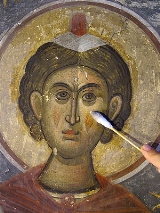
Conservation-restoration, also referred to as conservation, is a profession devoted to the preservation of cultural heritage
Cultural heritage
Cultural heritage is the legacy of physical artifacts and intangible attributes of a group or society that are inherited from past generations, maintained in the present and bestowed for the benefit of future generations...

 for the future. Conservation activities include examination, documentation, treatment, and preventive care
Preventive conservation
Preventive conservation is a specialization within the conservation profession, and it addresses concerns which apply to all disciplines within the field...

. All of this work is supported by research and education.
Discussion
Ask a question about 'Art conservation and restoration'
Start a new discussion about 'Art conservation and restoration'
Answer questions from other users
Full Discussion Forum
 
Unanswered Questions
Encyclopedia
Conservation-restoration, also referred to as conservation, is a profession devoted to the preservation of cultural heritage
Cultural heritage
Cultural heritage is the legacy of physical artifacts and intangible attributes of a group or society that are inherited from past generations, maintained in the present and bestowed for the benefit of future generations...

 for the future. Conservation activities include examination, documentation, treatment, and preventive care
Preventive conservation
Preventive conservation is a specialization within the conservation profession, and it addresses concerns which apply to all disciplines within the field...

. All of this work is supported by research and education.

Definition


The traditional definition of the role of the conservator involves the examination, conservation, and preservation of cultural heritage
Cultural heritage
Cultural heritage is the legacy of physical artifacts and intangible attributes of a group or society that are inherited from past generations, maintained in the present and bestowed for the benefit of future generations...

 using "any methods that prove effective in keeping that property in as close to its original condition as possible for as long as possible."

However, today the definition of the role of conservation has widened and would more accurately be described as that of ethical stewardship
Stewardship
Stewardship is an ethic that embodies responsible planning and management of resources. The concept of stewardship has been applied in diverse realms, including with respect to environment, economics, health, property, information, and religion, and is linked to the concept of sustainability...

.

The conservator applies some simple ethical guidelines, such as:
  • Minimal intervention.
  • Appropriate materials and methods that aim to be reversible to reduce possible problems with future treatment, investigation, and use.
  • Full documentation of all work undertaken.


In order for the conservator to apply their professional expertise accordingly, they must take into account the views of the stakeholder, the values
Values (heritage)
The values embodied in cultural heritage are identified in order to assess significance, prioritize resources, and inform conservation decision-making...

 and meaning of the object
Preservation of meaning
Preservation of meaning in library, archival or museum collections involves understanding spiritual, ritual, or cultural perceptions of value for specific objects, and ensuring these values are maintained and respected...

, and the physical needs of the material, in order to decide upon an appropriate conservation strategy.

Key dates


The tradition of conservation in Europe some consider to have begun in 1565 with the restoration of the Sistine Chapel frescoes
Restoration of the Sistine Chapel frescoes
The restoration of the frescoes of the Sistine Chapel was one of the most significant art restorations of the 20th century.The Sistine Chapel was built by Pope Sixtus IV within the Vatican immediately to the north of St. Peter's Basilica and completed in about 1481...

.

Brief history


The care for cultural patrimony has a long history within traditions of fixing and mending objects, and in individual restorations of artworks. During the 19th century, the fields of science and art became increasingly intertwined as scientists such as Michael Faraday began to study the damaging effects of the environment to works of art. Louis Pasteur carried out scientific analysis on paint during this time period as well. However, perhaps the first organised attempt to conserve cultural patrimony was the Society for the Protection of Ancient Buildings
Society for the Protection of Ancient Buildings
The Society for the Protection of Ancient Buildings was founded by William Morris, Philip Webb and J.J.Stevenson, and other notable members of the Pre Raphaelite brotherhood, in 1877, to oppose what they saw as the insensitive renovation of ancient buildings then occurring in Victorian...

 in the UK, influenced by the writings of John Ruskin
John Ruskin
John Ruskin was the leading English art critic of the Victorian era, also an art patron, draughtsman, watercolourist, a prominent social thinker and philanthropist. He wrote on subjects ranging from geology to architecture, myth to ornithology, literature to education, and botany to political...

 the society was founded by William Morris
William Morris
William Morris 24 March 18343 October 1896 was an English textile designer, artist, writer, and socialist associated with the Pre-Raphaelite Brotherhood and the English Arts and Crafts Movement...

 and Philip Webb
Philip Webb
Another Philip Webb — Philip Edward Webb was the architect son of leading architect Sir Aston Webb. Along with his brother, Maurice, he assisted his father towards the end of his career....

 in 1877. During the same period a movement with similar aims had also developed in France
France
The French Republic , The French Republic , The French Republic , (commonly known as France , is a unitary semi-presidential republic in Western Europe with several overseas territories and islands located on other continents and in the Indian, Pacific, and Atlantic oceans. Metropolitan France...

 under the direction of Eugène Viollet-le-Duc
Eugène Viollet-le-Duc
Eugène Emmanuel Viollet-le-Duc was a French architect and theorist, famous for his interpretive "restorations" of medieval buildings. Born in Paris, he was a major Gothic Revival architect.-Early years:...

 a French architect and theorist, famous for his "restorations" of medieval buildings.
Conservation, as a distinct field of study, initially developed in Germany, when in 1888 Friedrich Rathgen
Friedrich Rathgen
Friedrich Rathgen, was a German Chemist and a founder of Conservation science.-Biography:Friedrich Rathgen was born in Eckernförde, Schleswig-Holstein, on 2 June 1862. He began his formal education at the University of Göttingen in 1881 where he studied the natural sciences...

 became the first chemist
Chemist
A chemist is a scientist trained in the study of chemistry. Chemists study the composition of matter and its properties such as density and acidity. Chemists carefully describe the properties they study in terms of quantities, with detail on the level of molecules and their component atoms...

 to be employed by a Museum
Museum
A museum is an institution that cares for a collection of artifacts and other objects of scientific, artistic, cultural, or historical importance and makes them available for public viewing through exhibits that may be permanent or temporary. Most large museums are located in major cities...

, the Koniglichen Museen, Berlin (Royal Museums of Berlin). He not only developed a scientific approach to the care of objects in the collections, but disseminated this approach publishing a "Handbook of Conservation" in 1898. The early development of conservation in any area of the world is usually linked to the creation of positions for chemists within museums. However in the United Kingdom, pioneering research into painting materials and conservation, ceramics, and stone conservation was conducted by Arthur Pillans Laurie, academic chemist and Principal of Heriot Watt University from 1900. Laurie's interests were fostered by William Holman Hunt
William Holman Hunt
William Holman Hunt OM was an English painter, and one of the founders of the Pre-Raphaelite Brotherhood.-Biography:...

. In 1924 in the UK the chemist Harold Plenderleith
Harold Plenderleith
Harold Plenderleith was a Scottish art conservator and archaeologist.-Biography:Harold Plenderleith was born in Scotland on 19 September 1898....

 began to work at the British Museum
British Museum
The British Museum is a museum of human history and culture in London. Its collections, which number more than seven million objects, are amongst the largest and most comprehensive in the world and originate from all continents, illustrating and documenting the story of human culture from its...

 with Dr. Alexander Scott in the newly created Department of Scientific and Industrial Research, thus giving birth to the conservation profession in the UK. This department had been created by the museum to address objects in the collection that had begun to rapidly deteriorate as a result of being stored in the London Underground
London Underground
The London Underground is a rapid transit system serving a large part of Greater London and some parts of Buckinghamshire, Hertfordshire and Essex in England...

 tunnels during the First World War. The development of this department at the British Museum moved the focus for the development of conservation from Germany to Britain, and in 1956 Plenderleith wrote a significant handbook called The Conservation of Antiquities and Works of Art, it was this book rather than Rathgen's that is commonly seen as the major source for the development of conservation as we know it today.

In the United States
United States
The United States of America is a federal constitutional republic comprising fifty states and a federal district...

, the development of conservation can be traced to the Fogg Art Museum
Fogg Art Museum
The Fogg Museum, opened to the public in 1896, is the oldest of Harvard University's art museums. The Fogg joins the Busch-Reisinger Museum and the Arthur M. Sackler Museum as part of the Harvard Art Museums....

, and Edward Waldo Forbes, the Director of the Fogg from 1909 to 1944. He encouraged technical investigation, and was Chairman of the Advisory Committee for the first technical journal, Technical Studies, in the Field of the Fine Arts, published by the Fogg from 1932 to 1942. Importantly he also brought onto the museum staff chemists. Rutherford John Gettens was the first chemist
Chemist
A chemist is a scientist trained in the study of chemistry. Chemists study the composition of matter and its properties such as density and acidity. Chemists carefully describe the properties they study in terms of quantities, with detail on the level of molecules and their component atoms...

 in the U. S. to be permanently employed by an art museum. He worked with George L. Stout, the founder and first editor of Technical Studies. Gettens and Stout co-authored Painting Materials: A Short Encyclopaedia, first published in 1942 and reprinted in 1966. This compendium is still cited regularly. Only a few dates and descriptions in Gettens' and Stout's book are now outdated.

George T. Oliver, of Oliver Brothers Fine art Restoration and Conservation
Oliver Brothers Fine Art Restoration
Oliver Brothers Fine Art Restoration and Conservation is the longest continuously operating art restoration establishment in the United States...


(Est. 1850 in New York City) invented the vacuum hot table for relining paintings in 1920’s, he filed a patent for the table in 1937. Taylor's prototype table, which he designed and constructed, is still in operation.

The focus of conservation development then accelerated in Britain and America, and it was in Britain that the first International Conservation Organisations developed. The International Institute for Conservation of Historic and Artistic Works (IIC)
International Institute for Conservation
The International Institute for Conservation of Historic and Artistic Works is a global membership organisation for conservation professionals; with over two thousand members, in over fifty countries...

 was incorporated under British law in 1950 as "a permanent organization to co-ordinate and improve the knowledge, methods, and working standards needed to protect and preserve precious materials of all kinds." The rapid growth of conservation professional organizations, publications, journals, newsletters, both internationally and in localities, has spearheaded the development of the conservation profession, both practically and theoretically. Art historians and theorists such as Cesare Brandi
Cesare Brandi
Cesare Brandi was an art critic and historian, specialist in conservation-restoration theory....

 have also played a significant role in developing conservation-restoration theory. In recent years ethical concerns have been at the forefront of developments in conservation. Most significantly has been the idea of Preventive conservation. This concept is based in part on the pioneering work by Garry Thomson
Garry Thomson
Robert Howard Garry Thomson CBE, was a conservator and a Buddhist.-Biography:Robert Howard Garry Thomson was born on Carey Island, Malaya, where his father was a planter producing palm oil....

 CBE
CBE
CBE and C.B.E. are abbreviations for "Commander of the Order of the British Empire", a grade in the Order of the British Empire.Other uses include:* Chemical and Biochemical Engineering...

, and his book the Museum Environment, first published in 1978. Thomson was associated with the National Gallery (London), it was here that he established a set of guidelines or environmental controls for the best conditions in which objects could be stored and displayed within the Museum Environment. Although his exact guidelines are no longer rigidly followed they did inspire this field of conservation.

Ethics


The conservator's work is guided by ethical standards. These take the form of applied ethics
Applied ethics
Applied ethics is, in the words of Brenda Almond, co-founder of the Society for Applied Philosophy, "the philosophical examination, from a moral standpoint, of particular issues in private and public life that are matters of moral judgment"...

. Ethical standards have been established across the world, and national and international ethical guidelines have been written. One such example is:


Conservation OnLine's Ethical issues in conservation provides a number of articles on ethical issues in conservation; example of codes of ethics and guidelines for professional conduct in conservation and allied fields; and charters and treaties pertaining to ethical issues involving the preservation of cultural property.

Specialization within the profession


The profession of conservation-restoration is broad and encompasses many areas of speciality. Specialities may include:
  • Architectural conservation
    Architectural conservation
    Architectural conservation describes the process through which the material, historical, and design integrity of mankind's built heritage are prolonged through carefully planned interventions. The individual engaged in this pursuit is known as an architectural conservator...

    • Historic paint analysis
      Historic paint analysis
      Historic paint analysis is the scientific analysis of architectural finishes, including not only paints but also metallic finishes and clear and translucent finishes used on historic buildings. The primary purpose of such analysis is to determine the color of the finish used at a particular time in...

  • Book and paper conservation
  • Conservation science
    Conservation science
    Conservation science is the interdisciplinary study of cultural heritage conservation through the use of scientific inquiry and analytical equipment...

  • Electronic media conservation
    • Digital preservation
      Digital preservation
      Digital preservation is the set of processes, activities and management of digital information over time to ensure its long term accessibility. The goal of digital preservation is to preserve materials resulting from digital reformatting, and particularly information that is born-digital with no...

    • Film preservation
      Film preservation
      thumb|300px|Stacked containers filled with reels of [[film stock]]The film preservation, or film restoration, movement is an ongoing project among film historians, archivists, museums, cinematheques, and non-profit organizations to rescue decaying film stock and preserve the images which they contain...

    • Media preservation
      Media preservation
      Preservation of document, pictures, recordings, digital content, etc., is a major aspect of archival science. It is also an important consideration for people who are creating time capsules, family history, historical documents, scrapbooks and family trees...

    • Phonograph record preservation
  • Frame conservation
  • Furniture conservation
  • Ivory conservation
    Conservation of ivory
    Ivory carving is a decorative art or craft practised since prehistoric times. Its conservation is concerned particularly with the environmental causes of deterioration.-Ivory:...

  • Horological conservation
  • Metals conservation
    Metals conservation
    Metals conservation, or more precisely conservation-restoration of metals is the activity devoted to the protection and preservation of historical and archaeological objects made partly or entirely of metal...

  • Natural science conservation
  • Object conservation
    Object conservation
    Object conservation involves the preservation of three dimensional works of art. This type of conservator is differentiated from other specialists because they treat a broad range of objects and material types...

     (archaeological, ethnographic, and sculptural)
  • Paintings conservation
  • Photograph conservation
    Photograph conservation
    Photograph conservation is the study of the physical care and treatment of photographic materials, including an in-depth understanding of how photographs are made, and the causes and prevention of deterioration. Conservators use this knowledge to treat photographic materials, stabilizing them from...

  • Preventive conservation
    Preventive conservation
    Preventive conservation is a specialization within the conservation profession, and it addresses concerns which apply to all disciplines within the field...

  • Stained glass conservation
    Stained glass conservation
    Stained glass conservation refers to the protection and preservation of historic stained glass for present and future generations. It involves any and all actions devoted to the prevention, mitigation, or reversal of the processes of deterioration that affect such glass works and subsequently...

  • Textile conservation
    Textile preservation
    Textile preservation refers to the processes by which textiles are cared for and maintained to be preserved from future damage. The field falls under the category of art conservation as well as library preservation, depending on the type of collection...

  • Variable art conservation
    New media art preservation
    New media art preservation, a form of Art conservation, is the study and practice of techniques for sustaining artworks created using digital, biological, performative, and other variable media....


Preventive conservation


Many cultural works are sensitive to environmental conditions such as temperature
Temperature
Temperature is a physical property of matter that quantitatively expresses the common notions of hot and cold. Objects of low temperature are cold, while various degrees of higher temperatures are referred to as warm or hot...

, humidity
Humidity
Humidity is a term for the amount of water vapor in the air, and can refer to any one of several measurements of humidity. Formally, humid air is not "moist air" but a mixture of water vapor and other constituents of air, and humidity is defined in terms of the water content of this mixture,...

 and exposure to light
Light
Light or visible light is electromagnetic radiation that is visible to the human eye, and is responsible for the sense of sight. Visible light has wavelength in a range from about 380 nanometres to about 740 nm, with a frequency range of about 405 THz to 790 THz...

 and ultraviolet
Ultraviolet
Ultraviolet light is electromagnetic radiation with a wavelength shorter than that of visible light, but longer than X-rays, in the range 10 nm to 400 nm, and energies from 3 eV to 124 eV...

 light. They must be protected in a controlled environment where such variables are maintained within a range of damage-limiting levels. Shielding from sunlight of artifacts such as watercolour paintings for example is usually necessary to prevent fading of pigments.

Preventive conservation is an important element of museum policy and collections care. It is an essential responsibility of members of the museum profession to create and maintain a protective environment for the collections in their care, whether in store, on display, or in transit. A museum should carefully monitor the condition of collections to determine when an artifact requires conservation work and the services of a qualified conservator.


Interventive conservation


Interventive Conservation refers to any act by a conservator that involves a direct interaction between the conservator and the cultural material. These interventive treatments could involve cleaning, stabilizing, repair, or even replacement of parts of the original object. It is essential that the conservator should fully justify any such work. Complete documentation of the work; carried out before, during, and after the treatment rules out chances of later doubts.

The principal goal of a conservator is to nullify or at least reduce the rate of deterioration of an object, this can be achieved through either non-interventive or interventive methodologies. Interventive methodologies include all those actions taken by the conservator to directly intervene with the material fabric of the object. Such actions include surface cleaning such as varnish removal, or consolidation such as securing flaking paint. Such interventive actions are carried out for a variety of reasons including; aesthetic choices, Stabilization needs for structural integrity, or for cultural requirements for intangible continuity.

One of the guiding principles of conservation has traditionally been the idea of reversibility, that is that all interventions with the object should be fully reversible, and the object should be able to be returned to the state in which it was prior to the conservators intervention. Although this concept remains a guiding principle of the profession, it is a concept that has been widely critiqued within the conservation profession and is now considered by many to be "a fuzzy concept". Another important principle of conservation is that all alterations should be well documented and should be clearly distinguishable from the original object.

An example of a highly publicized interventive conservation effort would be the conservation work conducted on the Sistine Chapel
Restoration of the Sistine Chapel frescoes
The restoration of the frescoes of the Sistine Chapel was one of the most significant art restorations of the 20th century.The Sistine Chapel was built by Pope Sixtus IV within the Vatican immediately to the north of St. Peter's Basilica and completed in about 1481...

.

The conservation laboratory


Conservators routinely use chemical and scientific analysis for the examination and treatment of cultural works. The modern conservation lab uses equipment such as microscope
Microscope
A microscope is an instrument used to see objects that are too small for the naked eye. The science of investigating small objects using such an instrument is called microscopy...

s, spectrometer
Spectrometer
A spectrometer is an instrument used to measure properties of light over a specific portion of the electromagnetic spectrum, typically used in spectroscopic analysis to identify materials. The variable measured is most often the light's intensity but could also, for instance, be the polarization...

s, and x-ray
X-ray
X-radiation is a form of electromagnetic radiation. X-rays have a wavelength in the range of 0.01 to 10 nanometers, corresponding to frequencies in the range 30 petahertz to 30 exahertz and energies in the range 120 eV to 120 keV. They are shorter in wavelength than UV rays and longer than gamma...

 machines to better understand objects and their components. The data thus collected helps in deciding the conservation treatments to be provided to the object.

United States


Heritage Preservation, in partnership with the Institute of Museum and Library Services
Institute of Museum and Library Services
The Institute of Museum and Library Services is an independent agency of the United States federal government established in 1996. It is the main source of federal support for libraries and museums within the United States, having the mission to "create strong libraries and museums that connect...

, a U.S. federal agency, produced The Heritage Health Index. The results of this work was the report A Public Trust at Risk: The Heritage Health Index Report on the State of America's Collections, which was published in December 2005 and concluded that immediate action is needed to prevent the loss of 190 million artifacts that are in need of conservation treatment. The report made four recommendations:
  • Institutions must give priority to providing safe conditions for the collections they hold in trust.
  • Every collecting institution must develop an emergency plan to protect its collections and train staff to carry it out.
  • Every institution must assign responsibility for caring for collections to members of its staff.
  • Individuals at all levels of government and in the private sector must assume responsibility for providing the support that will allow these collections to survive

United Kingdom


In October 2006, the Department for Culture, Media and Sport
Department for Culture, Media and Sport
The Department for Culture, Media and Sport is a department of the United Kingdom government, with responsibility for culture and sport in England, and some aspects of the media throughout the whole UK, such as broadcasting and internet....

, a governmental department, authored a document: "Understanding the Future: Priorities for England's Museums". This document was based on several years of consultation aimed to lay out the government's priorities for museums in the 21st century.

The document listed the following as priorities for the next decade:
  1. Museums will fulfil their potential as learning resources (pp 7–10).
    • Museums will be embedded into the delivery of education in every school in the country.
    • Understanding of the effectiveness of museum education will be improved further and best practice built into education programmes.
    • The value of museums' collections as a research resource will be well understood and better links built between the academic community and museums.
  2. Museums will embrace their role in fostering, exploring, celebrating and questioning the identities of diverse communities (pp 11–14).
    • The sector needs to work with partners in academia and beyond to create an intellectual framework supporting museums' capacity to tackle issues of identity.
    • The museum sector must continue to develop improved practical techniques for engaging communities of all sorts.
  3. Museums' collections will be more dynamic and better used (pp 15–18).
    • Government and the sector will find new ways to encourage museums to collect actively and strategically, especially the record of contemporary society.
    • The sector will develop new collaborative approaches to sharing and developing collections and related expertise.
  4. Museums' workforces will be dynamic, highly skilled and representative (pp 17–22).
    • Museums' governing bodies and workforces will be representative of the communities they serve.
    • Find more varied ways for a broader range of skills to come into museums.
    • Improve continuing professional development.
  5. Museums will work more closely with each other and partners outside the sector (pp 23–26).
    • A consistent evidence base of the contribution of all kinds of museums to the full range of public service agendas will be developed.
    • There will be deeper and longer lasting partnerships between the national museums and a broader range of regional partners.
    • Museums' international roles will be strengthened to improve museum programmes in this country and Britain's image, reputation and relationships abroad.


The conservation profession response to this report was on the whole less than favourable, the Institute of Conservation
Institute of Conservation
The Institute of Conservation is the lead voice for the conservation of cultural heritage in the UK, with over three thousand individuals and organizations in membership, including professional conservators in all disciplines as well as others who share a commitment to improving the understanding...

 (ICON) published their response under the title "A Failure of Vision". It had the following to say:

Concluding:

Further to this the ICON website summary report lists the following specific recommendations:
  • A national survey to find out what the public want from museums, what motivates them to visit them and what makes for a rewarding visit.
  • A review of survey results and prioritisation of the various intrinsic, instrumental and institutional values to provide a clear basis for a 10-year strategy
  • HR consultants to be brought in from the commercial sector to review recruitment, career development and working practices in the national and regional museums.
  • A commitment to examine the potential for using Museum Accreditation as a more effective driver for improving recruitment, diversity, and career development across the sector.
  • DCMS to take full account of the eventual findings of the current Commons Select Committee enquiry into Care of Collections in the final version of this document
  • The adoption of those recommendations of the recent House of Lords enquiry into Science and Heritage which have a potential impact on the future of museums.


In November 2008, the UK based think tank
Think tank
A think tank is an organization that conducts research and engages in advocacy in areas such as social policy, political strategy, economics, military, and technology issues. Most think tanks are non-profit organizations, which some countries such as the United States and Canada provide with tax...

 Demos
Demos (UK think tank)
- History :Demos was founded in 1993 by former Marxism Today editor Martin Jacques, and Geoff Mulgan, who became its first director. It was formed in response to what Mulgan, Jacques and others saw as a crisis in politics in Britain, with voter engagement in decline and political institutions...

 published an influential pamphlet entitled 'It's a material world: caring for the public realm', in which they argue for integrating the public directly into efforts to conserve material culture, particularly that which is in the public, their argument, as stated on page 16, demonstrates their belief that society can benefit from conservation as a paradigm as well as a profession:

Training


Training in conservation for many years took the form of an apprenticeship
Apprenticeship
Apprenticeship is a system of training a new generation of practitioners of a skill. Apprentices or protégés build their careers from apprenticeships...

, whereby an apprentice slowly developed the necessary skills to undertake their job. For some specializations within conservation this is still the case. However, it is more common in the field of conservation today that the training required to become a practicing conservator comes from a recognized university course in conservation.

The University can rarely provide all the necessary training in first hand experience that an apprenticeship can, and therefore in addition to graduate level training the profession also tends towards encouraging conservation students to spend time as an intern
Intern
Internship is a system of onthejob training for white-collar jobs, similar to an apprenticeship. Interns are usually college or university students, but they can also be high school students or post graduate adults seeking skills for a new career. They may also be as young as middle school or in...

.

Conservation is an Interdisciplinary field as conservators have backgrounds in the fine arts, sciences (including chemistry
Chemistry
Chemistry is the science of matter, especially its chemical reactions, but also its composition, structure and properties. Chemistry is concerned with atoms and their interactions with other atoms, and particularly with the properties of chemical bonds....

, biology
Biology
Biology is a natural science concerned with the study of life and living organisms, including their structure, function, growth, origin, evolution, distribution, and taxonomy. Biology is a vast subject containing many subdivisions, topics, and disciplines...

, and materials science
Materials science
Materials science is an interdisciplinary field applying the properties of matter to various areas of science and engineering. This scientific field investigates the relationship between the structure of materials at atomic or molecular scales and their macroscopic properties. It incorporates...

), and closely related disciplines, such as art history
Art history
Art history has historically been understood as the academic study of objects of art in their historical development and stylistic contexts, i.e. genre, design, format, and style...

, archaeology
Archaeology
Archaeology, or archeology , is the study of human society, primarily through the recovery and analysis of the material culture and environmental data that they have left behind, which includes artifacts, architecture, biofacts and cultural landscapes...

, studio art
Studio art
Studio art is made of art and studio, and the term has several implications depending on the context used. The term encompasses all art forms, be they performing or visual.-Definition:...

, and anthropology
Anthropology
Anthropology is the study of humanity. It has origins in the humanities, the natural sciences, and the social sciences. The term "anthropology" is from the Greek anthrōpos , "man", understood to mean mankind or humanity, and -logia , "discourse" or "study", and was first used in 1501 by German...

. They also have design, fabrication, artistic, and other special skills necessary for the practical application of that knowledge.

Within the various schools that teach conservation, the approach differs according to the educational and vocational system within the country, and the focus of the school itself. This is acknowledged by the American Institute for Conservation
American Institute for Conservation
The American Institute for Conservation of Historic and Artistic Works supports the conservation professionals who preserve our cultural heritage...

 who advise "Specific admission requirements differ and potential candidates are encouraged to contact the programs directly for details on prerequisites, application procedures, and program curriculum".

Art selection


Due to the large quantities of artwork in modern times, there have debates as to whether all art is actually worth preserving.

Associations and professional organizations


Societies devoted to the care of cultural heritage have been in existence around the world for many years. One early example is the founding in 1877 of the Society for the Protection of Ancient Buildings
Society for the Protection of Ancient Buildings
The Society for the Protection of Ancient Buildings was founded by William Morris, Philip Webb and J.J.Stevenson, and other notable members of the Pre Raphaelite brotherhood, in 1877, to oppose what they saw as the insensitive renovation of ancient buildings then occurring in Victorian...

 in Britain to protect the built heritage, this society continues to be active today.

The built heritage was also at the forefront of the growth of member based organizations in the United States
United States
The United States of America is a federal constitutional republic comprising fifty states and a federal district...

 for example, founded in 1889, the Richmond, Virginia-based Preservation Virginia (formerly known as the Association for the Preservation of Virginia Antiquities) was the United States' first statewide historic preservation group. In 2003, it changed its name to reflect its wider focus in statewide preservation issues.

Today, professional conservators join and take part in the activities of numerous conservation associations and professional organizations with the wider conservation field, and within their area of specialization.

These organizations exist to "support the conservation professionals who preserve our cultural heritage".

This involves upholding professional standards, promoting research and publications, providing educational opportunities, and fostering the exchange of knowledge among conservators, allied professionals, and the public.

International cultural heritage documents

Year Document Sponsor Text (English where available)
1931 Athens Charter
Athens Charter (Preservation)
The Athens Charter for the Restoration of Historic Monuments is a seven point manifesto adopted at the First International Congress of Architects and Technicians of Historic Monuments in Athens in 1931.- Manifesto :...

International Congress of Architects and Technicians of Historic Monuments text
1931 Carta Di Atene Conferenza Internazionale di Atene text (Italian)
1932 Carta Italiana del restauro Consiglio Superiore Per Le Antichità e Belle Arti text (Italian)
1933 Charter of Athens
Athens Charter
The Athens Charter, or Charte d'Athènes was a document about urban planning published by the Swiss architect, Le Corbusier in 1943. The work was based upon Le Corbusier’s Ville Radieuse book of 1935 and urban studies undertaken by the Congrès International d'Architecture Moderne in the early...

IV CIAM
Congrès International d'Architecture Moderne
The Congrès internationaux d'architecture moderne – CIAM was an organization founded in 1928 and disbanded in 1959, responsible for a series of events and congresses arranged around the world by the most prominent architects of the time, with the objective of spreading the principles of the Modern...

text
1956 New Delhi Recommendation IX UNESCO
UNESCO
The United Nations Educational, Scientific and Cultural Organization is a specialized agency of the United Nations...

text, text
1962 Paris Recommendation XII UNESCO
UNESCO
The United Nations Educational, Scientific and Cultural Organization is a specialized agency of the United Nations...

text
1964 Venice Charter
Venice Charter
The Venice Charter for the Conservation and Restoration of Monuments and Sites is a treaty that gives an international framework for the preservation and restoration of ancient buildings...

II International Congress of Architects and Technicians of Historic Monuments text, text
1964 Paris Recommendation XIII UNESCO
UNESCO
The United Nations Educational, Scientific and Cultural Organization is a specialized agency of the United Nations...

text
1967 Norms of Quito OAS
Organization of American States
The Organization of American States is a regional international organization, headquartered in Washington, D.C., United States...

text (Spanish), text
1968 Paris Recommendation XV UNESCO
UNESCO
The United Nations Educational, Scientific and Cultural Organization is a specialized agency of the United Nations...

text
1972 Paris Convention XVII UNESCO
UNESCO
The United Nations Educational, Scientific and Cultural Organization is a specialized agency of the United Nations...

text
1972 Paris Recommendation XVII UNESCO
UNESCO
The United Nations Educational, Scientific and Cultural Organization is a specialized agency of the United Nations...

text
1972 Carta Italiana del Restauro text (Italian)
1972 Stockholm Declaration UNEP text
1974 Santo Domingo Resolution, Dominican Republic Interamerican Seminar on the Conservation and Restoration of the Architectural Heritage of the Colonial and Republican Periods - OAS
Organization of American States
The Organization of American States is a regional international organization, headquartered in Washington, D.C., United States...

text (Portuguese), text (Portuguese)
1975 Declaration of Amsterdam Congress on the European Architectural Heritage text
1975 European Charter of the Architectural Heritage Council of Europe
Council of Europe
The Council of Europe is an international organisation promoting co-operation between all countries of Europe in the areas of legal standards, human rights, democratic development, the rule of law and cultural co-operation...

text
1976 Charter on Cultural Tourism, Brussels International Seminar on Contemporary Tourism and Humanism text
1976 Nairobi Recommendation XIX UNESCO
UNESCO
The United Nations Educational, Scientific and Cultural Organization is a specialized agency of the United Nations...

text
1977 Machu Picchu Charter text (Portuguese), text (Portuguese), text (Spanish), ref (Spanish)
1981 Burra Charter
Burra Charter
The Burra Charter defines the basic principles and procedures to be followed in the conservation of Australian heritage places.In 1979, the Australia ICOMOS Charter for the Conservation of Places of Cultural Significance was adopted at a meeting of Australia ICOMOS at the historic mining town of...

ICOMOS text
1982 Florence Charter ICOMOS: Historic Gardens text, text
1982 Nairobi Declaration UNEP text
1982 Tlaxcala Declaration ICOMOS text
1982 México Declaration World Conference on Cultural Policies - MONDIACULT text, text
1983 Declaration of Rome ICOMOS text
1987 Carta della conservazione e del restauro degli oggetti d'arte e di cultura text (Italian)
1987 Washington Charter ICOMOS text, text
1989 Paris Recommendation XXV UNESCO
UNESCO
The United Nations Educational, Scientific and Cultural Organization is a specialized agency of the United Nations...

text
1990 Lausanne Charter ICOMOS / ICAHM text, text
1994 Nara Document UNESCO
UNESCO
The United Nations Educational, Scientific and Cultural Organization is a specialized agency of the United Nations...

 / ICCROM / ICOMOS
text, text
1995 European Recommendation Council of Europe
Council of Europe
The Council of Europe is an international organisation promoting co-operation between all countries of Europe in the areas of legal standards, human rights, democratic development, the rule of law and cultural co-operation...

, Committee of Ministers
Committee of Ministers
The Committee of Ministers of the Council of Europe or commonly the Committee of Ministers is the Council of Europe's decision-making body. It comprises the Foreign Affairs Ministers of all the member states, or their permanent diplomatic representatives in Strasbourg...

text (Rec(95)3E),
text (Rec(95)9E)
1996 Declaration of San Antonio ICOMOS text
1997 Declaration of Sofia XI ICOMOS or XXIX UNESCO
UNESCO
The United Nations Educational, Scientific and Cultural Organization is a specialized agency of the United Nations...

text
1997 Carta de Mar del Plata Mercosul text (Portuguese), text (Portuguese), text (Spanish), text (Spanish)
2000 Cracow Charter text (Italian)
2002 Declaration of Cartagena de Indias, Colômbia Conselho Andino, OAS
Organization of American States
The Organization of American States is a regional international organization, headquartered in Washington, D.C., United States...

text
2003 Paris Recommendation XXXII UNESCO
UNESCO
The United Nations Educational, Scientific and Cultural Organization is a specialized agency of the United Nations...

text

External lists


External lists of international cultural heritage documents:


Further reading


General resources


Scholarly journals


Relation to the public


Conservators in private practice that provide resources

  • Animation Art Conservation discusses the preservation of animation art and has many interviews with animation artists that detail their original intent and frequently how they made their art.
  • Conrad Schmitt Studios
    Conrad Schmitt Studios
    Conrad Schmitt Studios is an architectural arts studio located in New Berlin, Wisconsin. It provides ecclesiastical art, stained glass artistry, art glass, decorative painting, mosaics, murals and sculptural arts. The studio specializes in restoration services for buildings of architectural,...

    has been conserving artwork for buildings of architectural, historic, and religious significance since 1889.
  • EverGreene Architectural Arts, Inc. specializes in conservation and restoration practices globally.
  • Oliver Brothers Fine Art Restoration and Conservation, Boston-New York has been restoring and conserving paintings, works on paper, icons, murals, sculpture, gilded objects, and antique and contemporary picture frames since 1850.