
All Topics  
Art and architecture of Assyria

 
Art and Architecture of Assyria

   Email Print
   Bookmark   Link


Art and architecture of Assyria


Assyria
Assyria

Assyria was a political state centered on the Upper Tigris river, in Mesopotamia , that came to rule regional empires a number of times in history....
 flourished from the Old Assyrian period in the Middle Bronze Age until the Neo-Assyrian Empire
Neo-Assyrian Empire

The Neo-Assyrian Empire was a period of Mesopotamian history which began in 934 BC and ended in 609 BC. During this period, Assyria assumed a position as a great regional power, vying with Babylonia and other lesser powers for dominance of the region, though not until the reforms of Tiglath-Pileser III in the 8th century BC, did it become a p...
 in the Early Iron Age. Assyrians used art to not only educate and shape their own society and to establish human identity, but they also used art to influence other societies around them. Assyrian rulers found that if a society engages in creating and preserving culture through art, the society flourishes internally and spreads its influence through other regions.

Palace-Temples of Khorsabad, Nimroud and Kouyunjik
The capital, Ninus or Nineveh, was taken by the Medes under Cyaxares, and some 200 years after Xenophon passed over its site, then mere mounds of earth.


Discussion
Ask a question about 'Art and architecture of Assyria'
Start a new discussion about 'Art and architecture of Assyria'
Answer questions from other users
Full Discussion Forum


Recent Posts


Encyclopedia


Assyria
Assyria

Assyria was a political state centered on the Upper Tigris river, in Mesopotamia , that came to rule regional empires a number of times in history....
 flourished from the Old Assyrian period in the Middle Bronze Age until the Neo-Assyrian Empire
Neo-Assyrian Empire

The Neo-Assyrian Empire was a period of Mesopotamian history which began in 934 BC and ended in 609 BC. During this period, Assyria assumed a position as a great regional power, vying with Babylonia and other lesser powers for dominance of the region, though not until the reforms of Tiglath-Pileser III in the 8th century BC, did it become a p...
 in the Early Iron Age. Assyrians used art to not only educate and shape their own society and to establish human identity, but they also used art to influence other societies around them. Assyrian rulers found that if a society engages in creating and preserving culture through art, the society flourishes internally and spreads its influence through other regions.

Architecture


Palace-Temples of Khorsabad, Nimroud and Kouyunjik


The capital, Ninus or Nineveh, was taken by the Medes under Cyaxares, and some 200 years after Xenophon passed over its site, then mere mounds of earth. It remained buried until 1845, when Botta and Layard discovered the ruins of the Assyrian cities. The principal remains are those of Khorsabad, 10 miles N.E. of Mosul; of Nimroud, supposed to be the ancient Calah; and of Kouyunjik, in all probability the ancient Nineveh. In these cities are found fragments of several great buildings which seem to have been palace-temples. They were constructed chiefly of sun-dried bricks, and all that remains of them is the lower part of the walls, decorated with sculpture and paintings, portions of the pavements, a few indications of the elevation, and some interesting works connected with the drainage, &c.

The structures were built usually on artificial mounds, and approached, it is supposed, by great flights of steps (of which remains composed of black basalt have been found at Khorsabad). They consist of series of halls and chambers of no great size, the largest hall in Sennacherib’s palace at Kouyunjik being only 200 feet by 45 feet, where as Westminster Hall is 268 feet by 68 feet. In their proportions they are utterly unlike Egyptian structures, and they display the striking peculiarity of being elongated beyond anything known in other styles of architecture; e.g., one of the Kouyunjik halls is 122 feet long by 27 wide, another is 218 feet long by 25 wide. The great hall at Nimroud, though 162 feet by 62, was divided lengthwise in the centre by a wall 12 feet thick, leaving each side only 25 feet wide. Another peculiarity of these structures is the immense thickness of the walls. Those of the Kouyunjik hall (27 feet wide) were 15 feet thick, and those of Nimroud (32 feet wide) were 26 feet thick. It has, indeed, been reckoned by Mr. Fergusson, that in some of the palaces the area of the walls is as great as that of the chambers. The reason he suggests for this is that these thick walls supported a double row of columns as a clerestory under the roof, so arranged as to give light and air, while excluding the rays of the sun. he covers the halls with flat roofs, supported on columns, which being of wood have rotted or been burnt. An entirely different theory is that of M. Flandin, who studied the subject on the spot. He believes that the halls were vaulted and had small windows at the springing. M. Victor Place has found at Khorsabad several vaults, and also terra cotta tubes, through which he believes that the vaults were lighted, just as domes were in Persia in later times. But no vault has been found large enough to span any of the wide Assyrian halls. Of their elevations there are few traces remaining. At Nimroud, what is supposed to be the tomb of Sardanapalus has its lower part, which is about 20 feet high, of solid masonry, and the rest of burnt bricks. It has slightly projecting piers, but no ornaments or mouldings. At Khorsabad and the SE palace of Nimroud there is some attempt at decoration, by rude semi-columns, without capitals or bases, arranged in clusters of seven, side by side, the groups being separated by recesses. A few detached pieces of moulding have been found at Khorsabad, but of the very simplest kind, and we have no vestiges of capital or entablature.

Design of Assyrian Buildings, Fortifications, Temples


The plans of all the Assyrian buildings are rectangular, and we know that long ago, as now, the Eastern architects used this outline almost invariably, and upon it reared some of the most lovely and varied forms ever devised. They gather over the angles by graceful curves, and on the basis of an ordinary square hall carry up a minaret or a dome, an octagon or a circle. That this was sometimes done in Assyria is shown by the sculptures. Slabs from Kouyunjik show domes of varied form, and tower-like structures, each rising from a square base. The resemblance between the ancient form of the dome and those still used in the Assyrian villages is very striking. Whether sloping roofs were used is uncertain. Mr. Bonomi believes that they were, and a few sculptures seem to support his view. Of the private houses nothing, of course, remains; but they are represented on the slabs as being of several stories in height, the ground floor as usual having only a door and no windows. All have flat roofs, and we gather from one of the bas-reliefs, which represents a town on fire, that these roofs were made, just as they now are, with thick layers of earth on strong beams. These roofs are well-nigh fire proof, and the flames are represented as stopped by them, and coming out of the windows. No remains of a window, or, so far as we are aware, of an internal staircase, have been found.

Of the fortifications we know much more. In the north wall of Nimroud fifty-eight towers have been traced, and at Kouyunjik there are large remains of three walls, the lower part being of stone, and the upper of sun-dried bricks. At Khorsabad there are the remains of a wall, still 40 feet high, built of blocks of stone 3 to 4 feet thick, and the evidences wanting as to finishing of these is completely supplied by the sculptures, which show an extraordinary resemblance to mediaeval works of the same class. Tier upon tier of walls are represented, enclosing a great tower or keep in the centre. The entrances are great arched gateways flanked by square towers. These and the other towers have overhanging parapets just like the mediaeval machicolations, and are finished at top with battlements, remains of which have been found at Nimroud and Kouyunjik, and at Kale Shortage, the supposed capital of Assyria before Nineveh.

Of temples distinct from the palace we have a few supposed remains, but little is absolutely known as to their general form.

But in Chaldea there are some enormous masses of ruins, evidently remains of the vast mounds which formed the substructure of their temples. The grandest of all these and the most interesting is the Bis Nimroud, near Babylon, which has been identified as the temple of the Seven Spheres at Boris. This was reconstructed by Nebuchadnezzar, as appears by a well-known inscription. Another example is at Muggier, which was 198 feet by 133 feet at the base, and is even now 70 feet high, and it is clear that both it and the Bis were built with diminishing stages, presenting a series of grand platforms, decreasing in length as they ascended, and leaving a comparatively small one at top for the temple cell. This has been found, it is supposed, at the Birs Nimroud, of vitrified brick.

Building materials


In Babylonia, an abundance of brick, and lack of stone, led to greater use of mudbrick
Mudbrick

A mudbrick is a firefree brick made of clay, or mud mixed with a binding material such as rice husks or straw.In warm regions with very little timber available to fuel a kiln, bricks were generally sun dried....
; Babylonian temples are massive structures of crude brick, supported by buttress
Buttress

A buttress is an architecture structure built against or projecting from a wall which serves to support or reinforce the wall. Buttresses are fairly common on more ancient buildings, especially in Germany, as a means of providing support to act against the lateral forces arising out of the roof structures that lack adequate bracing....
es, the rain being carried off by drains. One such drain at Ur
Ur

Ur is modern Tell el-Mukayyar, Iraq, and was a city in ancient Sumer. Once a coastal city near the mouth of the then Euphrates river on the Persian Gulf, Ur is now well inland....
 was made of lead. The use of brick led to the early development of the pilaster
Pilaster

A pilaster is a slightly-projecting column built into or applied to the face of a wall. Most commonly flattened or rectangular in form, pilasters can also take a half-round form or the shape of any type of column, including tortile....
 and column, and of fresco
Fresco

Fresco is any of several related painting types, done on plaster on walls or ceilings. The word fresco comes from the Italian word affresco which derives from the adjective fresco , which has Latin origins....
es and enamelled tiles. The walls were brilliantly coloured, and sometimes plated with zinc
Zinc

Zinc is a metallic chemical element with the symbol Zn and atomic number 30. It is a first-row transition metal of the group 12 element of the periodic table....
 or gold, as well as with tiles. Painted terra-cotta cones for torches were also embedded in the plaster. Assyria, imitating Babylonian architecture, also built its palaces and temples of brick, even when stone was the natural building material of the country — faithfully preserving the brick platform, necessary in the marshy soil of Babylonia, but little needed in the north.

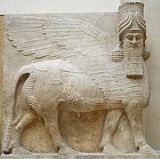
Human Headed Winged Bull Facing
As time went on, however, later Assyrian architects began to shake themselves free of Babylonian influence, and to use stone as well as brick. The walls of Assyrian palaces were lined with sculptured and coloured slabs of stone, instead of being painted as in Chaldea
Chaldea

Chaldea , "the Chaldees" of the King James Version of the Bible Old Testament, was a Hellenistic designation for a part of Babylonia, mainly around Sumerian Ur, which became an independent kingdom under the Chaldees....
. Three stages may be traced in the art of these bas-reliefs: it is vigorous but simple under Ashurnasirpal II, careful and realistic under Sargon II
Sargon II

Sargon II was an Neo-Assyrian Empiren king. Sargon II became co-regent with Shalmaneser V in 722 BC, and became the sole ruler of the kingdom of Assyria in 722 BC after the death of Shalmaneser V....
, and refined but wanting in boldness under Ashurbanipal
Ashurbanipal

Ashurbanipal , the son of Esarhaddon, was the last great monarch of the Neo-Assyrian Empire. He established the first systematically organized library in the ancient Middle East, the Library of Ashurbanipal, which survives in part today at Nineveh....
.

In Babylonia, in place of the bas relief, there is greater use of three-dimensional figures in the round — the earliest examples being the statues from Telloh, that are realistic if somewhat clumsy. The paucity of stone in Babylonia made every pebble precious, and led to a high perfection in the art of gem-cutting. Two seal-cylinders from the age of Sargon of Akkad
Sargon of Akkad

Sargon of Akkad, also known as Sargon the Great , was an Akkadian Empire emperor famous for his conquest of the Sumerian city-states in the 24th and 23rd centuries BC....
 are among the best examples of their kind. One of the first remarkable specimens of early metallurgy
Metallurgy

Metallurgy is a domain of materials science that studies the physical and chemical behavior of metallic Chemical element, their intermetallics, and their mixtures, which are called alloys....
 to be discovered by archaeologists is the silver vase of Entemena
Entemena

File:Foundation nail Entemena Louvre AO22934.jpgEntemena, son of En-anna-tum I, reestablished Lagash as a power in Sumer. He defeated Illi of Umma, with the aid of Lugal-kinishe-dudu of Uruk, successor to Enshakushanna, who is in the Sumerian king list ....
. At a later epoch, great excellence was attained in the manufacture of such jewellery as earrings and bracelets of gold. Copper, too, was worked with skill; indeed, it is possible that Babylonia was the original home of copper-working.

The people were famous at an early date for their embroideries and rugs. The forms of Assyrian pottery are graceful; the porcelain, like the glass discovered in the palaces of Nineveh
Nineveh

Nineveh , an "exceeding great city", as it is called in the Book of Jonah, lay on the eastern bank of the Tigris in ancient Assyria, across the river from the modern-day major city of Mosul, Iraq....
, was derived from Egyptian models. Transparent glass seems to have been first introduced in the reign of Sargon. Stone, clay and glass were used to make vases, and vases of hard stone have been dug up at Telloh similar to those of the early dynastic period of Egypt.

Sculptures, Bas-Reliefs


The sculptures lined the sides of the halls to a height of 10 feet. In them we see columns with both base and capital, and surmounted by entablatures. Sometimes the columns are combined with pilasters, as in the Greek porticos in antis. In one specimen the columns were carried on the back of bulls, as is shown by one of the bas-reliefs, and, more conclusively still, by the beautiful small model of a winged bull brought to England by Mr. George Smith, which has carved upon its back a base, just as is shown on the slabs.

In these bas-reliefs we have further-
1. The façade of a palace, having at top a grand row of window openings divided by Ionic columns.
2. A small building on the banks of a river, having two columns with bases and a kind if Ionic capitals, between two plain pilasters, and with rude indications of a cornice.
3. Another facade of two columns, with bases, and Corinthian capitals, between two pilasters, likewise with capitals. Over these is an entablature, somewhat rudely worked, but clearly showing architrave, frieze, and cornice, and antefixae over.
The latest of these slabs must have been carved many years before the earliest date assigned to any known Greek work. In view of these and similar remains the following words of Niebuhr are memorable: - "There is a want in Grecian art which no man living can supply. There is not enough in Egypt to account for the peculiar art and mythology of Greece. But those who live after me will see on the banks of the Tigris and Euphrates the origin of Grecian mythology and art."

Art


An Assyrian artistic style distinct from that of Babylonian art (see Sumerian and Babylonian art ), which was the dominant contemporary art in Mesopotamia, began to emerge c.1500 BC and lasted until the fall of Nineveh in 612 BC The characteristic Assyrian art form was the polychrome carved stone relief that decorated imperial monuments. The precisely delineated reliefs concern royal affairs, chiefly hunting and war making. Predominance is given to animal forms, particularly horses and lions, which are magnificently represented in great detail. Human figures are comparatively rigid and static but are also minutely detailed, as in triumphal scenes of sieges, battles, and individual combat. Among the best known of Assyrian reliefs are the lion-hunt alabaster carvings showing Assurnasirpal II (9th cent. BC) and Assurbanipal (7th cent. BC), both of which are in the British Museum. Guardian animals, usually lions and winged beasts with bearded human heads, were sculpted partially in the round for fortified royal gateways, an architectural form common throughout Asia Minor. At Nimrud carved ivories and bronze bowls were found that are decorated in the Assyrian style but were produced by Phoenician and Aramaean artisans. Exquisite examples of Assyrian relief carving may be seen at the British and Metropolitan museums.

See also

  • Babylonia and Assyria
    Babylonia and Assyria

    During the period when they were competing for dominance in Mesopotamia, the neighbouring sister-states of Babylonia and Assyria differed essentially in character....
  • Sumerian architecture
    Sumerian architecture

    The Sumerians were people who lived in Mesopotamia from the 4th millennium BC to the 3rd millennium BC. Their accomplishments include, the invention of urban planning, the courtyard house, and the Ziggurats ....