

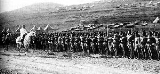
Army of the Levant

Encyclopedia
The Army of the Levant identifies the armed forces of France
and then Vichy France
which occupied, and were in part recruited from, a portion of the "Levant
" during the interwar period
and early World War II
.
 In 1920, the French were given a mandate over Syria
and Lebanon
by the League of Nations
. During this period Syria was known as the French Mandate of Syria
and Lebanon was known as the French Mandate of Lebanon
.
From 19 April to 26 April 1920 the San Remo Conference
was held in Sanremo
, Italy
. After this conference was concluded, the short-lived monarchy of King Faisal
's was defeated at the Battle of Maysalun
during the Franco-Syrian War
. The French army under General Henri Gouraud then occupied the Mandate of Syria and the Mandate of Lebanon.
A force called the Syrian Legion was raised by the French authorities shortly after the establishment of the two mandates. This comprised both cavalry and infantry units and was drawn mainly from minority groups within Syria itself.
s), Foreign Legion
(Légion étrangère), and Colonial Infantry units (French and Senegal
ese). The whole force constituted the Army of the Levant and was responsible for keeping order in both French mandates during the interwar period
.
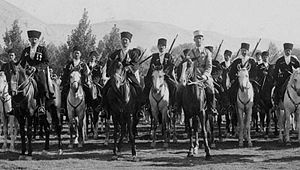 The French administration followed a principle of divide and rule in organising the Troupes Speciales. As far as possible the Sunni Muslim Arabs, who made up about 65% of the population of Syria, were excluded from service with the Troupes Speciales, who were drawn mainly from Druze
, Christian
, Circassian and ‘Alawi minorities. During the period from 1926 to 1939, the Army of the Levant included between 10,000 and 12,000 locally engaged troops organised into: ten battalions of infantry (mostly ‘Alawis), four squadrons of cavalry (Druze, Circassian and mixed Syrian), three companies of camel corps
(méhariste
s), engineer, armoured car, and support units. In addition, there were 9 companies of Lebanese light infantry (chasseurs libanais) and 22 squadrons of Druze, Circassian, and Kurdish
mounted infantry
forming the auxiliary troops (Troupes Supplementaires). This latter force provided a form of military police (gendarmerie
) for internal security purposes and were primarily deployed in the areas of their recruitment. Some of the Lebanese units were trained as ski troops for mountain service and wore the berets of the French elite mountain infantry (Chasseurs Alpins).
In 1938, the Troupes Speciales numbered 10,000, with 306 officers of whom only 88 were French. A military academy (École Militaire) was established at Homs
to train Syrian and Lebanese officers and specialists non-commissioned officer
s (NCOs).
headdress (red for Druze and white for other units), fezzes or turban
s. The Circassian mounted troops wore a black full dress that closely resembled that of the Caucasian Cossacks, complete with astrakhan hats. A common feature across the Troupes Speciales was the use of "violette" (purple-red) as a facing colour on tunic collar patches, belts and kepis. Squadron or branch insignia often included regional landmarks such as the cedars of Lebanon or the main mosque of Damascus.
. In 1941, British Commonwealth
, Free French and other Allied forces launched "Operation Exporter," the Syria-Lebanon Campaign
. They attacked the Army of the Levant from the British Mandate of Palestine and from the Kingdom of Iraq
, recently occupied during the Anglo-Iraqi War
. On 8 June 1941 at 2 am, British, Australia
n, and Free French forces crossed into Syria
and Lebanon
.
," the Army of the Levant was commanded by General
Henri Dentz
. Dentz was also the High Commissioner of the Levant
. Lieutenant-General Joseph-Antoine-Sylvain-Raoul de Verdillac was second in command at the time of the British
invasion.
, colonial troops, and the "Special Troops of the Levant" (Troupes Speciales du Levant).
The regular French troops consisted of four battalions of the 6th Foreign Legion
(according to Dentz, these were the best troops available to the Vichy French command) and three battalions of the 24th Colonial Infantry Regiment (French regulars enlisted for overseas service). The latter were brought up to strength by amalgamating them with two garrison battalions of Senegal
ese troops to form the "Mixed Colonial Regiment" (Regiment Mixte Coloniale).
The Troupes Speciales were formed by 11 battalions of infantry: three Lebanese light infantry battalions (bataillons de chasseurs Libanais) and eight Syrian battalions (bataillons de Levant). In addition, there were two artillery groups and supporting units. The "special troops" included at least 5,000 cavalry organized in squadrons of around 100 men each. Included in the cavalry force were 15 squadrons of Circassian cavalry of which three were motorized. The Troupes Speciales were led by indigenous officers and non-commissioned officers with a small cadre of French officers.
The African troops were formed from six Algeria
n, three Tunisia
n, three Senegalese, and one Moroccan
rifle (tirailleur) battalions.
The contingent of North Africa
n cavalry consisted of the 4th Tunisian, the 1st Moroccan, and the 8th Algerian Spahis and amounted to about 7,000 men. Most were on horseback or in light trucks. A few were equipped with armored cars.
The artillery available to the Vichy French consisted of 120 field and medium guns and numbered about 6,700 men. There was also a mechanized element which was provided by the 6th and 7th "African Light Horse" (Chasseurs d' Afrique) whose forces totalled 90 tanks (mostly Renault R-35 with a few Renault FT-17
) and a similar number of armored cars.
, the Polish Independent Carpathian Rifle Brigade
was formed from Polish exiles in the Levant. The brigade specialized in mountain warfare and was to be the Polish addition to Allied plans for landings in the Balkans. On 30 June, the brigade defected to Palestine.
(Armée de l'Air de Vichy) in the Levant was relatively strong at the outbreak of hostilities in 1939. But, in 1940, many of the aircraft stationed in Syria and Lebanon were sent back to Metropolitan France
. This left the Vichy French in the Levant with only a number of obsolete models. However, alarmed by the growing threat of British invasion, a fighter group was dispatched from Algeria
before the invasion. Once the fighting started, three additional groups were flown from France and from North Africa
. This brought the strength of the Vichy French air force in Lebanon and Syria up to 289 aircraft, including about 35 state-of-the-art Dewoitine D.520
fighters and some new, US-built Glenn Martin 167 light bombers. This initially gave the Vichy French an edge over the Allied air units. But the loss of Vichy French aircraft was very high: 179 aircraft were lost during the campaign, most having been destroyed on the ground.
(Marine Nationale) were available to support the Vichy forces in the Levant.
.
Free French General Georges Catroux
took control of Syria after the defeat of the Vichy French. On 26 November 1941, shortly after taking up this post, Catroux recognised the independence of Lebanon and Syria in the name of Free France. Even so, a period of military occupation followed.
On 8 November 1943, after elections, Lebanon became an independent state. On 27 February 1945, Lebanon declared war on Nazi Germany
and the Empire of Japan
.
On 1 January 1944, Syria followed Lebanon and also became an independent state. On 26 February 1945, Syria declared war on Nazi Germany
and the Empire of Japan
.
The Troupes Speciales had remained in existence during the military occupation and most transferred to the new Syrian Army
. The founders of the post-independence Lebanese Army also trained as officers in the Troupes Speciales.
France
The French Republic , The French Republic , The French Republic , (commonly known as France , is a unitary semi-presidential republic in Western Europe with several overseas territories and islands located on other continents and in the Indian, Pacific, and Atlantic oceans. Metropolitan France...
and then Vichy France
Vichy France
Vichy France, Vichy Regime, or Vichy Government, are common terms used to describe the government of France that collaborated with the Axis powers from July 1940 to August 1944. This government succeeded the Third Republic and preceded the Provisional Government of the French Republic...
which occupied, and were in part recruited from, a portion of the "Levant
Levant
The Levant or ) is the geographic region and culture zone of the "eastern Mediterranean littoral between Anatolia and Egypt" . The Levant includes most of modern Lebanon, Syria, Jordan, Israel, the Palestinian territories, and sometimes parts of Turkey and Iraq, and corresponds roughly to the...
" during the interwar period
Interwar period
Interwar period can refer to any period between two wars. The Interbellum is understood to be the period between the end of the Great War or First World War and the beginning of the Second World War in Europe....
and early World War II
World War II
World War II, or the Second World War , was a global conflict lasting from 1939 to 1945, involving most of the world's nations—including all of the great powers—eventually forming two opposing military alliances: the Allies and the Axis...
.
Origins
Syria
Syria , officially the Syrian Arab Republic , is a country in Western Asia, bordering Lebanon and the Mediterranean Sea to the West, Turkey to the north, Iraq to the east, Jordan to the south, and Israel to the southwest....
and Lebanon
Lebanon
Lebanon , officially the Republic of LebanonRepublic of Lebanon is the most common term used by Lebanese government agencies. The term Lebanese Republic, a literal translation of the official Arabic and French names that is not used in today's world. Arabic is the most common language spoken among...
by the League of Nations
League of Nations
The League of Nations was an intergovernmental organization founded as a result of the Paris Peace Conference that ended the First World War. It was the first permanent international organization whose principal mission was to maintain world peace...
. During this period Syria was known as the French Mandate of Syria
French Mandate of Syria
Officially the French Mandate for Syria and the Lebanon was a League of Nations mandate founded after the First World War and the partitioning of the Ottoman Empire...
and Lebanon was known as the French Mandate of Lebanon
French Mandate of Lebanon
The state of Greater Lebanon, the predecessor of modern Lebanon, was created in 1920 as part of the French scheme of dividing the French Mandate of Syria into six states....
.
From 19 April to 26 April 1920 the San Remo Conference
San Remo conference
The San Remo Conference was an international meeting of the post-World War I Allied Supreme Council, held in Sanremo, Italy, from 19 to 26 April 1920. It was attended by the four Principal Allied Powers of World War I who were represented by the prime ministers of Britain , France and Italy and...
was held in Sanremo
Sanremo
Sanremo or San Remo is a city with about 57,000 inhabitants on the Mediterranean coast of western Liguria in north-western Italy. Founded in Roman times, the city is best known as a tourist destination on the Italian Riviera. It hosts numerous cultural events, such as the Sanremo Music Festival...
, Italy
Italy
Italy , officially the Italian Republic languages]] under the European Charter for Regional or Minority Languages. In each of these, Italy's official name is as follows:;;;;;;;;), is a unitary parliamentary republic in South-Central Europe. To the north it borders France, Switzerland, Austria and...
. After this conference was concluded, the short-lived monarchy of King Faisal
Faisal I of Iraq
Faisal bin Hussein bin Ali al-Hashemi, was for a short time King of the Arab Kingdom of Syria or Greater Syria in 1920, and was King of the Kingdom of Iraq from 23 August 1921 to 1933...
's was defeated at the Battle of Maysalun
Battle of Maysalun
The Battle of Maysalun , also called The Battle of Maysalun Pass, took place between Syrian and French forces about 12 miles west of Damascus near the town of Maysalun on July 23, 1920.-Background:...
during the Franco-Syrian War
Franco-Syrian War
The Franco-Syrian War was a war from 1919 to 1921 between Syria and France. France conquered Syria; King Faisal, who was declared king of Greater Syria, was exiled to the United Kingdom...
. The French army under General Henri Gouraud then occupied the Mandate of Syria and the Mandate of Lebanon.
A force called the Syrian Legion was raised by the French authorities shortly after the establishment of the two mandates. This comprised both cavalry and infantry units and was drawn mainly from minority groups within Syria itself.
Inter-war period
Following the Druse revolt of 1925 to 1927, the Syrian Legion was reorganised into the "Special Troops of the Levant" (Troupes Speciales du Levant) augmented by North African infantry (tirailleurs) and cavalry (spahiSpahi
Spahis were light cavalry regiments of the French army recruited primarily from the indigenous populations of Algeria, Tunisia and Morocco. The modern French Army retains one regiment of Spahis as an armoured unit, with personnel now recruited in mainland France...
s), Foreign Legion
French Foreign Legion
The French Foreign Legion is a unique military service wing of the French Army established in 1831. The foreign legion was exclusively created for foreign nationals willing to serve in the French Armed Forces...
(Légion étrangère), and Colonial Infantry units (French and Senegal
Senegal
Senegal , officially the Republic of Senegal , is a country in western Africa. It owes its name to the Sénégal River that borders it to the east and north...
ese). The whole force constituted the Army of the Levant and was responsible for keeping order in both French mandates during the interwar period
Interwar period
Interwar period can refer to any period between two wars. The Interbellum is understood to be the period between the end of the Great War or First World War and the beginning of the Second World War in Europe....
.
Druze
The Druze are an esoteric, monotheistic religious community, found primarily in Syria, Lebanon, Israel, and Jordan, which emerged during the 11th century from Ismailism. The Druze have an eclectic set of beliefs that incorporate several elements from Abrahamic religions, Gnosticism, Neoplatonism...
, Christian
Christian
A Christian is a person who adheres to Christianity, an Abrahamic, monotheistic religion based on the life and teachings of Jesus of Nazareth as recorded in the Canonical gospels and the letters of the New Testament...
, Circassian and ‘Alawi minorities. During the period from 1926 to 1939, the Army of the Levant included between 10,000 and 12,000 locally engaged troops organised into: ten battalions of infantry (mostly ‘Alawis), four squadrons of cavalry (Druze, Circassian and mixed Syrian), three companies of camel corps
Camel cavalry
Camel cavalry, or camelry, is a generic designation for armed forces using camels as a means of transportation. Sometimes warriors or soldiers of this type also fought from camel-back with spears, bows or rifles....
(méhariste
Mehariste
Méhariste is a French word that roughly translates to camel cavalry. The word is most commonly used as a designation of military units.-Origins of French Camel Corps:...
s), engineer, armoured car, and support units. In addition, there were 9 companies of Lebanese light infantry (chasseurs libanais) and 22 squadrons of Druze, Circassian, and Kurdish
Kurdish people
The Kurdish people, or Kurds , are an Iranian people native to the Middle East, mostly inhabiting a region known as Kurdistan, which includes adjacent parts of Iran, Iraq, Syria, and Turkey...
mounted infantry
Mounted infantry
Mounted infantry were soldiers who rode horses instead of marching, but actually fought on foot . The original dragoons were essentially mounted infantry...
forming the auxiliary troops (Troupes Supplementaires). This latter force provided a form of military police (gendarmerie
Gendarmerie
A gendarmerie or gendarmery is a military force charged with police duties among civilian populations. Members of such a force are typically called "gendarmes". The Shorter Oxford English Dictionary describes a gendarme as "a soldier who is employed on police duties" and a "gendarmery, -erie" as...
) for internal security purposes and were primarily deployed in the areas of their recruitment. Some of the Lebanese units were trained as ski troops for mountain service and wore the berets of the French elite mountain infantry (Chasseurs Alpins).
In 1938, the Troupes Speciales numbered 10,000, with 306 officers of whom only 88 were French. A military academy (École Militaire) was established at Homs
Homs
Homs , previously known as Emesa , is a city in western Syria and the capital of the Homs Governorate. It is above sea level and is located north of Damascus...
to train Syrian and Lebanese officers and specialists non-commissioned officer
Non-commissioned officer
A non-commissioned officer , called a sub-officer in some countries, is a military officer who has not been given a commission...
s (NCOs).
Uniforms and insignia
Uniforms of the Troupes Speciales varied according to arm of service but showed a mixture of French and Levantine influences. Indigenous personnel wore either the keffiyehKeffiyeh
The keffiyeh/kufiya , also known as a ghutrah , ' , mashadah , shemagh or in Persian chafiye , Kurdish cemedanî and Turkish puşi, is a traditional Arab headdress fashioned from a square, usually cotton, scarf. It is typically worn by Arab men, as well as some Kurds...
headdress (red for Druze and white for other units), fezzes or turban
Turban
In English, Turban refers to several types of headwear popularly worn in the Middle East, North Africa, Punjab, Jamaica and Southwest Asia. A commonly used synonym is Pagri, the Indian word for turban.-Styles:...
s. The Circassian mounted troops wore a black full dress that closely resembled that of the Caucasian Cossacks, complete with astrakhan hats. A common feature across the Troupes Speciales was the use of "violette" (purple-red) as a facing colour on tunic collar patches, belts and kepis. Squadron or branch insignia often included regional landmarks such as the cedars of Lebanon or the main mosque of Damascus.
Army of the Levant during World War II
On 22 June, after the Fall of France, the forces in the Levant sided with the Vichy Government of Marshal Philippe PétainPhilippe Pétain
Henri Philippe Benoni Omer Joseph Pétain , generally known as Philippe Pétain or Marshal Pétain , was a French general who reached the distinction of Marshal of France, and was later Chief of State of Vichy France , from 1940 to 1944...
. In 1941, British Commonwealth
Commonwealth of Nations
The Commonwealth of Nations, normally referred to as the Commonwealth and formerly known as the British Commonwealth, is an intergovernmental organisation of fifty-four independent member states...
, Free French and other Allied forces launched "Operation Exporter," the Syria-Lebanon Campaign
Syria-Lebanon campaign
The Syria–Lebanon campaign, also known as Operation Exporter, was the Allied invasion of Vichy French-controlled Syria and Lebanon, in June–July 1941, during World War II. Time Magazine referred to the fighting as a "mixed show" while it was taking place and the campaign remains little known, even...
. They attacked the Army of the Levant from the British Mandate of Palestine and from the Kingdom of Iraq
Kingdom of Iraq
The Kingdom of Iraq was the sovereign state of Iraq during and after the British Mandate of Mesopotamia. The League of Nations mandate started in 1920. The kingdom began in August 1921 with the coronation of Faisal bin al-Hussein bin Ali al-Hashemi as King Faisal I...
, recently occupied during the Anglo-Iraqi War
Anglo-Iraqi War
The Anglo-Iraqi War was the name of the British campaign against the rebel government of Rashid Ali in the Kingdom of Iraq during the Second World War. The war lasted from 2 May to 31 May 1941. The campaign resulted in the re-occupation of Iraq by British armed forces and the return to power of the...
. On 8 June 1941 at 2 am, British, Australia
Australia
Australia , officially the Commonwealth of Australia, is a country in the Southern Hemisphere comprising the mainland of the Australian continent, the island of Tasmania, and numerous smaller islands in the Indian and Pacific Oceans. It is the world's sixth-largest country by total area...
n, and Free French forces crossed into Syria
Syria
Syria , officially the Syrian Arab Republic , is a country in Western Asia, bordering Lebanon and the Mediterranean Sea to the West, Turkey to the north, Iraq to the east, Jordan to the south, and Israel to the southwest....
and Lebanon
Lebanon
Lebanon , officially the Republic of LebanonRepublic of Lebanon is the most common term used by Lebanese government agencies. The term Lebanese Republic, a literal translation of the official Arabic and French names that is not used in today's world. Arabic is the most common language spoken among...
.
French command
During "Operation ExporterSyria-Lebanon campaign
The Syria–Lebanon campaign, also known as Operation Exporter, was the Allied invasion of Vichy French-controlled Syria and Lebanon, in June–July 1941, during World War II. Time Magazine referred to the fighting as a "mixed show" while it was taking place and the campaign remains little known, even...
," the Army of the Levant was commanded by General
General
A general officer is an officer of high military rank, usually in the army, and in some nations, the air force. The term is widely used by many nations of the world, and when a country uses a different term, there is an equivalent title given....
Henri Dentz
Henri Dentz
Henri Fernand Dentz was an officer in the French Army and, after France surrendered during World War II, he served with the Vichy French Army.-Syria-Lebanon campaign:...
. Dentz was also the High Commissioner of the Levant
High Commissioners of French-mandated Syria and Lebanon
High Commissioners of Syria and Lebanon were the highest ranking authority representing France in the french mandated countries of Syria and Lebanon. They were based in Beirut, Lebanon...
. Lieutenant-General Joseph-Antoine-Sylvain-Raoul de Verdillac was second in command at the time of the British
United Kingdom
The United Kingdom of Great Britain and Northern IrelandIn the United Kingdom and Dependencies, other languages have been officially recognised as legitimate autochthonous languages under the European Charter for Regional or Minority Languages...
invasion.
French ground forces
In 1941 the Army of the Levant was still divided into troops from Metropolitan FranceMetropolitan France
Metropolitan France is the part of France located in Europe. It can also be described as mainland France or as the French mainland and the island of Corsica...
, colonial troops, and the "Special Troops of the Levant" (Troupes Speciales du Levant).
The regular French troops consisted of four battalions of the 6th Foreign Legion
French Foreign Legion
The French Foreign Legion is a unique military service wing of the French Army established in 1831. The foreign legion was exclusively created for foreign nationals willing to serve in the French Armed Forces...
(according to Dentz, these were the best troops available to the Vichy French command) and three battalions of the 24th Colonial Infantry Regiment (French regulars enlisted for overseas service). The latter were brought up to strength by amalgamating them with two garrison battalions of Senegal
Senegal
Senegal , officially the Republic of Senegal , is a country in western Africa. It owes its name to the Sénégal River that borders it to the east and north...
ese troops to form the "Mixed Colonial Regiment" (Regiment Mixte Coloniale).
The Troupes Speciales were formed by 11 battalions of infantry: three Lebanese light infantry battalions (bataillons de chasseurs Libanais) and eight Syrian battalions (bataillons de Levant). In addition, there were two artillery groups and supporting units. The "special troops" included at least 5,000 cavalry organized in squadrons of around 100 men each. Included in the cavalry force were 15 squadrons of Circassian cavalry of which three were motorized. The Troupes Speciales were led by indigenous officers and non-commissioned officers with a small cadre of French officers.
The African troops were formed from six Algeria
Algeria
Algeria , officially the People's Democratic Republic of Algeria , also formally referred to as the Democratic and Popular Republic of Algeria, is a country in the Maghreb region of Northwest Africa with Algiers as its capital.In terms of land area, it is the largest country in Africa and the Arab...
n, three Tunisia
Tunisia
Tunisia , officially the Tunisian RepublicThe long name of Tunisia in other languages used in the country is: , is the northernmost country in Africa. It is a Maghreb country and is bordered by Algeria to the west, Libya to the southeast, and the Mediterranean Sea to the north and east. Its area...
n, three Senegalese, and one Moroccan
Morocco
Morocco , officially the Kingdom of Morocco , is a country located in North Africa. It has a population of more than 32 million and an area of 710,850 km², and also primarily administers the disputed region of the Western Sahara...
rifle (tirailleur) battalions.
The contingent of North Africa
North Africa
North Africa or Northern Africa is the northernmost region of the African continent, linked by the Sahara to Sub-Saharan Africa. Geopolitically, the United Nations definition of Northern Africa includes eight countries or territories; Algeria, Egypt, Libya, Morocco, South Sudan, Sudan, Tunisia, and...
n cavalry consisted of the 4th Tunisian, the 1st Moroccan, and the 8th Algerian Spahis and amounted to about 7,000 men. Most were on horseback or in light trucks. A few were equipped with armored cars.
The artillery available to the Vichy French consisted of 120 field and medium guns and numbered about 6,700 men. There was also a mechanized element which was provided by the 6th and 7th "African Light Horse" (Chasseurs d' Afrique) whose forces totalled 90 tanks (mostly Renault R-35 with a few Renault FT-17
Renault FT-17
The Renault FT, frequently referred to in post-WWI literature as the "FT-17" or "FT17" , was a French light tank; it is among the most revolutionary and influential tank designs in history...
) and a similar number of armored cars.
Polish Brigade
On 12 April 1940, after the invasion and fall of PolandInvasion of Poland (1939)
The Invasion of Poland, also known as the September Campaign or 1939 Defensive War in Poland and the Poland Campaign in Germany, was an invasion of Poland by Germany, the Soviet Union, and a small Slovak contingent that marked the start of World War II in Europe...
, the Polish Independent Carpathian Rifle Brigade
Polish Independent Carpathian Rifle Brigade
Polish Independent Carpathian Brigade was a Polish military unit formed in 1940 in French Syria composed of the Polish soldiers exiled after the Invasion of Poland in 1939 as part of the Polish Army in France...
was formed from Polish exiles in the Levant. The brigade specialized in mountain warfare and was to be the Polish addition to Allied plans for landings in the Balkans. On 30 June, the brigade defected to Palestine.
French air forces
The Vichy French Air ForceVichy French Air Force
The Vichy French Air Force was the aerial branch of the armed forces of Vichy France - the government of France that collaborated with the Axis powers following the defeat of France by Germany in 1940....
(Armée de l'Air de Vichy) in the Levant was relatively strong at the outbreak of hostilities in 1939. But, in 1940, many of the aircraft stationed in Syria and Lebanon were sent back to Metropolitan France
Metropolitan France
Metropolitan France is the part of France located in Europe. It can also be described as mainland France or as the French mainland and the island of Corsica...
. This left the Vichy French in the Levant with only a number of obsolete models. However, alarmed by the growing threat of British invasion, a fighter group was dispatched from Algeria
Algeria
Algeria , officially the People's Democratic Republic of Algeria , also formally referred to as the Democratic and Popular Republic of Algeria, is a country in the Maghreb region of Northwest Africa with Algiers as its capital.In terms of land area, it is the largest country in Africa and the Arab...
before the invasion. Once the fighting started, three additional groups were flown from France and from North Africa
North Africa
North Africa or Northern Africa is the northernmost region of the African continent, linked by the Sahara to Sub-Saharan Africa. Geopolitically, the United Nations definition of Northern Africa includes eight countries or territories; Algeria, Egypt, Libya, Morocco, South Sudan, Sudan, Tunisia, and...
. This brought the strength of the Vichy French air force in Lebanon and Syria up to 289 aircraft, including about 35 state-of-the-art Dewoitine D.520
Dewoitine D.520
The Dewoitine D.520 was a French fighter aircraft that entered service in early 1940, shortly after the opening of World War II. Unlike the Morane-Saulnier M.S.406, which was at that time the Armée de l'Airs most numerous fighter, the Dewoitine D.520 came close to being a match for the latest...
fighters and some new, US-built Glenn Martin 167 light bombers. This initially gave the Vichy French an edge over the Allied air units. But the loss of Vichy French aircraft was very high: 179 aircraft were lost during the campaign, most having been destroyed on the ground.
French naval forces
Two destroyers and three submarines of the French NavyFrench Navy
The French Navy, officially the Marine nationale and often called La Royale is the maritime arm of the French military. It includes a full range of fighting vessels, from patrol boats to a nuclear powered aircraft carrier and 10 nuclear-powered submarines, four of which are capable of launching...
(Marine Nationale) were available to support the Vichy forces in the Levant.
End of French rule
Following the Vichy defeat in 1941, the French and African components of the Army of the Levant were for the most part repatriated to their territories of origin. A minority (including some Lebanese and Syrians) took the opportunity to join the Free French ForcesFree French Forces
The Free French Forces were French partisans in World War II who decided to continue fighting against the forces of the Axis powers after the surrender of France and subsequent German occupation and, in the case of Vichy France, collaboration with the Germans.-Definition:In many sources, Free...
.
Free French General Georges Catroux
Georges Catroux
Georges Catroux was a French Army general and diplomat who served in both World War I and World War II, and served as Grand Chancellor of the Légion d'honneur from 1954 to 1969.-Biography:...
took control of Syria after the defeat of the Vichy French. On 26 November 1941, shortly after taking up this post, Catroux recognised the independence of Lebanon and Syria in the name of Free France. Even so, a period of military occupation followed.
On 8 November 1943, after elections, Lebanon became an independent state. On 27 February 1945, Lebanon declared war on Nazi Germany
Nazi Germany
Nazi Germany , also known as the Third Reich , but officially called German Reich from 1933 to 1943 and Greater German Reich from 26 June 1943 onward, is the name commonly used to refer to the state of Germany from 1933 to 1945, when it was a totalitarian dictatorship ruled by...
and the Empire of Japan
Empire of Japan
The Empire of Japan is the name of the state of Japan that existed from the Meiji Restoration on 3 January 1868 to the enactment of the post-World War II Constitution of...
.
On 1 January 1944, Syria followed Lebanon and also became an independent state. On 26 February 1945, Syria declared war on Nazi Germany
Nazi Germany
Nazi Germany , also known as the Third Reich , but officially called German Reich from 1933 to 1943 and Greater German Reich from 26 June 1943 onward, is the name commonly used to refer to the state of Germany from 1933 to 1945, when it was a totalitarian dictatorship ruled by...
and the Empire of Japan
Empire of Japan
The Empire of Japan is the name of the state of Japan that existed from the Meiji Restoration on 3 January 1868 to the enactment of the post-World War II Constitution of...
.
The Troupes Speciales had remained in existence during the military occupation and most transferred to the new Syrian Army
Syrian Army
The Syrian Army, officially called the Syrian Arab Army, is the land force branch of the Syrian Armed Forces. It is the dominant military service of the four uniformed services, controlling the senior most posts in the armed forces, and has the greatest manpower, approximately 80 percent of the...
. The founders of the post-independence Lebanese Army also trained as officers in the Troupes Speciales.
See also
- 1936 Syrian general strike1936 Syrian general strikeThe 1936 Syrian general strike gave fresh momentum to that country's nationalist movement, which had been stalled since the 1933 suspension of parliament. When French Mandate authorities arrested prominent members of the National Bloc and closed its offices in Damascus, demonstrations in that city,...
- League of NationsLeague of NationsThe League of Nations was an intergovernmental organization founded as a result of the Paris Peace Conference that ended the First World War. It was the first permanent international organization whose principal mission was to maintain world peace...
- Partitioning of the Ottoman EmpirePartitioning of the Ottoman EmpireThe Partitioning of the Ottoman Empire was a political event that occurred after World War I. The huge conglomeration of territories and peoples formerly ruled by the Sultan of the Ottoman Empire was divided into several new nations.The partitioning was planned from the early days of the war,...
- Syria-Lebanon CampaignSyria-Lebanon campaignThe Syria–Lebanon campaign, also known as Operation Exporter, was the Allied invasion of Vichy French-controlled Syria and Lebanon, in June–July 1941, during World War II. Time Magazine referred to the fighting as a "mixed show" while it was taking place and the campaign remains little known, even...
- Vichy French Air ForceVichy French Air ForceThe Vichy French Air Force was the aerial branch of the armed forces of Vichy France - the government of France that collaborated with the Axis powers following the defeat of France by Germany in 1940....
- Army of Africa (France)Army of Africa (France)The Army of Africa was an unofficial but commonly used term for those portions of the French Army recruited from or normally stationed in French North Africa from 1830 until the end of the Algerian War in 1962.-Composition:...
- French Colonial ForcesFrench Colonial ForcesThe French Colonial Forces , commonly called La Coloniale, was a general designation for the military forces that garrisoned in the French colonial empire from the late 17th century until 1960. They were recruited from mainland France or from the French settler and indigenous populations of the...
- History of the Armée de l'Air (1909-1942)History of the Armée de l'Air (1909-1942)The Armée de l'Air is the name of the French Air Force in its native language. It has borne this name only from August 1933 when it was still under the jurisdiction of the army...
- History of the Armée de l'Air (colonial presence 1939-1962)
- French colonial flagsFrench colonial flagsSome of the colonies, protectorates and mandates of the French Colonial Empire used distinctive colonial flags. These most commonly had a French Tricolour in the canton....
- French Colonial EmpireFrench colonial empireThe French colonial empire was the set of territories outside Europe that were under French rule primarily from the 17th century to the late 1960s. In the 19th and 20th centuries, the colonial empire of France was the second-largest in the world behind the British Empire. The French colonial empire...
- List of French possessions and colonies