
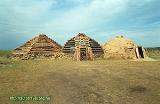
Arkaim is an archaeological site situated in the Southern Urals steppe, 8.2 kilometres (5.1 mi) north-to-northwest of Amurskiy, and 2.3 km (1.4 mi) south-to-southeast of Alexandronvskiy, two villages in the
Chelyabinsk Oblast
,
RussiaRussia or , officially known as both Russia and the Russian Federation , is a country in northern Eurasia. It is a federal semi-presidential republic, comprising 83 federal subjects...
, just to the north from the
KazakhstanKazakhstan , officially the Republic of Kazakhstan, is a transcontinental country in Central Asia and Eastern Europe. Ranked as the ninth largest country in the world, it is also the world's largest landlocked country; its territory of is greater than Western Europe...
border.
The site is generally dated to the 17th century BC. Earlier dates, up to the 20th century BC, have been proposed. It was a settlement of the Sintashta-Petrovka culture.
Discovery and excavation
The site was discovered in 1987 by a team of
ChelyabinskChelyabinsk is a city and the administrative center of Chelyabinsk Oblast, Russia, located in the northwestern side of the oblast, south of Yekaterinburg, just to the east of the Ural Mountains, on the Miass River. Population: -History:...
scientists who were preparing the area to be flooded in order to create a reservoir, and examined in rescue excavations led by :Gennadii Zdanovich. At first their findings were ignored by Soviet authorities, who planned to flood the site as they had flooded
SarkelSarkel was a large limestone-and-brick fortress built by the Khazars with Byzantine assistance in the 830s. It was named white-house because of the white limestone bricks they have used to build Sarkel...
earlier, but the attention attracted by news of the discovery forced the Soviet government to revoke its plans for flooding the area. It was designated a cultural reservation in 1991, and in May 2005 the site was visited by then-President
Vladimir PutinVladimir Vladimirovich Putin served as the second President of the Russian Federation and is the current Prime Minister of Russia, as well as chairman of United Russia and Chairman of the Council of Ministers of the Union of Russia and Belarus. He became acting President on 31 December 1999, when...
.
Settlement
Although the settlement was burned and abandoned, much detail is preserved. Arkaim is similar in form but much better preserved than neighbouring
SintashtaSintashta is an archaeological site in Chelyabinsk Oblast, Russia. It is the remains of a fortified settlement dating to the Bronze Age, c. 2800–1600 BC, and is the type site of the Sintashta culture...
, where the earliest
chariotThe chariot is a type of horse carriage used in both peace and war as the chief vehicle of many ancient peoples. Ox carts, proto-chariots, were built by the Proto-Indo-Europeans and also built in Mesopotamia as early as 3000 BC. The original horse chariot was a fast, light, open, two wheeled...
was unearthed. The site was protected by two circular walls. There was a central square, surrounded by two circles of dwellings separated by a street. The settlement covered ca. 20000 m² (23,919.8 sq yd). The diameter of the enclosing wall was 160 m (524.9 ft). It was built from earth packed into timber frames, and reinforced with unburned clay brick, with a thickness of 4 metre. and a height of 5.5 m (18 ft). The settlement was surrounded with a 2 m (6.6 ft)-deep moat.
There are four entrances into the settlement through the outer and inner wall with the main entrance to the west. The dwellings were between 110 square metre in area. The outer ring of dwellings number 39 or 40, with entrances to a circular street in the middle of the settlement. The inner ring of dwellings number 27, arranged along the inner wall, with doors to the central square of 25 by. The central street was drained by a covered channel. Zdanovich estimates that approximately 1500 to 2500 people could have lived in the settlement.
Surrounding Arkaim's walls, were arable fields, 130–140 m by 45 m (430–460 ft by 150 ft), irrigated by a system of canals and ditches. Remains of
milletThe millets are a group of small-seeded species of cereal crops or grains, widely grown around the world for food and fodder. They do not form a taxonomic group, but rather a functional or agronomic one. Their essential similarities are that they are small-seeded grasses grown in difficult...
and
barleyBarley is a major cereal grain, a member of the grass family. It serves as a major animal fodder, as a base malt for beer and certain distilled beverages, and as a component of various health foods...
seeds were found.
The 17th century date suggests that the settlement was about co-eval to, or just post-dating, the
Indo-Aryan migrationModels of the Indo-Aryan migration discuss scenarios of prehistoric migrations of the proto-Indo-Aryans to their historically attested areas of settlement in the northwest of the Indian subcontinent...
into South Asia and
MesopotamiaMesopotamia is a toponym for the area of the Tigris–Euphrates river system, largely corresponding to modern-day Iraq, northeastern Syria, southeastern Turkey and southwestern Iran.Widely considered to be the cradle of civilization, Bronze Age Mesopotamia included Sumer and the...
(the
Gandhara grave cultureThe Gandhara grave culture emerged ca. 1600 BC, and flourished in Gandhara, Pakistan ca. 1500 BC to 500 BC ....
appearing in the Northern Pakistan from ca. 1600 BC, the Indo-European
MitanniMitanni or Hanigalbat was a loosely organized Hurrian-speaking state in northern Syria and south-east Anatolia from ca. 1500 BC–1300 BC...
rulers reached
AnatoliaAnatolia is a geographic and historical term denoting the westernmost protrusion of Asia, comprising the majority of the Republic of Turkey...
before 1500 BC, both roughly 3000 kilometres (1,864.1 mi) removed from the Sintashta-Petrovka area), and that it was either an early Iranian culture, or an unknown branch of Indo-Iranian that did not survive into historical times.
In pseudoarchaeology and national mysticism
Since its discovery, Arkaim has attracted public and media attention in Russia, from a broad range of the population, including esoteric,
New AgeThe New Age movement is a Western spiritual movement that developed in the second half of the 20th century. Its central precepts have been described as "drawing on both Eastern and Western spiritual and metaphysical traditions and then infusing them with influences from self-help and motivational...
and pseudoscientific organizations. It is said to be the most enigmatic archaeological site within the territory of
RussiaRussia or , officially known as both Russia and the Russian Federation , is a country in northern Eurasia. It is a federal semi-presidential republic, comprising 83 federal subjects...
, and as with many archaeological discoveries, many conflicting interpretations have been put forward.
Swastika City
In order to gain publicity, the early investigators described Arkaim as "Swastika City", "Mandala City", and "the ancient capital of early
AryanAryan is an English language loanword derived from Sanskrit ārya and denoting variously*In scholarly usage:**Indo-Iranian languages *in dated usage:**the Indo-European languages more generally and their speakers...
civilization, as described in the
AvestaThe Avesta is the primary collection of sacred texts of Zoroastrianism, composed in the Avestan language.-Early transmission:The texts of the Avesta — which are all in the Avestan language — were composed over the course of several hundred years. The most important portion, the Gathas,...
and Vedas". The swastika description refers to the floor plan of the site, which (with some imagination) may appear similar to the
swastika symbolThe swastika is an equilateral cross with its arms bent at right angles, in either right-facing form in counter clock motion or its mirrored left-facing form in clock motion. Earliest archaeological evidence of swastika-shaped ornaments dates back to the Indus Valley Civilization of Ancient...
, albeit with rounded arms (similar to the
lauburuThe lauburu or Basque cross has four comma-shaped heads similar to the Japanese tomoe. It can be constructed with a compass and straightedge, beginning with the formation of a square template; each head can be drawn from a neighboring vertex of this template with two compass settings, with one...
) attached to a central ring instead of a cross.
Observatory
The similarity of latitude, date, and size led some
archaeoastronomistsArchaeoastronomy is the study of how people in the past "have understood the phenomena in the sky how they used phenomena in the sky and what role the sky played in their cultures." Clive Ruggles argues it is misleading to consider archaeoastronomy to be the study of ancient astronomy, as modern...
(Bystrushkin 2003) to compare Arkaim with
StonehengeStonehenge is a prehistoric monument located in the English county of Wiltshire, about west of Amesbury and north of Salisbury. One of the most famous sites in the world, Stonehenge is composed of a circular setting of large standing stones set within earthworks...
in England. According to their claims, the Neolithic
observatoryAn observatory is a location used for observing terrestrial or celestial events. Astronomy, climatology/meteorology, geology, oceanography and volcanology are examples of disciplines for which observatories have been constructed...
at Stonehenge allowed for observation of 15 astronomical phenomena using 22 elements, whereas the contemporaneous observatory at Arkaim allowed for observation of 18 astronomical phenomena using 30 elements. The precision of measurements in Stonehenge is estimated at 10 arc-minutes to a degree, that in Arkaim being put at 1 arc-minute. Such a precision of astronomical observations was not repeated until the compilation of
AlmagestThe Almagest is a 2nd-century mathematical and astronomical treatise on the apparent motions of the stars and planetary paths. Written in Greek by Claudius Ptolemy, a Roman era scholar of Egypt,...
about 2 millennia later. The interpretation as an observatory for either Stonehenge or Arkaim is not universally accepted.
External links