

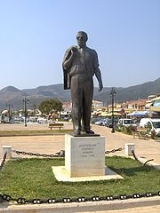
Aristotle Onassis

Encyclopedia
Aristotle Sokratis Onassis , commonly called Ari or Aristo Onassis, was a prominent Greek shipping magnate.
(now İzmir
, Turkey
) to Socrates and Penelope Onassis (née Dologu). Onassis had one full-sister, Artemis, and two half-sisters, Kalliroi and Merope, by his father's second marriage following Penelope's death. Socrates Onassis came from the village of Moutalasski (now named Talas
), near Cappadocia
in Asia Minor, which is the present-day Kayseri
province, in central Turkey. A successful shipping entrepreneur, he was able to send his children to prestigious schools. At the age of 16, Aristotle Onassis spoke four languages: Greek (his native language), Turkish, Spanish, and English, when he graduated from the local Evangelical Greek School
.
After being briefly administered by Greece
(1919–1922) in the aftermath of the Allied
victory in World War I
, Smyrna was re-taken by Turkey and the Onassis family's substantial property holdings were lost, causing them to become refugees
fleeing to Greece after the Great Fire of Smyrna
. During this period Aristotle Onassis lost three uncles, an aunt and her husband Chrysostomos Konialidis and their daughter, who were burned to death on fire in a church in Thyatira
where 500 Christians were seeking shelter from the Great Fire of Smyrna.
In 1923, Aristotle Onassis left for Buenos Aires
, Argentina
by Nansen passport
and got his first job with the British United River Plate Telephone Company.
citizenship. According to Peter Evans and Christian Cafarakis (a former employee) a considerable part of the tobacco was smuggled, helping him to rapidly accrue his first million dollars. In 1928, Onassis traded with Greece to the value of US$2,800,000 just four years after his arrival in Argentina. This was due in part to other illegitimate activities such as sabotaging his competitors and fraudulently using the name of a famous cigarette company: Bis. This last enterprise was profitable but ended when the real Bis company sued him.
The 1000% increase in tax on imported products from countries with no Greek trade agreement, announced in 1929, threatened Onassis' South American business. Argentina had few commercial relationships with Greece. With the help of his confidante, Costa Gratsos, Onassis corresponded the prime minister of Greece Eleutherios Venizelos and met with the foreign minister Andreas Michalakopoulos
to discuss the tax position, finally winning support with the help of extensive bribes. In 1931, again with Michalakopoulos' help, Onassis was granted tax exemptions for his freight ships and the title of Vice Consul. This position greatly increased the status of Onassis as well as his business. The biographer Evans states that Onassis exchanged vast sums of Greek currency on the black market, in spite of Gratsos' disapproval.
In 1954, the FBI investigated Onassis for fraud against the U.S. government
. He was charged with violating the citizenship provision of the shipping laws which require that all ships displaying the U.S. flag be owned by U.S. citizens. Onassis entered a guilty plea and paid $7 million.
Onassis founded Olympic Airways (today Olympic Air
), the Greek national carrier, in 1957. To finance his ships he used a method that he, in his own words, described as utilizing OPM ('Other People's Money'). He contracted to transport ore in ships he did not yet have, and closed several contracts to transport oil with tankers that had not yet been built. Onassis made large profits when the big oil companies like Mobil
, Socony, and Texaco
signed long-term contracts at fixed prices with him for the use of his fleet, while having trouble managing their own fleet which operated under US flags and thus at high cost. Onassis' fleet had Panamanian flags and sailed tax-free while operating at low cost. Because of this, Onassis could turn a profit in every transaction, even though he charged one of the lowest prices in the merchant navy market. He could recoup the cost of a tanker with a six-month contract. The rest of the service life of the tanker, usually 20 years, yielded high profits.
Onassis' owned a fleet of freighters and tankers that exceeded the seventy vessels. Stocks accounted for one-third of his capital, held in oil companies in the USA, the Middle East, and Venezuela. He also owned additional shares that secured his control of ninety-five multinational businesses on five continents. He owned gold processing plants in Argentina and Uruguay and a large share in an airline in Latin America and $4 million dollars worth of investments in Brazil. Also, he owned companies like Olympic Maritime and Olympic Tourist, a chemical company in Persia, apartments in Paris, London, Monte Carlo, Athens, Acapulco, a castle in South France, the Olympic Tower, a fifty-two story high-rise in Manhattan, another building in Sutton Place, Olympic Airways and Air Navigation, the islands Scorpios and Sparta, the yacht Christina and, finally, deposit accounts and accounts in treasuries in two hundred and seventeen banks in the whole world.
companies, for $8.5 million.
, who Evans states was on Onassis' extensive bribery list. Onassis and Papadopoulos were planning what they referred to as the "greatest business" in Greece. This project involved building an oil refinery, shipyards, power plants, and several aluminum facilities. The project was officially named the Omega Project. The project was heavily criticized by people such as Helen Vlachos, a journalist from Athens.
The Omega Project negotiations with the Papadopoulos government ended with Onassis losing part of the project to his competitor Stavros Niarchos
. The failure was due partly to opposition from influential people within the military junta, such as Ioannis-Orlandos Rodinos, Deputy Minister of the National Economy
, who opposed Onassis' offers in preference to Niarchos.
, daughter of shipping magnate Stavros Livanos and Arietta Zafrikakis, on December 28, 1946. Their son, Alexander (April 30, 1948 – January 23, 1973), and daughter Christina
(December 11, 1950 – November 19, 1988) after whom Onassis named his legendary super-yacht, were both born in New York City
.
To Onassis his marriage to Athina was more than the fulfillment of his ambitions. He also felt that the marriage dealt a blow to his father in law and the old-money Greek traditionalists who held Onassis in very low esteem. She divorced him when she discovered her husband having sex in the saloon of her daughter's namesake yacht, the Christina, with the opera singer Maria Callas.
embarked on an affair. They had met in 1957 during a party in Venice
promoted by Elsa Maxwell
. After this first encounter, Onassis commented to Spyros Skouras
: "There [was] just a natural curiosity; after all, we were the most famous Greeks alive in the world".
, widow of U.S. President John F. Kennedy
, on October 20, 1968. They married on Onassis's privately owned island of Skorpios
.
According to Peter Evans, Onassis offered Mrs. Kennedy US$3 million for herself and $1m for each son in return for marriage. After Onassis' death she would receive US$150,000 each year for the rest of her life. The whole marital contract was discussed with Ted Kennedy
and later reviewed by André Meyer
, her financial consultant.
Onassis' daughter Christina made clear that she did not like Jacqueline Kennedy, and after Alexander's death, she convinced Onassis that Jacqueline had some kind of curse due to John and Robert Kennedy's murders. The already strained relationship between Aristotle and Jacqueline soon came to an end.
During their marriage, the couple resided in a home they rented in Bernardsville, New Jersey
.
in Neuilly-sur-Seine
, France
, of respiratory failure, a complication of the myasthenia gravis
that he had been suffering from during the last years of his life. According to his will, his daughter Christina was to inherit 55% of the Onassis fortune while the other 45% were used as funds for the Alexander S. Onassis Foundation
set up to honor his son Alexander Onassis. This 45% was the share that his son Alexander would have inherited, had he not died in 1973. Jackie Kennedy also received her share of the estate settling for a reported $10,000,000 ($26 million according to other sources) which was negotiated by her brother-in-law
Ted Kennedy
(this amount would later grow to several hundred million under the financial stewardship of her companion Maurice Tempelsman
). Christina's share has since passed to her only child Athina, making her one of the wealthiest women in the world.
Early life
Onassis was born in Karatass, a suburb of SmyrnaSmyrna
Smyrna was an ancient city located at a central and strategic point on the Aegean coast of Anatolia. Thanks to its advantageous port conditions, its ease of defence and its good inland connections, Smyrna rose to prominence. The ancient city is located at two sites within modern İzmir, Turkey...
(now İzmir
Izmir
Izmir is a large metropolis in the western extremity of Anatolia. The metropolitan area in the entire Izmir Province had a population of 3.35 million as of 2010, making the city third most populous in Turkey...
, Turkey
Turkey
Turkey , known officially as the Republic of Turkey , is a Eurasian country located in Western Asia and in East Thrace in Southeastern Europe...
) to Socrates and Penelope Onassis (née Dologu). Onassis had one full-sister, Artemis, and two half-sisters, Kalliroi and Merope, by his father's second marriage following Penelope's death. Socrates Onassis came from the village of Moutalasski (now named Talas
Talas
-Places:*Talas River Kyrgyzstan and Karakhstan;*Talas Valley*Talas Alatau*Talas , an ancient Silk Road city in Kazakhstan*Talas, Kyrgyzstan, a modern town in Central Asia*Talas Province, Kyrgyzstan...
), near Cappadocia
Cappadocia
Cappadocia is a historical region in Central Anatolia, largely in Nevşehir Province.In the time of Herodotus, the Cappadocians were reported as occupying the whole region from Mount Taurus to the vicinity of the Euxine...
in Asia Minor, which is the present-day Kayseri
Kayseri
Kayseri is a large and industrialized city in Central Anatolia, Turkey. It is the seat of Kayseri Province. The city of Kayseri, as defined by the boundaries of Kayseri Metropolitan Municipality, is structurally composed of five metropolitan districts, the two core districts of Kocasinan and...
province, in central Turkey. A successful shipping entrepreneur, he was able to send his children to prestigious schools. At the age of 16, Aristotle Onassis spoke four languages: Greek (his native language), Turkish, Spanish, and English, when he graduated from the local Evangelical Greek School
Evangelical School of Smyrna
The Evangelical School was a Greek educational institution established in 1733 in Smyrna, Ottoman Empire, now Izmir, Turkey. The school, initially an Orthodox Church-approved institution, attracted major figures of the Modern Greek Enlightenment...
.
After being briefly administered by Greece
Greece
Greece , officially the Hellenic Republic , and historically Hellas or the Republic of Greece in English, is a country in southeastern Europe....
(1919–1922) in the aftermath of the Allied
Allies of World War I
The Entente Powers were the countries at war with the Central Powers during World War I. The members of the Triple Entente were the United Kingdom, France, and the Russian Empire; Italy entered the war on their side in 1915...
victory in World War I
World War I
World War I , which was predominantly called the World War or the Great War from its occurrence until 1939, and the First World War or World War I thereafter, was a major war centred in Europe that began on 28 July 1914 and lasted until 11 November 1918...
, Smyrna was re-taken by Turkey and the Onassis family's substantial property holdings were lost, causing them to become refugees
Greek refugees
Greek refugees is a collective term used to refer to the Greeks from Asia Minor who were evacuated or relocated in Greece following the Treaty of Lausanne and the Population exchange between Greece and Turkey...
fleeing to Greece after the Great Fire of Smyrna
Great Fire of Smyrna
The Great Fire of Smyrna or the Catastrophe of Smyrna was a fire that destroyed much of the port city of Izmir in September 1922. Eye-witness reports state that the fire began on 13 September 1922 and lasted until it was largely extinguished on September 22...
. During this period Aristotle Onassis lost three uncles, an aunt and her husband Chrysostomos Konialidis and their daughter, who were burned to death on fire in a church in Thyatira
Thyatira
Thyateira is the name of the modern Turkish city of Akhisar . The name comes from Koine Greek "Θυάτειρα" . The Turkish equivalent of Thyateira is Tepe Mezarligi. It lies in the far west of Turkey, south of Istanbul and almost due east of Athens...
where 500 Christians were seeking shelter from the Great Fire of Smyrna.
In 1923, Aristotle Onassis left for Buenos Aires
Buenos Aires
Buenos Aires is the capital and largest city of Argentina, and the second-largest metropolitan area in South America, after São Paulo. It is located on the western shore of the estuary of the Río de la Plata, on the southeastern coast of the South American continent...
, Argentina
Argentina
Argentina , officially the Argentine Republic , is the second largest country in South America by land area, after Brazil. It is constituted as a federation of 23 provinces and an autonomous city, Buenos Aires...
by Nansen passport
Nansen passport
Nansen passports were internationally recognized identity cards first issued by the League of Nations to stateless refugees.-Origins:Designed in 1921 by Fridtjof Nansen, in 1942 they were honored by governments in 52 countries and were the first refugee travel documents...
and got his first job with the British United River Plate Telephone Company.
Argentina
Onassis imported tobacco from Turkey with help from his father. The tobacco was softer than the Cuban variety, and he was sure it would appeal to women more. After the failure of a contract with Juan Gaona, the director of a major Argentine company, Onassis turned to making his own cigarettes. After some time managing this business and holding a job with British United River, he made a considerable amount of money. His power and influence increased rapidly; he frequently attended important social events, and in 1925 he received both Argentine and GreekGreece
Greece , officially the Hellenic Republic , and historically Hellas or the Republic of Greece in English, is a country in southeastern Europe....
citizenship. According to Peter Evans and Christian Cafarakis (a former employee) a considerable part of the tobacco was smuggled, helping him to rapidly accrue his first million dollars. In 1928, Onassis traded with Greece to the value of US$2,800,000 just four years after his arrival in Argentina. This was due in part to other illegitimate activities such as sabotaging his competitors and fraudulently using the name of a famous cigarette company: Bis. This last enterprise was profitable but ended when the real Bis company sued him.
The 1000% increase in tax on imported products from countries with no Greek trade agreement, announced in 1929, threatened Onassis' South American business. Argentina had few commercial relationships with Greece. With the help of his confidante, Costa Gratsos, Onassis corresponded the prime minister of Greece Eleutherios Venizelos and met with the foreign minister Andreas Michalakopoulos
Andreas Michalakopoulos
Andreas Michalakopoulos was an important liberal politician in the inter-war period who served as Prime Minister of Greece from 7 October 1924 to 26 June 1925....
to discuss the tax position, finally winning support with the help of extensive bribes. In 1931, again with Michalakopoulos' help, Onassis was granted tax exemptions for his freight ships and the title of Vice Consul. This position greatly increased the status of Onassis as well as his business. The biographer Evans states that Onassis exchanged vast sums of Greek currency on the black market, in spite of Gratsos' disapproval.
In 1954, the FBI investigated Onassis for fraud against the U.S. government
Federal government of the United States
The federal government of the United States is the national government of the constitutional republic of fifty states that is the United States of America. The federal government comprises three distinct branches of government: a legislative, an executive and a judiciary. These branches and...
. He was charged with violating the citizenship provision of the shipping laws which require that all ships displaying the U.S. flag be owned by U.S. citizens. Onassis entered a guilty plea and paid $7 million.
Onassis founded Olympic Airways (today Olympic Air
Olympic Air
Olympic Air is the largest Greek airline by destinations served, formed from the privatisation of the former national carrier Olympic Airlines. Olympic Air commenced limited operations on 29 September 2009, after Olympic Airlines ceased all operations, with the official full-scale opening of the...
), the Greek national carrier, in 1957. To finance his ships he used a method that he, in his own words, described as utilizing OPM ('Other People's Money'). He contracted to transport ore in ships he did not yet have, and closed several contracts to transport oil with tankers that had not yet been built. Onassis made large profits when the big oil companies like Mobil
Mobil
Mobil, previously known as the Socony-Vacuum Oil Company, was a major American oil company which merged with Exxon in 1999 to form ExxonMobil. Today Mobil continues as a major brand name within the combined company, as well as still being a gas station sometimes paired with their own store or On...
, Socony, and Texaco
Texaco
Texaco is the name of an American oil retail brand. Its flagship product is its fuel "Texaco with Techron". It also owns the Havoline motor oil brand....
signed long-term contracts at fixed prices with him for the use of his fleet, while having trouble managing their own fleet which operated under US flags and thus at high cost. Onassis' fleet had Panamanian flags and sailed tax-free while operating at low cost. Because of this, Onassis could turn a profit in every transaction, even though he charged one of the lowest prices in the merchant navy market. He could recoup the cost of a tanker with a six-month contract. The rest of the service life of the tanker, usually 20 years, yielded high profits.
Onassis' owned a fleet of freighters and tankers that exceeded the seventy vessels. Stocks accounted for one-third of his capital, held in oil companies in the USA, the Middle East, and Venezuela. He also owned additional shares that secured his control of ninety-five multinational businesses on five continents. He owned gold processing plants in Argentina and Uruguay and a large share in an airline in Latin America and $4 million dollars worth of investments in Brazil. Also, he owned companies like Olympic Maritime and Olympic Tourist, a chemical company in Persia, apartments in Paris, London, Monte Carlo, Athens, Acapulco, a castle in South France, the Olympic Tower, a fifty-two story high-rise in Manhattan, another building in Sutton Place, Olympic Airways and Air Navigation, the islands Scorpios and Sparta, the yacht Christina and, finally, deposit accounts and accounts in treasuries in two hundred and seventeen banks in the whole world.
Whaling
Between 1950 and 1956, Onassis had success whale hunting off the Peruvian coast. His first expedition made a net profit of US$4.5 million. That business ended when the Norwegian Whales Gazette made accusations based on sailors' testimonials, such as one given by Bruno Schalaghecke who worked on the whaler Olympic Challenger: "Pieces of fresh meat from the 124 whales we killed yesterday still remains on the deck. Among them all, just one could be considered adult. All animals that pass within the range of the harpoon are killed in cold blood". The venture came to an end after the business was sold to Kyokuyo Hogei Kaisha Whaling Company, one of the biggest Japanese whalingWhaling in Japan
Whaling in Japan may have begun as early as the 12th century. During the 20th century, Japan was heavily involved in commercial whaling until the International Whaling Commission moratorium on commercial whaling went into effect in 1986...
companies, for $8.5 million.
The Greek Colonel affair
According to the Evans biography, four days after his marriage with Jacqueline, Onassis was in close discussions with Colonel George PapadopoulosGeorge Papadopoulos
Colonel Georgios Papadopoulos was the head of the military coup d'état that took place in Greece on 21 April 1967 and leader of the military government that ruled the country from 1967 to 1974. Papadopoulos was a Colonel of Artillery...
, who Evans states was on Onassis' extensive bribery list. Onassis and Papadopoulos were planning what they referred to as the "greatest business" in Greece. This project involved building an oil refinery, shipyards, power plants, and several aluminum facilities. The project was officially named the Omega Project. The project was heavily criticized by people such as Helen Vlachos, a journalist from Athens.
The Omega Project negotiations with the Papadopoulos government ended with Onassis losing part of the project to his competitor Stavros Niarchos
Stavros Niarchos
Stavros Spyros Niarchos was a Greek shipping tycoon, sometimes known as "The Golden Greek." In 1952, Stavros Niarchos built the first supertankers capable of transporting large quantities of oil, and subsequently earned millions of dollars as global demand for his ships increased.- Early life :He...
. The failure was due partly to opposition from influential people within the military junta, such as Ioannis-Orlandos Rodinos, Deputy Minister of the National Economy
Economy
An economy consists of the economic system of a country or other area; the labor, capital and land resources; and the manufacturing, trade, distribution, and consumption of goods and services of that area...
, who opposed Onassis' offers in preference to Niarchos.
Athina Livanos
Onassis married Athina LivanosAthina Livanos
Athina Mary Livanos Onassis Spencer-Churchill Niarchos was the second daughter of the Greek shipping magnate Stavros Livanos. She was best known as the first wife of Aristotle Onassis, but she later married her older sister Eugenia's widower, Stavros Niarchos...
, daughter of shipping magnate Stavros Livanos and Arietta Zafrikakis, on December 28, 1946. Their son, Alexander (April 30, 1948 – January 23, 1973), and daughter Christina
Christina Onassis
-See also:*Christina, a song dedicated to her by artist - Patty Griffin*Christina O - the Onassis family yacht, named after Christina by her father-External links:...
(December 11, 1950 – November 19, 1988) after whom Onassis named his legendary super-yacht, were both born in New York City
New York City
New York is the most populous city in the United States and the center of the New York Metropolitan Area, one of the most populous metropolitan areas in the world. New York exerts a significant impact upon global commerce, finance, media, art, fashion, research, technology, education, and...
.
To Onassis his marriage to Athina was more than the fulfillment of his ambitions. He also felt that the marriage dealt a blow to his father in law and the old-money Greek traditionalists who held Onassis in very low esteem. She divorced him when she discovered her husband having sex in the saloon of her daughter's namesake yacht, the Christina, with the opera singer Maria Callas.
Maria Callas
Despite the fact they were both married, Onassis and opera diva Maria CallasMaria Callas
Maria Callas was an American-born Greek soprano and one of the most renowned opera singers of the 20th century. She combined an impressive bel canto technique, a wide-ranging voice and great dramatic gifts...
embarked on an affair. They had met in 1957 during a party in Venice
Venice
Venice is a city in northern Italy which is renowned for the beauty of its setting, its architecture and its artworks. It is the capital of the Veneto region...
promoted by Elsa Maxwell
Elsa Maxwell
Elsa Maxwell was an American gossip columnist and author, songwriter, and professional hostess renowned for her parties for royalty and high society figures of her day....
. After this first encounter, Onassis commented to Spyros Skouras
Spyros Skouras
Spyros Panagiotis Skouras was an American motion picture pioneer and movie executive who was the president of the 20th Century Fox from 1942 to 1962...
: "There [was] just a natural curiosity; after all, we were the most famous Greeks alive in the world".
Jacqueline Bouvier Kennedy
Onassis ended his relationship with Callas to marry Jacqueline KennedyJacqueline Kennedy Onassis
Jacqueline Lee Bouvier "Jackie" Kennedy Onassis was the wife of the 35th President of the United States, John F. Kennedy, and served as First Lady of the United States during his presidency from 1961 until his assassination in 1963. Five years later she married Greek shipping magnate Aristotle...
, widow of U.S. President John F. Kennedy
John F. Kennedy
John Fitzgerald "Jack" Kennedy , often referred to by his initials JFK, was the 35th President of the United States, serving from 1961 until his assassination in 1963....
, on October 20, 1968. They married on Onassis's privately owned island of Skorpios
Skorpios
Skorpios is a private island in the Ionian Sea off the western coast of Greece and just to the east of the island of Lefkada. The 2001 census reported a population of two inhabitants...
.
According to Peter Evans, Onassis offered Mrs. Kennedy US$3 million for herself and $1m for each son in return for marriage. After Onassis' death she would receive US$150,000 each year for the rest of her life. The whole marital contract was discussed with Ted Kennedy
Ted Kennedy
Edward Moore "Ted" Kennedy was a United States Senator from Massachusetts and a member of the Democratic Party. Serving almost 47 years, he was the second most senior member of the Senate when he died and is the fourth-longest-serving senator in United States history...
and later reviewed by André Meyer
André Meyer
André Benoit Mathieu Meyer was a French-born American Wall Street investment banker.Meyer was born in Paris to a low-income family. As a boy, he began following the workings of the stock market and out of necessity left school at age sixteen to work as a messenger at the Paris Bourse...
, her financial consultant.
Onassis' daughter Christina made clear that she did not like Jacqueline Kennedy, and after Alexander's death, she convinced Onassis that Jacqueline had some kind of curse due to John and Robert Kennedy's murders. The already strained relationship between Aristotle and Jacqueline soon came to an end.
During their marriage, the couple resided in a home they rented in Bernardsville, New Jersey
Bernardsville, New Jersey
Bernardsville is a borough and affluent suburb in Somerset County, New Jersey, United States. Bernardsville has the 10th-highest per capita income in the state. Nationwide, Bernardsville ranks 75th among the 100 highest-income places in the United States...
.
Death and legacy
Onassis died at age 69, on March 15, 1975 at the American Hospital of ParisAmerican Hospital of Paris
The American Hospital of Paris, founded in 1906, located in Neuilly-sur-Seine, is a private, not-for-profit institution that is considered agréé/non-conventionné under the French system of healthcare. It has 187 surgical, medical, and obstetric beds....
in Neuilly-sur-Seine
Neuilly-sur-Seine
Neuilly-sur-Seine is a commune in the western suburbs of Paris, France. It is located from the center of Paris.Although Neuilly is technically a suburb of Paris, it is immediately adjacent to the city and directly extends it. The area is composed of mostly wealthy, select residential...
, France
France
The French Republic , The French Republic , The French Republic , (commonly known as France , is a unitary semi-presidential republic in Western Europe with several overseas territories and islands located on other continents and in the Indian, Pacific, and Atlantic oceans. Metropolitan France...
, of respiratory failure, a complication of the myasthenia gravis
Myasthenia gravis
Myasthenia gravis is an autoimmune neuromuscular disease leading to fluctuating muscle weakness and fatiguability...
that he had been suffering from during the last years of his life. According to his will, his daughter Christina was to inherit 55% of the Onassis fortune while the other 45% were used as funds for the Alexander S. Onassis Foundation
Alexander S. Onassis Foundation
Wishing to honor the memory of his son Alexander, who died in 1973, in an airplane crash at the age of 25, Aristotle Onassis directed in his will that half of his estate should be transferred upon his own death to a foundation to be established in Alexander’s name...
set up to honor his son Alexander Onassis. This 45% was the share that his son Alexander would have inherited, had he not died in 1973. Jackie Kennedy also received her share of the estate settling for a reported $10,000,000 ($26 million according to other sources) which was negotiated by her brother-in-law
Brother-in-law
A brother-in-law is the brother of one's spouse, the husband of one's sibling, or the husband of one's spouse's sibling.-See also:*Affinity *Sister-in-law*Brothers in Law , a 1955 British comedy novel...
Ted Kennedy
Ted Kennedy
Edward Moore "Ted" Kennedy was a United States Senator from Massachusetts and a member of the Democratic Party. Serving almost 47 years, he was the second most senior member of the Senate when he died and is the fourth-longest-serving senator in United States history...
(this amount would later grow to several hundred million under the financial stewardship of her companion Maurice Tempelsman
Maurice Tempelsman
Maurice Tempelsman is a Belgian American businessman and diamond merchant. He moved to the United States as a child and attended New York City’s public schools and New York University...
). Christina's share has since passed to her only child Athina, making her one of the wealthiest women in the world.
See also
- Greek shippingGreek shippingThe Hellenic Merchant Marine refers to the Merchant Marine of Greece, engaged in commerce and transportation of goods and services universally. It consists of the merchant vessels owned by Greek civilians, flying either the Greek flag or a flag of convenience...
- SkorpiosSkorpiosSkorpios is a private island in the Ionian Sea off the western coast of Greece and just to the east of the island of Lefkada. The 2001 census reported a population of two inhabitants...
- Christina OChristina OChristina O is one of the world's longest private motor yachts at 325 feet 3 inches . She was originally a Canadian called HMCS Stormont and was launched in 1943. She served as a convoy escort during the Battle of the Atlantic and was present at the D-Day landings...
- Stavros NiarchosStavros NiarchosStavros Spyros Niarchos was a Greek shipping tycoon, sometimes known as "The Golden Greek." In 1952, Stavros Niarchos built the first supertankers capable of transporting large quantities of oil, and subsequently earned millions of dollars as global demand for his ships increased.- Early life :He...