


Ariosophy

Encyclopedia
Armanism and Ariosophy are the names of ideological systems of an esoteric nature, pioneered by Guido von List
and Jörg Lanz von Liebenfels respectively, in Austria
between 1890 and 1930. The term 'Ariosophy', meaning wisdom concerning the Aryan
s, was first coined by Lanz von Liebenfels in 1915 and became the label for his doctrine in the 1920s. In the book [i.e. The Occult Roots of Nazism
] 'Ariosophy' is used generically to describe the Aryan-esoteric theories of a subset of the 'Völkische Bewegung' (Goodrick-Clarke 1985: 227, note 1 to the Introduction). Liebenfels inspired numerous others and a variety of organizations in Germany
and Austria of that time.
This article follows the historian Goodrick-Clarke
in summarizing these developments under the term Ariosophy, although this broader use of the word is retrospective and was not generally current among the esotericists themselves. They were part of a general occult revival in Austria and Germany
of the late 19th and early 20th centuries, loosely inspired by historical Germanic paganism
, holistic philosophy as well as esoteric concepts influenced by German
romanticism
and Theosophy. The connection of this Germanic mysticism with historical Germanic culture, though tenuous, is evident in the mystics' fascination with runes, in the form of Guido von List's Armanen runes
. Ariosophy in its narrow sense was a Liturgic-free newthought-influenced movement without clearly delineated dogmatics, centered around the publications of the Herbert Reichstein Verlag.
(in the sense of Indo-Europeans
, though with Germanic peoples
being viewed as their purest representatives), runic symbols, the swastika
, and sometimes occultism are important elements in Ariosophy. From around 1900 onwards, these ariosophic ideas (together with, and influenced by, Theosophy
) contributed significantly to an occult counterculture
in Germany and Austria. A historic interest in this topic has stemmed from the ideological relation of Ariosophy to Nazism
, and is obvious in such book titles as:
However, Goodrick-Clarke's comprehensive study finds little evidence of direct influence, except in the case of the highly idiosyncratic ancient-German mythos elaborated by the 'clairvoyant' (but in fact schizophrenic) SS-Brigadeführer
Karl Maria Wiligut
, of which the practical consequences were, first, the incorporation of Wiligut's symbolism into the ceremonies of an elite circle within the SS; and, secondly, the official censure of those occultists and runic magicians whom Wiligut stigmatised as heretics, which may have persuaded Heinrich Himmler
to order the internment of several of them. The most notable other case is Himmler's Ahnenerbe
. (For the debate on the direct relations to Nazi ideology see Religious aspects of Nazism
.) Goodrick-Clarke (1985: 192-202) examines what evidence there is for influences on Hitler and on other Nazis, but he concludes that "Ariosophy is a symptom rather than an influence in the way that it anticipated Nazism" (ibid., 202).
and Günther Kirchoff, can more exactly be described as cultivating the Armanism of List (Goodrick-Clarke 1985: 155). In a less broad approach one could also treat rune occultism separately. Although the Armanen runes go back to List, Rudolf John Gorsleben
distinguished himself from other völkisch writers by making the esoteric importance of the runes central to his world view. Goodrick-Clarke therefore refers to the doctrine of Kummer and Gorsleben and his followers as rune occultism, a description which also fits the eclectic work of Karl Spiesberger
. Highly practical systems of rune occultism, influenced mainly by List, were developed by Friedrich Bernhard Marby
and Siegfried Adolf Kummer
(Goodrick-Clarke 1985: 160-62). Also worthy of mention are Peryt Shou
, the occult novelist; A. Frank Glahn
, noted more for his pendulum
dowsing
; Rudolf von Sebottendorff and Walter Nauhaus, who built up the Thule Society
; and Karl Maria Wiligut, who was the most notable occultist working for the SS
.
Organisations include: the Guido von List Society, the High Armanen Order, the Lumen Club, the Ordo Novi Templi, the Germanenorden (in which a schism occurred) and the Thule Society.
and returning to the pagan religions of the ancient Indo-Europeans (List preferred the equivalent term Ario-Germanen, or 'Aryo-Germans'). List recognised the theoretical distinction between the Indo-European ('Aryan') protolanguage and the derivative Germanic protolanguage but frequently obscured it by his tendency to treat them as a single long-lived entity. In this, he became strongly influenced by the Theosophical thought of Madame Blavatsky
, which he blended however with his own highly original beliefs, founded upon Germanic paganism.
Before he turned to occultism, Guido List had written articles for German nationalist newspapers in Austria, as well as four historical novels and three plays, some of which were "set in tribal Germany" before the advent of Christianity He also had written an anti-semitic essay in 1895. List adopted the aristocratic von between 1903 and 1907.
List called his doctrine Armanism after the Armanen, supposedly a body of priest-kings in the ancient Ario-Germanic nation. He claimed that this German name had been Latinized into the tribal name Herminones mentioned in Tacitus
and that it actually meant the heirs of the sun-king: an estate of intellectuals who were organised into a priesthood called the Armanenschaft.
His conception of the original religion of the Germanic tribes was a form of sun worship, with its priest-kings (similar to the Icelandic goði) as legendary rulers of ancient Germany. Religious instruction was imparted on two levels. The esoteric doctrine (Armanism) was concerned with the secret mysteries of the gnosis
, reserved for the initiated elite, while the exoteric doctrine (Wotanism) took the form of popular myths intended for the lower social classes.
List believed that the transition from Wotanism to Christianity had proceeded smoothly under the direction of the skald
s, so that native customs, festivals and names were preserved under a Christian veneer and only needed to be 'decoded' back into their heathen forms. This peaceful merging of the two religions had been disrupted by the forcible conversions under "bloody Charlemagne
— the Slaughterer of the Saxons
". List claimed that the dominance of the Roman Catholic Church
in Austria-Hungary
constituted a continuing occupation of the Germanic tribes by the Roman empire
, albeit now in a religious form, and a continuing persecution of the ancient religion of the Germanic peoples and Celts.
He also believed in the magical powers of the old runes. From 1891 onwards he claimed that heraldry
was based on a system of encoded runes, so that heraldic devices conveyed a secret heritage in cryptic form. In April 1903, he submitted an article concerning the alleged Aryan proto-language
to the Imperial Academy of Sciences in Vienna. Its highlight was a mystical and occult interpretation of the runic alphabet, which became the cornerstone of his ideology. Although the article was rejected by the academy, it would later be expanded by List and grew into his final masterpiece, a comprehensive treatment of his linguistic and historical theories published in 1914 as Die Ursprache der Ario-Germanen und ihre Mysteriensprache (The Proto-Language of the Aryo-Germans and their Mystery Language).
List’s doctrine has been described as gnostic, pantheist and deist. At its core is the mystical union of God, man and nature. Wotanism teaches that God dwells within the individual human spirit as an inner source of magical power, but is also immanent
within nature through the primal laws which govern the cycles of growth, decay and renewal. List explicitly rejects a dualism
of spirit versus matter or of God over against nature. Humanity is therefore one with the universe, which entails an obligation to live in accordance with nature. But the individual human ego does not seek to merge with the cosmos. "Man is a separate agent, necessary to the completion or perfection of ‘God’s work’". Being immortal, the ego passes through successive reincarnation
s until it overcomes all obstacles to its purpose. List foresaw the eventual consequences of this in a future utopia
on earth, which he identified with the promised Valhalla
, a world of victorious heroes:
List was familiar with the cyclical notion of time, which he encountered in Norse mythology
and in the theosophical adaptation of the Hindu time cycles
. He had already made use of cosmic rhythms in his early journalism on natural landscapes. In his later works List combined the cyclical concept of time with the "dualistic and linear time scheme" of western apocalyptic which counterposes a pessimism about the present world with an ultimate optimism regarding the future one. In Das Geheimnis der Runen, List addresses the seeming contradiction by explaining the final redemption of the linear time frame as an exoteric parable which stands for the esoteric truth of renewal in many future cycles and incarnations. However, in the original Norse myths and Hinduism
, the cycle of destruction and creation is repeated indefinitely, thus offering no possibility of ultimate salvation (Goodrick-Clarke 1985: 79; 239, note 14 to Chapter 9).
, a literary society
(Goodrick-Clarke 1985: 39).
In 1908 the Guido von List Society (Guido-von-List-Gesellschaft) was founded primarily by the Wannieck family (Friedrich Wannieck
and his son Friedrich Oskar Wannieck being prominent and enthusiastic Armanists) as an occult
völkisch organisation, with the purpose of financing and publishing List's research (Goodrick-Clarke 1985: 42). The List Society was supported by many leading figures in Austrian and German politics, publishing, and occultism. Although one might suspect a völkisch organisation to be antisemitic, the society included at least two Jews among its members: Moritz Altschüler, a rabbinical scholar (Goodrick-Clarke 1985: 99), and Ernst Wachler
. The List Society published List's works under the series Guido-List-Bücherei (GLB).
List had established exoteric and esoteric circles in his organisation. The High Armanen Order (Hoher Armanen Orden) was the inner circle of the Guido von List Society. Founded in midsummer 1911, it was set up as a magical order or lodge to support List's deeper and more practical work. The HAO conducted pilgrimages to what its members considered "holy Armanic sites", Stephansdom
in Vienna
, Carnuntum
etc. They also had occasional meetings between 1911 and 1918, but the exact nature of these remains unknown. In his introduction to List's The Secret of the Runes, Stephen E. Flowers (1988: 11) notes: "The HAO never really crystallized in List's lifetime – although it seems possible that he developed a theoretical body of unpublished documents and rituals relevant to the HAO which have only been put into full practice in more recent years".
joined a minor Bavarian political party and formed it into the NSDAP. After the Nazis had come to power, several advocates of Armanism fell victim to the suppression of esotericism in Nazi Germany
.
The main reason for the persecution of occultists was the Nazi policy of systematically closing down esoteric organisations (although Germanic paganism was still practised by some Nazis on an individual basis), but the instigator in certain cases was Himmler's personal occultist, Karl Maria Wiligut. Wiligut identified the monotheistic religion of Irminism as the true ancestral belief, claiming that Guido von List's Wotanism and runic row constituted a schismatic false religion.
Among the Listians — Kummer and Marby are not mentioned by Goodrick-Clarke among the signatories who endorsed the List Society around 1905 but both men were indebted to "Listian" ideas — who were subjected to censure were the rune occultists Friedrich Bernhard Marby and Siegfried Adolf Kummer, both of whom were denounced by Wiligut in 1934 in a letter to Himmler. Flowers writes: "The establishment of [an] 'official NS runology
' under Himmler, Wiligut, and others led directly to the need to suppress the rune-magical 'free agents' such as Marby". Despite having openly supported the Nazis, Marby was arrested by the Gestapo in 1936 as an anti-Nazi occultist and was interned in Welzheim
, Flossenbürg
and Dachau concentration camps. Kummer disappears from History after Wiligut’s denunciation in 1934, and his fate is unknown. He may have died in a concentration camp. According to Rudgley, "[u]nsubstantiated rumours" have him fleeing Nazi Germany in exile to South America, but "it is more likely that he perished in one of the camps that Marby was to survive or died during the Allied bombing of Dresden
."
Günter Kirchhoff, a List Society member whom Wiligut had recommended to Himmler on the strength of his researches into prehistory, is reported to have written that Wiligut by intrigue had ensured that Ernst Lauterer (a.k.a. "Tarnhari") — another List Society member, who claimed a secret clan tradition which rivalled Wiligut's own — was committed to a concentration camp as an "English agent". Flowers and Moynihan reproduce Kirchhoff's testimony as reported by both Adolf Schleipfer and researcher Manfred Lenz (but doubted by Wiligut's former secretary Gabriele Dechend).
ex-Cistercian monk, Bible scholar and inventor named Jörg Lanz-Liebenfels (subsequently, Jörg Lanz von Liebenfels) published a lengthy article under the Latin title 'Anthropozoon Biblicum' ("The Biblical Man-Animal") in a journal for Biblical studies edited by Moritz Altschüler, a Jewish admirer of Guido von List. The author undertook a comparative survey of ancient Near East
ern cultures, in which he detected evidence from iconography and literature which seemed to point to the continued survival, into early historical times, of hominid ape-men similar to the dwarfish Neanderthal
men known from fossil remains in Europe, or the Pithecanthropus (now called Homo erectus
) from Java
Furthermore, Lanz systematically analysed the Old Testament
in the light of his hypothesis, identifying and interpreting coded references to the ape-men which substantiated an illicit practice of interbreeding between humans and "lower" species in antiquity.
In 1905 he expanded these researches into a fundamental statement of doctrine titled Theozoologie oder die Kunde von den Sodoms-Äfflingen und dem Götter-Elektron (Theozoology, or the Science of the Sodomite-Apelings and the Divine Electron). He claimed that “Aryan” peoples originated from interstellar deities (termed Theozoa) who bred by electricity, while “lower” races were a result of interbreeding between humans and ape-men (or Anthropozoa). The effects of racial crossing caused the atrophy of paranormal
powers inherited from the gods, but these could be restored by the selective breeding of pure Aryan lineages. The book relied on somewhat lurid sexual imagery, decrying the abuse of white women by ethnically inferior but sexually active men. Thus, Lanz advocated mass castration of racially “apelike” or otherwise “inferior” males.
In the same year, Lanz commenced publication of the journal Ostara
(named after the pagan Germanic goddess of spring) to promote his vision of racial purity. On December 25, 1907 he founded the Order of the New Templars (Ordo Novi Templi, or ONT), a mystical association with its headquarters at Burg Werfenstein, a castle in Upper Austria
overlooking the river Danube
. Its declared aim was to harmonise science, art and religion on a basis of racial consciousness. Rituals were designed to beautify life in accordance with Aryan aesthetics, and to express the Order's theological system which Lanz called Ario-Christianity. The Order was the first to use the swastika
in an "Aryan" meaning, displaying on its flag the device of a red swastika facing right, on a yellow-orange field and surrounded by four blue fleurs-de-lys above, below, to the right and to the left.
The ONT declined from the mid-1930s and was suppressed by the Gestapo
in 1942. By this time it had established seven utopian communities in Austria, Germany and Hungary. Though suspending its activities in the Greater German Reich, the ONT survived in Hungary until around the end of World War II
. It went underground in Vienna after 1945, but was contacted in 1958 by a former Waffen-SS
lieutenant, Rudolf Mund, who became Prior of the Order in 1979. Mund also wrote biographies of Lanz and Wiligut.
This terminology was taken up by a group of occultists, formed in Berlin
around 1920 and referred to by one of its main figures, Ernst Issberner-Haldane, as the 'Swastika-Circle'. Lanz's publisher, Herbert Reichstein, made contact with the group in 1925 and formed it into an institute with himself as director. This association was named the Ariosophical Society in 1926, renamed the Neue Kalandsgesellschaft (from Kaland, Guido von List's term for a secret lodge or conventicle) in 1928, and renamed again as the Ariosophische Kulturzentrale in 1931, the year in which it opened an Ariosophical School at Pressbaum
that offered courses and lectures in runic lore, biorhythms, yoga
and Qabalah.
The institute maintained a friendly collaboration with Lanz, its guiding intellect and inspiration, but also acknowledged an indebtedness to List, declaring itself as the successor to the Armanen priest-kings and their hierophant
ic tradition. Reichstein's circle therefore establishes the historical precedent for a broad conception that was followed by Nicholas Goodrick-Clarke in 1985 when he redefined Ariosophy as a general term to describe Aryan-centric occult theories and hermetic practices, including both Lanz's Ario-Christianity and the earlier Armanism of List, as well as later derivatives of either or both systems. If the term is employed in this extended sense, then Guido von List, and not Lanz von Liebenfels, was the founder of Ariosophy.
The justification for the broad definition is that List and Lanz were mutually influencing. The two men joined one another's societies; List figures in Lanz's pedigree of initiated predecessors; and Lanz is cited several times by List in The Religion of the Aryo-Germanic Folk: Esoteric and Exoteric (1910).
and the Germanenorden, two "historically significant", "virulently antisemitic groups" in Germany. Both groups were organized by the political activist Theodor Fritsch
, a major figure in German antisemitism. Fritsch, born 1852, was the son of Saxon peasants, and he was concerned about the "small tradesmen and craftsmen" and their threat from what he perceived to be the large 'Jewish' industry.
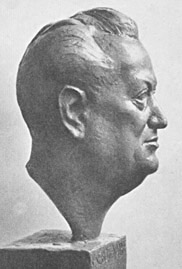 The List-inspired Germanenorden (Germanic or Teutonic Order, not to be confused with the medieval German order of the Teutonic Knights
) was a völkisch secret society
in early 20th century Germany. It was founded in Berlin in 1912 by Theodor Fritsch and several prominent German occultists including Philipp Stauff, who held office in the List Society and High Armanen Order as well as Hermann Pohl, who became the Germanenorden’s first leader. The group was a clandestine movement aimed at the upper echelons of society and was a sister movement to the more mainstream Reichshammerbund.
The order, whose symbol was a swastika, had a hierarchical fraternal structure similar to Freemasonry
. Local groups of the sect met to celebrate the summer solstice
, an important neopagan
festivity in völkisch circles (and later in Nazi Germany), and more regularly to read the Eddas as well as some of the German mystics.
In addition to occult and magical philosophies, it taught to its initiates nationalist ideologies of Nordic racial superiority and antisemitism, then rising throughout the Western world. As was becoming increasingly typical of völkisch organisations, it required its candidates to prove that they had no non-Aryan bloodlines and required from each a promise to maintain purity of his stock in marriage.
In 1916, during World War I
, the Germanenorden split into two parts. Eberhard von Brockhusen
became the Grand Master of the "loyalist" Germanenorden. Pohl, previously the order’s Chancellor, founded a schismatic offshoot: the Germanenorden Walvater of the Holy Grail. He was joined in the same year by Rudolf von Sebottendorff (formerly Rudolf Glauer), a wealthy adventurer with wide-ranging occult and mystical interests. A Freemason and a practitioner of sufism
and astrology
, Sebottendorff was also an admirer of Guido von List and Lanz von Liebenfels. Convinced that the Islamic and Germanic mystical systems shared a common Aryan root, he was attracted by Pohl’s runic lore and became the Master of the Walvater's Bavarian province late in 1917. Charged with reviving the province's fortunes, Sebottendorff increased membership from about a hundred in 1917 to 1500 by the autumn of the following year.
). The name of Nauhaus's original Thule Society was adopted as a cover-name for Sebottendorff's Munich lodge of the Germanenorden Walvater when it was formally dedicated on August 18, 1918, with Pohl’s assistance and approval. Sebottendorff states that the group was run jointly by himself and Nauhaus.
Deriving elements of its ideology and membership from earlier occult groups founded by List (Guido von List Society, established 1908) and Lanz von Liebenfels (the Order of the New Templars, established 1907), the Thule Society was dedicated to the triune god Walvater, identified with Wotan in triple form. For the Society's emblem Sebottendorff selected the oak leaves, dagger and swastika (Thomas 2005). The name Thule
(an island located by Greek geographers at the northernmost extremity of the world) was chosen for its significance in the works of Guido von List. According to Thule Society mythology, Thule was the capital of Hyperborea, a legendary country supposedly in the far North polar regions, originally mentioned by Herodotus
from Egyptian sources. In 1679, Olaf Rudbeck
equated the Hyperboreans with the survivors of Atlantis
, who were first mentioned by Plato
, again following Egyptian sources. Interestingly enough, Friedrich Nietzsche
(1844–1900) began his work Der Antichrist (The Antichrist
) in 1895 with, "Let us see ourselves for what we are. We are Hyperboreans."
From a historian's perspective, the importance of the Thule Society lies in its organising the discussion circle which led to the German Workers' Party
(Deutsche Arbeiter-Partei, or DAP), founded in January 1919. The Thule Society's Karl Harrer
was a co-founder, along with Anton Drexler
(the party's first chairman). Later the same year, Adolf Hitler
joined the DAP, which was renamed as the NSDAP (or Nazi party) on April 1, 1920. Some conspiracy theorists argue that the NSDAP, when under Hitler's leadership, was a political front for the Thule Society. However, against this theory stands Harrer's and Drexler's resistance to Hitler. After unsuccessful challenges to his growing power, both men resigned from the party, Harrer in 1920 and Drexler in 1923.
Speculative authors assert that a number of high Nazi Party officials had been members of the Thule Society (including such prominent figures as Max Amann
, Dietrich Eckart
, Rudolf Hess
, Alfred Rosenberg
and Gottfried Feder
). Eckart, the wealthy publisher of the newspaper Auf gut Deutsch (In Plain German), has been represented as a committed occultist and the most significant Thule influence on Hitler. He is believed to have taught Hitler a number of persuasive techniques, and so profound was his influence that Hitler’s book Mein Kampf
was dedicated to him. However, although Eckart attended Thule Society meetings, he was not a member and there is nothing to indicate that he trained Hitler in techniques of a mystical nature. Examining the membership lists, Goodrick-Clarke notes that Hess, Rosenberg and Feder were — like Eckart — guests of the Thule Society in 1918 but not actual members. He also describes a Thule Society membership roll including Hans Frank
and Heinrich Himmler
as "spurious". There is no evidence that Hitler himself had any connection with the Society, even as an associate or visitor. However, a member of the Thule Society, dentist Dr. Friedrich Krohn, did choose the swastika
symbol for the Nazi party (although the design was revised at Hitler's insistence).
In 1923, Sebottendorff was expelled from Germany as an undesirable alien; around 1925, the Thule Society disbanded. In 1933, Sebottendorff returned to Germany and published Bevor Hitler kam: Urkundliches aus der Frühzeit der nationalsozialistischen Bewegung von Rudolf von Sebottendorff. The book was banned by the Bavarian political police on March 1, 1934; Sebottendorff was arrested by the Gestapo
, interned in a concentration camp, then expelled to Turkey yet again, where he committed suicide by drowning in the Bosphorus on May 9, 1945, as the Nazis surrendered to the Allies.
of 1919 and, along with Dietrich Eckart, he was taken prisoner by the Communists, narrowly escaping execution. He threw himself into the ferment of Bavaria's völkisch politics and formed a close working relationship with the local Germanenorden before devoting himself to literary pursuits.
On 29 November 1925, Gorsleben founded the Edda Society (Edda-Gesellschaft), a mystic study group, at Dinkelsbühl
in Franconia
. He himself was Chancellor of the Society and published its periodical Deutsche Freiheit (German Freedom), later renamed Arische Freiheit (Aryan Freedom). Assisted by learned contributors to his study-group, Gorsleben developed an original and eclectic mystery religion
founded in part upon the Armanism of List, whom he quoted with approval (ibid., 156-159).
Grand Master of the Society was Werner von Bülow (1870–1947). The treasurer was Friedrich Schaefer from Mühlhausen
, whose wife, Käthe, kept open house for another occult-völkisch circle (the 'Free Sons of the North and Baltic Seas') which gathered around Karl Maria Wiligut in the early 1930s (ibid., 159, 183). Mathilde von Kemnitz, a prolific völkisch writer who married General Erich Ludendorff
in 1926, was an active member of the Edda Society.
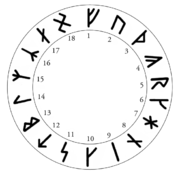
When Rudolf John Gorsleben died from heart disease in August 1930, the Edda Society was taken over by Bülow who had designed a 'world-rune-clock' which illustrated the correspondences between the runes, the gods and the zodiac
, as well as colours and numbers. Bülow also took over the running of Gorsleben's periodical and changed its name from Arische Freiheit to Hag All All Hag, and then Hagal
.
movements oriented themselves more towards polytheistic reconstructionism
, turning away from theosophic and occult elements, but elements of Ariosophical mysticism continue to play a role in some white supremacist organizations. Alleged mystical or shamanic aspects of historical pre-Christian Germanic culture, summarized as seidr are also practiced in Odinism
(Freya Aswynn, Nigel Pennick
, Karl Spiesberger
, see also Germanic Runic Astrology, The Book of Blotar).
The Guido von List Society was re-established in the late 1960s through contacts between the German/Austrian occultist Adolf Schleipfer (1947–) and the still living last president of the Society, Hanns Bierbach. Schleipfer had discovered some of List's works in an antique bookstore in the mid-1960s, and was inspired to found the runic and Armanist magazine Irminsul
in hopes of attracting suitable people for a revived Listian order. He was appointed the new president and continued to publish Irminsul as the "Voice of the Guido von List Society."
Schleipfer also attended meetings of a related organisation, the Gode-Orden (Gothi
-Order), which propagated a similar mixture of occult völkisch thinking. There he met his wife Sigrun Schleipfer, née Hammerbacher (1940–2009), daughter of the völkisch writer and former NSDAP district leader, Dr. Hans Wilhelm Hammerbacher. In 1976 the Schleipfers founded the Armanen-Orden (Armanen Order) as the reorganised Guido von List Society. Since then, Adolf and Sigrun have served as the Grandmasters of the Order, although they have divorced and Sigrun now refers to herself as "Sigrun von Schlichting" or "Sigrun Freifrau von Schlichting". They also revived the High Armanen Order (HAO) and brought it to "an unprecedented level of activity".
The Armanen-Orden is a neopagan esoteric society and religious order reviving the occult teachings of Guido von List. Its internal structure is organized in nine grades, inspired by Freemasonry
. The order is modelled on, but not limited to, the precepts of List, and its principles as formulated in its brochures are as follows:
The Armanen-Orden celebrates seasonal festivities in a similar fashion as Odinist groups do and invites interested people to these events. The highlights are three 'Things' at Ostara (Easter), Midsummer and Fall (Wotan's sacrificial death), which are mostly celebrated at castles close to sacred places, such as the Externsteine
. The author Stefanie von Schnurbein
attended a Fall Thing in 1990 and gives the following report in Religion als Kulturkritik (Religion and Cultural Criticism):
In 1977 Sigrun Schleipfer founded the Gemeinschaft zur Erhaltung der Burgen (Society for the Conservation of Castles), which proclaims castles to be among the "last paradises of the romantic era" in this cold modern age and had as its primary aim the purchase and restoration of a castle for the Order. In 1995, the society finally acquired the castle of Rothenhorn in Szlichtyngowa
(Poland
), a run-down structure dating back to the 12th century, though most of the complex dates from the 16th century.
Over many years, Adolf and Sigrun have republished all of List's works (and many others relating to the Armanen runes) in their original German. Adolf Schleipfer has also contributed an article to The Secret King, a study of Karl Maria Wiligut by Stephen Flowers and Michael Moynihan
, in which he points out the differences between Wiligut's beliefs and those which are accepted within Odinism or Armanism.
's book Der Mann, der Hitler die Ideen gab (The Man Who Gave Hitler His Ideas) (1957). Although the book was not always taken seriously within academia
, for some time Lanz was seen as one of the most important influences on Hitler. Since the 1990s, however, historians have cast doubt on Lanz' significance. The historian Brigitte Hamann
, who has written Hitler's Vienna: A Dictator's Apprenticeship, is of the view that Lanz partly influenced Hitler's diction, but had only marginal influences on Adolf Hitler's religious views.
lodge of the Germanenorden. It took its name from an alleged lost continent Thule
, which was assumed to be the mythical homeland from which the Aryan race
had originated. Atlantis
at least, and most likely also Hyperborea, were taken to be identical with Thule. The superiority of Aryans over all other races was a key concept and the members of various Germanenorden lodges saw themselves (as Teutons
or Germanic peoples
) as the 'purest' branch of the Aryan race.
Defenders of List and Lanz claim that the antisemitism that drove Nazi policies was much older and more deeply rooted among the peoples of central Europe
than can be credited to the "fringe works" of mystics and rune magicians. It has been alleged, for example, that the roots of Nazi antisemitism can be traced to the Lutheran and Catholic churches as it was the Catholic Church Fathers who first invented ideas about the Jews being an inferior "race", and who drove anti-semitic policies right up to and all during the Second World War.
Some of Lanz's proposals for racial purification anticipate the Nazis. The sterilisation of those deemed to be genetically "unfit" was in fact implemented under the Nazi eugenics
policies, but its basis lay in the theories of scientific racial hygienists. The Nazi eugenics programme has no proven connection with Lanz's mystical rationale. Eugenic ideas were widespread in his lifetime, whereas he himself was banned from publishing in the Third Reich and his writings were suppressed.
Following Goodrick-Clarke's caution in assessing the relation between the two, Adolf Hitler
cannot be considered a pupil of Lanz von Liebenfels, as Lanz himself had claimed. However, it has been suggested with some evidential basis that the young Hitler did read and collect Lanz's Ostara magazine while living in Vienna:
Nevertheless: "It also remains a fact that Hitler never mentioned the name of Lanz in any recorded conversation, speech, or document. If Hitler had been importantly influenced by [Lanz], he cannot be said to have ever acknowledged this debt".
The Organisation of Ariosophy today.
Guido von List
Guido Karl Anton List, better known as Guido von List was an Austrian/German poet, journalist, writer, businessman and dealer of leather goods, mountaineer, hiker, dramatist, playwright, and rower, but was most notable as an occultist and völkisch author who is seen as one of the most important...
and Jörg Lanz von Liebenfels respectively, in Austria
Austria
Austria , officially the Republic of Austria , is a landlocked country of roughly 8.4 million people in Central Europe. It is bordered by the Czech Republic and Germany to the north, Slovakia and Hungary to the east, Slovenia and Italy to the south, and Switzerland and Liechtenstein to the...
between 1890 and 1930. The term 'Ariosophy', meaning wisdom concerning the Aryan
Aryan
Aryan is an English language loanword derived from Sanskrit ārya and denoting variously*In scholarly usage:**Indo-Iranian languages *in dated usage:**the Indo-European languages more generally and their speakers...
s, was first coined by Lanz von Liebenfels in 1915 and became the label for his doctrine in the 1920s. In the book [i.e. The Occult Roots of Nazism
The Occult Roots of Nazism
thumb|right|Cover of the 1992 editionThe Occult Roots of Nazism: Secret Aryan Cults and Their Influence on Nazi Ideology: The Ariosophists of Austria and Germany, 1890-1935 is a book by Nicholas Goodrick-Clarke. It is the "seminal work" on Nazi occultism and Ariosophy. The book also includes some...
] 'Ariosophy' is used generically to describe the Aryan-esoteric theories of a subset of the 'Völkische Bewegung' (Goodrick-Clarke 1985: 227, note 1 to the Introduction). Liebenfels inspired numerous others and a variety of organizations in Germany
Germany
Germany , officially the Federal Republic of Germany , is a federal parliamentary republic in Europe. The country consists of 16 states while the capital and largest city is Berlin. Germany covers an area of 357,021 km2 and has a largely temperate seasonal climate...
and Austria of that time.
This article follows the historian Goodrick-Clarke
Nicholas Goodrick-Clarke
Nicholas Goodrick-Clarke B.A. , D.Phil. is a professor of Western Esotericism at University of Exeter and author of several books on esoteric traditions....
in summarizing these developments under the term Ariosophy, although this broader use of the word is retrospective and was not generally current among the esotericists themselves. They were part of a general occult revival in Austria and Germany
Esotericism in Germany and Austria
This article gives an overview of esoteric movements in Germany and Austria between 1880 and 1945, presenting Theosophy, Anthroposophy and Ariosophy, among others, against the influences of earlier European esotericism.-Knights Templar and occultism:...
of the late 19th and early 20th centuries, loosely inspired by historical Germanic paganism
Germanic paganism
Germanic paganism refers to the theology and religious practices of the Germanic peoples of north-western Europe from the Iron Age until their Christianization during the Medieval period...
, holistic philosophy as well as esoteric concepts influenced by German
German Empire
The German Empire refers to Germany during the "Second Reich" period from the unification of Germany and proclamation of Wilhelm I as German Emperor on 18 January 1871, to 1918, when it became a federal republic after defeat in World War I and the abdication of the Emperor, Wilhelm II.The German...
romanticism
Romanticism
Romanticism was an artistic, literary and intellectual movement that originated in the second half of the 18th century in Europe, and gained strength in reaction to the Industrial Revolution...
and Theosophy. The connection of this Germanic mysticism with historical Germanic culture, though tenuous, is evident in the mystics' fascination with runes, in the form of Guido von List's Armanen runes
Armanen runes
The Armanen runes, or Armanen 'Futharkh' as Guido von List referred to them, are a row of 18 runes that are closely based in shape on the Younger Futhark...
. Ariosophy in its narrow sense was a Liturgic-free newthought-influenced movement without clearly delineated dogmatics, centered around the publications of the Herbert Reichstein Verlag.
Overview
Ideology regarding the Aryan raceAryan race
The Aryan race is a concept historically influential in Western culture in the period of the late 19th century and early 20th century. It derives from the idea that the original speakers of the Indo-European languages and their descendants up to the present day constitute a distinctive race or...
(in the sense of Indo-Europeans
Proto-Indo-Europeans
The Proto-Indo-Europeans were the speakers of the Proto-Indo-European language , a reconstructed prehistoric language of Eurasia.Knowledge of them comes chiefly from the linguistic reconstruction, along with material evidence from archaeology and archaeogenetics...
, though with Germanic peoples
Germanic peoples
The Germanic peoples are an Indo-European ethno-linguistic group of Northern European origin, identified by their use of the Indo-European Germanic languages which diversified out of Proto-Germanic during the Pre-Roman Iron Age.Originating about 1800 BCE from the Corded Ware Culture on the North...
being viewed as their purest representatives), runic symbols, the swastika
Swastika
The swastika is an equilateral cross with its arms bent at right angles, in either right-facing form in counter clock motion or its mirrored left-facing form in clock motion. Earliest archaeological evidence of swastika-shaped ornaments dates back to the Indus Valley Civilization of Ancient...
, and sometimes occultism are important elements in Ariosophy. From around 1900 onwards, these ariosophic ideas (together with, and influenced by, Theosophy
Theosophy
Theosophy, in its modern presentation, is a spiritual philosophy developed since the late 19th century. Its major themes were originally described mainly by Helena Blavatsky , co-founder of the Theosophical Society...
) contributed significantly to an occult counterculture
Esotericism in Germany and Austria
This article gives an overview of esoteric movements in Germany and Austria between 1880 and 1945, presenting Theosophy, Anthroposophy and Ariosophy, among others, against the influences of earlier European esotericism.-Knights Templar and occultism:...
in Germany and Austria. A historic interest in this topic has stemmed from the ideological relation of Ariosophy to Nazism
Nazism
Nazism, the common short form name of National Socialism was the ideology and practice of the Nazi Party and of Nazi Germany...
, and is obvious in such book titles as:
- The Occult Roots of NazismThe Occult Roots of Nazismthumb|right|Cover of the 1992 editionThe Occult Roots of Nazism: Secret Aryan Cults and Their Influence on Nazi Ideology: The Ariosophists of Austria and Germany, 1890-1935 is a book by Nicholas Goodrick-Clarke. It is the "seminal work" on Nazi occultism and Ariosophy. The book also includes some...
by Nicholas Goodrick-ClarkeNicholas Goodrick-ClarkeNicholas Goodrick-Clarke B.A. , D.Phil. is a professor of Western Esotericism at University of Exeter and author of several books on esoteric traditions.... - Der Mann, der Hitler die Ideen gab (The Man Who Gave Hitler His Ideas), Wilfried DaimWilfried DaimWilfried Daim is an Austrian psychologist, psychotherapist, writer and art collector.Between 1940 and 1945 Daim was active in the catholic resistance in Austria...
's biography of Lanz von Liebenfels
However, Goodrick-Clarke's comprehensive study finds little evidence of direct influence, except in the case of the highly idiosyncratic ancient-German mythos elaborated by the 'clairvoyant' (but in fact schizophrenic) SS-Brigadeführer
Brigadeführer
SS-Brigadeführer was an SS rank that was used in Nazi Germany between the years of 1932 and 1945. Brigadeführer was also an SA rank....
Karl Maria Wiligut
Karl Maria Wiligut
Karl Maria Wiligut was an Austrian Ariosophist- Biography :...
, of which the practical consequences were, first, the incorporation of Wiligut's symbolism into the ceremonies of an elite circle within the SS; and, secondly, the official censure of those occultists and runic magicians whom Wiligut stigmatised as heretics, which may have persuaded Heinrich Himmler
Heinrich Himmler
Heinrich Luitpold Himmler was Reichsführer of the SS, a military commander, and a leading member of the Nazi Party. As Chief of the German Police and the Minister of the Interior from 1943, Himmler oversaw all internal and external police and security forces, including the Gestapo...
to order the internment of several of them. The most notable other case is Himmler's Ahnenerbe
Ahnenerbe
The Ahnenerbe was a Nazi German think tank that promoted itself as a "study society for Intellectual Ancient History." Founded on July 1, 1935, by Heinrich Himmler, Herman Wirth, and Richard Walther Darré, the Ahnenerbe's goal was to research the anthropological and cultural history of the Aryan...
. (For the debate on the direct relations to Nazi ideology see Religious aspects of Nazism
Religious aspects of Nazism
Historians, political scientists and even philosophers have studied Nazism with a specific focus on its religious or semi-religious aspects.The most prominent discourse here is the debate whether Nazism would constitute a political religion, but there has also been research on the millenarianistic,...
.) Goodrick-Clarke (1985: 192-202) examines what evidence there is for influences on Hitler and on other Nazis, but he concludes that "Ariosophy is a symptom rather than an influence in the way that it anticipated Nazism" (ibid., 202).
'Ariosophic' writers and organisations
While a broad definition of the term 'Ariosophy' is useful for some purposes, various of the later authors, including Ellegaard Ellerbek, Philipp StauffPhilipp Stauff
Philipp Stauff was a prominent German/Austrian journalist and publisher in Berlin. He was an enthusiastic Armanist, a close friend of Guido von List, and a founding member of the Guido-von-List-Society...
and Günther Kirchoff, can more exactly be described as cultivating the Armanism of List (Goodrick-Clarke 1985: 155). In a less broad approach one could also treat rune occultism separately. Although the Armanen runes go back to List, Rudolf John Gorsleben
Rudolf John Gorsleben
Rudolf John Gorsleben was a German Ariosophist, Armanist , journal editor and playwright.-Life:...
distinguished himself from other völkisch writers by making the esoteric importance of the runes central to his world view. Goodrick-Clarke therefore refers to the doctrine of Kummer and Gorsleben and his followers as rune occultism, a description which also fits the eclectic work of Karl Spiesberger
Karl Spiesberger
Karl Spiesberger was a German mystic, occultist, Germanic revivalist and Runosophist. He is most well known for his revivalism and usage of the Sidereal Pendulum for divination and dowsing and for his anti-racialist stance and revivalist usage of the Armanen Futharkh runic system after the second...
. Highly practical systems of rune occultism, influenced mainly by List, were developed by Friedrich Bernhard Marby
Friedrich Bernhard Marby
Friedrich Bernhard Marby was a German rune occultist and Germanic revivalist. He is abest known for his revivalism and use of the Armanen runes row. He was imprisoned during the Third Reich, which may have been due to a denunciation by Karl Maria Wiligut...
and Siegfried Adolf Kummer
Siegfried Adolf Kummer
Siegfried Adolf Kummer was a German mystic and Germanic revivalist. He is also most well known for his revivalism and use of the Armanen runes row...
(Goodrick-Clarke 1985: 160-62). Also worthy of mention are Peryt Shou
Peryt Shou
Peryt Shou was a German mysticist and Germanic pagan revivalist. He is mentioned briefly by Goodrick-Clarke as a writer of novels with occult themes and a significant figure in the post-World War I German occult movement...
, the occult novelist; A. Frank Glahn
A. Frank Glahn
A. Frank Glahn , was a German mysticist, Germanic revivalist and most notably a pendulum dowser. He was used by the German military in the Third Reich, not necessarily willingly....
, noted more for his pendulum
Pendulum
A pendulum is a weight suspended from a pivot so that it can swing freely. When a pendulum is displaced from its resting equilibrium position, it is subject to a restoring force due to gravity that will accelerate it back toward the equilibrium position...
dowsing
Dowsing
Dowsing is a type of divination employed in attempts to locate ground water, buried metals or ores, gemstones, oil, gravesites, and many other objects and materials, as well as so-called currents of earth radiation , without the use of scientific apparatus...
; Rudolf von Sebottendorff and Walter Nauhaus, who built up the Thule Society
Thule Society
The Thule Society , originally the Studiengruppe für germanisches Altertum , was a German occultist and völkisch group in Munich, named after a mythical northern country from Greek legend...
; and Karl Maria Wiligut, who was the most notable occultist working for the SS
Religious aspects of Nazism
Historians, political scientists and even philosophers have studied Nazism with a specific focus on its religious or semi-religious aspects.The most prominent discourse here is the debate whether Nazism would constitute a political religion, but there has also been research on the millenarianistic,...
.
Organisations include: the Guido von List Society, the High Armanen Order, the Lumen Club, the Ordo Novi Templi, the Germanenorden (in which a schism occurred) and the Thule Society.
Armanism
Guido von List elaborated a racial religion premised on the concept of renouncing the imposed foreign creed of ChristianityChristianity
Christianity is a monotheistic religion based on the life and teachings of Jesus as presented in canonical gospels and other New Testament writings...
and returning to the pagan religions of the ancient Indo-Europeans (List preferred the equivalent term Ario-Germanen, or 'Aryo-Germans'). List recognised the theoretical distinction between the Indo-European ('Aryan') protolanguage and the derivative Germanic protolanguage but frequently obscured it by his tendency to treat them as a single long-lived entity. In this, he became strongly influenced by the Theosophical thought of Madame Blavatsky
Madame Blavatsky
Helena Petrovna Blavatsky , was a theosophist, writer and traveler. Between 1848 and 1875 Blavatsky had gone around the world three times. In 1875, Blavatsky together with Colonel H. S. Olcott established the Theosophical Society...
, which he blended however with his own highly original beliefs, founded upon Germanic paganism.
Before he turned to occultism, Guido List had written articles for German nationalist newspapers in Austria, as well as four historical novels and three plays, some of which were "set in tribal Germany" before the advent of Christianity He also had written an anti-semitic essay in 1895. List adopted the aristocratic von between 1903 and 1907.
List called his doctrine Armanism after the Armanen, supposedly a body of priest-kings in the ancient Ario-Germanic nation. He claimed that this German name had been Latinized into the tribal name Herminones mentioned in Tacitus
Tacitus
Publius Cornelius Tacitus was a senator and a historian of the Roman Empire. The surviving portions of his two major works—the Annals and the Histories—examine the reigns of the Roman Emperors Tiberius, Claudius, Nero and those who reigned in the Year of the Four Emperors...
and that it actually meant the heirs of the sun-king: an estate of intellectuals who were organised into a priesthood called the Armanenschaft.
His conception of the original religion of the Germanic tribes was a form of sun worship, with its priest-kings (similar to the Icelandic goði) as legendary rulers of ancient Germany. Religious instruction was imparted on two levels. The esoteric doctrine (Armanism) was concerned with the secret mysteries of the gnosis
Gnosis
Gnosis is the common Greek noun for knowledge . In the context of the English language gnosis generally refers to the word's meaning within the spheres of Christian mysticism, Mystery religions and Gnosticism where it signifies 'spiritual knowledge' in the sense of mystical enlightenment.-Related...
, reserved for the initiated elite, while the exoteric doctrine (Wotanism) took the form of popular myths intended for the lower social classes.
List believed that the transition from Wotanism to Christianity had proceeded smoothly under the direction of the skald
Skald
The skald was a member of a group of poets, whose courtly poetry is associated with the courts of Scandinavian and Icelandic leaders during the Viking Age, who composed and performed renditions of aspects of what we now characterise as Old Norse poetry .The most prevalent metre of skaldic poetry is...
s, so that native customs, festivals and names were preserved under a Christian veneer and only needed to be 'decoded' back into their heathen forms. This peaceful merging of the two religions had been disrupted by the forcible conversions under "bloody Charlemagne
Charlemagne
Charlemagne was King of the Franks from 768 and Emperor of the Romans from 800 to his death in 814. He expanded the Frankish kingdom into an empire that incorporated much of Western and Central Europe. During his reign, he conquered Italy and was crowned by Pope Leo III on 25 December 800...
— the Slaughterer of the Saxons
Saxons
The Saxons were a confederation of Germanic tribes originating on the North German plain. The Saxons earliest known area of settlement is Northern Albingia, an area approximately that of modern Holstein...
". List claimed that the dominance of the Roman Catholic Church
Roman Catholic Church
The Catholic Church, also known as the Roman Catholic Church, is the world's largest Christian church, with over a billion members. Led by the Pope, it defines its mission as spreading the gospel of Jesus Christ, administering the sacraments and exercising charity...
in Austria-Hungary
Austria-Hungary
Austria-Hungary , more formally known as the Kingdoms and Lands Represented in the Imperial Council and the Lands of the Holy Hungarian Crown of Saint Stephen, was a constitutional monarchic union between the crowns of the Austrian Empire and the Kingdom of Hungary in...
constituted a continuing occupation of the Germanic tribes by the Roman empire
Roman Empire
The Roman Empire was the post-Republican period of the ancient Roman civilization, characterised by an autocratic form of government and large territorial holdings in Europe and around the Mediterranean....
, albeit now in a religious form, and a continuing persecution of the ancient religion of the Germanic peoples and Celts.
He also believed in the magical powers of the old runes. From 1891 onwards he claimed that heraldry
Heraldry
Heraldry is the profession, study, or art of creating, granting, and blazoning arms and ruling on questions of rank or protocol, as exercised by an officer of arms. Heraldry comes from Anglo-Norman herald, from the Germanic compound harja-waldaz, "army commander"...
was based on a system of encoded runes, so that heraldic devices conveyed a secret heritage in cryptic form. In April 1903, he submitted an article concerning the alleged Aryan proto-language
Proto-language
A proto-language in the tree model of historical linguistics is the common ancestor of the languages that form a language family. Occasionally, the German term Ursprache is used instead.Often the proto-language is not known directly...
to the Imperial Academy of Sciences in Vienna. Its highlight was a mystical and occult interpretation of the runic alphabet, which became the cornerstone of his ideology. Although the article was rejected by the academy, it would later be expanded by List and grew into his final masterpiece, a comprehensive treatment of his linguistic and historical theories published in 1914 as Die Ursprache der Ario-Germanen und ihre Mysteriensprache (The Proto-Language of the Aryo-Germans and their Mystery Language).
List’s doctrine has been described as gnostic, pantheist and deist. At its core is the mystical union of God, man and nature. Wotanism teaches that God dwells within the individual human spirit as an inner source of magical power, but is also immanent
Immanence
Immanence refers to philosophical and metaphysical theories of divine presence, in which the divine is seen to be manifested in or encompassing of the material world. It is often contrasted with theories of transcendence, in which the divine is seen to be outside the material world...
within nature through the primal laws which govern the cycles of growth, decay and renewal. List explicitly rejects a dualism
Dualism
Dualism denotes a state of two parts. The term 'dualism' was originally coined to denote co-eternal binary opposition, a meaning that is preserved in metaphysical and philosophical duality discourse but has been diluted in general or common usages. Dualism can refer to moral dualism, Dualism (from...
of spirit versus matter or of God over against nature. Humanity is therefore one with the universe, which entails an obligation to live in accordance with nature. But the individual human ego does not seek to merge with the cosmos. "Man is a separate agent, necessary to the completion or perfection of ‘God’s work’". Being immortal, the ego passes through successive reincarnation
Reincarnation
Reincarnation best describes the concept where the soul or spirit, after the death of the body, is believed to return to live in a new human body, or, in some traditions, either as a human being, animal or plant...
s until it overcomes all obstacles to its purpose. List foresaw the eventual consequences of this in a future utopia
Utopia
Utopia is an ideal community or society possessing a perfect socio-politico-legal system. The word was imported from Greek by Sir Thomas More for his 1516 book Utopia, describing a fictional island in the Atlantic Ocean. The term has been used to describe both intentional communities that attempt...
on earth, which he identified with the promised Valhalla
Valhalla
In Norse mythology, Valhalla is a majestic, enormous hall located in Asgard, ruled over by the god Odin. Chosen by Odin, half of those that die in combat travel to Valhalla upon death, led by valkyries, while the other half go to the goddess Freyja's field Fólkvangr...
, a world of victorious heroes:
List was familiar with the cyclical notion of time, which he encountered in Norse mythology
Norse mythology
Norse mythology, a subset of Germanic mythology, is the overall term for the myths, legends and beliefs about supernatural beings of Norse pagans. It flourished prior to the Christianization of Scandinavia, during the Early Middle Ages, and passed into Nordic folklore, with some aspects surviving...
and in the theosophical adaptation of the Hindu time cycles
Hindu units of measurement
Vedic and Puranic units of time span from the Paramáńu to the mahamanvantara . Its clearly given in Hindu Vedic knowledge that the creation and destruction of the universe is a cyclical process and the timespan of the universe is 311.04 trillion years...
. He had already made use of cosmic rhythms in his early journalism on natural landscapes. In his later works List combined the cyclical concept of time with the "dualistic and linear time scheme" of western apocalyptic which counterposes a pessimism about the present world with an ultimate optimism regarding the future one. In Das Geheimnis der Runen, List addresses the seeming contradiction by explaining the final redemption of the linear time frame as an exoteric parable which stands for the esoteric truth of renewal in many future cycles and incarnations. However, in the original Norse myths and Hinduism
Hinduism
Hinduism is the predominant and indigenous religious tradition of the Indian Subcontinent. Hinduism is known to its followers as , amongst many other expressions...
, the cycle of destruction and creation is repeated indefinitely, thus offering no possibility of ultimate salvation (Goodrick-Clarke 1985: 79; 239, note 14 to Chapter 9).
Guido von List Society and High Armanen Order
Already in 1893 Guido List together with Fanny Wschiansky, had founded the Literarische DonaugesellschaftLiterarische Donaugesellschaft
The Literarische Donaugesellschaft was an important literary association founded in 1893 by Guido von List and Fanny Wschiansky.It was formed when Iduna dissolved in 1893....
, a literary society
Literary society
A literary society is a group of people interested in literature. In the modern sense, this refers to a society that wants to promote one genre of literature or a specific writer. Modern literary societies typically promote research about their chosen author or genre, publish newsletters, and hold...
(Goodrick-Clarke 1985: 39).
In 1908 the Guido von List Society (Guido-von-List-Gesellschaft) was founded primarily by the Wannieck family (Friedrich Wannieck
Friedrich Wannieck
Friedrich Wannieck was a prominent and wealthy Austrian/German industrialist most notable for his successful business ventures and his enthusiastic support for the völkisch author, pioneer of Germanic mysticism and runic revivalist, Guido von List.He was an Armanist and supporter of List's Armanen...
and his son Friedrich Oskar Wannieck being prominent and enthusiastic Armanists) as an occult
Occult
The word occult comes from the Latin word occultus , referring to "knowledge of the hidden". In the medical sense it is used to refer to a structure or process that is hidden, e.g...
völkisch organisation, with the purpose of financing and publishing List's research (Goodrick-Clarke 1985: 42). The List Society was supported by many leading figures in Austrian and German politics, publishing, and occultism. Although one might suspect a völkisch organisation to be antisemitic, the society included at least two Jews among its members: Moritz Altschüler, a rabbinical scholar (Goodrick-Clarke 1985: 99), and Ernst Wachler
Ernst Wachler (author)
Heinrich Ernst Wachler was a völkisch-neopagan and anti-semitic writer, dramatist and publicist....
. The List Society published List's works under the series Guido-List-Bücherei (GLB).
List had established exoteric and esoteric circles in his organisation. The High Armanen Order (Hoher Armanen Orden) was the inner circle of the Guido von List Society. Founded in midsummer 1911, it was set up as a magical order or lodge to support List's deeper and more practical work. The HAO conducted pilgrimages to what its members considered "holy Armanic sites", Stephansdom
Stephansdom
St. Stephen's Cathedral is the mother church of the Archdiocese of Vienna and the seat of the Archbishop of Vienna, Christoph Cardinal Schönborn, OP...
in Vienna
Vienna
Vienna is the capital and largest city of the Republic of Austria and one of the nine states of Austria. Vienna is Austria's primary city, with a population of about 1.723 million , and is by far the largest city in Austria, as well as its cultural, economic, and political centre...
, Carnuntum
Carnuntum
Carnuntum was a Roman army camp on the Danube in the Noricum province and after the 1st century the capital of the Upper Pannonia province...
etc. They also had occasional meetings between 1911 and 1918, but the exact nature of these remains unknown. In his introduction to List's The Secret of the Runes, Stephen E. Flowers (1988: 11) notes: "The HAO never really crystallized in List's lifetime – although it seems possible that he developed a theoretical body of unpublished documents and rituals relevant to the HAO which have only been put into full practice in more recent years".
Listians under the Third Reich
List died on 17 May 1919, a few months before Adolf HitlerAdolf Hitler
Adolf Hitler was an Austrian-born German politician and the leader of the National Socialist German Workers Party , commonly referred to as the Nazi Party). He was Chancellor of Germany from 1933 to 1945, and head of state from 1934 to 1945...
joined a minor Bavarian political party and formed it into the NSDAP. After the Nazis had come to power, several advocates of Armanism fell victim to the suppression of esotericism in Nazi Germany
Esotericism in Germany and Austria
This article gives an overview of esoteric movements in Germany and Austria between 1880 and 1945, presenting Theosophy, Anthroposophy and Ariosophy, among others, against the influences of earlier European esotericism.-Knights Templar and occultism:...
.
The main reason for the persecution of occultists was the Nazi policy of systematically closing down esoteric organisations (although Germanic paganism was still practised by some Nazis on an individual basis), but the instigator in certain cases was Himmler's personal occultist, Karl Maria Wiligut. Wiligut identified the monotheistic religion of Irminism as the true ancestral belief, claiming that Guido von List's Wotanism and runic row constituted a schismatic false religion.
Among the Listians — Kummer and Marby are not mentioned by Goodrick-Clarke among the signatories who endorsed the List Society around 1905 but both men were indebted to "Listian" ideas — who were subjected to censure were the rune occultists Friedrich Bernhard Marby and Siegfried Adolf Kummer, both of whom were denounced by Wiligut in 1934 in a letter to Himmler. Flowers writes: "The establishment of [an] 'official NS runology
Runology
Runology is the study of the Runic alphabets, Runic inscriptions and their history. Runology forms a specialized branch of Germanic linguistics.-History:...
' under Himmler, Wiligut, and others led directly to the need to suppress the rune-magical 'free agents' such as Marby". Despite having openly supported the Nazis, Marby was arrested by the Gestapo in 1936 as an anti-Nazi occultist and was interned in Welzheim
Welzheim
Welzheim is a town in the Rems-Murr district, in Baden-Württemberg, Germany. It is located 35 km east of Stuttgart, and 15 km northwest of Schwäbisch Gmünd....
, Flossenbürg
Flossenbürg concentration camp
Konzentrationslager Flossenbürg was a Nazi concentration camp built in May 1938 by the Schutzstaffel Economic-Administrative Main Office at Flossenbürg, in the Oberpfalz region of Bavaria, Germany, near the border with Czechoslovakia. Until its liberation in April 1945, more than 96,000 prisoners...
and Dachau concentration camps. Kummer disappears from History after Wiligut’s denunciation in 1934, and his fate is unknown. He may have died in a concentration camp. According to Rudgley, "[u]nsubstantiated rumours" have him fleeing Nazi Germany in exile to South America, but "it is more likely that he perished in one of the camps that Marby was to survive or died during the Allied bombing of Dresden
Dresden
Dresden is the capital city of the Free State of Saxony in Germany. It is situated in a valley on the River Elbe, near the Czech border. The Dresden conurbation is part of the Saxon Triangle metropolitan area....
."
Günter Kirchhoff, a List Society member whom Wiligut had recommended to Himmler on the strength of his researches into prehistory, is reported to have written that Wiligut by intrigue had ensured that Ernst Lauterer (a.k.a. "Tarnhari") — another List Society member, who claimed a secret clan tradition which rivalled Wiligut's own — was committed to a concentration camp as an "English agent". Flowers and Moynihan reproduce Kirchhoff's testimony as reported by both Adolf Schleipfer and researcher Manfred Lenz (but doubted by Wiligut's former secretary Gabriele Dechend).
Theozoology
In 1903–4 a VienneseVienna
Vienna is the capital and largest city of the Republic of Austria and one of the nine states of Austria. Vienna is Austria's primary city, with a population of about 1.723 million , and is by far the largest city in Austria, as well as its cultural, economic, and political centre...
ex-Cistercian monk, Bible scholar and inventor named Jörg Lanz-Liebenfels (subsequently, Jörg Lanz von Liebenfels) published a lengthy article under the Latin title 'Anthropozoon Biblicum' ("The Biblical Man-Animal") in a journal for Biblical studies edited by Moritz Altschüler, a Jewish admirer of Guido von List. The author undertook a comparative survey of ancient Near East
Near East
The Near East is a geographical term that covers different countries for geographers, archeologists, and historians, on the one hand, and for political scientists, economists, and journalists, on the other...
ern cultures, in which he detected evidence from iconography and literature which seemed to point to the continued survival, into early historical times, of hominid ape-men similar to the dwarfish Neanderthal
Neanderthal
The Neanderthal is an extinct member of the Homo genus known from Pleistocene specimens found in Europe and parts of western and central Asia...
men known from fossil remains in Europe, or the Pithecanthropus (now called Homo erectus
Homo erectus
Homo erectus is an extinct species of hominid that lived from the end of the Pliocene epoch to the later Pleistocene, about . The species originated in Africa and spread as far as India, China and Java. There is still disagreement on the subject of the classification, ancestry, and progeny of H...
) from Java
Java
Java is an island of Indonesia. With a population of 135 million , it is the world's most populous island, and one of the most densely populated regions in the world. It is home to 60% of Indonesia's population. The Indonesian capital city, Jakarta, is in west Java...
Furthermore, Lanz systematically analysed the Old Testament
Old Testament
The Old Testament, of which Christians hold different views, is a Christian term for the religious writings of ancient Israel held sacred and inspired by Christians which overlaps with the 24-book canon of the Masoretic Text of Judaism...
in the light of his hypothesis, identifying and interpreting coded references to the ape-men which substantiated an illicit practice of interbreeding between humans and "lower" species in antiquity.
In 1905 he expanded these researches into a fundamental statement of doctrine titled Theozoologie oder die Kunde von den Sodoms-Äfflingen und dem Götter-Elektron (Theozoology, or the Science of the Sodomite-Apelings and the Divine Electron). He claimed that “Aryan” peoples originated from interstellar deities (termed Theozoa) who bred by electricity, while “lower” races were a result of interbreeding between humans and ape-men (or Anthropozoa). The effects of racial crossing caused the atrophy of paranormal
Paranormal
Paranormal is a general term that designates experiences that lie outside "the range of normal experience or scientific explanation" or that indicates phenomena understood to be outside of science's current ability to explain or measure...
powers inherited from the gods, but these could be restored by the selective breeding of pure Aryan lineages. The book relied on somewhat lurid sexual imagery, decrying the abuse of white women by ethnically inferior but sexually active men. Thus, Lanz advocated mass castration of racially “apelike” or otherwise “inferior” males.
In the same year, Lanz commenced publication of the journal Ostara
Ostara (magazine)
Ostara or Ostara, Briefbücherei der Blonden und Mannesrechtler was a German nationalist magazine founded in 1905 by the occultist Lanz von Liebenfels in Vienna, Austria....
(named after the pagan Germanic goddess of spring) to promote his vision of racial purity. On December 25, 1907 he founded the Order of the New Templars (Ordo Novi Templi, or ONT), a mystical association with its headquarters at Burg Werfenstein, a castle in Upper Austria
Upper Austria
Upper Austria is one of the nine states or Bundesländer of Austria. Its capital is Linz. Upper Austria borders on Germany and the Czech Republic, as well as on the other Austrian states of Lower Austria, Styria, and Salzburg...
overlooking the river Danube
Danube
The Danube is a river in the Central Europe and the Europe's second longest river after the Volga. It is classified as an international waterway....
. Its declared aim was to harmonise science, art and religion on a basis of racial consciousness. Rituals were designed to beautify life in accordance with Aryan aesthetics, and to express the Order's theological system which Lanz called Ario-Christianity. The Order was the first to use the swastika
Swastika
The swastika is an equilateral cross with its arms bent at right angles, in either right-facing form in counter clock motion or its mirrored left-facing form in clock motion. Earliest archaeological evidence of swastika-shaped ornaments dates back to the Indus Valley Civilization of Ancient...
in an "Aryan" meaning, displaying on its flag the device of a red swastika facing right, on a yellow-orange field and surrounded by four blue fleurs-de-lys above, below, to the right and to the left.
The ONT declined from the mid-1930s and was suppressed by the Gestapo
Gestapo
The Gestapo was the official secret police of Nazi Germany. Beginning on 20 April 1934, it was under the administration of the SS leader Heinrich Himmler in his position as Chief of German Police...
in 1942. By this time it had established seven utopian communities in Austria, Germany and Hungary. Though suspending its activities in the Greater German Reich, the ONT survived in Hungary until around the end of World War II
World War II
World War II, or the Second World War , was a global conflict lasting from 1939 to 1945, involving most of the world's nations—including all of the great powers—eventually forming two opposing military alliances: the Allies and the Axis...
. It went underground in Vienna after 1945, but was contacted in 1958 by a former Waffen-SS
Waffen-SS
The Waffen-SS was a multi-ethnic and multi-national military force of the Third Reich. It constituted the armed wing of the Schutzstaffel or SS, an organ of the Nazi Party. The Waffen-SS saw action throughout World War II and grew from three regiments to over 38 divisions, and served alongside...
lieutenant, Rudolf Mund, who became Prior of the Order in 1979. Mund also wrote biographies of Lanz and Wiligut.
Ariosophy
The term Ariosophy (wisdom concerning the Aryans) was coined by Lanz von Liebenfels in 1915, with “Theozoology” describing its Genesis and “Ario-Christianity” as the label for the overall doctrine in the 1920s.This terminology was taken up by a group of occultists, formed in Berlin
Berlin
Berlin is the capital city of Germany and is one of the 16 states of Germany. With a population of 3.45 million people, Berlin is Germany's largest city. It is the second most populous city proper and the seventh most populous urban area in the European Union...
around 1920 and referred to by one of its main figures, Ernst Issberner-Haldane, as the 'Swastika-Circle'. Lanz's publisher, Herbert Reichstein, made contact with the group in 1925 and formed it into an institute with himself as director. This association was named the Ariosophical Society in 1926, renamed the Neue Kalandsgesellschaft (from Kaland, Guido von List's term for a secret lodge or conventicle) in 1928, and renamed again as the Ariosophische Kulturzentrale in 1931, the year in which it opened an Ariosophical School at Pressbaum
Pressbaum
Pressbaum is a small town in the district of Wien-Umgebung in Lower Austria, Austria.Since 1964 it has enjoyed the status of a market town ....
that offered courses and lectures in runic lore, biorhythms, yoga
Yoga
Yoga is a physical, mental, and spiritual discipline, originating in ancient India. The goal of yoga, or of the person practicing yoga, is the attainment of a state of perfect spiritual insight and tranquility while meditating on Supersoul...
and Qabalah.
The institute maintained a friendly collaboration with Lanz, its guiding intellect and inspiration, but also acknowledged an indebtedness to List, declaring itself as the successor to the Armanen priest-kings and their hierophant
Hierophant
A hierophant is a person who brings religious congregants into the presence of that which is deemed holy. The word comes from Ancient Greece, where it was constructed from the combination of ta hiera, "the holy," and phainein, "to show." In Attica it was the title of the chief priest at the...
ic tradition. Reichstein's circle therefore establishes the historical precedent for a broad conception that was followed by Nicholas Goodrick-Clarke in 1985 when he redefined Ariosophy as a general term to describe Aryan-centric occult theories and hermetic practices, including both Lanz's Ario-Christianity and the earlier Armanism of List, as well as later derivatives of either or both systems. If the term is employed in this extended sense, then Guido von List, and not Lanz von Liebenfels, was the founder of Ariosophy.
The justification for the broad definition is that List and Lanz were mutually influencing. The two men joined one another's societies; List figures in Lanz's pedigree of initiated predecessors; and Lanz is cited several times by List in The Religion of the Aryo-Germanic Folk: Esoteric and Exoteric (1910).
Germanenorden
Although List had been concerned "to awaken German nationalist consciousness", the High Armanen Order had addressed itself to the upper and middle class Germans in Austria, and here List had preferred the "role of the mystagogue" over political activism. List’s disciples, however, became active in the ReichshammerbundReichshammerbund
Reichshammerbund was a German anti-Semitic movement founded in 1912 by Theodor Fritsch.Based on The Hammer, a journal founded by Fritsch in 1902, the Bund argued that Jewish influences had contaminated Germany and attempted to argue that their racism had a basis in biology...
and the Germanenorden, two "historically significant", "virulently antisemitic groups" in Germany. Both groups were organized by the political activist Theodor Fritsch
Theodor Fritsch
Theodor Fritsch, originally Emil Theodor Fritsche , was a German publisher and pundit. His anti-semitic writings did much to influence popular German opinion against Jews in the late 19th and early 20th centuries...
, a major figure in German antisemitism. Fritsch, born 1852, was the son of Saxon peasants, and he was concerned about the "small tradesmen and craftsmen" and their threat from what he perceived to be the large 'Jewish' industry.
Teutonic Knights
The Order of Brothers of the German House of Saint Mary in Jerusalem , commonly the Teutonic Order , is a German medieval military order, in modern times a purely religious Catholic order...
) was a völkisch secret society
Secret society
A secret society is a club or organization whose activities and inner functioning are concealed from non-members. The society may or may not attempt to conceal its existence. The term usually excludes covert groups, such as intelligence agencies or guerrilla insurgencies, which hide their...
in early 20th century Germany. It was founded in Berlin in 1912 by Theodor Fritsch and several prominent German occultists including Philipp Stauff, who held office in the List Society and High Armanen Order as well as Hermann Pohl, who became the Germanenorden’s first leader. The group was a clandestine movement aimed at the upper echelons of society and was a sister movement to the more mainstream Reichshammerbund.
The order, whose symbol was a swastika, had a hierarchical fraternal structure similar to Freemasonry
Freemasonry
Freemasonry is a fraternal organisation that arose from obscure origins in the late 16th to early 17th century. Freemasonry now exists in various forms all over the world, with a membership estimated at around six million, including approximately 150,000 under the jurisdictions of the Grand Lodge...
. Local groups of the sect met to celebrate the summer solstice
Solstice
A solstice is an astronomical event that happens twice each year when the Sun's apparent position in the sky, as viewed from Earth, reaches its northernmost or southernmost extremes...
, an important neopagan
Neopaganism
Neopaganism is an umbrella term used to identify a wide variety of modern religious movements, particularly those influenced by or claiming to be derived from the various pagan beliefs of pre-modern Europe...
festivity in völkisch circles (and later in Nazi Germany), and more regularly to read the Eddas as well as some of the German mystics.
In addition to occult and magical philosophies, it taught to its initiates nationalist ideologies of Nordic racial superiority and antisemitism, then rising throughout the Western world. As was becoming increasingly typical of völkisch organisations, it required its candidates to prove that they had no non-Aryan bloodlines and required from each a promise to maintain purity of his stock in marriage.
In 1916, during World War I
World War I
World War I , which was predominantly called the World War or the Great War from its occurrence until 1939, and the First World War or World War I thereafter, was a major war centred in Europe that began on 28 July 1914 and lasted until 11 November 1918...
, the Germanenorden split into two parts. Eberhard von Brockhusen
Eberhard von Brockhusen
Eberhard von Brockhusen, , was a patron of the List society who lived at Langen in Brandenburg, Germany. Guido von List was travelling to his manor house when he died in the spring of 1919....
became the Grand Master of the "loyalist" Germanenorden. Pohl, previously the order’s Chancellor, founded a schismatic offshoot: the Germanenorden Walvater of the Holy Grail. He was joined in the same year by Rudolf von Sebottendorff (formerly Rudolf Glauer), a wealthy adventurer with wide-ranging occult and mystical interests. A Freemason and a practitioner of sufism
Sufism
Sufism or ' is defined by its adherents as the inner, mystical dimension of Islam. A practitioner of this tradition is generally known as a '...
and astrology
Astrology
Astrology consists of a number of belief systems which hold that there is a relationship between astronomical phenomena and events in the human world...
, Sebottendorff was also an admirer of Guido von List and Lanz von Liebenfels. Convinced that the Islamic and Germanic mystical systems shared a common Aryan root, he was attracted by Pohl’s runic lore and became the Master of the Walvater's Bavarian province late in 1917. Charged with reviving the province's fortunes, Sebottendorff increased membership from about a hundred in 1917 to 1500 by the autumn of the following year.
Thule Society
In 1918 Sebottendorff made contact with Walter Nauhaus, a member of the Germanenorden who headed a "Germanic study group" called the Thule Gesellschaft (Thule SocietyThule Society
The Thule Society , originally the Studiengruppe für germanisches Altertum , was a German occultist and völkisch group in Munich, named after a mythical northern country from Greek legend...
). The name of Nauhaus's original Thule Society was adopted as a cover-name for Sebottendorff's Munich lodge of the Germanenorden Walvater when it was formally dedicated on August 18, 1918, with Pohl’s assistance and approval. Sebottendorff states that the group was run jointly by himself and Nauhaus.
Deriving elements of its ideology and membership from earlier occult groups founded by List (Guido von List Society, established 1908) and Lanz von Liebenfels (the Order of the New Templars, established 1907), the Thule Society was dedicated to the triune god Walvater, identified with Wotan in triple form. For the Society's emblem Sebottendorff selected the oak leaves, dagger and swastika (Thomas 2005). The name Thule
Thule
Thule Greek: Θούλη, Thoulē), also spelled Thula, Thila, or Thyïlea, is, in classical European literature and maps, a region in the far north. Though often considered to be an island in antiquity, modern interpretations of what was meant by Thule often identify it as Norway. Other interpretations...
(an island located by Greek geographers at the northernmost extremity of the world) was chosen for its significance in the works of Guido von List. According to Thule Society mythology, Thule was the capital of Hyperborea, a legendary country supposedly in the far North polar regions, originally mentioned by Herodotus
Herodotus
Herodotus was an ancient Greek historian who was born in Halicarnassus, Caria and lived in the 5th century BC . He has been called the "Father of History", and was the first historian known to collect his materials systematically, test their accuracy to a certain extent and arrange them in a...
from Egyptian sources. In 1679, Olaf Rudbeck
Olaus Rudbeck
Olaus Rudbeck was a Swedish scientist and writer, professor of medicine at Uppsala University and for several periods rector magnificus of the same university...
equated the Hyperboreans with the survivors of Atlantis
Atlantis
Atlantis is a legendary island first mentioned in Plato's dialogues Timaeus and Critias, written about 360 BC....
, who were first mentioned by Plato
Plato
Plato , was a Classical Greek philosopher, mathematician, student of Socrates, writer of philosophical dialogues, and founder of the Academy in Athens, the first institution of higher learning in the Western world. Along with his mentor, Socrates, and his student, Aristotle, Plato helped to lay the...
, again following Egyptian sources. Interestingly enough, Friedrich Nietzsche
Friedrich Nietzsche
Friedrich Wilhelm Nietzsche was a 19th-century German philosopher, poet, composer and classical philologist...
(1844–1900) began his work Der Antichrist (The Antichrist
The Antichrist (book)
The Antichrist is a book by the philosopher Friedrich Nietzsche, originally published in 1895. Although it was written in 1888, its controversial content made Franz Overbeck and Heinrich Köselitz delay its publication, along with Ecce Homo...
) in 1895 with, "Let us see ourselves for what we are. We are Hyperboreans."
From a historian's perspective, the importance of the Thule Society lies in its organising the discussion circle which led to the German Workers' Party
German Workers' Party
The German Workers' Party was the short-lived predecessor of the Nazi Party .-Origins:The DAP was founded in Munich in the hotel "Fürstenfelder Hof" on January 5, 1919 by Anton Drexler, a member of the occultist Thule Society. It developed out of the "Freien Arbeiterausschuss für einen guten...
(Deutsche Arbeiter-Partei, or DAP), founded in January 1919. The Thule Society's Karl Harrer
Karl Harrer
Karl Harrer was a German journalist and politician, one of the founding members of the "Deutsche Arbeiterpartei" in 1919, the party that soon would become the Nationalsozialistische Deutsche Arbeiterpartei .Harrer was also a member of the Thule Society, which gave him the task of founding a...
was a co-founder, along with Anton Drexler
Anton Drexler
Anton Drexler was a German right-wing political leader of the 1920s, known for being Adolf Hitler's mentor during his early days in politics.-Biography:...
(the party's first chairman). Later the same year, Adolf Hitler
Adolf Hitler
Adolf Hitler was an Austrian-born German politician and the leader of the National Socialist German Workers Party , commonly referred to as the Nazi Party). He was Chancellor of Germany from 1933 to 1945, and head of state from 1934 to 1945...
joined the DAP, which was renamed as the NSDAP (or Nazi party) on April 1, 1920. Some conspiracy theorists argue that the NSDAP, when under Hitler's leadership, was a political front for the Thule Society. However, against this theory stands Harrer's and Drexler's resistance to Hitler. After unsuccessful challenges to his growing power, both men resigned from the party, Harrer in 1920 and Drexler in 1923.
Speculative authors assert that a number of high Nazi Party officials had been members of the Thule Society (including such prominent figures as Max Amann
Max Amann
Max Aman was a German Nazi official with the honorary rank of SS-Obergruppenführer, politician and journalist.-Biography:Amann was born in Munich on November 24, 1891...
, Dietrich Eckart
Dietrich Eckart
Dietrich Eckart was a German journalist and politician, together with Adolf Hitler one of the early key members of the Nazi Party and a participant of the 1923 Beer Hall Putsch.-Biography:...
, Rudolf Hess
Rudolf Hess
Rudolf Walter Richard Hess was a prominent Nazi politician who was Adolf Hitler's deputy in the Nazi Party during the 1930s and early 1940s...
, Alfred Rosenberg
Alfred Rosenberg
' was an early and intellectually influential member of the Nazi Party. Rosenberg was first introduced to Adolf Hitler by Dietrich Eckart; he later held several important posts in the Nazi government...
and Gottfried Feder
Gottfried Feder
Gottfried Feder was an economist and one of the early key members of the Nazi party. He was their economic theoretician. Initially, it was his lecture in 1919 that drew Hitler into the party.- Biography :...
). Eckart, the wealthy publisher of the newspaper Auf gut Deutsch (In Plain German), has been represented as a committed occultist and the most significant Thule influence on Hitler. He is believed to have taught Hitler a number of persuasive techniques, and so profound was his influence that Hitler’s book Mein Kampf
Mein Kampf
Mein Kampf is a book written by Nazi leader Adolf Hitler. It combines elements of autobiography with an exposition of Hitler's political ideology. Volume 1 of Mein Kampf was published in 1925 and Volume 2 in 1926...
was dedicated to him. However, although Eckart attended Thule Society meetings, he was not a member and there is nothing to indicate that he trained Hitler in techniques of a mystical nature. Examining the membership lists, Goodrick-Clarke notes that Hess, Rosenberg and Feder were — like Eckart — guests of the Thule Society in 1918 but not actual members. He also describes a Thule Society membership roll including Hans Frank
Hans Frank
Hans Michael Frank was a German lawyer who worked for the Nazi party during the 1920s and 1930s and later became a high-ranking official in Nazi Germany...
and Heinrich Himmler
Heinrich Himmler
Heinrich Luitpold Himmler was Reichsführer of the SS, a military commander, and a leading member of the Nazi Party. As Chief of the German Police and the Minister of the Interior from 1943, Himmler oversaw all internal and external police and security forces, including the Gestapo...
as "spurious". There is no evidence that Hitler himself had any connection with the Society, even as an associate or visitor. However, a member of the Thule Society, dentist Dr. Friedrich Krohn, did choose the swastika
Swastika
The swastika is an equilateral cross with its arms bent at right angles, in either right-facing form in counter clock motion or its mirrored left-facing form in clock motion. Earliest archaeological evidence of swastika-shaped ornaments dates back to the Indus Valley Civilization of Ancient...
symbol for the Nazi party (although the design was revised at Hitler's insistence).
In 1923, Sebottendorff was expelled from Germany as an undesirable alien; around 1925, the Thule Society disbanded. In 1933, Sebottendorff returned to Germany and published Bevor Hitler kam: Urkundliches aus der Frühzeit der nationalsozialistischen Bewegung von Rudolf von Sebottendorff. The book was banned by the Bavarian political police on March 1, 1934; Sebottendorff was arrested by the Gestapo
Gestapo
The Gestapo was the official secret police of Nazi Germany. Beginning on 20 April 1934, it was under the administration of the SS leader Heinrich Himmler in his position as Chief of German Police...
, interned in a concentration camp, then expelled to Turkey yet again, where he committed suicide by drowning in the Bosphorus on May 9, 1945, as the Nazis surrendered to the Allies.
Edda Society
Rudolf John Gorsleben was associated with the Thule Society during the Bavarian Soviet RepublicBavarian Soviet Republic
The Bavarian Soviet Republic, also known as the Munich Soviet Republic was, as part of the German Revolution of 1918–1919, the short-lived attempt to establish a socialist state in form of a council republic in the Free State of Bavaria. It sought independence from the also recently proclaimed...
of 1919 and, along with Dietrich Eckart, he was taken prisoner by the Communists, narrowly escaping execution. He threw himself into the ferment of Bavaria's völkisch politics and formed a close working relationship with the local Germanenorden before devoting himself to literary pursuits.
On 29 November 1925, Gorsleben founded the Edda Society (Edda-Gesellschaft), a mystic study group, at Dinkelsbühl
Dinkelsbühl
Dinkelsbühl is a historic city in Bavaria, Germany and a former Free imperial city of the Holy Roman Empire. Now it belongs to the district of Ansbach, north of Aalen.-History:...
in Franconia
Franconia
Franconia is a region of Germany comprising the northern parts of the modern state of Bavaria, a small part of southern Thuringia, and a region in northeastern Baden-Württemberg called Tauberfranken...
. He himself was Chancellor of the Society and published its periodical Deutsche Freiheit (German Freedom), later renamed Arische Freiheit (Aryan Freedom). Assisted by learned contributors to his study-group, Gorsleben developed an original and eclectic mystery religion
Mystery religion
Mystery religions, sacred Mysteries or simply mysteries, were religious cults of the Greco-Roman world, participation in which was reserved to initiates....
founded in part upon the Armanism of List, whom he quoted with approval (ibid., 156-159).
Grand Master of the Society was Werner von Bülow (1870–1947). The treasurer was Friedrich Schaefer from Mühlhausen
Mühlhausen
Mühlhausen is a city in the federal state of Thuringia, Germany. It is the capital of the Unstrut-Hainich district, and lies along the river Unstrut. Mühlhausen had c. 37,000 inhabitants in 2006.-History:...
, whose wife, Käthe, kept open house for another occult-völkisch circle (the 'Free Sons of the North and Baltic Seas') which gathered around Karl Maria Wiligut in the early 1930s (ibid., 159, 183). Mathilde von Kemnitz, a prolific völkisch writer who married General Erich Ludendorff
Erich Ludendorff
Erich Friedrich Wilhelm Ludendorff was a German general, victor of Liège and of the Battle of Tannenberg...
in 1926, was an active member of the Edda Society.
When Rudolf John Gorsleben died from heart disease in August 1930, the Edda Society was taken over by Bülow who had designed a 'world-rune-clock' which illustrated the correspondences between the runes, the gods and the zodiac
Zodiac
In astronomy, the zodiac is a circle of twelve 30° divisions of celestial longitude which are centred upon the ecliptic: the apparent path of the Sun across the celestial sphere over the course of the year...
, as well as colours and numbers. Bülow also took over the running of Gorsleben's periodical and changed its name from Arische Freiheit to Hag All All Hag, and then Hagal
Hagal (Armanen rune)
Hagal is the 7th rune of Armanen Futharkh of Guido von List, derived from the Younger Futhark Hagal rune .Hagal is the "mother rune" of the Armanen system and also seen as such by List's contemporaries Jörg Lanz von Liebenfels, Adolf Schleipfer, Peryt Shou, Siegfried Adolf Kummer, Rudolf John...
.
Modern organisations
In the later 20th century, Germanic neopaganGermanic neopaganism
Germanic neopaganism is the contemporary revival of historical Germanic paganism. Precursor movements appeared in the early 20th century in Germany and Austria. A second wave of revival began in the early 1970s...
movements oriented themselves more towards polytheistic reconstructionism
Polytheistic reconstructionism
Polytheistic reconstructionism is an approach to Neopaganism first emerging in the late 1960s to early 1970s, and gathering momentum in the 1990s to 2000s...
, turning away from theosophic and occult elements, but elements of Ariosophical mysticism continue to play a role in some white supremacist organizations. Alleged mystical or shamanic aspects of historical pre-Christian Germanic culture, summarized as seidr are also practiced in Odinism
Odinism
Odinism is a type of Germanic Neopaganism.Odinism may also refer to:*Norse paganism** the cult of Odin- See also :*Odinist Fellowship*Odinic Rite*The Odin Brotherhood*Wotanism, a Völkisch / White Nationalist movement*Wodenism...
(Freya Aswynn, Nigel Pennick
Nigel Pennick
Nigel Campbell Pennick, born 1946 in Guildford, Surrey, England in the United Kingdom, an author publishing on occultism, magic, natural magic, divination, subterranea, rural folk customs, traditional performance and celtic art as well as runosophy....
, Karl Spiesberger
Karl Spiesberger
Karl Spiesberger was a German mystic, occultist, Germanic revivalist and Runosophist. He is most well known for his revivalism and usage of the Sidereal Pendulum for divination and dowsing and for his anti-racialist stance and revivalist usage of the Armanen Futharkh runic system after the second...
, see also Germanic Runic Astrology, The Book of Blotar).
Armanen-Orden
The Guido von List Society was re-established in the late 1960s through contacts between the German/Austrian occultist Adolf Schleipfer (1947–) and the still living last president of the Society, Hanns Bierbach. Schleipfer had discovered some of List's works in an antique bookstore in the mid-1960s, and was inspired to found the runic and Armanist magazine Irminsul
Irminsul
An Irminsul was a kind of pillar which is attested as playing an important role in the Germanic paganism of the Saxon people. The oldest chronicle describing an Irminsul refers to it as a tree trunk erected in the open air...
in hopes of attracting suitable people for a revived Listian order. He was appointed the new president and continued to publish Irminsul as the "Voice of the Guido von List Society."
Schleipfer also attended meetings of a related organisation, the Gode-Orden (Gothi
Gothi
A goði or gothi is the Old Norse term for a priest and chieftain. Gyðja signifies a priestess.The name appears in Wulfila's Gothic language translation of the bible as gudja for "priest", but in Old Norse it is only the feminine form gyðja that perfectly corresponds to the Gothic form...
-Order), which propagated a similar mixture of occult völkisch thinking. There he met his wife Sigrun Schleipfer, née Hammerbacher (1940–2009), daughter of the völkisch writer and former NSDAP district leader, Dr. Hans Wilhelm Hammerbacher. In 1976 the Schleipfers founded the Armanen-Orden (Armanen Order) as the reorganised Guido von List Society. Since then, Adolf and Sigrun have served as the Grandmasters of the Order, although they have divorced and Sigrun now refers to herself as "Sigrun von Schlichting" or "Sigrun Freifrau von Schlichting". They also revived the High Armanen Order (HAO) and brought it to "an unprecedented level of activity".
The Armanen-Orden is a neopagan esoteric society and religious order reviving the occult teachings of Guido von List. Its internal structure is organized in nine grades, inspired by Freemasonry
Freemasonry
Freemasonry is a fraternal organisation that arose from obscure origins in the late 16th to early 17th century. Freemasonry now exists in various forms all over the world, with a membership estimated at around six million, including approximately 150,000 under the jurisdictions of the Grand Lodge...
. The order is modelled on, but not limited to, the precepts of List, and its principles as formulated in its brochures are as follows:
The Armanen-Orden celebrates seasonal festivities in a similar fashion as Odinist groups do and invites interested people to these events. The highlights are three 'Things' at Ostara (Easter), Midsummer and Fall (Wotan's sacrificial death), which are mostly celebrated at castles close to sacred places, such as the Externsteine
Externsteine
The Externsteine are a distinctive rock formation located in Ostwestfalen-Lippe of northwestern Germany, not far from the city of Detmold at Horn-Bad Meinberg. The formation is a tor consisting of several tall, narrow columns of rock which rise abruptly from the surrounding wooded hills...
. The author Stefanie von Schnurbein
Stefanie von Schnurbein
Stefanie von Schnurbein is a German professor of modern literature who first became well known for her 1992 book Religion als Kulturkritik as well as for publishing research about occult literature.-Biography:...
attended a Fall Thing in 1990 and gives the following report in Religion als Kulturkritik (Religion and Cultural Criticism):
In 1977 Sigrun Schleipfer founded the Gemeinschaft zur Erhaltung der Burgen (Society for the Conservation of Castles), which proclaims castles to be among the "last paradises of the romantic era" in this cold modern age and had as its primary aim the purchase and restoration of a castle for the Order. In 1995, the society finally acquired the castle of Rothenhorn in Szlichtyngowa
Szlichtyngowa
Szlichtyngowa is a town in Poland, in the Wschowa County of the Lubuskie Voivodship, near the Oder River.It was founded in 1644, about one mile behind the border between Silesia and Greater Poland by the junker Johann Georg von Schlichting who obtained a royal charter from the King Władysław IV...
(Poland
Poland
Poland , officially the Republic of Poland , is a country in Central Europe bordered by Germany to the west; the Czech Republic and Slovakia to the south; Ukraine, Belarus and Lithuania to the east; and the Baltic Sea and Kaliningrad Oblast, a Russian exclave, to the north...
), a run-down structure dating back to the 12th century, though most of the complex dates from the 16th century.
Over many years, Adolf and Sigrun have republished all of List's works (and many others relating to the Armanen runes) in their original German. Adolf Schleipfer has also contributed an article to The Secret King, a study of Karl Maria Wiligut by Stephen Flowers and Michael Moynihan
Michael Moynihan (journalist)
Michael Moynihan is an American journalist, publisher and musician. He is best known for co-writing the book Lords of Chaos, about black metal....
, in which he points out the differences between Wiligut's beliefs and those which are accepted within Odinism or Armanism.
Research on Ariosophy
After the war, Lanz von Liebenfels was first brought to a wider (and scholarly) attention with Wilfried DaimWilfried Daim
Wilfried Daim is an Austrian psychologist, psychotherapist, writer and art collector.Between 1940 and 1945 Daim was active in the catholic resistance in Austria...
's book Der Mann, der Hitler die Ideen gab (The Man Who Gave Hitler His Ideas) (1957). Although the book was not always taken seriously within academia
Academia
Academia is the community of students and scholars engaged in higher education and research.-Etymology:The word comes from the akademeia in ancient Greece. Outside the city walls of Athens, the gymnasium was made famous by Plato as a center of learning...
, for some time Lanz was seen as one of the most important influences on Hitler. Since the 1990s, however, historians have cast doubt on Lanz' significance. The historian Brigitte Hamann
Brigitte Hamann
Brigitte Hamann Ph.D., is a German-Austrian author and historian based in Vienna.Born Brigitte Deitert in Essen, Germany, she studied history in Münster and Vienna and for a time worked as a journalist in her native Essen...
, who has written Hitler's Vienna: A Dictator's Apprenticeship, is of the view that Lanz partly influenced Hitler's diction, but had only marginal influences on Adolf Hitler's religious views.
The occult roots of Nazism?
The Thule Society, from which the NSDAP originated, was one of the ariosophic groups of the 1920s. Thule Gesellschaft had initially been the name of the MunichMunich
Munich The city's motto is "" . Before 2006, it was "Weltstadt mit Herz" . Its native name, , is derived from the Old High German Munichen, meaning "by the monks' place". The city's name derives from the monks of the Benedictine order who founded the city; hence the monk depicted on the city's coat...
lodge of the Germanenorden. It took its name from an alleged lost continent Thule
Thule
Thule Greek: Θούλη, Thoulē), also spelled Thula, Thila, or Thyïlea, is, in classical European literature and maps, a region in the far north. Though often considered to be an island in antiquity, modern interpretations of what was meant by Thule often identify it as Norway. Other interpretations...
, which was assumed to be the mythical homeland from which the Aryan race
Aryan race
The Aryan race is a concept historically influential in Western culture in the period of the late 19th century and early 20th century. It derives from the idea that the original speakers of the Indo-European languages and their descendants up to the present day constitute a distinctive race or...
had originated. Atlantis
Atlantis
Atlantis is a legendary island first mentioned in Plato's dialogues Timaeus and Critias, written about 360 BC....
at least, and most likely also Hyperborea, were taken to be identical with Thule. The superiority of Aryans over all other races was a key concept and the members of various Germanenorden lodges saw themselves (as Teutons
Teutons
The Teutons or Teutones were mentioned as a Germanic tribe by Greek and Roman authors, notably Strabo and Marcus Velleius Paterculus and normally in close connection with the Cimbri, whose ethnicity is contested between Gauls and Germani...
or Germanic peoples
Germanic peoples
The Germanic peoples are an Indo-European ethno-linguistic group of Northern European origin, identified by their use of the Indo-European Germanic languages which diversified out of Proto-Germanic during the Pre-Roman Iron Age.Originating about 1800 BCE from the Corded Ware Culture on the North...
) as the 'purest' branch of the Aryan race.
Defenders of List and Lanz claim that the antisemitism that drove Nazi policies was much older and more deeply rooted among the peoples of central Europe
Central Europe
Central Europe or alternatively Middle Europe is a region of the European continent lying between the variously defined areas of Eastern and Western Europe...
than can be credited to the "fringe works" of mystics and rune magicians. It has been alleged, for example, that the roots of Nazi antisemitism can be traced to the Lutheran and Catholic churches as it was the Catholic Church Fathers who first invented ideas about the Jews being an inferior "race", and who drove anti-semitic policies right up to and all during the Second World War.
Some of Lanz's proposals for racial purification anticipate the Nazis. The sterilisation of those deemed to be genetically "unfit" was in fact implemented under the Nazi eugenics
Nazi eugenics
Nazi eugenics were Nazi Germany's racially-based social policies that placed the improvement of the Aryan race through eugenics at the center of their concerns...
policies, but its basis lay in the theories of scientific racial hygienists. The Nazi eugenics programme has no proven connection with Lanz's mystical rationale. Eugenic ideas were widespread in his lifetime, whereas he himself was banned from publishing in the Third Reich and his writings were suppressed.
Following Goodrick-Clarke's caution in assessing the relation between the two, Adolf Hitler
Adolf Hitler
Adolf Hitler was an Austrian-born German politician and the leader of the National Socialist German Workers Party , commonly referred to as the Nazi Party). He was Chancellor of Germany from 1933 to 1945, and head of state from 1934 to 1945...
cannot be considered a pupil of Lanz von Liebenfels, as Lanz himself had claimed. However, it has been suggested with some evidential basis that the young Hitler did read and collect Lanz's Ostara magazine while living in Vienna:
Nevertheless: "It also remains a fact that Hitler never mentioned the name of Lanz in any recorded conversation, speech, or document. If Hitler had been importantly influenced by [Lanz], he cannot be said to have ever acknowledged this debt".
See also
- Black Sun (occult symbol)
- FylfotFylfotFylfot or fylfot cross , is a synonym for swastika, sometimes used in Britain.However – at least in modern heraldry texts, such as Friar and Woodcock & Robinson – the fylfot differs somewhat from the archetypal form of the swastika: always upright and typically with truncated limbs, as...
- Germanische Glaubens-Gemeinschaft (Neopagan community for Germanic beliefs)
- Ludwig FahrenkrogLudwig FahrenkrogLudwig Fahrenkrog was a German writer, playwright and artist. He was born in Rendsburg, Prussia, in 1867. He started his career as an artist in his youth, and attended the Berlin Royal Art Academy before being appointed a professor in 1913. He taught at the School of Arts and Crafts in Bremen from...
- Ludwig Fahrenkrog
- Julius EvolaJulius EvolaBarone Giulio Cesare Andrea Evola also known as Julius Evola, was an Italian philosopher and esotericist...
(Esotericist)- René GuénonRené GuénonRené Guénon , also known as Shaykh `Abd al-Wahid Yahya was a French author and intellectual who remains an influential figure in the domain of metaphysics, having written on topics ranging from metaphysics, sacred science and traditional studies to symbolism and initiation.In his writings, he...
- René Guénon
- List of terms in Germanic mysticism
- Sig RuneSig RuneSig is the name given by Guido von List for the Sigel or s rune of the Armanen Futharkh, and is also used by Karl Maria Wiligut for his runes.-Nazism:...
External links
- "Ariosophy Overview", a critical study from the pages of the left-oriented German Neopagan group Rabenclan
- "Der Runen ewiger Sinn" by H.W. Hammerbacher
- Works by and about Adolf Schleipfer in the German National LibraryGerman National LibraryThe German National Library is the central archival library and national bibliographic centre for the Federal Republic of Germany...
catalogue
- Homepage of the ORDO NOVI TEMPLI (ONT): www.deutschekirche.drhr.de http://www.deutschekirche.drhr.de
The Organisation of Ariosophy today.