

Archaeognatha

Encyclopedia
Archaeognatha is an order
of wingless insect
s, also known as jumping bristletails. They are among the least evolutionarily changed insects, appearing in the Devonian
period along with the arachnid
s. The name Archaeognatha is derived from Greek
Archaeos meaning "ancient" and gnatha meaning "jaw
". This refers to the articulation of the mandibles, which has a single condyle, where all higher insects have two. An alternate name, Microcoryphia comes from the Greek micro meaning "small" and coryphia meaning head.
The Order Archaeognatha has previously been combined with the Order Thysanura
, or bristletails, both of which groups possess three-pronged tails comprising two cerci
and an epiproct.
There are approximately 350 species in the two families, distributed worldwide. There are no species at current conservation risk, though the order is one of the most poorly-studied among insects, and therefore it may simply be that no one has yet recognized that any species are at risk.
, large compound eyes that meet at the top of the head, and three ocelli. Their mouthparts
are partially retractable, with simple chewing mandibles
and long maxillary palps.
Archaeognatha differ from Thysanura in being able to use their tail to spring up to 30 centimetres (11.8 in) into the air. They are also unique in possessing small, articulated "styli" on the hind (and sometimes middle) coxae
and sternites 2 to 9, which are sometimes considered to be rudimentary appendage
s, as well as paired eversible membranous vesicles through which they absorb water.
Further unusual features are that the abdominal sternites are each composed of three sclerite
s, and they cement themselves to the substrate before molting
. Like Thysanura
, the body is covered with scales, with a thin exoskeleton
that is susceptible to dehydration.
where they live in leaf litter and rock crevices. While most species are found in moist soil, others have adapted to chaparral
, and even sandy deserts. They feed primarily on algae
, but also lichen
s, moss
es, or decaying organic materials.
During courtship, the males spin a thread from their abdomen, attach one end to the substrate, and string packages of sperm (spermatophores) along it. After a series of courtship dances, the female picks up the spermatophores and places them on her ovipositor
. The female then lays a batch of around 30 eggs in a suitable crevice. The young resemble the adults, and take up to two years to reach sexual maturity. Unlike most insects, the adults continue to moult after reaching adulthood, and typically mate once at each instar
. Archaeognaths may have a total lifespan of up to four years, longer than many larger insects.
Order (biology)
In scientific classification used in biology, the order is# a taxonomic rank used in the classification of organisms. Other well-known ranks are life, domain, kingdom, phylum, class, family, genus, and species, with order fitting in between class and family...
of wingless insect
Insect
Insects are a class of living creatures within the arthropods that have a chitinous exoskeleton, a three-part body , three pairs of jointed legs, compound eyes, and two antennae...
s, also known as jumping bristletails. They are among the least evolutionarily changed insects, appearing in the Devonian
Devonian
The Devonian is a geologic period and system of the Paleozoic Era spanning from the end of the Silurian Period, about 416.0 ± 2.8 Mya , to the beginning of the Carboniferous Period, about 359.2 ± 2.5 Mya...
period along with the arachnid
Arachnid
Arachnids are a class of joint-legged invertebrate animals in the subphylum Chelicerata. All arachnids have eight legs, although in some species the front pair may convert to a sensory function. The term is derived from the Greek words , meaning "spider".Almost all extant arachnids are terrestrial...
s. The name Archaeognatha is derived from Greek
Greek language
Greek is an independent branch of the Indo-European family of languages. Native to the southern Balkans, it has the longest documented history of any Indo-European language, spanning 34 centuries of written records. Its writing system has been the Greek alphabet for the majority of its history;...
Archaeos meaning "ancient" and gnatha meaning "jaw
Insect mouthparts
Insects exhibit a range of mouthparts, adapted to particular modes of feeding. The earliest insects had chewing mouthparts...
". This refers to the articulation of the mandibles, which has a single condyle, where all higher insects have two. An alternate name, Microcoryphia comes from the Greek micro meaning "small" and coryphia meaning head.
The Order Archaeognatha has previously been combined with the Order Thysanura
Thysanura
Thysanura is an order of insects, encompassing silverfish and firebrats, known for their three long caudal filaments.The families Machilidae and Meinertellidae of the jumping bristletails were once included with Thysanura....
, or bristletails, both of which groups possess three-pronged tails comprising two cerci
Cercus
Cerci are paired appendages on the rear-most segments of many arthropods, including insects and arachnids but not crustaceans. Cerci often serve as sensory organs, but they may also be used as weapons or copulation aids, or they may simply be vestigial structures.Typical cerci may appear to be...
and an epiproct.
There are approximately 350 species in the two families, distributed worldwide. There are no species at current conservation risk, though the order is one of the most poorly-studied among insects, and therefore it may simply be that no one has yet recognized that any species are at risk.
Description
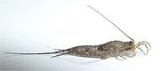
Archaeognaths are small insects with elongated bodies bent into an arch shape and three long tail-like structures. They have flexible antennaeAntenna (biology)
Antennae in biology have historically been paired appendages used for sensing in arthropods. More recently, the term has also been applied to cilium structures present in most cell types of eukaryotes....
, large compound eyes that meet at the top of the head, and three ocelli. Their mouthparts
Insect mouthparts
Insects exhibit a range of mouthparts, adapted to particular modes of feeding. The earliest insects had chewing mouthparts...
are partially retractable, with simple chewing mandibles
Mandible (arthropod)
thumb|250px|The mandibles of a [[Bull ant]]The mandible of an arthropod is either of a pair of mouthparts used for biting, cutting and holding food. Mandibles are often simply referred to as jaws. Mandibles are present in the extant subphyla Myriapoda , Crustacea and Hexapoda...
and long maxillary palps.
Archaeognatha differ from Thysanura in being able to use their tail to spring up to 30 centimetres (11.8 in) into the air. They are also unique in possessing small, articulated "styli" on the hind (and sometimes middle) coxae
Arthropod leg
The arthropod leg is a form of jointed appendage of arthropods, usually used for walking. Many of the terms used for arthropod leg segments are of Latin origin, and may be confused with terms for bones: coxa , trochanter , femur, tibia, tarsus, ischium, metatarsus, carpus, dactylus ,...
and sternites 2 to 9, which are sometimes considered to be rudimentary appendage
Appendage
In invertebrate biology, an appendage is an external body part, or natural prolongation, that protrudes from an organism's body . It is a general term that covers any of the homologous body parts that may extend from a body segment...
s, as well as paired eversible membranous vesicles through which they absorb water.
Further unusual features are that the abdominal sternites are each composed of three sclerite
Sclerite
A sclerite is a hardened body part. The term is used in various branches of biology for various structures including hardened portions of sponges, but it is most commonly used for the hardened portions of arthropod exoskeletons....
s, and they cement themselves to the substrate before molting
Ecdysis
Ecdysis is the moulting of the cuticula in many invertebrates. This process of moulting is the defining feature of the clade Ecdysozoa, comprising the arthropods, nematodes, velvet worms, horsehair worms, rotifers, tardigrades and Cephalorhyncha...
. Like Thysanura
Thysanura
Thysanura is an order of insects, encompassing silverfish and firebrats, known for their three long caudal filaments.The families Machilidae and Meinertellidae of the jumping bristletails were once included with Thysanura....
, the body is covered with scales, with a thin exoskeleton
Exoskeleton
An exoskeleton is the external skeleton that supports and protects an animal's body, in contrast to the internal skeleton of, for example, a human. In popular usage, some of the larger kinds of exoskeletons are known as "shells". Examples of exoskeleton animals include insects such as grasshoppers...
that is susceptible to dehydration.
Biology
Archaeognaths are found in a wide range of habitats, and are unusual among insects in that they can even be found in the ArcticArctic
The Arctic is a region located at the northern-most part of the Earth. The Arctic consists of the Arctic Ocean and parts of Canada, Russia, Greenland, the United States, Norway, Sweden, Finland, and Iceland. The Arctic region consists of a vast, ice-covered ocean, surrounded by treeless permafrost...
where they live in leaf litter and rock crevices. While most species are found in moist soil, others have adapted to chaparral
Chaparral
Chaparral is a shrubland or heathland plant community found primarily in the U.S. state of California and in the northern portion of the Baja California peninsula, Mexico...
, and even sandy deserts. They feed primarily on algae
Algae
Algae are a large and diverse group of simple, typically autotrophic organisms, ranging from unicellular to multicellular forms, such as the giant kelps that grow to 65 meters in length. They are photosynthetic like plants, and "simple" because their tissues are not organized into the many...
, but also lichen
Lichen
Lichens are composite organisms consisting of a symbiotic organism composed of a fungus with a photosynthetic partner , usually either a green alga or cyanobacterium...
s, moss
Moss
Mosses are small, soft plants that are typically 1–10 cm tall, though some species are much larger. They commonly grow close together in clumps or mats in damp or shady locations. They do not have flowers or seeds, and their simple leaves cover the thin wiry stems...
es, or decaying organic materials.
During courtship, the males spin a thread from their abdomen, attach one end to the substrate, and string packages of sperm (spermatophores) along it. After a series of courtship dances, the female picks up the spermatophores and places them on her ovipositor
Ovipositor
The ovipositor is an organ used by some animals for oviposition, i.e., the laying of eggs. It consists of a maximum of three pairs of appendages formed to transmit the egg, to prepare a place for it, and to place it properly...
. The female then lays a batch of around 30 eggs in a suitable crevice. The young resemble the adults, and take up to two years to reach sexual maturity. Unlike most insects, the adults continue to moult after reaching adulthood, and typically mate once at each instar
Instar
An instar is a developmental stage of arthropods, such as insects, between each molt , until sexual maturity is reached. Arthropods must shed the exoskeleton in order to grow or assume a new form. Differences between instars can often be seen in altered body proportions, colors, patterns, or...
. Archaeognaths may have a total lifespan of up to four years, longer than many larger insects.
External links
- Archaeognatha - Tree of Life Web Project
- Microcoryphia Virginia Polytechnic Institute and State College Department of Entomology