

Archaeocyatha

Encyclopedia
The Archaeocyatha or archaeocyathids ("ancient cups") were sessile
, reef
-building marine
organisms of warm tropical and subtropical waters that lived during the early (lower) Cambrian
period. It is believed that the centre of the Archaeocyatha origin is in East Siberia
, where they are first known from the beginning of the Tommotian Age of the Cambrian, 525 million years ago (mya). In other regions of the world, they appeared much later, during the Atdabanian, and quickly diversified into over a hundred families
. They became the planet's very first reef
-building animals and are an index fossil
for the Lower Cambrian worldwide.
ized structures: Some archaeocyathans were built like nested bowls, while others were as long as 30 cm. Some archaeocyaths were solitary organisms, while others formed colonies
. In the beginning of the Toyonian Age around 516 mya, the archaeocyaths went into a sharp decline. Almost all species became extinct by the Middle Cambrian, with the final-known species disappearing just prior to the end of the Cambrian period, Antarcticocyathus webberi. Their rapid decline and disappearance coincided with a rapid diversification
of the Demosponges.
The group were important reef-builders in the early to middle Cambrian, with reefs (and indeed any accumulation of carbonates) becoming very rare after their extinction until the diversification of coral reef-builders in the Ordovician
.
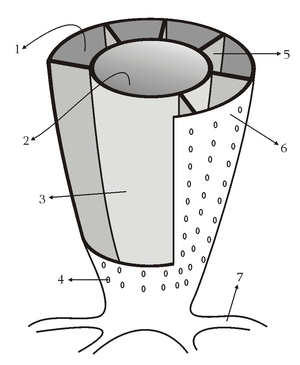
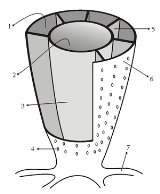
of calcite
similar to that of a sponge
. The structure appeared like a pair of perforated, nested ice cream cones. Their skeletons consisted of either a single porous wall (Monocyathida), or more commonly as two concentric porous walls, an inner and outer wall separated by a space. Inside the inner wall was a cavity (like the inside of an empty ice cream cone). At the base, these pleosponges were held to the substrate
by a holdfast
. The body presumably occupied the space between the inner and outer shells (the intervallum).
allowed them to exploit flow gradients, either by passively pumping water through the skeleton
, or, as in present-day, extant sponges, by drawing water through the pores, removing nutrients, and expelling spent water and wastes through the pores into the central space.
, might be explained by surmising that that they were planktonic during their larva
l stage.
Their phylogenetic affiliation has been subject to changing interpretations, yet the consensus is growing that the archaeocyath was indeed a kind of sponge, thus sometimes called a pleosponge. But some invertebrate
paleontologists have placed them in an extinct, separate phylum, known appropriately as the Archaeocyatha. However, one cladistic analysis suggests that Archaeocyatha is a clade
nested within the phylum
Porifera (better known as the true sponges).
Archaeocyatha have traditionally been divided into Regulares and Irregulares (Rowland, 2001):
However, Okulitch (1955), divided the phylum in three classis:
Sessility (zoology)
In zoology, sessility is a characteristic of animals which are not able to move about. They are usually permanently attached to a solid substrate of some kind, such as a part of a plant or dead tree trunk, a rock, or the hull of a ship in the case of barnacles. Corals lay down their own...
, reef
Reef
In nautical terminology, a reef is a rock, sandbar, or other feature lying beneath the surface of the water ....
-building marine
Marine (ocean)
Marine is an umbrella term. As an adjective it is usually applicable to things relating to the sea or ocean, such as marine biology, marine ecology and marine geology...
organisms of warm tropical and subtropical waters that lived during the early (lower) Cambrian
Cambrian
The Cambrian is the first geological period of the Paleozoic Era, lasting from Mya ; it is succeeded by the Ordovician. Its subdivisions, and indeed its base, are somewhat in flux. The period was established by Adam Sedgwick, who named it after Cambria, the Latin name for Wales, where Britain's...
period. It is believed that the centre of the Archaeocyatha origin is in East Siberia
Siberia
Siberia is an extensive region constituting almost all of Northern Asia. Comprising the central and eastern portion of the Russian Federation, it was part of the Soviet Union from its beginning, as its predecessor states, the Tsardom of Russia and the Russian Empire, conquered it during the 16th...
, where they are first known from the beginning of the Tommotian Age of the Cambrian, 525 million years ago (mya). In other regions of the world, they appeared much later, during the Atdabanian, and quickly diversified into over a hundred families
Family (biology)
In biological classification, family is* a taxonomic rank. Other well-known ranks are life, domain, kingdom, phylum, class, order, genus, and species, with family fitting between order and genus. As for the other well-known ranks, there is the option of an immediately lower rank, indicated by the...
. They became the planet's very first reef
Reef
In nautical terminology, a reef is a rock, sandbar, or other feature lying beneath the surface of the water ....
-building animals and are an index fossil
Index fossil
Index fossils are fossils used to define and identify geologic periods . They work on the premise that, although different sediments may look different depending on the conditions under which they were laid down, they may include the remains of the same species of fossil...
for the Lower Cambrian worldwide.
Geological history
Today, the archaeocyathan families are recognizable by small but consistent differences in their fossilFossil
Fossils are the preserved remains or traces of animals , plants, and other organisms from the remote past...
ized structures: Some archaeocyathans were built like nested bowls, while others were as long as 30 cm. Some archaeocyaths were solitary organisms, while others formed colonies
Colony (biology)
In biology, a colony reference to several individual organisms of the same species living closely together, usually for mutual benefit, such as stronger defense or the ability to attack bigger prey. Some insects live only in colonies...
. In the beginning of the Toyonian Age around 516 mya, the archaeocyaths went into a sharp decline. Almost all species became extinct by the Middle Cambrian, with the final-known species disappearing just prior to the end of the Cambrian period, Antarcticocyathus webberi. Their rapid decline and disappearance coincided with a rapid diversification
Adaptive radiation
In evolutionary biology, adaptive radiation is the evolution of ecological and phenotypic diversity within a rapidly multiplying lineage. Starting with a recent single ancestor, this process results in the speciation and phenotypic adaptation of an array of species exhibiting different...
of the Demosponges.
The group were important reef-builders in the early to middle Cambrian, with reefs (and indeed any accumulation of carbonates) becoming very rare after their extinction until the diversification of coral reef-builders in the Ordovician
Ordovician
The Ordovician is a geologic period and system, the second of six of the Paleozoic Era, and covers the time between 488.3±1.7 to 443.7±1.5 million years ago . It follows the Cambrian Period and is followed by the Silurian Period...
.
Morphology
The typical archaeocyathid resembled a hollow horn coral. Each had a conical or vase-shaped porous skeletonSkeleton
The skeleton is the body part that forms the supporting structure of an organism. There are two different skeletal types: the exoskeleton, which is the stable outer shell of an organism, and the endoskeleton, which forms the support structure inside the body.In a figurative sense, skeleton can...
of calcite
Calcite
Calcite is a carbonate mineral and the most stable polymorph of calcium carbonate . The other polymorphs are the minerals aragonite and vaterite. Aragonite will change to calcite at 380-470°C, and vaterite is even less stable.-Properties:...
similar to that of a sponge
Sea sponge
Sponges are animals of the phylum Porifera . Their bodies consist of jelly-like mesohyl sandwiched between two thin layers of cells. While all animals have unspecialized cells that can transform into specialized cells, sponges are unique in having some specialized cells, but can also have...
. The structure appeared like a pair of perforated, nested ice cream cones. Their skeletons consisted of either a single porous wall (Monocyathida), or more commonly as two concentric porous walls, an inner and outer wall separated by a space. Inside the inner wall was a cavity (like the inside of an empty ice cream cone). At the base, these pleosponges were held to the substrate
Substrate (marine biology)
Stream substrate is the material that rests at the bottom of a stream. There are several classification guides. One is:*Mud – silt and clay.*Sand – Particles between 0.06 and 2 mm in diameter.*Granule – Between 2 and 4 mm in diameter....
by a holdfast
Holdfast
A holdfast is a root-like structure that anchors aquatic sessile organisms, such as seaweed, other sessile algae, stalked crinoids, benthic cnidarians, and sponges, to the substrate. ...
. The body presumably occupied the space between the inner and outer shells (the intervallum).
Ecology
Flow tank experiments suggest that archaeocyathan morphologyMorphology (biology)
In biology, morphology is a branch of bioscience dealing with the study of the form and structure of organisms and their specific structural features....
allowed them to exploit flow gradients, either by passively pumping water through the skeleton
Skeleton
The skeleton is the body part that forms the supporting structure of an organism. There are two different skeletal types: the exoskeleton, which is the stable outer shell of an organism, and the endoskeleton, which forms the support structure inside the body.In a figurative sense, skeleton can...
, or, as in present-day, extant sponges, by drawing water through the pores, removing nutrients, and expelling spent water and wastes through the pores into the central space.
Distribution
The archaeocyathans inhabited coastal areas of shallow seas. Their widespread distribution over almost the entire Cambrian world, as well as the taxonomic diversity of the speciesSpecies
In biology, a species is one of the basic units of biological classification and a taxonomic rank. A species is often defined as a group of organisms capable of interbreeding and producing fertile offspring. While in many cases this definition is adequate, more precise or differing measures are...
, might be explained by surmising that that they were planktonic during their larva
Larva
A larva is a distinct juvenile form many animals undergo before metamorphosis into adults. Animals with indirect development such as insects, amphibians, or cnidarians typically have a larval phase of their life cycle...
l stage.
Their phylogenetic affiliation has been subject to changing interpretations, yet the consensus is growing that the archaeocyath was indeed a kind of sponge, thus sometimes called a pleosponge. But some invertebrate
Invertebrate
An invertebrate is an animal without a backbone. The group includes 97% of all animal species – all animals except those in the chordate subphylum Vertebrata .Invertebrates form a paraphyletic group...
paleontologists have placed them in an extinct, separate phylum, known appropriately as the Archaeocyatha. However, one cladistic analysis suggests that Archaeocyatha is a clade
Clade
A clade is a group consisting of a species and all its descendants. In the terms of biological systematics, a clade is a single "branch" on the "tree of life". The idea that such a "natural group" of organisms should be grouped together and given a taxonomic name is central to biological...
nested within the phylum
Phylum
In biology, a phylum The term was coined by Georges Cuvier from Greek φῦλον phylon, "race, stock," related to φυλή phyle, "tribe, clan." is a taxonomic rank below kingdom and above class. "Phylum" is equivalent to the botanical term division....
Porifera (better known as the true sponges).
Taxonomy
The cladeClade
A clade is a group consisting of a species and all its descendants. In the terms of biological systematics, a clade is a single "branch" on the "tree of life". The idea that such a "natural group" of organisms should be grouped together and given a taxonomic name is central to biological...
Archaeocyatha have traditionally been divided into Regulares and Irregulares (Rowland, 2001):
- Hetairacyathida (incertae sedisIncertae sedis, is a term used to define a taxonomic group where its broader relationships are unknown or undefined. Uncertainty at specific taxonomic levels is attributed by , , and similar terms.-Examples:*The fossil plant Paradinandra suecica could not be assigned to any...
) - Regulares
- Monocyathida
- Capsulocyathida
- Ajacicyathida
- Irregulares
- Thalassocyathida
- Archaeocyathida
- Kazakhstanicyathida
However, Okulitch (1955), divided the phylum in three classis:
- Phylum Archaeocyatha Vologdin, 1937
- Class Monocyathea Okulitch, 1943
- Class Archaeocyathea Okulitch, 1943
- Class Anthocyathea Okulitch, 1943
External links
- knowledge base and interactive key for identification of archaeocyathan genera: http://www.infosyslab.fr/archaeocyatha/
- (UCMP Berkeley) Archaeocyathans
- (Palaeos Invertebrates) Archaeocyatha