

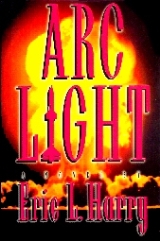
Arc Light

Encyclopedia
Arc Light is the debut novel
by Eric L. Harry, a techno-thriller
about limited nuclear war
published in 1994 and written in 1991-2.
As China
and Russia
clash in Siberia
in June 1999, nuclear missiles strike the United States
. The U.S. retaliates against Russia, and World War III
begins. The nuclear and conventional weapon details are provided and expounded upon, as well as the damage they can do. The political and popular response to a disaster of this magnitude is portrayed, and maps provide details of main battle plans. The concept of mutual assured destruction
is a major theme of the book, and how nations try to avoid it, yet are pushed toward it, as the ultimate conclusion looms.
by North Korea
. Next is the phone call from Russian General Yuri Razov to U.S. Chairman of the Joint Chiefs of Staff
General Andrew Thomas, informing him of Russia's intent to recapture land lost to China in a previous conflict. The beginning of this invasion will be the use of tactical nuclear weapons to clear the way for the army. Meanwhile, a radical Russian general, Zorin, seizes control of the Stavka
and gains access to Russia's nuclear launch codes. As China retaliates against Moscow
, Zorin launches a counterforce
nuclear strike against the U.S. missile silos, bomber bases, submarine pens, and command centers. The U.S. responds in kind, and though no cities in either country were intentionally targeted in the exchange, roughly four to seven million people are killed. A political crisis erupts as war is declared and President Walter Livingston is impeached.
The novel follows Greg Lambert, the National Security Advisor
to the President, in the inner governmental circles as the war begins and the Vice President is sworn in.
The United States Army Reserves are called up, and Major David Chandler reports to March AFB in California
, leaving behind his pregnant wife Melissa, an attorney. As the novel follows him from his leave to his assignment as a tank battalion commander, Melissa gives birth and deals with fallout and fear back home.
The novel proceeds along as conventional war begins as NATO is dissolved, and the U.S. and its new allies begin the invasion of Eastern Europe and Russia. Marines land in eastern Russia and push west. But Russia has not launched all of her nuclear weapons, and threatens to launch submarine-based missiles at the quickly emptying 304-largest U.S. cities. President Paul Constanzo and the joint chiefs must wrestle with the failing economy, failing support, and all-out nuclear war, while the Army continues its advance into the heart of Russia.
Debut novel
A debut novel is the first novel an author publishes. Debut novels are the author's first opportunity to make an impact on the publishing industry, and thus the success or failure of a debut novel can affect the ability of the author to publish in the future...
by Eric L. Harry, a techno-thriller
Techno-thriller
Techno-thrillers are a hybrid genre, drawing subject matter generally from spy/action thrillers, fantasy/war novels, and science fiction...
about limited nuclear war
Nuclear warfare
Nuclear warfare, or atomic warfare, is a military conflict or political strategy in which nuclear weaponry is detonated on an opponent. Compared to conventional warfare, nuclear warfare can be vastly more destructive in range and extent of damage...
published in 1994 and written in 1991-2.
As China
China
Chinese civilization may refer to:* China for more general discussion of the country.* Chinese culture* Greater China, the transnational community of ethnic Chinese.* History of China* Sinosphere, the area historically affected by Chinese culture...
and Russia
Russia
Russia or , officially known as both Russia and the Russian Federation , is a country in northern Eurasia. It is a federal semi-presidential republic, comprising 83 federal subjects...
clash in Siberia
Siberia
Siberia is an extensive region constituting almost all of Northern Asia. Comprising the central and eastern portion of the Russian Federation, it was part of the Soviet Union from its beginning, as its predecessor states, the Tsardom of Russia and the Russian Empire, conquered it during the 16th...
in June 1999, nuclear missiles strike the United States
United States
The United States of America is a federal constitutional republic comprising fifty states and a federal district...
. The U.S. retaliates against Russia, and World War III
World War III
World War III denotes a successor to World War II that would be on a global scale, with common speculation that it would be likely nuclear and devastating in nature....
begins. The nuclear and conventional weapon details are provided and expounded upon, as well as the damage they can do. The political and popular response to a disaster of this magnitude is portrayed, and maps provide details of main battle plans. The concept of mutual assured destruction
Mutual assured destruction
Mutual Assured Destruction, or mutually assured destruction , is a doctrine of military strategy and national security policy in which a full-scale use of high-yield weapons of mass destruction by two opposing sides would effectively result in the complete, utter and irrevocable annihilation of...
is a major theme of the book, and how nations try to avoid it, yet are pushed toward it, as the ultimate conclusion looms.
Plot summary
The novel opens with the invasion of the Korean Demilitarized ZoneKorean Demilitarized Zone
The Korean Demilitarized Zone is a strip of land running across the Korean Peninsula that serves as a buffer zone between North and South Korea. The DMZ cuts the Korean Peninsula roughly in half, crossing the 38th parallel on an angle, with the west end of the DMZ lying south of the parallel and...
by North Korea
North Korea
The Democratic People’s Republic of Korea , , is a country in East Asia, occupying the northern half of the Korean Peninsula. Its capital and largest city is Pyongyang. The Korean Demilitarized Zone serves as the buffer zone between North Korea and South Korea...
. Next is the phone call from Russian General Yuri Razov to U.S. Chairman of the Joint Chiefs of Staff
Chairman of the Joint Chiefs of Staff
The Chairman of the Joint Chiefs of Staff is by law the highest ranking military officer in the United States Armed Forces, and is the principal military adviser to the President of the United States, the National Security Council, the Homeland Security Council and the Secretary of Defense...
General Andrew Thomas, informing him of Russia's intent to recapture land lost to China in a previous conflict. The beginning of this invasion will be the use of tactical nuclear weapons to clear the way for the army. Meanwhile, a radical Russian general, Zorin, seizes control of the Stavka
Stavka
Stavka was the term used to refer to a command element of the armed forces from the time of the Kievan Rus′, more formally during the history of Imperial Russia as administrative staff and General Headquarters during late 19th Century Imperial Russian armed forces and those of the Soviet Union...
and gains access to Russia's nuclear launch codes. As China retaliates against Moscow
Moscow
Moscow is the capital, the most populous city, and the most populous federal subject of Russia. The city is a major political, economic, cultural, scientific, religious, financial, educational, and transportation centre of Russia and the continent...
, Zorin launches a counterforce
Counterforce
In nuclear strategy, a counterforce target is one that has a military value, such as a launch silo for intercontinental ballistic missiles, an airbase at which nuclear-armed bombers are stationed, a homeport for ballistic missile submarines, or a command and control installation...
nuclear strike against the U.S. missile silos, bomber bases, submarine pens, and command centers. The U.S. responds in kind, and though no cities in either country were intentionally targeted in the exchange, roughly four to seven million people are killed. A political crisis erupts as war is declared and President Walter Livingston is impeached.
The novel follows Greg Lambert, the National Security Advisor
National Security Advisor (United States)
The Assistant to the President for National Security Affairs, commonly referred to as the National Security Advisor , serves as the chief advisor to the President of the United States on national security issues...
to the President, in the inner governmental circles as the war begins and the Vice President is sworn in.
The United States Army Reserves are called up, and Major David Chandler reports to March AFB in California
California
California is a state located on the West Coast of the United States. It is by far the most populous U.S. state, and the third-largest by land area...
, leaving behind his pregnant wife Melissa, an attorney. As the novel follows him from his leave to his assignment as a tank battalion commander, Melissa gives birth and deals with fallout and fear back home.
The novel proceeds along as conventional war begins as NATO is dissolved, and the U.S. and its new allies begin the invasion of Eastern Europe and Russia. Marines land in eastern Russia and push west. But Russia has not launched all of her nuclear weapons, and threatens to launch submarine-based missiles at the quickly emptying 304-largest U.S. cities. President Paul Constanzo and the joint chiefs must wrestle with the failing economy, failing support, and all-out nuclear war, while the Army continues its advance into the heart of Russia.
External links
- http://eharry.com/arc.htm – page at author's website with writing and publication details (Dead Link)
- Review by Christian Sauvé
- Reader reviews at Library Thing