
All Topics  
Arborsculpture

 
Arborsculpture

   Email Print
   Bookmark   Link


Arborsculpture


Tree shaping, known under a variety of names, is the art and technique of growing and shaping trunks, branches and roots of trees and other woody plants. By grafting, shaping, and pruning the woody trunks, or guiding branches, trees are made to grow into ornamental or useful shapes. Tree shaping is similar to espalier
Espalier

Espalier is the horticulture technique of training trees through pruning and grafting in order to create formal "two-dimensional" or single plane patterns by the branches of the tree....
, Bonsai
Bonsai

Bonsai 'Bonsai' is a Japanese pronunciation of the earlier Chinese term penzai . The word bonsai is used in the West as an umbrella term for all miniature trees in containers or pots....
 and sometimes includes some topiary
Topiary

Topiary is the art of creating sculptures in the medium of clipped trees, shrubs and sub-shrubs. The word derives from the Latin word for an ornamental landscape gardener, topiarius, creator of topia or "places", a Greek word that Romans applied also to fictive indoor landscapes executed in fresco....
.

Method
Tree shaping relies on the ability of plants (trees) to be united together by approach grafting
Grafting

Grafting is a method of asexual plant propagation widely used in agriculture and horticulture where the tissues of one plant are encouraged to fuse with those of another....
 and the ability to retain a new shape when new layers of wood form to hold a desired shape.

Approach grafting
Grafting

Grafting is a method of asexual plant propagation widely used in agriculture and horticulture where the tissues of one plant are encouraged to fuse with those of another....
 is accomplished by wounding two or more parts of a tree or trees by cutting off the bark, to or past the cambium
Cambium

In botany the cambium is a layer or layers of tissue, also known as meristems, that are the source of cells for secondary growth. There are two types of cambium...
 layer and then binding the wounded parts together so good contact is secure while the wounded tree parts grow together.

Stems or branches, are shaped and temporarily supported for a year or more.


Discussion
Ask a question about 'Arborsculpture'
Start a new discussion about 'Arborsculpture'
Answer questions from other users
Full Discussion Forum


Recent Posts


Encyclopedia


Tree shaping, known under a variety of names, is the art and technique of growing and shaping trunks, branches and roots of trees and other woody plants. By grafting, shaping, and pruning the woody trunks, or guiding branches, trees are made to grow into ornamental or useful shapes. Tree shaping is similar to espalier
Espalier

Espalier is the horticulture technique of training trees through pruning and grafting in order to create formal "two-dimensional" or single plane patterns by the branches of the tree....
, Bonsai
Bonsai

Bonsai 'Bonsai' is a Japanese pronunciation of the earlier Chinese term penzai . The word bonsai is used in the West as an umbrella term for all miniature trees in containers or pots....
 and sometimes includes some topiary
Topiary

Topiary is the art of creating sculptures in the medium of clipped trees, shrubs and sub-shrubs. The word derives from the Latin word for an ornamental landscape gardener, topiarius, creator of topia or "places", a Greek word that Romans applied also to fictive indoor landscapes executed in fresco....
.

Method


Tree shaping relies on the ability of plants (trees) to be united together by approach grafting
Grafting

Grafting is a method of asexual plant propagation widely used in agriculture and horticulture where the tissues of one plant are encouraged to fuse with those of another....
 and the ability to retain a new shape when new layers of wood form to hold a desired shape.

Approach grafting
Grafting

Grafting is a method of asexual plant propagation widely used in agriculture and horticulture where the tissues of one plant are encouraged to fuse with those of another....
 is accomplished by wounding two or more parts of a tree or trees by cutting off the bark, to or past the cambium
Cambium

In botany the cambium is a layer or layers of tissue, also known as meristems, that are the source of cells for secondary growth. There are two types of cambium...
 layer and then binding the wounded parts together so good contact is secure while the wounded tree parts grow together.

Stems or branches, are shaped and temporarily supported for a year or more. Depending on the size of the design and the time frame the supports are need. During that time, The design swells with each additional layer of wood grown. Once the tree is able to support the shaping the temporary supports can be removed.

Pruning
Pruning

Pruning is the process of removing certain above-ground elements from a plant; in landscaping this process usually involves removal of diseased, non-productive, or otherwise unwanted portions from a plant....
 may be required to remove unwanted branches and direct the growth into the desired shape. Pruning may also redirect stem growth. A pruning cut above a Leaf
Leaf

In botany, a leaf is an above-ground plant Organ specialized for photosynthesis. For this purpose, a leaf is typically flat and thin, to expose the cells containing chloroplast to light over a broad area, and to allow light to penetrate fully into the tissues....
 or Node can steer the plant. If a leaf points to the right, then a cut above that leaf will produce new growth that grows to the right side. Likewise, a cut above a leaf pointing to the left, produces new growth that grows to the left.

Another technique is to grow trees in the air rather than in the ground. The roots then remain flexible and may be shaped as they grow to form art or functional structures. It is suggested that such techniques may develop into eco-architecture which may allow the growing of large structures such as homes.

Using these methods (also used in Arboriculture
Arboriculture

Arboriculture is the cultivation and management of trees within the landscape. This includes the study of how trees grow and respond to cultural practices and the environment, as well as application of cultural techniques such as selection, planting, care, surgery and removal....
), items like benches, chairs, etc., can be formed from trees by shaping, merging and manipulating Plant
Plant

Plants are Life organisms belonging to the Kingdom Plantae. They include familiar organisms such as trees, herbs, bushes, grasses, vines, ferns, mosses, and green algae....
 tissue.

Tools


A few of the tools used in tree shaping are similar to those used by a Gardener, an Arborist
Arborist

An arborist, arboriculturalist or tree surgeon is a professional in the practice of arboriculture, which is the management and maintenance of ornamental or shade trees....
, or a Horticulturist. These tools include handpruners (Secateur) and a pruning saw.

Shears (Pruning shears
Pruning shears

Secateurs , also called hand pruners or pruning shears, are a type of scissors for use with plants. They are strong enough to pruning hard branches of trees and shrubs, sometimes up to two centimetres thick....
 or a Hedge trimmer
Hedge trimmer

A hedge trimmer is a piece of gardening/agricultural equipment used especially for trimming Hedge s....
)) are used less commonly. Shears are used more often for topiary or a Hedge (barrier).

The tools, materials and items for growing and shaping are varied. Basically, this is whatever a tree shaper chooses for creating the design, and could include wood boards, pipe, rope, wire, string, tape, etc.. Even an item like a metal patio bench could be used as a pattern or mold (Molding (process)
Molding (process)

Molding or moulding is the process of manufacturing by shaping pliable raw material using a rigid frame or model called a pattern....
).

Time required


The time to grow and construct a tree shaping project varies, depending on the size of trees, the species rate of growth, cultivation conditions, the height of the design and methods used. It is possible to perform initial grafting and bending on a project in an hour (eg: the peace-sign tree below) using the Arborsculpture's methods, removing tape or material that holds the grafting or shape in as little as 1 year and following up with minimal pruning thereafter. "With the Pooktre's methods it can take as little as one season of guiding the trees growth to form the design, and then longer for the tree to thicken to the desired size. For example, see the harvested mirror below. "

Taller, architectural projects like the archway by Axel Erlandson
Axel Erlandson

Axel Erlandson was an United Statesfarmer who opened a horticultural attraction in 1947 featuring his uniquely shaped trees. The attraction was eventually named "The Tree Circus."...
 may require 10 years or more to grow the trees tall enough to accomplish the grafting.

Different styles of tree shaping have different time requirements. When growing a tree intended for harvest and drying, there is a defined point at which the piece is finished. When growing a piece intended to stay alive the piece is never finished until it dies.

Styles


Architectural

Planting and shaping trees into structures such as archways, rooms, houses, tunnels, gazebos. There are two methods within this style. Only using the trees to form the structures, or using trees and inclusions form the structures.

Living Art

Shaping trees with the intention the design will continue to grow for the tree's live span. This style includes, abstract, symbolic and functional.

Intentional Harvest

Designs where the tree(s) are cut from the ground, dried and finished.

Inclusion

Where an item, often inert is positioned so the growth of the tree includes and holds the item. Examples, table tops, stained glass and mirror.

Choosing a tree type

When choosing suitable trees, research is needed. Look for the mature trees that grow well in the area, are less prone to insect damage, and are less susceptible to disease. Any tree species has the potential for shaping. Each type of tree has its own quirks, but they can be understood with time and experience.

Tree species

Here is a list of some of the trees that have been shaped.
  • Box elders (Acer)
  • Sycamore (Platanus)
  • Ficus
  • Cherry (Prunus)
  • Black cherry (Prunus serotina)
  • Crepe myrtle (Lagerstroemia indica)
  • Maple (Acer)
  • Ash (Fraxinus)
  • Guava tree
  • Oak (Quercus)
  • Poplar (Populus)
  • Teak (Tectona grandis linn. F)
  • Wild Plum (Prunus myrobalan)
  • Weeping Willow


Notable tree shapers


John Krubsack

John Krubsack
John Krubsack

John Krubsack was a banker from Embarrass, Wisconsin U.S.A. He conceived, planted and shaped living trees to create the first known grown chair....
 planted 32 Box Elder (acer nugundo) seeds in 1903. He shaped and grafted the first known living chair. Dubbed "The Chair that Lived" is the only known tree shaping that John Krubsack did. He harvested and dried the chair 11 years after planting.

Axel Erlandson

Neadle
Axel Erlandson
Axel Erlandson

Axel Erlandson was an United Statesfarmer who opened a horticultural attraction in 1947 featuring his uniquely shaped trees. The attraction was eventually named "The Tree Circus."...
 started shaping trees as a hobby on his farm in Hilmar, California in 1925. In 1945 he opened a horticultural attraction called the Tree Circus in Scotts Valley, California
Scotts Valley, California

Scotts Valley is a small city in Santa Cruz County, California, California, United States, about thirty miles south of downtown San Jose, California and six miles north of Monterey Bay, in the upland slope of the Santa Cruz Mountains....
. He shaped over 70 trees during his life. Erlandson’s trees appeared in the column of Ripley's Believe It or Not!
Ripley's Believe It or Not!

Ripley's Believe It or Not! is a franchise, founded by Robert Ripley, which deals in bizarre events and items so strange and unusual that readers might question the claims ....
 twelve times. Erlandson's "Telephone Booth Tree" is on permanent display at the Baltimore, Maryland
Baltimore, Maryland

Baltimore is an independent city and the largest city in the U.S. state of Maryland in the United States. Baltimore is located in central Maryland along the tidal portion of the Patapsco River, an arm of the Chesapeake Bay....
 American Visionary Art Museum
American Visionary Art Museum

The American Visionary Art Museum is an art museum located in the Federal Hill, Baltimore neighborhood at 800 Key Highway in Baltimore, Maryland....
. Erlandson's "Birch Loop" tree is on permanent display at the Museum of Art History in Santa Cruz, California
Santa Cruz, California

Santa Cruz is the county seat and largest city of Santa Cruz County, California, California in the United States of America. As of the United States Census, 2000, Santa Cruz had a total population of 54,593....


Extreme Nature

Dan Ladd started shaping trees in 1979. He has a current project where he has grafted eleven trees next to each other up a hillside, to form a long banister. He also uses glass, metal and stone, as inclusions for trees to grow around and hold in place.

Grownup Furniture

Dr Christopher Cattle, thought of the idea, to shape trees in the late 1970s, but it wasn't until 1996 that he was able to start his first planting of furniture. He has grown 15, 3 legged stools to completion, using various species of trees. He has multiple plantings in at least 4 different locations in England. Besides the growing sites, he has taken part in several woodland and craft shows in England, and at the 'Big Tent' at Falkland Palace in Scotland. He also displayed his stools at the exhibit at Nagoya in Japan for Expo 2005. He uses wooden jigs for the shaping of his trees. He main aims appear to be, to show that it's possible to create genuinely useful things without adding to the pollution that industry inevitably seems to produce. And to encourage the revival of such simple and ecologically sound methods, and to promote and encourage new thought along these lines.

Arborsculpture


Some artists such as Reames use the word Arborsculpture to describe tree shaping in general, whereas other artists use the term to refer to a particular style of tree shaping. The term first appeared in the book How to Grow a Chair- The Art of Tree Trunk Topiary 1995 by Reames and Delbol ISBN 0-9647280-0-1 where Reames coined the word in an attempt to give a unifying name to the practice of shaping the growth of tree trunks. The word has since been used in media around the world, and appears in at least one published patent. Controversy exists about the branding of Arborsculpture, as some of the practitioners Reames presents in his book ("Arborsculpture Solutions for a small planet") don't accept the term, or agree to be tagged by it, whereas others do.

Richard Reames was inspired by the works of Axel Erlandson
Axel Erlandson

Axel Erlandson was an United Statesfarmer who opened a horticultural attraction in 1947 featuring his uniquely shaped trees. The attraction was eventually named "The Tree Circus."...
 to attempt his first experiments with growing trees into chairs, which lead him to writing his first book "How to grow a chair" before his experiments were mature.

Pooktre


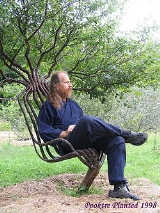
Pooktre is a method of tree shaping that was developed by artists Peter Cook and Becky Northey. The first tree shaping experiment was in 1987. In 1996 after nine years of experimentation and not being aware, of any other tree shapers they call they work Pooktre. Pooktre's methods involve gently guiding a tree's growth along predetermined design pathways over long time periods. The most common tree species used is Prunus myrobalan. Pooktre artists shape trees that are harvested, dried, and finished for indoor art, as well as trees that are intended to continue growing.

Since it was first debuted in public, has been worldwide internet and media interest in Pooktre. It first gained widespread attention at the world Expo in 2005 Aichi Japan at the Growing Village Pavilion where Peter Cook and Becky Northey showed eight of their art pieces for six months. Two of which were people trees.

Pooktre practitioners claim to have created the first shaped trees grown like people. Some examples of functional artwork created in the Pooktre style include
  • a growing garden table,
  • a harvested coffee table,
  • hat stands,
  • mirrors and
  • a gem stone neck piece.


Tree Chair

Mr Wu who lives in China has successfully grown an harvested chair. He has six more growing in his garden. He uses elm trees which are pliant and do not break easily, He says it takes about five years to grow a tree chair.

Differences from topiary


Topiary
Topiary

Topiary is the art of creating sculptures in the medium of clipped trees, shrubs and sub-shrubs. The word derives from the Latin word for an ornamental landscape gardener, topiarius, creator of topia or "places", a Greek word that Romans applied also to fictive indoor landscapes executed in fresco....
 may include the manipulation of stems, but is primarily the art and skill of producing shapes with leaves (foliage). By contrast, shaped trees is primarily the practice of manipulating stems and bonding trees together by grafting
Grafting

Grafting is a method of asexual plant propagation widely used in agriculture and horticulture where the tissues of one plant are encouraged to fuse with those of another....
. Shaped trees may include some topiary effects, but topiary is not the primary feature and consideration of the practice as a whole.

Although its possible to use grafting for topiary, its use is rare.

Shaped Trees include furniture and items that were constructed exclusively using plant growth and grafted plant tissue. These items can be severed from the roots or removed from the ground; no longer being living organisms. But topiary is virtually limited to live organisms (plants) with leaves.

Topiary almost always involves regular shearing and shaping of foliage, whereas shaped trees projects can easily be formed without shearing.

Differences from espalier


Espalier
Espalier

Espalier is the horticulture technique of training trees through pruning and grafting in order to create formal "two-dimensional" or single plane patterns by the branches of the tree....
 is the horticultural
Horticulture

'Horticulture' is the industry and science of plant cultivation. Horticulturists work and conduct research in the disciplines of plant propagation and cultivation, Crop , plant breeding and genetic engineering, plant biochemistry, and plant physiology....
 technique of training trees through pruning and (or) grafting
Grafting

Grafting is a method of asexual plant propagation widely used in agriculture and horticulture where the tissues of one plant are encouraged to fuse with those of another....
 to make formal "two-dimensional" or single plane patterns with branches of trees or shrubs. But shaped trees projects are not limited to a flat single plane, nor a pattern. Either technique may use species of trees which produce fruit. But espalier-trained trees are not known to be shaped into benches, mirror frames, table pedestles or woven pillars.

Differences from pleaching


Pleaching
Pleaching

Pleaching is the art of training trees into a raised Hedge or to form a quincunx. Commonly, deciduous trees are planted in lines, then shaped to form a flat plane above the ground level....
 is more similar to shaped trees than topiary or espalier. But pleaching is limited to flat planes and hedges, therefore it is not a 3 dimensional tree shaping. If a person chose to weave and graft several trees into a flat hedge, that hedge would be one individual shaped trees project.

Differences from bonsai


Bonsai
Bonsai

Bonsai 'Bonsai' is a Japanese pronunciation of the earlier Chinese term penzai . The word bonsai is used in the West as an umbrella term for all miniature trees in containers or pots....
 is an art of growing trees in pots and containers, using pruning
Pruning

Pruning is the process of removing certain above-ground elements from a plant; in landscaping this process usually involves removal of diseased, non-productive, or otherwise unwanted portions from a plant....
 techniques to keep the trees at a miniature size they also use copper wire to shape the tiny branches. Bonsai avoids woven branch patterns or branches bent to resemble identifiable shapes. A bonsai project is intended to appear as if a human had not shaped it; like representation of a miniature tree, if one could be found in the wild. Shaped trees is almost the opposite concept, because the project shapes visually "announce" that a human had shaped it.

It is possible to make a miniature shaped trees in a pot like Bonsai, and keep it reduced to miniature size. But if it were to resemble a pretzel
Pretzel

A pretzel is a bread pastry of Medieval European origin, that has the shape of a three looped knot or twisted braid. Pretzels are either soft or hard....
 for example, that would not be the true nature of "bonsai". It would just be a miniature shaped trees in a pot or container. Even a flat slab of rock can work for a planting tray, with moss retaining the soil.

See also

  • Topiary
    Topiary

    Topiary is the art of creating sculptures in the medium of clipped trees, shrubs and sub-shrubs. The word derives from the Latin word for an ornamental landscape gardener, topiarius, creator of topia or "places", a Greek word that Romans applied also to fictive indoor landscapes executed in fresco....
  • Espalier
    Espalier

    Espalier is the horticulture technique of training trees through pruning and grafting in order to create formal "two-dimensional" or single plane patterns by the branches of the tree....
  • Pleaching
    Pleaching

    Pleaching is the art of training trees into a raised Hedge or to form a quincunx. Commonly, deciduous trees are planted in lines, then shaped to form a flat plane above the ground level....
  • John Krubsack
    John Krubsack

    John Krubsack was a banker from Embarrass, Wisconsin U.S.A. He conceived, planted and shaped living trees to create the first known grown chair....
  • Axel Erlandson
    Axel Erlandson

    Axel Erlandson was an United Statesfarmer who opened a horticultural attraction in 1947 featuring his uniquely shaped trees. The attraction was eventually named "The Tree Circus."...
  • Fab Tree Hab
    Fab Tree Hab

    As a direct contribution to building knowledge in the fields of architecture and urban design the Fab Tree Hab supposes ecology as the main driver for dwelling....
    : Living Home of Shaped Trees
  • Gilroy Gardens
    Gilroy Gardens

    Gilroy Gardens is a 501 non-profit horticultural-themed family theme park in Gilroy, California and is the home of the world-famous Circus Trees created by Axel Erlandson....
    : Home of the Circus Trees


Bibliography External links

  • Discover Living Constructions on Earth!