
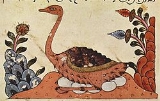
The
Middle Eastern Ostrich or
Arabian Ostrich (
Struthio camelus syriacus) is an extinct
subspeciesSubspecies in biological classification, is either a taxonomic rank subordinate to species, ora taxonomic unit in that rank . A subspecies cannot be recognized in isolation: a species will either be recognized as having no subspecies at all or two or more, never just one...
of the
ostrichThe Ostrich is one or two species of large flightless birds native to Africa, the only living member of the genus Struthio. Some analyses indicate that the Somali Ostrich may be better considered a full species apart from the Common Ostrich, but most taxonomists consider it to be a...
which once lived on the
Arabian PeninsulaThe Arabian Peninsula is a land mass situated north-east of Africa. Also known as Arabia or the Arabian subcontinent, it is the world's largest peninsula and covers 3,237,500 km2...
and in the
Near EastThe Near East is a geographical term that covers different countries for geographers, archeologists, and historians, on the one hand, and for political scientists, economists, and journalists, on the other...
. Its range seems to have been continuous in prehistoric times, but with the drying-up of the Arabian Peninsula, it disappeared from the inhospitable areas of the
Arabian DesertThe Arabian Desert is a vast desert wilderness stretching from Yemen to the Persian Gulf and Oman to Jordan and Iraq. It occupies most of the Arabian Peninsula, with an area of...
such as the
Rub'al-KhaliThe Rub' al Khali or Empty Quarter is one of the largest sand deserts in the world, encompassing most of the southern third of the Arabian Peninsula, including most of Saudi Arabia and areas of Oman, the United Arab Emirates, and Yemen. The desert covers some The Rub' al Khali or Empty Quarter...
. In historic times, the bird seems to have occurred in two discrete
relict populationsA relict is a surviving remnant of a natural phenomenon.* In biology a relict is an organism that at an earlier time was abundant in a large area but now occurs at only one or a few small areas....
: a smaller one in the southeast of the Arabian Peninsula and a larger one in the area where today the borders of
Saudi ArabiaThe Kingdom of Saudi Arabia , commonly known in British English as Saudi Arabia and in Arabic as as-Sa‘ūdiyyah , is the largest state in Western Asia by land area, constituting the bulk of the Arabian Peninsula, and the second-largest in the Arab World...
,
JordanJordan , officially the Hashemite Kingdom of Jordan , Al-Mamlaka al-Urduniyya al-Hashemiyya) is a kingdom on the East Bank of the River Jordan. The country borders Saudi Arabia to the east and south-east, Iraq to the north-east, Syria to the north and the West Bank and Israel to the west, sharing...
,
IraqIraq ; officially the Republic of Iraq is a country in Western Asia spanning most of the northwestern end of the Zagros mountain range, the eastern part of the Syrian Desert and the northern part of the Arabian Desert....
and
SyriaSyria , officially the Syrian Arab Republic , is a country in Western Asia, bordering Lebanon and the Mediterranean Sea to the West, Turkey to the north, Iraq to the east, Jordan to the south, and Israel to the southwest....
meet. Towards the
Sinai PeninsulaThe Sinai Peninsula or Sinai is a triangular peninsula in Egypt about in area. It is situated between the Mediterranean Sea to the north, and the Red Sea to the south, and is the only part of Egyptian territory located in Asia as opposed to Africa, effectively serving as a land bridge between two...
, it probably intergraded with the North African subspecies
camelus in earlier times. It looked exactly like that form; possibly, the females were of a slightly lighter coloration. The only certain way to distinguish
camelus and
syricaus was the smaller size of the latter, with only marginal overlap: the
tarsusIn tetrapods, the tarsus is a cluster of articulating bones in each foot situated between the lower end of tibia and fibula of the lower leg and the metatarsus. In the foot the tarsus articulates with the bones of the metatarsus, which in turn articulate with the bones of the individual toes...
was 390–465 mm long in
syriacus versus 450–530 mm in
camelus.
The Arabian Ostrich has long had a significant place in the culture of the region. An adult with 11 offspring is featured on the famous prehistoric "Graffiti Rock I" near
RiyadhRiyadh is the capital and largest city of Saudi Arabia. It is also the capital of Riyadh Province, and belongs to the historical regions of Najd and Al-Yamama. It is situated in the center of the Arabian Peninsula on a large plateau, and is home to 5,254,560 people, and the urban center of a...
. In
MesopotamiaMesopotamia is a toponym for the area of the Tigris–Euphrates river system, largely corresponding to modern-day Iraq, northeastern Syria, southeastern Turkey and southwestern Iran.Widely considered to be the cradle of civilization, Bronze Age Mesopotamia included Sumer and the...
, it was used as a
sacrificial animalAnimal sacrifice is the ritual killing of an animal as part of a religion. It is practised by many religions as a means of appeasing a god or gods or changing the course of nature...
and featured in artwork, painted on cups and other objects made from ostrich eggs, traded as far as
EtruriaEtruria—usually referred to in Greek and Latin source texts as Tyrrhenia—was a region of Central Italy, an area that covered part of what now are Tuscany, Latium, Emilia-Romagna, and Umbria. A particularly noteworthy work dealing with Etruscan locations is D. H...
during the
Neo-AssyrianAssyria was a Semitic Akkadian kingdom, extant as a nation state from the mid–23rd century BC to 608 BC centred on the Upper Tigris river, in northern Mesopotamia , that came to rule regional empires a number of times through history. It was named for its original capital, the ancient city of Assur...
period. In
Tang ChinaThe Tang Dynasty was an imperial dynasty of China preceded by the Sui Dynasty and followed by the Five Dynasties and Ten Kingdoms Period. It was founded by the Li family, who seized power during the decline and collapse of the Sui Empire...
, an ostrich was a welcome exotic gift fit for an emperor: ostriches figure in the decoration of the
Qianling MausoleumThe Qianling Mausoleum is a Tang Dynasty tomb site located in Qian County, Shaanxi province, China, and is northwest from Xi'an, formerly the Tang capital. Built by 684 , the tombs of the mausoleum complex house the remains of various members of the royal Li family. This includes Emperor...
, completed and closed in 706.
The Jewish view of this bird was less favorable. The fact that the female ostrich may leave the nest unattended (because the eggs are too thick-shelled to be easily broken open by predators) is the reason why the bird is contrasted with the parental instinct of the
storkStorks are large, long-legged, long-necked wading birds with long, stout bills. They belong to the family Ciconiidae. They are the only family in the biological order Ciconiiformes, which was once much larger and held a number of families....
in the
Book of JobThe Book of Job , commonly referred to simply as Job, is one of the books of the Hebrew Bible. It relates the story of Job, his trials at the hands of Satan, his discussions with friends on the origins and nature of his suffering, his challenge to God, and finally a response from God. The book is a...
(.) This is also the reason why the
Book of LamentationsThe Book of Lamentations ) is a poetic book of the Hebrew Bible composed by the Jewish prophet Jeremiah. It mourns the destruction of Jerusalem and the Holy Temple in the 6th Century BCE....
refers to the female ostrich as heartless. The Arabian Ostrich is possibly
among the birds forbidden to Jews as unclean under the
kashrutKashrut is the set of Jewish dietary laws. Food in accord with halakha is termed kosher in English, from the Ashkenazi pronunciation of the Hebrew term kashér , meaning "fit" Kashrut (also kashruth or kashrus) is the set of Jewish dietary laws. Food in accord with halakha (Jewish law) is termed...
in
LeviticusThe Book of Leviticus is the third book of the Hebrew Bible, and the third of five books of the Torah ....
, though the Israelites would just as likely have known the birds from the North African subspecies which was extant in the Nile Valley of
EgyptEgypt , officially the Arab Republic of Egypt, Arabic: , is a country mainly in North Africa, with the Sinai Peninsula forming a land bridge in Southwest Asia. Egypt is thus a transcontinental country, and a major power in Africa, the Mediterranean Basin, the Middle East and the Muslim world...
at that time.
In
RomanThe Roman Empire was the post-Republican period of the ancient Roman civilization, characterised by an autocratic form of government and large territorial holdings in Europe and around the Mediterranean....
times, there was a demand for ostriches to use in
venatioVenatio was a form of entertainment in Roman amphitheaters involving the hunting and slaying of wild animals. Exotic wild beasts from the far reaches of the Roman Empire were brought to Rome and hunts were held in the morning prior to the afternoon main event of gladiatorial duels...
games or cooking. These birds usually would have come from the North African subspecies rather than from the Arabian one, as the latter was only found in the unruly frontier regions of the Roman Empire, although it is to be noted that much later, the plumes of the Arabian Ostrich were considered superior material for millinery compared to those of the North African subspecies.
After the rise of
IslamIslam . The most common are and . : Arabic pronunciation varies regionally. The first vowel ranges from ~~. The second vowel ranges from ~~~...
, the Arabian Ostrich came to represent wealth and elegance; ostrich hunting became a popular pastime for the rich and noble (if slaughtered properly, ostrich meat is
halaal to
MuslimA Muslim, also spelled Moslem, is an adherent of Islam, a monotheistic, Abrahamic religion based on the Quran, which Muslims consider the verbatim word of God as revealed to prophet Muhammad. "Muslim" is the Arabic term for "submitter" .Muslims believe that God is one and incomparable...
s) and eggs, feathers and leather were extensively used in handicraft. Arabian Ostrich products as well as live birds were exported as far as
ChinaChinese civilization may refer to:* China for more general discussion of the country.* Chinese culture* Greater China, the transnational community of ethnic Chinese.* History of China* Sinosphere, the area historically affected by Chinese culture...
. A
Tang DynastyThe Tang Dynasty was an imperial dynasty of China preceded by the Sui Dynasty and followed by the Five Dynasties and Ten Kingdoms Period. It was founded by the Li family, who seized power during the decline and collapse of the Sui Empire...
source states that the "camel bird" inhabiting Arabia is
"four chiChinese units of measurement are the customary and traditional units of measure used in China. In the People's Republic of China, the units were re-standardised during the late 20th century to make them approximate SI units. Many of the units were formerly based on the number 16 instead of 10...
and more in height, its feet resembling those of a camel; its neck is very strong, and men are able to ride on its back...".
The Arabian Ostrich was also discussed in Mesopotamian scholarly writings from the time of the
BaghdadBaghdad is the capital of Iraq, as well as the coterminous Baghdad Governorate. The population of Baghdad in 2011 is approximately 7,216,040...
CaliphateThe term caliphate, "dominion of a caliph " , refers to the first system of government established in Islam and represented the political unity of the Muslim Ummah...
, such as
Zakariya al-QazwiniAbu Yahya Zakariya' ibn Muhammad al-Qazwini , was a Persian physician, astronomer, geographer and proto-science fiction writer....
's
cosmographyCosmography is the science that maps the general features of the universe, describing both heaven and Earth...
'Aja'ib al-makhluqat wa-ghara'ib al-mawjudatʿAjā'ib al-makhlūqāt wa gharā'ib al-mawjūdāt is an important work of cosmography by Zakariya ibn Muhammad ibn Mahmud Abu Yahya al-Qazwini who was born in Qazwin year 600 /1203.-Background to the work:...
, the
Kitab al-Hayawan ("Book of Animals") of
Al-JahizAl-Jāḥiẓ was an Arabic prose writer and author of works of literature, Mu'tazili theology, and politico-religious polemics.In biology, Al-Jahiz introduced the concept of food chains and also proposed a scheme of animal evolution that entailed...
, or Ibn al-Manzur's dictionary
Lisan al-Arab.
Extinction
The widespread introduction of firearms and, later, motor vehicles marked the start of the decline towards extinction of this subspecies. Earlier, hunting with bow, arrows and dogs had allowed most animals of a group to escape, but rifles enabled the poachers to shoot down many individuals for the sheer fun of it. By the early 20th century, the Arabian Ostrich had become rare. Its main stronghold was the northern
NefudAn Nafud or Al-Nefud or The Nefud is a desert in the northern part of the Arabian Peninsula at , occupying a great oval depression...
northwards to the Syrian Desert, between
latitudeIn geography, the latitude of a location on the Earth is the angular distance of that location south or north of the Equator. The latitude is an angle, and is usually measured in degrees . The equator has a latitude of 0°, the North pole has a latitude of 90° north , and the South pole has a...
s 34°N and 25°N and
longitudeLongitude is a geographic coordinate that specifies the east-west position of a point on the Earth's surface. It is an angular measurement, usually expressed in degrees, minutes and seconds, and denoted by the Greek letter lambda ....
38°E eastwards to the
EuphratesThe Euphrates is the longest and one of the most historically important rivers of Western Asia. Together with the Tigris, it is one of the two defining rivers of Mesopotamia...
Valley, and it was most plentiful in
Al Jawf ProvinceAl-Jawf , also spelled Al-Jouf, is a province of Saudi Arabia, located in the north of the country, bordering Jordan. It has an area of 100,212 km² and a population of 440,009 at the 2010 Census...
, where it associated with herds of the
Saudi GazelleThe Saudi Gazelle, Gazella saudiya, is an extinct species of gazelle that was once found in the Arabian peninsula. It is extinct due to hunting by humans of its native lands....
and the
Arabian OryxThe Arabian Oryx or White Oryx is a medium sized antelope with a distinct shoulder hump, long straight horns, and a tufted tail. It is a bovid, and the smallest member of Oryx genus, native to desert and steppe areas of the Arabian peninsula...
, both also extinct or very rare, respectively, nowadays. Some of the last sightings include an individual east of the Tall al-Rasatin at the Jordanian-Iraqi border in 1928, a bird shot and eaten by pipeline workers in the area of
JubailJubail , is a city in the Eastern province on the Persian Gulf coast of Saudi Arabia. It consists of the Old Town of Al Jubail, which was originally a small fishing village, up to 1975 and the new industrial area....
in the early 1940s (some sources specifically state 1941), two apocryphal records of birds suffering the same fate in 1948, and a dying individual found in the upper Wadi el-Hasa north of
PetraPetra is a historical and archaeological city in the Jordanian governorate of Ma'an that is famous for its rock cut architecture and water conduits system. Established sometime around the 6th century BC as the capital city of the Nabataeans, it is a symbol of Jordan as well as its most visited...
in 1966. Remains of old eggs are still found in the former range of the southern subpopulation, which disappeared between the 1900s and the 1920s, probably mainly because of increasing aridity. Some eggshell fragments were collected by
St. John PhilbyHarry St John Bridger Philby CIE , also known as Jack Philby or Sheikh Abdullah , his Arabic name, was an Arabist, explorer, writer, and British colonial office intelligence officer...
from Mahadir Summan, Arabia around 1931. Following analyses of mtDNA control region
haplotypeA haplotype in genetics is a combination of alleles at adjacent locations on the chromosome that are transmitted together...
s that confirmed the close relationship of the Arabian and the North African subspecies (Robinson & Matthee 1999), a
reintroductionReintroduction is the deliberate release of a species into the wild in zones formerly inhabited by said species but where it has disappeared from for a number of reasons, from captivity or relocated from other areas where the species still survives in...
project using
S. c. camelus was set up in Saudi Arabia (Seddon & Soorae 1999). Today the
Somali OstrichThe Somali Ostrich is a large flightless bird, a distinct subspecies, sometimes considered a full species, of the Ostrich.-Taxonomy:...
is re-introduced from captivity to the open areas of the
NegevThe Negev is a desert and semidesert region of southern Israel. The Arabs, including the native Bedouin population of the region, refer to the desert as al-Naqab. The origin of the word Neghebh is from the Hebrew root denoting 'dry'...
in
IsraelThe State of Israel is a parliamentary republic located in the Middle East, along the eastern shore of the Mediterranean Sea...
where the Arabian Ostrich lived before.