
Aquatint is an
intaglioIntaglio is a family of printmaking techniques in which the image is incised into a surface, known as the matrix or plate. Normally, copper or zinc plates are used as a surface, and the incisions are created by etching, engraving, drypoint, aquatint or mezzotint. Collographs may also be printed...
printmakingPrintmaking is the process of making artworks by printing, normally on paper. Printmaking normally covers only the process of creating prints with an element of originality, rather than just being a photographic reproduction of a painting. Except in the case of monotyping, the process is capable...
technique, a variant of
etchingEtching is the process of using strong acid or mordant to cut into the unprotected parts of a metal surface to create a design in intaglio in the metal...
.
Intaglio printmaking makes marks on the matrix (in the case of aquatint, a copper or zinc plate) that are capable of holding ink. The inked plate is passed through a
printing pressA printing press is a mechanical device for applying pressure to an inked surface resting upon a medium , thereby transferring an image. The mechanical systems involved were first assembled in Germany by the goldsmith Johannes Gutenberg around 1440, based on existing screw-presses used to press...
together with a sheet of paper, resulting in a transfer of the ink to the paper. This can be repeated a number of times, depending on the particular technique.
Like
etchingEtching is the process of using strong acid or mordant to cut into the unprotected parts of a metal surface to create a design in intaglio in the metal...
, aquatint uses the application of acid to make the marks in the metal plate.
Aquatint is an
intaglioIntaglio is a family of printmaking techniques in which the image is incised into a surface, known as the matrix or plate. Normally, copper or zinc plates are used as a surface, and the incisions are created by etching, engraving, drypoint, aquatint or mezzotint. Collographs may also be printed...
printmakingPrintmaking is the process of making artworks by printing, normally on paper. Printmaking normally covers only the process of creating prints with an element of originality, rather than just being a photographic reproduction of a painting. Except in the case of monotyping, the process is capable...
technique, a variant of
etchingEtching is the process of using strong acid or mordant to cut into the unprotected parts of a metal surface to create a design in intaglio in the metal...
.
Intaglio printmaking makes marks on the matrix (in the case of aquatint, a copper or zinc plate) that are capable of holding ink. The inked plate is passed through a
printing pressA printing press is a mechanical device for applying pressure to an inked surface resting upon a medium , thereby transferring an image. The mechanical systems involved were first assembled in Germany by the goldsmith Johannes Gutenberg around 1440, based on existing screw-presses used to press...
together with a sheet of paper, resulting in a transfer of the ink to the paper. This can be repeated a number of times, depending on the particular technique.
Like
etchingEtching is the process of using strong acid or mordant to cut into the unprotected parts of a metal surface to create a design in intaglio in the metal...
, aquatint uses the application of acid to make the marks in the metal plate. Where the etching technique uses a needle to make lines that print in black (or whatever colour ink is used), aquatint uses powdered
resinResin is a hydrocarbon secretion of many plants, particularly coniferous trees. It is valued for its chemical constituents and uses, such as varnishes and adhesives, as an important source of raw materials for organic synthesis, or for incense and perfume. Fossilized resins are the source of amber...
which is acid resistant in the ground to create a tonal effect. The tonal variation is controlled by the level of acid exposure over large areas, and thus the image is shaped by large sections at a time. Another tonal technique,
mezzotintMezzotint is a printmaking process of the intaglio family, technically a drypoint method. It was the first tonal method to be used, enabling half-tones to be produced without using line or dot based techniques like hatching, cross-hatching or stipple...
, begins with a plate surface that is evenly indented so that it will carry a fairly dark tone of ink, then smoothing areas to make them carry less ink and thus print a lighter shade; or, beginning with a smooth plate, areas are roughened to make them darker; or, these two techniques may be combined.
The technique of aquatint
An aquatint begins with a copper or zinc plate. The artist applies a ground by either dissolving powdered resin in spirits or applying the powder directly to the surface of the plate.
The plate is then heated; if the plate is covered with powder, the resin melts forming a fine and even coat; if it is in spirits, the spirits evaporate and the result is essentially the same. Now the plate is dipped in acid, producing an even and fine level of corrosion (the "bite") sufficient to hold ink. At this point, the plate is said to carry about a 50% halftone. This means that, were the plate printed with no further biting, the paper would display a gray color more or less directly in between white (no ink) and black (full ink).
At some point the artist will then etch an outline of any aspects of the drawing he wishes to establish with line; this provides the basis and guide for his later tone work. He may also have applied (at the very start, before any biting occurs) an acid-resistant "stop out" (also called an asphaltum or hard ground) if he intends to keep any areas totally white and free of ink, such as highlights.
The artist then begins immersing the plate in the acid bath, progressively stopping out (protecting from acid) any areas that have achieved the designed tonality. These tones, combined with the limited line elements, give aquatints a distinctive, watery look. Also, aquatints, like mezzotints, provide ease in creating large areas of tone without laborious cross-hatching; but aquatint plates, it is noted, are generally more durable than mezzotint plates.
The first etch should be for a short period of time (30 seconds to 1 minute, with a wide variation depending on how light the lightest tones are meant to be). A test piece may be made with etching times noted, as the strength of the etchant will vary. More than thirty minutes should produce a very dark area. Etching for many hours (up to 24) will be as dark as etching for one hour, but the deep etch would produce raised ink on the paper.
Contemporary printmakers often use spraypaint instead of a powder.
Famous examples
Francisco GoyaFrancisco José de Goya y Lucientes was a Spanish painter and printmaker regarded both as the last of the Old Masters and as the first of the moderns. Goya was a court painter to the Spanish Crown and a chronicler of history...
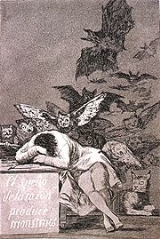
famously took great advantage of aquatint printmaking, in his
Los CaprichosLos Caprichos are a set of 80 aquatint prints created by the Spanish artist Francisco Goya in 1797 and 1798, and published as an album in 1799. The prints were an artistic experiment: a medium for Goya's condemnation of the universal follies and foolishness in the Spanish society in which he lived...
series (1799);
Los Desastres de la Guerra (1810–19);
La Tauromaquia (1816); and
Disparates (ca. 1816–23).
Master engraver Robert
HavellThe Havell family of Reading, Berkshire, England included a number of notable engravers, etchers and painters, as well as writers, publishers, educators, and musicians. In particular, members of this family were foremost practitioners of aquatint; and had a long association with Indian art and...
used aquatint for
John James AudubonJohn James Audubon was a French-American ornithologist, naturalist, hunter, and painter. He painted, catalogued, and described the birds of North America in a form far superior to what had gone before...
's
Birds of AmericaThe Birds of America is the title of a book by naturalist and painter John James Audubon, containing paintings and scientific description of a wide variety of birds of the United States. It was first published as a series of sections between 1827 and 1838....
(1826–38).
External links