
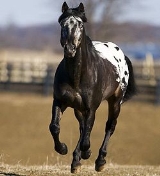
The
Appaloosa is a
horse breed best known for its colorful
leopardThe leopard complex is a group of genetically-related coat patterns in horses. These patterns range from progressive increases in interspersed white hair similar to graying or roan to distinctive, Dalmatian-like leopard spots on a white coat. Secondary characteristics associated with the leopard...
-spotted coat pattern. There is a wide range of body types within the breed, stemming from the influence of multiple breeds of horses throughout its history. Each horse's color pattern is genetically the result of various spotting patterns overlaid on top of one of several recognized base coat colors. The color pattern of the Appaloosa is of great interest to those who study
equine coat color geneticsEquine coat color genetics determine a horse's coat color. There are many different coat colors possible, but all colors are produced by the action of only a few different genes. The simplest genetic default color of all domesticated horses can be described as either "red" or "non-red", depending...
, as it and several other physical characteristics are linked to the
leopard complexThe leopard complex is a group of genetically-related coat patterns in horses. These patterns range from progressive increases in interspersed white hair similar to graying or roan to distinctive, Dalmatian-like leopard spots on a white coat. Secondary characteristics associated with the leopard...
mutation (LP). Appaloosas are prone to develop
equine recurrent uveitisEquine Recurrent Uveitis, is an acute, non-granulomatous inflammation of the uveal tract of the eye, occurring commonly in horses of all breeds, worldwide. The causative factor is not known, but several pathogeneses have been suggested. It is the most common cause of blindness in horses...
and
congenital stationary night blindnessNyctalopia is a condition making it difficult or impossible to see in relatively low light. It is a symptom of several eye diseases. Night blindness may exist from birth, or be caused by injury or malnutrition...
; the latter has been linked to the leopard complex.
Artwork depicting
domesticated horsesThere are a number of hypotheses on many of the key issues regarding the domestication of the horse. Although horses appeared in Paleolithic cave art as early as 30,000 BCE, these were truly wild horses and were probably hunted for meat. How and when horses became domesticated is disputed...
with leopard spotting patterns exists from
Ancient GreeceAncient Greece is a civilization belonging to a period of Greek history that lasted from the Archaic period of the 8th to 6th centuries BC to the end of antiquity. Immediately following this period was the beginning of the Early Middle Ages and the Byzantine era. Included in Ancient Greece is the...
through the
Early modern periodIn history, the early modern period of modern history follows the late Middle Ages. Although the chronological limits of the period are open to debate, the timeframe spans the period after the late portion of the Middle Ages through the beginning of the Age of Revolutions...
; the Nez Perce people of the United States
Pacific NorthwestThe Pacific Northwest is a region in northwestern North America, bounded by the Pacific Ocean to the west and, loosely, by the Rocky Mountains on the east. Definitions of the region vary and there is no commonly agreed upon boundary, even among Pacific Northwesterners. A common concept of the...
developed the original American breed. Appaloosas were once referred to by
settlersAmerican pioneers are any of the people in American history who migrated west to join in settling and developing new areas. The term especially refers to those who were going to settle any territory which had previously not been settled or developed by European or American society, although the...
as the "Palouse horse", possibly after the
Palouse RiverThe Palouse River is a tributary of the Snake River located in the U.S. states of Washington and Idaho. It flows for southwestwards, primarily through the Palouse region of southeastern Washington...
, which ran through the heart of Nez Perce country. Gradually, the name evolved into "Appaloosa". The Nez Perce lost most of their horses after the
Nez Perce WarThe Nez Perce War was an armed conflict between the Nez Perce and the United States government fought in 1877 as part of the American Indian Wars. After a series of battles in which both the U.S. Army and native people sustained significant casualties, the Nez Perce surrendered and were relocated...
in 1877, and the breed fell into decline for several decades. A small number of dedicated breeders preserved the Appaloosa as a distinct breed until the
Appaloosa Horse ClubThe Appaloosa Horse Club, located in Moscow, Idaho is dedicated to preserving and promoting the Appaloosa breed. The state of Idaho adopted the Appaloosa as its state horse in 1975. More than 630,000 Appaloosas have been registered with the Appaloosa Horse Club since its founding in 1938...
(ApHC) was formed as the
breed registryA breed registry, also known as a stud book or register, in animal husbandry and the hobby of animal fancy, is an official list of animals within a specific breed whose parents are known. Animals are usually registered by their breeders when they are still young...
in 1938. The modern breed maintains bloodlines tracing to the
foundation bloodstockFoundation bloodstock or foundation stock are horses that are the progenitor, or foundation, of a new horse breed or a given bloodline within a breed. The term is also used in a similar manner when discussing purebred dogs...
of the registry, and has a partially open stud book that allows addition of some
ThoroughbredThe Thoroughbred is a horse breed best known for its use in horse racing. Although the word thoroughbred is sometimes used to refer to any breed of purebred horse, it technically refers only to the Thoroughbred breed...
,
American Quarter HorseThe American Quarter Horse is an American breed of horse that excels at sprinting short distances. Its name came from its ability to outdistance other breeds of horses in races of a quarter mile or less; some individuals have been clocked at speeds up to 55 mph...
and
ArabianThe Arabian or Arab horse is a breed of horse that originated on the Arabian Peninsula. With a distinctive head shape and high tail carriage, the Arabian is one of the most easily recognizable horse breeds in the world. It is also one of the oldest breeds, with archaeological evidence of horses...
blood.
Today the Appaloosa is one of the most popular breeds in the United States; it was named the official
state horseTwelve U.S. states have designated a horse breed as the official state horse. The first state horse was designated in Vermont in 1961. The most recent state designations occurred in 2010, when North Carolina and South Carolina both declared state breeds...
of
IdahoIdaho is a state in the Rocky Mountain area of the United States. The state's largest city and capital is Boise. Residents are called "Idahoans". Idaho was admitted to the Union on July 3, 1890, as the 43rd state....
in 1975. It is best known as a
stock horseA Stock horse is a horse of a type that is well suited for working with livestock, particularly cattle. Such horses are riding horsescharacterized by agility, quickness, and powerful hindquarters...
used in a number of
western ridingWestern riding is a style of horseback riding which evolved from the ranching and warfare traditions brought to the Americas by the Spanish Conquistadors, and both equipment and riding style evolved to meet the working needs of the cowboy in the American West...
disciplines, but is also a versatile breed with representatives seen in many other types of
equestrianEquestrianism more often known as riding, horseback riding or horse riding refers to the skill of riding, driving, or vaulting with horses...
activity. Appaloosas have appeared in many movies and one is a mascot for the
Florida State SeminolesThe Florida State Seminoles are the men's and women's sports teams of Florida State University in Tallahassee, Florida. Florida State participates in the NCAA's Division I . FSU joined the Atlantic Coast Conference in 1991, and competes in the Atlantic Division in any sports split into a...
. Appaloosa bloodlines have influenced other horse breeds, including the
Pony of the AmericasThe Pony of the Americas, or the POA, was developed to be a children’s pony. The breed’s origins are in America, where an Iowa breeder accidentally crossed a Shetland stallion with an Arabian/Appaloosa mare to produce a pony-sized mount with leopard complex spotting.-Breed Characteristics:The POA...
, the
Nez Perce HorseThe Nez Perce Horse is a spotted horse breed of the Nez Perce tribe of Idaho. The Nez Perce Horse Registry program began in 1995 in Lapwai, Idaho and is based on cross-breeding the old-line Appaloosa horses with an ancient Central Asian breed called Akhal-Teke...
, and several
gaited horseGaited horses are horse breeds that have natural gaited tendencies, that is, the ability to perform one of the smooth to ride, intermediate speed four-beat horse gaits, collectively referred to as ambling gaits....
breeds.
Breed characteristics
The Appaloosa is best known for its distinctive, preferred
leopard complexThe leopard complex is a group of genetically-related coat patterns in horses. These patterns range from progressive increases in interspersed white hair similar to graying or roan to distinctive, Dalmatian-like leopard spots on a white coat. Secondary characteristics associated with the leopard...
spotted coat. Spotting occurs in several overlay patterns on one of several recognized base coat colors. There are three other distinctive, "core" characteristics:
mottleMottle or mottling is the appearance of uneven spots. It is commonly used to describe plants or the skin of animals. In plants, mottling usually consists of yellowish spots on plants, and is usually a sign of disease or malnutrition...
d skin, striped hooves, and eyes with a white
scleraThe sclera , also known as the white or white of the eye, is the opaque , fibrous, protective, outer layer of the eye containing collagen and elastic fiber. In the development of the embryo, the sclera is derived from the neural crest...
. Skin mottling is usually seen around the muzzle, eyes, anus, and genitalia. Striped hooves are a common trait, quite noticeable on Appaloosas, but not unique to the breed. The sclera is the part of the eye surrounding the
irisThe iris is a thin, circular structure in the eye, responsible for controlling the diameter and size of the pupils and thus the amount of light reaching the retina. "Eye color" is the color of the iris, which can be green, blue, or brown. In some cases it can be hazel , grey, violet, or even pink...
. Although all horses show white around the eye if the eye is rolled back, to have a readily visible white sclera with the eye in a normal position is a distinctive characteristic seen more often in Appaloosas than in other breeds. Because the occasional individual is born with little or no visible spotting pattern, the ApHC allows "regular" registration of horses with mottled skin plus at least one of the other core characteristics. Horses with two ApHC parents but no "identifiable Appaloosa characteristics" are registered as "non-characteristic," a limited special registration status.
There is a wide range of body types in the Appaloosa, in part because the leopard complex characteristics are its primary identifying factors, and also because several different
horse breeds influenced its development. The weight range varies from 950 lbs, and heights from . However, the ApHC does not allow
ponyA pony is a small horse . Depending on context, a pony may be a horse that is under an approximate or exact height at the withers, or a small horse with a specific conformation and temperament. There are many different breeds...
or
draftA draft horse , draught horse or dray horse , less often called a work horse or heavy horse, is a large horse bred for hard, heavy tasks such as ploughing and farm labour...
breeding.
The original "old time" or "old type" Appaloosa was a tall, narrow-bodied, rangy horse. The body style reflected a mix that started with the traditional
Spanish horsesThe Iberian horse is a title given to a number of horse breeds native to the Iberian peninsula. At present, 17 horse breeds are recognized by FAO as characteristic of the Iberian Peninsula....
already common on the plains of America before 1700. Then, 18th-century European bloodlines were added, particularly those of the "pied" horses popular in that period and shipped
en masse to the Americas once the color had become unfashionable in Europe. These horses were similar to a tall, slim
ThoroughbredThe Thoroughbred is a horse breed best known for its use in horse racing. Although the word thoroughbred is sometimes used to refer to any breed of purebred horse, it technically refers only to the Thoroughbred breed...
-
AndalusianThe Andalusian, also known as the Pure Spanish Horse or PRE , is a horse breed developed in the Iberian Peninsula. Its ancestors have been present on the Iberian Peninsula for thousands of years. The Andalusian has been recognized as an individual breed since the 15th century, and its conformation...
type of horse popular in Bourbon-era Spain. The original Appaloosa tended to have a convex facial profile that resembled that of the
warmbloodWarmbloods are a group of middle-weight horse types and breeds, primarily originating in Europe, registered with organizations that are characterized by open studbook policy, studbook selection, and the aim of breeding for equestrian sport...
-
JennetA Jennet or Spanish Jennet was a small Spanish horse. It was noted for a smooth naturally ambling gait, compact and well-muscled build, and a good disposition...
crosses first developed in the 16th century during the reign of
Charles VCharles V was ruler of the Holy Roman Empire from 1519 and, as Charles I, of the Spanish Empire from 1516 until his voluntary retirement and abdication in favor of his younger brother Ferdinand I and his son Philip II in 1556.As...
. The old-type Appaloosa was later modified by the addition of draft horse blood after the 1877 defeat of the Nez Perce, when U.S. Government policy forced the Indians to become farmers and provided them with draft horse mares to breed to existing stallions. The original Appaloosas frequently had a sparse
maneThe mane is the hair that grows from the top of the neck of a horse or other equine, reaching from the poll to the withers, and includes the forelock or foretop. It is thicker and coarser than the rest of the horse's coat, and naturally grows to roughly cover the neck...
and
tailThe tail of the horse and other equines consists of two parts, the dock and the skirt. The dock consists of the muscles and skin covering the coccygeal vertebrae. The term "skirt" refers to the long hairs that fall below the dock...
, but that was not a primary characteristic as many early Appaloosas did have full manes and tails. There is a possible genetic link between the leopard complex and sparse mane and tail growth, although the precise relationship is unknown.
After the formation of the Appaloosa Horse Club in 1938, a more modern type developed after the addition of
American Quarter HorseThe American Quarter Horse is an American breed of horse that excels at sprinting short distances. Its name came from its ability to outdistance other breeds of horses in races of a quarter mile or less; some individuals have been clocked at speeds up to 55 mph...
and
ArabianThe Arabian or Arab horse is a breed of horse that originated on the Arabian Peninsula. With a distinctive head shape and high tail carriage, the Arabian is one of the most easily recognizable horse breeds in the world. It is also one of the oldest breeds, with archaeological evidence of horses...
bloodlines. The addition of Quarter Horse lines produced Appaloosas that performed better in
sprint racingHorse racing is an equestrian sport that has a long history. Archaeological records indicate that horse racing occurred in ancient Babylon, Syria, and Egypt. Both chariot and mounted horse racing were events in the ancient Greek Olympics by 648 BC...
and in
halter"Halter" is a term used to describe a type of horse show class where horses are shown "in hand," meaning that they are led, not ridden, and are judged on their conformation and suitability as breeding stock...
competition. Many cutting and reining horses resulted from old-type Appaloosas crossed on Arabian bloodlines, particularly via the Appaloosa
foundation stallionFoundation bloodstock or foundation stock are horses that are the progenitor, or foundation, of a new horse breed or a given bloodline within a breed. The term is also used in a similar manner when discussing purebred dogs...
Red Eagle. An infusion of Thoroughbred blood was added during the 1970s to produce horses more suited for racing. Many current breeders also attempt to breed away from the sparse, "rat tail" trait, and therefore modern Appaloosas have fuller manes and tails.
Color and spotting patterns
The coat color of an Appaloosa is a combination of a base color with an overlaid spotting pattern. The base colors recognized by the Appaloosa Horse Club include bay,
blackBlack is a hair coat color of horses in which the entire hair coat is black. Black is a relatively uncommon coat color, and novices frequently mistake dark chestnuts or bays for black. However, some breeds of horses, such as the Friesian horse, Murgese and Ariegeois are almost exclusively black...
,
chestnutChestnut is a hair coat color of horses consisting of a reddish-to-brown coat with a mane and tail the same or lighter in color than the coat. Genetically and visually, chestnut is characterized by the absolute absence of true black hairs...
,
palominoPalomino is a coat color in horses, consisting of a gold coat and white mane and tail. Genetically, the palomino color is created by a single allele of a dilution gene called the cream gene working on a "red" base coat...
, buckskin,
cremello or perlinoThe cream gene is responsible for a number of horse coat colors. Horses that have the cream gene in addition to a base coat color that is chestnut will become palomino if they are heterozygous, having one copy of the cream gene, or cremello, if they are homozygous. Similarly, horses with a bay...
,
roanRoan is a horse coat color pattern characterized by an even mixture of colored and white hairs on the body, while the head and "points"—lower legs, mane and tail—are more solid-colored. The roan pattern is dominantly-inherited, and is found in many horse breeds...
,
grayGray or grey is a coat color of horses characterized by progressive silvering of the colored hairs of the coat. Most gray horses have black skin and dark eyes; unlike many depigmentation genes, gray does not affect skin or eye color Their adult hair coat is white, dappled, or white intermingled...
,
dunThe dun gene is a dilution gene that affects both red and black pigments in the coat color of a horse. The dun gene has the ability to affect the appearance of all black, bay, or chestnut -based horses to some degree by lightening the base body coat and suppressing the underlying base color to the...
and
grullaGrullo is a color of horses in the dun family, characterized by tan-gray or mouse-colored hairs on the body, often with shoulder and dorsal stripes and black barring on the lower legs. In this coloration each individual hair is mouse-colored, unlike a roan which is composed of a mixture of dark and...
. Appaloosa markings have several pattern variations. It is this unique group of spotting patterns, collectively called the "leopard complex", that most people associate with the Appaloosa horse. Spots overlay darker skin, and are often surrounded by a "halo", where the skin next to the spot is also dark but the overlying hair coat is white.
It is not always easy to predict a grown Appaloosa's color at birth. Foals of any breed tend to be born with coats that darken when they shed their baby hair. In addition, Appaloosa foals do not always show classic leopard complex characteristics. Patterns sometimes change over the course of the horse's life although some, such as the blanket and lepoard patterns, tend to be stable. Horses with the varnish roan and snowflake patterns are especially prone to show very little color pattern at birth, developing more visible spotting as they get older.
The ApHC also recognizes the concept of a "solid" horse, which has a base color "but no contrasting color in the form of an Appaloosa coat pattern". Solid horses can be registered if they have mottled skin and one other leopard complex characteristic.
Base colors are overlain by various spotting patterns, which are variable and often do not fit neatly into a specific category. These patterns are described as follows:
| Pattern |
Description |
Image |
| Spots |
General term that refers to a horse that has white or dark spots over all or a portion of its body. |
.jpg) |
| Blanket or snowcap |
A solid white area normally over, but not limited to, the hip area with a contrasting base color. |
|
| Blanket with spots |
A white blanket which has dark spots within the white. The spots are usually the same color as the horse's base color. |
|
| Leopard |
A white horse with dark spots that flow out over the entire body. Considered an extension of a blanket to cover the whole body. |
|
| Few spot leopard |
A mostly white horse with a bit of color remaining around the flank, neck and head. |
|
| Snowflake |
A horse with white spots, flecks, on a dark body. Typically the white spots increase in number and size as the horse ages. |
|
Appaloosa roan, marble or varnish roanVarnish roan describes a horse with coloration similar to roan, but with some changes in color over the years, though not to the extreme of a gray. This type of roaning only occurs in conjunction with the Leopard complex. Varnish roans are born with a dark base coat color, usually with some spotting...
|
A distinct version of the leopard complex. Intermixed dark and light hairs with lighter colored area on the forehead, jowls and frontal bones of the face, over the back, loin and hips. Darker areas may appear along the edges of the frontal bones of the face as well and also on the legs, stifle, above the eye, point of the hip and behind the elbow. The dark points over bony areas are called "varnish marks" and distinguish this pattern from a traditional roan Roan is a horse coat color pattern characterized by an even mixture of colored and white hairs on the body, while the head and "points"—lower legs, mane and tail—are more solid-colored. The roan pattern is dominantly-inherited, and is found in many horse breeds... . |
|
| Mottled |
A fewspot leopard that is completely white with only mottled skin showing. |
|
| Roan blanket or Frost |
Horses with roaning over the croup and hips. The blanket normally occurs over, but is not limited to, the hip area. |
|
| Roan blanket with spots |
A horse with a roan blanket that has white and/or dark spots within the roan area. |
|
Color genetics
Any horse that shows Appaloosa core characteristics of coat pattern, mottled skin, striped hooves, and a visible white sclera, carries at least one
alleleAn allele is one of two or more forms of a gene or a genetic locus . "Allel" is an abbreviation of allelomorph. Sometimes, different alleles can result in different observable phenotypic traits, such as different pigmentation...
of the dominant "leopard complex" (LP)
geneA gene is a molecular unit of heredity of a living organism. It is a name given to some stretches of DNA and RNA that code for a type of protein or for an RNA chain that has a function in the organism. Living beings depend on genes, as they specify all proteins and functional RNA chains...
. The use of the word "complex" is used to refer to the large group of visible patterns that may occur when LP is present. LP is an autosomal incomplete dominant
mutationIn molecular biology and genetics, mutations are changes in a genomic sequence: the DNA sequence of a cell's genome or the DNA or RNA sequence of a virus. They can be defined as sudden and spontaneous changes in the cell. Mutations are caused by radiation, viruses, transposons and mutagenic...
in the
TRPM1Transient receptor potential cation channel subfamily M member 1 is a protein that in humans is encoded by the TRPM1 gene.- Function :The protein encoded by this gene is similar to the transient receptor potential calcium channel family members...
gene located at horse chromosome 1 (ECA 1). All horses with at least one copy of LP show leopard characteristics, and it is hypothesized that LP acts together with other patterning genes (PATN) that have not yet been identified to produce the different coat patterns. Horses that are heterozygous for LP tend to be darker than homozygous horses, but this is not consistent.
Three single-nucleotide polymorphisms (SNPs) in the TRPM1 gene have been identified as closely associated with the LP mutation, although the mechanism by which the pattern is produced remains unclear. A commercially available DNA based test is likely to be developed in the near future, which breeders can use to determine if LP is present in horses that do not have visible Appaloosa characteristics.
Not every Appaloosa exhibits visible coat spotting, but even apparently solid-colored horses that carry at least one dominant LP allele will exhibit characteristics such as vertically striped hooves, white
scleraThe sclera , also known as the white or white of the eye, is the opaque , fibrous, protective, outer layer of the eye containing collagen and elastic fiber. In the development of the embryo, the sclera is derived from the neural crest...
of the eye, and mottled skin around the eyes, lips, and genitalia. Appaloosas may also exhibit
sabinoSabino is a group of white spotting patterns in horses that affect the skin and hair. A wide variety of irregular color patterns are accepted as sabino. In the strictest sense, "sabino" refers to the white patterns produced by the Sabino 1 gene, for which there is a DNA test...
or
pintoA pinto horse has a coat color that consists of large patches of white and any other color. The distinction between "pinto" and "solid" can be tenuous, as so-called "solid" horses frequently have areas of white hair. Various cultures throughout history appear to have selectively bred for pinto...
type markings, but because pinto genes may cover-up or obscure Appaloosa patterns, pinto breeding is discouraged by the ApHC, which will deny registration to horses with excessive white markings. The genes that create these different patterns can all be present in the same horse. The Appaloosa Project, a genetic study group, has researched the interactions of Appaloosa and pinto genes and how they affect each other.
History
Domesticated horses with leopard complex spotting patterns have been depicted in art dating as far back as Ancient Greece, Ancient Persia, and the
Han DynastyThe Han Dynasty was the second imperial dynasty of China, preceded by the Qin Dynasty and succeeded by the Three Kingdoms . It was founded by the rebel leader Liu Bang, known posthumously as Emperor Gaozu of Han. It was briefly interrupted by the Xin Dynasty of the former regent Wang Mang...
in China; later depictions appeared in 11th-century France and 12th-century England. French paintings from the 16th and 17th centuries show horses with spotted coats being used as riding horses, and other records indicate they were also used as coach horses at the court of
Louis XIV of FranceLouis XIV , known as Louis the Great or the Sun King , was a Bourbon monarch who ruled as King of France and Navarre. His reign, from 1643 to his death in 1715, began at the age of four and lasted seventy-two years, three months, and eighteen days...
. In mid-18th-century Europe, there was a great demand for horses with the leopard complex spotting pattern among the nobility and royalty. These horses were used in the schools of horsemanship, for parade use, and other forms of display. Modern horse breeds in Europe today that have leopard complex spotting include the Knabstrupper and the Pinzgau, or
Noriker horseThe Noriker horse, also called the Norico-Pinzgauer and historically known as the Pinzgauer horse, is a moderately heavy Austrian draught horse breed. The Noriker is considered indigenous to the central Alpine region of Europe, and is believed to have originated around the highest mountain of...
.
The Spanish probably obtained spotted horses through trade with southern Austria and Hungary, where the color pattern was known to exist. The
ConquistadorConquistadors were Spanish soldiers, explorers, and adventurers who brought much of the Americas under the control of Spain in the 15th to 16th centuries, following Europe's discovery of the New World by Christopher Columbus in 1492...
s and Spanish settlers then brought some vividly marked horses to the
AmericasThe Americas, or America , are lands in the Western hemisphere, also known as the New World. In English, the plural form the Americas is often used to refer to the landmasses of North America and South America with their associated islands and regions, while the singular form America is primarily...
when they first arrived in the early 16th century. One horse with snowflake patterning was listed with the 16 horses brought to Mexico by
CortezHernán Cortés de Monroy y Pizarro, 1st Marquis of the Valley of Oaxaca was a Spanish Conquistador who led an expedition that caused the fall of the Aztec Empire and brought large portions of mainland Mexico under the rule of the King of Castile in the early 16th century...
, and additional spotted horses were mentioned by Spanish writers by 1604. Others arrived in the western hemisphere when spotted horses went out of style in late 18th-century Europe, and were shipped to Mexico, California and Oregon.
The Nez Perce
The Nez Perce people lived in what today is eastern Washington,
OregonOregon is a state in the Pacific Northwest region of the United States. It is located on the Pacific coast, with Washington to the north, California to the south, Nevada on the southeast and Idaho to the east. The Columbia and Snake rivers delineate much of Oregon's northern and eastern...
, and western
IdahoIdaho is a state in the Rocky Mountain area of the United States. The state's largest city and capital is Boise. Residents are called "Idahoans". Idaho was admitted to the Union on July 3, 1890, as the 43rd state....
, where they engaged in agriculture as well as
horse breedingHorse breeding is reproduction in horses, and particularly the human-directed process of selective breeding of animals, particularly purebred horses of a given breed. Planned matings can be used to produce specifically desired characteristics in domesticated horses...
. The Nez Perce first obtained horses from the
ShoshoneThe Shoshone or Shoshoni are a Native American tribe in the United States with three large divisions: the Northern, the Western and the Eastern....
around 1730. They took advantage of the fact that they lived in excellent horse-breeding country, relatively safe from the raids of other tribes, and developed strict breeding selection practices for their animals, establishing breeding herds by 1750. They were one of the few tribes that actively used the practice of
geldingA gelding is a castrated horse or other equine such as a donkey or a mule. Castration, and the elimination of hormonally driven behavior associated with a stallion, allows a male horse to be calmer and better-behaved, making the animal quieter, gentler and potentially more suitable as an everyday...
inferior male horses and trading away poorer stock to remove unsuitable animals from the gene pool, and thus were notable as horse breeders by the early 19th century.
Early Nez Perce horses were considered to be of high quality.
Meriwether LewisMeriwether Lewis was an American explorer, soldier, and public administrator, best known for his role as the leader of the Lewis and Clark Expedition also known as the Corps of Discovery, with William Clark...
of the
Lewis and Clark ExpeditionThe Lewis and Clark Expedition, or ″Corps of Discovery Expedition" was the first transcontinental expedition to the Pacific Coast by the United States. Commissioned by President Thomas Jefferson and led by two Virginia-born veterans of Indian wars in the Ohio Valley, Meriwether Lewis and William...
wrote in his February 15, 1806, journal entry: "Their horses appear to be of an excellent race; they are lofty, eligantly [sic] formed, active and durable: in short many of them look like fine English coarsers [sic] and would make a figure in any country." Lewis did note spotting patterns, saying, "... some of these horses are pided [pied] with large spots of white irregularly scattered and intermixed with the black brown bey [sic] or some other dark colour". By "pied", Lewis may have been referring to leopard-spotted patterns seen in the modern Appaloosa, though Lewis also noted that "much the larger portion are of a uniform colour". The
Appaloosa Horse ClubThe Appaloosa Horse Club, located in Moscow, Idaho is dedicated to preserving and promoting the Appaloosa breed. The state of Idaho adopted the Appaloosa as its state horse in 1975. More than 630,000 Appaloosas have been registered with the Appaloosa Horse Club since its founding in 1938...
estimates that only about ten percent of the horses owned by the Nez Perce at the time were spotted. While the Nez Perce originally had many solid-colored horses and only began to emphasize color in their breeding some time after the visit of Lewis and Clark, they had many spotted horses by the late 19th century. As white settlers moved into traditional Nez Perce lands, a successful trade in horses enriched the Nez Perce, who in 1861 bred horses described as "elegant chargers, fit to mount a prince." At a time when ordinary horses could be purchased for $15, non-Indians who had purchased Appaloosa horses from the Nez Perce turned down offers of as much as $600.
Nez Perce War
Peace with the United States dated back to an alliance arranged by Lewis and Clark, but the encroachment of gold miners in the 1860s and settlers in the 1870s put pressure on the Nez Perce. Although a treaty of 1855 originally allowed them to keep most of their traditional land, another in 1863 reduced the land alloted to them by 90 percent. The Nez Perce who refused to give up their land under the 1863 treaty included a band living in the Wallowa Valley of Oregon, led by Heinmot Tooyalakekt, widely known as
Chief JosephHin-mah-too-yah-lat-kekt, popularly known as Chief Joseph, or Young Joseph was the leader of the Wal-lam-wat-kain band of Nez Perce during General Oliver O. Howard's attempt to forcibly remove his band and the other "non-treaty" Nez Perce to a reservation in Idaho...
. Tensions rose, and in May 1877, General Oliver Howard called a council and ordered the non-treaty bands to move to the reservation. Chief Joseph considered military resistance futile, and by June 14, 1877, had gathered about 600 people at a site near present-day
Grangeville, IdahoGrangeville is the largest city in and the county seat of Idaho County, Idaho, United States, in the west central part of the state. It had a population of 3,141 at the 2010 census.- Culture :...
. But on that day a small group of warriors staged an attack on nearby white settlers, which led to the Nez Perce War. After several small battles in Idaho, more than 800 Nez Perce, mostly non-warriors, took 2000 head of various livestock including horses and fled into
MontanaMontana is a state in the Western United States. The western third of Montana contains numerous mountain ranges. Smaller, "island ranges" are found in the central third of the state, for a total of 77 named ranges of the Rocky Mountains. This geographical fact is reflected in the state's name,...
, then traveled southeast, dipping into
Yellowstone National ParkYellowstone National Park, established by the U.S. Congress and signed into law by President Ulysses S. Grant on March 1, 1872, is a national park located primarily in the U.S. state of Wyoming, although it also extends into Montana and Idaho...
. A small number of Nez Perce fighters, probably fewer than 200, successfully held off larger forces of the U.S. Army in several skirmishes, including the two-day
Battle of the Big HoleThe Battle of the Big Hole was a costly battle in the Montana Territory between the Nez Percé and United States army during the Nez Perce War of 1877.-Background:...
in southwestern Montana. They then moved northeast and attempted to seek refuge with the
Crow NationThe Crow, also called the Absaroka or Apsáalooke, are a Siouan people of Native Americans who historically lived in the Yellowstone River valley, which extends from present-day Wyoming, through Montana and into North Dakota. They now live on a reservation south of Billings, Montana and in several...
; rebuffed, they headed for safety in Canada.
Throughout this journey of about 1400 miles (2,253.1 km) the Nez Perce relied heavily on their fast, agile and hardy Appaloosa horses. The journey came to an end when they stopped to rest near the Bears Paw Mountains in Montana, 40 miles (64.4 km) from the Canadian border. Unbeknownst to the Nez Perce, Colonel
Nelson A. MilesNelson Appleton Miles was a United States soldier who served in the American Civil War, Indian Wars, and the Spanish-American War.-Early life:Miles was born in Westminster, Massachusetts, on his family's farm...
had led an infantry-cavalry column from
Fort KeoghFort Keogh is located on the western edge of Miles City, Montana. Occasionally spelled Fort Keough. Originally a military post, today it is a United States Department of Agriculture livestock and range research station. It is listed on the National Register of Historic Places...
in pursuit. On October 5, 1877, after a five-day fight, Joseph surrendered. The battle—and the war—was over. With most of the war chiefs dead, and the noncombatants cold and starving, Joseph declared that he would "fight no more forever".
Aftermath of the Nez Perce War
When the U.S. 7th Cavalry accepted the surrender of Chief Joseph and the remaining Nez Perce, they immediately took more than 1,000 of the tribe's horses, sold what they could and shot many of the rest. But a significant population of horses had been left behind in the Wallowa valley when the Nez Perce began their retreat, and additional animals escaped or were abandoned along the way. The Nez Perce were ultimately settled on reservation lands in north central Idaho, were allowed few horses, and were required by the Army to breed what mares they still had to
draft horseA draft horse , draught horse or dray horse , less often called a work horse or heavy horse, is a large horse bred for hard, heavy tasks such as ploughing and farm labour...
stallions in an attempt to create farm horses. The Nez Perce tribe never regained its former position as breeders of Appaloosas, but in the late 20th century they began a program to develop a new horse breed, the
Nez Perce horseThe Nez Perce Horse is a spotted horse breed of the Nez Perce tribe of Idaho. The Nez Perce Horse Registry program began in 1995 in Lapwai, Idaho and is based on cross-breeding the old-line Appaloosa horses with an ancient Central Asian breed called Akhal-Teke...
, with the intent to resurrect their horse culture, tradition of selective breeding, and horsemanship.
Although a remnant population of Appaloosa horses remained after 1877, they were virtually forgotten as a distinct breed for almost 60 years. A few quality horses continued to be bred, mostly those captured or purchased by settlers and used as working
ranchA ranch is an area of landscape, including various structures, given primarily to the practice of ranching, the practice of raising grazing livestock such as cattle or sheep for meat or wool. The word most often applies to livestock-raising operations in the western United States and Canada, though...
horses. Others were used in circuses and related forms of entertainment such as Buffalo Bill's Wild West Show. The horses were originally called "Palouse horses" by settlers, a reference to the
Palouse RiverThe Palouse River is a tributary of the Snake River located in the U.S. states of Washington and Idaho. It flows for southwestwards, primarily through the Palouse region of southeastern Washington...
that ran through the heart of what was once Nez Perce country. Gradually, the name evolved into "Apalouse", and then "Appaloosa". Other early variations of the name included "Appalucy", "Apalousey" and "Appaloosie". In one 1948 book, the breed was called the "Opelousa horse", described as a "hardy tough breed of Indian and Spanish horse" used by backwoodsmen of the late 18th century to transport goods to New Orleans for sale. By the 1950s, "Appaloosa" was regarded as the correct spelling.
Revitalization
The Appaloosa came to the attention of the general public in January 1937 in
Western HorsemanWestern Horseman, a monthly magazine published by the Magazine Division of Morris Communications, was first published in January 1936. It features articles on Western riding, the breeding and care of horses, horse training and tack, and ranching...
magazine when Francis D. Haines, a history professor from
Lewiston, IdahoLewiston is a city in and also the county seat of Nez Perce County in the Pacific Northwest state of Idaho. It is the second-largest city in the northern Idaho region, behind Coeur d'Alene and ninth-largest in the state. Lewiston is the principal city of the Lewiston, ID - Clarkston, WA...
, published an article describing the breed's history and urging its preservation. Haines had performed extensive research, traveling with a friend and Appaloosa aficionado named George Hatley, visiting numerous Nez Perce villages, collecting history, and taking photographs. The article generated strong interest in the horse breed, and led to the founding of the
Appaloosa Horse ClubThe Appaloosa Horse Club, located in Moscow, Idaho is dedicated to preserving and promoting the Appaloosa breed. The state of Idaho adopted the Appaloosa as its state horse in 1975. More than 630,000 Appaloosas have been registered with the Appaloosa Horse Club since its founding in 1938...
(ApHC) by Claude Thompson and a small group of other dedicated breeders in 1938. The registry was originally housed in
Moro, OregonMoro is a city in Sherman County, Oregon, United States. The population was 337 at the 2000 census. It is the county seat of Sherman County...
; but in 1947 the organization moved to
Moscow, IdahoMoscow is a city in northern Idaho, situated along the Washington/Idaho border. It is the most populous city and county seat of Latah County and the home of the University of Idaho, the land grant institution and primary research university for the state...
, under the leadership of George Hatley. The Appaloosa Museum foundation was formed in 1975 to preserve the history of the Appaloosa horse. The
Western Horseman magazine, and particularly its longtime publisher, Dick Spencer, continued to support and promote the breed through many subsequent articles.
A significant
crossbreedA crossbreed or crossbred usually refers to an animal with purebred parents of two different breeds, varieties, or populations. Crossbreeding refers to the process of breeding such an animal, often with the intention to create offspring that share the traits of both parent lineages, or producing...
ing influence used to revitalize the Appaloosa was the
Arabian horseThe Arabian or Arab horse is a breed of horse that originated on the Arabian Peninsula. With a distinctive head shape and high tail carriage, the Arabian is one of the most easily recognizable horse breeds in the world. It is also one of the oldest breeds, with archaeological evidence of horses...
, as evidenced by early registration lists that show Arabian-Appaloosa crossbreeds as ten of the first fifteen horses registered with the ApHC. For example, one of Claude Thompson's major herd sires was Ferras, an Arabian stallion bred by
W.K. KelloggWill Keith Kellogg, generally referred to as W.K. Kellogg was an American industrialist in food manufacturing, best known as the founder of the Kellogg Company, which to this day produces a wide variety of popular breakfast cereals...
from horses imported from the
Crabbet Arabian StudThe Crabbet Arabian Stud, also known as the Crabbet Park Stud, was a horse breeding farm established on 2 July 1878 when the first Arabian horses brought to England by Wilfrid Scawen Blunt and Lady Anne Blunt arrived at Crabbet Park, their estate in Sussex...
of England. Ferras then sired Red Eagle, a prominent Appaloosa stallion, who was added to the Appaloosa Hall of Fame in 1988. Later,
ThoroughbredThe Thoroughbred is a horse breed best known for its use in horse racing. Although the word thoroughbred is sometimes used to refer to any breed of purebred horse, it technically refers only to the Thoroughbred breed...
and
Quarter HorseThe American Quarter Horse is an American breed of horse that excels at sprinting short distances. Its name came from its ability to outdistance other breeds of horses in races of a quarter mile or less; some individuals have been clocked at speeds up to 55 mph...
lines were added, as well as crosses from other breeds, including
MorgansThe Morgan is one of the earliest horse breeds developed in the United States. Tracing back to the stallion Figure, later named Justin Morgan after his best-known owner, the breed excels in many disciplines, and is known for its versatility....
and
StandardbredsStandardbreds are a breed of horse best known for their ability to race in harness at a trot or pace instead of under saddle at a gallop. Developed in North America, the breed is now recognized worldwide for its harness racing ability...
. In 1983 the ApHC reduced the number of allowable outcrosses to three main breeds: the Arabian horse, the American Quarter Horse and the Thoroughbred.
By 1978 the ApHC was the third largest horse registry for light horse breeds. From 1938 to 2007 more than 670,000 Appaloosas were registered by the ApHC. The state of
IdahoIdaho is a state in the Rocky Mountain area of the United States. The state's largest city and capital is Boise. Residents are called "Idahoans". Idaho was admitted to the Union on July 3, 1890, as the 43rd state....
adopted the Appaloosa as its official state horse on March 25, 1975, when Idaho Governor
Cecil AndrusCecil Dale Andrus was an American politician who served as Governor of Idaho from 1971 to 1977, and again from 1987 to 1995; and in Washington as United States Secretary of the Interior from 1977 to 1981, during the Carter administration...
signed the enabling legislation. Idaho even offers a custom license plate featuring an Appaloosa horse, the first state to offer a plate featuring a state horse.
Registration
Located in Moscow, Idaho, the ApHC is the principal body for the promotion and preservation of the Appaloosa breed and considers itself an international organization. Affiliate Appaloosa organizations exist in many South American and European countries, as well as South Africa, Australia, New Zealand, Canada, Mexico and Israel. The Appaloosa Horse Club has 33,000 members as of 2010, and the circulation of the
Appaloosa Journal, which is included with most types of membership, was at 32,000 in 2008. Other organizations exist; the American Appaloosa Association was founded in 1983 by members opposed to the registration of plain-colored horses as a result of the color rule controversy. Based in Missouri, it has a membership of more than 2,000 as of 2008. There are other "Appaloosa" registries not affiliated with the ApHC for horses with leopard complex genetics. These registries tend to have different
foundation breedingFoundation bloodstock or foundation stock are horses that are the progenitor, or foundation, of a new horse breed or a given bloodline within a breed. The term is also used in a similar manner when discussing purebred dogs...
and histories than the North American Appaloosa. However, the ApHC is by far the largest Appaloosa horse registry, and it hosts one of the world's largest breed shows.
The Appaloosa is "a breed defined by ApHC bloodline requirements and preferred characteristics, including coat pattern". In other words, the Appaloosa is a distinct breed from limited bloodlines with distinct physical traits and a desired color, referred to as a "color preference". Therefore Appaloosas are not strictly a "
color breedA color breed is a term that refers to horses that are registered based primarily on their coat color, regardless of the horse's actual breed or breed type....
". All ApHC-registered Appaloosas must be the offspring of two registered Appaloosa parents or a registered Appaloosa and a horse from an approved breed registry, which includes Arabian horses, Quarter Horses, and Thoroughbreds. In all cases, one parent must always be a regular registered Appaloosa. The only exception to the bloodline requirements is in the case of Appaloosa-colored geldings or spayed mares with unknown pedigrees; owners may apply for "hardship registration" for these non-breeding horses. The ApHC does not accept horses with draft, pony, Pinto, or Paint breeding, and requires mature Appaloosas to stand, unshod, at least . If a horse has excessive white markings not associated with the Appaloosa pattern (such as those characteristic of a pinto) it cannot be registered unless it is verified through DNA testing that both parents have ApHC registration.
Certain other characteristics are used to determine if a horse receives "regular" registration: striped hooves, white sclera visible when the eye is in a normal position, and mottled (spotted) skin around the eyes, lips, and genitalia. The Appaloosa is one of the few horse breeds to exhibit skin mottling, and therefore this characteristic "...is a very basic and decisive indication of an Appaloosa." Appaloosas born with visible coat pattern, or mottled skin and at least one other characteristic, are registered with "regular" papers and have full show and breeding privileges. A horse that meets bloodline requirements but is born without the recognized color pattern and characteristics can still be registered with the ApHC as a "non-characteristic" Appaloosa. These solid-colored, "non-characteristic" Appaloosas may not be shown at ApHC events unless the owner verifies the parentage through DNA testing and pays a supplementary fee to enter the horse into the ApHC's Performance Permit Program (PPP). Solid-colored Appaloosas also have breeding restrictions.
Color rule controversy
During the 1940s and 1950s, when both the Appaloosa Horse Club (ApHC) and the
American Quarter Horse AssociationThe American Quarter Horse Association , based in Amarillo, Texas, is an international organization dedicated to the preservation, improvement and record-keeping of the American Quarter Horse. The association sanctions many competitive events and maintains the official registry...
(AQHA) were in their formative years, minimally marked or roan Appaloosas were sometimes used in Quarter Horse breeding programs. At the same time, it was noted that two solid-colored registered Quarter Horse parents would sometimes produce what Quarter Horse aficionados call a "
cropoutA cropout, crop-out or crop out is a horse with body spots, including pinto or appaloosa spotting, or "high white" horse markings, with a sire and dam who both appeared to have been solid-colored. There are several variations in the definition, depending on the breed registry involved. There are...
", a foal with white coloration similar to that of an Appaloosa or
PintoA pinto horse has a coat color that consists of large patches of white and any other color. The distinction between "pinto" and "solid" can be tenuous, as so-called "solid" horses frequently have areas of white hair. Various cultures throughout history appear to have selectively bred for pinto...
. For a considerable time, until DNA testing could verify parentage, the AQHA refused to register such horses. The ApHC did accept cropout horses that exhibited proper Appaloosa traits, while cropout pintos became the core of the
American Paint Horse AssociationThe American Paint Horse Association is a breed registry for the American Paint Horse. It is currently headquartered in Fort Worth, Texas. It was founded in 1965 with the merging of two different color breed registries that had been formed to register pinto-colored horses of Quarter Horse bloodlines...
. Famous Appaloosas who were cropouts included Colida, Joker B, Bright Eyes Brother and Wapiti.
In the late 1970s the color controversy went in the opposite direction within the Appaloosa registry. The ApHC's decision in 1982 to allow solid-colored or "non-characteristic" Appaloosas to be registered resulted in substantial debate within the Appaloosa breeding community. Until then, a foal of Appaloosa parents that had insufficient color was often denied registration, although non-characteristic Appaloosas were allowed into the registry. But breeder experience had shown that some solid Appaloosas could throw a spotted foal in a subsequent generation, at least when bred to a spotted Appaloosa. In addition, many horses with a solid coat nevertheless exhibited secondary characteristics such as skin mottling, the white sclera, and striped hooves. The controversy stirred by the ApHC's decision was intense, and a number of Appaloosa breeders formed a breakaway organization in 1983.
Uses
Appaloosas are used extensively for both
WesternWestern riding is a style of horseback riding which evolved from the ranching and warfare traditions brought to the Americas by the Spanish Conquistadors, and both equipment and riding style evolved to meet the working needs of the cowboy in the American West...
and
English ridingEnglish riding is a term used to describe a form of horse riding that is seen throughout the world. There are many variations in English riding, but all feature a flat English saddle without the deep seat, high cantle or saddle horn seen on a Western saddle nor the knee pads seen on an Australian...
. Western competitions include
cuttingCutting is an equestrian event in the western riding style where a horse and rider are judged on their ability to separate a single animal away from a cattle herd and keep it away for a short period of time.-Description:...
,
reiningReining is a western riding competition for horses where the riders guide the horses through a precise pattern of circles, spins, and stops. All work is done at the lope and gallop; the fastest of the horse gaits...
,
ropingTeam roping also known as heading and heeling is a rodeo event that features a steer and two mounted riders. The first roper is referred to as the "header," the person who ropes the front of the steer, usually around the horns, but it is also legal for the rope to go around the neck, or go around...
and
O-Mok-SeeGymkhana is a term used in the United Kingdom, east coast of the United States, and other English-speaking nations to describe an equestrian event consisting of speed pattern racing and timed games for riders on horses...
sports such as
barrel racingBarrel racing is a rodeo event in which a horse and rider attempt to complete a clover-leaf pattern around preset barrels in the fastest time. Though both boys and girls compete at the youth level and men compete in some amateur venues, in collegiate and professional ranks, it is primarily a rodeo...
(known as the Camas Prairie Stump Race in Appaloosa-only competition) and
pole bendingPole bending is timed event that features a horse and one mounted rider, running a weaving or serpentine path around six poles arranged in a line...
(called the Nez Percé Stake Race at breed shows). English disciplines they are used in include
eventingEventing is an equestrian event comprising dressage, cross-country, and show jumping. This event has its roots in a comprehensive cavalry test requiring mastery of several types of riding...
,
show jumpingShow jumping, also known as "stadium jumping," "open jumping," or "jumpers," is a member of a family of English riding equestrian events that also includes dressage, eventing, hunters, and equitation. Jumping classes commonly are seen at horse shows throughout the world, including the Olympics...
, and
fox huntingFox hunting is an activity involving the tracking, chase, and sometimes killing of a fox, traditionally a red fox, by trained foxhounds or other scent hounds, and a group of followers led by a master of foxhounds, who follow the hounds on foot or on horseback.Fox hunting originated in its current...
. They are common in
endurance ridingEndurance riding is an equestrian sport based on controlled long-distance races. It is one of the international competitions recognized by the FEI. There are endurance rides worldwide....
competitions, as well as in casual
trail ridingTrail riding sometimes called horse or pony trekking is riding outdoors on natural trails and roads as opposed to riding in an enclosed area such as a riding arena. The term may encompass those who travel on horses, on mountain bikes, or on motorcycles and other motorized all-terrain vehicles...
. Appaloosas are also bred for
horse racingHorse racing is an equestrian sport that has a long history. Archaeological records indicate that horse racing occurred in ancient Babylon, Syria, and Egypt. Both chariot and mounted horse racing were events in the ancient Greek Olympics by 648 BC...
, with an active breed racing association promoting the sport. They are generally used for middle-distance racing at distances between 350 yards and 0.5 mile (0.80467 km); an Appaloosa holds the record for the 4.5 furlongs (905.3 m) distance, set in 1989.
Appaloosas are often used in Western movies and television series. Examples include "Cojo Rojo" in the
Marlon BrandoMarlon Brando, Jr. was an American movie star and political activist. "Unchallenged as the most important actor in modern American Cinema" according to the St...
film
The Appaloosa, "Zip Cochise" ridden by
John WayneMarion Mitchell Morrison , better known by his stage name John Wayne, was an American film actor, director and producer. He epitomized rugged masculinity and became an enduring American icon. He is famous for his distinctive calm voice, walk, and height...
in the 1966 film
El Dorado and "Cowboy", the mount of
Matt DamonMatthew Paige "Matt" Damon is an American actor, screenwriter, and philanthropist whose career was launched following the success of the film Good Will Hunting , from a screenplay he co-wrote with friend Ben Affleck...
in
True GritTrue Grit is a 2010 American Western film written and directed by the Coen brothers. It is the second adaptation of Charles Portis' 1968 novel of the same name, which was previously filmed in 1969 starring John Wayne. This version stars Hailee Steinfeld as Mattie Ross and Jeff Bridges as U.S....
. An Appaloosa horse is part of the controversial mascot team for the Florida State Seminoles,
Chief Osceola and RenegadeChief Osceola and Renegade are the official symbols of the Florida State University Seminoles. During home football games at Florida State, Chief Osceola, portraying the Seminole leader Osceola, charges down the field at Bobby Bowden Field at Doak Campbell Stadium riding an appaloosa horse named...
, even though the Seminole people were not directly associated with Appaloosa horses.
Influence
There are several American horse breeds with leopard coloring and Appaloosa ancestry. These include the
Pony of the AmericasThe Pony of the Americas, or the POA, was developed to be a children’s pony. The breed’s origins are in America, where an Iowa breeder accidentally crossed a Shetland stallion with an Arabian/Appaloosa mare to produce a pony-sized mount with leopard complex spotting.-Breed Characteristics:The POA...
and the
Colorado RangerThe Colorado Ranger is a horse breed named for its Colorado High Plains origins in the United States of America.-Characteristics:The registers horses that can be traced back to one of the two stallions and which also meet additional registration requirements. The breed traces back to one of the...
. Appaloosas are
crossbredA crossbreed or crossbred usually refers to an animal with purebred parents of two different breeds, varieties, or populations. Crossbreeding refers to the process of breeding such an animal, often with the intention to create offspring that share the traits of both parent lineages, or producing...
with
gaited horseGaited horses are horse breeds that have natural gaited tendencies, that is, the ability to perform one of the smooth to ride, intermediate speed four-beat horse gaits, collectively referred to as ambling gaits....
breeds in an attempt to create a leopard-spotted
amblingThe term amble or ambling is used to describe a number of four-beat intermediate gaits of horses. All are faster than a walk but usually slower than a canter or gallop...
horse. Because such crossbred offspring are not eligible for ApHC registration, their owners have formed breed registries for horses with leopard complex patterns and gaited ability. In 1995 the Nez Perce tribe began a program to develop a new and distinct horse breed, the
Nez Perce HorseThe Nez Perce Horse is a spotted horse breed of the Nez Perce tribe of Idaho. The Nez Perce Horse Registry program began in 1995 in Lapwai, Idaho and is based on cross-breeding the old-line Appaloosa horses with an ancient Central Asian breed called Akhal-Teke...
, based on
crossbreedA crossbreed or crossbred usually refers to an animal with purebred parents of two different breeds, varieties, or populations. Crossbreeding refers to the process of breeding such an animal, often with the intention to create offspring that share the traits of both parent lineages, or producing...
ing the Appaloosa with the
Akhal-TekeThe Akhal-Teke is a horse breed from Turkmenistan, where they are a national emblem. They are noted for their speed and for endurance on long marches. These "golden-horses" are adapted to severe climatic conditions and are thought to be one of the oldest surviving horse breeds...
breed from Central Asia. Appaloosa stallions have been exported to Denmark, to add new blood to the Knabstrup breed.
Genetically-linked blindness
Appaloosas have an eightfold greater risk of developing
Equine Recurrent UveitisEquine Recurrent Uveitis, is an acute, non-granulomatous inflammation of the uveal tract of the eye, occurring commonly in horses of all breeds, worldwide. The causative factor is not known, but several pathogeneses have been suggested. It is the most common cause of blindness in horses...
(ERU) than all other breeds combined. Up to 25 percent of all horses with ERU may be Appaloosas.
UveitisUveitis specifically refers to inflammation of the middle layer of the eye, termed the "uvea" but in common usage may refer to any inflammatory process involving the interior of the eye....
in horses has many causes, including eye trauma, disease, and bacterial, parasitic and viral infections, but ERU is characterized by recurring episodes of uveitis, rather than a single incident. If not treated, ERU can lead to blindness, which occurs more often in Appaloosas than in other breeds. Eighty percent of all uveitis cases are found in Appaloosas with physical characteristics including roan or light-colored coat patterns, little pigment around the eyelids and sparse hair in the mane and tail denoting the most at-risk individuals. Researchers may have identified a gene region containing an
alleleAn allele is one of two or more forms of a gene or a genetic locus . "Allel" is an abbreviation of allelomorph. Sometimes, different alleles can result in different observable phenotypic traits, such as different pigmentation...
that makes the breed more susceptible to the disease.
Appaloosas that are homozygous for the
leopard complexThe leopard complex is a group of genetically-related coat patterns in horses. These patterns range from progressive increases in interspersed white hair similar to graying or roan to distinctive, Dalmatian-like leopard spots on a white coat. Secondary characteristics associated with the leopard...
(LP)
geneA gene is a molecular unit of heredity of a living organism. It is a name given to some stretches of DNA and RNA that code for a type of protein or for an RNA chain that has a function in the organism. Living beings depend on genes, as they specify all proteins and functional RNA chains...
are also at risk for
congenital stationary night blindnessNyctalopia is a condition making it difficult or impossible to see in relatively low light. It is a symptom of several eye diseases. Night blindness may exist from birth, or be caused by injury or malnutrition...
(CSNB). This form of night blindness has been linked with the leopard complex since the 1970s, and in 2007 a "significant association" between LP and CSNB was identified. CSNB is a disorder that causes an affected animal to lack night vision, although day vision is normal. It is an inherited disorder, present from birth, and does not progress over time. Studies in 2008 and 2010 indicate that both CSNB and leopard complex spotting patterns are linked to
TRPM1Transient receptor potential cation channel subfamily M member 1 is a protein that in humans is encoded by the TRPM1 gene.- Function :The protein encoded by this gene is similar to the transient receptor potential calcium channel family members...
.
Drug rules
In 2007 the ApHC implemented new drug rules allowing Appaloosas to show with the drugs
furosemideFurosemide or frusemide is a loop diuretic used in the treatment of congestive heart failure and edema. It is most commonly marketed by Sanofi-Aventis under the brand name Lasix...
, known by the trade name of Lasix, and
acetazolamideAcetazolamide, sold under the trade name Diamox, is a carbonic anhydrase inhibitor that is used to treat glaucoma, epileptic seizures, Idiopathic intracranial hypertension , altitude sickness, cystinuria, and dural ectasia...
. Furosemide is used to prevent horses who bleed from the nose when subjected to strenuous work from having bleeding episodes when in competition, and is widely used in horse racing. Acetazolamide ("Acet") is used for treating horses with the genetic disease
hyperkalemic periodic paralysisHyperkalemic periodic paralysis is a genetic disorder which occurs in both humans and horses, where it is also known as Impressive Syndrome. It is an inherited autosomal dominant disorder which affects sodium channels in muscle cells and the ability to regulate potassium levels in the blood...
(HYPP), and prevents affected animals from having seizures. Acet is only allowed for horses that test positive for HYPP and have HYPP status noted on their registration papers. The ApHC recommends that Appaloosas that trace to certain
American Quarter HorseThe American Quarter Horse is an American breed of horse that excels at sprinting short distances. Its name came from its ability to outdistance other breeds of horses in races of a quarter mile or less; some individuals have been clocked at speeds up to 55 mph...
bloodlines be tested for HYPP, and owners have the option to choose to place HYPP testing results on registration papers. Foals of AQHA-registered stallions and mares born on or after January 1, 2007 that carry HYPP will be required to be HYPP tested and have their HYPP status designated on their registration papers.
Both drugs are controversial, in part because they are considered drug maskers and
diureticA diuretic provides a means of forced diuresis which elevates the rate of urination. There are several categories of diuretics. All diuretics increase the excretion of water from bodies, although each class does so in a distinct way.- Medical uses :...
s that can make it difficult to detect the presence of other drugs in the horse's system. On one side, it is argued that the
United States Equestrian FederationThe United States Equestrian Federation is the national governing body for most equestrian sports in the United States. It began on January 20, 1917 as the Association of American Horse Shows, later changed in 1933 to the American Horse Shows Association...
(USEF), which sponsors show competition for many different
horse breeds, and the
International Federation for Equestrian SportsThe Fédération Équestre Internationale or in English, the International Federation for Equestrian Sports, is the international governing body of equestrian sports. It recognizes ten international disciplines...
(FEI), which governs international and
OlympicEquestrianism made its Summer Olympics debut at the 1900 Summer Olympics in Paris, France. It disappeared until 1912, but has appeared at every Summer Olympic Games since. The current Olympic equestrian disciplines are Dressage, Eventing, and Jumping...
equestrian competition, ban the use of furosemide. On the other side of the controversy, several major stock horse registries that sanction their own shows, including the
American Quarter Horse AssociationThe American Quarter Horse Association , based in Amarillo, Texas, is an international organization dedicated to the preservation, improvement and record-keeping of the American Quarter Horse. The association sanctions many competitive events and maintains the official registry...
,
American Paint Horse AssociationThe American Paint Horse Association is a breed registry for the American Paint Horse. It is currently headquartered in Fort Worth, Texas. It was founded in 1965 with the merging of two different color breed registries that had been formed to register pinto-colored horses of Quarter Horse bloodlines...
, and the
PalominoPalomino is a coat color in horses, consisting of a gold coat and white mane and tail. Genetically, the palomino color is created by a single allele of a dilution gene called the cream gene working on a "red" base coat...
Horse Breeders of America, allow acetazolamide and furosemide to be used within 24 hours of showing under certain circumstances.
External links