


Aposematism

Encyclopedia

Predation
In ecology, predation describes a biological interaction where a predator feeds on its prey . Predators may or may not kill their prey prior to feeding on them, but the act of predation always results in the death of its prey and the eventual absorption of the prey's tissue through consumption...
. It is one form of "advertising
Advertising
Advertising is a form of communication used to persuade an audience to take some action with respect to products, ideas, or services. Most commonly, the desired result is to drive consumer behavior with respect to a commercial offering, although political and ideological advertising is also common...
" signal, with many others existing, such as the bright colours of flowers which lure pollinators
Pollination
Pollination is the process by which pollen is transferred in plants, thereby enabling fertilisation and sexual reproduction. Pollen grains transport the male gametes to where the female gamete are contained within the carpel; in gymnosperms the pollen is directly applied to the ovule itself...
. The warning signal may take the form of conspicuous colours, sound
Sound
Sound is a mechanical wave that is an oscillation of pressure transmitted through a solid, liquid, or gas, composed of frequencies within the range of hearing and of a level sufficiently strong to be heard, or the sensation stimulated in organs of hearing by such vibrations.-Propagation of...
s, odour
Odor
An odor or odour is caused by one or more volatilized chemical compounds, generally at a very low concentration, that humans or other animals perceive by the sense of olfaction. Odors are also commonly called scents, which can refer to both pleasant and unpleasant odors...
s or other perceivable
Perception
Perception is the process of attaining awareness or understanding of the environment by organizing and interpreting sensory information. All perception involves signals in the nervous system, which in turn result from physical stimulation of the sense organs...
characteristics. Aposematic signals are beneficial for both the predator and prey, both of which avoid potential harm.
This tendency to become highly noticeable and distinct from harmless organisms is the antithesis
Antithesis
Antithesis is a counter-proposition and denotes a direct contrast to the original proposition...
: crypsis
Crypsis
In ecology, crypsis is the ability of an organism to avoid observation or detection by other organisms. It may be either a predation strategy or an antipredator adaptation, and methods include camouflage, nocturnality, subterranean lifestyle, transparency, and mimicry...
, or avoidance of detection
Prey detection
Prey detection is the process by which predators are able to detect and locate their prey via sensory signals. This article treats predation in its broadest sense, i.e. where one organism eats another.-Evolutionary struggle and prey defenses:...
. Aposematism has been such a successful adaptation that harmless organisms have repeatedly evolved to mimic
Mimic
In evolutionary biology, mimicry is the similarity of one species to another which protects one or both. This similarity can be in appearance, behaviour, sound, scent and even location, with the mimics found in similar places to their models....
aposematic species, a pattern known as Batesian mimicry
Batesian mimicry
Batesian mimicry is a form of mimicry typified by a situation where a harmless species has evolved to imitate the warning signals of a harmful species directed at a common predator...
. Another related pattern is Müllerian mimicry
Müllerian mimicry
Müllerian mimicry is a natural phenomenon when two or more harmful species, that may or may not be closely related and share one or more common predators, have come to mimic each other's warning signals...
, where aposematic species come to resemble one another.
Defence mechanism
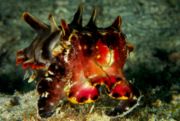
Unpalatability:such as from the bitter taste arising from some insect
Insect
Insects are a class of living creatures within the arthropods that have a chitinous exoskeleton, a three-part body , three pairs of jointed legs, compound eyes, and two antennae...
s such as the ladybird or tiger moth
Arctiidae
Arctiidae is a large and diverse family of moths with around 11,000 species found all over the world, including 6,000 neotropical species. This family includes the groups commonly known as tiger moths , which usually have bright colours, footmen , lichen moths and wasp moths...
, or the noxious odour produced by the skunk
Skunk
Skunks are mammals best known for their ability to secrete a liquid with a strong, foul odor. General appearance varies from species to species, from black-and-white to brown or cream colored. Skunks belong to the family Mephitidae and to the order Carnivora...
, or:
Other danger: such as the poison glands of the poison dart frog
Poison dart frog
Poison dart frog is the common name of a group of frogs in the family Dendrobatidae which are native to Central and South America. These species are diurnal and often have brightly-colored bodies...
, the sting
Stinger (organ)
A sting, sometimes called a stinger in the US, is a sharp organ or body part found in various animals that delivers some kind of venom . A true sting differs from other piercing structures in that it pierces by its own action and injects venom, as opposed to teeth, which pierce by the force of...
of a velvet ant or neurotoxin
Neurotoxin
A neurotoxin is a toxin that acts specifically on nerve cells , usually by interacting with membrane proteins such as ion channels. Some sources are more general, and define the effect of neurotoxins as occurring at nerve tissue...
in a black widow spider.
In these particular examples, the organism advertises its capabilities via either bright colouration in the case of the ladybird, frog and spider; or by conspicuous stripes in the case of the skunk. Various types of tiger moths advertise their unpalatability by either producing ultrasonic
Ultrasound
Ultrasound is cyclic sound pressure with a frequency greater than the upper limit of human hearing. Ultrasound is thus not separated from "normal" sound based on differences in physical properties, only the fact that humans cannot hear it. Although this limit varies from person to person, it is...
noises which warn bats to avoid them, or by warning postures which expose brightly coloured body parts (see Unkenreflex
Unkenreflex
The unken reflex is a passive defense posture adopted by toads, frogs and salamanders. When threatened by predators, they twist their bodies, or arch their backs and limbs to expose brightly-colored aposematic skin...
). Velvet ants have both bright colours and produce audible noises when grabbed (via stridulation
Stridulation
Stridulation is the act of producing sound by rubbing together certain body parts. This behavior is mostly associated with insects, but other animals are known to do this as well, such as a number of species of fishes, snakes and spiders...
), which serve to reinforce the warning.
Aposematic signals are primarily visual and involve bright and contrasting colours. They may be accompanied by one or more signals other than colour. These may be specific odours, sounds or behaviour. Together, the predator encounters a multi-modal signal which is more effectively detected.
Prevalence
Invertebrate
An invertebrate is an animal without a backbone. The group includes 97% of all animal species – all animals except those in the chordate subphylum Vertebrata .Invertebrates form a paraphyletic group...
s, particularly insects, but less so in vertebrate
Vertebrate
Vertebrates are animals that are members of the subphylum Vertebrata . Vertebrates are the largest group of chordates, with currently about 58,000 species described. Vertebrates include the jawless fishes, bony fishes, sharks and rays, amphibians, reptiles, mammals, and birds...
s, being mostly confined to a smaller number of reptile
Reptile
Reptiles are members of a class of air-breathing, ectothermic vertebrates which are characterized by laying shelled eggs , and having skin covered in scales and/or scutes. They are tetrapods, either having four limbs or being descended from four-limbed ancestors...
, amphibian
Amphibian
Amphibians , are a class of vertebrate animals including animals such as toads, frogs, caecilians, and salamanders. They are characterized as non-amniote ectothermic tetrapods...
, and fish
Fish
Fish are a paraphyletic group of organisms that consist of all gill-bearing aquatic vertebrate animals that lack limbs with digits. Included in this definition are the living hagfish, lampreys, and cartilaginous and bony fish, as well as various extinct related groups...
species. Some plant
Plant
Plants are living organisms belonging to the kingdom Plantae. Precise definitions of the kingdom vary, but as the term is used here, plants include familiar organisms such as trees, flowers, herbs, bushes, grasses, vines, ferns, mosses, and green algae. The group is also called green plants or...
s, such as Polygonum sagittatum
Polygonum sagittatum
Polygonum sagittatum is a plant in the buckwheat family, Polygonaceae.-Description:Polygonum sagittatum is a herbaceous plant with alternate, simple leaves, on spiny, rambling stems. The flowers are pink or white, borne in late summer through autumn....
, a species of knotweed
Polygonum
Polygonum is a genus in the Polygonaceae family. Common names include knotweed, knotgrass, bistort, tear-thumb, mile-a-minute, and several others. In the Middle English glossary of herbs "Alphita" , it was known as ars-smerte. There have been various opinions about how broadly the genus should be...
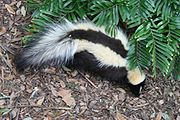
, are thought to employ aposematism to warn herbivores of chemical (such as unpalatability) or physical defences (such as prickled leaves or thorns). Sharply contrasting black-and-white skunks and zorilla
Striped Polecat
The Striped Polecat is a member of the Mustelidae family which somewhat resembles a skunk. It is found in savannahs and open country in sub-saharan Africa excluding the Congo basin and west Africa.Like other polecats, this carnivore is nocturnal...
s are examples within mammals. Some brightly coloured birds with contrasting patterns may also be aposematic.
It has been recently suggested that early hominids employed aposematims to intimidate predators and to obtain protein-rich food via competitive scavenging According to this suggestion, human habitual bipedalism, long leg
Leg
Łęg may refer to the following places in Poland:*A former name for the town of Ełk *Part of the Czyżyny district of Kraków*Łęg, Pleszew County in Greater Poland Voivodeship...
s, long head
Head
In anatomy, the head of an animal is the rostral part that usually comprises the brain, eyes, ears, nose and mouth . Some very simple animals may not have a head, but many bilaterally symmetric forms do....
hair
Hair
Hair is a filamentous biomaterial, that grows from follicles found in the dermis. Found exclusively in mammals, hair is one of the defining characteristics of the mammalian class....
, as well as tradition of group singing, body painting
Body painting
Body painting, or sometimes bodypainting, is a form of body art. Unlike tattoo and other forms of body art, body painting is temporary, painted onto the human skin, and lasts for only several hours, or at most a couple of weeks. Body painting that is limited to the face is known as face painting...
and use of clothes, evolved primarily as aposematic displays, to make hominids and early human
Human
Humans are the only living species in the Homo genus...
s more intimidating (to look bigger and more colourful, and to sound louder).
Behaviour
The defence mechanism relies on the memoryMemory
In psychology, memory is an organism's ability to store, retain, and recall information and experiences. Traditional studies of memory began in the fields of philosophy, including techniques of artificially enhancing memory....
of the would-be predator; a bird that has once experienced a foul-tasting grasshopper
Grasshopper
The grasshopper is an insect of the suborder Caelifera in the order Orthoptera. To distinguish it from bush crickets or katydids, it is sometimes referred to as the short-horned grasshopper...
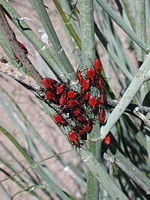
will endeavour to avoid a repetition of the experience. As a consequence, aposematic species are often gregarious. Before the memory of a bad experience attenuates, the predator may have the experience reinforced through repetition, or else leave all the remaining and similarly coloured prey alone and safe. Aposematic organisms often move in a languid fashion, as they have little need for speed and agility. Instead, their morphology is frequently tough and resistant to injury, thereby allowing them to escape once the predator gets a bad taste or sting before the kill.
Origins of the theory
Alfred Russel Wallace
Alfred Russel Wallace, OM, FRS was a British naturalist, explorer, geographer, anthropologist and biologist...
, in response to an 1866 letter from Charles Darwin
Charles Darwin
Charles Robert Darwin FRS was an English naturalist. He established that all species of life have descended over time from common ancestry, and proposed the scientific theory that this branching pattern of evolution resulted from a process that he called natural selection.He published his theory...
, was the first to suggest that the conspicuous colour schemes of some insects might have evolved through natural selection
Natural selection
Natural selection is the nonrandom process by which biologic traits become either more or less common in a population as a function of differential reproduction of their bearers. It is a key mechanism of evolution....
as a warning to predators. Darwin had proposed that conspicuous colouring could be explained in many species by means of sexual selection
Sexual selection
Sexual selection, a concept introduced by Charles Darwin in his 1859 book On the Origin of Species, is a significant element of his theory of natural selection...
practices, but had realised that this could not explain the bright colouring of some species of caterpillar, since they were not sexually active. Wallace responded with the suggestion that as the contrasting coloured bands of a hornet
Hornet
Hornets are the largest eusocial wasps; some species can reach up to in length. The true hornets make up the genus Vespa and are distinguished from other vespines by the width of the vertex , which is proportionally larger in Vespa and by the anteriorly rounded gasters .- Life cycle :In...
warned of its defensive sting, so could the bright colours of the caterpillar warn of its unpalatability. He also pointed out that John Jenner Weir
John Jenner Weir
John Jenner Weir FLS, FZS was an English amateur entomologist, ornithologist and British civil servant. He is best known today for being one of the naturalists who corresponded with and provided important data to both Charles Darwin and Alfred Russel Wallace. He played a particularly important...
had observed that birds in his aviary would not attempt to catch or eat a certain common white moth, and that a white moth at dusk would be as conspicuous as a brightly coloured caterpillar during the day. After Darwin responded enthusiastically to the suggestion, Wallace made a request at a meeting of the Entomological Society of London for data that could be used to test the hypothesis. In response, John Jenner Weir
John Jenner Weir
John Jenner Weir FLS, FZS was an English amateur entomologist, ornithologist and British civil servant. He is best known today for being one of the naturalists who corresponded with and provided important data to both Charles Darwin and Alfred Russel Wallace. He played a particularly important...
conducted experiments with caterpillars and birds in his aviary for two years. The results he reported in 1869 provided the first experimental evidence for warning colouration in animals.
Mimicry
Hornet Moth
The Hornet Moth or Hornet Clearwing, , is a large bulky moth which is a brilliant natural imitation of a hornet. Despite this, however, the moth is perfectly harmless.-Identification:...
is a mimic of the yellow jacket wasp; it resembles the wasp, but is not capable of stinging. A predator which would thus avoid the wasp would similarly avoid the Aegeria.
This form of mimicry, where the mimic lacks the defensive capabilities of its 'model', is known as Batesian mimicry
Batesian mimicry
Batesian mimicry is a form of mimicry typified by a situation where a harmless species has evolved to imitate the warning signals of a harmful species directed at a common predator...
, after Henry Walter Bates
Henry Walter Bates
Henry Walter Bates FRS FLS FGS was an English naturalist and explorer who gave the first scientific account of mimicry in animals. He was most famous for his expedition to the Amazon with Alfred Russel Wallace in 1848. Wallace returned in 1852, but lost his collection in a shipwreck...
, a British naturalist who studied Amazonian butterflies in the second half of the 19th century. Batesian mimicry finds greatest success when the ratio of 'mimic' to 'mimicked' is low; otherwise, predators learn to recognise the imposters. Batesian mimics are known to adapt their mimicry to match the prevalence of aposematic organisms in their environment.
A second form of aposematism mimicry occurs when two organisms share the same antipredation defence and mimic each other, to the benefit of both species. This form of mimicry is known as Müllerian mimicry
Müllerian mimicry
Müllerian mimicry is a natural phenomenon when two or more harmful species, that may or may not be closely related and share one or more common predators, have come to mimic each other's warning signals...
, after Fritz Müller
Fritz Müller
Johann Friedrich Theodor Müller , better known as Fritz Müller, and also as Müller-Desterro, was a German biologist and physician who emigrated to southern Brazil, where he lived in and near the German community of Blumenau, Santa Catarina...
, a German naturalist who studied the phenomenon in the Amazon
Amazon Basin
The Amazon Basin is the part of South America drained by the Amazon River and its tributaries that drains an area of about , or roughly 40 percent of South America. The basin is located in the countries of Bolivia, Brazil, Colombia, Ecuador, Guyana, Peru, and Venezuela...
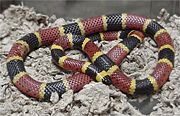
in the late 19th century. For example, a yellow jacket wasp and a honeybee are Müllerian mimics; their similar colouring teaches predators that a striped pattern is the pattern of a stinging insect. Therefore, a predator who has come into contact with either a wasp or a honeybee will likely avoid both in the future.
There are other forms of mimicry not related to aposematism, though these two forms are among the best known and most studied.
See also
- Animal coloration
- Handicap principleHandicap principleThe handicap principle is a hypothesis originally proposed in 1975 by biologist Amotz Zahavi to explain how evolution may lead to "honest" or reliable signaling between animals who have an obvious motivation to bluff or deceive each other...
- RattlesnakeRattlesnakeRattlesnakes are a group of venomous snakes of the genera Crotalus and Sistrurus of the subfamily Crotalinae . There are 32 known species of rattlesnake, with between 65-70 subspecies, all native to the Americas, ranging from southern Alberta and southern British Columbia in Canada to Central...
- Redback spider
- UnkenreflexUnkenreflexThe unken reflex is a passive defense posture adopted by toads, frogs and salamanders. When threatened by predators, they twist their bodies, or arch their backs and limbs to expose brightly-colored aposematic skin...
Online
- The arts of Deception and Camouflage, Mongabay.com
- The Functionality and Evolution of Aposematic Coloration, Sterling, T.
Further reading
- Ruxton, G. D.Graeme RuxtonGraeme Ruxton is Professor of theoretical ecology at the University of Glasgow, Scotland, United Kingdom. His studies focus on the evolutionary pressures on aggregation by animals, and predator-prey aspects of sensory ecology...
; Speed, M. P.; Sherratt, T. N. (2004). Avoiding Attack. The Evolutionary Ecology of Crypsis, Warning Signals and Mimicry. Oxford: Oxford University Press. ISBN 0198528604