

Apollo Computer

Encyclopedia
Apollo Computer, Inc., founded 1980 in Chelmsford, Massachusetts
by William Poduska
(a founder of Prime Computer
) and others, developed and produced Apollo/Domain
workstation
s in the 1980s. Along with Symbolics
and Sun Microsystems
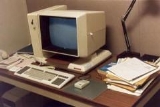
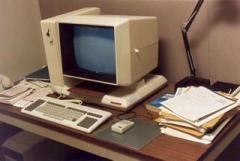
, Apollo was one of the first vendors of graphical workstations in the 1980s. Apollo produced much of its own hardware and software.
 Apollo was started in 1980, two years before Sun Microsystems
.
Besides Poduska, the founders included Dave Nelson (Engineering), Mike Greata (Engineering), Charlie Spector (COO), Bob Antonuccio (Manufacturing), Gerry Stanley (Sales and Marketing), and Dave Lubrano (Finance). The founding engineering team included Mike Sporer, Bernie Stumpf, Russ Barbour, Paul Leach, and Andy Marcuvitz.
In 1981, the company unveiled the DN100 workstation, which used the Motorola 68000
microprocessor
.
Apollo workstations ran Aegis (later replaced by Domain/OS
), a proprietary operating system
with a POSIX
-compliant Unix
alternative frontend. Apollo's networking was particularly elegant, among the first to allow demand paging
over the network, and allowing a degree of network transparency and low sysadmin-to-machine ratio.
From 1980 to 1987, Apollo was the largest manufacturer of network workstations. At the end of 1987, it was third in market share after Digital Equipment Corporation
and Sun Microsystems
, and ahead of Hewlett-Packard
and IBM
.
Apollo's largest customers were Mentor Graphics
(electronic design), General Motors, Ford
, Chrysler, Chicago Research and Trading (Options and Futures) and Boeing
(mechanical design).
Apollo was acquired by Hewlett-Packard
in 1989 for US $476 million, and gradually closed down over the period 1990-1997. But after acquiring Apollo Computer in 1989, HP integrated a lot of Apollo technology into their own HP 9000
series of workstations and servers. The Apollo engineering center took over PA-RISC workstation development and Apollo became an HP workstation brand name (HP Apollo 9000) for a while.
which inspired IBM Rational ClearCase. DSEE was pronounced "dizzy".
Apollo machines used a proprietary operating system, Aegis, because of the excessive cost of single CPU Unix licenses at the time of system definition. Aegis, like Unix
, was based on concepts from the Multics
time sharing operating system. It used the concepts of shell programming (ala Stephen Bourne), single level store, and object-oriented design. Aegis was written in a proprietary version of Pascal.
The dual 68000 processor design was to provide automatic page fault
switching, with one processor acting as a watchdog, while the other executed the OS and program instructions. When a page fault was raised, the main CPU was halted in mid (memory) cycle while the watchdog CPU would bring the page into memory and then allow the main CPU to continue, unaware of the page fault. Later improvements in the Motorola 68010
processor obviated the need for the dual processor design.
Certain efficiencies were gained by careful design, for example, the memory page size, network packet, and disk sector were all 1K byte in size. With this arrangement a page fault could take place across the network as well as on the individual computer and Aegis file system was a single system of memory mapped files across the entire network. The name space of the network was self discovering as new nodes (workstations) were added.
Domain/OS (Distributed On-line Multi-access Interactive Network/Operating System) was initially a layer over Aegis and was not built on a Unix kernel. Release 10 incorporated large parts of Unix but the burden of backwards compatibility with previous releases led to a system that was larger and significantly slower than the previous ones. In the end, Hewlett Packard shut down the Domain/OS line. Release 10 came out as competitors were gaining ground in the area of graphics and windowing systems, particularly with the trend to open system
s and the X Window System
.
Another feature was its proprietary token-ring network, which was originally designed to support relatively small networks of, at most, dozens of computers in an office environment. It was a superb design, allowing direct memory access
page faulting from any hard drive on the network, but it did not inter-operate with any other existing network hardware or software. The industry widely adopted Ethernet
and TCP/IP, a more universal, albeit much slower network. Apollo later added support for these industry standards while continuing to support its own Domain networking using both Ethernet
and Token Ring. The Domain networking was modeled after Xerox Network Systems.
The company moved from a proprietary data bus architecture in favor of IBM's AT-bus
, as used in the second generation of IBM PCs, and was simultaneously embracing RISC technology moving towards high-end processors, eventually producing the PRISM
line.
The workstation industry in general experienced hard times in the second half of the 1980s, as IBM Personal Computers and IBM PC compatible
s began making inroads on their customer base.
Thomas Vanderslice was hired as President and CEO in 1984,
and founder William Poduska left the company in 1985 to found Stellar
.
The company incurred large losses in 1987 in currency speculation due to the trading activities of one individual,
and in 1988 from declining demand for its products.
In 1989 Apollo was acquired by Hewlett-Packard.
This article was partly based on material from the Free On-line Dictionary of Computing and is used with permission under the GFDL.
Chelmsford, Massachusetts
Chelmsford is a suburban town in Middlesex County, Massachusetts in the Greater Boston area. As of the 2010 United States Census, the town's population was 33,802. The Census Bureau's 2008 population estimate for the town was 34,409, ranking it 14th in population among the 54 municipalities in...
by William Poduska
William Poduska
Dr. John William Poduska, Sr was a founder of Prime Computer, Apollo Computer, and Stellar Computer. Prior to that he headed the Electronics Research Lab at NASA's Cambridge, Massachusetts facility and also worked at Honeywell....
(a founder of Prime Computer
Prime Computer
Prime Computer, Inc. was a Natick, Massachusetts-based producer of minicomputers from 1972 until 1992. The alternative spellings "PR1ME" and "PR1ME Computer" were used as brand names or logos by the company.-Founders:...
) and others, developed and produced Apollo/Domain
Apollo/Domain
Apollo/Domain was a range of workstations developed and produced by Apollo Computer from circa 1980 to 1989. The machines were built around the Motorola 68k family of processors, except for the DN10000, which had from one to four of Apollo's RISC processors, named PRISM.-Operating system:The...
workstation
Workstation
A workstation is a high-end microcomputer designed for technical or scientific applications. Intended primarily to be used by one person at a time, they are commonly connected to a local area network and run multi-user operating systems...
s in the 1980s. Along with Symbolics
Symbolics
Symbolics refers to two companies: now-defunct computer manufacturer Symbolics, Inc., and a privately held company that acquired the assets of the former company and continues to sell and maintain the Open Genera Lisp system and the Macsyma computer algebra system.The symbolics.com domain was...
and Sun Microsystems
Sun Microsystems
Sun Microsystems, Inc. was a company that sold :computers, computer components, :computer software, and :information technology services. Sun was founded on February 24, 1982...
, Apollo was one of the first vendors of graphical workstations in the 1980s. Apollo produced much of its own hardware and software.
History
Sun Microsystems
Sun Microsystems, Inc. was a company that sold :computers, computer components, :computer software, and :information technology services. Sun was founded on February 24, 1982...
.
Besides Poduska, the founders included Dave Nelson (Engineering), Mike Greata (Engineering), Charlie Spector (COO), Bob Antonuccio (Manufacturing), Gerry Stanley (Sales and Marketing), and Dave Lubrano (Finance). The founding engineering team included Mike Sporer, Bernie Stumpf, Russ Barbour, Paul Leach, and Andy Marcuvitz.
In 1981, the company unveiled the DN100 workstation, which used the Motorola 68000
Motorola 68000
The Motorola 68000 is a 16/32-bit CISC microprocessor core designed and marketed by Freescale Semiconductor...
microprocessor
Microprocessor
A microprocessor incorporates the functions of a computer's central processing unit on a single integrated circuit, or at most a few integrated circuits. It is a multipurpose, programmable device that accepts digital data as input, processes it according to instructions stored in its memory, and...
.
Apollo workstations ran Aegis (later replaced by Domain/OS
Domain/OS
Domain/OS is the operating system used by the Apollo/Domain line of workstations manufactured by Apollo Computer, Inc. during the late 1980s, as the successor to the one previously used, AEGIS. It was one of the early distributed operating systems...
), a proprietary operating system
Operating system
An operating system is a set of programs that manage computer hardware resources and provide common services for application software. The operating system is the most important type of system software in a computer system...
with a POSIX
POSIX
POSIX , an acronym for "Portable Operating System Interface", is a family of standards specified by the IEEE for maintaining compatibility between operating systems...
-compliant Unix
Unix
Unix is a multitasking, multi-user computer operating system originally developed in 1969 by a group of AT&T employees at Bell Labs, including Ken Thompson, Dennis Ritchie, Brian Kernighan, Douglas McIlroy, and Joe Ossanna...
alternative frontend. Apollo's networking was particularly elegant, among the first to allow demand paging
Demand paging
In computer operating systems, demand paging is an application of virtual memory. In a system that uses demand paging, the operating system copies a disk page into physical memory only if an attempt is made to access it...
over the network, and allowing a degree of network transparency and low sysadmin-to-machine ratio.
From 1980 to 1987, Apollo was the largest manufacturer of network workstations. At the end of 1987, it was third in market share after Digital Equipment Corporation
Digital Equipment Corporation
Digital Equipment Corporation was a major American company in the computer industry and a leading vendor of computer systems, software and peripherals from the 1960s to the 1990s...
and Sun Microsystems
Sun Microsystems
Sun Microsystems, Inc. was a company that sold :computers, computer components, :computer software, and :information technology services. Sun was founded on February 24, 1982...
, and ahead of Hewlett-Packard
Hewlett-Packard
Hewlett-Packard Company or HP is an American multinational information technology corporation headquartered in Palo Alto, California, USA that provides products, technologies, softwares, solutions and services to consumers, small- and medium-sized businesses and large enterprises, including...
and IBM
IBM
International Business Machines Corporation or IBM is an American multinational technology and consulting corporation headquartered in Armonk, New York, United States. IBM manufactures and sells computer hardware and software, and it offers infrastructure, hosting and consulting services in areas...
.
Apollo's largest customers were Mentor Graphics
Mentor Graphics
Mentor Graphics, Inc is a US-based multinational corporation dealing in electronic design automation for electrical engineering and electronics, as of 2004, ranked third in the EDA industry it helped create...
(electronic design), General Motors, Ford
Ford Motor Company
Ford Motor Company is an American multinational automaker based in Dearborn, Michigan, a suburb of Detroit. The automaker was founded by Henry Ford and incorporated on June 16, 1903. In addition to the Ford and Lincoln brands, Ford also owns a small stake in Mazda in Japan and Aston Martin in the UK...
, Chrysler, Chicago Research and Trading (Options and Futures) and Boeing
Boeing
The Boeing Company is an American multinational aerospace and defense corporation, founded in 1916 by William E. Boeing in Seattle, Washington. Boeing has expanded over the years, merging with McDonnell Douglas in 1997. Boeing Corporate headquarters has been in Chicago, Illinois since 2001...
(mechanical design).
Apollo was acquired by Hewlett-Packard
Hewlett-Packard
Hewlett-Packard Company or HP is an American multinational information technology corporation headquartered in Palo Alto, California, USA that provides products, technologies, softwares, solutions and services to consumers, small- and medium-sized businesses and large enterprises, including...
in 1989 for US $476 million, and gradually closed down over the period 1990-1997. But after acquiring Apollo Computer in 1989, HP integrated a lot of Apollo technology into their own HP 9000
HP 9000
HP 9000 is the name for a line of workstation and server computer systems produced by the Hewlett-Packard Company . The native operating system for almost all HP 9000 systems is HP-UX, a derivative of Unix. The HP 9000 brand was introduced in 1984 to encompass several existing technical...
series of workstations and servers. The Apollo engineering center took over PA-RISC workstation development and Apollo became an HP workstation brand name (HP Apollo 9000) for a while.
which inspired IBM Rational ClearCase. DSEE was pronounced "dizzy".
Apollo machines used a proprietary operating system, Aegis, because of the excessive cost of single CPU Unix licenses at the time of system definition. Aegis, like Unix
Unix
Unix is a multitasking, multi-user computer operating system originally developed in 1969 by a group of AT&T employees at Bell Labs, including Ken Thompson, Dennis Ritchie, Brian Kernighan, Douglas McIlroy, and Joe Ossanna...
, was based on concepts from the Multics
Multics
Multics was an influential early time-sharing operating system. The project was started in 1964 in Cambridge, Massachusetts...
time sharing operating system. It used the concepts of shell programming (ala Stephen Bourne), single level store, and object-oriented design. Aegis was written in a proprietary version of Pascal.
The dual 68000 processor design was to provide automatic page fault
Page fault
A page fault is a trap to the software raised by the hardware when a program accesses a page that is mapped in the virtual address space, but not loaded in physical memory. In the typical case the operating system tries to handle the page fault by making the required page accessible at a location...
switching, with one processor acting as a watchdog, while the other executed the OS and program instructions. When a page fault was raised, the main CPU was halted in mid (memory) cycle while the watchdog CPU would bring the page into memory and then allow the main CPU to continue, unaware of the page fault. Later improvements in the Motorola 68010
Motorola 68010
The Motorola MC68010 processor is a 16/32-bit microprocessor from Motorola, released in 1982. In line with the Motorola 68000 naming convention, it is usually just referred to as the 010 ....
processor obviated the need for the dual processor design.
Certain efficiencies were gained by careful design, for example, the memory page size, network packet, and disk sector were all 1K byte in size. With this arrangement a page fault could take place across the network as well as on the individual computer and Aegis file system was a single system of memory mapped files across the entire network. The name space of the network was self discovering as new nodes (workstations) were added.
Domain/OS (Distributed On-line Multi-access Interactive Network/Operating System) was initially a layer over Aegis and was not built on a Unix kernel. Release 10 incorporated large parts of Unix but the burden of backwards compatibility with previous releases led to a system that was larger and significantly slower than the previous ones. In the end, Hewlett Packard shut down the Domain/OS line. Release 10 came out as competitors were gaining ground in the area of graphics and windowing systems, particularly with the trend to open system
Open system
Open system may refer to:*Open system , one of a class of computers and associated software that provides some combination of interoperability, portability and open software standards, particularly Unix and Unix-like systems...
s and the X Window System
X Window System
The X window system is a computer software system and network protocol that provides a basis for graphical user interfaces and rich input device capability for networked computers...
.
Another feature was its proprietary token-ring network, which was originally designed to support relatively small networks of, at most, dozens of computers in an office environment. It was a superb design, allowing direct memory access
Direct memory access
Direct memory access is a feature of modern computers that allows certain hardware subsystems within the computer to access system memory independently of the central processing unit ....
page faulting from any hard drive on the network, but it did not inter-operate with any other existing network hardware or software. The industry widely adopted Ethernet
Ethernet
Ethernet is a family of computer networking technologies for local area networks commercially introduced in 1980. Standardized in IEEE 802.3, Ethernet has largely replaced competing wired LAN technologies....
and TCP/IP, a more universal, albeit much slower network. Apollo later added support for these industry standards while continuing to support its own Domain networking using both Ethernet
Ethernet
Ethernet is a family of computer networking technologies for local area networks commercially introduced in 1980. Standardized in IEEE 802.3, Ethernet has largely replaced competing wired LAN technologies....
and Token Ring. The Domain networking was modeled after Xerox Network Systems.
The company moved from a proprietary data bus architecture in favor of IBM's AT-bus
Industry Standard Architecture
Industry Standard Architecture is a computer bus standard for IBM PC compatible computers introduced with the IBM Personal Computer to support its Intel 8088 microprocessor's 8-bit external data bus and extended to 16 bits for the IBM Personal Computer/AT's Intel 80286 processor...
, as used in the second generation of IBM PCs, and was simultaneously embracing RISC technology moving towards high-end processors, eventually producing the PRISM
Apollo PRISM
PRISM was Apollo Computer's high-performance CPU used in their DN10000 series workstations. It was for some time the fastest single-chip CPU available, a high fraction of a Cray-I in workstation...
line.
The workstation industry in general experienced hard times in the second half of the 1980s, as IBM Personal Computers and IBM PC compatible
IBM PC compatible
IBM PC compatible computers are those generally similar to the original IBM PC, XT, and AT. Such computers used to be referred to as PC clones, or IBM clones since they almost exactly duplicated all the significant features of the PC architecture, facilitated by various manufacturers' ability to...
s began making inroads on their customer base.
Thomas Vanderslice was hired as President and CEO in 1984,
and founder William Poduska left the company in 1985 to found Stellar
Stardent Inc.
-History:Stardent Inc. was formed from the merger of Ardent Computer Corporation and Stellar Computer Inc.. The merger was announced on August 30, 1989. Ardent was based in Sunnyvale, California and Stellar was based in Newton, Massachusetts. In early July 1990, the west coast portion of...
.
The company incurred large losses in 1987 in currency speculation due to the trading activities of one individual,
and in 1988 from declining demand for its products.
In 1989 Apollo was acquired by Hewlett-Packard.
Models
| System Type | Model | CPU | Speed (MHz) | Display | Release Date | Internal Name |
|---|---|---|---|---|---|---|
| SAU1 | DN416 | 2 x 68000 | 8 | Portrait Green & White | ||
| SAU1 | DN100 | 2 x 68000 | 8 | Portrait BW | ||
| SAU1 | DN400 | 2 x 68000 | 8 | Portrait BW | ||
| SAU1 | DN600 | 2 x 68000 | 8 | Color | ||
| SAU1 | DN420 | 2 x 68000 | 8 | Landscape BW | ||
| SAU2 | DN300 | 68010 | 8 | Landscape BW | Swallow | |
| SAU2 | DN320 | 68010 | 8 | Landscape BW | Swallow | |
| SAU2 | DN330 | 68020 | 12 | Landscape BW | Swallow | |
| SAU3 | DSP80, DSP80A | 68010 | 8 | none | Sparrow | |
| SAU3 | DSP90 | 68020 | 12 | none | Sparrow | SAU4 | DN460 | Custom 2900 bit slice | ? | BW | Tern | SAU4 | DN660 | Custom 2900 bit slice | ? | Color | Tern | SAU4 | DSP160 | Custom 2900 bit slice | ? | none | Tern | SAU5 | DN550 | 68010 | 10 | VME 600 Graphics | Stingray |
| SAU5 | DN560 | 68020 | 12 | VME 600 Graphics | Stingray | |
| SAU5 | DN570 | 68020 | 16 | Ocelot Graphics Single Card 8 plane | Banshee | |
| SAU5 | DN580 | 68020 | 16 | Aurora Graphics | Banshee | |
| SAU5 | DN590 | 68020 | 20 | Aurora Graphics | Banshee | |
| SAU6 | DN560T | 68020 | 12 | Color | Banshee | |
| SAU6 | DN570T | 68020 | 16 | Color | Banshee | |
| SAU6 | DN580T | 68020 | 16 | Color | Banshee | |
| SAU6 | DN590T | 68020 | 20 | Color | Banshee | |
| SAU7 | DN3500 | 68030 | 25 | BW / Color | Cougar II | |
| SAU7 | DN3550 | 68030 | 25 | BW / Color | ||
| SAU7 | DN4000 | 68020 | 25 | BW / Color | Mink | |
| SAU7 | DN4500 | 68020 | 33 | BW / Color | Roadrunner | |
| SAU8 | DN3000 | 68020 | 12 | BW / Color | Otter | |
| SAU8 | DN3010, DN3010A | 68020 | 12 | BW / Color | ||
| SAU8 | DN3040 | 68020 | 12 | BW / Color | ||
| SAU9 | DN2500 | 68030 | 20 | BW / Color | Frodo | |
| SAU10 | DN10000 | Prism | 18 | BW / Color | AT | |
| SAU11 | 9000/425S | 68040 | 25 | Trailways | ||
| SAU11 | 9000/425T | 68040 | 25 | HP DIOII | Strider | |
| SAU11 | 9000/425E | 68040 | 25 | Woody | ||
| SAU11 | 9000/433S | 68040 | 33 | Trailways | ||
| SAU11 | 9000/433T | 68040 | 33 | |||
| SAU12 | 9000/400S | 68030 | 50 | Trailways | ||
| SAU12 | 9000/400T | 68030 | 50 | Strider | ||
| SAU12 | 9000/400DL | 68030 | 50 | |||
| SAU14 | DN5500 | 68040 | 25 | BW / Color | Leopard |
Domain System Software
| Release | Date |
|---|---|
| 1.0 | March, 1981 |
| 1.1 | April, 1981 |
| 2.0 | July, 1981 |
| 2.1 | August, 1981 |
| 2.2 | September, 1981 |
| 3.0 | November, 1981 |
| 3.1 | January, 1982 |
| 4.0 | April, 1982 |
| 6.0 | May, 1983 |
| 7.0 | October, 1983 |
| 8.0 | April, 1984 |
| 8.1 | February, 1985 |
| 9.2 | February, 1986 |
| 9.2.3 | April, 1986 |
| 9.2.5 | May, 1986 |
| 9.5 | January, 1987 |
| 9.7 | November, 1987 |
| 10.1 | December, 1988 |
| 10.2 | November, 1989 |
| 10.3 | August, 1990 |
| 10.4 | March, 1992 |
External links
- HP Domain Apollo Series
- More on Sun vs. Apollo
- University of Michigan Apollo Archive
- Apollo CPUs table
This article was partly based on material from the Free On-line Dictionary of Computing and is used with permission under the GFDL.